
 100% FREE ACCESS
12th Standard CBSE Syllabus & Materials
12th Standard CBSE
CBSE 12th Economics Government Budget and the Economy Previous year Question Papers Study Material - QB365 Set A
NEW12th Standard CBSE
CBSE 12th Computer Science Interface Python with MySQL - New Previous year Question Papers Study Material - QB365 Set A
NEW12th Standard CBSE
CBSE 12th Computer Science Database Concept - New Previous year Question Papers Study Material - QB365 Set A
NEW12th Standard CBSE
CBSE 12th Computer Science Data Communication - New Previous year Question Papers Study Material - QB365 Set A
NEW12th Standard CBSE
CBSE 12th Computer Science Data Structures - New Previous year Question Papers Study Material - QB365 Set A
NEW12th Standard CBSE
CBSE 12th Computer Science Functions - New Previous year Question Papers Study Material - QB365 Set A

Published on: 25/10/2025
Download CBSE Class 12th Standard CBSE Physics question papers, sample papers, important questions, and previous year solved papers in PDF format. Get free study materials, NCERT solutions, and exam preparation resources for Class 12th Standard CBSE Physics
Questions + Answers key
Take MCQ Physics Test
1.
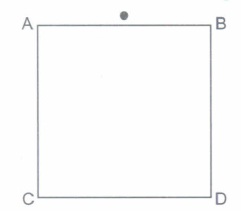
A rectangular block of glass ABCD has a refractive index 1.6. A pin is placed midway on the face AB When observed from the face AD, the pin shall
appear to be near A
appear to be near D.
appear to be at the centre of AD
not be seen at all.
2.
An object is placed at a distance of 0.5 m in front of a plane mirror. The distance between object and image will be
0.25 m
0.5 m
1.0 m
2.0 m
3.
First and second focal lengths of spherical surface of n refractive index are f1 and f2 respectively. The relation between them, is
f2 = f1
f2 = -f1
f2 = nf1
f2 = -nf1
4.
Light from a point source in air falls on a spherical glass surface (n = 1.5 and radius of curvature = 20 cm). The distance of the light source from the glass surface is 100 cm. Image distance from the glass surface is
20 cm
50 cm
100 cm
75 cm
5.
In reflection over a spherical mirror, ray parallel to principal axis, after reflection from mirror pass through
focus
centre of curvature
pole of mirror
any point
6.
The. distance of moon form the earth is 3.8x 10⁵ km. Supposing that the eye is most sensitive to the light of wavelength 550 nm, the separation of two points on the moon that can be resolved by a 500 cm telescope is
50 m
55 m
51 m
60 m
7.
A glass slab consists of thin uniform layers of progressively decreasing refractive indices refractive index such that the refractive index of any layer is \(\mu -m\Delta \mu \) Here, \(\mu \) and \(\Delta \mu \) denote the refractive index of 0th layer and the difference in refractive index between any two consecutive layers, respectively. The integer m = 0, 1, 2, 3, ... denotes the numbers of the successive layers. A ray of light from the 0th layer enters the 1st layer at an angle of incidence of 30°. After undergoing the mth refraction, the ray emerges parallel to the interface. If \(\mu \) = 1.5 and \(\Delta \mu \) = 0.015, then the value of m is
20
30
40
50
8.
Two lamps of powers \({ P }_{ 1 }\)and \({ P }_{ 2 }\) are placed on either side of a paper having an oil spot. The lamps are at 1m and 2 m respectively, On either side of the paper and the oil spot is invisible. What is the value of \({ P }_{ 1 }/{ P }_{ 2 }\)?
0.25
0.40
0.50
0.60
9.
If in a plano-convex lens, radius of curvature of convex surface is 10 cm and the focal length of the lens is 30 cm. The refractive index of the material of the lens will be
1.5
1.66
1.33
3
10.
Aglass slab ( \(\mu \) = 1.5) of thickness 6 cm is placed over a paper. What is the shift in the letters?
4 cm
2 cm
1 cm
None of these
11.
A convex lens of refractive index 1.5 has a focal length of 18 cm in air. Calculate the change in its focal length when it is immersed in water of refractive Index, 4/3.
12.
Determine the value of the angle of incidence for a ray of light travelling from a medium of refractive index μ1 = \(\sqrt{2}\) into the medium of refractive index μ2 = 1, so that it just grazes along the surface of separation.
13.
A ray of light passing through an equilateral triangular glass from air undergoes minimum deviation when angle of incidence is 3/4th of the angle of prism. Calculate the speed of light in the prism.
14.
(i) Draw a schematic labelled ray diagram of a reflecting type telescope.
(ii) Write two important advantages justifying why reflecting type telescopes are preferred over refracting telescopes.
(iii) Write two important advantages justifying why reflecting type telescopes are preferred over refracting telescopes.
15.
Define power of a lens. Write its units. Deduce the relation \(\frac{1}{f}=\frac{1}{f_{1}}+\frac{1}{f_{2}}\) for two thin Lenses kept in contact coaxially.
16.
(a) How is the focal length of a spherical mirror affected when it is immersed in glycerine?
(b) A convex lens has 15 cm focal length in air. What is its focal length in water? (Refractive index of air-water = 1.33, refractive index of air-glass = 1.5)
17.
A beam of light strikes a glass sphere of diameter 15 cm converging towards a point 30 cm behind the pole of the spherical surface. Find the position of the image, if μ of glass is 1.5.
18.
The image obtained with a convex lens is erect and its length is four times the length of the object. If the focal length of the lens is 20 cm, calculate the object and image distances.
19.
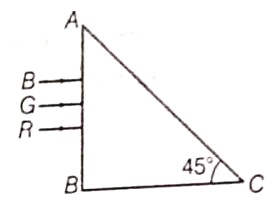
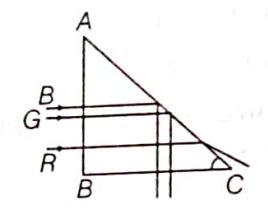
Three light rays, red (R), green (G) and blue (B) are incident on a right angled prism ABC at face AB. The refractive indices of the material of the prism for red, green and blue wavelengths are 1.39, 1.44 and 1.47, respectively. Out of the three, which colour of ray will emerge out of face AC? Justify your answer. Trace the path of these rays after passing through face AB.
20.
A myopic person has been using spectacles of power -1.0 dioptre for distant vision. During old age he also needs to use separate reading glass of power + 2.0 dioptres. Explain what may have happened.
21.
A ray of light is incident normally on one face of an equilateral glass prism of refractive index \(\mu\). When the prism is completely immersed in a transparent medium, it is observed that the emergent ray just grazes the adjacent face. Find the refractive index of the medium.
22.
Can absolute value of refractive index of a medium be less than unity?
23.
A telescope consists of two thin lenses of focal lengths 0.3 m and 3 cm, respectively. It is focused on moon which subtends an angle of 0.5\(\unicode{xb0} \) at the objective. Then, what will be the angle subtended at the eye by the final image?
24.
Why does bluish colour predominate in a clear sky?
25.
Write the relationship between angle of incidence i, angle of prism A and angle of minimum deviation \(\delta \)m for a triangular prism.
26.
Show analytically from the lens equation that when the object is at the principal focus, the image is formed at infinity.
27.
For the same value of angle of incidence, the angles of refraction in three media A, B and C are 15°, 25° and 35°, respectively. In which medium would the velocity of light be minimum?
28.
How can the real image of an object be obtained with a convex mirror?
29.
A thick plane mirror forms a number of images of a point source of light. Which image is the brightest?
30.
(a) Differentiate between a wavefront and a ray.
(b) State Huygens' principle and verify laws of reflection using suitable diagram.
(c) In Young's double slit experiment, the slits S1 and S2 are 3 mm apart and the screen is placed 1.0 m away from the slits. It is observed that the fourth bright fringe is at a distance of 5 mm from the second dark fringe. Find the wavelength of light used.
31.
State and derive mirror formula for a concave mirror. State the sign convention used.
32.
(a) Draw a ray diagram for the formation of image by a compound microscope. Define its magnifying power. Deduce the expression for the magnifying power of the microscope.
(b) Explain:
(i) why must both the objective and the eyepiece of a compound microscope have short focal lengths?
(ii) while viewing through a compound microscope, why should our eyes be positioned not on the eyepiece but a short distance away from it for best viewing?
33.
(i) Deduce the expression by drawing a suitable ray diagram for the refractive index of a triangular glass prism in terms of the. angle of minimum deviation (D) and the angle of prism (A) Draw a plot showing the variation of the angle of deviation with the angle of incidence.
(ii) Calculate the value of the angle of incidence when a ray of light incident on one face of an equilateral glass prism produces the emergent ray, which just grazes along the adjacent face. Refractive index of the prism is \(\sqrt {2}\).
34.
(i) Draw a labeled ray diagram showing the formation of a final image by a compound • microscope at least distance of distinct vision.
(ii) The total magnification produced by a compound microscope is 20. The magnification produced by the eyepiece is 5. The microscope is focused on a certain object. The distance between the object and eyepiece is observed to be 14 cm. If least distance of distinct vision is 20 cm, calculate the focal length of the object and the eyepiece.
35.
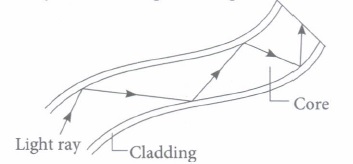
An optical fibre is a thin tube of transparent material that allows light to pass through, without being refracted into the air or another external medium. It make use of total internal reflection. These fibres are fabricated in such a way that light reflected at one side of the inner surface strikes the other at an angle larger than critical angle. Even, if fibre is bent, light can easily travel along the length.
(i) Which of the following is based on the phenomenon of total internal reflection of light?
| (a) Sparkling of diamond | (c) Instrument used by doctors for endoscopy |
| (b) Optical fibre communication | (d) All of these |
(ii) A ray of light will undergo rotal internal reflection inside the optical fibre, if it
| (a) goes from rarer medium to denser medium |
| (b) is incident at an angle less than the critical angle |
| (c) strikes the interface normally |
| (d) is incident at an angle greater than the critical angle |
(iii) If in core, angle of incidence is equal to critical angle, then angle of refraction will be
| (a) 0° | (b) 45° | (c) 90 | (d) 180° |
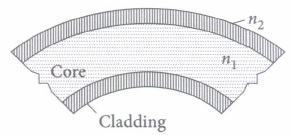
(iv) In an optical fibre (shown), correct relation for refractive indices of core and cladding is
| (a) n1 = n2 | (b) n1 > n2 | (c) n1 < n2 | (d) n1 + n2 = 2 |
(v) If the value of critical angle is 30° for total internal reflection from given optical fibre, then speed of light in that fibre is
| (a) 3 x 10⁸ m S-1 | (b) 1.5 x 10⁸ m S-1 | (c) 6 x 10⁸ m s-1 | (d) 4.5 x 10⁸ m s-1 |
36.
A convex or converging lens is thicker at the centre than at the edges. It converges a parallel beam of light on refraction through it. It has a real focus. Convex lens is of three types:
(i) Double convex lens
(ii) Plano-convex lens
(iii) Concavo-convex lens. Concave lens is thinner at the centre than at the edges. It diverges a parallel beam of light on refraction through it. It has a virtual focus.
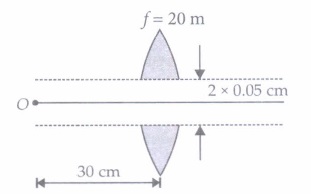
(i) A point object 0 is placed at a distance of 0.3 m from a convex lens (focal length 0.2 m) cut into two halves each of which is displaced by 0.0005 m as shown in figure.What will be the location of the image?
| (a) 30 cm right of lens | (b) 60 ern right of lens |
| (c) 70 ern left of lens | (d) 40 cm left oflens |
(ii) Two thin lenses are in contact and the focal length of the combination is 80 cm. If the focal length of one lens is 20 cm, the focal length of the other would be
| (a) -26.7 cm | (b) 60 crn |
| (c) 80 cm | (d) 20 cm |
(iii) A spherical air bubble is embedded in a piece of glass. For a ray of light passing through the bubble, it behaves like a
| (a) converging lens | (b) diverging lens |
| (c) plano-converging lens | (d) plano-diverging lens |
(iv) Lens used in magnifying glass is
| (a) Concave lens | (b) Convex lens | (c) Both (a) and (b) | (d) None of the above |
(v) The magnification of an image by a convex lens is positive only when the object is placed
| (a) at its focus F | (b) between F and 2F |
| (c) at 2F | (d) between F and optical centre |
37.
38.
39.
Assertion (A) : In compound microscope, objective lens is taken as of small focal length.
Reason (R) : This increases the magnifying power of microscope.
(a) Both Assertion and Reason are true and Reason is the correct explanation of Assertion.
(b) Both Assertion and Reason are true but Reason is not the correct explanation of Assertion.
(c) Assertion is true but Reason is false.
(d) Assertion is false but Reason is true.
40.
Assertion (A) : A single lens produces a coloured image of an object illuminated by white light.
Reason (R) : The refractive index of the material of lens is different for different wavelengths of light.
Codes:
(a) Both A and R are true and R is the correct explanation of A
(b) Both A and R are true but R is NOT the correct explanation of A
(c) A is true but R is false
(d) A is false and R is also false
1.
(d)
not be seen at all.
2.
(c)
1.0 m
3.
(b)
f2 = -f1
4.
(c)
100 cm
5.
(a)
focus
6.
(b)
55 m
7.
(d)
50
8.
(a)
0.25
9.
(c)
1.33
10.
(b)
2 cm
11.
Given: \({ }^{a} \mu_{g}=1.5=3 / 2 ; f=+18 \mathrm{~cm}\)
\(
\frac{1}{f}=\left({ }^{a} \mu_{g}-1\right)\left[\frac{1}{R_{1}}-\frac{1}{R_{2}}\right]
\) .......(i)
\(\frac{1}{f^{\prime}}=\left({ }^{w} \mu_{g}-1\right)\left[\frac{1}{R_{1}}-\frac{1}{R_{2}}\right]
\) ............(ii)
Dividing equation (i) by (ii), we get
\(
\frac{f^{\prime}}{f}=\frac{\mu_{g} / \mu_{a}-1}{\mu_{g} / \mu_{w}-1}
\)
\(\Rightarrow \quad f^{\prime} =\left(\frac{3 / 2-1}{9 / 8-1}\right) f=4 f
\)
∴f' = 4 x 18 = 72 cm
Change in focal length = 3 f = 54 cm
12.
According to Snell's law
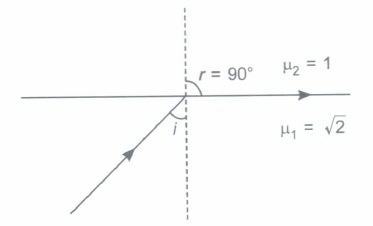
\(
\mu_{1} =\sqrt{2}, \mu_{2}=1
\)
\(\mu_{1} \sin i =\mu_{2} \sin r
\)
\(\sqrt{2} \sin i =1 \sin 90^{\circ}=1
\)
\(\sin i =\frac{1}{\sqrt{2}}=\sin 45^{\circ}
\)
\(i =45^{\circ}
\)
13.
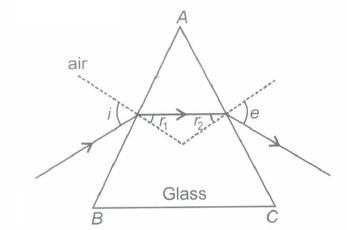
\(\because \quad r_{1}+r_{2}=A\)
At minimum deviation,
\( r_{1}=r_{2} \)
\(\text {i.e. } r=\frac{A}{2}=30^{\circ} \)
\( \text {As } i=\frac{3}{4} \times A=45^{\circ} \)
\(\therefore \quad \ \mu=\frac{c_{1}}{c_{2}}=\frac{\sin 45^{\circ}}{\sin 30^{\circ}} \)
\(\Rightarrow \ c_{2}=2.12 \times 10^{8} \mathrm{~ms}^{-1}\)
14.
(i) Cassegrainian telescope
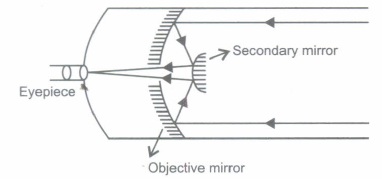
(ii) The following are the two advantages of a reflecting type telescope over a refracting type telescope:
1. As there is no refraction, it is free from the chromatic aberration.
2. The light gathering power of the objective must be higher to get better resolution. It is easier to handle and cheaper to make mirrors of larger diameters.
(iii) Magnifying power of a telescope,
\(m=-\frac{f_{o}}{f_{e}}\left(1+\frac{f_{e}}{D}\right)\)
So, the focal length of objective must be larger for higher magnification.
With the larger aperture of object, light gathering capacity ofthe telescope increases. Hence, a better resolution is obtained.
15.
Power of a lens is the measure of convergence or divergence which a lens can introduce in beam of light falling on it. The SI unit of power is dioptre (D).
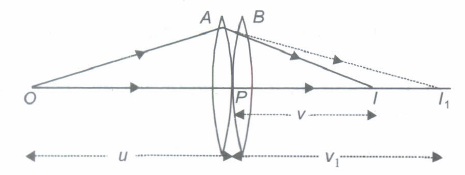
For the 1st lens, we have relation
\(\frac{1}{f_{1}}=\frac{1}{v_{1}}-\frac{1}{u}\) .........(i)
For the 2nd lens, the relation is
\(\frac{1}{f_{2}}=\frac{1}{v}-\frac{1}{v_{1}}\) .........(ii)
Here an image formed by the 1st lens acts as a virtual object for the 2nd lens.
Adding equations (i) and (ii), we get
\(\frac{1}{v}-\frac{1}{u}=\frac{1}{f_{1}}+\frac{1}{f_{2}}\)
If this two lens system is considered as an equivalent single lens of focal length f, we have
\( \frac{1}{v}-\frac{1}{u} =\frac{1}{f} \)
\(\therefore \quad \text { Power } P =\frac{1}{f}=\frac{1}{f_{1}}+\frac{1}{f_{2}} \)
16.
(a) As there is no refraction in case of mirror, the focal length will not change.
(b) Given: \(f_{a}=15 \mathrm{~cm}, \mu_{w}=1.33, \mu_{g}=1.5\)
\(
\therefore \quad f_{w} =\frac{\left(\mu_{g}-1\right)}{\left(\frac{\mu_{g}}{\mu_{w}}-1\right)} \times f_{a}
\)
\(=\frac{(1.5-1)}{\left(\frac{1.5}{1.33}-1\right)} \times 15
\)
\(=\frac{0.5 \times 1.33}{0.17} \times 15 \approx 59 \mathrm{~cm}
\)
17.
Here, \(\mu_{1}=1, \mu_{2}=1.5, u=-\infty, R=\frac{15}{2}=7.5 \mathrm{~cm}\)
∴ Using \(\frac{\mu_{2}}{v}-\frac{\mu_{1}}{u}=\frac{\mu_{2}-\mu_{1}}{R}\)
18.
As magnification, m = \(\frac{I}{O}=\frac{v}{u} \Rightarrow I=4 \times\) length of object
\(\Rightarrow \frac{I}{O}=4\Rightarrow \frac{v}{u}=4 \Rightarrow v=4 u\)
Using lens formula, \(\frac{1}{f}=\frac{1}{v}-\frac{1}{u}=\frac{1}{(-4 u)}-\frac{1}{(-u)}\)
\( \Rightarrow \frac{1}{f}=-\frac{1}{4 u}+\frac{1}{u} \Rightarrow \frac{1}{20}=\frac{4-1}{4 u}=\frac{3}{4 u} \)
\(\Rightarrow u=\frac{20 \times 3}{4}=15 \mathrm{~cm} \)
⇒ v = 4u = 15 x 4 = 60 cm
Distance of the object, u = 15 cm
Distance of the image, v = 60 cm
The image is on the same side of the object.
19.
By geometry, angle of incidence (i) at face AC for all three rays is 45°. Light suffers total internal reflection for which this angle of incidence is greater than critical angle.
i > ic ⇒ sin i > sin ic
or sin 45° > sin ic
\(\Rightarrow \quad \frac{1}{\sin 45^{\circ}}<\frac{1}{\sin i_{c}} \Rightarrow \sqrt{2}<\mu\)
Total internal reflection takes place on AC for rays with μ > \(\sqrt {2}\) = 1.414, i.e. green and blue colour suffer total internal reflection, whereas red undergoes refraction.
20.
The power of the spectacles used by the myopic person, P = -1.0 D
Focal length of the spectacles, \(f=\frac{1}{P}=\frac{1}{-1 \times 10^{-2}}=-100 \mathrm{~cm}\)
Hence, the far point of the person is 100 cm. He might have a normal near point of 25 cm. When he uses the spectacles, the objects placed at infinity produce virtual images at 100 cm. He uses the ability of accommodation of the eye-lens to see the objects placed between 100 cm and 25 cm.
During old age, the person uses reading glasses of power, P′ = +2D
The ability of accommodation is lost in old age. This defect is called presbyopia. As a result, he is unable to see clearly the objects placed at 25 cm.
21.
By Snell's law,
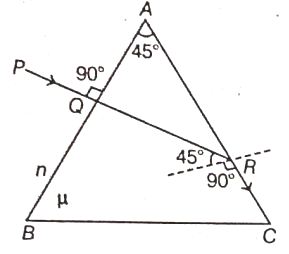
\(\begin{aligned}
\frac{\sin i}{\sin r} & =\frac{n}{\mu}
\end{aligned}\)
\(\begin{aligned}
\frac{\sin 45^{\circ}}{\sin 90^{\circ}} & =\frac{n}{\mu}
\end{aligned}\)
n = \(\mu\) sin 45° [\(\because\) sin 90° = 1]
\(n=\frac{\mu}{\sqrt{2}}\) \(\left[\because \sin 45^{\circ}=\frac{1}{\sqrt{2}}\right]\)
Thus, refractive index ofthe transparent medium is \(n=\frac{\mu}{\sqrt{2}}\)
22.
As the speed of light is maximum in vacuum, therefore absolute value of refractive index cannot be less than unity as it is given by the relation \(n=\frac{c}{v}\)
23.
Since, \(m=\frac{\tan \beta}{\tan \alpha} \approx \frac{\beta}{\alpha}=\frac{f_{e}}{f_{e}}\)
\(\therefore \quad \frac{\beta}{0.5^{\circ}}=\frac{0.3}{0.03}=5^{\circ}\)
24.
Blue colour of the sky is due to scattering of light from atmosphere's particles. Light of shorter wavelength is scattered more than the light of longer wavelength.
25.
The relation between the angle of incidence i, angle of prism A and the angle of minimum deviation \(\delta \)m, for a triangular is given as i \(=\frac{A+\delta_m}{2}\)
26.
Given, u = -f
∴ Lens equation is, \(\frac{1}{v}-\frac{1}{u}=\frac{1}{f} \Rightarrow \frac{1}{v}+\frac{1}{f}=\frac{1}{f} \Rightarrow \frac{1}{v}=0\)
\(\Rightarrow \quad v=\frac{1}{0}\) infinity
27.
From Snell's law, \(\mu=\frac{\sin i}{\sin r}=\frac{c}{v}\)
⇒ v ∝ sin r, for given value of i.
Smaller the angle of refraction, smaller the velocity of light in medium.
Velocity of light is minimum in medium A as the angle of refraction is minimum, i.e. 15°.
28.
A convex mirror produces a real image of a virtual object. Therefore, if a beam of light from a virtual object converges to a point behind the convex mirror, then its real image will be formed in front of the mirror.
29.
A thick plana mirror consist of two surfaces (top and bottom), where the reflection takes place. The images are formed after reflection from both the surfaces, except for the first image, The second image is the brightest of all as minimum absorption takes place and bounces of the silvery layers which makes the bottom surface.
30.
(a) A wavefront is defined as the locus of all the particles of a medium vibrating in the same phase at a given instant. The shape of a wavefront depends upon the shape of the source of disturbance and it is normal to the direction of propagation of wave.
A line drawn perpendicular to the plane wavefront gives the direction of propagation of a wave and is called ray of light.
(b) Huygens' Principle and Reflection at a Plane Surface
(c) Position of nth maxima, \(y_n=\frac{n D \lambda}{d}\) (Bright fringe) and position of mth minima,
\(y_m^{\prime}=\left(m-\frac{1}{2}\right) \frac{D \lambda}{d}\) (Dark fringe)
Given, d = 3 mm = 3 \(\times\) 10-3 m
D = 1 m
and y4 - y2' = 5 mm = 5 \(\times\) 10-3m
Now, \(\frac{4 D \lambda}{d}-\left(2-\frac{1}{2}\right) \frac{D \lambda}{d}=5 \times 10^{-3} \mathrm{~m}\)
\(\Rightarrow\) \(\frac{4 D \lambda}{d}-\frac{3}{2} \frac{D \lambda}{d}=5 \times 10^{-3}\)
\(\begin{aligned} \Rightarrow \left(4-\frac{3}{2}\right) \frac{D \lambda}{d}=5 \times 10^{-3} \end{aligned}\)
\(\begin{aligned} \Rightarrow \frac{5}{2}\left(\frac{(1) \lambda}{3 \times 10^{-3}}\right)=5 \times 10^{-3} \end{aligned}\)
\(\Rightarrow\) \(\lambda=\frac{3}{2} \times 10^{-6} \mathrm{~m}\)
\(\Rightarrow\) \(\lambda=1.5 \times 10^{-6} \mathrm{~m}\)
\(\Rightarrow\) \(\lambda=1.5 \mu \mathrm{m}\)
31.
Mirror Formula
Mirror formula (or equation) is a relation between focal length of the mirror, distances of object and image from the mirror.
In principle, we can take any two rays originating from a point on an object, trace their paths, find their point of intersection and thus, obrain the image of the point due to reflection at a spherical mirror.
However, in practice, it is convenient to choose any two of the following rays
(i) The ray from the point, which is parallel to the principal axis after reflection goes through the focus of the mirror.
(ii) The ray passing through the centre of curvature of a concave mirror or appearing to pass through it for a convex mirror simply retraces the path.
(iii) The ray passing through (or directed towards) the focus of the concave mirror or appearing to pass through (or directed towards) the focus of a convex mirror after reflection is parallel to the principal axis.
(iv) The ray incident at any angle at the pole is reflected following the laws of reflection.
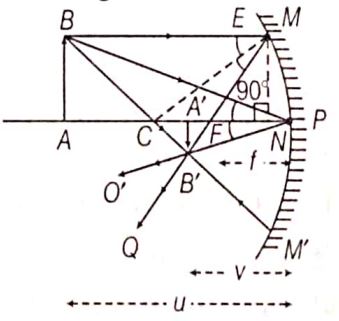
In the above figure, the ray diagram is considering three rays for image formation by a concave mirror. In the figure, triangles A'B'F and NEF are similar.
Then, \(\frac{A^{\prime} B^{\prime}}{N E}=\frac{A^{\prime} F}{N F}\)
As, the aperture of the concave mirror is small and the points N and P lie very close to each other, then
NF \(\approx\) PF and NE = AB
\(\Rightarrow \quad \frac{A^{\prime} B^{\prime}}{A B}=\frac{A^{\prime} F}{P F}\)
Since, all the distances are measured from the pole of the concave mirror, we have
A' F = PA' - PF
\(\therefore \quad \frac{A^{\prime} B^{\prime}}{A B}=\frac{P A^{\prime}-P F}{P F}\) ....(i)
Also, triangles ABP and A'B'P are similar, then
\(\frac{A^{\prime} B^{\prime}}{A B}=\frac{P A^{\prime}}{P A}\) ...(ii)
From Eqs. (i) and (ii), we get
\(\frac{P A^{\prime}-P F}{P F}=\frac{P A^{\prime}}{P A}\) ...(iii)
Applying new Cartesian sign convention, we have
PA = - u
[\(\because\) distance of object is measured against incident ray]
PA' = -v
[\(\because\) distance of image is measured against incident ray]
PF = -f
[\(\because\) focal length of concave mirror is measured agaist incident ray]
Substituting these values in Eq. (iii), we have
\(\begin{aligned} \frac{-v-(-f)}{-f}=\frac{-v}{-u} \end{aligned}\)
\(\begin{aligned} \Rightarrow \quad \frac{v-f}{f} & =\frac{v}{u} \Rightarrow \frac{v}{f}-1=\frac{v}{u} \end{aligned}\)
Dividing both sides by v, we get
\(\therefore\) \(\frac{1}{f}=\frac{1}{u}+\frac{1}{v}\)
The above relation is called mirror formula. Relation between u, v and R
\(\because\) Focal length of the mirror, \(f=\frac{R}{2}\)
\(\therefore\)\(\frac{1}{u}+\frac{1}{v}=\frac{1}{R / 2} \Rightarrow \frac{1}{u}+\frac{1}{v}=\frac{2}{R}\)
32.
A compound microscope consists of two convex lenses. The lens facing the object to be seen is called an objective lens. The lens facing the eye is called an eye lens. Generally, the eye lens is a combination of lenses and is called an eyepiece. The aperture and the focal length of the objective lens are smaller as compared with those of eye lens. The object to be magnified is placed just beyond the focal point of the objective lens which forms its real, magnified and inverted image. This image acts as the object for the eye lens whose position is so adjusted that the final image formed by the eye lens is at the distance of distinct vision as shown in the diagram.
(b) (i) To achieve a large magni fication of small object, the eyepiece and the objective must have short focal lengths.
(ii) If we place our eyes too close to the eyepiece, the area of the pupil of the eye is less than the area of the eye-ring. So, our eyes will not collect much of the light and our field of view will get reduced.
33.
(ii) Given, the emergent ray grazes along the face AC,
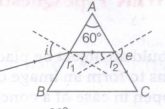
e = 90\(\unicode{xb0} \)
μ = \(\sqrt {2}\)
\(\frac{\sin i}{\sin r_{1}}=\mu=\frac{\sin e}{\sin r_{2}}\)
\(\Rightarrow \ \frac{\sin 90^{\circ}}{\sin r_{2}}=\sqrt{2}\)
\(\text { i.e. } \ \sin r_{2}=\frac{1}{\sqrt{2}} \text { or } r_{2}=45^{\circ}\)
⇒ r1 + r2 = ∠A = 60\(\unicode{xb0} \)
r1 = 60 - r2 = 15\(\unicode{xb0} \)
\(\Rightarrow \ \frac{\sin i}{\sin 15^{\circ}}=\sqrt{2}\)
⇒ i = 21.47\(\unicode{xb0} \)
34.
(ii) Given, magnification, m = 20
Magnification of eyepiece, me = 5
Least distance vision, D = 20 cm
Distance between the object and eyepiece,
L = 14 cm
We know that, magnification, m = me x mo
\(\Rightarrow \quad m_{o}=\frac{m}{m_{e}}=\frac{20}{5}=4\)
As, \(m_{e}=1+\frac{D}{f_{e}}\)
where, fe is focal length of eyepiece.
\(\Rightarrow \quad 5=1+\frac{20}{f_{e}} \Rightarrow f_{e}=5 \mathrm{~cm}\)
Using lens formula for eyepiece,
\(\frac{1}{u_{e}}=\frac{-1}{20}-\frac{1}{5}=\frac{-5}{20}=\frac{-1}{4}\)
⇒ ue = -4 cm (object distance for eyepiece)
⇒ L = vo + | ue |
⇒ vo = L - | ue |
⇒ vo = L - | ue |
= 14 - 4 = 10 cm
Magnification produced by object, mo = \(-\frac{v_{o}}{u_{o}}\)
Object distance for object,
\(u_{o}=\frac{-v_{o}}{m_{o}}=\frac{-10}{4}=-2.5 \mathrm{~cm}\)
Using lens formula for object,
\(\frac{1}{f_{0}}=\frac{1}{v_{o}}-\frac{1}{u_{0}}=\frac{1}{10}-\frac{1}{-2.5}=\frac{1}{10}+\frac{1}{2.5}\)
fo = 2 cm
35.
(i) (d): Total internal reflection is the basis for following phenomenon:
(a) Sparkling of diamond.
(b) Optical fibre communication.
(c) Instrument used by doctors for endoscopy.
(ii) (d): Total internal reflection (TIR) is the phenomenon that involves the reflection of all the incident light off the boundary. TIR only takes place when both of the following two conditions are met:The light is in the more denser medium and approaching the less denser medium.The angle of incidence is greater than the critical angle.
(iii) (c) : If incidence of angle, i = critical angle e, then angle of refraction, r = \(90^{\circ}\)
(iv) (b): In optical fibres, core is surrounded by cladding, where the refractive index of the material of the core is higher than that of cladding to bound the light rays inside the core.
(v) (b): From Snell's law, \(\sin C={ }_{1} n_{2}=\frac{v_{1}}{v_{2}}\)
where, c = critical angle = 30° and V1 and V2 are speed oflight in medium and vacuum, respectively.
We know that, v2 = 3 x 10⁸ m s-l
\(\therefore \quad \sin 30^{\circ}=\frac{v_{1}}{3 \times 10^{8}} \)
\(\Rightarrow \quad v_{1}=3 \times 10^{8} \times \frac{1}{2} \Rightarrow v_{1}=1.5 \times 10^{8} \mathrm{~ms}^{-1} \)
36.
(i) (b): Each half lens will form an image in the same plane. The optic axes of the lenses are displaced
\(\frac{1}{v}-\frac{1}{(-30)}=\frac{1}{20} ; v=60 \mathrm{~cm}\)
(ii) (a): Here \(f_{1}=20 \mathrm{~cm} ; f_{2}=?\)
F= 80 cm
\(\text { As } \frac{1}{f_{1}}+\frac{1}{f_{2}}=\frac{1}{F} \Rightarrow \frac{1}{f_{2}}=\frac{1}{F}-\frac{1}{f_{1}}\)
\(\frac{1}{f_{2}}=\frac{1}{80}-\frac{1}{20}=\frac{-3}{80}\)
\(f_{2}=\frac{-80}{3}=-26.7 \mathrm{~cm}\)
(iii) (b): The bubble behaves libe a diverging lens
(iv) (b): Convex lens is used in magnifying glass.
(v) (d)
37.
38.
39.
(a) Both Assertion and Reason are true and Reason is the correct explanation of Assertion.
40.
(a): Due to the variation of the refractive index of the material of the lens, the focal length also varies accordingly. Now as white light is composed of different colours of light, each colour will produce its own image based on the focal length for that colour.This particular phenomenon for a single lens is known as chromatic aberration.

12th Standard CBSE Syllabus & Materials
12th Standard CBSE
CBSE 12th Computer Science Python Revision Tour I - New Previous year Question Papers Study Material - QB365 Set A
NEW12th Standard CBSE
CBSE 12th Business Studies Planning Important Questions And Answers Study Material - QB365 Set A
NEW12th Standard CBSE
CBSE 12th Business Studies Business Environment Important Questions And Answers Study Material - QB365 Set A
NEW12th Standard CBSE
CBSE 12th Business Studies Principles of Management Important Questions And Answers Study Material - QB365 Set A



NCERT Books

Syllabus

Exam Pattern

Sample Question Papers

Previous year Question Papers

Important Notes

MCQ Practice test

NCERT Exemplers

Case study Questions

Image Based Questions

Passage based Questions

HOT Questions

Value Based Questions

Model Questions Papers
NCERT ( Book Back ) Questions

Assertion and Reason
Important Questions And Answers

CBSE 12th Standard CBSE Subjects
CBSE Standards








