
 100% FREE ACCESS
12th Standard CBSE Syllabus & Materials
12th Standard CBSE
CBSE 12th Economics Government Budget and the Economy Previous year Question Papers Study Material - QB365 Set A
NEW12th Standard CBSE
CBSE 12th Computer Science Interface Python with MySQL - New Previous year Question Papers Study Material - QB365 Set A
NEW12th Standard CBSE
CBSE 12th Computer Science Database Concept - New Previous year Question Papers Study Material - QB365 Set A
NEW12th Standard CBSE
CBSE 12th Computer Science Data Communication - New Previous year Question Papers Study Material - QB365 Set A
NEW12th Standard CBSE
CBSE 12th Computer Science Data Structures - New Previous year Question Papers Study Material - QB365 Set A
NEW12th Standard CBSE
CBSE 12th Computer Science Functions - New Previous year Question Papers Study Material - QB365 Set A

Published on: 25/10/2025
Download CBSE Class 12th Standard CBSE Physics question papers, sample papers, important questions, and previous year solved papers in PDF format. Get free study materials, NCERT solutions, and exam preparation resources for Class 12th Standard CBSE Physics
Questions + Answers key
Take MCQ Physics Test
1.
(a) Draw a labelled ray diagram of a refraction type telescope in normal adjustment.
(b) Give its two shortcomings over reflection type telescope.
(c) Why is the eyepiece of a telescope of short focal length, while objective is of large focal length? Explain.
2.
A figure divided into squares each of size 1 mm2 is being viewed at a distance of 8 cm through a converging lens of focal length 12 cm.
(i) What is the magnification produced by the lens?
(ii) How much is the area of each square in the virtual image?
3.
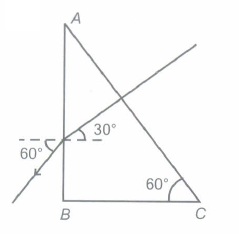
Trace the path of a ray of light passing through a glass prism (ABC) as shown in the figure. If the refractive index of glass is \(\sqrt{3}\) find out the value of the angle of emergence from the prism.
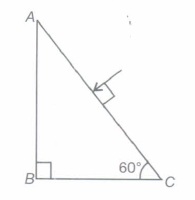
4.
How does the refractive index of a transparent medium depend on the wavelength of incident light used? Velocity of light in glass is 2 x 10⁸ m/s and in air is 3 x 10⁸ m/s, If the ray of light passes from glass to air, calculate the value of critical angle.
5.
Show that a convex lens produces an N times magnified image when the object distances, from the lens, have magnitudes \(\left(f \pm \frac{f}{N}\right)\) Here f is the magnitude of the focal length of the lens.
Hence find the two values of object distance, for which a convex lens, of power 2.5 D, will produce an image that is four times as large as the object?
6.
(a) How is the focal length of a spherical mirror affected when it is immersed in glycerine?
(b) A convex lens has 15 cm focal length in air. What is its focal length in water? (Refractive index of air-water = 1.33, refractive index of air-glass = 1.5)
7.
A compound microscope uses an objective lens of focal length 4 cm and eyepiece lens of focal length 10 cm. An object is placed at 6 cm from the objective lens. Calculate the magnifying power of the compound microscope. Also, calculate the length of the microscope.
8.
You are given three lenses L1 , L2 and L3 each of focal length 10 cm, An object is kept at 15 cm in front of L1 , as shown in figure. The final real image is formed at the focus of L3. Find the separation between L1, L2 and t L3.
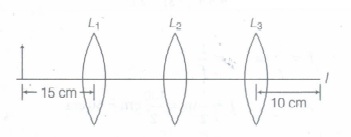
9.
The objective of an astronomical telescope has a diameter of 150 mm and a focal length of 4 m. The eyepiece has a focal length of 25 mm. Calculate the magnifying and resolving power of telescope (λ = 6000 \(\overset{o}{A}\) for yellow colour).
10.
A container is filled with water μ = 1.33 upto a height of 33.25 cm. A concave mirror is placed 15 cm above the water level and the image of an object placed at the bottom is formed 25 cm below the water level. What will be the focal length?
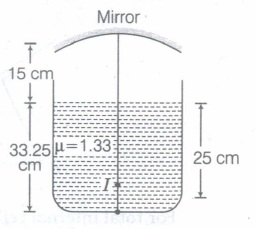
11.
Show that for a material with refractive index μ > \(\sqrt {2}\) light incident at any angle shall be guided along a length perpendicular to the incident face.
12.
Velocity of light in glass is 2 x 10⁸ m/s and that in air is 3 x 10⁸ m/s. By how much would an ink dot appear to be raised, when covered by a glass plate 6 cm thick?
13.
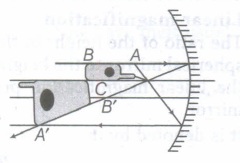
(i) A mobile phone lies along the principal axis of a concave mirror. Show with the help of a suitable diagram the formation of its image. Explain, why magnification is not uniform?
(ii) Suppose the lower half of the concave mirror's reflecting surface is covered with an opaque material. What effect this will have on the image of the object? Explain.
14.
A myopic person has been using spectacles of power -1.0 dioptre for distant vision. During old age he also needs to use separate reading glass of power + 2.0 dioptres. Explain what may have happened.
15.
A ray of light is incident normally on one face of an equilateral glass prism of refractive index \(\mu\). When the prism is completely immersed in a transparent medium, it is observed that the emergent ray just grazes the adjacent face. Find the refractive index of the medium.
16.
A ray of light passes through an equilateral glass prism, such that the angle of incidence is equal to the angle of emergence. If the angle of emergence is 3/4 times the angle of prism, calculate the refractive index of the glass prism.
17.
A screen is placed 80 cm from an object. The image of the object on the screen is formed by a convex lens at two different locations, separated by 10 cm. Calculate the focal length of the lens used.
18.
The line AB in the ray diagram represents a lens. State whether the lens is convex or concave.
19.
Name the principle on which an optical fibre works.
20.
A green light is incident from water to the air-water interface at the critical angle (θ). Which part of the spectrum will come out in the air medium?
21.
For which material the value of refractive index is (i) minimum and (ii) maximum?
22.
At what angle, is a ray of light falling normally on a mirror reflected?
23.
A telescope consists of two thin lenses of focal lengths 0.3 m and 3 cm, respectively. It is focused on moon which subtends an angle of 0.5\(\unicode{xb0} \) at the objective. Then, what will be the angle subtended at the eye by the final image?
24.
You are given two converging lenses offocal length 1.25 cm and 5 cm to design a compound microscope. If it is desired to have a magnification of 30, then find out the separation between the objective and eyepiece.
25.
The near vision of an average person is 25 cm. To view an object with an angular magnification of 10, what should be the power of the microscope?
26.
The following table gives the values of the angle of deviation, for different values of the angle of incidence, for a triangular prism.
| Angle of incidence | 33° | 38° | 42° | 52° | 60° | 71° |
| Angle of deviation | 60° | 50° | 46° | 40° | 43° | 50° |
(i) For what value of the angle of incidence, is the angle of emergence likely to be equal to the angle of incidence itself?
(ii) Draw a ray diagram, showing the passage of a ray of light through this prism, when the angle of incidence has the above value.
27.
A glass lens is immersed in water. How is power of the lens affected?
28.
What is the apparent position of an object below a rectangular block of glass 6 cm thick, if a layer of water 4 cm thick is on the top of the glass? Given, nga = 1.5 and nwa = 1.33.
29.
Mention any two situations in which Snell's law of refraction fails.
1.
(a) When the final image is formed at infinity, the telescope is said to be in normal adjustment and its magnifying power is given as
\(m=\frac{f_{o}}{-f_{e}}\)
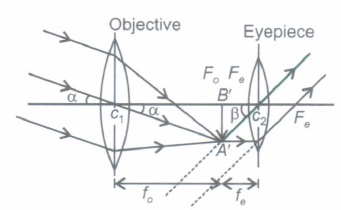
The given figure shows the formation of an image by a refracting telescope in normal adjustment. In this arrangement, the separation between the objective and the eyepiece is (fo + fe).
(b) (i) It is not free from chromatic aberration.
(ii) Lenses oflarge aperture are big and heavy. So, they are difficult to make and support by their edges.
(c) Magnifying power of a telescope, \(m=\frac{f_{o}}{f_{e}}\)
So, for a higher magnifying power, the telescope must have an eyepiece of shorter focal length and an objective of larger focal length.
2.
Given: u = -8 cm,f = +12 cm
\(\because \frac{1}{v}=\frac{1}{f}+\frac{1}{u}=\frac{1}{12}-\frac{1}{8} \Rightarrow v=-24 \mathrm{~cm}
\)
\((i) m=\frac{v}{u}=\frac{-24}{-8}=3
\)
\((ii) A_{o}=1 \mathrm{~mm}^{2}\)
∵ Areal magnification \(=\frac{A_{I}}{A_{o}}=m^{2}\)
\(\Rightarrow A_{I}=A_{o} \times m^{2}=1 \mathrm{~mm}^{2} \times(3)^{2}=9 \mathrm{~mm}^{2}\)
∴ The area of each square in the virtual image is equal to 9 mm2.
3.
From Snell's law,
\(\frac{\sin 30^{\circ}}{\sin e}=\frac{1}{\mu}\)
\(
\Rightarrow \sin e =\mu \sin 30^{\circ}=\sqrt{3} \times \frac{1}{2}
\)
\(\therefore \quad e =\sin ^{-1}\left(\sqrt{\frac{3}{2}}\right)=60^{\circ}
\)
4.
The refractive index of a transparent medium decreases with increase in wavelength of the incident light.
We have \(\mu_{g a}=\frac{v_{a}}{v_{g}}=\frac{3 \times 10^{8}}{2 \times 10^{8}}=\frac{3}{2}=1.5\)
\(
\therefore \quad \mu_{g a}=\frac{1}{\sin i_{c}}
\)
\(\Rightarrow i_{c}=\sin ^{-1}\left(\frac{1}{\mu_{g a}}\right)
\)
\(\Rightarrow \quad i_{c}=\sin ^{-1}\left(\frac{2}{3}\right)=41.8\)
5.
Given: \(|u|=f \pm \frac{f}{N}=f\left(\frac{N \pm 1}{N}\right)\)
As we know \(\frac{1}{v}-\frac{1}{u}=\frac{1}{f}\)
\(
\therefore v=f(N \pm 1)
\)
\(\text { and } |m|=\left|\frac{v}{u}\right|=N
\)
\(\therefore \quad f=\frac{100}{2.5}=40 \mathrm{~cm} \quad(\because P=2.5 \mathrm{D})
\)
\(\therefore \quad m=\frac{v}{u}=N
\)
\(
\Rightarrow u=\frac{v}{N}=\frac{f(N \pm 1)}{N}=f+\frac{f}{N}
\)
\(\text { and } u=f-\frac{f}{N} \quad(\because N=4)
\)
\(\text { i.e. } u=40+\frac{40}{4}=50 \mathrm{~cm}
\)
\(\text { or } u=40-\frac{40}{4}=30 \mathrm{~cm}
\)
6.
(a) As there is no refraction in case of mirror, the focal length will not change.
(b) Given: \(f_{a}=15 \mathrm{~cm}, \mu_{w}=1.33, \mu_{g}=1.5\)
\(
\therefore \quad f_{w} =\frac{\left(\mu_{g}-1\right)}{\left(\frac{\mu_{g}}{\mu_{w}}-1\right)} \times f_{a}
\)
\(=\frac{(1.5-1)}{\left(\frac{1.5}{1.33}-1\right)} \times 15
\)
\(=\frac{0.5 \times 1.33}{0.17} \times 15 \approx 59 \mathrm{~cm}
\)
7.
For compound microscope, 10 = 4 cm, fe = 10 cm,
uo = - 6 cm, ve = D = -25 cm
For objective lens, \(\frac{1}{f_{0}} \equiv \frac{1}{v_{o}}-\frac{1}{u_{o}} \Rightarrow \frac{1}{4}=\frac{1}{v_{o}}+\frac{1}{6}\)
\(\Rightarrow \quad \frac{1}{v_{o}}=\frac{1}{4}-\frac{1}{6}=\frac{1}{12} \Rightarrow v_{o}=12 \mathrm{~cm}\)
∴ magnifying power, m = -2 \(-\left(\frac{v_{o}}{u_{o}}\right)\left(1+\frac{D}{f_{e}}\right)\)
\(=-\left(\frac{12}{6}\right)\left(1+\frac{25}{10}\right)=-2\left(\frac{7}{2}\right)=-7\)
Length of microscope = | vo | + | ue |
where, vo = 12 cm
for eye lens, ve = -25 cm, fe = 10 cm, ue = ?
\( \therefore \quad \frac{1}{f_{e}}=\frac{1}{v_{e}}-\frac{1}{u_{e}} \)
\(\Rightarrow \quad \frac{1}{u_{e}}=\frac{1}{v_{e}}-\frac{1}{f_{e}}=\frac{1}{-25}-\frac{1}{10} \)
\(\Rightarrow \quad \frac{1}{u_{e}}=\frac{-2-5}{50}=-\frac{7}{50}\)
⇒ ue = -7.14 cm
∴ Length of microscope = | vo | + | ue |
= 12 + 7.14 = 19.14 cm
8.
For lens \(L_{1}, \frac{1}{f}=\frac{1}{v}-\frac{1}{u}\)
Given, u = - 15 cm, f = +10 cm, v =?
\(\therefore \quad \frac{1}{10}=\frac{1}{v}+\frac{1}{15} \Rightarrow \frac{1}{v}=\frac{1}{10}-\frac{1}{15} \Rightarrow \frac{1}{v}=\frac{1}{30}\)
Distance of image from lens L1, v = 30 cm
For lens L3, \(\frac{1}{f^{\prime \prime}}=\frac{1}{v^{\prime \prime}}-\frac{1}{u^{\prime \prime}}\)
Distance of image from lens L3, v" = 10 cm
\(\therefore \quad \frac{1}{10}=\frac{1}{10}-\frac{1}{u^{\prime \prime}} \Rightarrow \frac{1}{u^{\prime \prime}}=0 \Rightarrow u^{\prime \prime}=\infty\)
The refracted rays from lens L2 becomes parallel to principal axis. It is possible only when image formed by L1 lies at first focus of L2 , i.e. at a distance of 10 cm from L2
Separation between L1 and L2 = 30 + 10 = 40 cm
The distance between L2 and L3 may take any value.
9.
The diameter of objective of the telescope
= 150 x 10-3 m, fo = 4 m
fe = 25 x 10-3 m and D = 0.25 m
Magnifying power, m = \(-\frac{f_{0}}{f_{e}}\left(1+\frac{D}{f_{e}}\right)\)
\(=-\frac{4}{25 \times 10^{-3}}\left(1+\frac{0.25}{25 \times 10^{-3}}\right)=-1760\)
Now, \(d \theta=\frac{1.22 \lambda}{D}=\frac{1.22 \times 6 \times 10^{-7}}{0.25}\)
= 2.9 x 10⁻⁶ rad
∴ Resolving power \(=\frac{1}{d \theta}=\frac{1}{2.9 \times 10^{-6}}\)
= 0.34 x 10⁶
10.
Distance of object from mirror
\(=15+\frac{33.25}{4} \times 3=39.93 \mathrm{~cm}\)
Distance of image from the mirror
\(=15+\frac{25}{4} \times 3=33.75 \mathrm{~cm}\)
Using mirror formula, \(\frac{1}{v}+\frac{1}{u}=\frac{1}{f}\)
\(\Rightarrow \frac{1}{-33.75}-\frac{1}{39.93}=\frac{1}{f}\)
∴ f = -18.3 cm
11.
Any ray entering at an angle i shall be guided along AC, if the ray makes an angle Φ with the face AC greater than the critical angle as per the principle of total internal reflection, Φ + r = 90°, therefore sin Φ = cos r.
\(\Rightarrow \quad \sin \phi \geq \frac{1}{\mu} \Rightarrow \cos r \geq \frac{1}{\mu}\)
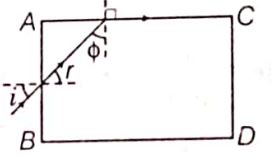
\(\text { or } 1-\cos ^{2} r \leq 1-\frac{1}{\mu^{2}} \Rightarrow \sin ^{2} r \leq 1-\frac{1}{\mu^{2}}\) [∵ 1 - cos2 r = sin2 r]
Since sin i = μ sin r
\(\frac{1}{\mu^{2}} \sin ^{2} i \leq 1-\frac{1}{\mu^{2}}\)
or sin2 i > μ2 -1
When i = \(\frac{\pi}{2}\) then we have smallest angle Φ.
If the angle Ф is greater than the critical angle, then all other angles of incidence shall be more than the critical angle.
Thus, 1 < μ2 -1 or μ2 > 2
\(\Rightarrow\) μ > \(\sqrt{2}\)
This is the required result.
12.
Given, velocity of light in glass, v = 2 x 10⁸ m/s
Velocity of light in air, c = 3 x 10⁸ m/s
∴ Refractive index of glass with respect to air,
\({ }^{a} \mu_{g}=\frac{c}{v}=\frac{3 \times 10^{8}}{2 \times 10^{8}}=1.5\)
∴ Normal shift in the position of ink dot,
\(
d =t\left(1-\frac{1}{{ }^{a} \mu_{g}}\right) \quad[\because t=6 \mathrm{~cm}]
\)
\(=6\left(1-\frac{1}{1.5}\right)=\frac{6 \times 0.5}{1.5}=2 \mathrm{~cm}
\)
13.
(i) The ray diagram for the formation of the image of the mobile phone is shown below. The image of the part which is on the plane perpendicular to principal axis will be on the same plane. It will be of the same size, i.e. B'C = BC
(ii) We may think that the image will now show only half of the object, but considering the laws of reflection to be true for all points of the remaining part of the mirror, the image will be that of the whole object.
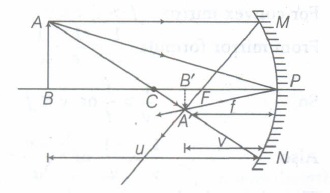
However, as the area of the reflecting surface has been reduced, the intensity of the image will be low, i.e. half.
14.
The power of the spectacles used by the myopic person, P = -1.0 D
Focal length of the spectacles, \(f=\frac{1}{P}=\frac{1}{-1 \times 10^{-2}}=-100 \mathrm{~cm}\)
Hence, the far point of the person is 100 cm. He might have a normal near point of 25 cm. When he uses the spectacles, the objects placed at infinity produce virtual images at 100 cm. He uses the ability of accommodation of the eye-lens to see the objects placed between 100 cm and 25 cm.
During old age, the person uses reading glasses of power, P′ = +2D
The ability of accommodation is lost in old age. This defect is called presbyopia. As a result, he is unable to see clearly the objects placed at 25 cm.
15.
By Snell's law,
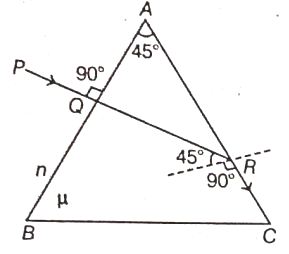
\(\begin{aligned}
\frac{\sin i}{\sin r} & =\frac{n}{\mu}
\end{aligned}\)
\(\begin{aligned}
\frac{\sin 45^{\circ}}{\sin 90^{\circ}} & =\frac{n}{\mu}
\end{aligned}\)
n = \(\mu\) sin 45° [\(\because\) sin 90° = 1]
\(n=\frac{\mu}{\sqrt{2}}\) \(\left[\because \sin 45^{\circ}=\frac{1}{\sqrt{2}}\right]\)
Thus, refractive index ofthe transparent medium is \(n=\frac{\mu}{\sqrt{2}}\)
16.
\( \text { Given: } \angle A=60^{\circ}, \angle i=\angle e, \angle i=\frac{3}{4} \angle A=45^{\circ} \text { and } \)
\(\angle r=\frac{\angle A}{2}=30^{\circ} \)
\(\mu=\frac{\sin i}{\sin r}=\frac{2}{\sqrt{2}}=1.414\)
17.
Given: D = 80 cm, d = 10 cm
\( \therefore \quad f =\frac{D^{2}-d^{2}}{4 D} \)
\(=\frac{6400-100}{320}=\frac{6300}{320}=19.7 \mathrm{~cm} \)
18.
It is a diverging (concave lens) and the refracted rays are bending away from the principal axis.

19.
Total internal reflection.
20.
The spectrum of visible light whose frequency is less than that of green light will come out of the water into the air.
21.
(i) Refractive index is minimum for vacuum (μ = 1).
(ii) Refractive index is maximum for diamond.
22.
A ray of light which is incident normally on a mirror, is reflected along the same path, i.e. the angle of incidence as well as the angle of reflection is zero.
23.
Since, \(m=\frac{\tan \beta}{\tan \alpha} \approx \frac{\beta}{\alpha}=\frac{f_{e}}{f_{e}}\)
\(\therefore \quad \frac{\beta}{0.5^{\circ}}=\frac{0.3}{0.03}=5^{\circ}\)
24.
Given, fo = 1.25 cm, f. = - 5 cm
Magnification, m = 30 , D = 25 cm
If the object is very close to the principal focus of the objective and the image formed by the objective is very close to eyepiece, then magnifying power of a microscope is given by
\( m=-\frac{L}{f_{0}} \cdot \frac{D}{f_{e}} \)
\(\Rightarrow 30=\frac{L}{1.25} \cdot \frac{25}{5} \)
\(\Rightarrow L=\frac{125 \times 30 \times 5}{25 \times 100} \)
\(\Rightarrow L=\frac{25 \times 30}{100} \Rightarrow L=\frac{30}{4} \)
⇒ L = 7.5 cm
This is a required separation between the objective and the eyepiece.
25.
The least distance of distinct vision of an average person, (i.e. D) is 25 cm, in order to view an object with magnification of 10.
Here, v = D = 25 cm and u = f
But the magnification, m = v/u = D/f
\(\therefore \quad m=\frac{D}{f}\)
\(\Rightarrow \quad f=\frac{D}{m}=\frac{25}{10}=25=0.025 \mathrm{~m}\)
and \(P=\frac{1}{0.025}=40 \mathrm{D}\) \(\left[\because P=\frac{1}{f}\right]\)
This is the required power of lens.
26.
(i) i = 52\(\unicode{xb0} \), when prism is adjusted at an angle of minimum deviation, then angle of incidence is equal to the angle of emergence.
Hence, r = 0
This ray pass unrefracted at AC interface and reaches AB interface. Here, we can see angle of incidence becomes 30\(\unicode{xb0} \).
Thus, applying snell's law, \(\frac{\sin 30^{\circ}}{\sin e}=\frac{\mu_{a}}{\mu_{g}}=\frac{1}{\sqrt{3}}\)
\(\sin e=\sqrt{3} \times \sin 30^{\circ}=\frac{\sqrt{3}}{2}\)
Thus, e = 60\(\unicode{xb0} \)
27.
When a glass lens (\(\mu\)g = 1.5) is immersed in water (\(\mu\)w = 1.33), then focal length of the lens increases but its nature remains unchanged. due to increase in focal length, its power reduces.
28.
Here, \(\mu=\frac{\text { real depth } / \text { thickness of object }}{\text { apparent depth }}\)
Now, due to refraction at two different boundaries, the apparent depth of object,
apparent depth = \(\frac{\text { thickness of glass }}{\mu_{\text {glass }}}+\frac{\text { thickness of water }}{\mu_{\text {water }}}\)
\(=\frac{6}{1.5}+\frac{4}{1.3}=3+4=7 \mathrm{~cm}\)
29.
Snell's law of refraction fails in two situations
(i) When both media have same value of refractive index.
(ii) When light is incident normally on a surface, as i = 0, r = 0.

12th Standard CBSE Syllabus & Materials
12th Standard CBSE
CBSE 12th Computer Science Python Revision Tour I - New Previous year Question Papers Study Material - QB365 Set A
NEW12th Standard CBSE
CBSE 12th Business Studies Planning Important Questions And Answers Study Material - QB365 Set A
NEW12th Standard CBSE
CBSE 12th Business Studies Business Environment Important Questions And Answers Study Material - QB365 Set A
NEW12th Standard CBSE
CBSE 12th Business Studies Principles of Management Important Questions And Answers Study Material - QB365 Set A



NCERT Books

Syllabus

Exam Pattern

Sample Question Papers

Previous year Question Papers

Important Notes

MCQ Practice test

NCERT Exemplers

Case study Questions

Image Based Questions

Passage based Questions

HOT Questions

Value Based Questions

Model Questions Papers
NCERT ( Book Back ) Questions

Assertion and Reason
Important Questions And Answers

CBSE 12th Standard CBSE Subjects
CBSE Standards








