
 100% FREE ACCESS
12th Standard CBSE Syllabus & Materials
12th Standard CBSE
CBSE 12th Economics Government Budget and the Economy Previous year Question Papers Study Material - QB365 Set A
NEW12th Standard CBSE
CBSE 12th Computer Science Interface Python with MySQL - New Previous year Question Papers Study Material - QB365 Set A
NEW12th Standard CBSE
CBSE 12th Computer Science Database Concept - New Previous year Question Papers Study Material - QB365 Set A
NEW12th Standard CBSE
CBSE 12th Computer Science Data Communication - New Previous year Question Papers Study Material - QB365 Set A
NEW12th Standard CBSE
CBSE 12th Computer Science Data Structures - New Previous year Question Papers Study Material - QB365 Set A
NEW12th Standard CBSE
CBSE 12th Computer Science Functions - New Previous year Question Papers Study Material - QB365 Set A

Published on: 25/10/2025
Download CBSE Class 12th Standard CBSE Physics question papers, sample papers, important questions, and previous year solved papers in PDF format. Get free study materials, NCERT solutions, and exam preparation resources for Class 12th Standard CBSE Physics
Questions + Answers key
Take MCQ Physics Test
1.
A beam of light is incident on a glass slab in a direction as shown in the figure. The reflected light is analysed by a polaroid prism. On rotating the polaroid,
the intensity remains unchanged
the intensity is reduced to zero and remains at zero
the intensity gradually reduced to zero and then again increases
the intensity increase continuously
the intensity increases initially and remains constant afterwards
2.
A magnetic needle suspended parallel to a magnetic field requires \(\sqrt { 3 } J\) of work to turn it through \({ 60 }^{ ° }.\) The torque needed to maintain the needle in this position will be :
\(2\sqrt { 3 } J\)
\(3J\)
\(\sqrt { 3 } J\)
\(\frac { 3 }{ 2 } J\)
3.
For an LCR circuit, the power transferred from the driving source to the driven oscillator from the driving source tothe driven oscillator is P = I2Z cos \(\phi \).
Here, the power factor cos \(\phi \ge 0,\ P\ge 0\)
The driving force can given no energy to the oscillator (P = 0) in some cases
The driving force can not syphon out (P<0) the energy out of oscillator
The driving force can take away energy out of the oscillator
4.
The correct formula for magnifying power of a simple microscope is
\(m=\left( 1+\frac { f }{ d } \right) \)
\(m=\left( 1-\frac { d }{ f } \right) \)
\(m=\left( 1+\frac { d }{ f } \right) \)
\(m=\left( 1-\frac { f }{ d } \right) \)
5.
In a semiconducting material (1/5) th of the total current is carried by the holes and the remaining is carried by the holes and the remaining is carried by the electrons. The drift speed of electrons is twice that of holes at this temperature The ratio between the number densities of electrons and holes is
21/6
5
3/8
2
6.
Electrons used in an electron microscope are accelerated by a voltage of 25kV. If the voltage is increased to 100 kV then the de-Broglie wavelength associated with the electrons would
increase by 2 times
decrease by 2 times
decrease by 4 times
increase by 4 times
7.
Which of the following is not an insulator?
glass
rubber
ebonite
human body
8.
The SI unit of electric field intensity is
N
N/C
C/m2
N/m2
9.
A red LED emits light of 0.1 watts uniformly around it. The amplitude of the electric field of the light at a distance of 1 m from the diode is
1.73 V/m
2.45 V/m
5.48 V/m
7.75 V/m
10.
Taking the Bohr radius as a0 = 53pm, the radius of Li++ ion its ground state, on the basis of Bohr's model, will be about
53pm
27pm
18pm
13pm
11.
What is the focal length of a convex lens of focal length 30cm in contact with a concave lens of focal length 20cm? Is the system a converging or a diverging lens? Ignore thickness of the lenses.
12.
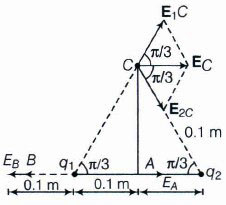
A two point charges q1 and q2 of magnitude 10-7 C and - 10-7 C, respectively are placed 0.2 m apart. Calculate the electric fields at points A, B and C as shown in the figure.
13.
Answer the following questions.
(i) Name the electromagnetic waves which are used for the treatment of certain forms of cancer. Write their frequency range.
(ii) Thin ozone layer on top of stratosphere is crucial for human survival. Why?
(iii) Why is the amount of the momentum transferred by the electromagnetic waves incident on the surface so small?
14.
What is meant by selectivity and sensitivity of radio receiver?
15.
If the effective current in a 50 cycle a.c. circuit is 5 A, what is the peak value of current? What is the current 1/600 sec. after it was zero?
16.
A resistance of 900 \(\Omega \) is connected in series with a galvanometer of resistance 100 \(\Omega \) . A potential difference of 1 volt produces 100 division deflection in the galvanomter. Find the figure of merit of galvanometer.
17.
An object is placed at (i) 10 cm, (ii) 5 cm in front of a concave mirror of radius of curvature 15 cm. Find the position, nature, and magnification of the image in each case.
18.
Draw the "Energy bands', diagrams for a(i) pure semiconductor, (ii) insulator. How does the energy band, for a pure semiconductor, get affected when this semiconductor is doped with (a) an acceptor impurity (b) donor impurity?
Hence discuss why the 'holes, and the 'electrons' respectively, become the 'majority charge carriers' in these two cases?
Write the two process involved in the formation of p-n junction.
19.
(a) A point object is placed in front of a double convex lens (of refractive index n =n2/n1 with respect air) with its spherical faces of radii of curvature R1 and R2.. Show the path of rays due to surface to obtain the formation of the real image of the object.
Hence obtain the lens maker's formula for a thin lens.
(b) A double convex lens having both faces of the same radius of curvature has refractive index 1.55. Find out the radius of curvature of the lens required to get the focal length of 20 cm.
20.
A dipole consisting of an electron and a proton separated by a distance of \(4\times 10^{-10}m\) is situated in an electric field of intensity \(3\times 10^5NC^{-1}\) at an angle of 30o with the field. Calculate the dipole moment and the torque acting on it. Charge e on an electron = \(1.6\times 10^{-19}C\)
21.
Find the de-Broglie wavelength(in \(\overset { \circ }{ A } \) ) associated with an example with an electron moving with a velocity 0.6c, where c=\(3\times { 10 }^{ 8 }m/s\)and rest mass of electron=\(9.1\times { 10 }^{ -31 }kg\), \(h=6.6\times { 10 }^{ -34 }Js\)
22.
Electric flux over an area in an electric field represents the ................ crossing this area.
23.
Draw a block diagram of a generalized communication system.
24.
A ray of light passes through an equilateral glass prism, such that the angle of incidence is equal to the angle of emergence. If the angle of emergence is ¾ times the angle of the prism, Calculate the refractive index of the glass prism
25.
Total resistance of the circuit is R/3 in which three identical resistors are connected in parallel. Find the value of each resistance?
26.
The Sequence of bands marked on a carbon resistor are: Red, Red, Red, Silver, Write the value of resistance with tolerance.
27.
A message signal of frequency 10 kHz and peak voltage 10 V is used to modulate a carrier wave of frequency 1 MHz and peak voltage 20 V. Determine
(i) The modulation index
(ii) the side bands produced.
28.
A e.m. wave, Y1, has a wavelength of 1cm while another e.m. wave, Y2, has a frequency of 1015 Hz. Name these two types of waves and write one useful application for each.
1.
(c)
the intensity gradually reduced to zero and then again increases
2.
(b)
\(3J\)
3.
(b)
The driving force can given no energy to the oscillator (P = 0) in some cases
4.
(c)
\(m=\left( 1+\frac { d }{ f } \right) \)
5.
(d)
2
6.
(b)
decrease by 2 times
7.
(d)
human body
8.
(b)
N/C
9.
(b)
2.45 V/m
10.
(c)
18pm
11.
Given, focal length of convex lens, f1 = 30 cm
Focal length of the concave lens, f2 = -20 cm
Using the formula of combination of lenses,
\(\frac{1}{f}=\frac{1}{f_{1}}+\frac{1}{f_{2}}=\frac{1}{30}-\frac{1}{20}=\frac{2-3}{60}=-\frac{1}{60}\)
\(\Rightarrow\) f = -60 cm
Since, the focal length of combination is negative in nature. so, the combination behaves like a diverging lens, i.e. as a concave lens.
12.
The electric field vector E1A at A due to the positive charge q1 points towards the right. Its magnitude,
E1A = \(\frac { (9\times { 10 }^{ 9 }N-{ m }^{ 2 }c^{ -2 })({ 10 }^{ -7 }) }{ { (0.1\quad m) }^{ 2 } } =9\times { 10 }^{ 4 }\) NC-1
EA is directed towards right.
The electric field vector E2 A due to q2 points to the right and has the same magnitude. Hence, the magnitude of total electric field EA at A,
EA = E1 A + E2 A = 18 \(\times\) 104 NC-1
EA is directed towards right.
The electric field E1 B at B due to q1 points towards the left and has a magnitude,
E1B = \(\frac { (9\times { 10 }^{ 9 }N-{ m }^{ 2 }c^{ -2 })({ 10 }^{ -7 }C) }{ { (0.1\quad m) }^{ 2 } } =9\times { 10 }^{ 4 }\) NC-1
The electric field E2 B at B due to the negative charge q2 points towards the right and has a magnitude
E2B = \(\frac { (9\times { 10 }^{ 9 }N-{ m }^{ 2 }c^{ -2 })({ 10 }^{ -7 }C) }{ { (0.3\quad m) }^{ 2 } } =1\times { 10 }^{ 4 }\) NC-1
The magnitude of the total electric field at B,
EB = E1 B - E2 B = 8 \(\times\) 104 NC-1
EB is directed towards the left.
The magnitude of each electric field vector at point C due to charge q1 and q2,
E1 C = E2 C = \(\frac { (9\times { 10 }^{ 9 }N-{ m }^{ 2 }{ c }^{ -2 })({ 10 }^{ -7 }C) }{ { (0.2\quad m) }^{ 2 } } \)
= \(2.25\times10^4\) NC-1
The resultant of these two vectors,
EC = E1 C cos\(\frac { \pi }{ 3 }\) + E2 C cos\(\frac { \pi }{ 3 }\)
= \(2.25\times10^4\) NC-1
EC points towards the right.
13.
(i) Y-rays are used for the treatment of certain forms of cancer. Its frequency range is from 3 x 10¹⁹ Hz to 3 x 10²³ Hz.
(ii) The thin ozone layer on top of stratosphere absorbs most of the harmful ultraviolet rays coming from the sun towards the earth. They include UVA, UVB and UVC radiations which can destroy the life system on the earth. Hence, this layer is crucial for human survival.
(iii) Momentum transferred = Energy/Speed of light
\(=\frac { E }{ c } =\frac { hV }{ c } ={ 10 }^{ -22 }\)
Thus, the amount of the momentum transferred by the electromagnetic waves incident on the surface is very small.
14.
Selectivity of radio receiver is the ability of a receiver to accept the wanted signal and to reject the unwanted signals. Sensitivity of a radio receiver is its ability to amplify the desired weak signal.
15.
7.07 A, 3.535 A
\(I_{ v }=5\ A,\ I_{ O }=\sqrt { 2 } I_{ v }=1.414\times 5=7.07\ A\)
From \(I=I_{ 0 }sin\quad \omega t\)
\(=7.07 \ sin \ \frac { \pi }{ 6 } =7.07\times \frac { 1 }{ 2 } =3.535\ A\)
16.
Figure of merit,
\(K=\frac { I }{ \theta } =\frac { V }{ R\theta } =\frac { 1 }{ (900+100)100 } \)
= 10-5 A/div.
17.
The focal length f = -15/2 cm = -7.5 cm
(i) The object distance u = -10 cm. Then Eq gives
\(\frac { 1 }{ v } +\frac { 1 }{ 10 } =\frac { 1 }{ -7.5 } \)
or \(v=\frac { 10\times 7.5 }{ -2.5 } =-30\) cm
The image is 30 cm from the mirror on the same side as the object
Also, magnification m = \(\frac { v }{ u } =-\frac { (-30) }{ (-10) } =-3\)
The image is magnified, real and inverted.
(ii) The object distance u = -5 cm. Then from Eq
\(\frac { 1 }{ v } +\frac { 1 }{ -5 } =\frac { 1 }{ -7.5 } \)
or \(v=\frac { 5\times 7.5 }{ (7.5-5) } =15\) cm
This image is formed at 15 cm behind the mirror. It is a virtual image.
Magnification m = 15 \(-\frac { v }{ u } =-\frac { 15 }{ (-5) } =3\)
The image is magnified, virtual and erect.
18.
The required energy band diagram are as shown:
.png)
.png)
(a) When the semiconductor is doped with an acceptor impurity there is an additional energy level a little above the top of the valence band.
(b) The donor impurity results in an additional energy level a little below the bottom of the conduction band.
(Also accept diagrammatic representations) In the first case, electrons, from the valence band, easily jump over to the acceptor level, leaving 'holes' behind. Hence, 'holes' become the majority charge carriers.
In the second case, electrons from the donor level, easily 'jump over' to the conduction band. Hence, electrons become the majority charge carriers.
The two processes, involved in the formation of the p-n junction are.
(i) Diffusion
(ii) Drift
19.
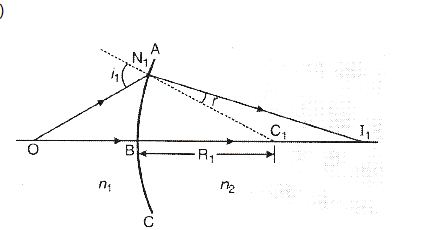
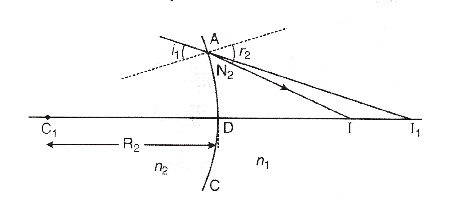
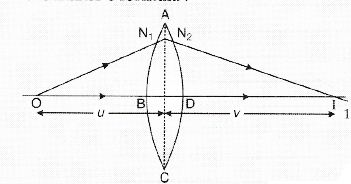
The first refracting ABC forms the image I1 of the object O. The image I1 acts as virtual object for the second refracting surface ADC, which forms the real image I as shown in the diagram
For refraction at ABC
\(\frac { { n }_{ 2 } }{ { v }_{ 1 } } -\frac { { n }_{ 1 } }{ u } =\frac { { n }_{ 2 }-{ n }_{ 1 } }{ { R }_{ 1 } } \)
For refraction at ADC
\(\frac { { n }_{ 1 } }{ v } -\frac { { n }_{ 2 } }{ { v }_{ 1 } } =\frac { { n }_{ 1 }-{ n }_{ 2 } }{ { R }_{ 2 } } \)
Adding equation (i) and equation (ii)
\(\frac { { n }_{ 1 } }{ v } -\frac { { n }_{ 2 } }{ u } =\left( { n }_{ 2 }-{ n }_{ 1 } \right) \left( \frac { 1 }{ { R }_{ 1 } } -\frac { 1 }{ { R }_{ 2 } } \right) \)
\(\frac { 1 }{ v } -\frac { 1 }{ u } =\left( \frac { { n }_{ 2 } }{ { n }_{ 1 } } -1 \right) \left( \frac { 1 }{ { R }_{ 1 } } -\frac { 1 }{ { R }_{ 2 } } \right) \)
We know, If \(u=\infty ,v=f\)
\(\frac { 1 }{ v } -\frac { 1 }{ u } =\frac { 1 }{ f } \)
\(\frac { 1 }{ f } =\left( \frac { { n }_{ 2 } }{ { n }_{ 1 } } -1 \right) \frac { 1 }{ { R }_{ 1 } } -\frac { 1 }{ { R }_{ 2 } } \)
\(\frac { 1 }{ f } =\left( { \mu }_{ 21 }-1 \right) \left( \frac { 1 }{ { R }_{ 1 } } -\frac { 1 }{ { R }_{ 2 } } \right) \)
\(\frac { 1 }{ f } =\left( { \mu }_{ 21 }-1 \right) \left( \frac { 1 }{ { R }_{ 1 } } -\frac { 1 }{ { R }_{ 2 } } \right) \)
\(\frac { 1 }{ f } =\left( 1.55-1 \right) \left( \frac { 1 }{ R } -\frac { 1 }{ -R } \right) \)
\(=0.55\times \frac { 2 }{ R } \)
\(R=0.55\times 2\times 20=22 \ cm\)
20.
Here q = \(1.6\times 10^{-19}C\)
\(2a=4\times10^{-10}m, E=3\times 10^5NC^{-1}, \theta=30^o\)
\(p=q\times2a=1.6\times10^{-19}\times4\times10^{-10}\)
= \(6.4\times10^{-29}Cm\)
\(\tau=pEsin\theta=6.4\times10^{-29}\times3\times10^5\times sin 30^o\)
\(=9.6\times 10^{-24}Nm\)
21.
Rest mass of electron,
\({ m }_{ 0 }=9.1\times { 10 }^{ -31 }kg\)
\(v=0.6c=0.6,\times 3\times { 10 }^{ 8 }=1.8\times { 10 }^{ 8 }{ ms }^{ -1 }\)
As v is comparable to c, hence mass of the electron in motion will be a relativistic mass. So,
\(m=\frac { { m }_{ 0 } }{ \sqrt { 1-{ v }^{ 2 }/{ c }^{ 2 } } } =\frac { { m }_{ 0 } }{ \sqrt { 1-\frac { { \left( 0.6 \right) }^{ 2 } }{ { c }^{ 2 } } } } =\frac { { m }_{ 0 } }{ 0.8 } \)
De-Broglie wavelength,
\(\lambda =\frac { h }{ mv } =\frac { h }{ \left( { m }_{ 0 }/0.8 \right) \times v } =\frac { h\times 0.8 }{ { m }_{ 0 }v } \)
\(=\frac { \left( 6.6\times { 10 }^{ -34 } \right) \times 0.8 }{ \left( 9.1\times { 10 }^{ -31 } \right) \times \left( 1.8\times { 10 }^{ 8 } \right) }\)
\( =0.322\times { 10 }^{ -11 }m=0.0322\times { 10 }^{ -10 }m\)
\(=0.032\overset { \circ }{ A } \)
22.
()
total number of electric lines of force
23.
()
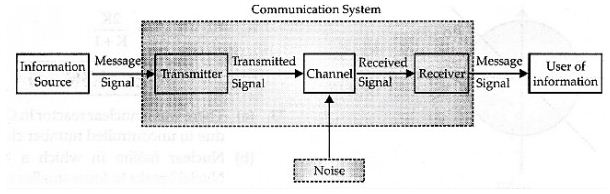
Alternatively: Also accept if the student gives only the following diagram:
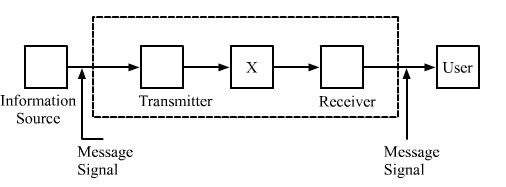
24.
A = 600 , \(\delta \)m = 300
i = e = ¾ A = 450
as A + \(\delta \) = i + e
60 + \(\delta \) = 45 +45
or \(\delta \) = 300
Refractive index,
\(\mu \) = sin a + \(\delta \)m /2/sin A/2 = sin 600+300/2/sin 600/2
= sin 450/sin300 = 1\(\surd 2\) 1/2 = \(\surd 2\) = 1.414
25.
R
26.
\(22*102 Ω ± 10%\)
27.
(a) Modulation index =10 / 20 = 0.5
(b) The side bands are at (1000+10 kHz)=1010 kHz and (1000 –10 kHz) = 990 kHz.
28.
Y1 Microwaves
Microwave oven, Aircraft Navigator or any other
Y2 Ultraviolet waves
Sterilize surgical instruments, food preservation or any other

12th Standard CBSE Syllabus & Materials
12th Standard CBSE
CBSE 12th Computer Science Python Revision Tour I - New Previous year Question Papers Study Material - QB365 Set A
NEW12th Standard CBSE
CBSE 12th Business Studies Planning Important Questions And Answers Study Material - QB365 Set A
NEW12th Standard CBSE
CBSE 12th Business Studies Business Environment Important Questions And Answers Study Material - QB365 Set A
NEW12th Standard CBSE
CBSE 12th Business Studies Principles of Management Important Questions And Answers Study Material - QB365 Set A



NCERT Books

Syllabus

Exam Pattern

Sample Question Papers

Previous year Question Papers

Important Notes

MCQ Practice test

NCERT Exemplers

Case study Questions

Image Based Questions

Passage based Questions

HOT Questions

Value Based Questions

Model Questions Papers
NCERT ( Book Back ) Questions

Assertion and Reason
Important Questions And Answers

CBSE 12th Standard CBSE Subjects
CBSE Standards








