
 100% FREE ACCESS
12th Standard CBSE Syllabus & Materials
12th Standard CBSE
CBSE 12th Economics Government Budget and the Economy Previous year Question Papers Study Material - QB365 Set A
NEW12th Standard CBSE
CBSE 12th Computer Science Interface Python with MySQL - New Previous year Question Papers Study Material - QB365 Set A
NEW12th Standard CBSE
CBSE 12th Computer Science Database Concept - New Previous year Question Papers Study Material - QB365 Set A
NEW12th Standard CBSE
CBSE 12th Computer Science Data Communication - New Previous year Question Papers Study Material - QB365 Set A
NEW12th Standard CBSE
CBSE 12th Computer Science Data Structures - New Previous year Question Papers Study Material - QB365 Set A
NEW12th Standard CBSE
CBSE 12th Computer Science Functions - New Previous year Question Papers Study Material - QB365 Set A

Published on: 25/10/2025
Download CBSE Class 12th Standard CBSE Physics question papers, sample papers, important questions, and previous year solved papers in PDF format. Get free study materials, NCERT solutions, and exam preparation resources for Class 12th Standard CBSE Physics
Questions + Answers key
Take MCQ Physics Test
1.
A small candle, 2.5 cm in size is placed at 27 cm in front of a concave mirror of radius of curvature 36 cm. At what distance from the mirror should a screen be placed in order to obtain a sharp image? Describe the nature and size of the image. If the candle is moved closer to the mirror, how would the screen have to be moved?
2.
(a) A point object is placed in front of a double convex lens (of refractive index n =n2/n1 with respect air) with its spherical faces of radii of curvature R1 and R2.. Show the path of rays due to surface to obtain the formation of the real image of the object.
Hence obtain the lens maker's formula for a thin lens.
(b) A double convex lens having both faces of the same radius of curvature has refractive index 1.55. Find out the radius of curvature of the lens required to get the focal length of 20 cm.
3.
A capacitor of unknown capacitance is connected across a battery of V volts. The charge stored in it is 360\(\mu C\). When potential across the capacitor is reduced by 120V, the charge stored in it becomes 120 \(\mu C\).
(i) Calculate the potential V and the unknown capacitance C.
(ii) what will be the charge stored in the capacitor, if the voltage applied had increased by 120 V?
4.
A long straight conductor C carrying a current of 3 A is placed parallel to a short conductor D of length 5 cm, carrying a current 4 A. The two conductors are 10 cm apart. Find
(i) the magnetic field due to C at D.
(ii) The approximate force on D.
5.
Figure shows a potentiometer with a cell of 2.0V and internal resistance 0.40\(\Omega\) maintaining a potential drop across the resistor wire AB. A standard cell which maintains a constant e.m.f. of 1.02V (for very moderate currents upto a few mA) gives a balance point at 67.3 cm length of the wire. To ensure very low currents drawn from the standard cell a very high resistance of 600k\(\Omega\) is put in series with it, which is shorted close to the balance point. The standard is then replaced by a cell of unknown e.m.f. E and the balance point found similarly, turns out to be at 82.3 cm length of the wire.
(a) What is the value o E?
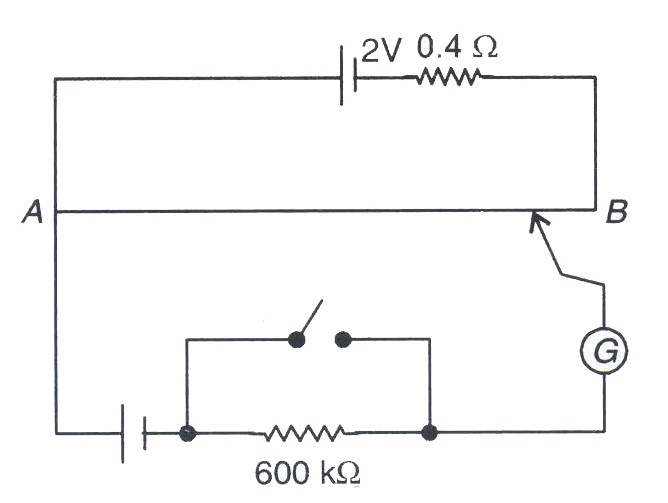
(b) What purpose does the high resistance of 600k\(\Omega\) have?
(c) Is the balance point affected by this high resistance?
(d) Is the balance point affected by the internal resistance of the driver cell?
(e) Would the method work in the above situation if the driver cell of the potentio-meter had an e.m.f of 1.0V instead of 2.0V?
(f) Would the circuit work cell for determining an extremely small e.m.f. say of the order of a few mV (such as the typical e.m.f. of a thermo-couple)? If not, how will you modify the circuit?
6.
Suppose that the lower half of the concave mirror’s reflecting surface in Fig. is covered with an opaque (non-reflective) material. What effect will this have on the image of an object placed in front of the mirror?
7.
Why does the conductivity of a semi conductor change with the rise in temperature ?
8.
Identify the electromagnetic waves whose wavelengths vary as
(i) 10-12m < \(\lambda\) < 10-8 m
(ii) 10-3m < \(\lambda\) < 10-1 m
Write one use for each.
9.
In the given figure this loop is placed in a horizontal plane near a long straight conductor carrying a steady current \(I_1\) at a distance \(l\) as shown. Give reasons to explain that the loop will experience a net force but no torque. Write the expression for this force acting on the loop.
10.
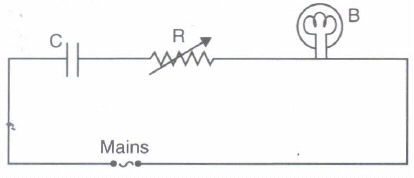
A capacitor 'C', a variable resistor 'R' and a bulb 'B' are connected in series to the ac mains in circuit as shown. The bulb glows with some brightness. How will the glow of the bulb change if
(i) a dielectric slab is introduced between the plates of the capacitor, keeping resistance R to be the same;
(ii) the resistance R is increased keeping the same capacitance?
11.
Define intensity of radiation on the basis of photon picture of light. Write its S.I. unit.
12.
What are the conditions required for making a conductor as a super conductor?
13.
Two slits in Young's double slit experiment have width in the ratio 81:1. what is the ratio of the amplitudes of light waves from them?
14.
When two resistance wires are in the two gaps of a meter bridge, the balance point was found to be 1/3 m from the zero end. When a 6\(\Omega \) coil is connected in series with the smaller of the two resistances, the balance point is shifted to 2/3 m from the same end. Find the resistance of the two wires.
15.
A circular coil of 200 turns, radius 5 cm carries a current of 2.5 a. It is suspended vertically in a uniform horizontal magnetic field of 0.25 T, with the plane of the coil making an angle of 60o with the field lines. Calculate the magnitude of the torque that must be applied on it to prevent it from turning.
16.
The plates of a parallel plate capacitor have an area of \(90{ cm }^{ 2 }\)each and are separated by 2.5mm.The capacitor is capacitor is charged by connecting it to a 400V supply.
(a) How much electrostatic energy is stored by the capacitor?
(b) View this energy as stored in the electrostatic field between the plates, and obtain the energy per unit volume u.Hence arrive at a relation between u and the magnitude of electric field E between the plates.
17.
In vacuum, to travel distance d, light takes time t and in medium to travel distance 5d, it takes time T. The critical angle of the medium is
\({ sin }^{ -1 }\left( \frac { 5T }{ t } \right) \)
\({ sin }^{ -1 }\left( \frac { 5t }{3T } \right) \)
\({ sin }^{ -1 }\left( \frac { 5t }{ T } \right) \)
\({ sin }^{ -1 }\left( \frac { 3t }{ 5T } \right) \)
18.
Two beams of red and violet colours made to pass separately through a prism (A = 60°). In the minimum deviation position, the angle of refraction inside the prism will be
greater for red colour
equal but not 30° for both the colours
greater for violet colour
30° for both the colours
19.
Electrical energy is transmitted over large distances at high alternating voltages. Which of the following statements is (are) correct?
For a given power level, there is a lower current
Lower current implies less power loss
Transmission lines can be made thinner
It is easy to reduce the voltage at he receiveing end using step-down transformers
20.
In a compound microscope, the distance between objective lens and eye lens is
fixed
variable
infinite
1 metre
21.
The energy that should be added to an electron to reduce its de-Broglie wavelength from \(2\times { 10 }^{ -9 }\) to \(0.5\times { 10 }^{ -9 }\) will be
1.1 MeV
0.56MeV
0.56KeV
5.6 eV
22.
The efficiency of d.c.motor id given by \(\eta \) =
\(\frac { back \ e.m.f. }{ applied \ e.m.f. } \)
\(\frac { applied \ e.m.f }{ back \ e.m.f. } \)
\(back \ e.m.f.\ \times \ applied \ e.m.f.\)
none of the above
23.
Out of glass (rod) and silk (cloth) work function of glass is
smaller
larger
equal
none of the above
24.
A circular coil carrying current behaves as a
bar magnet
horse shoe magnet
magnetic shell
solenoid
25.
The dominant mechanisms for motion of charge carriers in forward and reverse biased silicon p-n junction are
drift in forward biased,diffusion in reverse bias
diffusion in forward biased,drift in reverse bias
diffusion in both forward and reverse bias
drift in both forward and reverse bias
26.
The ground state energy of electron in case of \(_{ 3 }{ { Li }^{ 7 } }\)is
13.6 eV
-13.6 eV
30.4 eV
-30.4 eV
27.
One cannot see through fog, because
fog absorbs the light
light suffers total reflection at droplets
refractive index of the fog is infinity
light is scattered by droplets
28.
Lightning is a common example of ........
1.
Size of the candle, h = 2.5 cm
Image size = h’
Object distance, u = -27 cm
Radius of curvature of the concave mirror, R = -36 cm
\(f=\frac { R }{ 2 } =-18\)cm
Image distance = v
The image distance can be obtained using the mirror formula:
\(\frac { 1 }{ u } +\frac { 1 }{ v } =\frac { 1 }{ f } \)
\(\frac { 1 }{ v } =\frac { 1 }{ f } -\frac { 1 }{ u } \)
\(\frac { 1 }{ -18 } =\frac { 1 }{ -27 } =\frac { -3+2 }{ 54 } =-\frac { 1 }{ 54 } \)
∴ v = -54 cm
Therefore, the screen should be placed 54 cm away from the mirror to obtain a sharp image.
The magnification of the image is given as:
\(m=\frac { { h }^{ ' } }{ h } =-\frac { v }{ u } \)
\(\therefore { h }^{ ' }=-\frac { v }{ u } \times h\)
\(=-\left( \frac { -54 }{ -27 } \right) \times 2.5=-5\)cm
The height of the candle’s image is 5 cm. The negative sign indicates that the image is inverted and real.
If the candle is moved closer to the mirror, then the screen will have to be moved away from the mirror in order to obtain the image.
2.
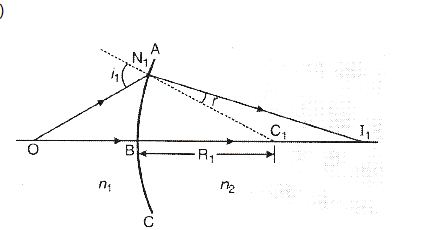
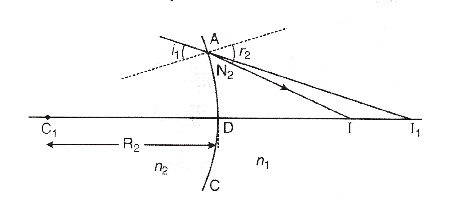
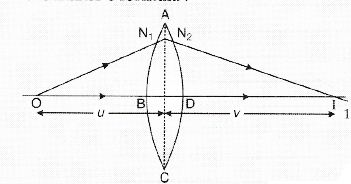
The first refracting ABC forms the image I1 of the object O. The image I1 acts as virtual object for the second refracting surface ADC, which forms the real image I as shown in the diagram
For refraction at ABC
\(\frac { { n }_{ 2 } }{ { v }_{ 1 } } -\frac { { n }_{ 1 } }{ u } =\frac { { n }_{ 2 }-{ n }_{ 1 } }{ { R }_{ 1 } } \)
For refraction at ADC
\(\frac { { n }_{ 1 } }{ v } -\frac { { n }_{ 2 } }{ { v }_{ 1 } } =\frac { { n }_{ 1 }-{ n }_{ 2 } }{ { R }_{ 2 } } \)
Adding equation (i) and equation (ii)
\(\frac { { n }_{ 1 } }{ v } -\frac { { n }_{ 2 } }{ u } =\left( { n }_{ 2 }-{ n }_{ 1 } \right) \left( \frac { 1 }{ { R }_{ 1 } } -\frac { 1 }{ { R }_{ 2 } } \right) \)
\(\frac { 1 }{ v } -\frac { 1 }{ u } =\left( \frac { { n }_{ 2 } }{ { n }_{ 1 } } -1 \right) \left( \frac { 1 }{ { R }_{ 1 } } -\frac { 1 }{ { R }_{ 2 } } \right) \)
We know, If \(u=\infty ,v=f\)
\(\frac { 1 }{ v } -\frac { 1 }{ u } =\frac { 1 }{ f } \)
\(\frac { 1 }{ f } =\left( \frac { { n }_{ 2 } }{ { n }_{ 1 } } -1 \right) \frac { 1 }{ { R }_{ 1 } } -\frac { 1 }{ { R }_{ 2 } } \)
\(\frac { 1 }{ f } =\left( { \mu }_{ 21 }-1 \right) \left( \frac { 1 }{ { R }_{ 1 } } -\frac { 1 }{ { R }_{ 2 } } \right) \)
\(\frac { 1 }{ f } =\left( { \mu }_{ 21 }-1 \right) \left( \frac { 1 }{ { R }_{ 1 } } -\frac { 1 }{ { R }_{ 2 } } \right) \)
\(\frac { 1 }{ f } =\left( 1.55-1 \right) \left( \frac { 1 }{ R } -\frac { 1 }{ -R } \right) \)
\(=0.55\times \frac { 2 }{ R } \)
\(R=0.55\times 2\times 20=22 \ cm\)
3.
(i) We have, initial voltage, V1 = V volt
and charge stored, Q1 = 360 \(\mu\)C
Q1 = CV1 ....(i)
Charged potential, V2 = V - 120
Q2 = 120 \(\mu\)C
\(\Rightarrow\) Q2 = CV2 = C(V - 120) ....(ii)
By dividing Eq. (ii) from Eq. (i), we get
\(\frac{Q_1}{Q_2}=\frac{C V_1}{C V_2} \Rightarrow \frac{360}{120}=\frac{V}{V-120}\)
\(\Rightarrow\) V = 180 V
\(\therefore \quad C=\frac{Q_1}{V_1}=\frac{360 \times 10^{-6}}{180}=2 \times 10^{-6} \mathrm{~F}\)
= 2 \(\mu\)F
Hence, the potential, V = 180 V and unknown capacitance is 2 \(\mu\)F.
(ii) If the voltage applied had increased by 120 V, then V3 = 180 + 120 = 300 V
Hence, charge stored in the capacitor,
Q3 = CV3 = 2 \(\times\)10-6 \(\times\)300 = 600 \(\mu\)C
4.
(i) Magnetic field due to C at D is
\(B=\frac { { \mu }_{ o } }{ 4\pi } \frac { 2I }{ r } ={ 10 }^{ -7 }\times \frac { 2\times 3 }{ 0.10 } =6\times { 10 }^{ -6 }T\)
(ii) Force on D, F = BI1 lsin\(\theta \) = (6 x 10-6) x 4 x (5 x 10-2) x sin 90o
= 1.2 x 10⁻⁶ N
5.
(a) E = 1.25V
6.
You may think that the image will now show only half of the object, but taking the laws of reflection to be true for all points of the remaining part of the mirror, the image will be that of the whole object. However, as the area of the reflecting surface has been reduced, the intensity of the image will be low (in this case, half).
7.
When a semi conductor is heated more & more electrons get enough energy to jump across the forbidden energy gap from valence band to the conduction band, where they are free to conduct electricity. Thereby increasing the conductivity of a semi conductor.
8.
(i) 10-12 m - 10-8 m = 0.01 \(\overset{\circ}{A}\) - 100 \(\overset{\circ}{A}\) \(\rightarrow\) X-rays.
These are used in crystallography.
(ii) 10-3 m - 10-1 m = 0.1 cm - 10 cm \(\rightarrow\) Radio waves.
These are used in radio communication.
9.
Force on upper horizontal side
\(=\frac {Il\mu_0 I_1}{2 \pi l}=\frac {\mu_0 {II}_1}{2 \pi }=\frac {\mu_0I I_1}{2 \pi }(attractive)\)
Force on lower horizontal side
\(=\frac {Il\mu_0 I_1}{2 \pi (2l)}=\frac {I\mu_0 {I}_1}{4 \pi }(repulsive)\)
The direction of these forces being opposite to each other therefore net force.
\(F=\frac {\mu_0I I_1}{2\pi}(attractive)\)
(the net force on the two vertical sides is zero)
10.
(i) Reactance of the capacitor will decrease, resulting in increase of the current in the circuit, Therefore the bulb will glow brighter.
(ii) The bulb will go dimmer.
11.
The amount of light energy / photon energy, incident per metre square per second is called intensity of joule/Sec-meter2 radiation.
SI Unit: W/m2 or Joule/Sec-meter2
12.
A conductor will become a superconductor if its temperature becomes equals to or less than its critical temperature.
13.
9:1
14.
Then,R = R1, S = R2, l = \(\frac { 1 }{ 3 } \)m and (100 - l) = 1 - \(\frac { 1 }{ 3 } \) = \(\frac { 1 }{ 3 } \)m
\(\therefore \frac { R1 }{ R2 } =\frac { l }{ (1oo-l) } =\frac { 1/3 }{ 2/3 } =\frac { 1 }{ 2 }\) or R2 = 2 R1
So, R1 < R2
As 6 \(\Omega \) coil is connected in series with the smaller resistance R1, so resistance of the left gap becomes, R1 = R1 + 6. Resistance of right gap is R2 .
Now, \(l'=\frac { 2 }{ 3 } m\)
and (100 - l) = \(1-\frac { 2 }{ 3 } =\frac { 1 }{ 3 } m\)
\(\therefore \frac { R1' }{ R2 } =\frac { l' }{ (100-l') } or\frac { R1+6 }{ R2 } =\frac { 2/3 }{ 1/3 } =2\)
or R1+ 6 = 2 R2 = 2 x 2R1 = 4 R1
and R2 = 2 R1 = 2 x 2 = 4\(\Omega \)
R1 = 2\(\Omega \)
15.
\(\tau =nIBA \ sin\alpha \ ; \ Here, \ n=200, \ I=2.5 \ A;\)
\( B=0.25 \ T \ ; \ \alpha ={ 90 }^{ o }-{ 60 }^{ o } \ ={ 30 }^{ o }\)
\(A=\pi { r }^{ 2 }=\frac { 22 }{ 7 } \times { \left( 0.05 \right) }^{ 2 }{ m }^{ 2 }\)
16.
\(\quad \quad \quad \quad \quad \ d=2.5mm=2.5\times { 10 }^{ -3 }m\\ \quad \quad \quad \quad \quad \ A=90{ cm }^{ 2 }=90\times { 10 }^{ -4 }{ m }^{ 2 }\\ potential\quad \quad V=400\quad volt\)
(a) Electrostatic energy stored in the capacitor
\(\quad \quad \quad \quad u=\frac { 1 }{ 2 } { CV }^{ 2 }=\frac { 1 }{ 2 } .\frac { { \varepsilon }_{ 0 }A }{ d } { V }^{ 2 }\\ or\quad \quad \quad u=\frac { 1 }{ 2 } .\frac { (8.85\times { 10 }^{ -12 })\times 90\times { 10 }^{ -4 }\times { (400) }^{ 2 } }{ 2.5\times { 10 }^{ -3 } } \\ or\quad \quad \quad u=\frac { 8.85\times 90\times 16 }{ 2\times 2.5 } \times { 10 }^{ -9 }=2.55\times { 10 }^{ -6 }J\\ (b)\quad Volume=A\times d\\ \quad \quad \quad \quad =90\times { 10 }^{ -4 }\times 2.5\times { 10 }^{ -3 }\\ \quad \quad \quad \quad =225\times { 10 }^{ -7 }{ m }^{ 3 }\)
Energy per unit volume,
\(\quad \quad \quad \quad \quad u=\frac { 2.55\times { 10 }^{ -6 }J }{ 225\times { 10 }^{ -7 }{ m }^{ 3 } } =0.113{ Jm }^{ -3 }\\ Now\quad \quad \quad u=\frac { Energy }{ Volume } =\frac { 1 }{ 2 } \frac { { \varepsilon }_{ 0 }A.{ V }^{ 2 } }{ d\times A\times d } =\frac { 1 }{ 2 } \frac { { \varepsilon }_{ 0 }.{ V }^{ 2 } }{ { d }^{ 2 } } \\ or\quad \quad \quad \quad u=\frac { 1 }{ 2 } { \varepsilon }_{ 0 }.{ E }^{ 2 }\)
17.
(c)
\({ sin }^{ -1 }\left( \frac { 5t }{ T } \right) \)
18.
(d)
30° for both the colours
19.
(a)
For a given power level, there is a lower current
20.
(a)
fixed
21.
(d)
5.6 eV
22.
(a)
\(\frac { back \ e.m.f. }{ applied \ e.m.f. } \)
23.
(a)
smaller
24.
(c)
magnetic shell
25.
(b)
diffusion in forward biased,drift in reverse bias
26.
(d)
-30.4 eV
27.
(d)
light is scattered by droplets
28.
()
electric discharge through air

12th Standard CBSE Syllabus & Materials
12th Standard CBSE
CBSE 12th Computer Science Python Revision Tour I - New Previous year Question Papers Study Material - QB365 Set A
NEW12th Standard CBSE
CBSE 12th Business Studies Planning Important Questions And Answers Study Material - QB365 Set A
NEW12th Standard CBSE
CBSE 12th Business Studies Business Environment Important Questions And Answers Study Material - QB365 Set A
NEW12th Standard CBSE
CBSE 12th Business Studies Principles of Management Important Questions And Answers Study Material - QB365 Set A



NCERT Books

Syllabus

Exam Pattern

Sample Question Papers

Previous year Question Papers

Important Notes

MCQ Practice test

NCERT Exemplers

Case study Questions

Image Based Questions

Passage based Questions

HOT Questions

Value Based Questions

Model Questions Papers
NCERT ( Book Back ) Questions

Assertion and Reason
Important Questions And Answers

CBSE 12th Standard CBSE Subjects
CBSE Standards








