
 100% FREE ACCESS
12th Standard CBSE Syllabus & Materials
12th Standard CBSE
CBSE 12th Economics Government Budget and the Economy Previous year Question Papers Study Material - QB365 Set A
NEW12th Standard CBSE
CBSE 12th Computer Science Interface Python with MySQL - New Previous year Question Papers Study Material - QB365 Set A
NEW12th Standard CBSE
CBSE 12th Computer Science Database Concept - New Previous year Question Papers Study Material - QB365 Set A
NEW12th Standard CBSE
CBSE 12th Computer Science Data Communication - New Previous year Question Papers Study Material - QB365 Set A
NEW12th Standard CBSE
CBSE 12th Computer Science Data Structures - New Previous year Question Papers Study Material - QB365 Set A
NEW12th Standard CBSE
CBSE 12th Computer Science Functions - New Previous year Question Papers Study Material - QB365 Set A

Published on: 25/10/2025
Download CBSE Class 12th Standard CBSE Physics question papers, sample papers, important questions, and previous year solved papers in PDF format. Get free study materials, NCERT solutions, and exam preparation resources for Class 12th Standard CBSE Physics
Questions + Answers key
Take MCQ Physics Test
1.
Give reasons for the following :
(i) The Zener diode is fabricated by heavily doping both the p and n sides of the junction
(ii) A photodiode, when used as a detector of optical singles is operated under reverse bias.
(iii) The band gap of the semiconductor used for fabrication of visible LED's must at least be 1.8 eV.
2.
A young's experiment, the width of the fringes obtained with light wavelength 6000 is 2mm.What will be the fringe width, if the entire apparatus is immersed in a liquid of refractive index 1.33?
3.
Find the position of the image formed of the object O by the lens combination given in the figure.

4.
The oscillating magnetic field in plane electromagnetic wave is given by \({ B }_{ y }=8\times 10^{ 6 } \ sin \ (2\times 10^{ 11 }t+300\pi x) \ T\)
(i) Calculate the wavelength of electromagnetic wave.
(ii) Write down the expression for the oscillating electric field.
5.
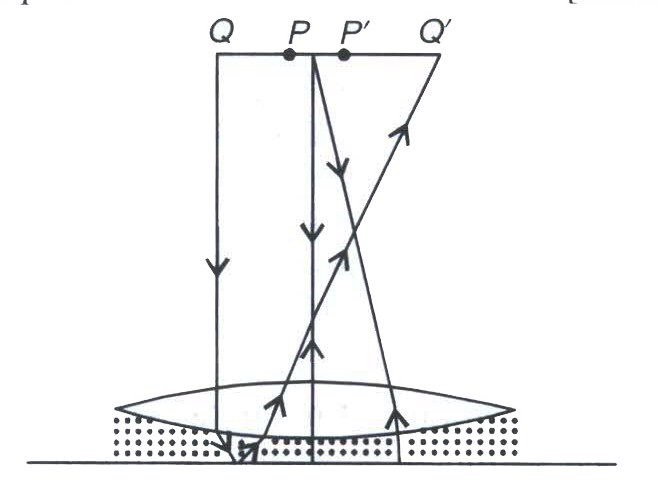
Figure shows an equiconvex lens (of refractive index 1.50) in contact with a liquid layer on top of a plane mirror. A small needle with its tip on the principal axis until its inverted image is found at the position of the needle. The distance of the needle from the lens is measured to be 45.0 cm The liquid is removed and the experiment is repeated. The new distance is measured to be 30.0 cm. What is the refractive index of the liquid?
6.
A proton and α particle have the same de-Broglie wavelength. Determine the ratio of
(i) their accelerating potentials
(ii) their speeds
7.
How will the interference pattern i Young's double slit experiment get affected, when
(i) distance between the slits S1 and S2 reduced and
(ii) the entire set up is immersed in water? Justify your answer in each case.
8.
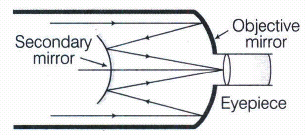
A Cassegrain telescope uses two mirrors as shown in the figure. Such a telescope is built with the mirrors 20mm apart. If the radius of curvature of large mirror is 220mm and the small mirror is 140 mm, where will the final image of an object at infinity be?
9.
You are given a \(2\mu F\) parallel plate capacitor. How would you establish an instantaneous displacement current of 1 mA in the space between its plates?
10.
(i) Describe briefly how an unpolarised light gets linearly polarised, when it passes through a polaroid.
(ii) Three identical polaroid sheets \({ P }_{ 1 },{ P }_{ 2 }and{ P }_{ 3 }\) are oriented, so that the pass axis of \({ P }_{ 2 }and{ P }_{ 3 }\) are inclined at angles of \({ 60 }^{ \circ }and{ 90 }^{ \circ }\) respectively with respect to the pass axis of \({ P }_{ 1 }\) A monochromatic source S of unpolarised light of intensity I is kept in front of the polaroid sheet \({ P }_{ 1 }\) as shown in the figure.

Determine the intensities of light as observed by the observers\({ O }_{ 1 },{ O }_{ 2 }and{ O }_{ 3 }\) as shown in the figure.
11.
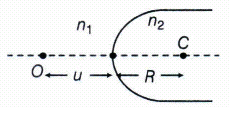
(i) A point object O is kept in amedium of refractive index n1, in front of a convex spherical surface of radius of curvature R which separates the second medium of refractive index n2 from the first one, as shown in the figure.
Draw the ray diagram showing the image formation and deduce the relationship between the object distance and the image distance in term of n1, n2 and R.
(ii) When the image formed above acts as a virtual object for a concave spherical surface separating the medium n2 from n1(n2 > n1), draw this ray diagram and write the similar [similar to (i)] relation. Hence, obtain the expression for lens maker's formula.
1.
(i) Heavy doping makes the depletion region very thin. This makes the electric field of the junction.
(ii) When operated under reverse bias, the photodiode can detect changes in current with changes in light intensity more easily.
(iii) The photon energy, of visible light photons varies from about 1.8 eV. Hence for visible LED's, the semiconductor must have a band gap of 1.8 eV.
2.
As,
\( \beta =\frac { D\lambda }{ d } and \ { \beta }_{ 1 }=\frac { { D\lambda }_{ 1 } }{ d }\)
\( \because \ \frac { { \beta }_{ 1 } }{ \beta } =\frac { \frac { { D\lambda }_{ 1 } }{ d } }{ \frac { D\lambda }{ d } } =\frac { { \lambda }_{ 1 } }{ { \lambda } } =\frac { 1 }{ \mu } \)
or \({ \beta }_{ 1 }=\frac { \beta }{ \mu } =\frac { 2 }{ 1.22 } =1.5mm\)
3.
For convex lens of focal length 10 cm,
f =+ 10cm, u = -3 cm
Using lens formula,
\( \frac { 1 }{ f } =\frac { 1 }{ v } -\frac { 1 }{ u }\)
\(\Rightarrow \ \frac { 1 }{ 10 } =\frac { 1 }{ v } -\frac { 1 }{ \left( -30 \right) } \Rightarrow v=15cm\)
The image formed by first lens acts as a virtual object for plano-concave lens.
For plano-concave lens,
\(u=+10cm,\quad f=-10cm,v=?\)
Using lens formula,
\(\frac { 1 }{ f } =\frac { 1 }{ v } -\frac { 1 }{ u } \)
\(\Rightarrow \quad \frac { 1 }{ v } =0\)
\( \Rightarrow \quad v=\infty \)
The refracted ray becomes parallel to principal axis for convex lens of focal length 30 cm.
\(u=-\infty ,v=?,f=30cm\)
\(\frac { 1 }{ f } =\frac { 1 }{ v } -\frac { 1 }{ u } \)
\(\Rightarrow \ \frac { 1 }{ 30 } =\frac { 1 }{ v } -\frac { 1 }{ \left( -\infty \right) } \ \Rightarrow \ v=30cm\)
So, final image is formed at a distance of 30 cm from second convex lens on the other side of u.
4.
Given \(B=8\times 10^{ 6 } \ sin \ (2\times 10^{ 11 }t+300\pi x) \ T\) wave from equation of magnetic field.
\({ B }_{ y }={ B }_{ 0 } \ sin \ \left( \frac { 2\pi }{ T } t+\frac { 2\pi }{ \lambda } x \right) \)
or \(300\pi =\frac { 2\pi }{ \lambda } \)
or \(\lambda =\frac { 2\pi }{ 300\pi } =\frac { 1 }{ 150 } =6.3\times { 10 }^{ -3 } \ m\)
(ii) Electric field is given as
\({ E }_{ Z }={ B }_{ Z } \ c=24\times 10^{ 14 }sin\left[ 2\times 10^{ 11 }t+300\pi x \right] Vm^{ -1 }\)
5.
1.33
6.
(i) The de-Broglie wavelength of a particle is given by
\(\lambda =\frac { 12.27 }{ \sqrt { V_{ } } } \mathring { A } \)
[Where, V is the accelerating potential of the particle]
\(\because \quad \lambda _{ p }=\lambda _{ \alpha }\) [given]
\(=\frac { 12.27 }{ \sqrt { V_{ p } } } =\frac { 12.27 }{ \sqrt { V_{ \alpha } } }\)
\( \Rightarrow \frac { V_{ p } }{ V_{ \alpha } } =1\)
(ii) The de-Broglie wavelength of the particle is given by
\(\lambda =\frac { h }{ mv } \)
\( \lambda _{ p }=\frac { h }{ m_{ p }.v_{ p } } \ and \ \lambda _{ \alpha }=\frac { h }{ m_{ \alpha }v_{ \alpha } } \)
We know that, \(\\ m_{ \alpha }=4 m _{ p }\)
\( \because \lambda_{p}=\lambda_{\alpha} \) [given]
\( \therefore \frac{h}{m_{p} \cdot v_{p}}=\frac{h}{4 m_{p} \cdot v_{\alpha}} \Rightarrow \frac{v_{p}}{v_{\alpha}}=4 \)
7.
(i) The fringe width interference pattern increase with the decrase in separation between S1 and S2 as \(\beta \alpha \frac { 1 }{ d } \)
(ii) The fring width decreases as wavelength gets reduced, when interferences set up is taken from air to water as, \(\beta \alpha \lambda \)
8.
Radius of curvature of objectrive mirror,
R1 = 220 mm
\({ f }_{ 1 }=\frac { { R }_{ 1 } }{ 2 } =\frac { 220 }{ 2 } =110 \ mm\)
Radius of curvature of secondary mirrors, R2 = 140 mm
\({ f }_{ 2 }=\frac { { R }_{ 2 } }{ 2 } =\frac { 140 }{ 2 } =70 \ mm\)
Distance between two mirrors, d = 20 mm from objective mirror.
Now, for secondary mirror, u = f1 - d = 110 - 20
= 90 mm
From mirror formula,
\(\frac { 1 }{ v } +\frac { 1 }{ u } =\frac { 1 }{ { f }_{ 2 } } \Longrightarrow \frac { 1 }{ v } =\frac { 1 }{ { f }_{ 2 } } -\frac { 1 }{ u } \)
\( =\frac { 1 }{ 70 } -\frac { 1 }{ 90 } \Longrightarrow v=\frac { 630 }{ 2 } =315\ mm\)
i.i., final image will be at 31.5 cm to the right of secondary mirror.
9.
Here, ID = 1 mA = 10-3A ; C = \(2\mu F\) = 2 x 10⁻⁶ F, \({ I }_{ D }=I=\frac { d }{ dt } \left( CV \right) =C\frac { dV }{ dt } \)
Therefore, \(\frac { dV }{ dt } =\frac { { I }_{ D } }{ C } =\frac { { 10 }^{ -3 } }{ 2\times { 10 }^{ -6 } } =500V/s\)
So, by applying a varying potential difference of 500 V/s, we would produce a displaccment current of desired value.
10.
(ii) We know that, \(I={ I }_{ \circ }cos^{ 2 }\theta \)
Intensity at \({ O }_{ 1 },I={ I }_{ \circ }cos^{ 2 }\theta \)
Intensity at \({ O }_{ 2 }{ I }_{ 1 }={ I }cos^{ 2 }\theta _{ 1 }\)
\(={ I }_{ \circ }cos^{ 2 }\theta cos^{ 2 }{ 60 }^{ \circ } \ \left[ \therefore \theta _{ 1 }={ 60 }^{ \circ } \right]\)
\({ I }_{ 1 }=\frac { { I }cos^{ 2 }\theta _{ 1 } }{ 4 } \)
Intensity at \({ O }_{ 3 },{ I }_{ 2 }={ I }_{ 1 }cos^{ 2 }\theta _{ 2 }\)
\(=\frac { { I }_{ \circ }cos^{ 2 }\theta }{ 4 } \times cos^{ 2 }{ 90 }^{ \circ }\quad \left[ \therefore \theta _{ 2 }={ 90 }^{ \circ } \right]\)
\( =0\)
11.
(i) \(\frac { { n }_{ 1 } }{ v } -\frac { { n }_{ 2 } }{ u } =\frac { { n }_{ 2 }-{ n }_{ 1 } }{ R } \) ............(i)
(ii) Now, the image I' acts as a virtual object for the second surface that will form a real at I. As, refraction takes place from denser to rarer medium,
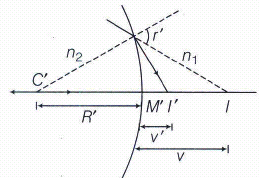
\(\therefore \quad \frac { { -n }_{ 2 } }{ v } +\frac { { n }_{ 1 } }{ { v }^{ ' } } =\frac { { n }_{ 2 }-{ n }_{ 1 } }{ { R }^{ ' } } \) ............(ii)
On adding Eqs. (i) and (ii), we get
\(\frac { 1 }{ f } =\left( { n }_{ 21 }-1 \right) \left( \frac { 1 }{ R } -\frac { 1 }{ { R }^{ ' } } \right) \ \left[ \therefore { n }_{ 21 }=\frac { { n }_{ 2 } }{ { n }_{ 1 } } ,\frac { 1 }{ f } =\frac { 1 }{ v } -\frac { 1 }{ u } \right] \)

12th Standard CBSE Syllabus & Materials
12th Standard CBSE
CBSE 12th Computer Science Python Revision Tour I - New Previous year Question Papers Study Material - QB365 Set A
NEW12th Standard CBSE
CBSE 12th Business Studies Planning Important Questions And Answers Study Material - QB365 Set A
NEW12th Standard CBSE
CBSE 12th Business Studies Business Environment Important Questions And Answers Study Material - QB365 Set A
NEW12th Standard CBSE
CBSE 12th Business Studies Principles of Management Important Questions And Answers Study Material - QB365 Set A



NCERT Books

Syllabus

Exam Pattern

Sample Question Papers

Previous year Question Papers

Important Notes

MCQ Practice test

NCERT Exemplers

Case study Questions

Image Based Questions

Passage based Questions

HOT Questions

Value Based Questions

Model Questions Papers
NCERT ( Book Back ) Questions

Assertion and Reason
Important Questions And Answers

CBSE 12th Standard CBSE Subjects
CBSE Standards








