
 100% FREE ACCESS
12th Standard CBSE Syllabus & Materials
12th Standard CBSE
CBSE 12th Economics Government Budget and the Economy Previous year Question Papers Study Material - QB365 Set A
NEW12th Standard CBSE
CBSE 12th Computer Science Interface Python with MySQL - New Previous year Question Papers Study Material - QB365 Set A
NEW12th Standard CBSE
CBSE 12th Computer Science Database Concept - New Previous year Question Papers Study Material - QB365 Set A
NEW12th Standard CBSE
CBSE 12th Computer Science Data Communication - New Previous year Question Papers Study Material - QB365 Set A
NEW12th Standard CBSE
CBSE 12th Computer Science Data Structures - New Previous year Question Papers Study Material - QB365 Set A
NEW12th Standard CBSE
CBSE 12th Computer Science Functions - New Previous year Question Papers Study Material - QB365 Set A

Published on: 25/10/2025
Download CBSE Class 12th Standard CBSE Physics question papers, sample papers, important questions, and previous year solved papers in PDF format. Get free study materials, NCERT solutions, and exam preparation resources for Class 12th Standard CBSE Physics
Questions + Answers key
Take MCQ Physics Test
1.
Write the main use of the
(i) photodiode
(ii) Zener diode.
2.
Draw the circuit diagram showing how a p-n junction diode is
(i) forward biased (ii) reverse biased
3.
Distinguish between 'intrinsic' and 'extrinsic' semiconductors?
4.
What is the most common use of photodiode?
5.
A nucleus \(_{ 92 }^{ 238 }{ U }\) undergoes α-decay and transforms to thorium. What is
(i) the mass number and
(ii) atomic number of the nucleus produced?
6.
A nucleus undergoes β-decay. How does its
(i) mass number and
(ii) atomic number change?
7.
What is the relationship between the half-life and mean life of a radioactive nucleus?
8.
Name the semiconductor device that can be used to regulate an unregulated de power supply. With the help of I-V characteristics of this device, explain its working principle.
9.
Explain with the help of a circuit diagram, the working of a p-n junction diode as a half-wave rectifier.
10.
How biasing in diode, used in rectification ?
11.
Write the SI unit of activity of a radioactive nuclide.
12.
State two characteristic properties of nuclear forces.
13.
According to energy band diagram, what makes a substance
(a) conductor
(b) insulator?
14.
Define the term
(i) mass defect
(ii) binding energy for a nuceus and state the relation between the two.
For a given nuclear reaction,the B.E/nucleon of the product nuclear/nuclei is more than that for the original nucleus/nuclei.Is this nuclear reaction exothermic or endothermic in nature?Justify your choice.
15.
(a) Deduce the expression ,N = \({ N }_{ 0 }{ e }^{ -\lambda t }\), for the law of radioactive decay
(b) (i) Write symbolically the process expressing the \({ \beta }^{ + }\) decay of \(_{ 11 }^{ 22 }{ Na }\) . Also write the basic nuclear process underlying this decay.
(ii) Is the nucleus formed in the decay of the nucleus \(_{ 11 }^{ 22 }{ Na }\), an isotope or an isobar?
16.
Calculate the decay constant of a radioactive sample, if number of atoms present in it drops to 1/16th of its initial in 40 years.
17.
The half-life of a sample is 20 minutes. In how much time will the activity of sample drop to 1/16 of its initial value?
18.
The half-life of radon is 3.8 days. After how many days 19/20 of the sample will decay?
19.
The nuclear forces
are stronger, being roughly hundred times that of electromagnetic forces
have a short range dominant over a distance of about a few fermi
are central forces, independent of the spin of the nucleons
are independent of the nuclear charge.
20.
As the mass number 'A' increases, which of the following quantities related to nucleus do not change?
mass
volume
density
binding energy
21.
\({ C }^{ 14 }\) has half life 5700 years. At the end of 11400 years, the actual amount left is
0.5 g of or original amount
0.25 of original amount
0.125 of original amount
none of the above.
22.
In the depletion region of a diode
there are no mobile charges
equal number of holes and electrons exist, making the region neutral
recombination of holes and electrons has taken place
mmobile charged ions exist
23.
In the nuclear decay given below
\(_{ Z }{ { X }^{ A } }\longrightarrow _{ Z+1 }{ { Y }^{ A } }\longrightarrow _{ Z-1 }{ { B* }^{ A-4 } }\longrightarrow _{ Z-1 }{ { B }^{ A-4 } }\)
The particles emitted in the sequence are :
\(\alpha ,\ \beta ,\ \gamma \)
\(\beta ,\ \alpha ,\ \gamma \)
\(\gamma ,\ \beta ,\ \alpha \)
\(\beta ,\ \gamma ,\ \alpha \)
24.
When an electric field is applied across a semiconductor
electrons move from lower energy level to higher energy level in the condition band
electrons move from higher energy level to lower energy level in the conduction band
holes in the valence band move from higher energy level to lower energy level
holes in the valence band move from lower energy level to higher energy level.
25.
Hole is
an anti-particle of electron
a vacancy created when an electron leaves a covalent bond
absence of free electron
an artificially created particle
26.
The reverse saturation of p-n junction
depends on doping concentration
depends on diffusion lengths of carriers
depends on the doping concentrations and diffusions lengths
depends on the doping concentartions, diffusion length and device temperature
27.
A p-type semiconductor is obtained by doping silicon with
germanium
gallium
bismuth
Phosphorus
28.
In intrinsic semiconductor at room temperature, the number of electrons and holes are
equal
zero
unequal
infinite
1.
(i) Main use of photodiode In demodulation optical signal and detection of optical signal. In light operated switches, electronic counters.
(ii) Main use of Zener diode As DC voltage regulator.
2.
Circuit diagram of forward biased and reverse biased p-n junction diode is shown below
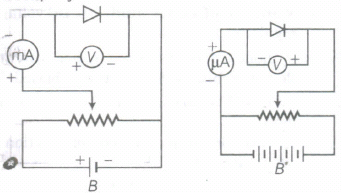
The width of depletion layer
(i) decreases in forward bias.
(ii) increases in reverse bias.
3.
| Intrinsic semiconductor | Extrinsic semiconductor |
| 1. It is a pure semiconductor material with no impurity atoms in it. | It is prepared by doping a small quantity of impurity atoms to the pure semiconductor. |
| 2. The number of free electrons in the conduction band and the number of holes in valence band is exactly equal. ne = nh = ni |
The number of free electrons and holes is never equal. There is an excess of electrons in n-type ne > ni semiconductors and excess of holes in p-type nh > ni semiconductors. |
4.
The photodiode can be used as a photodetector to detect optical signals. In light operated switches.
5.
In α-decay, the mass number of parent nucleus decreases by 4 units and atomic number decreases by 2 units.
\(\therefore 238_{U_{02}} \stackrel{\alpha-\text { decay }}{\longrightarrow} 234 T h_{90}\)
6.
During β-decay,
(i) no change in mass number.
(ii) atomic number increases by 1.
7.
\(T_{1 / 2}=\frac{\operatorname{In} 2}{\lambda} \tau I n 2\)
8.
Zener diode
Alternatively
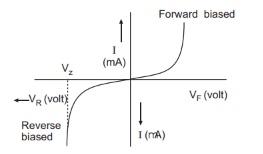
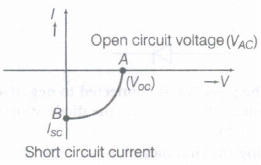
After the breakdown voltage, there is an insignificant change in the (reverse) bias voltage across the Zener diode (and hence the load) even for large changes in current.
9.
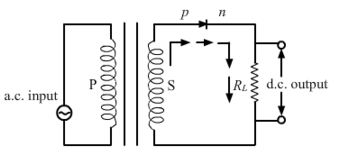
Working:
During one-half of the input AC, the diode is forward biased and a current flows through RL. During the other half of the input AC, the diode is reverse biased and no current flows through the load RL. Hence, the given AC input is rectified.
.png)
10.
From the V-I characteristics of a junction diode. It is clear that it allows the current to pass only when it is forward biased. So when an alternatively voltage is applied across the diode, current flows only during that part of the cycle when it is forward biased.
11.
The SI unit of activity is becquerel
1 becquerel = 1 Bq = 1 decay/sec.
12.
Nuclear forces are the strongest forces in nature.They are effective only inside the nucleus.
13.
(a) Overlapping of conduction band and valence band
(b) A large energy gap (more than 3 eV) Between conduction band and valence band.
14.
(i) Mass defect \((\triangle M)\) ,of any nucleus \(_{ Z }^{ A }{ X }\) is the sum of masses of the nucleus (=M) and the sum of masses of its constituent nucleons (=M')
\(\triangle M={ M }^{ ' }-M\)
\(=\left[ { Zm }_{ p }+(A-Z){ m }_{ n } \right] -M\)
where \({ m }_{ p }\) and \({ m }_{ n }\) denote the mass of the proton and the neutron respectively.
(ii) Binding energy is the energy required to seperate a nucleus into its constituent nucleons. The relation between the two is B.E=(mass defect) c2
(iii) There is a release of energy i.e., the reaction is exothermic. Reason: Increase in B.E/nucleon implies that more mass has been converted into energy.
15.
(a) \(\frac { dN }{ dt } =-\lambda N\)
\(\int _{ { N }_{ 0 } }^{ N }{ \frac { dN }{ N } =\int _{ 0 }^{ t }{ -\lambda dt } } \)
\(\left[ { log }_{ e }^{ N } \right] _{ { N }_{ 0 } }^{ N }=-\lambda \left[ t \right] _{ 0 }^{ t }\)
\(loge\frac { N }{ { N }_{ 0 } } =-\lambda t\)
\(N={ N }_{ 0 }{ e }^{ -\lambda t }\)
(b) (i) \(_{ 11 }^{ 22 }{ Na }\rightarrow _{ 10 }^{ 22 }Ne+{ e }^{ x }+\upsilon \)
Also accept,if a student does not identify the product nucleus and writes as
\(_{ 11 }^{ 22 }{ Na }\rightarrow _{ 10 }^{ 22 }Xe+{ e }^{ x }+\upsilon \)
Basic process
\(p\rightarrow n+{ e }^{ + }+\upsilon \)
(ii) Isobar
16.
Let N0 and N be the values of the number of atoms in a radioactive sample at t=0 and at t=40 years, respectively.
Here, N = \(\frac { 1 }{ 16 } \) N0, t = 40 years
Decay constant is given by
\(\lambda =\frac { 2.303 }{ t } \log _{ 10 }{ \left( \frac { { N }_{ 0 } }{ N } \right) } =\frac { 2.303 }{ 40 } \log _{ 10 }{ \left( \frac { { N }_{ 0 } }{ { N }_{ 0 }/16 } \right) }\)
\(=\frac { 2.303 }{ 40 } \times \log _{ 10 }{ 16 } =\frac { 2.303 }{ 40 } \times 1.2041\)
\( \lambda =0.0693 \ { year }^{ -1 }\)
17.
80min.
18.
\(N={ N }_{ 0 }-\frac { 19 }{ 20 } { N }_{ 0 }=\frac { 1 }{ 20 } { N }_{ 0 }\)
\( Use \ \frac { N }{ { N }_{ 0 } } ={ \left( \frac { 1 }{ 2 } \right) }^{ n }; \ t=nT\)
19.
(a)
are stronger, being roughly hundred times that of electromagnetic forces
20.
(c)
density
21.
(b)
0.25 of original amount
22.
(a)
there are no mobile charges
23.
(b)
\(\beta ,\ \alpha ,\ \gamma \)
24.
(a)
electrons move from lower energy level to higher energy level in the condition band
25.
(b)
a vacancy created when an electron leaves a covalent bond
26.
(d)
depends on the doping concentartions, diffusion length and device temperature
27.
(b)
gallium
28.
equal

12th Standard CBSE Syllabus & Materials
12th Standard CBSE
CBSE 12th Computer Science Python Revision Tour I - New Previous year Question Papers Study Material - QB365 Set A
NEW12th Standard CBSE
CBSE 12th Business Studies Planning Important Questions And Answers Study Material - QB365 Set A
NEW12th Standard CBSE
CBSE 12th Business Studies Business Environment Important Questions And Answers Study Material - QB365 Set A
NEW12th Standard CBSE
CBSE 12th Business Studies Principles of Management Important Questions And Answers Study Material - QB365 Set A



NCERT Books

Syllabus

Exam Pattern

Sample Question Papers

Previous year Question Papers

Important Notes

MCQ Practice test

NCERT Exemplers

Case study Questions

Image Based Questions

Passage based Questions

HOT Questions

Value Based Questions

Model Questions Papers
NCERT ( Book Back ) Questions

Assertion and Reason
Important Questions And Answers

CBSE 12th Standard CBSE Subjects
CBSE Standards








