
 100% FREE ACCESS
12th Standard CBSE Syllabus & Materials
12th Standard CBSE
CBSE 12th Economics Government Budget and the Economy Previous year Question Papers Study Material - QB365 Set A
NEW12th Standard CBSE
CBSE 12th Computer Science Interface Python with MySQL - New Previous year Question Papers Study Material - QB365 Set A
NEW12th Standard CBSE
CBSE 12th Computer Science Database Concept - New Previous year Question Papers Study Material - QB365 Set A
NEW12th Standard CBSE
CBSE 12th Computer Science Data Communication - New Previous year Question Papers Study Material - QB365 Set A
NEW12th Standard CBSE
CBSE 12th Computer Science Data Structures - New Previous year Question Papers Study Material - QB365 Set A
NEW12th Standard CBSE
CBSE 12th Computer Science Functions - New Previous year Question Papers Study Material - QB365 Set A

Published on: 25/10/2025
Download CBSE Class 12th Standard CBSE Physics question papers, sample papers, important questions, and previous year solved papers in PDF format. Get free study materials, NCERT solutions, and exam preparation resources for Class 12th Standard CBSE Physics
Questions + Answers key
Take MCQ Physics Test
1.
How is Huygen's principle used to obtain the diffraction pattern due to a single slit? Show the plot of variation of intensity with angle and state the reason for the reduction in intensity of secondary maxima compared to central maximum.
2.
(i) Why are coherent sources necessary to produce a sustained interference pattern?
(ii) In young's double sit experiment using monochromatic light of wavelength \(\lambda \) , the intensity of light at a point on the screen, where path difference is \(\lambda \), is K unit. Find out the intensity of light at a point, where path difference is \(\lambda \)/3.
3.
A beam of light converges to a point P. A lens is placed in the path of the convergent beam 12 cm from P. At What point does the beam converge if the lens is
(a) a convex lens of focal length 20cm
(b) a concave lens of focal length 16 cm?
4.
Fig (a) and (b) show refraction of a ray in air incident at with the normal to a \({ 60 }^{ \circ }\) glass in air and water-air interface respectively. Predict the angle of refraction in glass when the angle of incidence in water at \({ 45 }^{ \circ }\) with the normal to a water-glass interface
-Q.png)
-Q.png)
-Q.png)
5.
Trace the rays of light showing the formation of an image due to a point object placed on the axis of a spherical surface separating the two media of refractive indices n1 and n2 Establish the relation between the distance of the object, the distance of image and the radius of
6.
What are the essential condition for two light waves to be coherent?
7.
Over a given wavefront, is the amplitude constant?
8.
What is the cause of refraction of light?
9.
What is path difference for destructive interference?
nλ
\(n(\lambda+1)\)
\((2 n+1) \frac{\lambda}{2}\)
\((n+1) \frac{\lambda}{2}\)
10.
An astronomical telescope has a large aperture to
Reduce spherical aberration
Have high resolution
Increase span of observation
Have low dispersion
11.
The resolving power of teleoscope is
Directly proportional to the diameter (aperture) of the objective lens and inversely proportional to the wavelength of light used
Directly proportional to the diameter of the objective lens and also directly proportional to the wavelength of the light used
Directly proportional to the wavelength of light used and inversely proportional to the diameter of the objective lens
None of these
12.
The focal length of a lens depends on
The radii of curvature of its surfaces
The refractive index of its material
The refractive index of the medium surrounding the lens
All the above facors
13.
It is possible to observe total internal reflaction when a ray travels from
Air to water
Air into glass
Water into glass
Glass into water
14.
Light of wavelength \(6000 \ \overset { \circ }{ A } \) falls on a plane reflecting surface. The reflected wavelength is
\(6000 \ \overset { \circ }{ A } \)
\(<6000 \ \overset { \circ }{ A } \)
\(>6000 \ \overset { \circ }{ A } \)
cannot say
15.
(a) Write three characteristic features to distinguish between the interference fringes in Young's double slit experiment and the diffraction pattern obtained due to a narrow single slit.
(b) A parallel beam of light wavelength 500 nm falls on a narrow slit and the resulting diffraction pattern is observed on a screen 1 m away. it is observed that the first minimum is at distance of 2.5 mm away from the center. Find the width of the slit.
16.
17.
Assertion (A) : If we have a point source emitting waves uniformly in all directions, the locus of point which have the same amplitude and vibrate in the same phase are spheres.
Reason (R) : Each point of the wavefront is the source of a secondary disturbance and the wavelets emanating from these points spread out in all directions with the speed of the wave.
(a) Both A and R are true and R is the correct explanation of A.
(b) Both A and R are true but R is not the correct explanation of A.
(c) A is true but R is false.
(d) A is false but R is true.
18.
Assertion (A) : Newton's rings are formed in the reflected system. When the space between the lens and the glass plate is filled with a liquid of refractive index greater than that of glass, the central spot of the pattern is dark.
Reason (R) : The reflections in Newton's ring cases will be from a denser to a rarer medium and the two interfering rays are reflected under similar conditions
Codes:
(a) Both A and R are true and R is the correct explanation of A
(b) Both A and R are true but R is NOT the correct explanation of A
(c) A is true but R is false
(d) A is false and R is also false
19.
"According to Richard Feynman, no one has ever been able to distinguish between interference and diffraction satisfactorily. Roughly speaking if the number of sources are few, say two interfering sources then the result is usually interference, but if there is a large number of them, it seems that the word diffraction is more often used". Now explain the following:
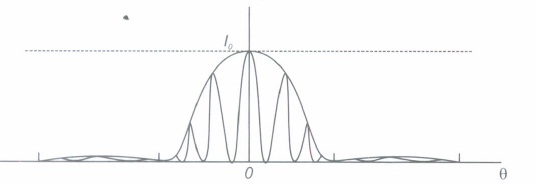
(i) "In the double-slit experiment, the pattern on the screen is due to superposition of single slit diffraction from each slit." Justify this statement.
(il) In a double slit experiment, the wavelength \(\lambda\) of the light source is 400 nm, the slit separation is 20\(\mu\)m, and the slit width a is 4\(\mu\)m. Consider the interference of the light from the two slits and also diffraction of the light through each slit
(a) Determine how many bright fringes are within the central peak of the diffraction envelope?
(b) How many bright fringes are within either of the first side peak of the diffraction envelope?
1.
When a plane wavefront is incident on a single slit, all the point sources of light constituting the wavefronts are in same phase. The wavelets coming out from the wavefront might meet over the screen with some path difference, i.e. a phase difference is introduced between them.
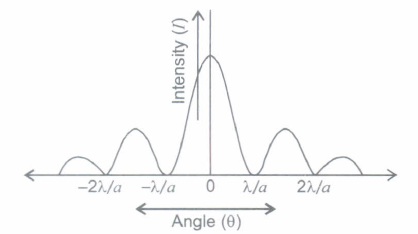
The brightness at a point on the screen depends on the phase difference between the wavelets meeting at the point. We imagine that the slit is divided into smaller parts and the wavelets coming out from these portions meet and superpose on the screen with proper phase difference.
The wavelets from different parts of the wavefront, incident on the slit, meet with zero phase difference to constitute a central maximum. In case of secondary maxima, there are some wavelets meeting the screen out of phase, thus, reducing intensity of secondary maxima.
2.
(i) Coherent sources produce light of constant phase difference and hence, permanent fringr pattern is produced due to interfernce of light.
(iii) Intensity of light at a point on the screen is given by
\({ I }_{ R }={ I }_{ 1 }+{ I }_{ 2 }+2\sqrt { { I }_{ 1 }{ I }_{ 2 }cos\phi } \)
For the path difference \(\lambda \) , phase difference is 2\(\pi \).
As, sources are coherent and taken out of the same source in Young's double slit experiment,
\({ I }_{ 1 }={ I }_{ 2 }=I\)
\(\\ { I }_{ R }=2I+2I \ cos2\pi \)
\(\\ { I }_{ R }=4I\)
\(\\ 4I=K\quad unit\quad \quad \quad \quad \quad .........(1)\)
For path difference, \(\frac { \lambda }{ 3 } \) correspomding to phase difference of \(\frac { 2\pi }{ 3 } \)
\({ I }_{ R }=2I+2I\quad cos\frac { 2\pi }{ 3 } =2I-I=\quad I\quad \quad \quad \quad \quad \quad .......(ii)\)
From Eqs. (i) and (ii), we conclude
\({ I }_{ R }=\frac { K }{ 4 } unit\)
3.
Here, the point P on the right of the lens acts as a virtual object
u = 12 cm, v = ?
(a) f = 20 cm
\(As \ \frac { 1 }{ v } -\frac { 1 }{ u } =\frac { 1 }{ f }\)
\( \frac { 1 }{ v } -\frac { 1 }{ 12 } =\frac { 1 }{ 20 } \)
\( \frac { 1 }{ v } =\frac { 1 }{ 20 } +\frac { 1 }{ 12 } =\frac { 3+5 }{ 60 } =\frac { 8 }{ 60 } \)
\( v=60/8=7.5cm\)
The image is at 7.5cm to the right of the lens where the beam converges.
(b) f = -16 cm, u = 12 cm
\(As\quad \frac { 1 }{ v } =\frac { 1 }{ f } +\frac { 1 }{ u }\)
\( -\frac { 1 }{ 16 } +\frac { 1 }{ 12 } =\frac { -3+4 }{ 48 } =\frac { 1 }{ 48 }\)
\( v=48 \ cm\)
Hence, the image is at 48 cm. to the right of the lens, where the beam would converge.
4.
\(First\ case,\)
\(angle \ of \ incidence \ i={ 60 }^{ \circ }\)
\(angle \ of \ refraction \ r={ 35 }^{ \circ }\)
\({ \alpha }_{ { \mu }_{ g } }= \ \frac { 1 }{ { g }_{ { \mu }_{ \alpha } } } =\frac { sin\ i }{ sin \ r } \)
\(Second \ case,\)
\( { \alpha }_{ { \mu }_{ \omega } }=\frac { sin\ { 60 }^{ \circ } }{ sin\ { 47 }^{ \circ } } =1.18\)
\( { \omega }_{ { \mu }_{ g } }= { \alpha }_{ { \mu }_{ g } }\times { \omega }_{ { \mu }_{ \alpha } }\)
\(=\frac { { \alpha }_{ { \mu }_{ g } } }{ { \alpha }_{ { \mu }_{ \omega } } } =\frac { 1.51 }{ 1.18 } =1.28\)
\(Third \ case,\)
\( angle \ of \ incidence \ i={ 45 }^{ \circ }\)
\( angle \ of \ refraction \ r=?\)
\( { \omega }_{ { \mu }_{ g } }=\frac { sin\ i }{ sin\ r } \)
\(\frac { sin \ i }{ sin\ r } =1.28\)
\(sin \ r=\frac { sin \ { 45 }^{ \circ } }{ 1.28 } =0.5525\)
\( sin \ r= \ sin{ 33 }^{ \circ }54'\)
\(r= \ { 33 }^{ \circ }54'\)
5.
Lens maker's formula
6.
(i) light waves must have same frequency/ wavelengths
(ii) they should have zero or constant phase diff.
7.
Yes, provided the medium is homogeneous.
8.
Change in the velocity of light on change in the medium.
9.
(c)
\((2 n+1) \frac{\lambda}{2}\)
10.
(a)
Reduce spherical aberration
11.
(d)
None of these
12.
(d)
All the above facors
13.
(d)
Glass into water
14.
(a)
\(6000 \ \overset { \circ }{ A } \)
15.
(a)
| Sno | Interference | Diffraction |
|---|---|---|
| 1. | Width of central maxima is same as that of the other fringes. |
Width of central maxima is more than of the other fringes |
| 2. | all Bright fringes are of equal intensity | Intensity of secondary maxima keeps on decreasing. |
| 3. | Large number of fringes | Only a small number of fringes. |
(b) \({ y }_{ n }=\frac { n\lambda D }{ d } \)
\(d=\frac { n\lambda D }{ { y }_{ n } }\)
\( =\frac { 1\times 500\times { 10 }^{ -9 }\times 1 }{ 2.5\times { 10 }^{ -3 } } m\)
\( =2\times { 10 }^{ -4 }m(=0.2mm)\)
16.
17.
(a) Both A and R are true and R is the correct explanation of A.
18.
(a): The central spot of Newton's rings is dark when the medium between plano convex lens and plane glass is rarer than the medium of lens and glass. The central spot is dark because the phase change of \(\pi\) is introduced between the rays reflected from surfaces of denser to rarer and rarer to denser media.
19.
(i) n the double-slit experiment, the pattern on the screen is actually a superposition of single-slit diffraction from each slit or hole and the double-slit interference pattern as shown in the given figure. It shows a broader diffraction peak in which there appear several fringes of smaller width due to double-slit interference. The number of interference fringes occuring in the broad diffraction peak depends on the ratio d/a, which is the ratio of the distance between the two slits to the width of a slit. In the limit of a becoming very small, the diffraction pattern will become flat and we will observe the two slit interference pattern.
(ii) (a) \(\lambda\)Given = 400 nm
= 4 x 10- 7 m,
d = 20 \(\mu\)m = 2 x 10- 5 m,
a = 4\(\mu\)m = 4 x 10⁻⁶ m
If n = no. of bright fringes within central peak of diffraction envelope
Then \(\frac{2 \lambda \mathrm{D}}{a}=n \lambda \frac{\mathrm{D}}{d}\)
\(\Rightarrow \ \frac{2}{a}=\frac{n}{d}\)
\(\Rightarrow \quad n=\frac{2 d}{a}=\frac{2 \times 2 \times 10^{-5}}{4 \times 10^{-6}}=10\)
(b) \(\frac{\lambda \mathrm{D}}{a}=n \lambda \frac{\mathrm{D}}{d}\)
\(\Rightarrow \ \frac{1}{a}=\frac{n}{d}\)
\(\Rightarrow \ n=\frac{d}{a}=\frac{2 \times 10^{-5}}{4 \times 10^{-6}}=5\)

12th Standard CBSE Syllabus & Materials
12th Standard CBSE
CBSE 12th Computer Science Python Revision Tour I - New Previous year Question Papers Study Material - QB365 Set A
NEW12th Standard CBSE
CBSE 12th Business Studies Planning Important Questions And Answers Study Material - QB365 Set A
NEW12th Standard CBSE
CBSE 12th Business Studies Business Environment Important Questions And Answers Study Material - QB365 Set A
NEW12th Standard CBSE
CBSE 12th Business Studies Principles of Management Important Questions And Answers Study Material - QB365 Set A



NCERT Books

Syllabus

Exam Pattern

Sample Question Papers

Previous year Question Papers

Important Notes

MCQ Practice test

NCERT Exemplers

Case study Questions

Image Based Questions

Passage based Questions

HOT Questions

Value Based Questions

Model Questions Papers
NCERT ( Book Back ) Questions

Assertion and Reason
Important Questions And Answers

CBSE 12th Standard CBSE Subjects
CBSE Standards








