
 100% FREE ACCESS
12th Standard CBSE Syllabus & Materials
12th Standard CBSE
CBSE 12th Economics Government Budget and the Economy Previous year Question Papers Study Material - QB365 Set A
NEW12th Standard CBSE
CBSE 12th Computer Science Interface Python with MySQL - New Previous year Question Papers Study Material - QB365 Set A
NEW12th Standard CBSE
CBSE 12th Computer Science Database Concept - New Previous year Question Papers Study Material - QB365 Set A
NEW12th Standard CBSE
CBSE 12th Computer Science Data Communication - New Previous year Question Papers Study Material - QB365 Set A
NEW12th Standard CBSE
CBSE 12th Computer Science Data Structures - New Previous year Question Papers Study Material - QB365 Set A
NEW12th Standard CBSE
CBSE 12th Computer Science Functions - New Previous year Question Papers Study Material - QB365 Set A

Published on: 25/10/2025
Download CBSE Class 12th Standard CBSE Physics question papers, sample papers, important questions, and previous year solved papers in PDF format. Get free study materials, NCERT solutions, and exam preparation resources for Class 12th Standard CBSE Physics
Questions + Answers key
Take MCQ Physics Test
1.
What is the shape of the wavefront in each of the following cases:
(a) Light diverging from a point source.
(b) Light emerging out of a convex lens when a point source is placed at its focus.
(c) The portion of the wavefront of light from a distant star intercepted by the Earth.
2.
(a) The refractive index of glass is 1.5. What is the speed of light in glass?
(b) Is the speed of light in glass independent of the color of light? If not, which of the two colors, red and violet travels slower in a glass prism?
3.
Monochromatic light of wavelength 589 nm is incident from air on a water surface. What are the wavelength, frequency, and speed of
(a) reflected and
(b) refracted light? Refractive index of water is 1.33 ?
4.
Explain the terms interference of light and define constructive and destructive interference. Is law of conservation of energy obeyed?
5.
(a) Write the necessary conditions for the phenomenon of total internal reflection to occur.
(b) Write the relation between the refractive index and critical angle for a given pair of optical media.
6.
What is the apparent position of an object below a rectangular block of glass 6 cm thick, if a layer of water 4 cm thick is on the top of the glass?
Given, nga = 1.5 and nwa=1.33.
7.
In the wave picture of light, intensity of light is determined by the square of the amplitude of the wave. What determines the intensity of light in the photon of light?
8.
Can we increase the range of a telescope by increasing the diameter of the objective lens?
9.
(a) When monochromatic light is incident on a surface separating two media, the reflected and refracted light both have the same frequency as the incident frequency. Explain why?
(b) When light travels from a rarer to a denser medium, the speed decreases. Does the reduction in speed simply a reduction in the energy caried by the light wave?
(c) In the wave picture of light, intensity of light is determined by the square of the amplitude of the wave What determines the intensity of light in the photon picture of light.
10.
(i) Determine the "effective focal length" of the combination of the two lenses in Q.5 on page 353, if they are placed 8 cm apart with their principal axes coincident. Does the answer depend on which side of the combination a beam of parallel light is incident? Is the notion of effective focal length of this system useful at all?
(ii) An object 1.5 cm in size is placed on the side of the convex in the arrangement (i) above. The distance between the object and the convex lens is 40 cm. Determine the magnification produced by the two lens system, and the size of the image.
11.
If the radii of curvature of the faces of a double convex lens are 9 cm and 15 cm reflective index of glass is 1.5 then determine the focal length and the power of the lens.
12.
an object is to be seen through a simple microscope of power 10D. Where should an object be placed to produce maximum angular magnification? Least distance of distinct vision is 25 cm.
13.
Discuss the intensity of Transmitted light when a polaroid sheet is rotated between two crossed polaroids?
14.
Phenomenon of bending of light around corners of a small obstacle and spreading into region of geometrical shadow is called __________ of light.
15.
The basic cause of refraction is..................in going.............. .
16.
Fresnel distance is the ____________before its deviation from _____________ becomes __________.
17.
The width of central maximum is the __________ between ___________ on either side of _____________.
18.
Image formed in a convex mirror is always...............whatever be..................
19.
The angle of incidence at which reflected light is totally polarised for reflection from air to glass (refractive index n) is
\( \sin ^{-1}(n) \)
\( \sin ^{-1}\left(\frac{1}{n}\right) \)
\(\tan ^{-1}\left(\frac{1}{n}\right) \)
\( \tan ^{-1}(n) \)
20.
The angle of polarisation (Brewster's angle) for an incident light when it is incident on a surface of refractive index (n) will be)
\(\sin ^{-1}(n)\)
\(\tan ^{-1}(n)\)
\(\cos ^{-1}(n)\)
\(\tan ^{-1}\left(\frac{1}{n}\right)\)
21.
The interference is produced by two waves of intensity ratio 16 : 9. The ratio of maximum and minimum intensities in interference pattern is
4:3
49:1
25:7
256:81
22.
A plane mirror is approaching you at 5 cm per second. You can see your can see your image in it. At what speed will your image approach you?
10 cm per sec.
5 cm per sec.
20 cm per sec.
15 cm per sec.
23.
The image of a distant object as seen through an astronomical telescope is
Erect
Inverted
Perverted
None of these
24.
Interference is based on the superposition principle. According to this principle, at a particular point in the medium, the resultant displacement produced by a number of waves is the vector sum of the displacements produced by each of the waves. If two sodium lamps illuminate two pinholes S1 and S2. The intensities will add up and no interference fringes will be observed on the screen. Here the source undergoes abrupt phase change in times of the order of 10-10 seconds.
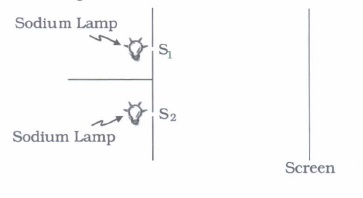
(i) Two coherent sources of intensity 10 W/m2 and 25 W/m2 interfere to form fringes. Find the ratio of maximum intensity to minimum intensity
| (a) 15.54 | (b) 16.78 | (c) 19.72 | (d) 18.39 |
(ii) Which of the following does not show interference?
| (a) Soap bubble | (b) Excessively thin film | (c) A thick film | (d) Wedge shaped film |
(iii) In a Young's double-slit experiment, the slit separation is doubled. To maintain the same fringe spacing on the screen, the screen-to-slit distance D must be changed to
| (a) 2D | (b) 4D | (c) D/2 | (d) D/4 |
(iv) The maximum number of possible interference maxima for slit separation equal to twice the wavelength in Young's double-slit experiment, is
| (a) infinite | (b) five | (c) three | (d) zero |
(v) The resultant amplitude of a vibrating particle by the superposition of the two waves \(y_{1}=a \sin \left[\omega t+\frac{\pi}{3}\right] \text { and } y_{2}=a \sin \omega t \text { is }\)
| (a) a | (b)\(\sqrt{2}\) a | (c) 2a | (d) \(\sqrt{3}\) a |
25.
26.
Assertion (A) : In an interference pattern observed in Young's double slit experiment, if the separation (d) between coherent sources as well as the distance (D) of the screen from the coherent sources both are reduced to 1/3rd, then new fringe width remains the same.
Reason (R) : Fringe width is proportional to (d/D).
(a) Both A and R are true and R is the correct explanation of A.
(b) Both A and R are true but R is not the correct explanation of A.
(c) A is true but R is false.
(d) A is false but R is true.
27.
Assertion (A) : The emergent plane wavefront is tilted on refraction of a plane wave by a thin prism.
Reason (R) : The speed of light waves is more in glass and the base of the prism is thicker than the top.
(a) Both A and R are true and R is the correct explanation of A.
(b) Both A and R are true but R is not the correct explanation of A.
(c) A is true but R is false.
(d) A is false but R is true.
28.
Assertion (A) : In Young's experiment the fringe width is directly proportional to wavelength of the source used.
Reason (R) : When a thin transparent sheet is placed in front of both the slits of Young's experiment, the fringe width will increase.
Codes:
(a) Both A and R are true and R is the correct explanation of A
(b) Both A and R are true but R is NOT the correct explanation of A
(c) A is true but R is false
(d) A is false and R is also false
1.
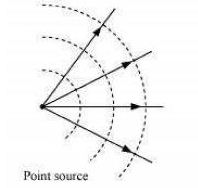
(a) The shape of the wavefront in case of a light diverging from a point source is spherical. The wavefront emanating from a point source is shown in the given figure.
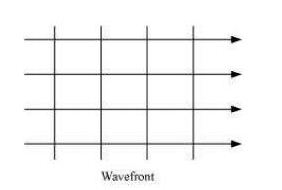
(b) The shape of the wavefront in case of a light emerging out of a convex lens when a point source is placed at its focus is a parallel grid. This is shown in the given figure.
(c) The portion of the wavefront of light from a distant star intercepted by the Earth is a plane.
2.
(a) Refractive index of glass, μ = 1.5
Speed of light, c = 3 x 10⁸ m/s
Speed of light in glass is given by the relation
\(v=\frac{c}{\mu}\)
\(=\frac{3 \times 10^{8}}{1.5}=2 \times 10^{8} \mathrm{~m} / \mathrm{s}\)
Hence, the speed of light in glass is 2 x 10⁸ m/s.
(b) The speed of light in glass is not independent of the colour of light
The refractive index of a violet component of white light is greater than the refractive index of a red component. Hence, the speed of violet light is less than the speed of red light in glass. Hence, violet light travels slower than red light in a glass prism.
3.
\(Here, \ \lambda =589 \ nm,\ c=3\times { 10 }^{ 8 }m/s, \ \mu =1.33\)
(a) For reflected light
\(wavelength,\ \lambda =589\quad nm=589\times { 10 }^{ -9 }m,\quad v=\frac { c }{ \lambda } =\frac { 3\times { 10 }^{ 8 } }{ 589\times { 10 }^{ -9 } } =5.09\times { 10 }^{ 14 }hertz\)
\(speed,\ v=c=3\times { 10 }^{ 8 }m/s\)
(b) For refracted light \( \lambda '=\frac { \lambda }{ \mu } =\frac { 589\times { 10 }^{ -9 } }{ 1.33 } =4.42\times { 10 }^{ -7 }m\)
As frequency remains unaffected on entering another medium,
\(\\ therefore,\quad v'=v=5.09\times { 10 }^{ 14 }hertz\)
\(speed, \ v'=\frac { c }{ \mu } =\frac { 3\times { 10 }^{ 8 } }{ 1.33 } =2.25\times { 10 }^{ 8 }m/s\)
4.
Interference of Light. The phenomenon of redistribution of energy in a medium due to superimposition of waves from two coherent source of light is called Interference of Light.
Constructive Interference. At points, where the crest of one wave falls the crest of the other or a through of one falls on the through of the other, the amplitude of the resulting wave becomes maximum. Hence the energy or the intensity of light at such points becomes maximum. This is called Constructive Interference.
Destructive Interference. At some other points where the through of one falls on the crest of the other or crest of one falls on the through of the other, the amplitude of the resulting waves becomes minimum. Hence the energy or intensity becomes minimum. This is called Destructive Interference.
Law of conservation of energy is obeyed. It should be clearly understood that in interference of light no light energy is destroyed. The loss of energy at the points of destructive interference appears as the increase of energy at the points of constructive interference.
5.
(a) (i) Ray of light should travel from denser to rarer medium.
(ii) Angle of incidence should be more than the critcical angle
(b) \(\mu =\frac { 1 }{ { sini }_{ c }\quad } \) where ic is the critical angle
6.
3 cm
7.
For a given frequency, intensity of light in the photon is determined by the number of photons crossing a unit area per unit time.
8.
Yes, because objective with larger diameter will collect more light and even the distant objects can be seen.
9.
(a) Reflection and refraction arise through interaction of incident light with the atomic constituents of matter. Atoms may be viewed as oscillators, which take up the frequency of the external agency (light) causing forced oscillations. The frequency of light emitted by a charged oscillator equals its frequency of oscillation. Thus the frequency of scattered light equals the frequency of incident light.
(b) No, Energy carried by a wave depends on the amplitude of the wave, not on the speed of wave propagation.
(c) For a given frequency, intensity of light in the photon crossing an unit area per uni time.
10.
(i) Given, the focal length of convex lens, f1 = 30 cm
The focal length of concave lens, f2 = -20 cm, d = 8 cm
Use the formula,
\(\frac { 1 }{ f } =\frac { 1 }{ { f }_{ 1 } } +\frac { 1 }{ { f }_{ 2 } } -\frac { d }{ { f }_{ 1 }{ f }_{ 2 } }\)
\(\frac { 1 }{ f } =\frac { 1 }{ 30 } -\frac { 1 }{ 20 } -\frac { 8 }{ 30\times (-20) } =\frac { 20-30+8 }{ 30\times 20 }\)
\( \frac { 1 }{ f } =-\frac { 2 }{ 600 } \)
\( f=-300 \ cm\)
(a) Let us take that the incident beam falls on convex lens and assume that concave lens is absent.
\(\therefore \ { u }_{ 1 }=\infty ,{ f }_{ 1 }=30 \ cm\)
\(Using \ lens \ formula,\frac { 1 }{ { f }_{ 1 } } =\frac { 1 }{ { v }_{ 1 } } -\frac { 1 }{ { u }_{ 1 } } \)
\(\\ d \frac { 1 }{ 30 } =\frac { 1 }{ { v }_{ 1 } } -\frac { 1 }{ \infty } \)
Position of the image formed by convex lens,
v1= 30 cm
Now, this image acts as an object for concave lens.
Now, distance of object
u2 = + (30-8) = 22 cm
f2 = -20 cm,
v2 = ?
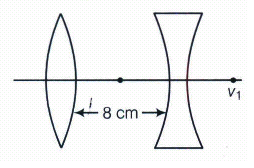
Using lens formula,
\(\frac { 1 }{ { f }_{ 2 } } =\frac { 1 }{ { v }_{ 2 } } -\frac { 1 }{ { u }_{ 2 } } \)
\(\frac { 1 }{ { v }_{ 2 } } =-\frac { 1 }{ 20 } +\frac { 1 }{ 22 } =-\frac { 1 }{ 220 }\)
Distance of final image, v2 = -220 cm
Thus, the parallel neam would appear to diverge from a point 220-4 = 216 cm from the centre of two lens system.
(b) Let us take the parallel beam first falls on concave lens.
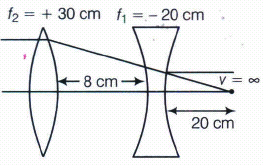
\({ u }_{ 1 }=-\infty ,{ f }_{ 1 }=-20cm,{ v }_{ 1 }=?\)
\( \frac { 1 }{ { v }_{ 1 } } +\frac { 1 }{ \infty } =\frac { 1 }{ -20 } \)
\( { v }_{ 1 }=-20 \ cm\)
This acts as an object for convex lens.
\({ u }_{ 2 }=-(20+8)=-28cm,\)
\( { f }_{ 2 }=30cm,\ { v }_{ 2 }=?\)
\(\frac { 1 }{ { v }_{ 2 } } +\frac { 1 }{ 28 } =\frac { 1 }{ 30 } \)
\(\frac { 1 }{ { v }_{ 2 } } =\frac { 1 }{ 30 } -\frac { 1 }{ 28 } =\frac { 14-15 }{ 420 } =-\frac { 1 }{ 420 }\)
\({ v }_{ 2 }=-420cm\)
The parallel beam appears to diverge from a point 420-4 = 416 cm on the left of the centre of the two lens system. From the above two cases it concludes that the answer depends on which side of the lens system, the parallel beam is incident. So, the notion of effective focal length does not seem to be useful here.
(ii) Give, size of object, O = 1.5 cm
Distance from the convex lens, u1= -40 cm
For the convex lens, \(\frac { 1 }{ { v }_{ 1 } } -\frac { 1 }{ { u }_{ 1 } } =\frac { 1 }{ { f }_{ 1 } }\)
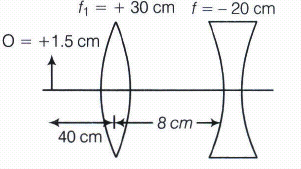
So, \(\frac { 1 }{ { v }_{ 1 } } =\frac { 1 }{ 30 } +\frac { 1 }{ (-40) } =\frac { 4-3 }{ 120 } =\frac { 1 }{ 120 } \)
v1 = 120 cm
Magnification produced by convex lens,
\({ m }_{ 1 }=\frac { { v }_{ 1 } }{ { u }_{ 1 } } =\frac { 120 }{ -40 } =-3\)
Now, this image acts as an object for concave lens,
For concave lens, u2 = 120 - 8 = 112 cm,
f2 = -20 cm
So,
\(\frac { 1 }{ { v }_{ 2 } } =\frac { 1 }{ -20 } +\frac { 1 }{ 112 } =\frac { -112+20 }{ 112\times 20 } =\frac { -92 }{ 112\times 20 }\)
\({ v }_{ 2 }=\frac { -112\times 20 }{ 92 } cm\)
Magnification produced by concave lens,
\({ m }_{ 2 }=\frac { { v }_{ 2 } }{ { u }_{ 2 } } =\frac { (-112\times 20) }{ 92\times 112 } =-\frac { 20 }{ 92 }\)
Maginification produced by combination,
\(m={ m }_{ 1 }\times { m }_{ 2 }=(-3)\times (-\frac { 20 }{ 90 } )=\frac { 60 }{ 92 } \)
m = 0.652
Size of image = m x Size of object
= 0.652 x 1.5 = 0.98 cm
Thus. the magnification produced by the two lens system is 0.652 and size of image is 0.98 cm.
11.
radii of curvatures R1 = 9 cm , R2 = -15 cm
\(\frac { 1 }{ f } =(\mu -1)\frac { 1 }{ R_{ 1 } } -\frac { 1 }{ R_{ 2 } }\)
\( \\ \frac { 1 }{ f } =(1.5-1)\frac { 1 }{ 9 } +\frac { 1 }{ 15 } \Rightarrow \frac { 1 }{ f } =0.5(\frac { 45 }{ 4 } )=11.25\quad cm\)
\(\\ \frac { 1 }{ f } =\frac { 1 }{ 11.25\times 10^{ -2 } } \)
\(p=\frac { 1000 }{ 1125 } =8.88D\)
12.
Angular magnification is maximum, when final image is formed at the least of distinct vision.
v = -25cm, \(f={100\over P}={100\over10}=10cm, u=?\)
From \({1\over v}-{1\over u}={1\over f}\)
\({1\over u}={1\over v}-{1\over f}={1\over -25}-{1\over 10}={-7\over50}\)
\(u=-{50\over7}\)
= -7.1cm
13.
Let I0 be the intensity of polarised light after passing through the first polariser P1. Then the intensity of light after passing through second polariser P2 will be
I = I0 cos 2 \(\theta\)
where \(\theta\) is the angle between pass axes of P1 and P2. Since P1 and P3 are crossed the angle between the pass axes of P2 and P3 will be ( \(\pi\) / 2 –\(\theta\) ). Hence the intensity of light emerging from P3 will be
\(I=I_{0} \cos ^{2} \theta \cos ^{2}\left(\frac{\pi}{2}-\theta\right)\)
\(=I_{0} \cos ^{2} \theta \sin ^{2} \theta=\left(I_{0} / 4\right) \sin ^{2} 2 \theta\)
Therefore, the transmitted intensity will be maximum when \(\theta\) = \(\pi\) / 4.
14.
()
diffraction
15.
()
change in the velocity of light ; from one medium to another.
16.
()
minimum distance traveled by a beam of light; straight line path; becomes significant/noticeable.
17.
()
distance; first secondary minimum of light.
18.
()
virtual and erect ; the position of object.
19.
(d)
\( \tan ^{-1}(n) \)
20.
(b)
\(\tan ^{-1}(n)\)
21.
(b)
49:1
22.
(b)
5 cm per sec.
23.
(b)
Inverted
24.
(i) (c) : Given \(I_{1}=10 \mathrm{~W} / \mathrm{m}^{2} \text { and } I_{2}=25 \mathrm{~W} / \mathrm{m}^{2}\)
\(\frac{I_{1}}{I_{2}}=\frac{a_{1}^{2}}{a_{2}^{2}}=\frac{10}{25} \Rightarrow \frac{a_{1}}{a_{2}}=\frac{3.16}{5} \text { or } a_{1}=\frac{3.16}{5} a_{2}=0.6324 a_{2}\)
\(\frac{I_{\max }}{I_{\min }}=\frac{\left(a_{1}+a_{2}\right)^{2}}{\left(a_{1}-a_{2}\right)^{2}}=\frac{\left[0.6324 a_{2}+a_{2}\right]^{2}}{\left[0.6324 a_{2}-a_{2}\right]^{2}}=19.724\)
(ii) (b): In an excessively thin film, the thickness of the film is negligible. Thus the path difference between the reflected rays becomes \(\lambda\)/2 which produces a minima.
(iii) (a): Since, \(\beta=\frac{\lambda D}{d} \text { for } d=2 d\)
\(\beta^{\prime}=\frac{\lambda D^{\prime}}{2 d}=\beta(\text { Gives })\)
\(\therefore \quad D_{1}=2 D\)
(iv) (b): The condition for possible interference maxima on the screen is, dsin \(\theta\) = n\(\lambda\)
where d is slit separation and Ais the wavelength.
\(\text { As } d=2 \lambda \text { (given) } \quad \therefore 2 \lambda \sin \theta=n \lambda \text { or } 2 \sin \theta=n\)
For number of interference maxima to be maximum,sin\(\theta\) = 1 :. n = 2
The interference maxima will be formed when n = 0, ± 1, ± 2
Hence the maximum number of possible maxima is 5.
(v) (d): \(y_{1}=a \sin \left(\omega t+\frac{\pi}{3}\right) \text { and } y_{2}=a \sin \omega t\)
\(A=\sqrt{a_{1}^{2}+a_{2}^{2}+2 a_{1} a_{2} \cos \phi}, \text { where } \phi=\frac{\pi}{3}\)
\(=\sqrt{a^{2}+a^{2}+2 a a \cos \frac{\pi}{3}}=\sqrt{3} a\)
25.
26.
(c) A is true but R is false.
27.
(c) A is true but R is false.
28.
(c): Fringe width \(\beta\) = \(\lambda\)D/d shall remain the same as the waves travel in air only, after passing through the thin transparent sheet. Due to introduction of thin sheet, only path difference of the wave is changed due to which there is shift of position of fringes only, Which is given As \(\Delta x=\frac{D(\mu-1) t}{d}\)Where \(\mu\) is refractive index of thin sheet and t is its thickness.

12th Standard CBSE Syllabus & Materials
12th Standard CBSE
CBSE 12th Computer Science Python Revision Tour I - New Previous year Question Papers Study Material - QB365 Set A
NEW12th Standard CBSE
CBSE 12th Business Studies Planning Important Questions And Answers Study Material - QB365 Set A
NEW12th Standard CBSE
CBSE 12th Business Studies Business Environment Important Questions And Answers Study Material - QB365 Set A
NEW12th Standard CBSE
CBSE 12th Business Studies Principles of Management Important Questions And Answers Study Material - QB365 Set A



NCERT Books

Syllabus

Exam Pattern

Sample Question Papers

Previous year Question Papers

Important Notes

MCQ Practice test

NCERT Exemplers

Case study Questions

Image Based Questions

Passage based Questions

HOT Questions

Value Based Questions

Model Questions Papers
NCERT ( Book Back ) Questions

Assertion and Reason
Important Questions And Answers

CBSE 12th Standard CBSE Subjects
CBSE Standards








