
 100% FREE ACCESS
12th Standard CBSE Syllabus & Materials
12th Standard CBSE
CBSE 12th Economics Government Budget and the Economy Previous year Question Papers Study Material - QB365 Set A
NEW12th Standard CBSE
CBSE 12th Computer Science Interface Python with MySQL - New Previous year Question Papers Study Material - QB365 Set A
NEW12th Standard CBSE
CBSE 12th Computer Science Database Concept - New Previous year Question Papers Study Material - QB365 Set A
NEW12th Standard CBSE
CBSE 12th Computer Science Data Communication - New Previous year Question Papers Study Material - QB365 Set A
NEW12th Standard CBSE
CBSE 12th Computer Science Data Structures - New Previous year Question Papers Study Material - QB365 Set A
NEW12th Standard CBSE
CBSE 12th Computer Science Functions - New Previous year Question Papers Study Material - QB365 Set A

Published on: 25/10/2025
Download CBSE Class 12th Standard CBSE Physics question papers, sample papers, important questions, and previous year solved papers in PDF format. Get free study materials, NCERT solutions, and exam preparation resources for Class 12th Standard CBSE Physics
Questions + Answers key
Take MCQ Physics Test
1.
The earth takes 24 h to rotate once about its axis. How much time does the sun take to shift by 1° when viewed from the earth?
2.
A lens forms a real image of an object. The distance of the object to the lens is 4 cm and the distance of the image from the lens is v cm. The given graph shows the variation of v with u.
(i) What is the nature of the lens?
(ii) Using this graph, find the focal length of this lens.
3.
If the area of the TV telecast is to be doubled then what will be the height of the transmitting antenna ?
4.
In series L-C-R circuit, the plot of Imax\(\omega \) versus is shown in the figure. Find the bandwidth and mark in the figure.

5.
AB is a potentiometer wire as shown in figure. If the value of R is increased, in which direction will the balance point J shift?

6.
When an electron falls from a higher energy to a lower energy level, the difference in the energies appears in the form of electromagnetic radiation. Why can not it be emitted as other forms of energy?
7.
What is the order of magnitude of the resistance of a (dry) human body?
8.
An object has an image thrice of its original size when kept at 8 em and 16 cm from a convex lens. Focal length of the lens is
less than 8 cm
8 cm
16 cm
between 8 and 16 cm
9.
The critical angle of a prism is 30°. The velocity of light in the medium is
1.5 x 10⁸ m/s
3 x 10⁸ m/s
4.5 x 10⁸ m/s
None of these
10.
A magnetic needle lying parallel to a magnetic field requires W units of work to turn it through \({ 60 }^{ ° }.\) The torque required to keep the needle in this position will be
2 W
W
\(\frac { W }{ \sqrt { 2 } } \)
\(\frac { W }{ \sqrt { 3 } } \)
\(\sqrt { 3 } W\)
11.
The decimal equivalent of the binary number \((11010.101)_{ 2 }\) is
17+9.625
15+9.625
26+0.625
24+0.625
12.
A telescope uses an objective lens of focal length \(f_{ 0 }\) and an eye lens of focal length \(f_{ e }\). In normal adjustment, distance between the two lenses is
\(f_{ o }/f_{ e }\)
\(f_{ e }/f_{ o }\)
\((f_{ o }-f_{ e })\)
\((f_{ o }+f_{ e })\)
13.
The dimensional formula of electric flux is
[M1L2T-2A-1]
[M-1L3T-3A]
[M1L3T-3A-1]
[M1L-3T-3A-1]
14.
The energy of a hydrogen atom in the ground state is -13.6 eV. The energy of a \({ He }^{ + }\) ion in the first excited state will be
-13.6 eV
-27.2 eV
-54.4 eV
-6.8 eV
15.
The maximum velocity of an electron emitted by light of wavelength \(\lambda \)incident on the surface of a metal of wor4k function \(\phi \) is[h = Plank's constant, c = speed of light and m = mass of electron]
\({ \left[ \frac { 2\left( hc+\lambda \phi \right) }{ m\lambda } \right] }^{ 1/2 }\)
\(\frac { 2\left( hc-\lambda \phi \right) }{ m } \)
\({ \left[ \frac { 2\left( hc-\lambda \phi \right) }{ m\lambda } \right] }^{ 1/2 }\)
\({ \left[ \frac { 2\left( hc-\lambda \phi \right) }{ m } \right] }^{ 1/2 }\)
16.
If a source of power 4 KW produces \({ 10 }^{ 20 }\) Photon/second, the radiation belongs to part of the spectrum called
Ultraviolet rays
Microwaves
Gamma rays
x-rays
17.
The cause of induced e.m.f. is
magnetic flux
magnetic field
area
change in magnetic flux
18.
(a) If \(\alpha \)-decay of \(_{ 92 }{ { U }^{ 238 } }\) is energetically allowed (i.e. the decay products have a total mass less than the mass of \(_{ 92 }{ { U }^{ 238 } }\)), what prevents \(_{ 92 }{ { U }^{ 238 } }\) from decaying all at once? Why is its half life so large?
(b) The \(\alpha \)-particle faces a Coulomb barrier. A neutron being uncharged faces no such barrier. Why does the nucleus \(_{ 92 }{ { U }^{ 238 } }\) not decay spontaneously, by emitting a neutron?
19.
Two identical magnets with a length 10 cm and weight 50 gf each are arranged freely with their like poles facing in a vertical glass tube. The upper magnet hangs in air above the lower one so that the distance between the nearest poles of the magnets is 3 mm. Determine the pole strength of the poles of these magnets.
20.
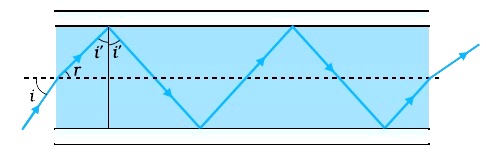
(a) Figure shows a cross-section of a ‘light pipe’ made of a glass fibre of refractive index 1.68. The outer covering of the pipe is made of a material of refractive index 1.44. What is the range of the angles of the incident rays with the axis of the pipe for which total reflections inside the pipe take place, as shown in the figure.
(b) What is the answer if there is no outer covering of the pipe?
21.
An object is placed at (i) 10 cm, (ii) 5 cm in front of a concave mirror of radius of curvature 15 cm. Find the position, nature, and magnification of the image in each case.
22.
With the help of a labelled diagram, state the underlying principle of a cyclotron.
Explain clearly how it works to accelerate the charged particles? Show that cyclotron frequency is independent of energy of the particle. Is there an upper limit on the energy acquired by the particle? Give reason.
23.
(a) A point object is placed in front of a double convex lens (of refractive index n =n2/n1 with respect air) with its spherical faces of radii of curvature R1 and R2.. Show the path of rays due to surface to obtain the formation of the real image of the object.
Hence obtain the lens maker's formula for a thin lens.
(b) A double convex lens having both faces of the same radius of curvature has refractive index 1.55. Find out the radius of curvature of the lens required to get the focal length of 20 cm.
24.
The polarizing angle for a piece of glass for a piece glass for green light is \(60°\)Find the angle of minimum deviation for green light for its passage through \(60°\) prism, made of the same glass.
1.
Time taken for 360° shift = 24 h
Time taken for 1° shift = 24/360 h = 4 min.
2.
(i) As the lens forms a real iamge, it must be a convex lens.
(ii) From the graph, when u = 20 cm , we have v = 20 cm.
For the convex lens forming a real iamge, u is negative and v and f are positive.
U = -20 cm v = +20cm
Using this lens formula,
1/f = 1/v – 1/u = 1/20 – 1/-20 = 1/10 or f = + 10 cm
3.
doubled
4.
Consider the diagram.
Bandwidth = \(\omega _{ 2 }-{ \omega }_{ 1 }\),

Where , \(\omega_1\) and \(\omega_2\) correspond to frequencies at which magnitude of current is \(\frac { 1 }{ \sqrt { 2 } } \) times of maximum value.
\({ I }_{ rms }=\frac { { I }_{ max } }{ \sqrt { 2 } } =\frac { 1 }{ \sqrt { 2 } } \approx 0.7A\)
Clearly, from the diagram, the corresponding frequencies are 0.8 rad/s and rad/s.
\(\triangle \omega \) = B and width = 1.2 - 0.8 = 0.4 rad/s
5.
As, the value of R is increased, the current flowing in the circuit will decrease. And the potential gradient, i.e. potential drop per unit length also decreases, so that the balance length will increase. Thus, J will shift towards B.
6.
When an electron falls from a higher energy to a lower energy level, difference in energies appears in the form of electromagnetic radiation only. This is because electrons (being charged) interact only electromagnetically.
7.
About \(10 kΩ.\) This resistance is mainly due to skin through which current enters and leaves our body.
8.
(d)
between 8 and 16 cm
9.
(a)
1.5 x 10⁸ m/s
10.
(e)
\(\sqrt { 3 } W\)
11.
(a)
17+9.625
12.
(d)
\((f_{ o }+f_{ e })\)
13.
(c)
[M1L3T-3A-1]
14.
(a)
-13.6 eV
15.
(c)
\({ \left[ \frac { 2\left( hc-\lambda \phi \right) }{ m\lambda } \right] }^{ 1/2 }\)
16.
(a)
Ultraviolet rays
17.
(d)
change in magnetic flux
18.
(a) As explained in theory, \(\alpha \)-decay is caused by the quantum mechanical tunnelling of an alpha particle through a repulsive Coulomb barrier. The rate of tunnelling would depend upon the height and width of the barrier. The decay cannot be all at once. And that is the reason why half life of \(_{ 92 }{ { U }^{ 238 } }\) against \(\alpha \)-decay is large.
(b) The possible nuclear reaction is \(_{ 92 }{ { U }^{ 238 } }\rightarrow _{ 92 }{ { U }^{ 237 } }+_{ 0 }{ { n }^{ 1 } }\)
The data shows that \(m\left( _{ 92 }{ { U }^{ 237 } } \right) +m\left( n \right) \) is greater than \(m\left( _{ 92 }{ { U }^{ 238 } } \right) .\) Therefore, the decay is not allowed energetically. Rather, some external energy has to be supplied to separate a neutron from \(_{ 92 }{ { U }^{ 238 } }\).
19.
Let m1 = m2 = m, r= 3 mm = 3 \(\times\) 10-3 m
For hanging in air in balanced position,
F= 50 gf = 50 \(\times\) 10-3\(\times\)9.8 N
\(As\quad F=\frac { { \mu }_{ 0 } }{ 4\pi } \frac { { m }_{ 1 }{ m }_{ 2 } }{ { r }^{ 2 } } \\ \therefore \quad 50\times { 10 }^{ -3 }\times 9.8={ 10 }^{ -7 }\frac { m.m }{ { \left( 3\times { 10 }^{ -3 } \right) }^{ 2 } } \)
m2=9\(\times\)59.8\(\times\)10-1 , m = 6.64 Am.
20.
(a) Refractive index of the glass fibre, μ1 = 1.68
Refractive index of the outer covering of the pipe, μ2 = 1.44
Angle of incidence = i
Angle of refraction = r
Angle of incidence at the interface = i’
The refractive index (μ) of the inner core − outer core interface is given a
\(\mu =\frac { { \mu }_{ 1 } }{ { \mu }_{ 2 } } =\frac { 1 }{ sin \ i } \)
sin i' = \(\frac { { \mu }_{ 1 } }{ { \mu }_{ 2 } } \)
= \(\frac{1.44}{1.68}\) = 0.8571
∴ i' = 59o
For the critical angle, total internal reflection (TIR) takes place only wheni > i', i.e., i > 59°
Maximum angle of reflection, rmax = 90o - i' = 90o - 59o = 31o
Let, imax be the maximum angle of incidence.
The refractive index at the air - glass interface, μ1 = 1.68
We have the relation for the maximum angles of incidence and reflection as:
\({ \mu }_1\) = \(\frac { sin{ i }_{ max } }{ sin{ r }_{ max } } \)
sin imsx = μ1 sin rmax
= 1.68 sin 31o
= 1.68 x 0.5150
= 0.8652
∴ imax = sin-1 0.8652 ≈ 60o
Thus, all the rays incident at angles lying in the range 0 < i < 60° will suffer total internal reflection.
(b) If the outer covering of the pipe is not present, then:
Refractive index of the outer pipe, μ1 = Refractive index of air = 1
For the angle of incidence i = 90°, we can write Snell’s law at the air − pipe interface as:
\(\frac { sin \ i }{ sin \ r } ={ \mu }_{ 2 }\) = 1.68
\(sinr=\frac { { sin90 }^{ o } }{ 1.68 } =\frac { 1 }{ 1.68 } \)
r = sin-1 (0.5952)
= 36.5o
∴ i' = 90o - 36.5o = 53.5o
Since i' > r, all incident rays will suffer total internal reflection.
21.
The focal length f = -15/2 cm = -7.5 cm
(i) The object distance u = -10 cm. Then Eq gives
\(\frac { 1 }{ v } +\frac { 1 }{ 10 } =\frac { 1 }{ -7.5 } \)
or \(v=\frac { 10\times 7.5 }{ -2.5 } =-30\) cm
The image is 30 cm from the mirror on the same side as the object
Also, magnification m = \(\frac { v }{ u } =-\frac { (-30) }{ (-10) } =-3\)
The image is magnified, real and inverted.
(ii) The object distance u = -5 cm. Then from Eq
\(\frac { 1 }{ v } +\frac { 1 }{ -5 } =\frac { 1 }{ -7.5 } \)
or \(v=\frac { 5\times 7.5 }{ (7.5-5) } =15\) cm
This image is formed at 15 cm behind the mirror. It is a virtual image.
Magnification m = 15 \(-\frac { v }{ u } =-\frac { 15 }{ (-5) } =3\)
The image is magnified, virtual and erect.
22.
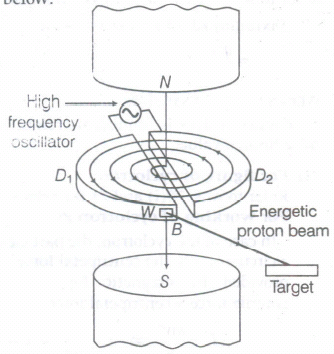
Working Let initially positively charged is accelerated towards D2 and enter into it.
Now, the charged particle experiences magnetic Lorentz force due to a strong normal magnetic field. It performs circular motion. The time taken by the charge particle to complete half revolution is equal to half of time period of AC oscillator between two dees.
The charge d particle again accelerated towards D1 as D2 acquires positive and d negative polarity. Thus, the charge particle is brought again and again in the small region of oscillating electrical field by strong normal magnetic field.
The charged particle repeatedly passes through oscillating electrical field. It traversed on spiral path and finally having radius of its circular path becomes equal to the radius of dees and finally comes out through window W and strikes to the target.
∵ Maximum KE of charged particle
= \(\frac{q^{2}B^{2}r_{0}^{2}}{2m}\)
where, r0 = radius of dees
∴ Radius of dees is limited, therefore, KEmax also have limited value.
23.
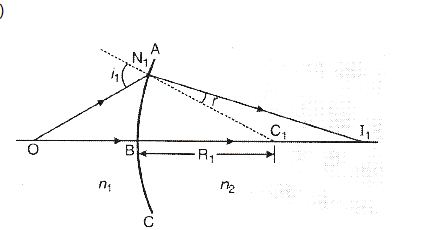
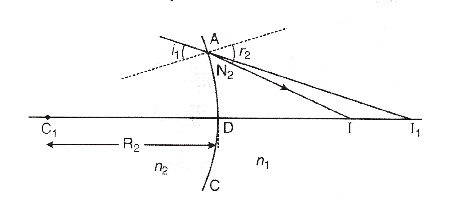
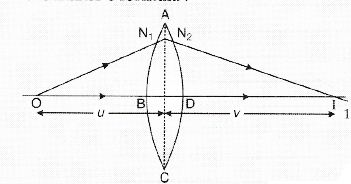
The first refracting ABC forms the image I1 of the object O. The image I1 acts as virtual object for the second refracting surface ADC, which forms the real image I as shown in the diagram
For refraction at ABC
\(\frac { { n }_{ 2 } }{ { v }_{ 1 } } -\frac { { n }_{ 1 } }{ u } =\frac { { n }_{ 2 }-{ n }_{ 1 } }{ { R }_{ 1 } } \)
For refraction at ADC
\(\frac { { n }_{ 1 } }{ v } -\frac { { n }_{ 2 } }{ { v }_{ 1 } } =\frac { { n }_{ 1 }-{ n }_{ 2 } }{ { R }_{ 2 } } \)
Adding equation (i) and equation (ii)
\(\frac { { n }_{ 1 } }{ v } -\frac { { n }_{ 2 } }{ u } =\left( { n }_{ 2 }-{ n }_{ 1 } \right) \left( \frac { 1 }{ { R }_{ 1 } } -\frac { 1 }{ { R }_{ 2 } } \right) \)
\(\frac { 1 }{ v } -\frac { 1 }{ u } =\left( \frac { { n }_{ 2 } }{ { n }_{ 1 } } -1 \right) \left( \frac { 1 }{ { R }_{ 1 } } -\frac { 1 }{ { R }_{ 2 } } \right) \)
We know, If \(u=\infty ,v=f\)
\(\frac { 1 }{ v } -\frac { 1 }{ u } =\frac { 1 }{ f } \)
\(\frac { 1 }{ f } =\left( \frac { { n }_{ 2 } }{ { n }_{ 1 } } -1 \right) \frac { 1 }{ { R }_{ 1 } } -\frac { 1 }{ { R }_{ 2 } } \)
\(\frac { 1 }{ f } =\left( { \mu }_{ 21 }-1 \right) \left( \frac { 1 }{ { R }_{ 1 } } -\frac { 1 }{ { R }_{ 2 } } \right) \)
\(\frac { 1 }{ f } =\left( { \mu }_{ 21 }-1 \right) \left( \frac { 1 }{ { R }_{ 1 } } -\frac { 1 }{ { R }_{ 2 } } \right) \)
\(\frac { 1 }{ f } =\left( 1.55-1 \right) \left( \frac { 1 }{ R } -\frac { 1 }{ -R } \right) \)
\(=0.55\times \frac { 2 }{ R } \)
\(R=0.55\times 2\times 20=22 \ cm\)
24.
\(Here,\ { i }_{ p }=60°,\delta m=? \ A=60°\)
\( \mu =tan{ i }_{ p }=tan60°=\sqrt { 3 }\)
\( For \ prism \ formula,\ \mu =\frac { sin(A+\delta m)/2 }{ sin \ A/2 }\)
\(\sqrt { 3 } =\frac { sin(60°+\delta m)/2 }{ sin30° }\)
\(\frac { sin(60°+\delta m) }{ 2 } =\sqrt { 3 } \times \frac { 1 }{ 2 } =sin60°\)
\(\frac { 60°+\delta m }{ 2 } =60°\ \delta m=2\times 60°-60°=60°\)

12th Standard CBSE Syllabus & Materials
12th Standard CBSE
CBSE 12th Computer Science Python Revision Tour I - New Previous year Question Papers Study Material - QB365 Set A
NEW12th Standard CBSE
CBSE 12th Business Studies Planning Important Questions And Answers Study Material - QB365 Set A
NEW12th Standard CBSE
CBSE 12th Business Studies Business Environment Important Questions And Answers Study Material - QB365 Set A
NEW12th Standard CBSE
CBSE 12th Business Studies Principles of Management Important Questions And Answers Study Material - QB365 Set A



NCERT Books

Syllabus

Exam Pattern

Sample Question Papers

Previous year Question Papers

Important Notes

MCQ Practice test

NCERT Exemplers

Case study Questions

Image Based Questions

Passage based Questions

HOT Questions

Value Based Questions

Model Questions Papers
NCERT ( Book Back ) Questions

Assertion and Reason
Important Questions And Answers

CBSE 12th Standard CBSE Subjects
CBSE Standards








