
 100% FREE ACCESS
12th Standard CBSE Syllabus & Materials
12th Standard CBSE
CBSE 12th Economics Government Budget and the Economy Previous year Question Papers Study Material - QB365 Set A
NEW12th Standard CBSE
CBSE 12th Computer Science Interface Python with MySQL - New Previous year Question Papers Study Material - QB365 Set A
NEW12th Standard CBSE
CBSE 12th Computer Science Database Concept - New Previous year Question Papers Study Material - QB365 Set A
NEW12th Standard CBSE
CBSE 12th Computer Science Data Communication - New Previous year Question Papers Study Material - QB365 Set A
NEW12th Standard CBSE
CBSE 12th Computer Science Data Structures - New Previous year Question Papers Study Material - QB365 Set A
NEW12th Standard CBSE
CBSE 12th Computer Science Functions - New Previous year Question Papers Study Material - QB365 Set A

Published on: 25/10/2025
Download CBSE Class 12th Standard CBSE Physics question papers, sample papers, important questions, and previous year solved papers in PDF format. Get free study materials, NCERT solutions, and exam preparation resources for Class 12th Standard CBSE Physics
Questions + Answers key
Take MCQ Physics Test
1.
Does short-sightedness (myopia) or long-sightedness (hypermetropia) imply necessarily that the eye has partially lost its ability of accommodation? If not, what might cause these defects of vision?
2.
What is the focal length of a convex lens of focal length 30cm in contact with a concave lens of focal length 20cm? Is the system a converging or a diverging lens? Ignore thickness of the lenses.
3.
In half wave rectification , what is the output frequency if the input frequency is 50 Hz. What is the output frequency of a full wave rectification for the same input frequency.
4.
Draw a schematic ray diagram of reflecting telescope showing how rays coming from a distant object are received at the eyepiece. Write its two important advantages over a refracting telescope.
5.
A potential barrier of 0.4 V exists across p-n junction.
(i) If the depletion region is \(4.0\times { 10 }^{ -7 }\) m wide, what is the intensity of the electric field in this region?
(ii) if an electron with speed \(4\times { 10 }^{ 5 }\)m/s approaches the p-n junction from then n-side, find the speed with which it will the p-side.
6.
The photoelectric cut-off voltage in a certain experiment is 1.5V. What is the maximum kinetic energy of photoelectrons emitted?
7.
Discuss the intensity of Transmitted light when a polaroid sheet is rotated between two crossed polaroids?
8.
A boy is running towards a plane mirror with a speed of 2 m/s, With what speed, the image of the boy approach him?
9.
A screen is placed 90cm from an object. The image of the object on the screen is formed by a convex lens at two different locations separated by 20cm. Determine the focal length of the lens.
10.
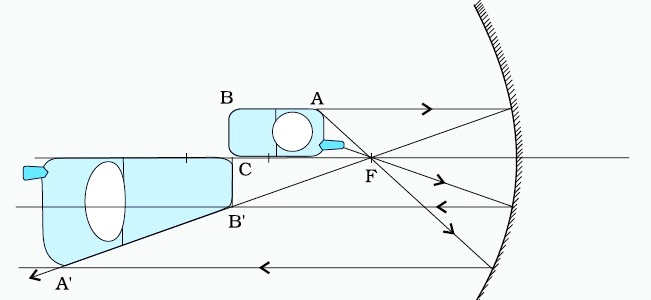
A mobile phone lies along the principal axis of a concave mirror, as shown in Fig. Show by suitable diagram, the formation of its image. Explain why the magnification is not uniform. Will the distortion of image depend on the location of the phone with respect to the mirror?
11.
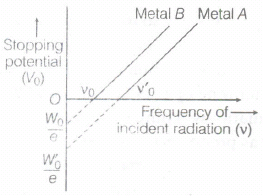
The graph shows variation of stopping potential Vo versus frequency of incident radiation v for two photosensitive metals A and B. Which one of the two metals has higher threshold frequency and why?
12.
A source of light is placed at a distance of 1m. from a photocell and the cutoff potential is found to be.\({ V }_{ 0 }\) If the distance is doubled what will be the cutoff potential?
13.
Electrical conductivity of a semiconductor
decreases with the rise in its temperature.
increases with the rise in its temperature
does not change with the rise in its temperature.
first increases and then decreases with the rise in its temperature
14.
Work function of metal is
the minimum energy required to free an electron from surface against coulomb forces.
the minimum energy required to free an nucleon
the minimum energy to ionise an atom.
the minimum energy required to eject an electron orbit.
15.
The energy of photon of wavelength 450 nm is
2.5 x 10⁻¹⁷ J
1.25 x 10⁻¹⁷ J
4.4 x 10⁻¹⁹ J
2.5 x 10⁻¹⁹ J
16.
A convex lens of refractive index 3/2 has a power of 2.5 D in air. If it is placed in a liquid of refractive index 2 then the new power of the lens is
- 1.25 D
- 1.5 D
1.25 D
1.5 D
17.
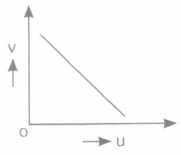
In an experiment to find focal length of a concave mirror, a graph is drawn between the magnitude of u and v. The graph looks like
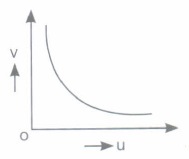
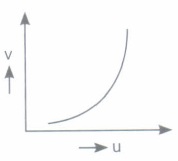
18.
Which of the following figures represent the variation of particle momentum and the associated-de-Broglie wavelength?
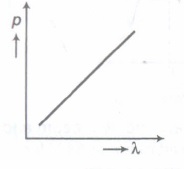
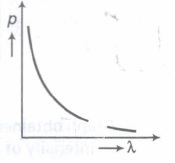
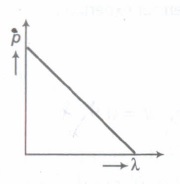
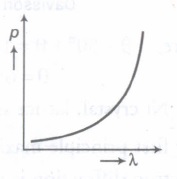
19.
Variation of photoelectric current with intensity of light is
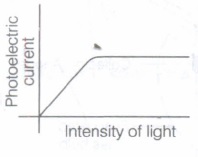
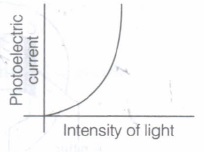
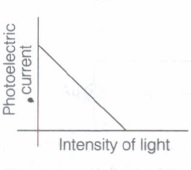
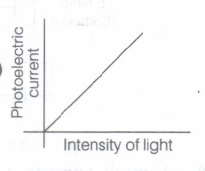
20.
A focal length of a lens is 10 cm. What is power of a lens in dioptre?
0.1 D
10 D
15 D
1 D
21.
The width of depletion region in p-n junction diode is 500 nm and an intrinsic electric field of \({ 6\times10 }^{ 5 }\) \(Vm^{ -1 }\) is also found to exist in it. What is the kinetic energy which a conduction electron must have in order to diffuse from the n-side to p-side?
0.03 eV
0.30 eV
0.45 eV
0.60 eV
22.
The barrier potential of a p-n junction depends on :
(i) type of semiconductor material
(ii) amount of doping
(iii) temperature.
Which one of the following is correct?
(i) and (ii) only
(ii) only
(ii) and (iii) only
(i),(ii) and (iii)
23.
We may state that the energy E of a photon of frequency v is E = hv, where h is Plank's constant.The momentum p of a photon is \(p=h/\lambda \). where \(\lambda \) is the wavelength of the photon.From the above statement one may conclude that the wave velocity of light is equal to
\(3\times { 10 }^{ 8 }m/s\)
\(E/p\)
\(Ep\)
\({ \left( E/p \right) }^{ 2 }\)
24.
Ultraviolet light of wavelength 300nm and intensity 1.0 watt/m2 falls on the surface of a photosensitive material. If one percent of the incident photon produce photoelectron then the number of photoelectrons emitted per second from an area 1.0cm2 of the surface is nearly. \(h=6.6\times { 10 }^{ -34 }Js\)
\(2.13\times { 10 }^{ 11 }\)
\(1.51\times { 10 }^{ 12 }\)
\(4.12\times { 10 }^{ 13 }\)
\(9.61\times { 10 }^{ 14 }\)
25.
Consider an npn transistor with its base emitter junction forward biased and collector base junction reverse biased. Which of the following statements are true?
Electrons crossover from emitter to collector
Holes move from base to collector
Electrons move from emitter to base
Electrons from emitter move out of base without going to the collector
26.
The gate for which outout is high, if atleast one input is low is
NAND
NOR
AND
OR
27.
The wavelength of matter wave is independent of
mass
velocity
momentum
charge
28.
An angular magnification (magnifying power) of 30X is desired using an objective of focal length 1.25cm and an eyepiece of focal length 5cm. How will you set up the compound microscope?
29.
(a) The refractive index of glass is 1.5. What is the speed of light in glass?
(b) Is the speed of light in glass independent of the color of light? If not, which of the two colors, red and violet travels slower in a glass prism?
30.
Find the
(a) maximum frequency and
(b) minimum wavelength of X-rays produced by 30 kv electrons.
31.

32.
Refraction of light is the change in the path oflight as it passes obliquely from one transparent medium to another medium. According to law of refraction \(\frac{\sin i}{\sin r}={ }^{1} \mu_{2}\) where \({ }^{1} \mu_{2}\) is called refractive index of second medium with respect to first medium. From refraction at a convex spherical surface, we have \(\frac{\mu_{2}}{v}-\frac{\mu_{1}}{u}=\frac{\mu_{2}-\mu_{1}}{R}\) Similarly from refraction at a concave spherical surface when object lies in the rarer medium, we have \(\frac{\mu_{2}}{v}-\frac{\mu_{1}}{u}=\frac{\mu_{2}-\mu_{1}}{R}\) and when object lies in the denser medium, we have \(\frac{\mu_{1}}{v}-\frac{\mu_{2}}{u}=\frac{\mu_{1}-\mu_{2}}{R}\).
(i) Refractive index of a medium depends upon
| (a) nature of the medium | (b) wavelength of the light used |
| (c) temperature | (d) all of these |
(ii) A ray of light of frequency 5 x 10¹⁴ Hz is passed through a liquid. The wavelength of light measured inside the liquid is found to be 450 x 10-9 m. The refractive index of the liquid is
| (a) 1.33 | (b) 2.52 | (c) 2.22 | (d) 0.75 |
(iii) A ray of light is incident at an angle of 60° on one face of a rectangular glass slab of refractive index 1.5. The angle of refraction is
| (a) sin-1(0.95) | (b) sin-1(0.58) | (c) sin-1(0.79) | (d) sin-1(0.86) |
(iv) A point object is placed at the centre of a glass sphere of radius 6 cm and refractive index 1.5. The distance of the virtual image from the surface of sphere is
| (a) 2 cm | (b) 4 cm | (c) 6 cm | (d) 12 cm |
(v) In refraction, light waves are bent on passing from one medium to the second medium because in the second medium
| (a) the frequency is different | (b) the co-efficient of elasticity is different |
| (c) the speed is different | (d) the amplitude is smaller. |
1.
A myopic or hypermetropic person can also possess the normal ability of accommodation of the eye-lens. Myopia occurs when the eye-balls get elongated from front to back. Hypermetropia occurs when the eye-balls get shortened. When the eye-lens loses its ability of accommodation, the defect is called presbyopia.
2.
Given, focal length of convex lens, f1 = 30 cm
Focal length of the concave lens, f2 = -20 cm
Using the formula of combination of lenses,
\(\frac{1}{f}=\frac{1}{f_{1}}+\frac{1}{f_{2}}=\frac{1}{30}-\frac{1}{20}=\frac{2-3}{60}=-\frac{1}{60}\)
\(\Rightarrow\) f = -60 cm
Since, the focal length of combination is negative in nature. so, the combination behaves like a diverging lens, i.e. as a concave lens.
3.
Given, input frequency = 50 Hz
For a half-wave rectifier, the output frequency is equal to the input frequency.
\(\therefore\) Output frequency = 50 Hz
For a full-wave rectifier, the output frequency is twice the input frequency.
\(\therefore\) Output frequency = 2 x 50 = 100 Hz.
4.
Reflecting telescope consists of concave mirror of large aperture and large focal length (objective). A plane mirror is placed between the concave mirror and its focus. A small convex lens works as eyepiece.
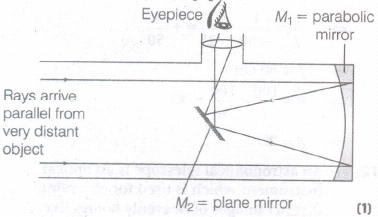
Advantages of Reflecting Telescope over Refracting Telescope
For a reflecting telescope, the mirror affords several advantages over the objective lens in astronomical telescope
(i) A mirror is easier to produce with a larger diameter, so that it can intercept rays crossing a larger area and direct them to the eyepiece.
(ii) The mirror can be made parabolic to reduce spherical aberration. Aberration is further reduced because passage through one layer of glass (the objective lens) is eliminated.
5.
Given, V = 0.4 V
(i) d = 4 \(\times\) 10-7 m, E = ?
Electric field, \(E=\frac{V}{d}=\frac{0.4}{4 \times 10^{-7}}\)
\(=1 \times 10^6 \mathrm{~V} / \mathrm{m}\)
(ii) v1 = 4 \(\times\) 105 m/s, v2 = ?
Let v1 be the speed of electron when it enters the depletion layer and v2 be the speed when it comes out of the depletion layer.
According to principle of conservation of energy, KE before entering the depletion layer = loss in PE + KE after crossing the depletion layer
\(\begin{aligned}
\Rightarrow \quad \frac{1}{2} m v_1^2=e \times V+\frac{1}{2} m v_2^2
\end{aligned}\)
\(\begin{aligned}
\Rightarrow \quad \frac{1}{2} \times 9.1 \times 10^{-31} \times\left(4 \times 10^5\right)^2
\end{aligned}\)
\(\begin{aligned}
=1.6 \times 10^{-19} \times 0.4 +\frac{1}{2} \times 9.1 \times 10^{-31} \times v_2^2
\end{aligned}\)
\(\therefore\) v2 = 1.39 \(\times\) 105 m/s
6.
Given, cut-off voltage, V0 = 1.5 V
Maximum kinetic energy is given by,
\(\begin{aligned}
\mathrm{KE}_{\text {max }} & =e V_0=1.5 \space \mathrm{eV}=1.5 \times 1.6 \times 10^{-19}
\end{aligned}\)
\(=2.4 \times 10^{-19} \mathrm{~J}\)
7.
Let I0 be the intensity of polarised light after passing through the first polariser P1. Then the intensity of light after passing through second polariser P2 will be
I = I0 cos 2 \(\theta\)
where \(\theta\) is the angle between pass axes of P1 and P2. Since P1 and P3 are crossed the angle between the pass axes of P2 and P3 will be ( \(\pi\) / 2 –\(\theta\) ). Hence the intensity of light emerging from P3 will be
\(I=I_{0} \cos ^{2} \theta \cos ^{2}\left(\frac{\pi}{2}-\theta\right)\)
\(=I_{0} \cos ^{2} \theta \sin ^{2} \theta=\left(I_{0} / 4\right) \sin ^{2} 2 \theta\)
Therefore, the transmitted intensity will be maximum when \(\theta\) = \(\pi\) / 4.
8.
The image of the object in a plane mirror is as far behind the mirror as the object is in front of it. Therefore, the image of the boy comes near the mirror through the distance equal to that moved by the boy towards the plane mirror. Hence, the image of the boy will approach him with double his speed, i.e. with 4 m/s.
9.
Distance between the image (screen) and the object, D = 90 cm
Distance between two locations of the convex lens, d = 20 cm
Focal length of the lens = f
Focal length is related to d and D as:
f = \(\frac { { D }^{ 2 }-{ d }^{ 2 } }{ 4D } \)
= \(\frac { { (90) }^{ 2 }-({ 20) }^{ 2 } }{ 4\times 90 } =\frac { 770 }{ 36 } =21.3\) cm
Therefore, the focal length of the convex lens is 21.39 cm.
10.
The ray diagram for the formation of the image of the phone is shown in Fig. The image of the part which is on the plane perpendicular to principal axis will be on the same plane. It will be of the same size, i.e., B'C = BC. You can yourself realise why the image is distorted.
11.

\(
\text { As } O Q>O P \\
\therefore v_0^{\prime}>v_0
\)
So, the threshold frequency of metal A is greater than metal B.
12.
\(V_0\) When the distance is doubled, the intensity of incident light becomes one-fourth, but the frequency of incident light remains unchanged. The value of cutoff potential of a material only depends upon the frequency of the incident light and is independent of the intensity of incident light.
13.
(b)
increases with the rise in its temperature
14.
(a)
the minimum energy required to free an electron from surface against coulomb forces.
15.
(c)
4.4 x 10⁻¹⁹ J
16.
(a)
- 1.25 D
17.
(c)
18.
(b)
19.
(d)
20.
(b)
10 D
21.
(b)
0.30 eV
22.
(d)
(i),(ii) and (iii)
23.
(b)
\(E/p\)
24.
(b)
\(1.51\times { 10 }^{ 12 }\)
25.
(c)
Electrons move from emitter to base
26.
(a)
NAND
27.
(d)
charge
28.
Focal length of the objective lens, fo = 1.25 cm
Focal length of the eyepiece, fe = 5 cm
Least distance of distinct vision, d = 25 cm
Angular magnification of the compound microscope = 30X
Total magnifying power of the compound microscope, m = 30
The angular magnification of the eyepiece is given by the relation:
\({ m }_{ e }=\left( 1+\frac { d }{ { f }_{ e } } \right) \)
\(=\left( 1+\frac { 25 }{ 5 } \right) =6\)
The angular magnification of the objective lens (mo) is related to me as:
mo me = m
mo = \(\frac { m }{ { m }_{ c } } \)
\(=\frac { 30 }{ 6 } \) = 5
We also have the relation:
mo = \(\frac{Image \ distance \ for \ the \ objective \ lens (v_o)}{ Object \ distace \ for \ the \ objective \ lens (u_o)}\)
\(5=\frac { { v }_{ o } }{ -{ u }_{ o } } \)
∴ vo = -5uo .........(1)
Applying the lens formula for the objective lens:
\(\frac { 1 }{ { f }_{ o } } =\frac { 1 }{ { v }_{ o } } -\frac { 1 }{ { u }_{ o } } \)
\(\frac { 1 }{ 1.25 } =\frac { 1 }{ -5{ u }_{ o } } -\frac { 1 }{ { u }_{ o } } =\frac { -6 }{ 5{ u }_{ 0 } } \)
\(\therefore { u }_{ o }=\frac { -6 }{ 5 } \times 1.25=-1.5\) cm
And vo = -5uo
= -5 x (-1.5) = 7.5 cm
The object should be placed 1.5 cm away from the objective lens to obtain the desired magnification.
Applying the lens formula for the eyepiece:
\(\frac { 1 }{ { v }_{ e } } -\frac { 1 }{ { u }_{ e } } =\frac { 1 }{ { f }_{ e } } \)
Where,
ve = Image distance for the eyepiece = -d = -25 cm
ue = Object distance for the eyepiece
\(\frac { 1 }{ { u }_{ e } } =\frac { 1 }{ { v }_{ e } } -\frac { 1 }{ { f }_{ e } } \)
\(=\frac { -1 }{ 25 } -\frac { 1 }{ 5 } =-\frac { 6 }{ 25 } \)
∴ ue = -4.17 cm
Separation between the objective lens and the eyepiece = |ue| + |vo|
= 4.17 + 7.5
=11.67 cm
Therefore, the separation between the objective lens and the eyepiece should be 11.67 cm.
29.
(a) Refractive index of glass, μ = 1.5
Speed of light, c = 3 x 10⁸ m/s
Speed of light in glass is given by the relation
\(v=\frac{c}{\mu}\)
\(=\frac{3 \times 10^{8}}{1.5}=2 \times 10^{8} \mathrm{~m} / \mathrm{s}\)
Hence, the speed of light in glass is 2 x 10⁸ m/s.
(b) The speed of light in glass is not independent of the colour of light
The refractive index of a violet component of white light is greater than the refractive index of a red component. Hence, the speed of violet light is less than the speed of red light in glass. Hence, violet light travels slower than red light in a glass prism.
30.
(i) Energy = eV= hv
or \(v=\frac{e V}{h}=\frac{1.6 \times 10^{-19} \times 30 \times 10^3}{6.63 \times 10^{-34}}\)
= 7.24 \(\times\) 1018 Hz
(ii) As, \(c=v \lambda\)
\(\therefore\) Wavelength, \(\lambda=\frac{c}{v}=\frac{3 \times 10^8}{7.24 \times 10^{18}}=0.0414 \mathrm{~nm}\)
31.
32.
(i) (d): Refractive index ofa medium depends upon nature and temperature of the medium, wavelength of light.
(ii) (a): Here \(v=5 \times 10^{14} \mathrm{~Hz} ; \lambda=450 \times 10^{-9} \mathrm{~m}\)
\(c=3 \times 10^{8} \mathrm{~m} \mathrm{~s}^{-1}\)
Refractive index of the liquid,
\(\mu=\frac{c}{v}=\frac{c}{v \lambda}=\frac{3 \times 10^{8}}{5 \times 10^{14} \times 450 \times 10^{-9}} \)
\(\mu=1.33\)
(iii) (b): Here i = 60° ; \(\mu\)= 1.5
By snell's law, \(\mu=\frac{\sin i}{\sin r}\)
\(\sin r=\frac{\sin i}{\mu}=\frac{\sin 60^{\circ}}{1.5}=\frac{0.866}{1.5} \)
\(\sin r=0.5773 \text { or } r=\sin ^{-1}(0.58)\)
(iv) (c): As object is at the centre of the sphere, the image must be at the centre only.
\(\therefore\) Distance of virtual image from centre of sphere = 6cm.
(v) (c): Speed of light in second medium is different than that in first medium.

12th Standard CBSE Syllabus & Materials
12th Standard CBSE
CBSE 12th Computer Science Python Revision Tour I - New Previous year Question Papers Study Material - QB365 Set A
NEW12th Standard CBSE
CBSE 12th Business Studies Planning Important Questions And Answers Study Material - QB365 Set A
NEW12th Standard CBSE
CBSE 12th Business Studies Business Environment Important Questions And Answers Study Material - QB365 Set A
NEW12th Standard CBSE
CBSE 12th Business Studies Principles of Management Important Questions And Answers Study Material - QB365 Set A



NCERT Books

Syllabus

Exam Pattern

Sample Question Papers

Previous year Question Papers

Important Notes

MCQ Practice test

NCERT Exemplers

Case study Questions

Image Based Questions

Passage based Questions

HOT Questions

Value Based Questions

Model Questions Papers
NCERT ( Book Back ) Questions

Assertion and Reason
Important Questions And Answers

CBSE 12th Standard CBSE Subjects
CBSE Standards








