
 100% FREE ACCESS
12th Standard CBSE Syllabus & Materials
12th Standard CBSE
CBSE 12th Economics Government Budget and the Economy Previous year Question Papers Study Material - QB365 Set A
NEW12th Standard CBSE
CBSE 12th Computer Science Interface Python with MySQL - New Previous year Question Papers Study Material - QB365 Set A
NEW12th Standard CBSE
CBSE 12th Computer Science Database Concept - New Previous year Question Papers Study Material - QB365 Set A
NEW12th Standard CBSE
CBSE 12th Computer Science Data Communication - New Previous year Question Papers Study Material - QB365 Set A
NEW12th Standard CBSE
CBSE 12th Computer Science Data Structures - New Previous year Question Papers Study Material - QB365 Set A
NEW12th Standard CBSE
CBSE 12th Computer Science Functions - New Previous year Question Papers Study Material - QB365 Set A

Published on: 25/10/2025
Download CBSE Class 12th Standard CBSE Physics question papers, sample papers, important questions, and previous year solved papers in PDF format. Get free study materials, NCERT solutions, and exam preparation resources for Class 12th Standard CBSE Physics
Questions + Answers key
Take MCQ Physics Test
1.
Define resolving power of a compound microscope.
How does the resolving power of a compound microscope change when
(i) refractive index of the medium between the object and objective lens increases?
(ii) wavelength of the radiation used is increased?
2.
Laser light of wavelength 640 nm incident on a pair of slits produces an interface pattern in which the bright fringes are separated by 7.2 mm. Calculate the wavelength of another source of light which produces interference fringes separated by 8.1 mm using same arrangement. Also find the minimum value of the order (n) of bright fringe of shorter wavelength which coincides with that of the wavelength.
3.
(a) Write the necessary conditions for the phenomenon of total internal reflection to occur.
(b) Write the relation between the refractive index and critical angle for a given pair of optical media.
4.
What is meant by depth of focus?
5.
(a) When monochromatic light is incident on a surface separating two media, the reflected and refracted light both have the same frequency as the incident frequency. Explain why?
(b) When light travels from a rarer to a denser medium, the speed decreases. Does the reduction in speed simply a reduction in the energy caried by the light wave?
(c) In the wave picture of light, intensity of light is determined by the square of the amplitude of the wave What determines the intensity of light in the photon picture of light.
6.
(a) Unpolarised Iight of intensity I0 passes through two Polaroids P1 and P2 such that pass axis of P2 makes an angle \(\theta\) with the pass axis of P1. Plot a graph showing the variation of intensity of light transmitted through P2 as the angle e varies from zero to 180°.
(b) A third polariod P3 is placed between P1 and P2 with pass axis of P3 making an angle \(\beta\) with that of P1 If 12 and 13 represent the intensities of light transmitted by P1 P2 and P3 determine the values of angle \(\theta\) and 13 for which I1 = !2 = I3
7.
A slit 4 cm wide is irradiated with microwave of length 2 cm. Find the angular speed of center maximum, assuming incidence normal to the plane of the slit.
8.
A telescope consists of two thin lensees of focal lengths 0.3m and 3cm respectively. It is focusses on moon which subtends an angle of 0.50 at the objective. Calculate the angle subtend at the eye by the final image in normal adjustment of the telescope.
9.
Discuss the intensity of Transmitted light when a polaroid sheet is rotated between two crossed polaroids?
10.
What is the shape of the wavefront in each of the following cases:
(a) Light diverging from a point source.
(b) Light emerging out of a convex lens when a point source is placed at its focus.
(c) The portion of the wavefront of light from a distant star intercepted by the Earth.
11.
In Young's double slit experiment, the slits are separated by 0.28 mm and the screen is placed 1.4 m away. The distance between the central bright fringe and the fourth bright fringe is measured to be 1.2 cm, determine the wavelength of light used in the experiment.
12.
Monochromatic light of wavelength 589 nm is incident from air on a water surface. What are the wavelength, frequency, and speed of
(a) reflected and
(b) refracted light? Refractive index of water is 1.33 ?
13.
An astronomical telescope is designed to have a magnifying power of 50 in normal adjustment. If the length pf the tube is 120cm, find the powers of objective and eye piece.
14.
Fringe width central maximum in diffraction pattern is ________.
15.
A continuous locus of particles of medium vibrating in the same phase at any instant is known as ___________.
16.
One dioptre is................of focal length.............. .
17.
The basic cause of refraction is..................in going.............. .
18.
Diffraction of light is the phenomenon of ______________.
19.
Image formed by a convex lens is virtual and erect when the object is placed
at F
between F and the lens
beyond 2F
at 2F
20.
In a room fitted with a green bulb, a red cloth will appear to be:
Yellow
Orange
Black
Blue
21.
Refractive index of diamond is about
1.33
1.5
1
2.45
22.
If a glass rod is immersed in a liquid of the same refractive index, then it will
look bent
disappear
look longer
none of these
23.
24.
Assertion (A) : When tiny circular obstacle is placed in the path of light from some distance, a bright spot is seen at the centre of the shadow of the obstacle.
Reason (R) : Destructive interference occurs at the centre of the shadow.
Codes:
(a) Both A and R are true and R is the correct explanation of A
(b) Both A and R are true but R is NOT the correct explanation of A
(c) A is true but R is false
(d) A is false and R is also false
25.
Assertion (A) : The film which appears bright in reflected system will appear dark in the transmitted light and vice-versa.
Reason (R) : The conditions for film to appear bright or dark in reflected light are just reverse to those in the transmitted light.
Codes:
(a) Both A and R are true and R is the correct explanation of A
(b) Both A and R are true but R is NOT the correct explanation of A
(c) A is true but R is false
(d) A is false and R is also false
26.
Assertion (A) : When monochromatic light is incident on a surface separating two media, the reflected and refracted light both have the same frequency as the incident frequency.
Reason (R) : The frequency of monochromatic light depends on media.
Codes:
(a) Both A and R are true and R is the correct explanation of A
(b) Both A and R are true but R is NOT the correct explanation of A
(c) A is true but R is false
(d) A is false and R is also false
27.
Huygens Wave Theory of Light
1. According to wave theory, light from a source is propagated in the form of longitudinal waves with uniform velocity in a homogeneous medium.
2. To explain the propagation of waves through vacuum, Huygens assumed existance of a hypothetical medium called luminiferous ether. According to Huygens, ether particles are present and possess properties such as inertia, zero density and perfect transparency.
3. On the basis of Huygens wave theory, various colours of light are due to different wavelengths of the light of the waves.
(i) Write two merits and two demerits of Huygens wave theory of light.
(ii) Write Huygen's postulates to explain wave theory of light.
(iii) What are primary source and secondary source of light considered in wave theory?
1.
Resolving power of a microscope is the reciprocal of the minimum separation of two points seen as distinct
Resolving power \(=\frac{1}{d_{\min }}=\frac{2 \mu \sin \beta}{1.22 \lambda}\)
(i) As resolving power ∝ μ, on increasing the refractive index of the medium between the object and objective lens, resolving power increases.
(ii) As resolving power \(\propto \frac{1}{\lambda},\) on increasing the wavelength of the radiation resolving power decreases.
2.
As, fringe width,
\(\beta =\frac { 2\lambda }{ 2d } \)
\(\therefore \ 7.2mm=\frac { D\times 660nm }{ 2d } \)
\(and \ 8.1mm=\frac { D\times \lambda }{ 2d } \)
Dividing (i) by (ii)
\(\therefore \) \(\frac { 7.2mm }{ 8.1mm } =\frac { 640nm }{ { \lambda }^{ ' } } \)
or \({ \lambda }^{ ' }\)= 640 x \(2.1\over7.2\)nm = 720 nm
Also \({ y }_{ n }={ n }_{ 1 }\frac { D\lambda }{ 2d } ={ n }_{ 2 }\frac { D{ \lambda }^{ ' } }{ 2d } \)
\(or \ { n }_{ 1 }\lambda = \ { n }_{ 2 }{ \lambda }^{ ' }\)
\(\Rightarrow { n }_{ 1 }\times 640={ n }_{ 2 }\times 720\)
\(\frac { { n }_{ 1 } }{ { n }_{ 2 } } =\frac { 720 }{ 640 } =\frac { 9 }{ 8 } \)
3.
(a) (i) Ray of light should travel from denser to rarer medium.
(ii) Angle of incidence should be more than the critcical angle
(b) \(\mu =\frac { 1 }{ { sini }_{ c }\quad } \) where ic is the critical angle
4.
Depth of focus indicates the range of the object distances over which the focussing is reasonably good.
5.
(a) Reflection and refraction arise through interaction of incident light with the atomic constituents of matter. Atoms may be viewed as oscillators, which take up the frequency of the external agency (light) causing forced oscillations. The frequency of light emitted by a charged oscillator equals its frequency of oscillation. Thus the frequency of scattered light equals the frequency of incident light.
(b) No, Energy carried by a wave depends on the amplitude of the wave, not on the speed of wave propagation.
(c) For a given frequency, intensity of light in the photon crossing an unit area per uni time.
6.
(a) The required graph would have the form shown as:
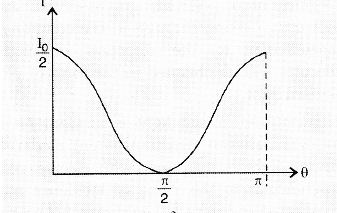
Using I2 = I1cos2\(\theta\)
(b) I1 = Light transmitted by P1
I3 = Light transmitted by P3 = I1cos2 \(\beta\)
I2 = Light transmitted by P2 = 13cos2 (\(\theta\)-\(\beta\))
Alternatively, (Award mark to student who indicates current value of I1, I2 and I3 by making a diagram)
I2 = I3
I1 COS2 \(\beta\).cos2 (\(\theta\)-\(\beta\) ) = I1 COS2 \(\beta\)
\(\theta\)= \(\beta\)
Also I1 = I2
I1 = I1 cos2 \(\beta\)
or cos2 \(\theta\) = 1
\(\therefore\) \(\theta\) = 00
∴ \(\beta\) = 00
7.
Here, \(a=4 \ cm=4\times { 10 }^{ -2 }m\)
\(\\ \lambda =2\quad cm=2\times { 10 }^{ -2 }m\)
Angular spread of central maximum \((2\theta )\) is
\(2\theta =\cfrac { 2\lambda }{ a } =\cfrac { 2\times 2\times { 10 }^{ -2 } }{ 4\times { 10 }^{ -2 } } =1 \ rad\)
8.
Here, f0 = 0.3m and fe = 3cm, \(\alpha\)= 0.50, \(\beta\)=?
Use \({\beta\over\alpha}={f_0\over f_e}\)
9.
Let I0 be the intensity of polarised light after passing through the first polariser P1. Then the intensity of light after passing through second polariser P2 will be
I = I0 cos 2 \(\theta\)
where \(\theta\) is the angle between pass axes of P1 and P2. Since P1 and P3 are crossed the angle between the pass axes of P2 and P3 will be ( \(\pi\) / 2 –\(\theta\) ). Hence the intensity of light emerging from P3 will be
\(I=I_{0} \cos ^{2} \theta \cos ^{2}\left(\frac{\pi}{2}-\theta\right)\)
\(=I_{0} \cos ^{2} \theta \sin ^{2} \theta=\left(I_{0} / 4\right) \sin ^{2} 2 \theta\)
Therefore, the transmitted intensity will be maximum when \(\theta\) = \(\pi\) / 4.
10.
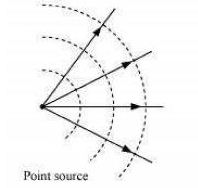
(a) The shape of the wavefront in case of a light diverging from a point source is spherical. The wavefront emanating from a point source is shown in the given figure.
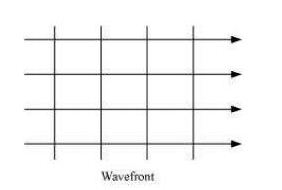
(b) The shape of the wavefront in case of a light emerging out of a convex lens when a point source is placed at its focus is a parallel grid. This is shown in the given figure.
(c) The portion of the wavefront of light from a distant star intercepted by the Earth is a plane.
11.
Here, slit width,d = 0.28 mm = \(0.28\times { 10 }^{ -3 }m\)
Distance between slit and screen, D = 1.4m
\(y=1.2cm=1.2\times { 10 }^{ -2 }m,n=4,\lambda =?\)
For constructive interference,
\(y=\eta \lambda \frac { D }{ d } or\lambda =\frac { yd }{ nD }\)
\( \\ =\frac { 1.2\times { 10 }^{ -2 }\times 0.28\times { 10 }^{ -3 } }{ 4\times 1.4 } =6\times { 10 }^{ -7 }m\)
= 600 nm
Hence, the wavelength of the light is 600 nm.
12.
\(Here, \ \lambda =589 \ nm,\ c=3\times { 10 }^{ 8 }m/s, \ \mu =1.33\)
(a) For reflected light
\(wavelength,\ \lambda =589\quad nm=589\times { 10 }^{ -9 }m,\quad v=\frac { c }{ \lambda } =\frac { 3\times { 10 }^{ 8 } }{ 589\times { 10 }^{ -9 } } =5.09\times { 10 }^{ 14 }hertz\)
\(speed,\ v=c=3\times { 10 }^{ 8 }m/s\)
(b) For refracted light \( \lambda '=\frac { \lambda }{ \mu } =\frac { 589\times { 10 }^{ -9 } }{ 1.33 } =4.42\times { 10 }^{ -7 }m\)
As frequency remains unaffected on entering another medium,
\(\\ therefore,\quad v'=v=5.09\times { 10 }^{ 14 }hertz\)
\(speed, \ v'=\frac { c }{ \mu } =\frac { 3\times { 10 }^{ 8 } }{ 1.33 } =2.25\times { 10 }^{ 8 }m/s\)
13.
Here m =-50, L = 102cm
As \(m=-{f_0\over f_e}=-50, f_0=50f_e\)
Also, L = f0 + fe= 102;
50f0 + fe= 102, fe = 2 cm
f0 = 50 fe= 50 x 2= 100 cm
\(P_o={100\over f_0}={100\over100}\)= 1D,
\(P_e={100\over f_e}={100\over2}\)= 50D
14.
()
\(\frac{2 D \lambda}{a}\)
15.
()
wavefront
16.
()
power of a lens ; one metre
17.
()
change in the velocity of light ; from one medium to another.
18.
()
bending of light around the corners of an obstacle/aperture in its path.
19.
(b)
between F and the lens
20.
(c)
Black
21.
(d)
2.45
22.
(b)
disappear
23.
24.
(c): The waves diffracted from the edges of circular obstacle, placed in the path of light, interfere constructively at the centre of the shadow resulting in the formation of a bright spot.
25.
(a): For reflected system of the film, the maxima or constructive interference is\(2 \mu t \cos r\) = while the maxima for transmitted system of film is given by equation
\(2 \mu t \cos r=n \lambda\)
where t is thickness of the film and r is angle of refraction.
From these two equations we can see that condition for maxima in reflected system and transmitted system are just opposite.
26.
(c): The reflection and refraction of light occurs on account of interaction of light with the atoms of the surface of separation. These atoms can be regarded as oscillators. Light incident on the interface forces the atomic oscillators to oscillate with frequency of incident light. As frequency oflight emitted by these (charged). oscillators is equal to their own frequency of oscillation, therefore, reflected and refracted light have the same frequency as that of incident light.
27.
(i) Merits of Huygens Wave theory of light:
(a) Wave theory correctly predicted that velocity of light in an optically denser medium is less than that in the rarer medium which is in agreement with the experimental results.
(b) On the basis of wave theory phenomenon of reflection, refraction, interference, diffraction, polarization of light could be explained.
Demiritssof Huygens wave theory of light
(a) Huygens wave theory assumes the existence of luminiferous ether. However,experimentally it couldn't be proved.
(b) This theory couldn't explain rectilinear propagation of light.
(ii) (1) Each pointon a given primary wavefront acts as a source of secondary wavelets, sending out disturbances (waves) in all directions in a similar manner as the original source of light does.
(2) The new position of the wavefront at any instant (secondary wavefront) is given by the forward envelope to the secondary wavelets at that instant.
Huygens' construction
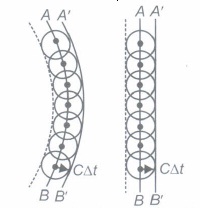
Using this principle the laws of reflection and refraction can be verified.
(iii) Primary source of light: It is a real source of light. It generates light itself and sends primary wavefronts in all directions.
Secondary source of light: It is a fictitious source of light presents on the wavefront and sends out secondary waves only in forward direction.

12th Standard CBSE Syllabus & Materials
12th Standard CBSE
CBSE 12th Computer Science Python Revision Tour I - New Previous year Question Papers Study Material - QB365 Set A
NEW12th Standard CBSE
CBSE 12th Business Studies Planning Important Questions And Answers Study Material - QB365 Set A
NEW12th Standard CBSE
CBSE 12th Business Studies Business Environment Important Questions And Answers Study Material - QB365 Set A
NEW12th Standard CBSE
CBSE 12th Business Studies Principles of Management Important Questions And Answers Study Material - QB365 Set A



NCERT Books

Syllabus

Exam Pattern

Sample Question Papers

Previous year Question Papers

Important Notes

MCQ Practice test

NCERT Exemplers

Case study Questions

Image Based Questions

Passage based Questions

HOT Questions

Value Based Questions

Model Questions Papers
NCERT ( Book Back ) Questions

Assertion and Reason
Important Questions And Answers

CBSE 12th Standard CBSE Subjects
CBSE Standards








