
 100% FREE ACCESS
12th Standard CBSE Syllabus & Materials
12th Standard CBSE
CBSE 12th Economics Government Budget and the Economy Previous year Question Papers Study Material - QB365 Set A
NEW12th Standard CBSE
CBSE 12th Computer Science Interface Python with MySQL - New Previous year Question Papers Study Material - QB365 Set A
NEW12th Standard CBSE
CBSE 12th Computer Science Database Concept - New Previous year Question Papers Study Material - QB365 Set A
NEW12th Standard CBSE
CBSE 12th Computer Science Data Communication - New Previous year Question Papers Study Material - QB365 Set A
NEW12th Standard CBSE
CBSE 12th Computer Science Data Structures - New Previous year Question Papers Study Material - QB365 Set A
NEW12th Standard CBSE
CBSE 12th Computer Science Functions - New Previous year Question Papers Study Material - QB365 Set A

Published on: 30/07/2018
In this question paper, some of the important one mark, two and five marks questions from the chapter Electromagnetic Induction and Alternating Currents are covered. The questions are prepared from the book back and previous year questions.
Teachers can prepared question paper with answer key within five minutes. Please Click Here for getting the question paper with answer key
Download CBSE Class 12th Standard CBSE Physics question papers, sample papers, important questions, and previous year solved papers in PDF format. Get free study materials, NCERT solutions, and exam preparation resources for Class 12th Standard CBSE Physics
Questions + Answers key
Take MCQ Physics Test
1.
An a.c. generator consists of a coil of 2000 turns each of area and rotating at an angular speed of 200 rpm in a uniform magnetic field of \(4.8\times { 10 }^{ -2 }T.\) Calculate the peak and rms values of e.m.f. induced in the coil.
2.
A resistor of \(12\Omega \), a capacitor of reactance \(14\Omega \) and an inductor of reactance \(30\Omega \) are joined in series and placed across a \(230 \ volt\), \(50 \ Hz\), supply. Calculate:
(i) the current in the circuit.
(ii) the phase angle between the current and the voltage, and
(iii) power factor.
3.
(i) Define self-inductance. Write its SI unit.
(ii) A long solenoid with 15 turns per cm has a small loop of area 2.0 cm2 placed inside normal to the axis. If the current carried by the solenoid changes steadily from 2.0 A to 4.0 A in 0.1 s, what is the induced emf in the loop while the current is changing?
4.
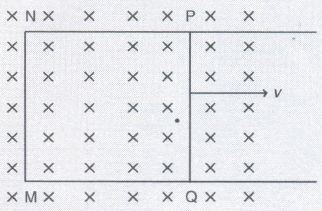
A rectangular loop PQMN with movable arm PQMN of length 10 em and resistance 2 \(\Omega\) is placed in a uniform magnetic field of 0.1 Tesla perpendicular to the plane of the loop as shown in the figure. The resistance, pf the arms MN, NP, and MQ are negligible. Calculate the
(i) emf induced in the arm PQ and
(ii) current induced in the loop when arm PQ is moved with velocity 20 m/s.
5.
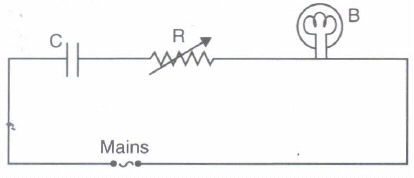
A capacitor 'C', a variable resistor 'R' and a bulb 'B' are connected in series to the ac mains in circuit as shown. The bulb glows with some brightness. How will the glow of the bulb change if
(i) a dielectric slab is introduced between the plates of the capacitor, keeping resistance R to be the same;
(ii) the resistance R is increased keeping the same capacitance?
6.
(i) A metal ring is held horizontally and a bar magnet is dropped through the ring with its length along the axis of the ring. What will be the acceleration of a falling magnet?
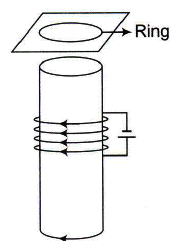
(ii) Consider a metal ring kept on top of a fixed solenoid (say on cardboard) (see figure). The center of the ring coincides with the axis of the solenoid. If the current is suddenly switched ON, the metal ring jumps up. Explain.
7.
Why is choke coil needed in the use of fluorescent tubes with ac mains?
8.
Explain why resistance coils are usually double wound.
9.
Does Lenz's law violet the principle of energy conservation ?
10.
Why are oscillations of a copper sheet in a magnetic field highly damped ?
11.
A train is moving with uniform speed from north to south. Will any induced e.m.f. appear across the ends of its axle ? Will the answer be affected if train moves from east to west ?
12.
What is the relation between weber and Maxwell ?
13.
A coil having n turns and resistance R is connected with a galvanometer of resistance 4R. This combination is moved in time t seconds from a magnetic flux \({ \phi }_{ 1 }\) Weber to \({ \phi }_{ 2 }\) Weber. The induced current in the circuit is :
\(\frac { { \phi }_{ 2 }-{ \phi }_{ 1 } }{ 5Rnt } \)
\(\frac { -n\left( { \phi }_{ 2 }-{ \phi }_{ 1 } \right) }{ 5Rt } \)
\(\frac { -\left( { \phi }_{ 2 }-{ \phi }_{ 1 } \right) }{ Rnt } \)
\(\frac { -n\left( { \phi }_{ 2 }-{ \phi }_{ 1 } \right) }{ Rt } \)
14.
A conducting circuit loop is placed in a uniform magnetic field of induction B tesla with its plane normal to the field. Now, the radius of the loop starts sharinking at the rate dr/dt. The induced emf at the instant when the radius is R is:
\(\pi rB\left( \frac { dr }{ dt } \right) \)
\(2\pi rB\left( \frac { dr }{ dt } \right) \)
\(\pi r^{ 2 }\left( \frac { dr }{ dt } \right) \)
\(\left( \frac { \pi r^{ 2 } }{ 2 } \right) ^{ 2 }\left( \frac { dr }{ dt } \right) \)
15.
The output of a step-down transformer is measured to be 24V when connected to a 12 watt light blub. The value of the peak current is
\(1/\sqrt { 2 } A\)
\(\sqrt { 2 } A\)
2 A
\(2\sqrt { 2 } A\)
16.
A circular coil expands radially in a region of magnetic field and no electromotive force is produced in the coil. This can be because
the magentic field is constant
the magnetic field is in the same plane as the circular coil and it may or may not vary
the magnetic field has a perpendicular componet whose magnitude is decreasing suitably
there is a constant magnetic field in the perpendicular direction.
17.
The efficiency of d.c.motor id given by \(\eta \) =
\(\frac { back \ e.m.f. }{ applied \ e.m.f. } \)
\(\frac { applied \ e.m.f }{ back \ e.m.f. } \)
\(back \ e.m.f.\ \times \ applied \ e.m.f.\)
none of the above
18.
Q factor of resonance is given by
\(\frac { 1 }{ R } \sqrt { \frac { L }{ C } } \)
\(\frac { 1 }{ R } \sqrt { \frac { C }{ L } } \)
\(\frac { 1 }{ L } \sqrt { \frac { R }{ C } } \)
\(\frac { 1 }{ C } \sqrt { \frac { L }{ R } } \)
19.
Phase difference between voltage across L and C in series is
\({ 0 }^{ \circ }\)
\({9 0 }^{ \circ }\)
\({180 }^{ \circ }\)
\({ 360 }^{ \circ }\)
20.
When number of turns of a soleniod is doubled, its self inductance becomes k times, where k =
2
1
8
4
21.
Amount of charge induced in a circuit of resistance R is given by
\(dQ=(d\phi )\times R\)
\(dQ=\frac { d\phi }{ R } \)
\(dQ={ R }^{ 2 }d\phi \)
\(dQ=\frac { d\phi }{ R^{ 2 } } \)
22.
In the relation \(\phi \) = BA cos \(\theta \), \(\theta \) is angle........
which normal to surface area makes with the direction of magnetic field
which magnetic field makes with the surface
which is never constant
none of the above
23.
A metallic rod of length l and resistance R is rotated with a frequency v, with one end hinged at the centre and the other end at the circumference of a circular metallic ring of radius l, about an axis passing through the centre and perpendicular to the plane of the ring. A constant and uniform magnetic field B parallel to the axis is present everywhere.
(a) Derive the expression for the induced emf and the current in the rod.
(b) Due to the presence of the current in the rod and of the magnetic field, find the expression for the magnitude and direction of the force acting on this rod.
(c) Hence obtain the expression for the power required to rotate the rod.
24.
A circuit containing 80 mH inductor and a \(60\mu F\) capacitor in series is connected to a 230 V, 50 Hz supply. The resistance in the circuit is negligible.
(i) Obtain the current amplitude and rms value.
(ii) Obtain tha rms value of potential drop across each element.
(iii) What is the average power transferred to inductor?
(iv) What is the average power transferred to capacitor?
(v) What is the total average power absorbed by the circuit?
1.
16.1 V, 11.4 V
2.
\(R=12\Omega ; \ { X }_{ C }=12\Omega ; \ { X }_{ L }=30\Omega ;\)
\(E=230 \ volt; \ v=50Hz\)
\((i) \ Current=\frac { E }{ \sqrt { { R }^{ 2 }+{ \left( { X }_{ L }-{ X }_{ C } \right) }^{ 2 } } } \)
\(=\frac { 230 }{ \sqrt { { 12 }^{ 2 }+\left( 30-14 \right) ^{ 2 } } }\)
\( I=\frac { 230 }{ \sqrt { 144+256 } } =\frac { 230 }{ 20 }\)
\(I=11.5A\\ (ii) \ tan\phi =\frac { { X }_{ L }-{ X }_{ C } }{ R } =\frac { 30-40 }{ 12 } =\frac { 16 }{ 12 } \)
\(tan\phi =1.3333=tan\left( 53°,8\prime \right)\)
\(\phi =53°,8\prime\)
\( \\ Voltage \ leads \ current \ by \ 53°,8\prime \)
\((iii) \ Power \ factors \ cos\theta =\frac { R }{ Z }\)
\(=\frac { R }{ \sqrt { { R }^{ 2 }+{ \left( { X }_{ L }-{ X }_{ C } \right) }^{ 2 } } } \)
\(or \ cos\theta =\frac { 12 }{ \sqrt { { \left( 12 \right) }^{ 2 } } +{ \left( 30-14 \right) }^{ 2 } }\)
\(=\frac { 12 }{ 20 } =0.6 \ or \ Power \ factor=0.6\)
3.
Self-Inductance When the current in a coil is changed, a back emf is induced in the same coil. This phenomenon is called self-inductance. If Lis self-inductance of coil, then
\(N\phi \propto I\Rightarrow N\phi =LI\Rightarrow L=\frac { N\phi }{ I } \)
The SI unit of self-inductance is Henry (H).
(ii) Mutual inductance of solenoid coil system
\(M=\frac { { \mu }_{ 0 }{ N }_{ 1 }{ N }_{ 2 }{ A }_{ 2 } }{ l } \)
Here, N1 = 15, N2 = 1, l = 1cm = 10-2m,
A = 2.0cm2 = 20 x 10-4m2
∴ \(M=\frac { 4\pi \times { 10 }^{ -7 }\times 15\times 1\times 2.0\times { 10 }^{ -4 } }{ { 10 }^{ -2 } } \)
\(=120\pi \times { 10 }^{ -9 }H\)
Induced emf in the loop
\({ \varepsilon }_{ 2 }=M\frac { { \Delta I }_{ 1 } }{ { \Delta t } } (numerically)=20\pi \times { 10 }^{ -9 }\frac { \left( 4-2 \right) }{ 0.1 } \)
\(=120\times 3.14\times { 10 }^{ -9 }\times \frac { 2 }{ 0.1 } =7.5\times { 10 }^{ -6 }V=7.5\mu V\)
4.
emf induced
e = Blv
= 0.1 x 10 x 10-2 x 20 V
= 0.2 volt
(ii) Current in the loop
\(i=\frac{e}{R} \)
\(=\frac{0.2}{2}A=0.1A\)
5.
(i) Reactance of the capacitor will decrease, resulting in increase of the current in the circuit, Therefore the bulb will glow brighter.
(ii) The bulb will go dimmer.
6.
(i) As the magnet falls, the magnetic flux linked with the ring increases. This induces emf in the ring which opposes the motion of the falling magnet, hence a < g.
7.
A choke coil reduces the voltage across the fluorescent tube without wastage of power.
8.
The resistance coils are double wound to avoid induction effects. Magnetic field due to current in one half of the coil is cancelled by magnetic field due to current in the other half of the coil (which is in opposite direction).
9.
No, Lenz's law does not violate this principle.
10.
This is because of eddy currents developed in copper sheet.
11.
Yes, it will appear as the train is intercepting vertical component of earth's magnetic field. No, answer is not affected.
12.
1 weber = 108 Maxwell
13.
(b)
\(\frac { -n\left( { \phi }_{ 2 }-{ \phi }_{ 1 } \right) }{ 5Rt } \)
14.
(b)
\(2\pi rB\left( \frac { dr }{ dt } \right) \)
15.
(a)
\(1/\sqrt { 2 } A\)
16.
(b)
the magnetic field is in the same plane as the circular coil and it may or may not vary
17.
(a)
\(\frac { back \ e.m.f. }{ applied \ e.m.f. } \)
18.
(a)
\(\frac { 1 }{ R } \sqrt { \frac { L }{ C } } \)
19.
(c)
\({180 }^{ \circ }\)
20.
(d)
4
21.
(b)
\(dQ=\frac { d\phi }{ R } \)
22.
(a)
which normal to surface area makes with the direction of magnetic field
23.
(a) In one revolution
Change of area, \(dA=\pi l^2\)
\(\therefore\) change of magnetic flux
\(d\phi =\vec { B } .\vec { dA } =B.dA{ \cos { 0 } }^{ \circ }\)
\(=B\pi l^{ 2 }\)
(i) Induced emf, \(\varepsilon \) \(=B\pi l^{ 2 }/T=B\pi l^{ 2 }/v\)
(ii) Induced current in the rod, \(I=\frac{\varepsilon }{R}=\frac{\pi vB l^2}{R}\)
(b) Force acting on the rod, F = IlB
\(=\frac{\pi vB^2 l^3}{R}\)
The external force required to rotate the rod opposes the Lorentz force acting on the rod/ external force acts in the direction opposite the Lorentz force
(c) Power required to rotate the rod
Power = Force X velocity
P = Fx v
\(=\frac{\pi vB^2 l^3}{R}\times v\)
24.
Given,
\(L=80mH=80\times { 10 }^{ -3 }H, \ R=0, \ v=50Hz\)
\(C=60\mu F=60\times { 10 }^{ -6 }F,\)
\(\omega =2\pi v=100\pi \ rad/s \)
\({ V }_{ rms }=230 \ V,\)
and \(\\ { V }_{ 0 }=\sqrt { 2{ V }_{ rms } } =\sqrt { 2 } \times 230V\)
(i) I0 = ? and Irms = ?
\(\begin{aligned} \Rightarrow I_0 & =\frac{V_0}{Z}=\frac{V_0}{\left|\omega L-\frac{1}{\omega C}\right|} \\ \end{aligned}\)
\(\begin{aligned} & =\frac{230 \sqrt{2}}{\left|100 \pi \times 80 \times 10^{-3}-\frac{1}{100 \pi \times 60 \times 10^{-6}}\right|} \\ \end{aligned}\)
\(\begin{aligned} =\frac{230 \sqrt{2}}{\left|8 \pi-\frac{1000}{6 \pi}\right|}=-11.63 \mathrm{~A} \\ \end{aligned}\)
\(\begin{aligned} I_{\mathrm{rms}} & =\frac{I_0}{\sqrt{2}}=\frac{-11.63}{\sqrt{2}}=8.23 \mathrm{~A} \end{aligned}\)
(ii) For L, VL = Irms \(\omega \)L = 8.23 \(\times\) 100\(\pi\)\(\times\)80 \(\times\)10-3
= 206.84 V
For C, \(V_C=I_{\mathrm{rms}} \frac{1}{\omega C}=8.23 \times \frac{1}{100 \pi \times 60 \times 10^{-6}}\)
= 436.84 V
Since, voltage across L and C are 180° out of phase, therefore they are subtracted.
Thus, applied rms voltage = 436.84 - 206.84
= 230.0 V
(iii) Average power transferred per cycle by source to inductor is always zero because of phase difference of \(\pi\)/2 between voltage and current through inductor.
(iv) Average power transferred per cycle by source to inductor is always zero because of phase difference of \(\pi\)/2 between voltage and current through inductor
(v) \(\therefore\) Total average power absorbed by the circuit is also zero.

12th Standard CBSE Syllabus & Materials
12th Standard CBSE
CBSE 12th Computer Science Python Revision Tour I - New Previous year Question Papers Study Material - QB365 Set A
NEW12th Standard CBSE
CBSE 12th Business Studies Planning Important Questions And Answers Study Material - QB365 Set A
NEW12th Standard CBSE
CBSE 12th Business Studies Business Environment Important Questions And Answers Study Material - QB365 Set A
NEW12th Standard CBSE
CBSE 12th Business Studies Principles of Management Important Questions And Answers Study Material - QB365 Set A



CBSE 12th Standard CBSE Subjects
CBSE Standards










