
 100% FREE ACCESS
12th Standard CBSE Syllabus & Materials
12th Standard CBSE
CBSE 12th Economics Government Budget and the Economy Previous year Question Papers Study Material - QB365 Set A
NEW12th Standard CBSE
CBSE 12th Computer Science Interface Python with MySQL - New Previous year Question Papers Study Material - QB365 Set A
NEW12th Standard CBSE
CBSE 12th Computer Science Database Concept - New Previous year Question Papers Study Material - QB365 Set A
NEW12th Standard CBSE
CBSE 12th Computer Science Data Communication - New Previous year Question Papers Study Material - QB365 Set A
NEW12th Standard CBSE
CBSE 12th Computer Science Data Structures - New Previous year Question Papers Study Material - QB365 Set A
NEW12th Standard CBSE
CBSE 12th Computer Science Functions - New Previous year Question Papers Study Material - QB365 Set A

Published on: 03/03/2020
12th Standard Biology Board Exam Sample Question 2020
Download CBSE Class 12th Standard CBSE Biology question papers, sample papers, important questions, and previous year solved papers in PDF format. Get free study materials, NCERT solutions, and exam preparation resources for Class 12th Standard CBSE Biology
Questions + Answers key
Take MCQ Biology Test
1.
Name the insect pest that is killed by the product of cry IAc gene.
2.
List two essential roles of ribosomes during translation.
3.
How does nature depollutes the air?
4.
What is homoeostasis?
5.
Name any two common Indian millet crops. State one characteristic of millets that has been improved as a result of hybrid breeding as to produce high yielding millet crops.
6.
Describe importance of cloning site in a vector. Illustrate with an example.
7.
Why is the frequency of red green colour blindness is many times higher in males than in the females?
8.
List Robert Koch's postulates.
9.
Difference between Zona pellucida and Corona radiata
10.
What are genetic disorders?
11.
Mention any four diseases that can be treated by antibiotics.
12.
Describe chipko movement
13.
What is Gause's competitive exclusion principle? Give an example.
14.
Name the two layers of seed coat. Where are they formed from?
15.
During recent years many disease resistant crops plants have been released and many chemical pesticides have also been used to control the pest and diseases, so as to improve the agricultural yield. But such methods of pest and disease management have led to the development of 'super pests and super weeds' which require more scientific methods to control them
Answer the following questions on the basis of above information:
(i) Should we continue such a practice of pest and disease management?
(ii) What other method should be adopted to keep the pest and diseases at managable level so as to enhance the agricultural yield?
(iii) What value have not been kept in mind in the above case.
16.
Describe the advantages for keeping the ecosystems healthy
17.
It was obserbed by a team of research workers the population of fish eating birds is declining gradually year after year after the nearby establishment of a pesticide producing factory a few years ago. Answer the following on the basis of above information.
(i) What may be the possible cause of the declining population of the fish eating birds, in your opinion?
(ii) What may be the alternative to the pesticide.
18.
Mohan is a second-year student of engineering and Raghu is his best friend and classmate too. But in recent days, Mohan feels Raghu is not behaving the same way with him and has done badly in his assessment tests as well, He suspects Raghu to have taken drugs.
(i)Enumerate the symptoms which mus have made Mohan think so
(ii)List the possible reasons that might have made Raghu take drugs.
(iii)How can Mohan help his friend to give up drugs and come back to normal life?
(iv) What values are promoted by Mohan?
19.
Comment on the growth curve given below.
20.
"Modern methods of breeding animals and plants can alleviate the global food shortage". Comment on the statement and give suitable examples.
21.
(ii) Explain a monohybrid cross, taking seed coat colour as a trait in pisum sativum. Work out the cross upto F2 generation.
(ii) State the laws of inheritance that can be derived from such a cross.
(iii) What is the phenotypic ratio in a dihybrid cross?
22.
How does the megaspore mother cell develop into a 7-celled, 8-nucleate embryo sac in an angiosperm? Draw a labelled diagram of a mature embryo sac.
23.
'Determination of Biological Oxygen Demand (BOD) can help in suggesting the quality of a water body'.Explain.
24.
The diagram shows the arrangement of blood vessels in the uterus wall and placenta of a pregnant woman.If the women has high blood pressure, would it affect the developing foetus?

25.
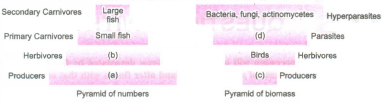
Given below are two figures depicting pyramid of numbers and pyramid of biomass in aquatic ecosystem and parasitic food chain.Observe the figures carefully and fill in the blanks (a), (b), (c) and (d).
26.
Name the gobar gas liberated from a biogas plant.Which type of bacteria are responsible for its production? What are the advantages of using it as a source of energy?
27.
(a) A married female, not habitual of using birth control techniques, becomes preganant. The couple does not want to have the child at this time. Which birth control techniques will be most suitable for this female in this situation?
(b) What are the other two reasons in which this technique is adopted?
28.
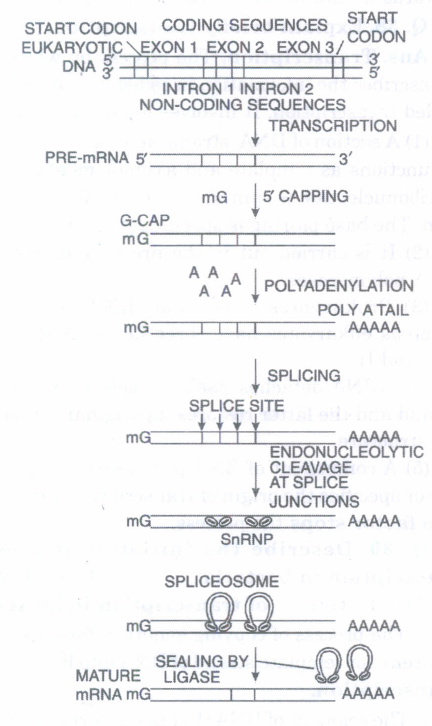
Show the transcription in eukaryotes with the help of sketches only
29.
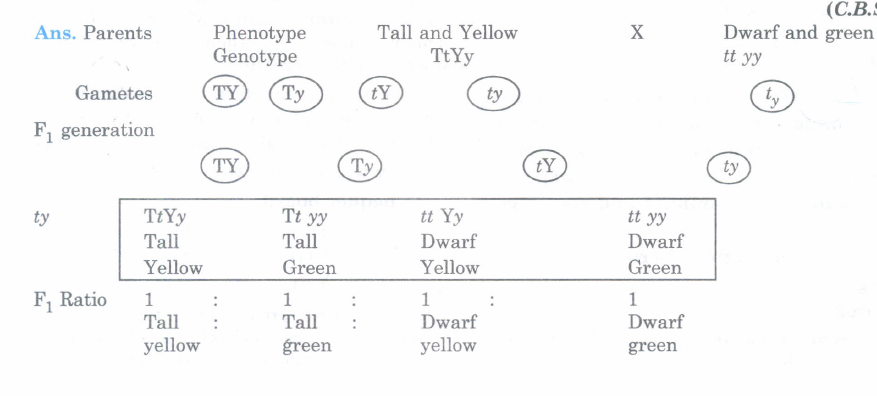
A tall pea plant with yellow seeds (heterozygous for both the traits) is crossed with dwarf pea plant with green seeds.Using a Punnet square work out the cross to show the phenotypes and genotypes of \({ F }_{ 1 }\) generation.
30.
Explain the increase in the numbers of melanic (dark-winged) moths in the urban areas of post-industrialisation period in England.
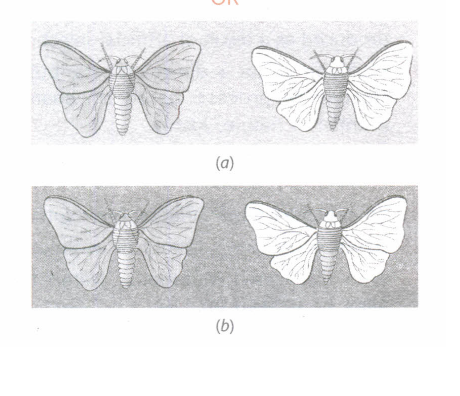
What do these picture 'a' and 'b' illustrate with reference to evolution?Explain.
31.
Ornithologies observed a decline in the bird population in the area near a lake after the setting of an industrial unit in the same area.Explain the cause responsible for the decline observed.
32.
Describe briefly Downstream processing.
33.
Trace the life cycle of malarial parasite in the human body,when bitten by an infected female Anopheles.
34.
Water is very essential for life. Write any three features both for plants and animals, which enable them to survive in water-scarce environment.
35.
Name the biological product made in transgenic animal to treat emphysema. Explain the same.
36.
(i) mention the property that enable sthe explants to regenerate into a new plant.
(ii) A banana herb is virus - infected. Describe the method that will help in obtaining healthy banana plants from this diseased plant.
37.
The embryo at 16 celled stage is known as
morula
gastrula
blastula
blastomere
38.
Green house effect is mainly due to
SO2
CO2
CO
O2
39.
The amino acid attaches to the tRNA at its:
5' - end
3' - end
Anti codon site
DHU loop
40.
During the process of ecological succession the changes that take place in communities are:
Orderly and sequential
Random
Very quick
Not influenced by the physical environment.
41.
Extinction of a species in a food chain is compensated by
food chain
ecological pyramid
food web
none of these
42.
In a dihydrid cross where two parents differ in two pairs of contrasting traits like seed colour yellow (YY) and seed colour green (yy) with seed shape round (RR) and seed shape wrinkled (rr), the number of green coloured seeds (yy) among sixteen products of F2 generation will be
2
4
6
8
43.
When seeds are attached to parent plant the type of germination is known as
Ovipary
Epigeal
Vivipary
Hypogeal
44.
Silencing of m-RNA has been used in producing transgenic plants resistant to
bollworms
nematodes
white rusts
bacterial blights
45.
Animals have the innate ability to escape from predation. Examples for the same are given below. Select the incorrect example.
colour change in chamaeleon
enlargement of body size by swallowing air in puffer fish
poison fangs in snakes
melanism in months
46.
Which one of these is not used as a bioweapon
Bacillus anthracis
biofertilizers
Bacillus thuringiensis
Small pox
47.
A bacterial cell was transformed with a recombinant DNA that was generated using a human gene. However, the transformed cells did not produce the desired protein. Reasons could be:
Human gene may have intron which bacteria can not process
Amino acid codons for humans and bacteria are different
Human protein is formed but degraded by bacteria
All of the above
48.
Which one of the following is the most widely accepted method of contraception in India at present?
cervical caps
tubectomy
diaphragms
IUDs (Intra uterine devices)
49.
Haploids are more suitable for mutation studies than the diploids. This is because
Haploids are more abundant in nature than diploids
All mutations,whether dominant or recessive are expressed in haploids
Haploids are reproductivity more stable than diploids
Mutagens penetrate in haploids more effectively than in diploids
50.
Chiropterophily means...
Pollination by insects
Pollination by the wind
Pollination by bats
Pollination by snails
51.
Marijuana and charas are
Stimulant
Hallucinogens
Depressant
Sedative
1.
Tobacco budworm.
The protein coded by cnJIAc gene control the cotton bollworms
2.
Two essential roles played by ribosomes during translation are:
(i) One of the ribosomal RNA (rRNA, 23S in prokaryotes)acts as a transferase ribozyme for the formation of peptide bonds.
(ii) The mRNA and changed tRNAs are attached to ribosomal sites.Thus, these provide sites for the attachment during protein synthesis.
3.
Strong winds disperse the pollutants, reducing their concentration and diluting their effect. Precipitation (rain, snow) rids the air of pollutants.
4.
Maintenance of constant internal conditions by organisms for survival. This is achieved by regulating metabolic processes.
5.
Hybrid varieties of maize, jower and bajra have been developed in India by plant breeders Hybrid breeding have led to the development of several high yielding varietres resistant to water stress.
6.
Cloning site is necessary in order to link the alien DNA to the vector.
The vector should have preferably a single recognition site, for the commonly used restriction enzyme.
1. In E.coli the ligation of alien DNA is carried out at one of two antibiotic resistance genes.
2. A foreign DNA can be ligated at the Bam H I site of tetracycline resistance gene in the vector pBR 322.
3. The recombinant plasmid will lose the tetracycline resistance, but can grow on ampicillin-containing medium.
4. When they are transferred to tetracycline containing medium, the recombinant cannot grow while the non-recombinants will grow on both ampicillin and tetracycline containing medium. Thus cloning sites help in the selection of recombinants.
7.
1. The gene for red-green colour blindness is located on X-chromosome and it is recessively inherited disorder.
2. Since a male has only one X-chromosome, the recessive trait is easily expressed.
3. A female has two X-chromosomes and she has to be homozygous recessive for the expression of the trait; hence chances of the disorder are less.
8.
Koch's postulates.
1. The origanism must be regularly found in tthe body of animals that have the disease.
2. It must be possible to isolate the organism and grow it in pure culture or artificial medium.
3. A healthy animal must contact the disease and show its characteristic symptoms when it is inoculated with the culture of the organism.
4. It must be possible to recover the same organism from the body of inoculated animal.
9.
Difference between Zona pellucida and Corona radiata
| Zona pellucida | Corona Radiata |
| 1.The non-cellular, secretory layer around the ovum is termed zona pellucida (or oolama). | 1.The cellular layer around zona pellucida is termed corona radiata. |
| 2.This layer is thick and transparent. | 2.It is very thick layer of follicular cells with granular cytoplasm. |
| 3.It encloses perivitelline space around plasma around plasma membrane. | 3.It does not enclose any space. |
10.
Genetic disorders. These are inborn errors. These are deficiencies with which a child is born, such as mongolism. The genetic disorders also include deficiencies or defects which a child inherits from birth.
11.
(i) Diphtheria
(ii) Whooping cough
(iii) Leprosy
(iv) Plague.
12.
It is a movement that was started in Garwal Himalayas, by Sh. Sunder Lal Bahuguna in 1974. It aimed at protecting trees. The local women showed enormous bravery in protecting the trees from the axes of the contractors by hugging them.
13.
Gause's competitive exclusion principle states that two closely related species competing for the same resources cannot co-exist indefinitely and the competitively inferior one will be eliminated, e.g.
On the rocky sea coasts of Scotland, the larger and competitively superior barnacle Balanus dominates the intertidal area and excludes the smaller barnacle, Chathamalus from that zone
14.
The two layers of seed coat are:
(i) Testa
Testa is formed from the outer integument.
(ii) Tegmen
Tegmen is formed from the inner integument.
15.
(i) No doubt such practice helps in the management of pest and diseases but at the same time have some adverse side effects too. Therefore such practices should be used judiciously after proper scrutinisation so that harm to the environment is minimum and agricultural output is maximum.
(ii) Biocontrolmethods of pest and disease management should be preferred. It is a natural method of pest and pathogen control. It involves the use of microorganisms or other natural predaters or their product for controlling the plant diseases. e.g. the fungus Trichoderma exerts biocontrol over several plant pathogens. Their biocontrol agents are specific and unlike chemical pesticides do not harm the useful non target organisms and keep the pest and ecological balance managable.
(iii) Ethical values with regard to the safety of environment have been neglected in this case.
16.
A healthy ecosystem is stable. It has a functional balance amongst the different population present in the ecosystem. The important advantages of a healthy ecosystem are:
(i) Purification of air and release of oxygen:The healthy ecosystem helps in purifying air by intercepting the particulate matter by the vegetation and making them to settle down. The air is further purified by removal of CO2 and release of oxygen during photosynthethetic activity.
(ii) Water: A greater amount of rain water is held over the soilby plant litter which slowly percolates down and becomes the source of springs and rivers.
(iii) Floods do not occur because of little run off.
(iv) Protection of soil: Healthy ecosystem helps in checking soil erosion because the soil particles remain bound together by plant roots. land slides also are rare.
(v) Biodiversity: The natural and healthy ecosystems help to maintain the biodiversity with <:1 variety of genes, gene pool, species and habitates.
17.
(i) The pesticides enter the fish through food chain and slow biomagnification. The birds which eat such fish accumulate the increasing amount of pesticides in bodies which is toxic and as such result in the death of the such fish eating birds.
(ii) Biocontrolling agent should be searched out to remove the pests.
18.
(i) Mohan must have observed one or more of the following symptoms:
Drop in academic performance, unexplained absence from college, Lack of interest in personal hygiene, isolation and family, loss of interest in hobbies, change in eating and sleeping habits, fluctuations in appetite and weight.
(ii) Causes/reasons for drug abuse;
(a) Curiosity.
(b)Need for adventure.
(c) Excitement.
(d)experimentation.
(e)To escape from stress.
(f)UnSupportive family structure.
(iii)(a)Mohan must inform Raghu's parents to take appropriate measures.
(b) Talk to Raghu to find out the cause behind taking drugs.
(c)He must be taken to a psychologist/Psychiatrist to get rid of drugs.
(iv)Mohan's empathy, his concern for his friend and helping nature.
19.
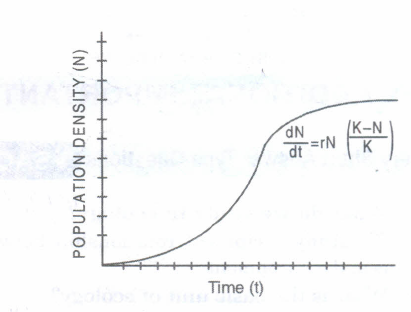
The growth curve shown aboveis logistic growth curve or S-shaped curve.
Logistic growth curve is considered more realistic because unlimited resources are not available in an ecosystem or in a habital, where
K-stands for carrying capacity.
N-indicates population density, which is the number of species of a population per unit area. r-is for intrinsic rate of natural increase.
20.
(A) Role of modern methods of breeding animals:
(i) By continued inbreeding, superior genes can be accumulated and less desirable genes can be eliminated by selection. It is also used to produce pure line.
(ii) By cross-breeding, good characters of different breeds can be combined to produce high yielding hybrid animals Examples 1.Karan Swiss breed of Switzerland and Sahiwal of India and gives about 3,500 litres of milk during its lactation period of 300 days.
2. High yielding layers of fowls e.g. IBL-80; B-77 and HH-260 are also cross-breeds out of which IBL-80 and B-77 breeds produce 200 eggs while HH-260 produces 260 eggs in a year.
3. Hissardale is a high wool and meat-yielding cross breed of sheep, while mules are more sturdier and stronger interspecific hybrids produced by a cross between male donkey and female horse (mare).
(iii) Multiple Ovulation-Embryo Transfer (MOET):
(iv) Artificial Insemination
(B)Role of modern methods of plant breeding:
1. Green revolution.
2. Genetically modified crops.
21.
(i) In a monohybrid cross, when homozygous dominant and honozygous recessive parents arc crossed, F1- hybrid would be heterozygous for the trait and would express the dominant allele.
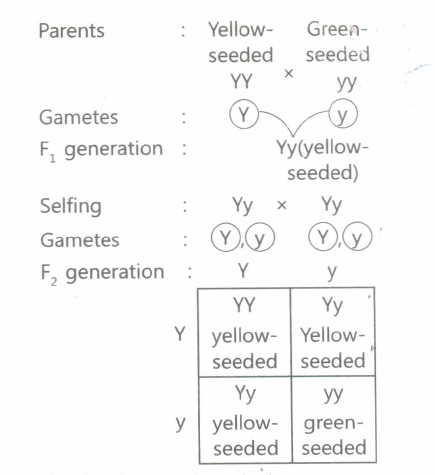
(ii) The hybrid is heterozygous containing both alternative alleles (Y and y) but only one trait, i.e. yellow colour appeared and green colour trait is suppressed in F1 -generation.
This shows that yellow seed colour is dominant over the green seed colour trait. This explains Mendel's law of dominance.
(iii) Phenotypic ralio in Fgeneration, Yellow seeds :Green seeds (3 : 1) in monohybrid cross andin dihybrid cross 9:3 :3: 1.
22.
Development of Female Gametophyte:
- The megaspore mother cell undergoes meiosis to form four megaspores.
- Three of them degenerate and the functional megaspore enlarges to form the embryo sac.
- Its haploid nucleus undergoes a mitotic division and the two daughter nuclei move towards the poles.
- Each of them undergoes two successive mitotic divisions.
- Cell wall formation starts in the 8-nucleate stage.
- Three of them at the micropylar end form the egg apparatus, consisting of a female gamete and two synergids.
- Three of them at the chalazal end form the antipodal cells.
- One nucleus from each of the poles moves to the centre; they are called polar nuclei.
- The two polar nuclei fuse in the centre (now the central cell) to form a diploid secondary nucleus.
- Thus, the mature embryo sac is 7-celled and 8-nucleate.
23.
Biochemical Oxygen Demand (BOD) is the amount of dissolved oxygen required for microbial breakdown of biodegradable organic matter.
Aerobic organisms use a lot of oxygen and as a result, there is a sharp decline in Dissolved Oxygen (DO) in the water body. This can cause a death of fishes and other aquatic species.The relationship between BOD and sewage can be understood from the graph given below:
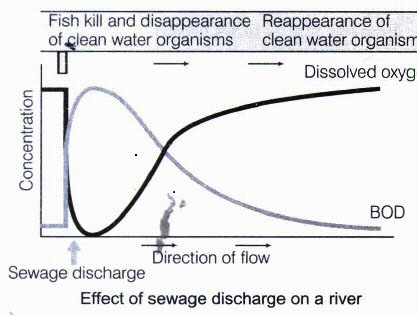
Determination of BOD is thus an important parameter in suggesting the quality of a water body.The presence of more organic waste increases the microbial activity thus decreasing the DO.BOD is higher in polluted water and lesser in clean water.
24.
Yes, if a pregnant woman has high blood pressure, the woman develops preeclampsia, which can threaten the lives of both the mother and the foetus.It can cause low birth weight and early delivery of foetus,sometimes the child,born very early also may die.
High blood pressure can harm the mother's kidneys and other organs and also lower the number of platelets.
25.
(a) Phytoplanktons
(b) Zooplanktons
(c) Oak tree
(d) lice and bugs
26.
The name of gobar gas (or biogas) is methane.It is generated by the activity of methanogenic bacteria (i.e., methane producing anaerobic bacteria). Following are advantages of using methane as a source of energy:
(i) Methane is insoluble and therefore, separates very easily from the fermentor.
(ii) It can be very easily pressurized or liquefied for storage
(iii) It is readily combustible.
27.
(a) Medical Termination of pregancy (MTP).
(b) MTP is done to get rid of unwanted pregnancy due too
(i) Casual unprotected intercourse
(ii) Failure of the contraceptive used during coitus, and
(iii) Rape.
28.
29.
30.
1. In England, before industrial revolution, there were more white-winged or dull-grey moths on the tree trunks, than the dark-winged or melanic moths.
2. In the collection of moths, carried out in the same area after industrial revolution, there were more dark-winged moths.
3. The explanation given for this observation was that predators will spot a month against a contrasting background.
4. During the post-industrialisation period, the trunks became dark with the industrial smoke and soot.
5. Under this condition, white-winged moths did not survive as predators could easily spot these, while dark-winged or melanic moths survived better.
6. Before industrialisation, there used to be a thick growth of the almost white coloured lichens on the tree trunks and in that background, the white-winged moths survived better; the dark coloured moths were easily spotted and picked up by their predators.
7. In this case,the moths which were able to camouflage and hide in the background survived and increased their population size through reproduction.
31.
1. It refers to the increase in concentration of the harmful/toxic substances at successive trophic levels.
2. It happens because such harmful/toxic substances can neither be metabolised nor excreted, but are passed onto the next (higher) trophic level.
3. In fish-eating birds, the high concentrations of DDT disturb the calcium metabolism.
4. It causes thinning of eggshell and the premature breaking of such eggs leads to a decline in bird populations of fish-eating birds.
32.
Downstream processing refers to the series of processes, to which a product has to be subjected before it is ready to be marketed.
The processes include separation and purification.
The 'product has to be formulated with suitable preservatives.
Such formulation has to undergo thorough clinical trials in the case of drugs.
Strict quality control testing is also required .
33.
1. Life cycle of Plasmodium in human body.
2. When an infected female Anopheles mosquito bites a person,the sporozoites are injected into the body.
3. They reach the liver cells through blood.
4. The parasite reproduces asexually in the liver cells and by the bursting of liver cells,new cells are released into the blood.
5. They enter the red blood cells (RBCs) and reproduce asexually;by bursting the red blood cells,the cells of the parasite release haemozoin,which causes the cycles of fever,chill and shivering.
6. The released parasite cells infect new red blood cells;some continue the asexual reproduction and cause the cycles of fever.
7. Others enter the sexual stage and form gametocytes in the RBCs,which are picked by the Anopheles mosquito, along with the blood meal.
34.
Plants:
The adaptations of plants to water scarcity are as follows:
(i) Desert plants have a thick cuticle on their leaf surface.
(ii) Their stomata are arranged in deep pits (sunken) to minimise water loss through transpiration.
(iii) Leaves are reduced to spines and the photosynthetic function is carried out by thick, fleshy flattened stems (phylloclades).
Animals:
(i) Animals like kangaroo rats are capable of meeting the water requirements through internal oxidation of fat.
(ii) They can concentrate their urine so that minimal volume of water is excreted.
(iii) Animals like snails undergo aestivation during hot summers.
35.
\(\alpha \) -1-antitrypsin is produced to treat emphysema.
The gene for this protein is isolated or synthesized and introduced into a mouse.
The transgenic mouse produces the protein, which is to be isolated, purified and used on human beings after clinical trials.
36.
(i) Totipotency of cells is the property that enables the explants to regenerate.
(ii) Healthy banana plants can be obtained by meristem culture, as the meristems are free of virus, and by
micropropagation.
An explant from the meristem of the banana plant is to be made.
The nutrient medium should provide a carbon source like sucrose, inorganic salts, vitamins, amino acids and growth regulators (auxins, cytokinins and gibberellins).
The nutrient medium must be sterilised and the explants can be grown on that under sterile conditions.
37.
(c)
blastula
38.
(b)
CO2
39.
(b)
3' - end
40.
(a)
Orderly and sequential
41.
(c)
food web
42.
(b)
4
43.
(c)
Vivipary
44.
(b)
nematodes
45.
(c)
poison fangs in snakes
46.
(c)
Bacillus thuringiensis
47.
(a)
Human gene may have intron which bacteria can not process
48.
(d)
IUDs (Intra uterine devices)
49.
(a)
Haploids are more abundant in nature than diploids
50.
(c)
Pollination by bats
51.
(b)
Hallucinogens

12th Standard CBSE Syllabus & Materials
12th Standard CBSE
CBSE 12th Computer Science Python Revision Tour I - New Previous year Question Papers Study Material - QB365 Set A
NEW12th Standard CBSE
CBSE 12th Business Studies Planning Important Questions And Answers Study Material - QB365 Set A
NEW12th Standard CBSE
CBSE 12th Business Studies Business Environment Important Questions And Answers Study Material - QB365 Set A
NEW12th Standard CBSE
CBSE 12th Business Studies Principles of Management Important Questions And Answers Study Material - QB365 Set A



CBSE 12th Standard CBSE Subjects
CBSE Standards










