
 100% FREE ACCESS
12th Standard CBSE Syllabus & Materials
12th Standard CBSE
CBSE 12th Economics Government Budget and the Economy Previous year Question Papers Study Material - QB365 Set A
NEW12th Standard CBSE
CBSE 12th Computer Science Interface Python with MySQL - New Previous year Question Papers Study Material - QB365 Set A
NEW12th Standard CBSE
CBSE 12th Computer Science Database Concept - New Previous year Question Papers Study Material - QB365 Set A
NEW12th Standard CBSE
CBSE 12th Computer Science Data Communication - New Previous year Question Papers Study Material - QB365 Set A
NEW12th Standard CBSE
CBSE 12th Computer Science Data Structures - New Previous year Question Papers Study Material - QB365 Set A
NEW12th Standard CBSE
CBSE 12th Computer Science Functions - New Previous year Question Papers Study Material - QB365 Set A

Published on: 16/09/2019
Biotechnology: Principles and Processes
Download CBSE Class 12th Standard CBSE Biology question papers, sample papers, important questions, and previous year solved papers in PDF format. Get free study materials, NCERT solutions, and exam preparation resources for Class 12th Standard CBSE Biology
Questions + Answers key
Take MCQ Biology Test
1.
Write the pallinodromic sequence of the following
5'_________ GAATTC______ 3'
2.
In nature A. tumifaciens which is called a natural genetic engineer, infects only dicots. Unfortunately many important crop plants are monocots and thus could not be easily transfacted. Scientists have discovered certain processes to introduce naked DNA molecules into the plant tissue that are not susceptible to A. tumefactions ? Explain any two.
3.
Discuss the role the enzyme DNA ligase plays during DNA replication.
4.
Differentiate gene therapy and gene cloning.
5.
Why and how bacteria can be made 'component'?
6.
Name the various cloning vectors and explain how a plasmid can be used for genetic engineering.
7.
Give the source of restriction enzyme, Bam HI and Kpn I.
8.
What does EcoRI signify? How its name is derived?
9.
List three important features necessary for preparing genetically modifying organism.
10.
What is genetic engineering?
11.
How is the gene z used as a marker?
12.
Describe briefly origin of replication.
13.
How are recombinant vectors created? Why is only one type of restriction endonuclease required for creating one recombinantvector?
14.
Name the source organism from which Ti plasmid is isolated. Explain the use of this plasmid in biotechnology.
1.
5'_________CTTAAG_________ 3'
2.
For explanation refer text book.
a. Micro-injection
b. Biolistics
3.
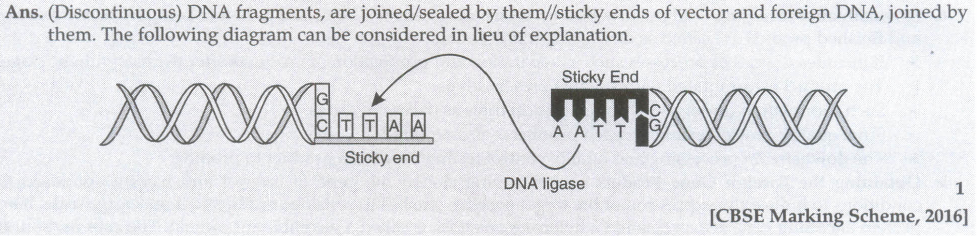
Detailed Answer:
DNA ligase joins or seals the discontinuous DNA fragments. The sticky ends of vector and foreign DNA are also joined and sealed with the help of DNA-ligase. The sticky ends are the single stranded overhanging stretches at the end of each strand of DNA formed as a result of endonuclease activity.
4.
Differences between gene therapy and gene cloning.
| Gene Therapy | Gene Cloning |
| It is the replacement and/ or alteration of defective genes responsible for hereditary diseases by normal genes. | It is the technique of obtaining identical copies of a particular segment of DNA or a gene. |
5.
Competent host for transformation with recombinant DNA
1. Treating bacteria with specific concentration of divalent cations, such as calcium which increases the efficiency with which DNA enters the bacterium through pores in the cell wall.
2. Recombinant DNA then is forced'into such cells by incubating the cells with recombinant DNA on ice.
3. It is followed by placing them briefly at 42°C.It is termed 'heat shock'
4. These bacteria are placed back on ice.
This enables bacteria to take up recombinant DNA.
6.
Cloning vectors
1. Plasmids
2. Bacteriophages
3. Plant and animal vectors
4. Jumping genes (Transposons)
5. Artificial chromosome, of bacteria, yeast and mammals.
Use of plasmid as genetic material
Plasmids are obtained from bacteria. They are treated with restriction endonuclease enzyme as to obtain the fragments of desired genome. They are allowed to fuse with the help of DNA ligase enzyme. The recombinant plasmids thus formed are used as genetic material.
7.
Kpn I is obtained from Klebsiella pneumoniae and Bam HI is obtained from Bacillus amyloliquefaciens H.
8.
EcoRI signifies the name of restriction endonuclease.
(i) First capital letter of the name comes from the genus Escherichia is 'E'.
(ii) Second two small letters come from the species of prokaryotic cells from which they are isolated i.e. 'co'.
(iii) Letter R is derived from the name of strain i.e. Escherichia Coli By. 13.
(iv) Roman number indicate the order in which enzymes were isolated from that strain of bacteria.
9.
Conditions necessary for preparing.
1) Identification of DNA with desirable genes.
2) Introduction of the identified DNA into the host.
3) Maintenance of introduced DNA in the host and transfer of the DNA to its progeny.
10.
Genetic Engineering: THe methods of artificial synthesis of new genes and their subsequent "transplantation" in the genome of an organism or methods of correcting the defective genes is called genetic engineering. It is a kind of biotechnology. It involves transfer or replacement of genes. Har Govind Khorana developed the technique of synthesis of known sequence of nucleotide or gene in test tube.
11.
A recombinant DNA is inserted within the coding sequence of \(\beta \) -galactosidase; this results into inactivation of the enzyme (called insertional inactivation).
It is treated with a chromogenic substance. If the plasmid in the bacteria have no insert blue colour appears; if they do not produce blue colour, they are recombinants.
12.
Origin of replication:
Origin of replication (Ori) is a specific sequence of DNA bases, which is responsible for initiating replication.
An alien DNA for replication should be linked to the origin of replication.
A prokaryotic DNA has normally a single origin of replication, while eukaryotic DNA may have more than one origin of replication
13.
The vector DNA is cut at a particular restriction site using a restriction enzyme used to cut the desired DNA segment.
The alien DNA is then linked with the plasmid DNA using a ligase to form the recombinant vector.
Since a restriction enzyme recognises and cuts the DNA at a particular sequence called recognition site, the same restriction enzyme is used for cutting the DNA segment from both the vector and the other source.
14.
The Ti plasmid of Agrobacterium is responsible for the transformation of plant cell into tumours.
So,it is modified into a non-pathogenic one but still usable to deliver the DNA; this disarmed plasmid o Agrobacterium is used as a vector for transformation of plant cells.

12th Standard CBSE Syllabus & Materials
12th Standard CBSE
CBSE 12th Computer Science Python Revision Tour I - New Previous year Question Papers Study Material - QB365 Set A
NEW12th Standard CBSE
CBSE 12th Business Studies Planning Important Questions And Answers Study Material - QB365 Set A
NEW12th Standard CBSE
CBSE 12th Business Studies Business Environment Important Questions And Answers Study Material - QB365 Set A
NEW12th Standard CBSE
CBSE 12th Business Studies Principles of Management Important Questions And Answers Study Material - QB365 Set A



CBSE 12th Standard CBSE Subjects
CBSE Standards










