
 100% FREE ACCESS
12th Standard CBSE Syllabus & Materials
12th Standard CBSE
CBSE 12th Economics Government Budget and the Economy Previous year Question Papers Study Material - QB365 Set A
NEW12th Standard CBSE
CBSE 12th Computer Science Interface Python with MySQL - New Previous year Question Papers Study Material - QB365 Set A
NEW12th Standard CBSE
CBSE 12th Computer Science Database Concept - New Previous year Question Papers Study Material - QB365 Set A
NEW12th Standard CBSE
CBSE 12th Computer Science Data Communication - New Previous year Question Papers Study Material - QB365 Set A
NEW12th Standard CBSE
CBSE 12th Computer Science Data Structures - New Previous year Question Papers Study Material - QB365 Set A
NEW12th Standard CBSE
CBSE 12th Computer Science Functions - New Previous year Question Papers Study Material - QB365 Set A

Published on: 05/09/2019
Evolution
Download CBSE Class 12th Standard CBSE Biology question papers, sample papers, important questions, and previous year solved papers in PDF format. Get free study materials, NCERT solutions, and exam preparation resources for Class 12th Standard CBSE Biology
Questions + Answers key
Take MCQ Biology Test
1.
Why are lichens regarded as pollution indicators?
2.
How does a population become 'founders' of a new species?
3.
State the significance of Coelacanth in evolution.
4.
State the significance of biochemical similarities among diverse organisms in evolution.
5.
Why are scientists searching for existence of life on other planets?
6.
Explain the term biogenesis.
7.
When we say 'survival of the fittest', does it mean that:
(a) those whose are fit only survive or
(b) those that survive are called fit? Comment.
8.
How do Darwin and de Vries differ in their views on the mechanism of evolution of life on earth?
9.
Convergent evolution leads to analogous structures. Explain with the help of an example.
10.
Make a list of the theories put forward for the origin of life?
11.
Comment on the statement that "evolution and natural selection are end result of consequences of some other processes but themselves are not processes.
12.
(a) What is adaptive radiation?
(b) Explain with the help of a suitable example, where adaptive radiation has occurred to represent convergent evolution.
13.
(a) Explain the theory of abiogenesis.
(b) How did Miller demonstrate experimentally the chemical evolution that happened three billion years ago?
14.
(a) Write Hardy-Weinberg principle.
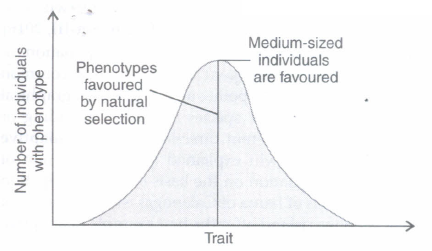
(b) Explain the three different ways the natural selection can affect the frequency of a heritable trait in a population shown in the graph given below.
15.
One day, while returning home from school, Anil saw a crowd gathering front of Mr. Sharma's house. He asked his mother about it. She told that Mrs. Sharma gave birth to a child with small tail. Many people gathered just for curiosity and some whispered that it is a bad omen.
Read the above passage and answer the following questions:
(i) What is your opinion about child?
(ii) What is atavism?
(iii) What will be your role as a good citizen and student of biology?
16.
(a) Name the primates that lived about 15 million years ago. List their characteristic features.
(b) (i) Where was the first man-like animal found?
(ii) Write the order in which Neanderthals, Homo habilis and Homo erectus appeared on the earth. State the brain capacity of each one of them.
(iii) When did modern Homo sapiens appear on this planet?
17.
Which of the following are not analogous organs?
fins of fishes and flippers of whales
stings of honey bee and scorpion
thorn of Bougainvillea and tendril of Cucurbita
wings of insect and wings of pterodactyl
18.
Evolutionary history of an organism is known as
ontogeny
phylogeny
ancestry
paleontology
19.
The biogenetic law of Hackel is
Omnis vivum-e-vivum
Omnis cellula-e-cellula
Ontogeny repeats phylogeny
Phylogeny repeats ontogeny
20.
De Vries gave his mutation theory on organic evolution while working on
pisum sativum
Drosophila melanogaster
Oenothera lamarckiana
Althea rosea
21.
Presence of gills in the tadpole of frog indicates that
fishes evolved from frog-like ancestors
frogs will have gills in future
frogs evolved from gilled ancestors
fishes were amphibious in the past
1.
()
Since, lichens do not grow in polluted areas, they are regarded as pollution indicators.
2.
()
When the change in allele frequency is so different that the new sample of population becomes a different species, the original drifted population becomes founders.
3.
()
Their discovery was significant as they proved thatamphibians have evolved from fish-like organisms. Lobefins are the ancestors of modern day frogs and
salamanders.
4.
()
The biochemical similarities point to the same shared ancestry among diverse organisms.
5.
They want to know whether the organisms on other planets, if any, are similar, have similar genetic code and similar elements to ours or different.
6.
The concept of biogenesis means that new life at present comes only from preexisting life (Omne vivum exvivo).
7.
Survival of the fittest means that those individuals which survive and reproduce successfully in their given environment or habitat, are called fit.
Such individuals produce more progeny (with more fit individuals), than the others who are less-adapted to survive and reproduce in that environment.
8.
| Darwinian Concept | de Vries' Concept |
|
According to Darwin, speciation occurs with the accumulation of minor heritable variations. Evolution was gradual and occurs through a number of generations. Variations are small and directional. |
According to de Vries, mutations arising suddenly in a population, are responsible for speciation. Evolution occurs in a large single-step mutation (saltation). Mutations are random and directionless. |
9.
convergent evolution is the evolutionary process, where anatomically different structures in different groups of organisms evolve towards the same function, in similar habitats.
Such structures in different groups of organisms which perform similar function, but are anatomically different, are called analogous organs.
The wings of a butterfly and those of bird are anatomically different, but perform the same function (flying); hence they are said to be analogous organs.
10.
1. Theory of special creation,
2. Theory os spontaneous generation.
3. Theory of catastrophism.
4. Interplanetary theory,
5. Theory of Eternity of life
6. Modern or chemical or naturalistic theory.
11.
1. We are still not clear whether evolution and natural selection are processes or results of some unknown processes.
2. On one hand, when we describe the world as we see today, we describe evolution a process.
3. On the other hand, when we describe life on earth, we treat evolution as a consequences of the process of natural selection.
12.
Adaptive radiation is the evolutionary process in which a common ancestor evolves into a number of species, in a given geographical area, starting from a point and literally radiating to other areas of geography.
A number of Australian marsupials, each different from the other, evolved from an ancestral stock, all within the Australian island continent.
When more than one adaptive radiation appeared to have occurred in an isolated geographical area, representing different habitats, it can be called convergent evolution.
Placental mammals of Australia also exhibit adaptive radiation in evolving into varieties of such placental mammals, each of which appears to be 'similar' to a corresponding marsupial, e.g. Bob cat resembles Tasmanian tiger cat.
Lemur - Spotted cuscus.
Anteater - Numbat.
13.
(a) Theory of chemical evolution or abiogenesis was proposed by Oparin and Haldane.
It states that the first form of life could have come from pre-existing non-living organic molecules (like RNA, proteins, etc.) and that formation of life was preceded by chemical evolution, i.e. formation of diverse organic molecules from inorganic constituents.
(b) Miller's experiment:
He created conditions similar to the primitive earth in the laboratory.
Electric discharge was produced (by using electrons) in a closed flask, containing methane, hydrogen, ammonia and water vapour.
The temperature was kept at \(800\)\(^{ \circ }{ C }\).
After a week, he observed formation of amino acids.
Such molecules must have reacted among themselves to form giant, self-replicating molecules, the first form of life.
14.
(a) Hardy-Weinberg's principle says that allele frequencies in a population are stable and constant
from generation to generation. The gene pool remains constant. This is called genetic equilibrium.
Sum total of all the allelic frequencies is 1. Individual frequencies, e.g., can be named p, q, etc.
Natural selection disturbs the allelic frequencies. Through natural selection either the frequency of
p increases or the frequency of q it will disturb the natural frequency. In a diploid, p and q represent the frequency of allele A and allele a. The frequency of AA individuals in a population is simply p2. This is simply stated in another ways , i.e., the probability that an allele A with a frequency of p appear on both the chromosomes of a diploid individual is the product of the probabilities.
Hence, p2 + 2pq + p2 = 1
The factors that affect the Hardy-weinberg's equilibrium are :
(i) Migration
(ii) Gene flow
(ill) Genetic drift
(iv) Mutation
(v) Genetic recombination
(b) Variation due to mutation or recombination during gametogenesis or due to gene flow or genetic drift results in changed frequency of genes and alleles in future generation. Natural selection can lead to stabilization (in which more individuals acquire mean character value), directional change (more individuals acquire value other than the mean character value) or disruption (more individuals acquire peripheral character value at both ends of the distribution curve).
15.
(i) Actually, the child is normal and carries the vestigial organ, i.e., remnant of last vertebra.
(ii) It refers to the reappearance of structures that were dominant in our remote ancestors.
(iii) As a good citizen and a biology student, I will educate people about vestigial organs and phenomenon of atavism so that they stop believing in myths.
16.
(a) Dryopithecus and Ramapithecus:
Characteristics:
(i) They were hairy.
(ii) They walked like gorillas and chimpanzees.
(iii) Ramapithecus was more man-like while Dryopithecus was more ape-like.
(b) (i) East African grasslands.
(ii) Homo habilis, Homo erectus and Neanderthals had brain capacities of 650-800 cc, 900 cc and 1400 cc, respectively.
(iii) During the ice age between 75,000-10,000 years ago.
17.
(c)
thorn of Bougainvillea and tendril of Cucurbita
18.
(b)
phylogeny
19.
(c)
Ontogeny repeats phylogeny
20.
(c)
Oenothera lamarckiana
21.
(c)
frogs evolved from gilled ancestors

12th Standard CBSE Syllabus & Materials
12th Standard CBSE
CBSE 12th Computer Science Python Revision Tour I - New Previous year Question Papers Study Material - QB365 Set A
NEW12th Standard CBSE
CBSE 12th Business Studies Planning Important Questions And Answers Study Material - QB365 Set A
NEW12th Standard CBSE
CBSE 12th Business Studies Business Environment Important Questions And Answers Study Material - QB365 Set A
NEW12th Standard CBSE
CBSE 12th Business Studies Principles of Management Important Questions And Answers Study Material - QB365 Set A



CBSE 12th Standard CBSE Subjects
CBSE Standards










