
 100% FREE ACCESS
12th Standard CBSE Syllabus & Materials
12th Standard CBSE
CBSE 12th Economics Government Budget and the Economy Previous year Question Papers Study Material - QB365 Set A
NEW12th Standard CBSE
CBSE 12th Computer Science Interface Python with MySQL - New Previous year Question Papers Study Material - QB365 Set A
NEW12th Standard CBSE
CBSE 12th Computer Science Database Concept - New Previous year Question Papers Study Material - QB365 Set A
NEW12th Standard CBSE
CBSE 12th Computer Science Data Communication - New Previous year Question Papers Study Material - QB365 Set A
NEW12th Standard CBSE
CBSE 12th Computer Science Data Structures - New Previous year Question Papers Study Material - QB365 Set A
NEW12th Standard CBSE
CBSE 12th Computer Science Functions - New Previous year Question Papers Study Material - QB365 Set A

Published on: 03/03/2020
12th Standard CBSE Biology Public Exam Sample Question 2020
Download CBSE Class 12th Standard CBSE Biology question papers, sample papers, important questions, and previous year solved papers in PDF format. Get free study materials, NCERT solutions, and exam preparation resources for Class 12th Standard CBSE Biology
Questions + Answers key
Take MCQ Biology Test
1.
Mass extinction at the end of mesozoic era was probably due to
continental drift
the collision of earth with large meteorites
massive glaciations
change in earth's orbit
2.
In females, the hormone inhibin is secreted by
granulosa and theca cells
granulosa cells and corpus luteum
granulosa and cumulus oophorous cells
granulosa cells and zona pellucida
3.
The extinction of passenger pigeon was due to:
Increased number of predatory birds.
Over-exploitation by humans.
Non-availability of the food.
Bird flu virus infection.
4.
Effect of pollution is first marked on
microorganism
green vegetation of an area
food crop
none of these
5.
Pyramid of energy in aquatic ecosystem is
always straight
always inverted
bell shaped
none of these
6.
Which of the following would necessarily decrease the density of a population in a given habitat?
Natality > mortality
Immigration > emigration
Mortality and emigration
Natality and immigration
7.
The substance produced by a cell in viral infection that can protect other cells from further infection is:
Serotonin
Colostrum
Interferon
Histamine
8.
Choose the mismatched option
Wind - Cannabis: Anemophily
Water - Zostera: Hydrophily
Insects - Salvia: Entomophily
Birds - Adansonia: Ornithophily
Bats - Kigelia: Chiropterophily
9.
Biogas production is carried out by
thermoacidophils
methanogens
halophiles
luminants
10.
Significance of 'heat-shock' method in bacterial transformations is to facilitate:
Binding of DNA to the cell wall
Uptake of DNA through membrane transport proteins
Uptake of DNA through transient pores in the bacterial cell wall
Expression of antibiotic resistance gene
11.
The technique called Gamete Intra Fallopian Transfer (GIFT) is recommended for those females
who cannot produce an ovum
who cannot retain the foetus inside uterus
whose cervical canal is too narrow to allow passage for the sperms
who cannot provide suitable environment for fertilization
12.
Out of 64 codons how many codons do not code for any amino acid?
62
61
3
1
13.
A self-fertilising trihybrid plant forms
4 different gametes and 16 different zygotes
8 different gametes and 16 different zygotes
8 different gametes and 32 different zygotes
8 different gametes and 64 different zygotes
14.
Male and female sex chromosomes are also called
Polytene
Autosomes
Holandric
Allosomes
15.
Insect resistance trangenic cotton has been produced by inserting a piece of DNA from
an insect
a bacterium
a wild relative of cotton
a virus
16.
Which of the following statements is true of yeast?
The cell divides by binary fission. One of them develops into a bud.
The cell divides unequally. The smaller cell develops into a bud.
The cell produces conidia, which develop into a bud.
17.
Name a bacterium which yields a number of antibiotics.
18.
Name the nematode that damages the roots of tobacco plants. How is a transgenic tobacco plant made resistant to nematode using biotechnology?
19.
(i) Name the selectable markers in the cloning vector pBR322.Mention the role they play.
(ii) Why is the coding sequence of an enzyme \(\beta \)- galactosidase a preferred selectable marker in comparison to the ones named above?
20.
A doctor prescribed morphine as a sedative and pain killer to your cousin who had undergone surgery. Even after recovery, he craved for the prescribed medicine. What do you conclude about his condition, had he continued with the same medication? After appraising yourself, what measures will you suggest to him to overcome this problem? Briefly explain any two.
21.
Why are decomposers essential in nature?
22.
Match the items in column I with appropriate items (one or more) of column II.
| Column I | Column II |
| (i) Connecting link between annelids and arthropods | (a) Impression or imprints of past animals and plants in the sedimentary rocks. |
| (ii) Vestigial organ in man. | (b) Peripatus |
| (iii) Fossils | (c) Auricular muscles |
| (iv) Extinct bird | (d) Seymouria |
| (v) Missing link between amphibian and reptiles. | (e) Coccyx (tail bone) |
| (f) Archaeopteryx | |
| (g) Vermiform appendix |
23.
Explain briefly the genetic code
24.
Particulate and gaseous pollutions along with harmless gases are released from the thermal power plants.
(i) Name the two harmless gases released.
(ii) Name the most widely- used device for moving particulate pollutans from the air.Explain how the device is used.
25.
(a) In plant breeding experiments, pistillate flowers are not emasculated, but are still bagged. Explain.
(b) Why are outbreeding devices developed by some flowering plants?
26.
What are the measures one has to take to prevent from contracting STDs?
27.
E-waste is creating a big problem. Developing countries are more responsible for it, affecting the environment of developing countries. Explain.
(i) What is e-waste ? Why is it a cause of concern for our environment?
(ii) How is it produced and how does it affect the developing countries?
28.
(a) What is Central dogma? Who proposed it ?
(b) Describe Meselson and Stahl's experiment to prove that the DNA replication is semi-conservative.
29.
(a) Draw a labelled diagram of the sectional view of microsporangium of an angiosperm.
(b) Explain the development of male gametophyte in the microsporangium.
30.
Rahul introduced Ronit to his uncle and told him that Ronit is pursuing course in biotechnology in America.
His uncle had never of this term earlier and was curious to know about this term. Ronit pointed towards a big tree at the base of which were present numerous tumour-like structures and said that this is the example of natural biotechnology.
(i) What is biotechnology?
(ii) How these crown gall tumours are formed?
(iii) What are the value shown by Rahul's uncle?
31.
Last year, Dadaji was going to meet his old friend in a village near Lucknow. Dadaji's friend was earnings a lot by exporting mangoes. Anil also accompanied Dadaji as he also very found of mangoes. Dadaji's friend invited him to visit the orchard. Anil knew that there are many varieties of mangoes with different shapes, color of skin and tastes. On visiting the orchard, Anil was surprised to see that more than one type of mangoes were growing on the same tree.
(i) Is it possible for Anil to grow for commercial purpose any variety of mango on the tree of mango growing in his garden?
(ii) What type of reproduction is involved in this process?
(iii) Name any other species which can be propagated by this technique for commercial purpose.
(iv) How could Dadaji's friend improve the varieties of mangoes in his garden?
32.
We are told that evolution is a continuing phenomenon for all living things. Are humans also evolving? Justify your answer.
33.
Describe the role of living organisms in the cycle .
34.
What are transgenic animals? Explain any four ways in which such animals can be beneficial to humans.
35.
Name the methods employed in animal breeding.According to you which one of the methods is the best? Why?
36.
Differentiate between the following:
(a) Polgenic inheritance and Pleiotropy
(b) Dominance, Codominance and Incomplete dominance
37.
(a) Draw a diagramatic sectional view of human ovary showing different stages of oogenesis along with corpus luteum.
(b) Where is morula formed in human?Explain the process of its development from zygote.
38.
Write the formula to calculate allele frequency in future generations according to Hardy- Weinberg equilibrium
39.
What is ozone shield and why is it important? Name the gases that cause stratospheric ozone, depletion.
40.
Sound of what intensity is harmful for ears?
41.
Very briefly explain Pleiotropy
42.
Write the names of any four essential amino acids which our body fails to synthesize.
43.
Write a note on natality.
44.
When foreign DNA is introduced into an organism, how is it maintained in the host and how is it transferred to the progency of organism?
45.
List the properties of antibiotics.
46.
Differentiate between quiescence and dormancy with reference to seed germination.
47.
It is said that diseases are spreading faster due to globalisation and increased movement of people. Justify the statement taking the example of \({ H }_{ 5 }{ N }_{ 1 }\) virus.
48.
What are the conditions in which medical termination of pregnancy is advised?
49.
In which the type of reproduction, do we associate the reduction division? Analyse the reasons for it.
50.
Explain the role of Ti plasmids in biotechnology
51.
Describe frameshift mutations.
1.
(b)
the collision of earth with large meteorites
2.
(b)
granulosa cells and corpus luteum
3.
(b)
Over-exploitation by humans.
4.
(b)
green vegetation of an area
5.
(a)
always straight
6.
(c)
Mortality and emigration
7.
(c)
Interferon
8.
(d)
Birds - Adansonia: Ornithophily
9.
(b)
methanogens
10.
(c)
Uptake of DNA through transient pores in the bacterial cell wall
11.
(a)
who cannot produce an ovum
12.
(c)
3
13.
(d)
8 different gametes and 64 different zygotes
14.
(d)
Allosomes
15.
(b)
a bacterium
16.
(b)
The cell divides unequally. The smaller cell develops into a bud.
17.
Streptomyces
18.
Nematode - Meloidogyne incognita.
(i) A nematode Meloidogyne incognita infect the roots of tobacco plants and causes a great reduction in yield. RNAi takes place in all eukaryotic organisms as a method of cellular defence. This method involves silencing of a specific mRNA due to a complementary dsRNA molecule that builds to and prevents translation of the mRNA (silencing).
(ii) Using Agrobacterium vectors, nematode-specific genes were introduced into the host plant. The introduction of DNA was such that it produces both sense and anti-sense RNA in the host cells. These two RNAs being complementary to each other formed a double-stranded RNA (dsRNA) that initiated RNAi and thus silenced the specificmRNA of the nematode. As a consequence the parasite could not survive in a transgenic host expressing specific interfering RNA
19.
(a) ampR / ampicillin resistance genes, tetR/ tetracycline resistance gene.
They help in identifying and eliminating non-transformants/non recombinants and selectively permitting the growth of the transformants / recombinants.
(b) Simpler process / less cumbersome, in the presence of chromogenic substrate recombinants are colourless and non recombinants are blue in colour.
20.
Drug dependence is the tendency of the body to manifest a characteristic and unpleasant withdrawal syndrome if regular dose of drugs is abruptly discontinued because of perceived benefits, drugs are frequently used repeatedly from which the person may not be able to rid off
Measures:
Education and counselling-to face problems and tresses/to channelize the energy into healthy pursuits like reading, music, yoga and other extracurricular activities
Seeking help from parents-to guide the person appropriately and immediately
Seeking professional and medical help-to help the person to get rid of the problem completely with sufficient efforts and will power.
21.
Bacteria, fungi, and actinomycetes act ad decompose to decompose dead bodies of plants and animals and their wastes to release locked in organic materials for their recycling in the environmental.Therefore, decomposers are essential in natural.
22.
(i) b (ii) c, e and g (iii) a (iv) f (v) d.
23.
Genetic code:
1. The sequence of the base on the DNA molecule determines the structure of mRNA which in turn governs the sequences of tRNA molecule each carrying a specific amino acid. The sequence of amino acid determines the structure of protein.
2. The mRNA molecule contains a series of nucleotides, in triplets which code the synthesis of proteins, Gamow (1954) first suggested triplets code. Each triplets containing three nucleotides is called a codon.
3.DNA contains four kinds of nucleotides and there are 20 different amino acids.
24.
(i) Oxygen and nitrogen.
(ii) Electrostatic precipitator is used.
1. It is the most widely used method for removal of particulate matter; about 90% of particulate matter is removed from the exhaust of thermal power plants.
2. It has electrode wires and a stage of collecting plates.
3. The electrode wires are maintained at several thousand volts, which produce a corona that releases electrons.
4. These electrons get attached to the dust particles and give them a net negative charge within a very small fraction of a second.
5. The collecting plates are grounded and hence attract the charged particles.
6. The velocity of air between the plates must be low enough to allow the particles to fall on them.
25.
(a) In plant breeding experiments, pollen from the selected male parent only, are used for pollination.
To prevent contamination of the stigma by any other pollen grain, the pistillate flowers are bagged.
(b) Continued self-pollination leads to inbreeding depression; hence to discourage self-pollination, outbreeding devices have been developed by flowers.
26.
STDs can be prevented by
(i) Avoiding sex with unknown partner or multiple partners.
(ii) Avoid unprotected sexual intercourse, always use condoms.
(iii) Use sterilised needles and syringes.
(iv) In case of doubt, consult a doctor as early as possible for early detection and get completely treated if diagnosed with disease.
27.
(i) E-waste is electronic products nearing the end of their useful life. It includes computers, monitors, CDs, DVDs, VCRs, televisions, mobiles, laptops, games, etc.
It causes toxicity due to some of the substances.
(ii) Uncontrolled burning and disposal of e-waste is causing environment problems.
28.
(a) Central dogma:
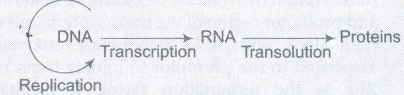
given by Francis Crick.
(b) Messelsont & stanl experiment:
.jpg)
(Same value points to be awarded in an explanation).
29.
Each cell of sporogenous tissue, functions as microspore mother cells \(\rightarrow \) meiosis/ microsporogenesis, \(\rightarrow \) microspore tetrad \(\rightarrow \) 4-pollen grains (male gametophyte) 2-celled stage
See Quick Review \(\rightarrow \) Microsporogenesis
30.
(i) Biotechnology deals with the techniques of using live organisms or enzymes from organisms to produce products and processes useful to human.
(ii) These are formed by integration of a segment of DNA of the bacterium Agrobacterium tumifacients into the host DNA.
(iii) Rahul's uncle has a positive desire to know about latest discoveries and developments in the field of science.
31.
(i) Yes, by using grafting technique he can grow any variety of mango on the already existing trees.
(ii) Artificial method can also be used for commerecial production of roses.
(iii) This technique can also be used for commercial production of roses.
(iv) Dadaji's friend improved the varieties of mangoes by using grafting techniques .
32.
New research suggests that despite modern technology and industrialisation, 'humans continue to evolve'. In the last 10,000 years or so, the pace of our evolution has speeded up 100 times creating more mutations in our genes and hence, greater natural selection.
Some clues that show humans are evolving are
(i) Lactose Tolerance: Historically the gene that regulated human's ability to digets lactose was shut down as infants are weaned off of their mother's breast milk. However, adult human in regions of Africa and Northern Europe developed the ability to tolerate lactose in their diets as recent as 5,000 or 6,000 years ago due to mutations.
(ii) Wisdom Teeth: Our ancestors had much bigger jaws than we do to lactose their eating habits. Today our jaws are much smaller and wisdom teeth are often impact estimates say that they will disappear in the coming population.
33.
Role of organisms
1. The roots of plants absorb the minute quantities of phosphates found dissolved in the soil solution.
2. The consumers obtain this element either directly (herbivores) or indirectly (carnivores) from plants.
3. The organic wastes from the living organisms and the dead organisms are decomposed and the phosphate-solubilising bacteria release phosphorus.
34.
Transgenic animals are those animals which have their DNA manipulated to possess and express one/more foreign gene(s).
They are produced for the following purposes:
(i) Transgenic animals are designed to allow the study of how genes are regulated and how they affect the normal functions of the body and its development, e.g. information has been obtained as to how insulin hasnt a role as growth factor.
(ii) Transgenic animals that produce useful biological compounds are created by introducing a portion of the DNA that codes for the product, e.g. a-1- antitrypsin is produced for treating emphysema.
(iii) Transgenic animals are being developed to test the safety of vaccines, e.g. polio vaccine has been tested on transgenic mice.
(iv) Transgenic animals with more sensitivity to toxic substances are being developed to test the toxicity of drugs.
35.
The methods employed in animal breeding are:
A. Natural methods. These are as follows:
(a) Inbreeding.
(b) Outbreeding which may be done by:
(i) Outcrossing
(ii) Cross breeding
(iii) Interspecific hybridization
B. Artificial methods. They include super ovulation and embryo transplantation, and multiple ovulatlon embryo transfer technology (MOET.)
Out of these methods, cross breeding is the best method of animal breeding because it is breeding between the superior males of another superior female breed. It allows the desirable qualities of two different breeds to be combined and give the best quality of yield.
36.
(a)
| Polygenic inheritance | Pleiotropy |
| It is a phenomenon in which a character is controlled by two or more genes. There is gradation in the phenotypes. |
It is a phenomenon where a single gene controls more than one phenotypic effect. There is no gradation of the phenotype. |
(b) Dominance·
It is the phenomenon in which one allele of a gene expresses itself and suppresses the expression of the other (recessive) allele of the same gene, when they are present together in a hybrid.
The hybrid resembles one of the parents.
Codominance:
It is the phenomenon in which two alleles of a gene are equally dominant and express themselves in the presence of the other.
The hybrid shows characters of both the parents.
Incomplete dominance:
It is the phenomenon in which neither of the two alleles of a gene is completely dominant over the other.
The hybrid is intermediate between the two parents.
37.
(b) Morula is formed in the isthmus of the oviduct/fallopian tube.
The zygote undergoes mitotic divisions in quick succession,called cleavage,forming 2,4,8 and 16 daughter cells,called blastomeres.
The embryo with 8-16 blastomeres is called a morula.
38.
(p + q)2 =p2+2pq+q2=1
39.
Ozone shield is a part of stratasphere in which the concentration of ozone is very high. It is called as ozone shield because it prevents the sun's UVradiations entering the earth atmosphere and in this way protects the living beings from harmful effects of these radiations.
Stratospheric ozone deplition results in the impairment of photosynthetic machinary in green plants which increases CO2 concentration and result in global warming and skin cancer and catract in humans. CFCs and CH2 gases cause damage to ozone shield.
40.
Over 75 dB.
41.
The multiple effects of a gene is called pleiotropy.
42.
Essential amino acid are those amino acids which are essential for growth and metabolism for human body but are not synthesized by it. Our body fails to synthesize lycine, tryptophan, methionine and cysteine.
43.
Natality. The birth, hatching or germination is called natality. It is one factor which determines the population and population density of an area at a time. It adds number of individuals to the population and increases it at a given time. If the birth rate is high, population increases.
44.
Foreign DNA is generally ligated to a plasmid and introduced in a host. As the plasmid replicates the foreign DNAalso gets replicated. When the host organism divides, its progeny also receives the plasmid with foreign DNA
45.
1. An antibiotic substance should have a broad spectrum, i.e., it should be able to destroy or inhibit a variety of pathogenic microbes.
2. It should not allow to develop the resistance to micro-organism when we take drugs or medicines.
3. It should not be harmful nor should it have any side effect in the body of host.
4. Normal microbial organism of the host should not be destroyed.
46.
Quiescent seeds can germinate when soaked in water under suitable temperature and in presence of oxygen. Quiescent condition is due to unfavourable factors.
The dormancy of seed is the condition of seed when it fails to germinate even through environmental conditions usually considered favourable for active growth are present. Dormancy is inability of seed to germinate even if conditions are favourable.
47.
\({ H }_{ 5 }{ N }_{ 1 }\) strain of bird flu virus mainly affects the poultry birds and cause an epidemic disease, called avian flu, in them. There are proofs of its transmission to other species of animals like cats, pigs, white tigers and even humans. The bird flu virus also shows human-to-human transmission. Due to globalization and increased movement of people, the disease can also spread rapidly from one state to another state of a country, and even one country to another country of the world. The chances of spread of disease are further increased when affected poultry products are imported from an affected nation.
48.
1. If pregnancy is likely to produce a congenitally malformed child.
2. In case of rape.
3. Contraceptive failure.
4. Pregnancy is likely to harm the mother.
49.
Reduction division or meiosis is associated with the sexual reproduction. Sexual reproduction involves fusion of gametes to form zygote that grows to form the offspring.
(i) Fusion of gametes causes doubling of chromosomes. There before, the gametes must be haploid.
(ii) Haploid gametes are formed from diploid cells. This is possible only through meiosis.
(iii) Reduction division maintains the constancy of chromosome number in the organisms generation after generation.
50.
The Ti plasmid of Agrobacterium is responsible for the transformation of plant cells into tumours.
So, it is modified into a non-pathogenic one but still usable to deliver the DNA; this disarmed plasmid of Agrobacterium is used as a vector for transformation of plant cells.
51.
1.Frameshift mutation is the type of mutation where addition/insertion or deletion of one or two bases changes the reading frame from the site of mutation, resulting in a protein with a different set of amino acids.
2. This forms the basis of proof that codon is a triplet and codons are read in a contiguous manner.
3. Insertion or deletion of three or its multiples of bases, does not alter the reading frame, but one or more amino acid(s) is/are coded in the polypeptide translated.

12th Standard CBSE Syllabus & Materials
12th Standard CBSE
CBSE 12th Computer Science Python Revision Tour I - New Previous year Question Papers Study Material - QB365 Set A
NEW12th Standard CBSE
CBSE 12th Business Studies Planning Important Questions And Answers Study Material - QB365 Set A
NEW12th Standard CBSE
CBSE 12th Business Studies Business Environment Important Questions And Answers Study Material - QB365 Set A
NEW12th Standard CBSE
CBSE 12th Business Studies Principles of Management Important Questions And Answers Study Material - QB365 Set A



CBSE 12th Standard CBSE Subjects
CBSE Standards










