
 100% FREE ACCESS
12th Standard CBSE Syllabus & Materials
12th Standard CBSE
CBSE 12th Economics Government Budget and the Economy Previous year Question Papers Study Material - QB365 Set A
NEW12th Standard CBSE
CBSE 12th Computer Science Interface Python with MySQL - New Previous year Question Papers Study Material - QB365 Set A
NEW12th Standard CBSE
CBSE 12th Computer Science Database Concept - New Previous year Question Papers Study Material - QB365 Set A
NEW12th Standard CBSE
CBSE 12th Computer Science Data Communication - New Previous year Question Papers Study Material - QB365 Set A
NEW12th Standard CBSE
CBSE 12th Computer Science Data Structures - New Previous year Question Papers Study Material - QB365 Set A
NEW12th Standard CBSE
CBSE 12th Computer Science Functions - New Previous year Question Papers Study Material - QB365 Set A

Published on: 30/08/2019
Reproduction in Organisms
Download CBSE Class 12th Standard CBSE Biology question papers, sample papers, important questions, and previous year solved papers in PDF format. Get free study materials, NCERT solutions, and exam preparation resources for Class 12th Standard CBSE Biology
Questions + Answers key
Take MCQ Biology Test
1.
What are possible types of pollination in chasmogamous flowers. Give reasons.
2.
The generative cell of a two-celled pollen divides in the pollen tube but not in three celled pollen. Give reasons.
3.
The cell division involved in gamete formation is not of the same type in different organisms. Justify.
4.
Which one of the following is common to multicellular fungi, filaments algea and protonema of mosses?
Diplontic life cycle
Members of kingdom plantae
Mode of Nutrition
Multiplication by fragmentation
5.
Banana is vegetatively propagated by
tubers
rhizomes
bulbs
suckers
6.
Which of the following animal is having longitudinal binary fission?
Euglena
Plasmodium
Planaria
Paramecium
Hydra
7.
In which of the following organism, self-fertilization is seen?
Fish
Roundworm
Earthworm
Liver fluke
8.
Refer to the diagram given below and answer the questions that follow.
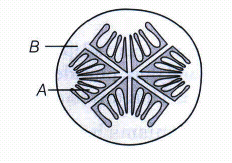
i) Label the parts A and B
ii) Which part of flower develops into seed and fruit?
iii) What is the function of both the labeled parts?
9.
Mohan "got very much excited to visit his hometown Kolkata after 5 years. On his way to his house from the railway station he saw that almost all small ponds were covered with some green weed,
(a) What could be the reason of this green cover.
(b) What damages does it cause to the ecology?
10.
What happens to the fate of zygote in algae and fungi?
11.
On which factors does the development of zygote depends?
12.
What are the events included in post-fertilisation?
13.
In which plants does the zygote develop a thick wall which is resistant to the desication and damage and undergoes a period of rest before germination?
14.
Which is the vital link between organisms of one generation and the next generation?
1.
Self-pollination and cross-pollination both can occur in chasmogamous flower. For details,refer Basics and Basis.
2.
In a 3-celled pollen, there is one vegetative or tube cell and two male gametes. in two-celled pollen, there is one vegetative cell and a generative cell. Here the generative cell divides in the pollen tube to form two male gametes which are already present in 3-celled pollen. Therefore, there is no need for further division in 3-celled pollen.
3.
1. In haploid organisms, showing haplontic life cycle, gamete formation involves only mitosis; the diploid zygote formed by the fusion of two haploid gametes, undergoes meiosis (zygotic meiosis).
2. In diploid organisms, showing diplontic or haplodiplontic life cycle, gamete formation involues meiosis (gametic meiosis) and haploid gametes are formedl; the diploid zygote undergoes mitosis to form diploid individuals.
4.
(d)
Multiplication by fragmentation
5.
(b)
rhizomes
6.
(a)
Euglena
7.
(d)
Liver fluke
8.
i) The part A is seed and B are pericarps.
ii) The part of the flower which develops into seed and fruit is ovule and ovary, respectively
iii) The seeds germinate to produce new plants while pericarp is protective in function.It protects the young seed.
9.
(a) The ponds were covered with a water weed which is commonly called as water hyacinth (Eichhornia crassipes).
(b) It propagates vegetatively by offsets at an alarming rate thereby spreading all over the water, totally covering it within a short period. Its thick cover over the water body prevents light entering the water and reduces the oxygen level of water. This results into the death of fishes and aquatic life in greatly disturbed.
10.
()
In many algae and fungi, the zygote secretes a thick wall around itself and undergoes a period of rest before germination. It undergoes meiosis and the product of meiosis form haploid individuals.
11.
()
The development of zygote depends on the type of life cycle of the organism and the nature of environment.
12.
()
It includes the events after the formation of zygote. It is the first cell of new generation events that, factors sexually reproducing organisms.
13.
()
Fungi and algae
14.
()
Zygote.

12th Standard CBSE Syllabus & Materials
12th Standard CBSE
CBSE 12th Computer Science Python Revision Tour I - New Previous year Question Papers Study Material - QB365 Set A
NEW12th Standard CBSE
CBSE 12th Business Studies Planning Important Questions And Answers Study Material - QB365 Set A
NEW12th Standard CBSE
CBSE 12th Business Studies Business Environment Important Questions And Answers Study Material - QB365 Set A
NEW12th Standard CBSE
CBSE 12th Business Studies Principles of Management Important Questions And Answers Study Material - QB365 Set A



CBSE 12th Standard CBSE Subjects
CBSE Standards










