
 100% FREE ACCESS
12th Standard CBSE Syllabus & Materials
12th Standard CBSE
CBSE 12th Economics Government Budget and the Economy Previous year Question Papers Study Material - QB365 Set A
NEW12th Standard CBSE
CBSE 12th Computer Science Interface Python with MySQL - New Previous year Question Papers Study Material - QB365 Set A
NEW12th Standard CBSE
CBSE 12th Computer Science Database Concept - New Previous year Question Papers Study Material - QB365 Set A
NEW12th Standard CBSE
CBSE 12th Computer Science Data Communication - New Previous year Question Papers Study Material - QB365 Set A
NEW12th Standard CBSE
CBSE 12th Computer Science Data Structures - New Previous year Question Papers Study Material - QB365 Set A
NEW12th Standard CBSE
CBSE 12th Computer Science Functions - New Previous year Question Papers Study Material - QB365 Set A

Published on: 31/08/2019
Sexual Reproduction in Flowering Plants
Download CBSE Class 12th Standard CBSE Biology question papers, sample papers, important questions, and previous year solved papers in PDF format. Get free study materials, NCERT solutions, and exam preparation resources for Class 12th Standard CBSE Biology
Questions + Answers key
Take MCQ Biology Test
1.
The meiocyte of rice has 24 chromosomes. Write the number of chromosomes in its endosperm.
2.
Write the cellular contents carried by the pollen tube. How does the pollen tube. How does the pollen tube gain its energy into the embryo sac?
3.
If you squeeze a seed of orange, you might observe many embryos of different sizes. How is it possible? Explain.
4.
Differentiate between the two cells enclosed in a mature male gametophyte of an angiosperm.
5.
Explain how false, true and parthenocarpic fruits are different from each other. Give one example of each.
6.
Draw the diagram of a microsporangium and label its wall layers. Write briefly about the wall layers.
7.
(a) Describe the process of megasporogenesis, in angiosperms.
(b) Draw a diagram of a mature embryo sac of angiosperm, label its any six parts.
8.
Explain double fertilisation and trace the post-fertilisation events in sequential order leading to seed formation in a typical dicotyledonous plant.
9.
Pick the odd one out
Chalazogamy
Porogamy
Mesogamy
Allogamy
10.
Which type of association is found in between entomophilous flower and pollinating agent?
Mutualism
Commensalism
Cooperation
Coevolution
11.
Intraspecific incompatibility can be overcome by
Wetting of anthers
Mixed pollination
Intraovarian fertilization
Intraspecific competition
1.
()
36 chromosomes.
2.
1. Pollen tube carries two male gametes and the vegetative nucleus.
2. Pollen tube grows through the tissues of stigma and style to reach the ovary.
3. It enters the ovule through the micropyle and then enters the embryo sac through the filiform apparatus of one of the synergids.
3.
1. It is a case of polyembryony, the phenomenon of occurrence of more than one embryo in a seed.
2. It is possible in the following ways:
(i) Some of the nucellar cells surrounding the embryo sac start dividing, protrude into the embryos.
(ii) Synergids of the embryo sac divide and form embryos.
4.
| Vegetative cell |
Generative cell |
|
It is larger and irregularly-shaped. Its cytoplasm is less dense and nucleus is large and irregular in shape. It has abundant food reserve. It does not divide further. |
It is smaller and spindle-shaped. It has a dense cytoplasm and a small round nucleus. It does not have food reserve. It divides mitotically to form two male gametes. |
5.
| False fruit | True fruit | Parthenocarpic fruit |
|
- When any part other than the ovary, contributes to the formation of fruit, it is called a false fruit, e.g. Apple, strawberry. |
- When a fruit is formed only by the ovary, it is called a true fruit, e.g. Tomato, brinjal | - When the ovary transforms into a fruit, without fertilisation, it is called a parthenocarpic fruit, e.g. banana. |
6.
A typical microsporangium is surrounded by four wall layers, i.e. the epidermis, endothecium, middle layers and the tapetum. The outer three wall layers are protective in function and help in dehiscence of anther to release pollen grains.
The innermost layer (tapetum) nourishes the developing microspores or pollen grains. The cells of tapetum possess dense cytoplasm and generally have more than one nucleus.
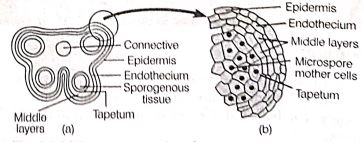
When the anther is young, a group of compactly arranged homogenous cells called the sporogenous tissue occupies the centre of each microsporangium.
7.
(i) The process of formation of megaspores from Megaspore Mother Cell or MMC (diploid) is called megasporogenesis.
It occurs inside the nucellus of developing ovule of angiosperms. The process begins very early when nucellus is not conmpletely surrounded by the integuments. The MMC (a large cell containing dense cytoplasm and a prominent nucleus) enlarges in size and divides by meiosis. It first divides transversely into two cells called megaspore dyad.
These two cells apgain divide transversely as a result, a linear row of four haploid cells megaspore tetrad is produced.
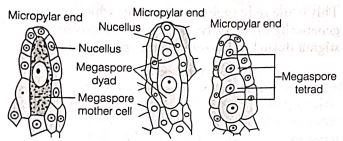
Out of the four megaspores one situated at the chalazal end remains functional and the rest three gradually degenerate. Such a development of embryo sac is called monosporic development, e.g. Pobygonum.
(ii)
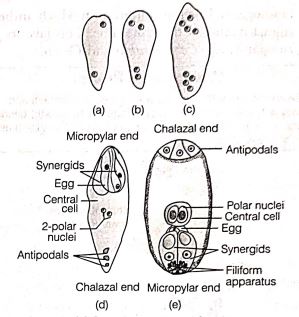
8.
- After entering one of the synergids,the pollen tube discharges the two male gametes into the cytoplasm of that synergid.
- One of the male gametes moves towards the female gamete/egg and fuses with it; this fusion is called syngamy and it results in the formation of a zygote.
- The second male gamete moves towards the two polar nuclei in the central cell.
- The two polar nuclei just fuse to form a secondary nucleus and the second male gamete fuses with the secondary nucleus in the central cell; this fusion is called triple fusion and, it results in the formation of a triploid primary endosperm nucleus.
- Since two fusions, syngamy and triple fusion occur in an ovule, the phenomenon is known as double fertilisation in angiosperms.
Post-fertilisation events:
- The central cell becomes the primary endosperm cell after triple fusion; the primary endosperm nucleus develops into the endosperm.
- Zygote develops into the embryo.
- Antipodals and synergids degenerate.
- The integuments develop into the seed coat.
- The ovule becomes transformed into a seed.
9.
(d)
Allogamy
10.
(a)
Mutualism
11.
(b)
Mixed pollination

12th Standard CBSE Syllabus & Materials
12th Standard CBSE
CBSE 12th Computer Science Python Revision Tour I - New Previous year Question Papers Study Material - QB365 Set A
NEW12th Standard CBSE
CBSE 12th Business Studies Planning Important Questions And Answers Study Material - QB365 Set A
NEW12th Standard CBSE
CBSE 12th Business Studies Business Environment Important Questions And Answers Study Material - QB365 Set A
NEW12th Standard CBSE
CBSE 12th Business Studies Principles of Management Important Questions And Answers Study Material - QB365 Set A



CBSE 12th Standard CBSE Subjects
CBSE Standards










