
 100% FREE ACCESS
12th Standard CBSE Syllabus & Materials
12th Standard CBSE
CBSE 12th Economics Government Budget and the Economy Previous year Question Papers Study Material - QB365 Set A
NEW12th Standard CBSE
CBSE 12th Computer Science Interface Python with MySQL - New Previous year Question Papers Study Material - QB365 Set A
NEW12th Standard CBSE
CBSE 12th Computer Science Database Concept - New Previous year Question Papers Study Material - QB365 Set A
NEW12th Standard CBSE
CBSE 12th Computer Science Data Communication - New Previous year Question Papers Study Material - QB365 Set A
NEW12th Standard CBSE
CBSE 12th Computer Science Data Structures - New Previous year Question Papers Study Material - QB365 Set A
NEW12th Standard CBSE
CBSE 12th Computer Science Functions - New Previous year Question Papers Study Material - QB365 Set A

Published on: 11/10/2019
Aldehydes , Ketones and Carboxylic Acids
Download CBSE Class 12th Standard CBSE Chemistry question papers, sample papers, important questions, and previous year solved papers in PDF format. Get free study materials, NCERT solutions, and exam preparation resources for Class 12th Standard CBSE Chemistry
Questions + Answers key
Take MCQ Chemistry Test
1.
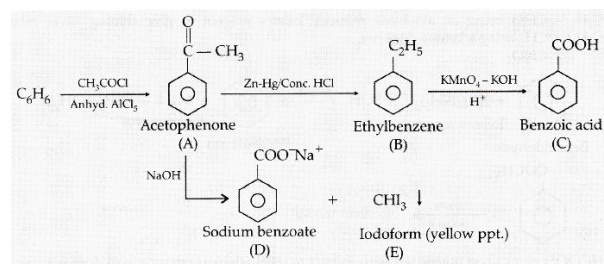
(i) Write the structures of A, B, C, D and.E in the following reactions:
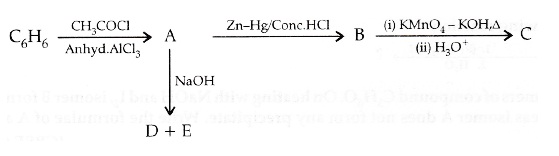
(ii) Write the chemical equation for the reaction involved in Cannizzaro reaction
(iii) Draw the structure of the semicarbazone of ethanal.
(iv) Why pKa of F - CH2 - COOH is lower than that of Cl- CH2 - COOH?
(v) Write the product in the following reaction
\({ CH }_{ 3 }-CH=CH-{ CH }_{ 2 }CN\begin{matrix} (i)\quad DIBAL-H \\ \longrightarrow \\ (ii)\ H_{ 2 }O \end{matrix}?\)
(vi) How can you distinguish between propanal and propanone?
2.
An organic compound (A) having molecular formula, C2H4O reduces Tollens' reagent. Two moles of (A) react with AI(OC2H5)3 to yield C4H8O2 (B) which reacts with NH3 to give C2H6O (C) and C2H5NO (D). Identify A,B,C and D.
3.
An organic compound (A) on treatment with ethyl alcohol gives a carboxylic acid (B) and compound (C). Hydrolysis of (C) under acidified conditions gives (B) and (D). Oxidation of (D) with KMnO4 also gives (B). (B) on heating with Ca(OH)2 gives (E) having moleuclar formula C3H6O. (E) does not give TOllens'test and does not reduce Fehiling's solution but forms 2, 4-dinitrophenyhydrazone. Identify (A),(B),(C),(D) and (E).
4.
Me3CCH2COOH is more acidic than Me3SiCH2COOH
5.
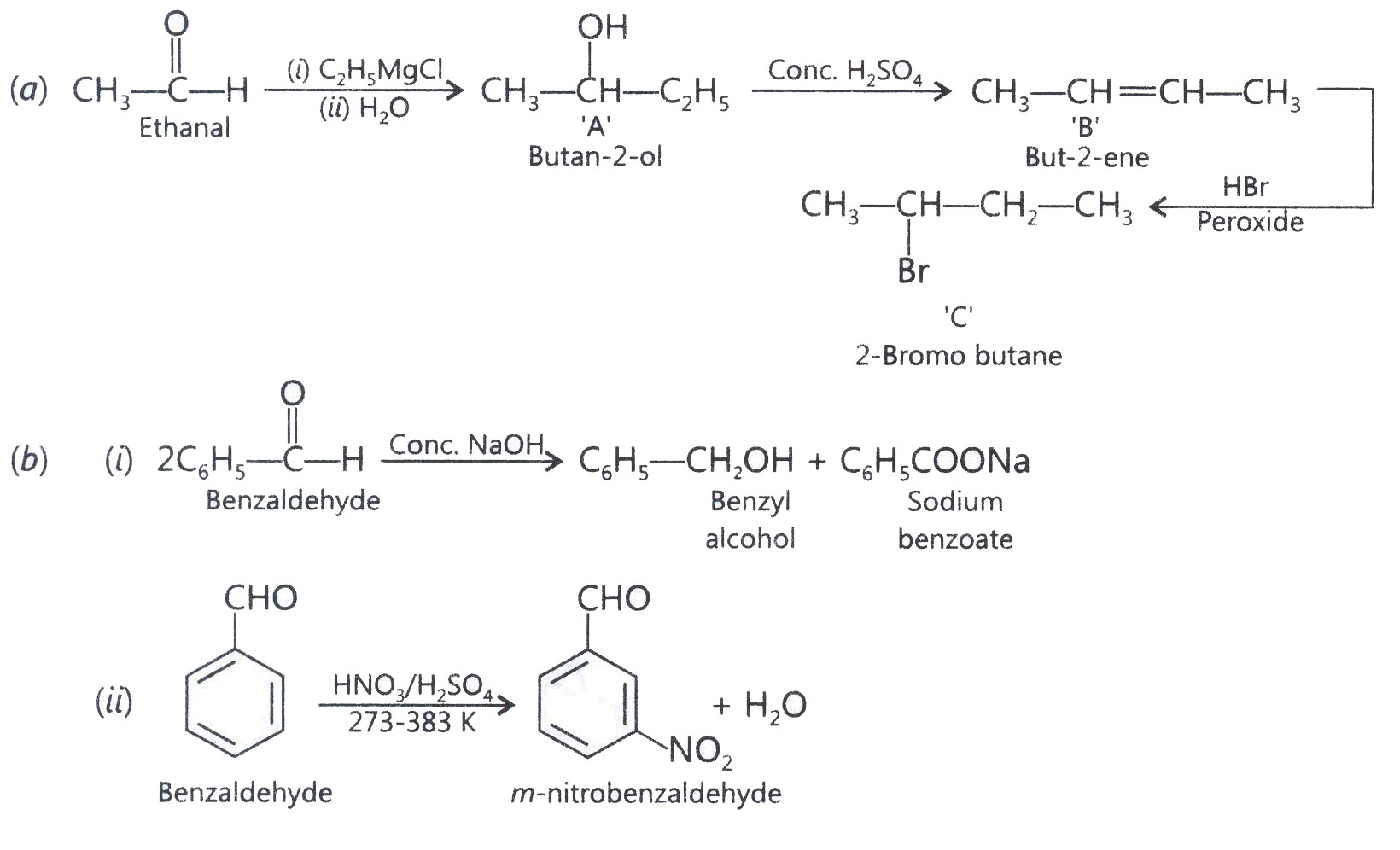
(a) Identify A, B and C in the following sequence of reactions:
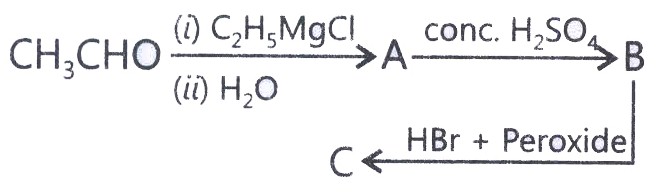
(b) Predict the structures of the products formed when benzaldehyde is treated with
(i) conc. NaOH
(ii) HNO3 / H2SO4 (at 273 - 383 k)
6.
(a) Describe the following giving linked chemical equations:
(i) Cannizzaro reaction
(ii) Decarboxylation
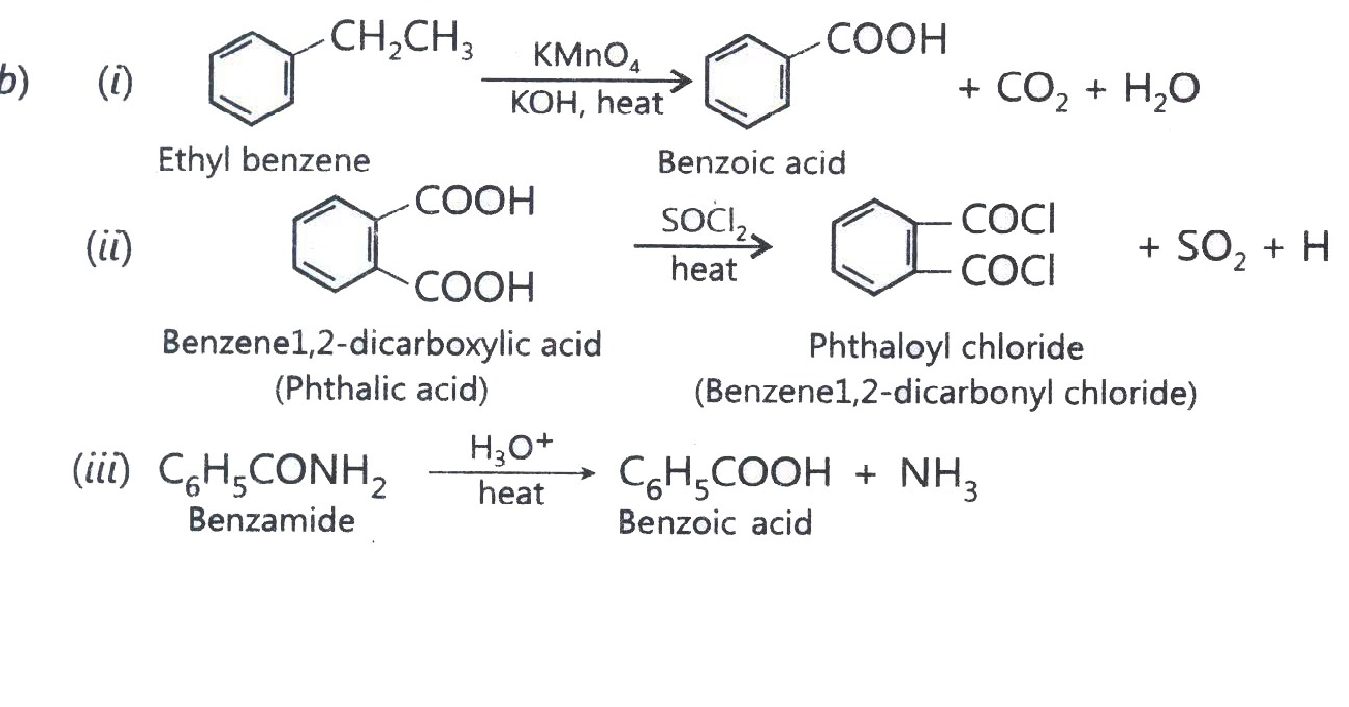
(b) Complete the following chemical equations:
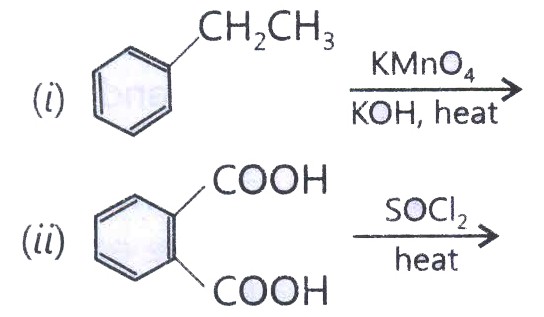
(iii) \(C_6H_5CONH_2 \xrightarrow [heat] {H_3O^+}\)
1.
(i)
(ii) \(2HCHO\overset { Conc.NaOH }{ \longrightarrow } { CH }_{ 3 }OH+HCOONa\)
(iii) \({ CH }_{ 3 }-CH=N-NH-CO-NH_{ 2 }\)
(iv) In FCH2 - COOH, fluorine is more electron withdrawing and has stronger -I effect than chlorine in ClCH2COOH. So, FCH2COOH is more acidic than CICH2COOH hence its pKa value is lesser than ClCH2COOH.
(v) \(CH_{ 3 }-CH=CH-{ CH }_{ 2 }-CN\overset { DIBAL-H }{ \underset { { H }_{ 2 }O }{ \longrightarrow } } { CH }_{ 3 }-CH=CH-{ CH }_{ 2 }-CHO\)
Pent-3-enenitrile Pent-3-ene-1-al
(v) Propanal and propanone can be differentiated by Tollen's reagent i.e. propanal will give silver mirror but propanone will not.
\({ CH }_{ 3 }-{ CH }_{ 2 }-CHO+2[Ag({ NH }_{ 3 })_{ 2 }]^{ + }\rightarrow { CH }_{ 3 }-{ CH }_{ 2 }-{ COO }^{ - }+2Ag\downarrow +{ H }_{ 2 }O+4{ NH }_{ 3 }\ (Or\ any\ other\ correct\ test)\) (Silver mirror)
2.
(i) Since compound (A) with M.F. C2H4O reduces Tollens' reagent, it must be an aldehyde, i.e., acetaldehyde (CH3HO).
\(\underset{Acetaldehyde}{CH_3CHO}+\underset{Tollens\ reagent}{2[Ag(NH_3)_2]^+}+3OH^-\longrightarrow CH_3COO^-+2Ag\downarrow+4NH_3+2H_2O\)
(ii) In presence of Al(OC2H5)3 aldehydes undergo Tischenko reaction to give esters. Thus, when two moles of acetaldehyde (CH3CHO) react in presence of AI(OC2H5)3 ethyl acetate (B) with M.F. C4H8O2 is produced
\(\underset{Acetaldehyde(A)\\(Two\ moles)}{CH_3CHO+OHCCH_3}\xrightarrow[(Tischenko reaction)]{Al(OC_2H_5)_3}\underset{Ethyl\ acetate\\ M/F.\ C_4H_8O_2}{CH_3COOCH_2CH_3}\)
(iii) The structure of ethyl acetate (B) is confirmed by the observation that on treatment with NH3, it gives one molecule of an alcohol, i.e., ethyl alcohol, CH3CH2OH (C) and one molecule of an amide, i.e., acetamide, CH3CONH2(D)
\(\underset{Ethyl\ acetate(B)}{CH_3COOCH_2CH_3}\xrightarrow{NH_3}\underset{Ethyl alcohol (C)\\ M.F. C_2H_6O}{CH_3CH_2OH}+\underset{Acetamide (D)\\ M.F. C_2H_5NO}{CH_3CONH_2}\)
3.
(i) Since compound (E) with molecular formula, C3H60 does not reduce Tollens' reagent and Fehling's solution but forms 2, 4-dinitrophenylhydrazone, it must be a ketone. But the only possible ketone having the molecular formula, C3H6O is acetone or propanone. Thus, compound (E) is acetone or (propanone) CH3COCH3·
(ii) Since acetone (E) is obtained by heating compound (8) with Ca(OH)2 therefore, (B) must be acetic acid (ethanoic acid), CH3COOH.
(iii) Since (D) on oxidation with KMn04 gives acetic acid (8), therefore, (D) must be ethyl alcohol (ethanol), CH3CH2OH.
(iv) Since acetic acid (8) and ethyl alcohol (D) are obtained by hydrolysis of (C) under acidic conditions, therefore, (C) must be ethyl acetate (ethyl ethanoate), CH3COOC2H5
(v) Since ethyl acetate (C) and acetic acid (8) are obtained by treatment of compound (A) with ethyl alcohol, therefore, compound (A) must be acetic anhydride (ethanoic anhydride), (CH3COO)2O.
(vi) All the reactions involved in this problem can now be explained as follows
4.
Si (E.N. = 8) is more electropositive than C (E.N. = 2.5), therefore, Me3Si (trimethylsilyl group) has greater +l-effect than that of Me3C (r-butyl group). As a result, Me3Si intesifies the -ve charge on the carboxylate ion relative to r-butyl group and hence Me3CCH2COOH is a stronger acid that Me3SiCH2COOH.
5.
6.
(a) (i) Cannizzaro's reaction:
When aldehydes which do not have \(\alpha\)-hydrogen gets oxidised as well as reduced in presence of conc. alkali, it is called Cannizzaro's reaction.
\(\underset { Methanal }{ 2HCHO } \overset { 50%NaOH }{ \longrightarrow } \underset { Sodium\quad Methanoate }{ HCOONa } +\underset { Methanol }{ CH_{ 3 }OH } \)
(ii) Decarboxylation : Sodium salts of acids when heated with soda lime, lower alkanes are formed
\(\underset { Sodium\quad acetate }{ CH_{ 3 }COONa } +\underset { Sodalime }{ NaOH } \longrightarrow \underset { Methane }{ CH_{ 4 } } +\underset { sodium\quad carbonate }{ Na_{ 2 }CO_{ 3 } } \)

12th Standard CBSE Syllabus & Materials
12th Standard CBSE
CBSE 12th Computer Science Python Revision Tour I - New Previous year Question Papers Study Material - QB365 Set A
NEW12th Standard CBSE
CBSE 12th Business Studies Planning Important Questions And Answers Study Material - QB365 Set A
NEW12th Standard CBSE
CBSE 12th Business Studies Business Environment Important Questions And Answers Study Material - QB365 Set A
NEW12th Standard CBSE
CBSE 12th Business Studies Principles of Management Important Questions And Answers Study Material - QB365 Set A



CBSE 12th Standard CBSE Subjects
CBSE Standards










