
 100% FREE ACCESS
12th Standard CBSE Syllabus & Materials
12th Standard CBSE
CBSE 12th Economics Government Budget and the Economy Previous year Question Papers Study Material - QB365 Set A
NEW12th Standard CBSE
CBSE 12th Computer Science Interface Python with MySQL - New Previous year Question Papers Study Material - QB365 Set A
NEW12th Standard CBSE
CBSE 12th Computer Science Database Concept - New Previous year Question Papers Study Material - QB365 Set A
NEW12th Standard CBSE
CBSE 12th Computer Science Data Communication - New Previous year Question Papers Study Material - QB365 Set A
NEW12th Standard CBSE
CBSE 12th Computer Science Data Structures - New Previous year Question Papers Study Material - QB365 Set A
NEW12th Standard CBSE
CBSE 12th Computer Science Functions - New Previous year Question Papers Study Material - QB365 Set A

Published on: 05/10/2019
Chemical Kinetics
Download CBSE Class 12th Standard CBSE Chemistry question papers, sample papers, important questions, and previous year solved papers in PDF format. Get free study materials, NCERT solutions, and exam preparation resources for Class 12th Standard CBSE Chemistry
Questions + Answers key
Take MCQ Chemistry Test
1.
(a) For a reaction A + B⟶P, the rate is given by Rate = k[A] [B]2
(i) How is the rate of reaction affected if the concentration of B is doubled?
(ii) What is the overall order of reaction if A is present in large excess?
(b) A first order reaction takes 30 minutes for 50% completion. Calculate the time required for 90% completion of this reactions. (log 2 = 0.3010)
2.
For the hydrolysis of methyl acetate in aqueous solution, the following results were obtained:
| t/s | 0 | 30 | 60 |
| [CH3COOCH3]/mol L-1 | 0.60 | 0.30 | 0.15 |
(i) Show that It follows pseudo first order reaction, as the concentration of water remains constant.
(ii) Calculate the average rate of reaction between the time interval 30 to 60 seconds. [Given log 2 = 0.3010, log 4 = 0.6021]
3.
Describe briefly the dependence of reaction rate of a chemical reaction on temperature. Explain the effect of temperature on the rate constant of a reaction.
4.
What is Arrhenius equation to describe the effect of temperature on rate of a reaction? How can it be used to calculate the activation energy of a reaction?
5.
When inversion of surcose is studied at pH = 5, the half-life period is always found to be 500 minutes irrespective of any initial concentration but when it is studied at pH = 6, the half-life period is found to be 50 minutes. Derive the rate law expression for the inversion of surcose.
6.
Two first reactions proceed at the same rate at 15oC when started with same initial concentration. The temperature coefficient of the first reaction is 2 while that of the second reaction is 3. What will be the ratio of the rates of these reactions at 55oC ?
7.
The energy change accompanying the equilibrium reaction A \(\rightleftharpoons \) B is -33.0 kJ mol-1. Calculate
(i) Equilibrium constant Kc for the reaction at 300 K
(ii) Energy of activation forward and backward reaction (Ef and Eb) at 300 K. Given that Ef and Assume that pre-exponential factor is same for forward and backward reaction.
8.
For the reaction, N2O5(g) = 2 NO2(g) + 0.5 O2 (g), calculate the mole fraction of N2O5 (g) decomposed at a constant volume and temperature, if the initial presure is 600 mm Hg and the pressure at any time is 960 mm Hg. Assume ideal gas behaviour.
9.
The time required for 10% completion of a first order reaction at 298 K is equal to that required for its 25% completion at 318 K. If the pre-exponential factor for the reaction is 3.56 \(\times 10 ^{9} s^{-1}\), calculate its rate constant at 318 K and also the energy of activation.
10.
(a) Explain the following terms:
(i) Order of a reaction
(ii) Molecularity of a reaction
(b) The rate of a reaction increases four times when the temperature changes from 300 k to 320 K. Calculate the energy of activation of the reaction, assuming that it does not change with temperature.
(R = 8.314 J K-1 mol-1)
11.
(a) Define the following:
(i) Order of a reaction
(ii) Elementary step in a reaction
(b) A first order reaction has a rate constant value of 0.00510 min-1. If we begin with 0.10 M concentration of the reactant, how much of the reactant will remain after 3.0 hours?
1.
A + B⟶P
Rate = k[A] [B]2
(i) When concentration of B is doubled it means conc. of B becomes 2 times.
Thus: Rate = k[A]1 [B]2
= k[A] [4B2]
So, the rate becomes 4 times.
(ii) Order of reaction is the no. of molecules whose conc. alters after the reaction. If A is present in excess i.e., its conc. is un-effected.
So, rate is depending only on the conc. of B. As
= k[B]2
Thus the reaction is of second order.
(b) For the 1st order reaction
\(k=\frac{2.303}{t}\log \frac{a}{a-x}\)
\(t=30 \times 60=1800\ sec\)
\(k=\frac{2.303}{1800}\log \frac{100}{100-50}\)
\(=\frac{2.303}{1800}\log 2\)
\(=\frac{2.303}{1800}\times0.3010\)
\(t=\frac{2.303}{k}\log \frac{a}{a-x}\)
\(=\frac{2.303}{k}\log \frac{100}{100-90}\)
\(=\frac{2.303}{k}\log 10=\frac{2.303}{k}\)
By putting the value of k here, we get
\(\Rightarrow \ t=\frac{2.303\times 1800}{2.303\times0.3010}\)
\(=5.98\times 10^3 sec\)
2.
For the first order reaction
\(t_1=30sec\)
\(t_2=30sec\)
\(k_1=\frac{2.303}{t_1}\log \frac{a}{(a-x)}\)
\(\Rightarrow\ \ \ \ k_1=\frac{2.303}{30}\log \frac{0.60}{0.30}\)
\(=\frac{2.303}{30}\log 2\)
\(\Rightarrow\ \ \ \ k_1=\frac{2.303}{30}\times 0.3010\)
\(=0.0231 \ s^{-1}\)
and \(k_2=\frac{2.303}{t_2}\log \frac{a}{(a-x)}\)
\(=\frac{2.303}{60}\log \frac{0.60}{0.15}\)
\(=\frac{2.303}{60}\log 2^2\)
\(\Rightarrow\ \ k_2=\frac{2.303\times 2 \times 0.3010}{30}\)
\(=0.0231\ s^{-1}\)
\(\because\ k_1=k_2\)
Hence, the reaction is pseudo first order reaction.
(ii) \(Rate=\frac{\Delta x}{\Delta t}\)
\(=\frac{0.30-0.15}{60-30}=\frac{0.15}{30}\)
\(=0.005 \ mol\ L^{-1} \ s^{-1}\)
3.
Temperature has a great effect on reaction rates or reaction rate constants. In general, an increase in temperature increases the rates of almost all reactions. For homogeneous chemical reactions, the rate of the reaction or rate constant (k) becomes almost double for every 10° rises in temperature.According to collision theory, the rate of reaction depends upon,
(i) the collision frequency of the reacting molecules.
(ii) the fraction of effective collisions.
The frequency of collisions between reacting molecules depends upon the average velocity of the molecules. With the increase in temperature, the average velocity of the molecules increases which results into increase in collision frequency. However, an increase of 10° rise of temperature increases the number of collisions by only 1.016 times. Further, we know that all the collisions are not effective. For molecules to undergo effective collisions, they must possess a certain minimum amount of energy called threshold energy. The molecules which possess energy equal to or greater than threshold energy will result in the formation of products. However, the fraction of such molecules capable of effective collisions is very small. As the temperature has increased the fraction of molecules possessing energies greater than threshold energy increases and so the rate of the reaction increases.
Let us consider the effect of increase of temperature on the number of effective collisions (having energies greater than threshold energy). The energy. distribution, of molecules at two temperatures \({ T }_{ 1 }\) and \({ T }_{ 2 }\) (where \({ T }_{ 2 }={ T }_{ 1 }+10°\)) is shown in figure. It is clear from the figure that the curve at higher temperature gets shifted towards the right indicating that at higher temperature, the molecules have higher energies. Further, the curve at higher temperature is flatter than that at lower temperature which also indicates that the number of molecules with higher energy content have increased.
The minimum energy required for the effective collisions also shown in the diagram and the number of molecules possessing energies equal to or greater than E, is proportional to area abed at temperature \({ T }_{ 1 }\) and area above at temperature \({ T }_{ 2 }\). In the figure, the area abef is roughly twice as large as abcd. Since the rate of reaction depends upon the number of molecules which possess energies larger than activation energy (for effective collisions), it may be interpreted that the fraction of molecules possessing activation energy has increased approximately two times and thereby, increases the rate of reaction by two times for a rise of 10 degrees.
Thus, we may conclude that increase in the rate of reaction with the rise in temperature is mainly due to the increase in number of effective collisions.
4.
Arrhenius equation. To deduce a quantitative relationship between rate constant and temperature, Arrhenius gave the following equation:
\(k=A{ e }^{ { { -E }_{ a } }/{ RT } }\quad \quad ..(i)\)
where A is a constant of proportionality, Ea is the activation energy which represents the minimum energy that the reacting molecules must possess before undergoing a reaction, T is the absolute temperature and R is the gas constant. This equation is called Arrhenius equation.
Taking logarithm, eq. (i) may be written as
\(ln\ \ \ k=ln\ A-\frac { { E }_{ a } }{ R } \times \frac { 1 }{ T } \quad \)
Converting to logarithm to the base 10 (InX = 2.303 log X), we get
\(2.303\log { k } =2.303\log { A } -\frac { { E }_{ a } }{ RT } \quad \quad ...(ii)\)
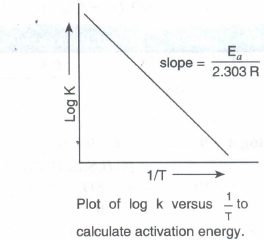
When log k is plotted against \(\frac { 1 }{ T } \) , we get a straight line as shown in diagram.
The intercept of this line is equal to log A and slope is equal to \(-\frac { { E }_{ a } }{ 2.303R } \quad \)
Therefore,
\(Slope=-\frac { { E }_{ a } }{ 2.303R } \)
Knowing the value of slope and gas constant R, activation energy can be calculated as
\({ E }_{ a }=-2.303R\times Slope\)
Alternatively, \({ E }_{ a }\) and A can be calculated by determining the values of rate constant at two different temperatures. Le,t \({ k }_{ 1 }\) and \({ k }_{ 2 }\) are the rate constants for the reaction at two different temperatures \({ T }_{ 1 }\) and \(T_{ 2 }\) respectively. Then,
\(\log { { k }_{ 1 } } =\log { A- } \frac { { E }_{ a } }{ 2.303\quad R{ T }_{ 1 } } \)
\(and\ \ \log { { k }_{ 2 } } =\log { A- } \frac { { E }_{ a } }{ 2.303\quad R{ T }_{ 1 } } \)
Subtracting eq. (iv) from eq. (iii), we get
\(\log { { k }_{ 2 } } -\log { { k }_{ 1 } } =\frac { { E }_{ a } }{ 2.303R } \left[ \frac { 1 }{ { T }_{ 1 } } -\frac { 1 }{ T_{ 2 } } \right] \)
 \(or\ log=\frac { { E }_{ a } }{ 2.303R } \left[ \frac { 1 }{ { T }_{ 1 } } -\frac { 1 }{ T_{ 2 } } \right] \)
By substituting the values of \({ k }_{ 1 }\) and\({ k }_{ 2 }\) and temperatures \({ T }_{ 1 }\) and \(T_{ 2 }\), \({ E }_{ a }\)can be calculated.
5.
At pH = 5, as half-life period is found to be independent of initial concentration of sucrose, this means with respect to sucrose, it is a reaction of first order, i.e., Rate = k [Sucrose].
If n is the order with respect to H+ion, t1/2 ∝ [H+]I-n,
i.e., 500 ∝ (10-5)I-n [PH = 5 means [H+] = 10-5 M] .......(I)
and 50 ∝ (l0-6)I-n [pH = 6 means [H+] = 10-6 M] .......(ii)
Dividing (i) by (ii), 10 = (lo)l-n i.e. 1 - n = 1 or n = 0, i.e., order with respect to H+ion = O.Hence, overall rate law is Rate = k [Sucrose] [H+]o.
6.
If RI is the rate of first reaction at 25°C, then as its temperature coefficient is 2, its rate at 35°C will be = 2 R1, at 45°C = 2 x 2 R1 = 4 R1 and at 55°C = 2 x 4 R1 = 8 R1
If R2.is the rate of the second reaction at 25°C, then as its temperature coefficient is 3, its rate at 35°C will be = 3 R2, at 45°C = 3 x 3 R2 = 9 R2 and at 55°C = 3 x 9 R2 = 27 R2
Also, we are given R1 = R2, i.e., at 25°C, the rates are equal.
At 550C, \({Rate\ of\ 2nd\ reaction\over Rate\ of\ 1st\ reaction}={27R_2\over 8R_1}={27\over 8}\)
7.
As.ΔH = - 33 kJ mol-1, the reaction is exothermic. The activation energy diagram will be as shown in fig.
ΔH = Ef - Eb= - 33 kJ
kf = Ae-Ef/RT
kb = Ae-Eb/RT
\(K_c={k_f\over k_b}=e^{(E_b-E_f)/RT}\)
In \(K_c={E_b-E_f\over RT}\ or\ log\ K_c={E_b-E_f\over 2.303RT}={30000\ J\ mol^{-1}\over 2.303(8.314JK^{-1}mol^{-1})300K}=5.2227\)
Kc = Antilog 5·2227 = 1·67 x 105
Substituting \(E_b={31\over 20}E_f,\)We get
\(E_f-{31\over 20}E_f=-33\ or\ {-{11\over 20}}E_f=-33\ or\ E_f={33\times20\over 11}=60kJ\ mol^{-1}\)
Eb = Ef + 33 = 60 + 33 = 93 kJ mol-1
8.
Suppose initial pressure of N2O5 is P mm and decrease is pressure of N2O5 in time t is p mm.
Then N2O5 (g) = 2 N02 (g) + 0·5 02 (g)
Initial P mm
After time t, (P-p) 2p 0·5 p Total = P + 1·5p
P ∝ 600 mm and (P + 1·5p) ∝ 960 mm or 1·5p ∝ 360 mm or p o∝ 240 mm
Mole fraction of N2O5 decomposed\(={p\over P}={240\over 600}=0.4\)
9.
\(t_1={2.303\over k_1}log{a\over 0.10a}=t_1={2.303\over k_2}log{a\over a-0.25a}\)
As t1 = t2 \({2.303\over k_1}log{a\over 0.90a}={2.303\over k_2}log{a\over 0.7a};\ {k_2\over k_1}={log(100/75)\over log(100/90)}=2.73\)
But \(log{k_2\over k_1}={E_a\over 2.303R}\left(T_2-T_1\over T_1T_2\right)\)
Putting k2/k1) = 2.73, R = 8.314 J K-1 mol-1, T1 = 298 K, T2 = 308 K, we get Ea = 76.6 kJ mol-1
Further, k - Ae-Ea / RT or log k = log A -\({E_a\over 2.303RT}\)
Putting A = 3.56 x 10⁹s-1, R = 8.314 x 10⁻³ kJ K-1 mol-1, Ea = 76.6 kJ mol-1, T = 318 K, we get
k = 9.3 x 10⁻⁴ S-1.
10.
(a) (i) Order of a reaction. The sum of the exponents (powers) of the concentration of reactants in the rate law is termed as order of the reaction. It can be in fraction. It can be zero also.
(ii) Molecularity: Total number of atoms, ions or molecules of the reactants involved in the reaction is termed as its molecularity. It is always in whole number. It is never more than three. It cannot be zero.
(b)
\(\log { \frac { { k }_{ 2 } }{ { k }_{ 1 } } } =\frac { { E }_{ a } }{ 2.303R } \left( \frac { 1 }{ { T }_{ 1 } } -\frac { 1 }{ { T }_{ 2 } } \right)\)
\(\log { 4 } =\frac { { E }_{ a } }{ 2.303\times 8.314 } \left( \frac { 1 }{ 300 } -\frac { 1 }{ 320 } \right) \)
\({ E }_{ a }=\frac { 19.147\times 0.6021\times 300\times 320 }{ 20 }\)
\(=55.336\quad kJ\ { mol }^{ -1 }\)
11.
(a) (i) It is sum of powers to which cone. terms are raised in rate law or rate equation.
(ii) Each step of complex reaction (which takes place in more than one step) is called elementary, step in a reaction.
\((b) \ k=0.00510 \ { min }^{ -1 }\)
\(t=\frac { 2.303 }{ k } \log { \frac { { \left[ R \right] }_{ 0 } }{ \left[ R \right] } }\)
\(3\times 60\times 60=\frac { 2.303 }{ 0.00510 } \log { \frac { 0.1 }{ \left[ R \right] } }\)
\(\log { \frac { 0.1 }{ \left[ R \right] } } =\frac { 10800\times 0.00510 }{ 2.303 } \)
\(=23.94\)
\(\frac { 0.1 }{ \left[ R \right] } =Antilog \ 23.94\)
\(\frac { 0.1 }{ \left[ R \right] } =8.71\times { 10 }^{ 23 }\)
\(\left[ R \right] =\frac { 0.1 }{ 8.71\times { 10 }^{ 23 } }\)
\(\left[ R \right] =0.1148\times { 10 }^{ -24 }\)
\(\left[ R \right] =1.148\times { 10 }^{ -25 }M\)

12th Standard CBSE Syllabus & Materials
12th Standard CBSE
CBSE 12th Computer Science Python Revision Tour I - New Previous year Question Papers Study Material - QB365 Set A
NEW12th Standard CBSE
CBSE 12th Business Studies Planning Important Questions And Answers Study Material - QB365 Set A
NEW12th Standard CBSE
CBSE 12th Business Studies Business Environment Important Questions And Answers Study Material - QB365 Set A
NEW12th Standard CBSE
CBSE 12th Business Studies Principles of Management Important Questions And Answers Study Material - QB365 Set A



CBSE 12th Standard CBSE Subjects
CBSE Standards










