
 100% FREE ACCESS
12th Standard CBSE Syllabus & Materials
12th Standard CBSE
CBSE 12th Economics Government Budget and the Economy Previous year Question Papers Study Material - QB365 Set A
NEW12th Standard CBSE
CBSE 12th Computer Science Interface Python with MySQL - New Previous year Question Papers Study Material - QB365 Set A
NEW12th Standard CBSE
CBSE 12th Computer Science Database Concept - New Previous year Question Papers Study Material - QB365 Set A
NEW12th Standard CBSE
CBSE 12th Computer Science Data Communication - New Previous year Question Papers Study Material - QB365 Set A
NEW12th Standard CBSE
CBSE 12th Computer Science Data Structures - New Previous year Question Papers Study Material - QB365 Set A
NEW12th Standard CBSE
CBSE 12th Computer Science Functions - New Previous year Question Papers Study Material - QB365 Set A

Published on: 05/09/2019
Coordination Compounds
Download CBSE Class 12th Standard CBSE Chemistry question papers, sample papers, important questions, and previous year solved papers in PDF format. Get free study materials, NCERT solutions, and exam preparation resources for Class 12th Standard CBSE Chemistry
Questions + Answers key
Take MCQ Chemistry Test
1.
Give reason in two or three sentences only for the following:
The species [CuCl4]2- exists while [CuI4]2- does not?
2.
Write the IUPAC name of [Ni(CN)4]2- ion.
3.
Write the IUPAC name of
(i) Hg[Co(CNS)4]
(ii) K[Co(CN)(CO)2(NO)]
4.
Write I.U.P.A.C name of
(i) [Co(NH3)5Cl] Cl2
(ii) [Co (en)2Cl (ONO)]+
5.
[Fe(H2O)6]3+ is strongly paramagnetic where as [Fe(CN)6]3- is weakely paramagnetic. Explain.
6.
How is stability of coordination compounds determined in aqueous solution?
7.
Name the following coordination compounds and draw their structures:
(i) [CoCl2(en)2]Cl
(ii) [Pt(NH3)2CI(NO2)]
(At no. Co = 27, Pt = 78)
8.
The oxidation number of cobalt in K[Co(CO)4] is
(a) +1
(b) +3
(c) -1
(d) -3
9.
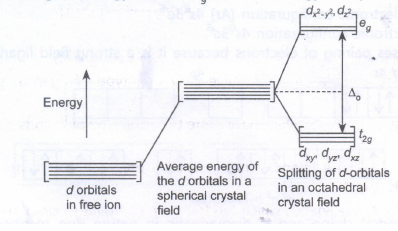
Draw figure to show splitting of d orbitals in an octahedral crystal field.
10.
(a) What is a ligand? Give an example of a bidentate ligand.
(b) Explain as to how the two complexes of nickel. [Ni(CN)4]2- and Ni(CO)4, have different structures but do not differ in their magetic behaviour. (Atomic number of Ni = 28).
11.
For the complex [Fe(en)2Cl2]Cl, identify the following:
(i) Oxidation number of iron.
(ii) Hybrid orbitals and shape of the complex.
(iii) Magnetic behavior of the complex.
(iv) Number of its geometrical isomers.
(v) Whether there may be optical isomer also.
(vi) Name of the complex.
12.
The increasing order of the crystal field splitting power of some common ligands is
H2O < OH- < Cl- < F- < CN-
CN- < H2O < OH- < F- < Cl-
F- < CN- < OH- < Cl- < H2O
Cl- < F- < OH- < H2O < CN-
13.
Which of the following compound has tetrahedral geometry?
[Ni(CN)4]2-
[Pd(CN)4]2-
[PdCl4]2-
[NiCl4]2-
14.
The hybridisation of Fe in K4[Fe(CN)6] is
dsp2
sp3
d2sp3
sp3d2
15.
The primary and secondary valencies of chromium in the complex ion, dichlorodioxalatochromium (III) are respectively
3,4
4,3
3,6
6,3
16.
The ionization isomer of [Cr(H2O)4Cl(NO2)]Cl is
[Cr(H2O)4 (O2N)] Cl2
[Cr(H2O)4Cl2] (NO2)
[Cr(H2O)4Cl(ONO)] Cl
Cr(H2O)4Cl2(NO2)] H2O
17.
Cs [FeCl4]
18.
[Co(NH3)5Cl] Cl2
19.
K4 [Mn(CN)6]
20.
K [Cr(H2O)2 (C2O4)2].3 H2O
21.
d7
22.
Why are different colours observed in octahedral and tetrahedral complexes for the same metal and same ligands ?
23.
What is the relationship between observed colour of the complex and the wavelength of light absorbed by the complex ?
1.
This is because Cu2+ oxidizes I- to I2(2Cu2+ + 4I- \(\rightarrow \) Cu2I2(s)+I2) or I- ions reduce Cu2+ to Cu+.
2.
tetracyanonickelate (II) ion.
3.
(i) mercuric tetrathiocyanatocobaltate (II)
(ii) potassium dicarbonylcyanonitrosocobaltate (II)
4.
(i) pentaamminechloridocobalt (III) chloride
(ii) chloridobis (ethane-1, 2-diamine) nitritocobalt (III) ion.
5.
In both the complexes, Fe is in +3 oxidation state with the configuration 3d5. CN- is a strong ligand. In its presence, 3d electrons pair up leaving only one unpaired electron. The hybridization is d 2sp3forming inner orbital complex. H20 is a weak ligand. In its presence, 3d electrons do not pair up. The hybridization is sp3 d2 forming an outer orbital complex containing five unpaired electrons. Hence, it is strongly paramagnetic.
6.
Stability of coordination compounds in aqueous solution is determined with the help of satbility constant. Higher the value of stability constant, greater will be stability. Smaller the cation, higher the charge on the cation, more stable will be the complex. Chelating agents form more stable complex than monodentate ligand. Stronger the ligand, more stable will be the complex.
7.
(I) Dichlorido-bis (ethane 1,2-diamine) cobalt(ill) chloride.
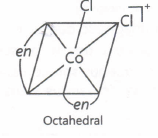
(il) Diamminechloridonitrito-N-platinum (II)
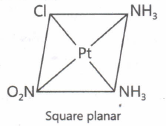
8.
-1 ∵ + 1 + x + 0 = 0 ⇒ x = -1
[oxidation number of 'K' is +1, CO is neutral ligand].
9.
Let us assume that the six ligands are positioned symmetrically along the cartesian axes, with metal atom at the origin. As the ligands approach, first there is an increase in energy of d-orbitals relative to that of the free ion just as would be the case in a spherical field The orbitals lying along the axes (\({ d }_{ { z }^{ 2 } }\)nd \({ d }_{ { x }^{ 2 }-{ y }^{ 2 } }\))get repelled more strongly than dx1 d and dyz and dzx orbitals which have lobes directed between the axes. The \({ d }_{ { z }^{ 2 } }\)and orbitals get raised in energy and dxy dyz d xz orbitals are lowered in energy relative to the average energy in the spherical crystal field. Thus, the degenerate set of d-orbitals get split into two sets : the lower energy orbitals set and the higher energy orbitals eg set. The energy is separated by t2g and the higher energy orbitals eg set. The energy is separated by \({ \Delta }_{ 0 }\)
10.
(a) Ligand is an atom or group of atoms or ions which can donate a pair of electrons to vacant d-orbitals of metal atom or ion. Ethane -1, 2-diamine H2NCH2CH2NH2 or oxalate ion is an example of bidentate ligand.
(b) Ni(28) : [Ar]4s23d8,
Ni2+ : [Ar] 4s03d8
CN- is strong field ligand will cause pairing of electrons.

It has dsp2 hybridisation, square planar shape and diamagnetic in nature.
Ni (28) : [Ar] 4s23d8
Ni(28) : [Ar]4s03d10
.png)
11.
(i) +3 (III)
(ii) dsp, octahedral
(iii) paramagnetic
(iv) Two geometrical isomers
(v) Yes, there may be optical isomer also due to presence of polydentate ligand.
(vi) Dichlorido bis-(ethane 1, 2-diamine) Iron (III)
12.
(d)
Cl- < F- < OH- < H2O < CN-
13.
(d)
[NiCl4]2-
14.
(c)
d2sp3
15.
(c)
3,6
16.
(b)
[Cr(H2O)4Cl2] (NO2)
17.
()
5.92 BM
18.
()
Zero
19.
()
1.73 BM
20.
()
3.87 BM
21.
()
- 0.8
22.
\({ \triangle }_{ t }=\left( \frac { 4 }{ 9 } \right) { \triangle }_{ 0 }\). Thus, \({ \triangle }_{ t }\) is smaller than \({ \triangle }_{ 0 }\). Hence, less energy (higher wavelength) is absorbed by tetrahedral complexes than by octahedral complexes of the same metal and ligands. Therefore, the observed colour are different.
23.
When white light falls on the complex, some part of it is absorbed. Greater the CFSE, greater is the energy absorbed or shorter is the wavelength absorbed \((E={hc\over\lambda })\). The observed colour is the complementary colour of the colour absorbed.

12th Standard CBSE Syllabus & Materials
12th Standard CBSE
CBSE 12th Computer Science Python Revision Tour I - New Previous year Question Papers Study Material - QB365 Set A
NEW12th Standard CBSE
CBSE 12th Business Studies Planning Important Questions And Answers Study Material - QB365 Set A
NEW12th Standard CBSE
CBSE 12th Business Studies Business Environment Important Questions And Answers Study Material - QB365 Set A
NEW12th Standard CBSE
CBSE 12th Business Studies Principles of Management Important Questions And Answers Study Material - QB365 Set A



CBSE 12th Standard CBSE Subjects
CBSE Standards










