
 100% FREE ACCESS
12th Standard CBSE Syllabus & Materials
12th Standard CBSE
CBSE 12th Economics Government Budget and the Economy Previous year Question Papers Study Material - QB365 Set A
NEW12th Standard CBSE
CBSE 12th Computer Science Interface Python with MySQL - New Previous year Question Papers Study Material - QB365 Set A
NEW12th Standard CBSE
CBSE 12th Computer Science Database Concept - New Previous year Question Papers Study Material - QB365 Set A
NEW12th Standard CBSE
CBSE 12th Computer Science Data Communication - New Previous year Question Papers Study Material - QB365 Set A
NEW12th Standard CBSE
CBSE 12th Computer Science Data Structures - New Previous year Question Papers Study Material - QB365 Set A
NEW12th Standard CBSE
CBSE 12th Computer Science Functions - New Previous year Question Papers Study Material - QB365 Set A

Published on: 19/08/2019
Haloalkanes and Haloarenes
Download CBSE Class 12th Standard CBSE Chemistry question papers, sample papers, important questions, and previous year solved papers in PDF format. Get free study materials, NCERT solutions, and exam preparation resources for Class 12th Standard CBSE Chemistry
Questions + Answers key
Take MCQ Chemistry Test
1.
Draw the structure of the following compound: 4-bromo-3-methylpent-2-ene.
2.
How will you bring about the conversion : methyl bromide to methyl iodide ?
3.
Explain why thionyl chloride method is preferred for preparing alkyl chlorides from alcols?
4.
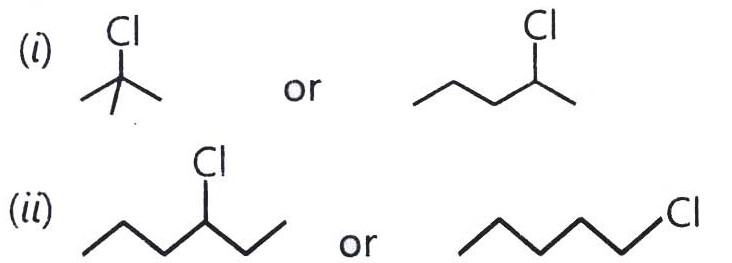
Which one in the following pairs undergoes SN1 substitution reaction faster and why?
5.
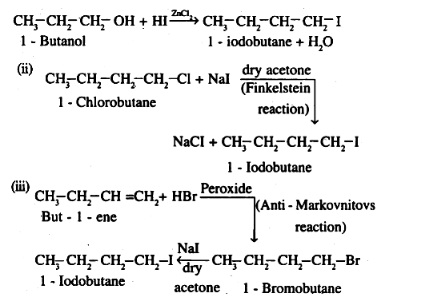
Write the equations for the preparation of 1-iodobutane from:
(a) 1-iodobutane from:
(b) 1-butanol
(c) but-1-ene.
6.
In the following reaction,
C6H5CH2Br \(\xrightarrow [ (ii){ H }_{ 3 }{ O }^{ + } ]{ (i)Mg,ether } \)
the product 'X' is
C6H5CH2OCH2C6H5
C6H5CH2OH
C6H5CH3
C6H5CH2CH2C6H5
7.
Alkyl halides are prepared from alcohols by treating with
HCl+ZnCl2
Red P+Br2
H2SO4+KI
All the above
8.
Which reagent will you use for the following reaction?
CH3CH2CH2CH3 \(\longrightarrow\) CH3CH2CH2CH2Cl+CH3CH2CHClCH3
Cl2/UV light
NaCl+H2SO4
Cl2 gas in dark
Cl2 gas in the presence of iron in dark
9.
Arrange the following : CH3CH2CH2CI (I), CH3CH2CHCICH3 (II), (CH3)2CHCH2CI (III) and(CH3)3C__CI (IV) in order of decreasing tensency towards SN2 reactions
I > III > II > IV
III > IV > II > I
II > I > III > IV
IV > III > II > I
10.
The compound,
C7H8 \(\xrightarrow { 3{ CI }_{ 2 }/\triangle } A\xrightarrow { Br_{ 2 }/Fe } B\xrightarrow { Zn/HCI } C\)
The compound C is
o-Bromotoluene
m-Bromotoluene
p-Bromotoluene
3-Bromo-2,4,6-trichlorotoluene
11.
The intermidiate during the addition of HCI to propane in presence of peroxide is
CH3\(\overset { \bullet }{ C } \)HCH2 CI
CH3\(\overset {+ }{ C } \)CH3
CH3CH2\(\overset { \bullet }{ C } \)H2
CH3CH2\(\overset {+ }{ C } \)H2
12.
Which one of the following forms propanenitrile as the major product?
Ethyl bromide ||+ alcoholic KCN
Propyl bromide+alcoholic KCN
Propyl bromide +alcoholic AgCN
Ethyl bromide+alcoholic AgCN
13.
Which of the following compounds has the highest boiling point?
CH3CH2CH2Cl
CH3CH2CH2CH2Cl
CH3CH(CH3)CH2Cl
(CH3)3CCl
14.
Which of the following halogen-exchange reaction will occur?
R-I+NaCl
R-F+KCl
R-Cl+NaI
CH3 -F+AgBr
15.
The reaction of hydrogen bromide with propene in absence of peroxide is an example of a/an
free radical addition
nucleophilic addition
electrophilic substitution
electrophilic addition
16.
Hydrolysis of 2-bromo-3-methylbutane yields only.............
17.
Benzene on reaction with HOCI in presence of an acid produces organic compound (A), (A) on treatment with NaNH2/liq. NH3 furnishes another organic compound (B). (B) on treatment with HBF4 affords an organic compound (C) wich on heating with NaNO2 gives organic compound (D). Identify (A), (B), (C) and (D).
1.

2.
\({ CH }_{ 3 }-Br+NaI\overset { Dry\ acetone }{ \underset { (Filkenstein\ reaction) }{ \longrightarrow } } \ \underset { Methyl\ iodile }{ { CH }_{ 3 }-I } \)
3.
Because the products of the reaction. i.e., SO2 and HCI being gases escape into the atmosphere leaving behind alkyl chorides in almost pure state.
4.
(i)
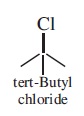
3° halide reacts faster than 2° halide because of the greater stability of tertiary carbocation.
(ii)
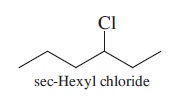
(ii) 2° halide reacts faster than 1° halide because of the greater stability of secondary carbocation than primary.
5.
(i) 1-butanol
6.
(a)
C6H5CH2OCH2C6H5
7.
(a)
HCl+ZnCl2
8.
(a)
Cl2/UV light
9.
(a)
I > III > II > IV
10.
(b)
m-Bromotoluene
11.
(a)
CH3\(\overset { \bullet }{ C } \)HCH2 CI
12.
(a)
Ethyl bromide ||+ alcoholic KCN
13.
(b)
CH3CH2CH2CH2Cl
14.
(c)
R-Cl+NaI
15.
(d)
electrophilic addition
16.
()
2-Methyl-2-butanol
17.
(i) HOCI in presence of an acid generates the reactive electrophile, chloronium ion «r, which attacks benzene to give chlorobenzene (A).
(ii) Chlorobenzene (A) on treatment with NaNH2/liq. NH3 undergaes-dehydrohalogenation via benzyne to afford aniline (B).
(iii) Aniline (B) on treatment with HBF4 forms the corresponding salt anilinium tetrafluoroborate (C) which on heating with NaNO2 undergoes Balz-Schiemann reaction through the intermedium formation of benzenediazonium tetrafluoroborate to afford fluorobenzene (D).

12th Standard CBSE Syllabus & Materials
12th Standard CBSE
CBSE 12th Computer Science Python Revision Tour I - New Previous year Question Papers Study Material - QB365 Set A
NEW12th Standard CBSE
CBSE 12th Business Studies Planning Important Questions And Answers Study Material - QB365 Set A
NEW12th Standard CBSE
CBSE 12th Business Studies Business Environment Important Questions And Answers Study Material - QB365 Set A
NEW12th Standard CBSE
CBSE 12th Business Studies Principles of Management Important Questions And Answers Study Material - QB365 Set A



CBSE 12th Standard CBSE Subjects
CBSE Standards










