
 100% FREE ACCESS
12th Standard CBSE Syllabus & Materials
12th Standard CBSE
CBSE 12th Economics Government Budget and the Economy Previous year Question Papers Study Material - QB365 Set A
NEW12th Standard CBSE
CBSE 12th Computer Science Interface Python with MySQL - New Previous year Question Papers Study Material - QB365 Set A
NEW12th Standard CBSE
CBSE 12th Computer Science Database Concept - New Previous year Question Papers Study Material - QB365 Set A
NEW12th Standard CBSE
CBSE 12th Computer Science Data Communication - New Previous year Question Papers Study Material - QB365 Set A
NEW12th Standard CBSE
CBSE 12th Computer Science Data Structures - New Previous year Question Papers Study Material - QB365 Set A
NEW12th Standard CBSE
CBSE 12th Computer Science Functions - New Previous year Question Papers Study Material - QB365 Set A

Published on: 16/09/2019
Haloalkanes and Haloarenes
Download CBSE Class 12th Standard CBSE Chemistry question papers, sample papers, important questions, and previous year solved papers in PDF format. Get free study materials, NCERT solutions, and exam preparation resources for Class 12th Standard CBSE Chemistry
Questions + Answers key
Take MCQ Chemistry Test
1.
Name the following halides according to IUPAC system and classify them as alkyl, allyl, benzyl(primary, secondary,tertiary), vinyl or aryl halides.
(i) CH3CH=CHC(Br)(CH3)2
(ii) p-ClC6H4CH2CH(CH3)2
(iii) m-ClCH2C6H4CH2C(CH3)3
(iv) o-Br-C6H4CH(CH3)CH2CH3
2.
What are the IUPAC names of the insecticide DDT and banned in India and other countries?
3.
Which of the following haloalkanes reacts with aqueous KOH most easily? Explain giving reason.
(i) 1-Bromobutane
(ii) 2-Bromobutane
(iii) 2-Bromo-2-methylpropane
(iv) 2-Chlorobutane
4.
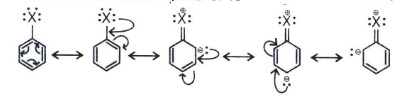
Draw other resonance structures
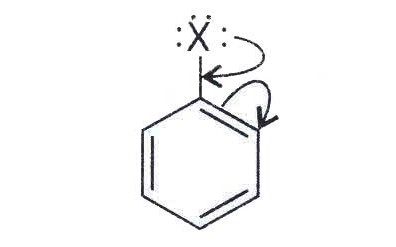
related to the following structure and find out whether the functional group present in the molecule is ortho, para directing or meta directing.
5.
Which of the following compounds(a) and (b) will not react with a mixture of NaBr and H2SO4. Explain why?

6.
Aryl chlorides and bromides can be easily prepared by electrophilic substitution of arenes with chlorine and bromine respectively in the presence of Lewis acid catalysts. But why does preparation of aryl iodides requires presence of an oxidising agent?
7.
Why are haloarenes more stable than haloalkanes and undergo electrophilic substitution reaction at ortho and para positions?
8.
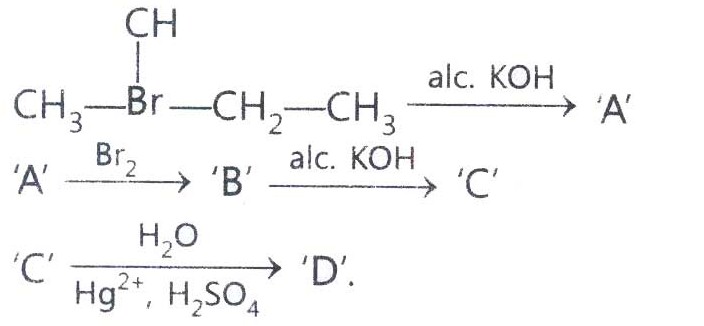
Write the structural formulae of the organic compounds 'A', 'B', 'C' and 'D' in the following sequence of reaction
9.
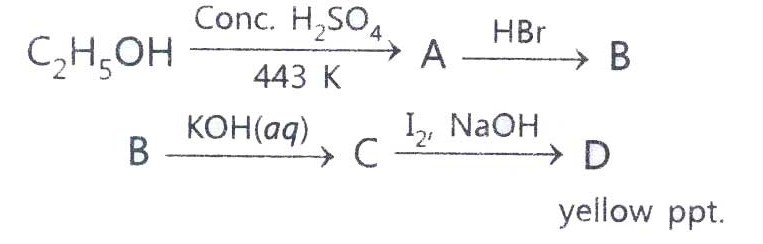
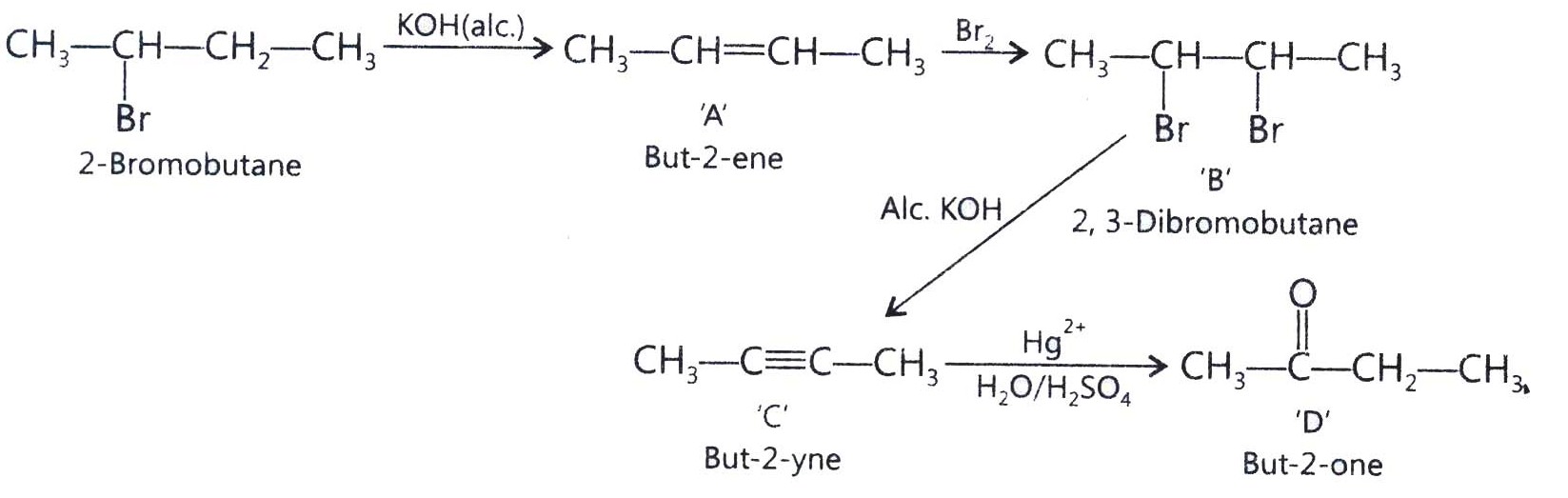
Identify the compounds A, B, C and D in the following sequence of reaction:
10.
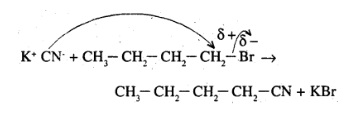
Suggest a possible mechanism for the following reaction:
\(n-BuBr + KCN \xrightarrow{EtOH_2,\ H_2O} n-BuCN\)
11.
What are ambident nucleophiles? Explain with an example.
1.
(i) 4-Bromo-4-methylpent-2-ene 3° and Allylic halide
(ii) 1-Chloro-4-(2-methylpropyl) benzene Aryl halide
(iii) 1-Chloromethyl-3-(2,2-dimethylpropyl) Benzene Benzylic halide (1°)
(iv) 1-Bromo-2-(1-methylpropyl)benzene Aryl halide
2.
The IUPAC name of DDT is 2,2-bis(4-chlorophenyl)-1,1,1-trichloroethane. The IUPAC name of bezenehexachloride is 1,2,3,4,5,6-hexachlorocyclohexane. Their use is banned in India and other countries because DDT is not metabolised very rapidly or solubilized effectively by animals.
3.
(iii) 2-Bromo-2 methylpropane will react with aq KOH most easily because it will form 3o carbocation which is most stable.
4.
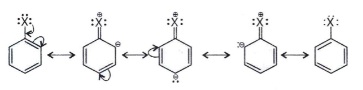
The functional group is ortho and para directing because electron density is maximum at ortho and partho para-positions.
5.
(b) will not react due to presence of double bond character in C---- O bond due to resonance.
6.
It is because iodination is reversible as HI formed is good reducing agent which needs to be removed with the help of oxidising agent.
7.
Haloarenes are resonance stabilized. Due to resonance, C-X bond in haloarenes acquire a double bond character which makes them more stable than haloalkanes.
8.
9.

10.
The reaction is an SN2 reaction. In this reaction, CN- acts as the nucleophile and attacks the carbon atom to which Br is attacked. CN- is an ambident nucleophile and can attack through both C and N. In this case, it attacks through the C-atom.
11.
Ambident Nucleophile- An anionic nucleophile, which has two nucleophilic centers, or two negative sites is known as an ambident nucleophile. This negative charge is delocalized due to resonance.
Example – Cyanide and Thiocyanate are examples of ambident nucleophiles.
-C≡N ↔ :C=N-
S=C=N- ↔ -S - C≡ N

12th Standard CBSE Syllabus & Materials
12th Standard CBSE
CBSE 12th Computer Science Python Revision Tour I - New Previous year Question Papers Study Material - QB365 Set A
NEW12th Standard CBSE
CBSE 12th Business Studies Planning Important Questions And Answers Study Material - QB365 Set A
NEW12th Standard CBSE
CBSE 12th Business Studies Business Environment Important Questions And Answers Study Material - QB365 Set A
NEW12th Standard CBSE
CBSE 12th Business Studies Principles of Management Important Questions And Answers Study Material - QB365 Set A



CBSE 12th Standard CBSE Subjects
CBSE Standards










