
 100% FREE ACCESS
12th Standard CBSE Syllabus & Materials
12th Standard CBSE
CBSE 12th Economics Government Budget and the Economy Previous year Question Papers Study Material - QB365 Set A
NEW12th Standard CBSE
CBSE 12th Computer Science Interface Python with MySQL - New Previous year Question Papers Study Material - QB365 Set A
NEW12th Standard CBSE
CBSE 12th Computer Science Database Concept - New Previous year Question Papers Study Material - QB365 Set A
NEW12th Standard CBSE
CBSE 12th Computer Science Data Communication - New Previous year Question Papers Study Material - QB365 Set A
NEW12th Standard CBSE
CBSE 12th Computer Science Data Structures - New Previous year Question Papers Study Material - QB365 Set A
NEW12th Standard CBSE
CBSE 12th Computer Science Functions - New Previous year Question Papers Study Material - QB365 Set A

Published on: 29/12/2018
Important Problems ( HOTS )
Download CBSE Class 12th Standard CBSE Chemistry question papers, sample papers, important questions, and previous year solved papers in PDF format. Get free study materials, NCERT solutions, and exam preparation resources for Class 12th Standard CBSE Chemistry
Questions + Answers key
Take MCQ Chemistry Test
1.
A 5 percent solution (by mass) of cane-sugar (M.W. 342) is isotonic with 0.877% solution of substance X. Find the molecular weight of X.
2.
Two reactions,
(i) A \(\longrightarrow\) Products
(ii) B \(\longrightarrow\) Products, follow first order kinetics.
The rate of reaction
(i) is doubled when temperature is raised from 300 K to 310 K. The half life for this reaction at 310 K is 30 minutes. At the same temperature, B decomposes twice as fast as A. If the energy of activation for the reaction
(ii) is half that of reaction
(iii), calculate the rate constant of reaction (ii) at 300 K.
3.
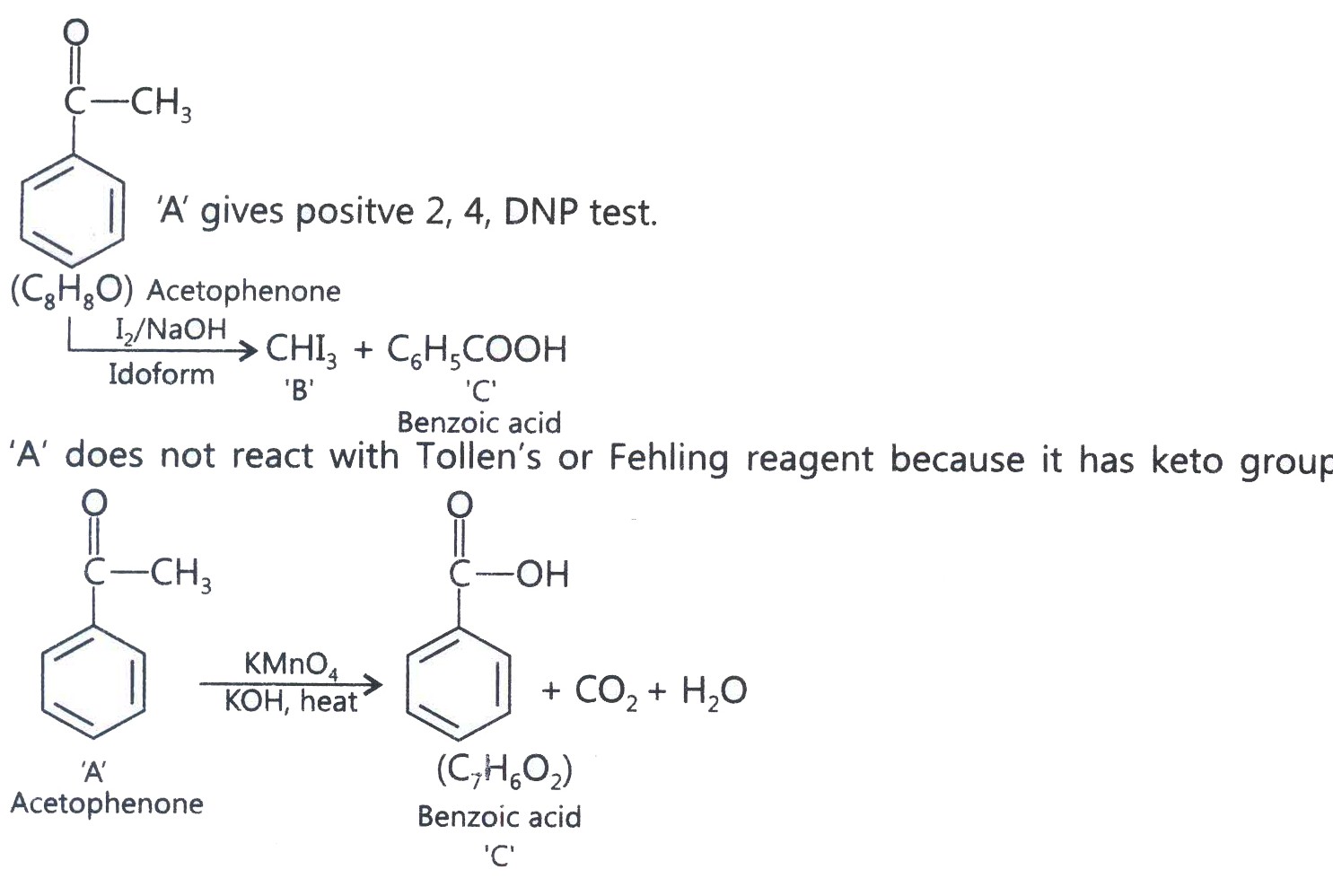
An aromatic compound 'A' (Molecular formula C8H8O) gives positive 2, 4-DNP test. It gives a yellow precipitates of compound 'B' on treatments with iodine and sodium hydroxide solution. Compound 'A' does not give Tollen's or Fehling's test. On drastic oxidation with potassium permanganate it forms a carboxylic acid 'C' (Molecular formula C7HO)6O2), which is also formed along with the yellow compound in the above reaction. Identify A, B and C write all the reacitons involved.
4.
White phosphorus reacts with chlorine and the product hydrolyses in the presence of water. Calculate the mass of HCl obtained by the hydrolysis of the product formed by the reaction of 62g of white phosphorus with chlorine in the presence of water.
5.
(a) Calculate the freezing point of solution when 1.9 g of MgCI2 (M = 95 g mol-1) was dissolved in 50 g of water, assuming MgCI2 undergoes complete ionization. (Kf for water = 1.86 K kg mol-1)
(b) (i) Out of 1 M glucose and 2 M glucose, which one has a higher boiling point and why?
(ii) What happens when the external pressure applied becames more than the osmotic pressure of solution?
6.
An organic compound (A) on treatment with CHCl3 and KOH gives two compounds B and C.Both B and C give the same product (D) when distilled with zinc dust.Oxidation of D gives E having molecular formula C7H6O2.The sodium salt of E on heating with soda-lime gives F which may also be obtained by distilling A with zinc dust.Identify A to F
7.
A compound A on oxidation gives B (C2H4O2). A reacts with dil. NaOH and on subsequent heating forms C. C on catalytic hydrogenation gives D. Identify A, B, C, D and write down the reactions involved.
8.
An organic compound (A) on treatment with ethyl alcohol gives a carboxylic acid (B) and compound (C). Hydrolysis of (C) under acidified conditions gives (B) and (D). Oxidation of (D) with KMnO4 also gives (B). (B) on heating with Ca(OH)2 gives (E) having moleuclar formula C3H6O. (E) does not give TOllens'test and does not reduce Fehiling's solution but forms 2, 4-dinitrophenyhydrazone. Identify (A),(B),(C),(D) and (E).
9.
A ketone A (C4H8O), which undergoes haloform reactions gives compound B on reduction. B on heating with sulphuric acid gives a compound C which forms mono-ozonide D.D on hydrolysis in presence of zinc dust gives only scetaldehyde E. Identify A, B ,C, D and E. Write the reactions involved.
10.
Benzene on reaction with HOCI in presence of an acid produces organic compound (A), (A) on treatment with NaNH2/liq. NH3 furnishes another organic compound (B). (B) on treatment with HBF4 affords an organic compound (C) wich on heating with NaNO2 gives organic compound (D). Identify (A), (B), (C) and (D).
11.
Two first reactions proceed at the same rate at 15oC when started with same initial concentration. The temperature coefficient of the first reaction is 2 while that of the second reaction is 3. What will be the ratio of the rates of these reactions at 55oC ?
12.
The half time of first order decomposition of nitramide is 2.1 hour at 15oC. NH2NO2(aq) \(\longrightarrow\) N2O(g) + H2O (I)
If 6.2 g of MH2NO2 is allowed to decompose, calculate
(i) time taken for NH2NO2 to decompose 99% and
(ii) volume of dry N2O produced at this point, measured at STP.
13.
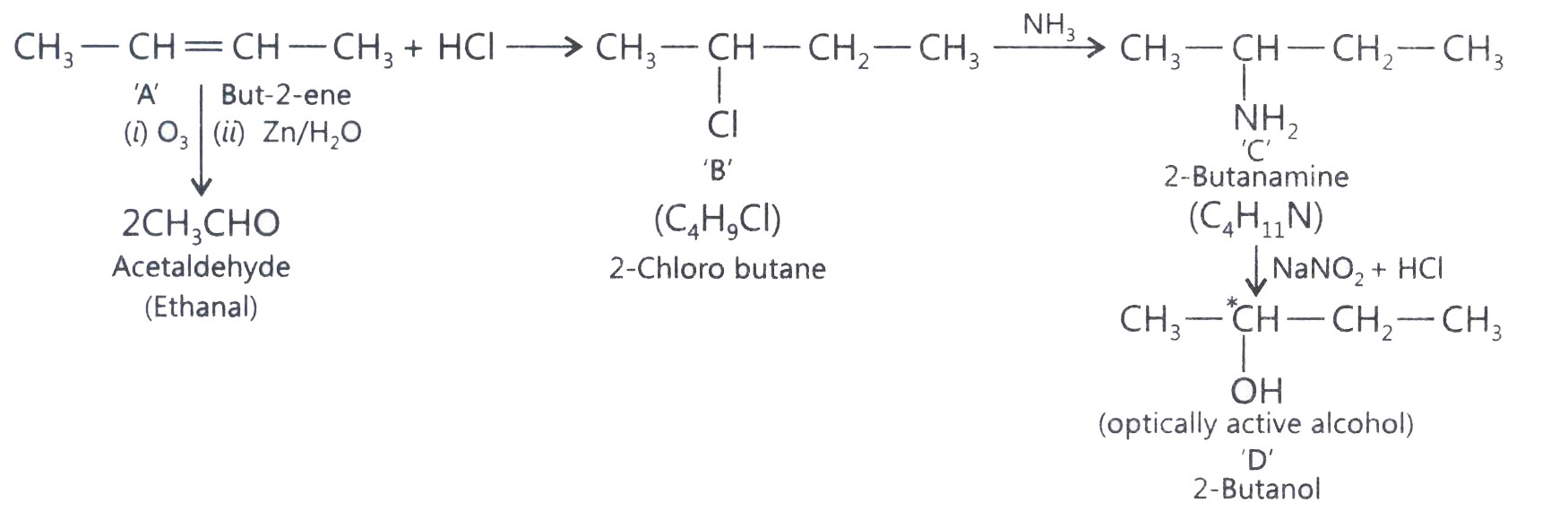
A hydrocarbon 'A' (C4H8) on reaction with HCI gives a compound 'B' , (C4H11N). On reacting with NaNO2 and HCI followed by treatment with water, compound 'C'. Ozonolysis of 'A' gives 2 moles of acetaldehyde. Identify compounds 'A' to 'D' . Explain the reactions involved.
14.
On heating lead (II) nitrate gives a brown gas "A". The gas "A" on cooling changes to colourless solid "B". Solid "B" on heating with NO changes to a blue solid 'C'. Identify 'A', 'B' and 'C' and also write reactions involved and draw the structures of 'B' and 'C'.
1.
\({ \pi }_{ cane\ sugar }={ \pi }_{ X }\)
Therefore, ccane sugar=cX
(where c is molar concentration)
\(\frac { { W }_{ cane\ sugar } }{ { M }_{ cane\ sugar } } =\frac { { W }_{ X } }{ { M }_{ X } } \)
\(\frac { 5g }{ 342 \ g \ { mol }^{ -1 } } =\frac { 0.877 }{ { M }_{ X } } \)
\(\\ \Rightarrow { M }_{ X }=\frac { 0.877\times 342 }{ 5 } g\ { mol }^{ -1 }\)
\(\Rightarrow { M }_{ X }=59.9 \ or \ 60 \ g{ \ { mol }^{ -1 } }\)
2.
Calculation of activation energy of reaction (i)
T1= 300 K, T2 = 310 K, k1 = k, k2 = 2 k
\(log{k_2\over k_1}={E_A\over 2.303E}\left(T_2-T_2\over T_1T_2\right ),ie.,\ log2={E_a\over 2.303\times8.314}\times{10\over 300\times310}\ or\ E_a=53.60kJmol^{-1}\)
Calculation of rate constant of reaction (i) at 310 K
\(k={0.693\over t_{1/2}}={0.693\over 30\ min}=2.31\times10^{-2}min^{-1}\)
Rate constant of reaction (ii) at 310 K = 2 x 2·31x 10-2 min-1 = 4·62 x 10-2 min-1
Energy 0f ac tiva tion 0f reac tion (ii) =\({53.60kJ\ mol^{-1}\over 2}=26.80kJ\ mol^{-1}\)
Aim. To calculate k for reaction (ii) at 300 K
\(log{4.62\times10^{-2}\over k_{300}}={26.80\over 2.303\times8.314\times10^{-3}}\times{10\over 300\times310}=0.0151\)
or \({4.62\times10^{-2}\over k_{300k}}=Antilog\ or\ 0151 = 1.035\ or \ k_{300k}={4.62\times10^{-2}\over 1.035}=4.46\times10^{-2}min^{-1}\)
3.
4.
\({ P }_{ 4 }={ 6CI }_{ 2 }\longrightarrow { 4PCI }_{ 3 }\)
\(\left[ { PCI }_{ 3 }+{ 6H }_{ 2 }O\longrightarrow { H }_{ 3 }{ PO }_{ 3 }+3HCI \right] \times 4\)
\({ P }_{ 4 }+{ 6CI }_{ 2 }+{ 12H }_{ 2 }O\longrightarrow { 4H }_{ 3 }{ PO }_{ 3 }+{ 12HCI }\)
1 mole of white phosphorus produces 12 moles of HCI.
\(\frac { 62 }{ 124 }\)mole of white phosphorus produces \(12\times \frac { 62 }{ 124 } =6\)moles of HCI.
Mass of 6 moles of HCI= 6 X 36.5
= 219.0 g of HCI.
5.
(a) \(\Delta { T }_{ f }=i\frac { { K }_{ f }{ W }_{ b }\times 1000 }{ { M }_{ b }\times { W }_{ a } } \)
\(\Delta { T }_{ f }=3\times \left( \frac { 1.86\times 1.9 }{ 95\times 50 } \right) \times 1000\)
= 2.23 K
\(\Delta { T }_{ f }-{ \Delta T }_{ f }^{ ' }=\frac { 273.15-2.23 }{ 273-2.23 } \)
\({ T }_{ f }^{ ' }\) = 270.92 K or 270.77 K
(b) (i) 2 M glucose has a higher boiling point because higher the number of particles lesser is the vapour pressure.
(ii) Reverse osmosis.
6.
(i) Since compound (A) on treatment with CHCI3 and KOH (i.e., Reimer-Tiemann reaction), gives two products Band C, therefore, A must be phenol and Band C must be o-hydroxybenzaldehyde and P: hydroxybenzaldehyde respectively or vice-versa.
(ii) Since both Band C on distillation with Zn dust give the same compound (D), therefore, D must be benzaldehyde.
(iii) Since oxidation of D gives E with M.F. C7R602, therefore, E must be benzoic acid.
(iv) Since sodium salt of E, i.e.benzoic acid upon heating with soda-lime gives compound (F), therefore.
(F) must be benzene. Zn dust distillation of A would also give benzene (F).
7.
(i) Since compound A on oxidation gives compound 8 with M.F. C2H4O2, therefore, compound 8 may be acetic acid, CH3COOH and A may be acetaldehyde, CH3CHO.
(ii) Since compound A, i.e., acetaldehyde reacts with dil. NaOH, therefore, it undergoes aldol condensation to afford an aldol.Further since this aldol on heating gives compound (C), therefore, (C) must be an α, β- unsaturated aldehyde, i.e., but-2-en-I-al (crotonaldehyde).
(iii) Since compound (C) on catalytic hydrogenation gives compound D, therefore, D may be either I-butanal or I-butanol depending upon the extent of hydrogenation.
AIl the reactions involved in this question are explained below:
8.
(i) Since compound (E) with molecular formula, C3H60 does not reduce Tollens' reagent and Fehling's solution but forms 2, 4-dinitrophenylhydrazone, it must be a ketone. But the only possible ketone having the molecular formula, C3H6O is acetone or propanone. Thus, compound (E) is acetone or (propanone) CH3COCH3·
(ii) Since acetone (E) is obtained by heating compound (8) with Ca(OH)2 therefore, (B) must be acetic acid (ethanoic acid), CH3COOH.
(iii) Since (D) on oxidation with KMn04 gives acetic acid (8), therefore, (D) must be ethyl alcohol (ethanol), CH3CH2OH.
(iv) Since acetic acid (8) and ethyl alcohol (D) are obtained by hydrolysis of (C) under acidic conditions, therefore, (C) must be ethyl acetate (ethyl ethanoate), CH3COOC2H5
(v) Since ethyl acetate (C) and acetic acid (8) are obtained by treatment of compound (A) with ethyl alcohol, therefore, compound (A) must be acetic anhydride (ethanoic anhydride), (CH3COO)2O.
(vi) All the reactions involved in this problem can now be explained as follows
9.
(i) Since ketone A (C4H8O) undergoes haloforrn reaction, it must contain the grouping CH}CO. Therefore, ketone A (C4H8O) must be butanone (CH3COCH2CH3).
(ii) Since ketone A, i.e., butanone gives compound B on reduction, therefore, B must be 2-butanol (CH3CHOHCH2CH3).
(iii) Since B, i.e., 2-butanol on heating with H2SO4 gives compound C which forms a mono-ozonide therefore, compound C must be an alkene.
(iv) Since alkene C forms a mono-ozonide D which on hydrolysis in presence of zinc dust (z.e., reductive ozonolysis) gives only acetaldehyde E, therefore, C must be a symmetrical alkene, i.e., 2-butene.
(v) All the reactions involved in the problem can now be explained as follows:
10.
(i) HOCI in presence of an acid generates the reactive electrophile, chloronium ion «r, which attacks benzene to give chlorobenzene (A).
(ii) Chlorobenzene (A) on treatment with NaNH2/liq. NH3 undergaes-dehydrohalogenation via benzyne to afford aniline (B).
(iii) Aniline (B) on treatment with HBF4 forms the corresponding salt anilinium tetrafluoroborate (C) which on heating with NaNO2 undergoes Balz-Schiemann reaction through the intermedium formation of benzenediazonium tetrafluoroborate to afford fluorobenzene (D).
11.
If RI is the rate of first reaction at 25°C, then as its temperature coefficient is 2, its rate at 35°C will be = 2 R1, at 45°C = 2 x 2 R1 = 4 R1 and at 55°C = 2 x 4 R1 = 8 R1
If R2.is the rate of the second reaction at 25°C, then as its temperature coefficient is 3, its rate at 35°C will be = 3 R2, at 45°C = 3 x 3 R2 = 9 R2 and at 55°C = 3 x 9 R2 = 27 R2
Also, we are given R1 = R2, i.e., at 25°C, the rates are equal.
At 550C, \({Rate\ of\ 2nd\ reaction\over Rate\ of\ 1st\ reaction}={27R_2\over 8R_1}={27\over 8}\)
12.
\(k={0.693\over t_{1/2}}={0.693\over 2.1hr}=0.33hr^{-1}\)
x = 99% of a = 0·99 a
\(t={2.303\over k}log{a\over a-x}={2.303\over 0.33hr^{-1}}log{a\over a-0.99a}={2.303\over 0.33}log 10^2=13.69hours\)
(ii) Amount decomposed = 99% of 6.2 g =\({99\over 100}\times 6.2g=6.138g\)
1 mol NH2NO2 (63g) produce N2O at STP = 22·4 L
6.138 g will produce N2O at STP =\({22.4\over 63}\times6.138\ L=2.2176L\)
13.
14.
\(2Pb{ { { { (NO }_{ 3 }) } } }_{ 2 }\xrightarrow { heat } 2PbO(s)+{ NO }_{ 2 }+{ O }_{ 2 }\)
Brown (A)
\({ 2NO }_{ 2 }(g)\overset { cooling }{ \rightleftharpoons } { N }_{ 2 }{ O }_{ 4 }(s)\)
(B) Colourless
\({ N }_{ 2 }{ O }_{ 4 }+2NO\overset { heat }{ \underset { 250k }{ \rightleftharpoons } } { 2N }_{ 2 }{ O }_{ 3 }(s)\)
(C) Blue solid
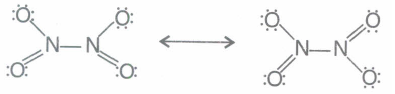
Resonating Structures of \({ N }_{ 2 }{ O }_{ 4 }\)

12th Standard CBSE Syllabus & Materials
12th Standard CBSE
CBSE 12th Computer Science Python Revision Tour I - New Previous year Question Papers Study Material - QB365 Set A
NEW12th Standard CBSE
CBSE 12th Business Studies Planning Important Questions And Answers Study Material - QB365 Set A
NEW12th Standard CBSE
CBSE 12th Business Studies Business Environment Important Questions And Answers Study Material - QB365 Set A
NEW12th Standard CBSE
CBSE 12th Business Studies Principles of Management Important Questions And Answers Study Material - QB365 Set A



CBSE 12th Standard CBSE Subjects
CBSE Standards










