
 100% FREE ACCESS
12th Standard CBSE Syllabus & Materials
12th Standard CBSE
CBSE 12th Economics Government Budget and the Economy Previous year Question Papers Study Material - QB365 Set A
NEW12th Standard CBSE
CBSE 12th Computer Science Interface Python with MySQL - New Previous year Question Papers Study Material - QB365 Set A
NEW12th Standard CBSE
CBSE 12th Computer Science Database Concept - New Previous year Question Papers Study Material - QB365 Set A
NEW12th Standard CBSE
CBSE 12th Computer Science Data Communication - New Previous year Question Papers Study Material - QB365 Set A
NEW12th Standard CBSE
CBSE 12th Computer Science Data Structures - New Previous year Question Papers Study Material - QB365 Set A
NEW12th Standard CBSE
CBSE 12th Computer Science Functions - New Previous year Question Papers Study Material - QB365 Set A

Published on: 18/09/2019
Polymers
Download CBSE Class 12th Standard CBSE Chemistry question papers, sample papers, important questions, and previous year solved papers in PDF format. Get free study materials, NCERT solutions, and exam preparation resources for Class 12th Standard CBSE Chemistry
Questions + Answers key
Take MCQ Chemistry Test
1.
How are polymer classified on the basis of forces operating between the molecules?To which of these classes does nylon6,6 belong?
2.
How are polymers classified into different categories on the basis of intermolecular forces of attraction?Give one example of a polymer of each of these categories.
3.
Give one example each of
(i) addition polymers
(ii) condensation polymers
4.
Differentiate between a homopolymer and a copolymer.Give one example of each type.
5.
What are polymers?Why are they called macromolecules?
6.
Why should the monomers used in addition polymerisation through free radical pathway be very pure ?
7.
Which type of biomolecules have some structural similarity with synthetic polymides ? What is this similarity ?
8.
What is the structural difference between HDP and LDP ? How does the structure account for different behaviour and nature, hence the use of a polymer ?
9.
How are polymers classified on the basis of structure ?
10.
Name the sub-groups into which polymers are classified on the basis of magnitude of intermolecular forces.
11.
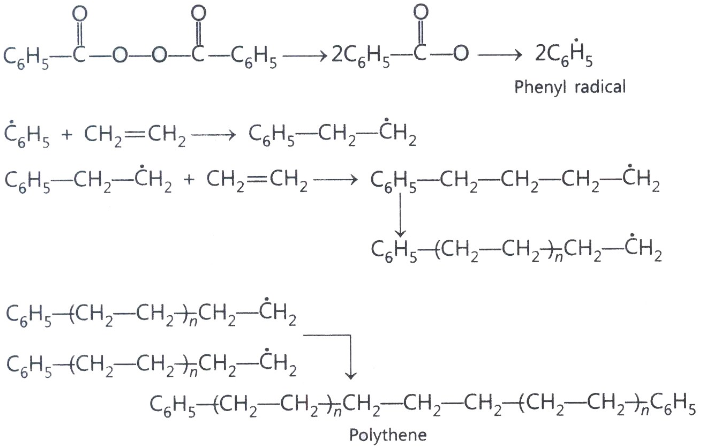
What is the role of benzoyl peroxide in addition polymerisation of alkenes ?
12.
Classify the following as addition and condensation polymers : Terylene, Bakelite, Polyvinyl chloride, polythene.
1.
(i) Elastomers: They are rubber like materials which have weak van der Waals' forces of attraction. They are elastic in nature, e.g. natural rubber.
(ii) Thermoplastics: They are plastics which become soft on heating and can be remoulded. They have more forces than elastomers, e.g. polythene.
(iii) Thermosetting plastics: They do not become soft on heating and cannot be remoulded. They have a strong force of attraction, e.g. bakelite.
(iv) Fibres are thread-like materials which are crystalline in nature. They have a strong force of attraction. Nylon-66 belongs to fibres.
2.
Classification of polymers on the basis of intermolecular forces. The polymers can be classified on the basis of intermolecular forces between the monomers. These are of four types :
1. Elastomers. In elastomers, the polymer chains are held together by weak intermolecular forces. Because of the presence of weak forces, the polymer can be easily stretched. However, a few cross linked are also introduced in the chains which impart the property of regaining the original positions after the stretching force is released. 'The common example is vulcanised rubber.
2. Fibres.These are the polymers which are used for making the fibres.The intermolecular forces between the chains are hydrogen bonds. Because of strong forces, the chains are closely packed giving them high tensile strength. Therefore, these polymers have sharp melting points. The common example is nylon-66.
3. Thermoplastics. These are the polymers in which the intermolecular forces are intermediate between those of elastomers and fibres.These can be easily moulded by he.s.U;.inIgn. these types of polymers, there is no cross linking between the chains. Examples of thermoplastics are polyethylene, polystyrene, etc.
4. Thermosetting. These are prepared from low molecular mass semi-fluid substances. When heated in
a mould, they get highly cross linked to form hard, infusible and insoluble products. The common example is bakelite.
3.
Addition polymers are those 'which are formed from unsaturated monomers without loss of small molecules like HP, NH3, etc., e.g. polyethene. Condensation polymers are those which are formed from monomers having multi-functional groups with the loss of small molecules like HP, NH3, etc., e.g. Nylon-66.
4.
The homopolymer is a high molecular mass macro molecule (polymer) which is formed from one type of monomers. For example, polythene is a homopolymer because it is forme from ethene monomer. The copolymer is a high molecular mass macromolecule (or polymer) which is formed from two or more different monomers. For example, nylon-66 is a copolymer formed from hexamethylene diamine and adipic acid.
5.
Polymers are high molecular mass substances formed by the combination of a large number of simple molecules. They are also called macromolecules. For example, polythene, bakelite, etc.
6.
Pure polymers are required because even traces of impurities may act like inhibitors which lead to formation of polymer with shorter chain length.
7.
Proteins have some structural similarity with synthetic polyamide.Both have \(-\overset{\overset{O}||}{C}-NH-\)peptide linkage
8.
|
HDP |
LDP |
|
1.It consists of linear molecules and has high density |
1. It consists of branched chain structure and has low |
|
2. It is chemically inert and more tougher and harder. |
2. It is chemically inert and tough but flexible and a poor conductor of electricity. |
|
3. It is used for manufacturing buckets dustbins, bottles, pipes, etc. |
3.It is used as insulator of electric wires and manufacture of squeeze bottles, tops and flexible pipes. |
9.
(i) Linear polymers,
(ii) Branched chain polymers,
(iii) Cross-linked or network polymers.
10.
(i) Elastomers
(ii) Fibres
(iii) Thermoplastics
(iv) Thermosetting polymers.
11.
It acts as initator in free radical polymerisation
12.
Addition polymers : Polyvinyl chloride, Polythene.

12th Standard CBSE Syllabus & Materials
12th Standard CBSE
CBSE 12th Computer Science Python Revision Tour I - New Previous year Question Papers Study Material - QB365 Set A
NEW12th Standard CBSE
CBSE 12th Business Studies Planning Important Questions And Answers Study Material - QB365 Set A
NEW12th Standard CBSE
CBSE 12th Business Studies Business Environment Important Questions And Answers Study Material - QB365 Set A
NEW12th Standard CBSE
CBSE 12th Business Studies Principles of Management Important Questions And Answers Study Material - QB365 Set A



CBSE 12th Standard CBSE Subjects
CBSE Standards










