
 100% FREE ACCESS
12th Standard CBSE Syllabus & Materials
12th Standard CBSE
CBSE 12th Economics Government Budget and the Economy Previous year Question Papers Study Material - QB365 Set A
NEW12th Standard CBSE
CBSE 12th Computer Science Interface Python with MySQL - New Previous year Question Papers Study Material - QB365 Set A
NEW12th Standard CBSE
CBSE 12th Computer Science Database Concept - New Previous year Question Papers Study Material - QB365 Set A
NEW12th Standard CBSE
CBSE 12th Computer Science Data Communication - New Previous year Question Papers Study Material - QB365 Set A
NEW12th Standard CBSE
CBSE 12th Computer Science Data Structures - New Previous year Question Papers Study Material - QB365 Set A
NEW12th Standard CBSE
CBSE 12th Computer Science Functions - New Previous year Question Papers Study Material - QB365 Set A

Published on: 03/03/2020
12th Standard CBSE Chemistry Public Exam Important Question 2019-2020
Download CBSE Class 12th Standard CBSE Chemistry question papers, sample papers, important questions, and previous year solved papers in PDF format. Get free study materials, NCERT solutions, and exam preparation resources for Class 12th Standard CBSE Chemistry
Questions + Answers key
Take MCQ Chemistry Test
1.
Write the IUPAC name of ion is at ion isomer of [Ni(NH3)3NO3]Cl.
2.
(i) Why are alkyl halides insoluble in water?
(ii) Why is butan-1-ol optically inactive but butan-2-ol is optically active?
3.
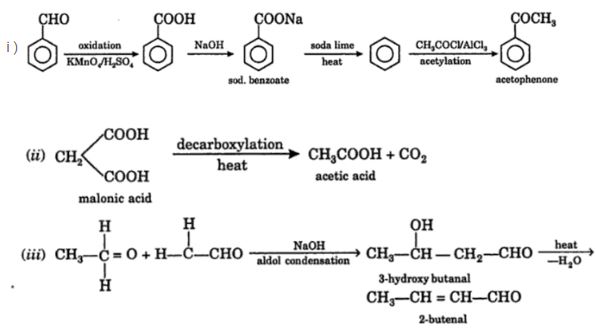
How will you convert
(i) ethanal to 2-hydroxy-3-butenoic acid
(ii) malonic acid to acetic acid
(iii) acetone to 2-methyl-2-propanol?
4.
Two half cells are: AI3+ (aq) / AI and Mg2+ (aq)/ Mg. The reduction potentials of these half cells are -1.66 V and - 2.36 V respectively. Calculate the cell potential. Write the cell reaction also.
5.
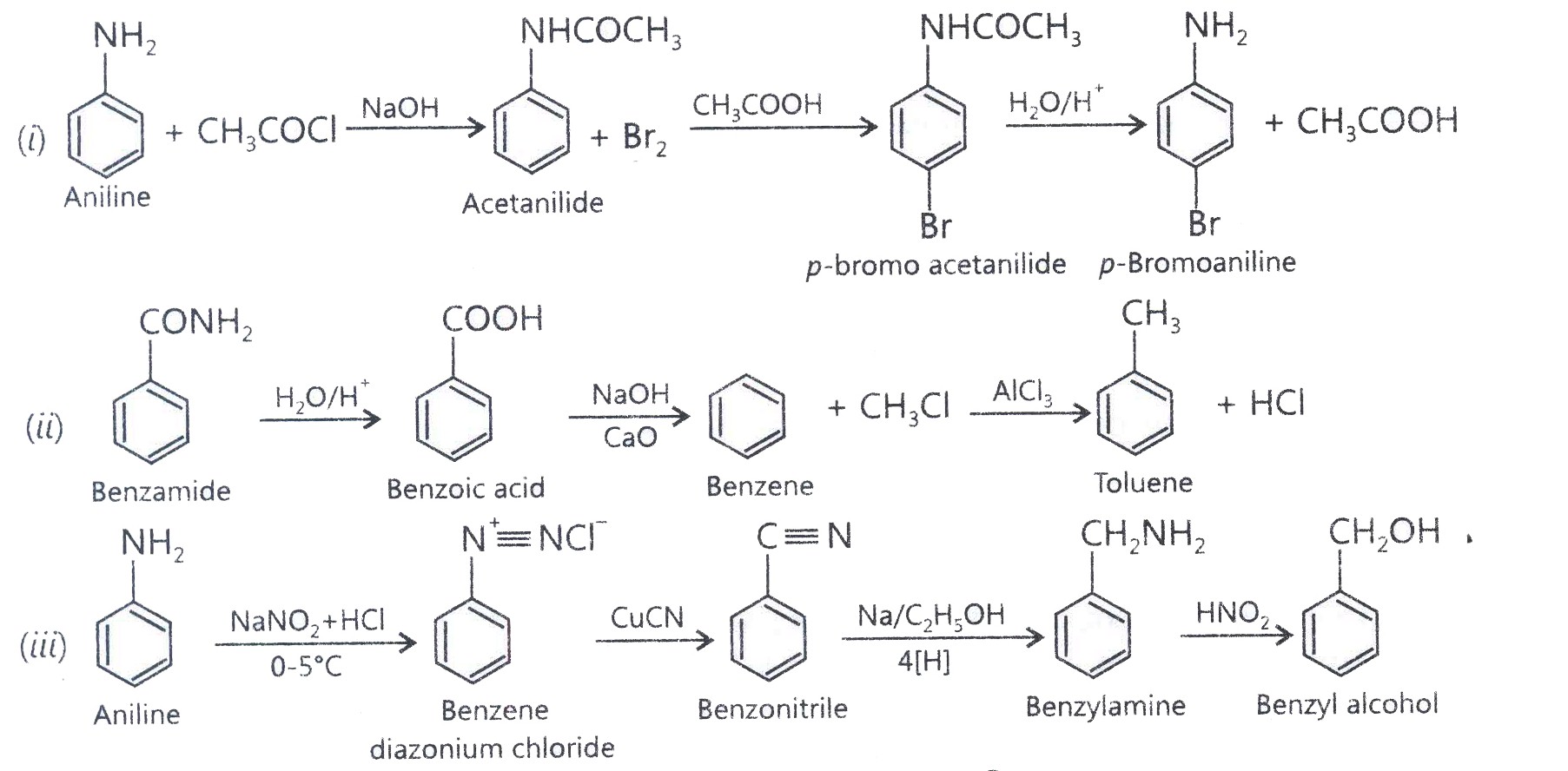
Accomplish the following conversions:
(i) Aniline to p-bromoaniline
(ii) Benzamide to toluene
(iii) Aniline to benzyle alcohol
6.
What are addition polymers ? How are the two types of addition polymers different from each other ? Give one example of each type.
7.
Define the following and give one example of each:
(a) Isoelectric point
(b) Mutarotation
(c) Enzymes
8.
An element occurs in bcc structure. It has a cell edge length of 250 pm. Calculate the molar mass if its densuty is 8.0 g cm-3. Also calculate the radius of an atom of this element.
9.
Certain crystals, when subjected to a mechanical stress get deformed and produce electricity due to displacement of ions. The electricity thus produced is called piezoelectricity and such crystals are called piezoelectric crystals. On the other hand, when such crystals are subjected to an electric field, the atomic displacements are produced which cause mechanical distortion in the crystals. These unique properties of piezoelectric crystals find several applications. Now, answer the following questions:
(i) How do piezoelectric crystals behave?
(ii) Mention one application of piezoelectric crystals.
(iii) Just like certain crystals piezoelectric crystals perform better even under mechanical stress and show' various application, how do you behave under stress? What values we can adopt from even these non-living crystals?
10.
Formaldehyde is a constituent of a number of polymers also called resins. These are non-volatile solids or semi-solids which are obtained from certain plants and also be synthesized in the laboratory.
(i) Name the main formaldehyde resins.
(ii) Mention the major components of these resins also called polymers.
(iii) Which out of these is useful in the manufacture of crockery?
(iv) Formaldehyde is obtained from plants. Similarly we obtain many useful things from plants. Is it worth to destroy plants for obtaining useful material ?
11.
Mr. Roy, the principal of one reputed school organized a seminar in which he invited parents and principals to discuss the serious issue of diabetes and depression in students. They all resolved this issue by strictly banning the junk food in schools and to introduce healthy snacks and drinks like soup, lassi, milk etc. in school canteens. They also decided to make compulsory half an hour physical activities for the students in the morning assembly daily. After six months, Mr. Royconducted the health survey in most of the schools and discovered a tremendous improvement in the health of students.
After reading the above passage, answer the following:
(i)What are the values (at least two) displayed by Mr.Roy?
(ii) As a student, how can you spread awareness about this issue?
(iii) What are tranquillizers? Give an example.
(iv)Why is use of aspartame limited to cold foods and drinks?
12.
Swati was having a party for her friends in the evening. She was preparing Lemonade. While dissolving a large amount of sugar in water. As it was taking a long time, her mother suggested warming the mixture.
(i) What will happen on heating?
(ii) What is the effect of temperature on the rate of chemical reaction?
(iii) Why does the rate of reaction doubles on 10'C rise in temperature?
(iv) What are the values associated with Sonia's mother?
13.
Reetu is purely vegetarian but her husband Rohit likes non-vegetarian food. He regularly buys nonvegetarian goods (fish, meet, eggs etc.) and store these in fridge. The intermixing of odours creates problem for Reetu. Their daughter Rihana is a student of science. One day Rihana suggested her mother to put some small pieces of charcoal in the fridge as she thinks that this will solve the problem to some extent.
(i) Do you think by putting some small pieces of charcoal in the fridge will solve the problem of intermixing of odours. Give reason for your answer.
(ii) What are the values associated with Rihana's suggestion?
14.
In roasting, the are is heated in a regular supply of air in furnace at a temperature below the melting point of the metal. Metal sulphide gets converted into metal oxide and sulphur dioxide gas is formed
which is air pollutant. It also leads to the formation of acid rain which is harmful for crops and buildings made from marble.
How can sulphuric acid help in national economy?
15.
Complete the following chemical equations:
(b) Explain each of the following:
(i) Nitrogen is much less reactive than phosphorus.
(ii) The stability of +5 oxidation state decreases down group 15.
(iii) The bond angles (O-N-O) are not of the same value in \({ NO }_{ 2 }^{ - }\)and
16.
Write the structure of alanine at pH = 2 and pH = 10.
17.
Some halogen containing compounds are useful in daily life. Some compounds of this class are responsible for exposure of flora and fauna to more and more of UV light which causes destruction to a great extent. Name the class of these halo compounds. In your opinion, what should be done to minimise harmful effects of these compounds.
18.
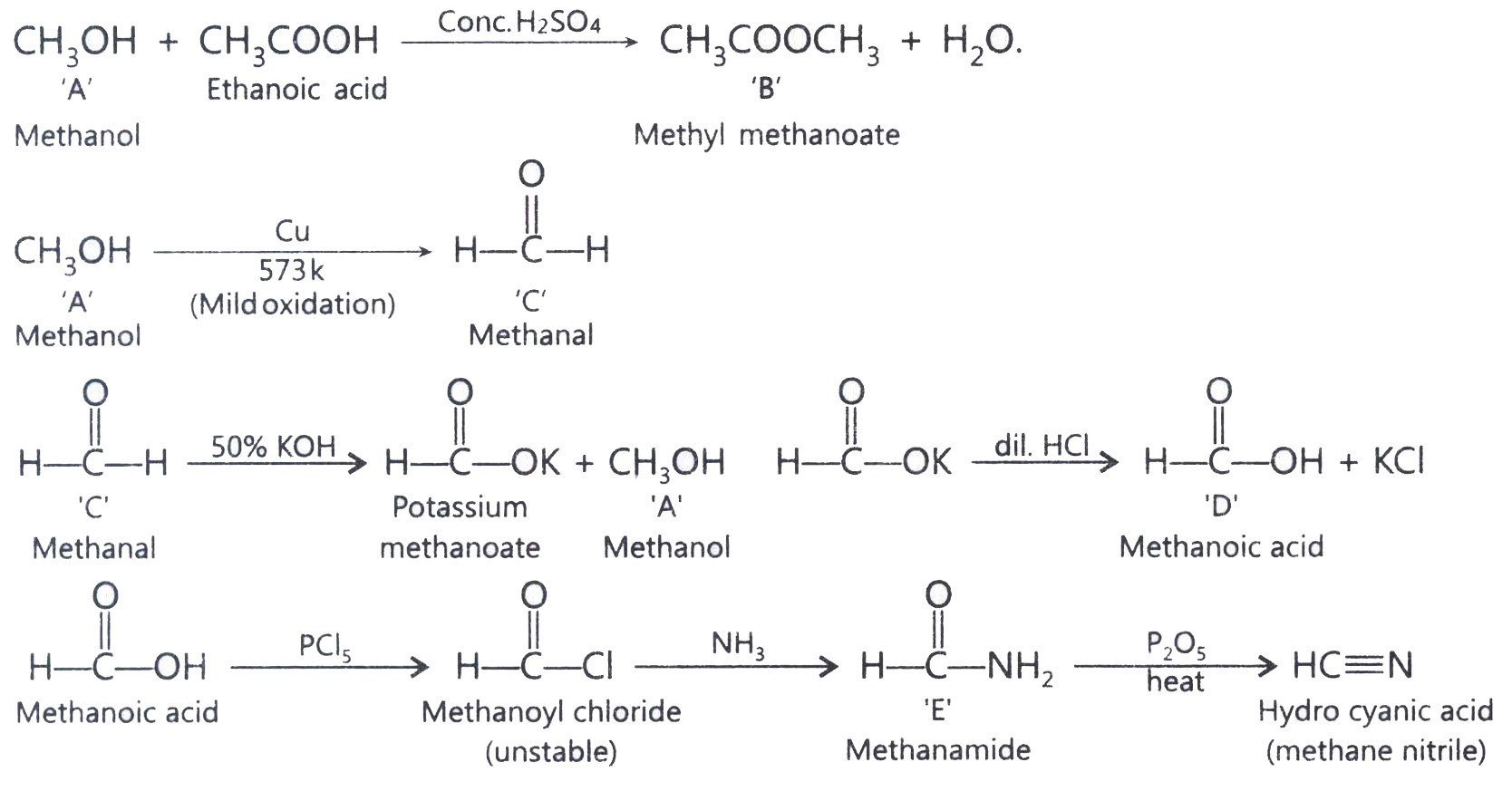
An organic compound (A) on treatment with acetic acid in the presence of sulphuric acid produces an ester (B). (A) on mild oxidation gives (C). (C) with 50% KOH followed by acidification with dilute HCl generates (A) and (D). (D) with PCl5 followed by reaction with ammonia gives (E). (E) on dehydration produces hydrocyanic acid. Identify the compounds A, B, C, D and E.
19.
Compare the general characteristics of the first series of the transition metals with those of the second and third columns. Give special emphasis on the following points:
(i) electronic configurations,
(ii) oxidation states,
(iii) ionisation enthalpies and
(iv) atomic sizes.
20.
Name the following coordination entities and describe their structures:
(i) \({ \left[ Fe{ \left( CN \right) }_{ 6 } \right] }^{ 4- }\)
(ii) \({ \left[ Cr{ \left( { NH }_{ 3 } \right) }_{ 4 }{ Cl }_{ 2 } \right] }^{ + }\)
(iii) \({ \left[ Ni{ \left( CN \right) }_{ 4 } \right] }^{ 2- }\)
(Atomic numbers Fe = 26, Cr = 24, Ni = 28)
21.
Give the biological functions of the following proteins:
(i) Haemoglobin and
(ii) Collagen
22.
Why is NH2 group of aniline acetylated before carrying out nitration?
23.
Write the monomers used for getting the following polymers.
(i) Polyvinyl chloride
(ii) Teflon
(iii) Bakelite
24.
Explain the following terms in relation to colloidal solution
(i) Brownian movement
(ii) Tyndal effect
(iii) Coagulation
(iv) Peptisation.
25.
Why is Frenkel defect not found on pure alkali metal halides?
26.
Name the following compounds are according to IUPAC system of nomenclature:
(i) CH3CH(CH3)CH2CH2CHO
(ii) CH3CH=CHCHO
(iii) CH3CH(CH3)CH2C(CH3)2COCH3
(iv) OHCC6H4CHO-p
27.
The most useful classification of drugs for medicinal chemists is ___________.
on the basis of chemical structure
on the basis of drug action
on the basis of molecular targets
on the basis of pharmacological effect
28.
Reaction of cyclohexanone with dimethylamine in the presence of catalytic amount of an acid forms a compound if water during the reaction is continuously removed. The compound formed is generally known as
an enamine
a Schiff's base
an amine
an imine
29.
Which one of the following does not exhibit the phenomenon of mutarotation?
(-) Fructose
(+)Sucrose
(+)Lactose
(+)MAltose
30.
Which of the following are addition homopolymers?
Teflon
SBR
PVC
Natural rubber
31.
In acidic medium, H2O2 changes \({ Cr }_{ 2 }{ O }_{ 7 }^{ 2- }\) to CrO5 which has two (-O-O-) bonds. Oxidation state of Cr in CrO5 is
+ 5
+ 3
+ 6
- 10
32.
In the following sequence of reactions, \(Z \overset { { PCl }_{ 5 } }{ \longrightarrow } X\overset { Alc.KOH }{ \longrightarrow } Y\overset { (i)conc.H_{ 2 }{ SO }_{ 4 } }{ \underset { (ii)H_{ 2 }O,boil }{ \longrightarrow } } Z \) Z is
CH3CH2CH2OH
CH3CHOHCH3
CH3CH2CH2CH2OH
(CH3)3CCH2OH
33.
Formic acid can be distinguished from acetic acid by reaction with
NaHCO3
dil.acidified KMnO4 solution
2, 4-dinitrophenylhydrazine
Na metal
34.
Bottles containing C6H5I and C6H5CH2I lost their original labels. They were labelled as A and B for testing. A and B were separately taken in test tubes and boiled with NaOH solution. The end solution in each tube was made acidic with dilute HNO3 and some AgNO3 solution was added. Substance B gave a yellow precipitate. Which one of the following statements is true for this experiment?
Addition of HNO3 was unnecessary
A was C6H5I
A was C6H5CH2I
B was C6H5I
35.
Indicate the complex ion which shows geometrical isomerism.
[Cr(H2O)4Cl2]+
[Pt(NH3)3Cl]
[Co(NH3)6]3+
[Co(CN)5(NC)]3-
36.
Species which are isoelectronic with OF2 is/are
ClO-
ClF
NH2Cl
ClO2
37.
Given below are the half cell reactions :
\({ Mn }^{ 2+ }+{ 2e }^{ - }\longrightarrow Mn, \ { \ \ \ \ E }^{ 0 }=-1.18V\)
\(\\ 2({ Mn }^{ 3+ }+{ e }^{ - }\longrightarrow { Mn }^{ 2+ }), \ \ { E }^{ 0 } \ =+1.51V \ \)
The E0 for \(3{ Mn }^{ 2+ }\longrightarrow Mn+2{ Mn }^{ 3+ }\) will be
- 0.33 V, the reaction will occur
- 2.69 V, the reaction will not occur
- 269 V, the reaction will occur
- 0.33 V the reaction will not occur
38.
What happens when a lyophilic sol is added to a lyophobic sol?
Lyophobic sol is protected
Lyophilic sol is protected
Film of lyophilic sol is formed over lyophobic sol
Film of lyophobic sol is formed over lyophilic sol
39.
The method of zone refining of metals is based on the principle of
greater mobility of the pure metal than that of the impurity
higher melting point of the impurity than that of the pure metal
greater noble character of the solid metal than that of the impurity
greater solubility of the impurity in the molten state than the solid
40.
When ethyl acetate was hydrolysed in presence of 0.1 N HCI, the rate constant was found to be 5.40 \(\times\) 10-5 s-1 . From these values we can say that
H2SO4 is stronger than HCI
H2SO4 is weaker than HCI
Both the acids have equal strength
The data is insufficient to compare the strengths of HCI and H2SO4
41.
A metal has cubic close packed (ccp) arrangement,the layer sequence of which is shown below: A face diagonal passes through the centre of atom 4 and the centre(s) of which other atom(s)?
1
2,5
8,12
9,10
42.
Increasing the temperature of an aqueous solution will cause
Decrease in molality
decrease in molarity
decrease in mole fraction
decrease in % w/w
1.
The ionisation isomer of [Ni(NH3)3NO3]Cl is [Ni(NH3)3Cl]NO3. Its IUPAC name is triamminechloridonickel (II) nitrate.
2.
Butan-1-ol is optically inactive compound due to the absence of asymmetric C-atom (or chiral C-atom) whereas butan-2-ol is optically active compound due to the presence of asymmetric C-atom (or chiral C-atom).
.png)
3.
(i)Ethanal to 2-hydroxy-3-butenoic acid
(ii) Malonic acid to acetic acid
(iii) Acetone to 2-methyl-2-propanol
4.
0.70 V, 3Mg + 2 AI3+ \(\longrightarrow\) 3 Mg2+ + 2 AI
5.
6.
Those polymers in unsaturated monomers combine together without loss of any molecule are called addition polymers.
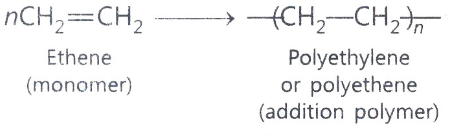
There are two types of addition polymers:
(i) Homopolymers: when addition polymerisation of single monomeric species take places, the polymer formed are called homopolymers, e.g. polythene is homopolymer.
(ii) Copolymers: The polymer made by addition polymerisation from two different monomers are called copolymers, .g. Buna-S is copolymer of 1,3-butadiene and styrene.
7.
(a) Isoelectric point: It is the pH at which +ve and -ve charges on zwitter ion are equal, e.g., amino acid exists as zwitter ion at pH =5.5 to 6.3.
(b) Mutarotation : It is a spontaneous change in optical rotaion when an optically active substance is dissolved in water, e.g., \(\alpha\)-glucose, when dissolved in water, its optical rotaion changes from 111o to 52.5o.
(c)Enzymes : They are biological catalysts which catalyse specific biochemical reactions, e.g.,
\(\underset { sucrose }{ C_{ 12 }H_{ 22 }O_{ 11 } } +H_{ 2 }O\quad \overset { invertase }{ \longrightarrow } \underset { Glucose }{ C_{ 6 }H_{ { 12 } }O_{ 6 } } +\underset { Fructose }{ C_{ 6 }H_{ 12 }O_{ 6 } } \)
Most of enzymes are globular proteins.
8.
\(d=\frac { Z\times M }{ { a }^{ 3 }\times { N }_{ A } } \)
\(\\ M=\frac { d\times { a }^{ 3 }\times { N }_{ A } }{ Z }\)
\( Z=\frac { 8.0g{ cm }^{ -3 }\times { \left( 250 \right) }^{ 3 }\times { 10 }^{ -30 }{ cm }^{ 3 }\times 6.023\times { 10 }^{ 23 } }{ 2 }\)
\(Z=\frac { 8\times 15.625\times 6.023 }{ 20 } \)
\(=\frac { 752.875 }{ 20 } \)
\(\\ 37.64 \ g{ \ mol }^{ -1 }\)
\(For \ bcc, \ 4r=\sqrt { 3 } a\)
\(\ r=\frac { \sqrt { 3 } a }{ 4 } =\frac { 1.732\times 250 }{ 4 } =108.25 \ pm\)
9.
(i) Piezoelectric crystals behaves as mechanical electrical transducer.
(ii) Piezoelectric crystals are used as pickups in record players where they produce electric signals by application of pressure.
(iii) We generally become tense and pessimistic under stress. But we should face every situation, accept every worst situation as challenge and maintain our mental balance. It will definitely result in our performance just like in piezoelectric crystals. We can learn from these non-living crystals to be optimistic as worst situations can be converted into an opportunity.
10.
(i) Main formaldehyde resins: Bakelite, melamine formaldehyde and urea Formaldehyde.
(ii) Bakelite: Phenol and formaldehyde.
Melamine formaldehyde: Melamine and formaldehyde.
Urea formaldehyde: Urea and formaldehyde.
(iii) Melamine is used for this purpose.
(iv) In the modern world, polymer industry has a major role. No doubt, natural polymers are also useful but synthetic polymers have an impact on most of our daily house hold necessity items. It may range from kitchen, bed room and also all luxury items. But it is not worth to destroy plants as they are life giving.
11.
(i) Awareness about health. Discussion by mutual understanding.
(ii) We can spread awareness about these issues by organizing seminars or discussions with the other people.
(iii) Tranquilizers are chemical substances used for the treatment of mental diseases and tensions. e.g., Barbituric acid, veronal etc
(iv) Aspartame is unstable at higher temperature. Thus, its use is limited to cold foods and drinks.
12.
(i) The dissolution of sugar will increase on heating the mixture.
(ii) The rate of reaction increases with the rate of reaction.
(iii) On increasing the temperature by 10'C, the molecules possessing activation energy becomes double. Therefore, the rate of reaction doubles.
(iv) Presence of mind and ability to give advice
13.
(i) Yes, putting some small pieces of charcoal in the fridge can solve the problem of intermixing of odours to some extent. This is because charcoal is a good adsorbent of odours or vapours. Further breaking a big lump of charcoal into small pieces will increase the surface area of adsorbent, more is the extent of adsorption.
(ii) Values associated with Rihana's suggestion are:
(i) Love for her parents
(ii) Keen observation
(iii) Use of chemistry in daily life
(iv) A will to experiment and explore
(v) Presence of mind.
14.
Sulphuric acid is one of the most useful industrial chemicals. It is used in strongest batteries, in textiles paper and leather industry, in manufacture of points and pigments.
15.
(a) \({ (i)\ XeF }_{ 4 }+{ SbF }_{ 5 }\longrightarrow { XeF }_{ 4 }.{ SbF }_{ 5 }\longrightarrow { { [XeF }_{ 3 }] }^{ + }{ { [SbF }_{ 6 }] }^{ - }\)
\(\\ (ii)\ { CI }_{ 2 }+{ 3F }_{ 2 }\overset { 547K }{ \longrightarrow } { 2CIF }_{ 3 }\)
(excess)
(b)
(i) In molecular nitrogen, there is a triple bond between two nitrogen atoms (N = N) and it is nonpolar in character. Due to the presence of a triple bond, it has very high bond dissociation energy (\(941.4kJ\quad { mol }^{ -1 }\) ) and therefore, it does not react with other elements under normal conditions and is very unreactive. However, it may react at higher temperatures.
(ii) The stability of +5 oxidation state decreases down the group because of inert pair effect. Therefore, the +5 oxidation state of Bi is less stable than that of Sb.
(iii) In \({ NO }_{ 2 }\) , there is one electron on N while in \({ NO }_{ 2 }^{ + }\) , there is no electron and in \({ NO }_{ 2 }^{ - }\) , there is a lone pair of electrons on N as shown below:
.png)
\({ NO }_{ 2 }^{ + }\)molecule is linear and has bond angle of 180°. The repulsion by single electron is less as compared to repulsion by a lone pair of electrons. Therefore, bond pairs in \({ NO }_{ 2 }^{ - }\) are forces more closer than in \({ NO }_{ 2 }\) .
16.
Alanine exists as a zwitterion (I) in aqueous solution. In presence of acid (pH = 2), the basic - COO- group accepts a proton to give cation (II) but in presence of a base (pH = 10), the acidic - \({ NH }_{ 3 }\) group donates a proton to the base and thus exists as an anion (III).
\(\quad \quad \quad { CH }_{ 3 }\quad \quad \quad \quad \quad \quad \quad \quad \quad \quad \quad \quad { CH }_{ 3 }\\ \quad \quad \quad \quad |\quad \quad \quad \quad \quad \quad \quad \quad \quad \quad \quad \quad \quad |\\ \overset { + }{ { NH }_{ 3 } } -CH-{ COO }^{ - }\quad \overset { { H }^{ + } }{ \longrightarrow } \overset { + }{ { NH }_{ 3 } } -CH-{ COO }H\\ \quad \quad Alanine\quad (I)\quad \quad \quad \quad \quad \quad \quad \quad II\)
\(\\ \quad \quad \quad { CH }_{ 3 }\quad \quad \quad \quad \quad \quad \quad \quad \quad \quad \quad \quad { CH }_{ 3 }\\ \quad \quad \quad \quad |\quad \quad \quad \quad \quad \quad \quad \quad \quad \quad \quad \quad \quad |\\ \overset { + }{ { NH }_{ 3 } } -CH-{ COO }^{ - }\quad \overset { { OH }^{ - } }{ \longrightarrow } \overset { + }{ { NH }_{ 3 } } -CH-{ { COO }^{ - } }\\ \quad \quad Alanine\quad (I)\quad \quad \quad \quad \quad \quad \quad \quad III\\ \)
17.
CFC (chlorofluoro carbons) are responsible for the destruction of ozone layer and UV light can reach earth which may cause skin cancer and affect flora and fauna.
These compounds should be banned and their use should be made to minimum extent.
18.
19.
(i) Electronic configurations: In 1st transition series, 3d orbitals are progressively filled, whereas, in 2nd transition series, 4d orbitals are progressively filled and in 3rd transition series, 5d-orbitals are progressively filled.
(ii) Oxidation states: Elements show variable oxidation states in both the. series. The highest oxidation state is equal to a total number of electrons in '5' as well as 'd' orbitals. The number of oxidation states shown is less in 5d transition series than 4d series. In 3d series +2, +3 oxidation states are common and they form stable complexes in these oxidation states. In other series, SO4 and PtF6 are formed which are quite stable in higher oxidation state.
(iii) ionization enthalpies: The ionization enthalpy of 5d series is higher than 3d and 4d series due to lanthanide contraction, the effective nuclear charge is more.
(iv) Atomic sizes: The atomic sizes of 4d and 5d series do not differ appreciably due to lanthanoid contraction. The atomic radii of second and third series are larger than 3d series.
20.
(i) [Fe(CN)J4-: Hexacyanoferrate (II) ion. Structure. In this case, iron is in +2 oxidation state having the outer electronic configuration 3d6 . To account for the diamagnetic character, all the electrons get paired leaving two vacant orbitals.
The hybridization scheme and bonding is as shown below:
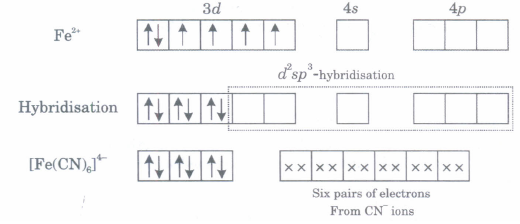
(ii) [Cr(NH3)4CI2]+: Tetraamminedichlorido chromium (III) ion. The chromium (Z = 24) has the electronic configuration 3d54S1. The chromium in this complex is in + 3 oxidation state and the ion is formed by the loss of one 4s and two of the 3d-electrons as shown in Fig. (a). The inner d-orbitals are already vacant and two vacant 3d, one 4s, and three 4p-orbitals are hybridized to form six d2sp3 -hybrid orbitals. Six pairs of electrons one from each NH3molecule and Cl ions (shown by xx) occupy the six vacant hybrid orbitals. The molecule has octahedral geometry. Since the complex contains three unpaired electrons, it is paramagnetic.
.png)
21.
(i) Haemoglobin present in blood transports oxygen from lungs to all the tissues of the body and \({ CO }_{ 2 }\)from the tissues to the lungs for exhale.
(ii) Collagen is a fibrous protein present in connecting tissues of tendons, cartilages, and bones.
22.
It is because it will get oxidised with nitric acid if it is not acetylated.
23.
(i) The monomer of polyvinyl chloride is CH2 = CHCl vinyl chloride.
(ii) The monomer of teflon is CF2 = CF2 tetrafluoroethylene.
(iii) The monomers involved in the formation of bakelite are HCHO formaldehyde and C6H5OH phenol.
24.
(i) The molecules of the colloidal medium due to their kinetic motion, collide with. the particles of the dispersed phase. The impacts of the dispersion medium particles are unequal and this causes a zigzag motion of the colloidal particles known as Brownian movement
(ii) The phenomenon of scattering of light by colloidal particles as a result of which the path of the beam becomes visible is called Tyndall effect
(iii) The phenomenon of precipitation of a colloidal sol by the addition pf excess of an electrolyte is called coagulation of cell ideal sol.
(iv) The process of converting freshly prepared precipitates into colloidal form by the addition of a suitable electrolyte is called peptization. The electrolytes used for the purpose are called peptizing agents. For example, on treating precipitate of iron (III) oxide with a small amount of FeCl3 solution, gives a reddish brown colored colloidal solution. During peptization, the suitable ions from the added electrolyte are adsorbed by the particles of the precipitate. The charged particles repel one another and form a colloidal solution. In this case, Fe3+ ions from ferric chloride are adsorbed by Fe(OH)3 precipitate.
25.
This is due to the face that alkali metal ions have large size which cannot fit into the interstitial sites.
26.
(i) 4-Methylpentanal
(ii) But-2-en-1-al
(iii) 3,3,5-Trimethylhexan-2-one
(iv) Benzene-1, 4-dicarbaldehyde
27.
(d)
on the basis of pharmacological effect
28.
An enamine
29.
(b)
(+)Sucrose
30.
SBR (styrene-butadiene rubber) is an addition copolymer.
31.
(c)
+ 6
32.
(b)
CH3CHOHCH3
33.
(b)
dil.acidified KMnO4 solution
34.
(b)
A was C6H5I
35.
(a)
[Cr(H2O)4Cl2]+
36.
(a)
ClO-
37.
(b)
- 2.69 V, the reaction will not occur
38.
(a)
Lyophobic sol is protected
39.
(d)
greater solubility of the impurity in the molten state than the solid
40.
(a) : For equimolar solution of twoi acids, \(\frac { Strength of Acid 1}{Strength of Acid 2} = \) \(\frac {k_1}{k_2}\)
41.
(c)
8,12
42.
On increasing the temperature, volume of the solution increases. Hence Molarity decreases.

12th Standard CBSE Syllabus & Materials
12th Standard CBSE
CBSE 12th Computer Science Python Revision Tour I - New Previous year Question Papers Study Material - QB365 Set A
NEW12th Standard CBSE
CBSE 12th Business Studies Planning Important Questions And Answers Study Material - QB365 Set A
NEW12th Standard CBSE
CBSE 12th Business Studies Business Environment Important Questions And Answers Study Material - QB365 Set A
NEW12th Standard CBSE
CBSE 12th Business Studies Principles of Management Important Questions And Answers Study Material - QB365 Set A



CBSE 12th Standard CBSE Subjects
CBSE Standards










