
 100% FREE ACCESS
12th Standard CBSE Syllabus & Materials
12th Standard CBSE
CBSE 12th Economics Government Budget and the Economy Previous year Question Papers Study Material - QB365 Set A
NEW12th Standard CBSE
CBSE 12th Computer Science Interface Python with MySQL - New Previous year Question Papers Study Material - QB365 Set A
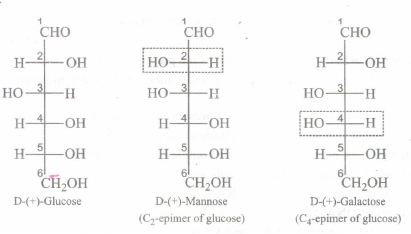
NEW12th Standard CBSE
CBSE 12th Computer Science Database Concept - New Previous year Question Papers Study Material - QB365 Set A
NEW12th Standard CBSE
CBSE 12th Computer Science Data Communication - New Previous year Question Papers Study Material - QB365 Set A
NEW12th Standard CBSE
CBSE 12th Computer Science Data Structures - New Previous year Question Papers Study Material - QB365 Set A
NEW12th Standard CBSE
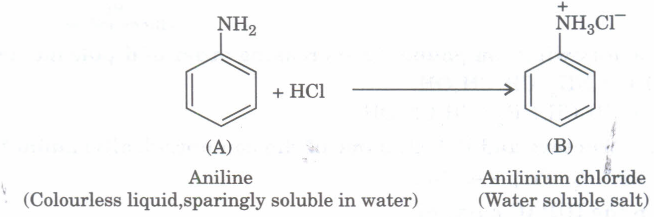
CBSE 12th Computer Science Functions - New Previous year Question Papers Study Material - QB365 Set A

Published on: 03/03/2020
12th Standard CBSE Chemistry Public Exam Sample Question 2020
Download CBSE Class 12th Standard CBSE Chemistry question papers, sample papers, important questions, and previous year solved papers in PDF format. Get free study materials, NCERT solutions, and exam preparation resources for Class 12th Standard CBSE Chemistry
Questions + Answers key
Take MCQ Chemistry Test
1.
Bakelites are phenol formaldehyde resins. These are both linear chains and cross-linked in nature. As a result of cross linking, bakelites become hard and brittle.
(i) What are the monomer units of bakelites?
(ii) What is the nature of the reaction that leads to polymerization?
(iii) What are the uses of both soft and hard bakelites?
2.
Just like human beings, plants also need various nutrients for their healthy growth. Iron is one of these. The deficiency of iron results in disorder known as iron chlorosis. It appears in the form of yellow leaves. It adversely affect the yield of fruits from citrus trees.
(i) In which oxidation state is iron generally present in the soil?
(ii) Why is iron hydroxide not assimilated in the soil?
(ill) Which complex of iron is readily absorbed by soil?
(iv) What can you suggest to stop the adverse effect of iron deficiency?
3.
(a) Define the following terms:
(i) Molarity
(ii) Molal elevation constant (Kb)
(b) A solution containing 15 g urea (molar mass = 60 g mol-1) per litre of solution in water has the same osmotic pressure (isotonic) as a solution of glucose (molar mass = 180 g mol-1 ) in water. Calculate the mass glucose present in one litre of its solution.
4.
In roasting, the are is heated in a regular supply of air in furnace at a temperature below the melting point of the metal. Metal sulphide gets converted into metal oxide and sulphur dioxide gas is formed
which is air pollutant. It also leads to the formation of acid rain which is harmful for crops and buildings made from marble.
(i) Where should we have industries using roasting process in metallurgy? Give reason.
(ii) How can sulphuric acid help in national economy?
5.
(a) Account for the following:
(i) Acidic character increases from HF to HL
(ii) There is large difference between the melting and boiling points of oxygen and sulphur.
(iii) Nitrogen does not form pentahalide.
(b) Draw the structures of the following:
\((i)CIF_{ 3 }\quad (ii)\quad XeF_{ 3 }\)
6.
How do expimers differ from anomers ?
7.
Although both allyl alcohol and 1-propanol are primary alcohols,they can still be distinguished by Lucas reagent. Explain how?
8.
Give reasons for the following:
(i) Oximes are more acidic than hydroxylamine.
(ii) Iodoform is obtained by the reaction of acetone with hypoiodite but with iodide ion.
(iii) Oxidation of tolune to benzaldehyde with CrO3 is carried out presence of acetic anhydride and not in presence of H2SO4.
9.
Wurtz reaction falils in case of tert-alkyl halides. Explain.
10.
Using IUPAC norms write the systematic names for the following:
(a) [Co(NH3)6]Cl3
(b) [Co(Nh3)4Cl(NO2)]Cl
(c) [Ni(NH3)6]Cl2
(d) [Pt(NH3)2Cl(NH2CH3)]Cl
(e) [Mn(H2O)6]2+
(f) [Co(en)3]3+
(iii) [Ti(H2O)6]3+
(vi) [NiCl4]2–
(ix) [Ni(CO)4]
11.
Vapour pressure of chloroform (CHCI3) and dichloromethane (CH2CI2) at 298 K are 200 mm Hg and 415 mm Hg respectively.
(i) Calculate the vapour pressure of the solution prepared by mixing 25.5 g of CHCl3 and 40 g of CH2Cl2 at 298 K and
(ii) mole fractions of each component in vapour phase.
12.
Describe the principle controlling each of the following processes :
(i) Preparation of cast iron from pig Iron.
(ii) Preparation of pure alumina (Al2O3) from bauxite ore.
13.
Why is aniline soluble in aqueous HCI?
14.
What type of solids are electrical conductors, malleable and ductile?
15.
What are vitamins?Deficiency of which vitamin causes
(i) Pernicious anaemia?
(ii) Convulsions?
16.
Explain the following terms:
(i) Crystal field splitting in an octahedral field
(ii) Spectrochemical series
17.
Complete the following chemical equations:
(i) MnO4-(aq)+C2O42-(aq)+H+(aq) \(\rightarrow \)
(ii) Cr2O72-(aq) + Fe2+(aq) +H+(aq) \(\rightarrow \)
18.
(i) The reaction,
Cr2O3 + 2Al ⟶ Al2O3 + 2Cr
ΔG° = - 421 kJ is thermodynamically feasible as is apparent from the Gibbs energy value. Why does it not hike place at room temperature?
(ii) Write all the reactions involved in the extraction of aluminium from bauxite ore.
19.
Give the structure of A, B and C in the following reactions:
(i) \({ C }_{ 6 }{ H }_{ 5 }{ NO }_{ 2 }\overset { Sn/HCI }{ \longrightarrow } A\overset { NaNO_{ 2 }+HCI }{ \underset { 273K }{ \longrightarrow } } B\overset { { H }_{ 2 }O }{ \longrightarrow } C\)
(ii) \({ C }{ H }_{ 3 }CN\overset { { H }_{ 2 }O/{ H }^{ + } }{ \longrightarrow } A\overset { NH_{ 3 } }{ \underset { \triangle }{ \longrightarrow } } B\overset { { Br }_{ 2 }+KOH }{ \longrightarrow } C\)
20.
Some farmers feel that lightening help in producing a better crop. What is the scientific reason behind this?
21.
Although fluorine is more electronegative than oxygen, but the ability of oxygen to stabilise higher oxidation states exceeds that of fluorine. Why?
22.
Why are medicines more effective in colloidal state?
23.
The decomposition of a compound is found to follow a first order rate law.If it takes 15 minutes for 20 percent of original material to react,calculate
(i) specific rate constant
(ii) the time at which 10 percent of the original material remains unreacted,
(iii) the time it takes for the next 20 percent of the reactant left to react after the first 15 minutes.
24.
The measured resistance of a conductance cell containing 7.5\(\times\)10-3 M solution of KCI at 25oC was 1005 ohms. Calculate (a) specific conductance (b) molar conductance of the solution. Cell constant = 1.25 cm-1.
25.
Differentiate between the modes of formation of an addition polymer and a condensation polymer. Give one example of each of these formations.
26.
What are artifical sweetening agents? Give two examples. Name the sweetening agent used in the preparation of sweets for a diabetic patient.
27.
Write the chemical reaction equations for the glucose with
(i) acetic anhydride
(ii) NH2OH Also draw Fischer projections of D-glucose and L-glucose.
28.
Complete the following reactions:
(i) \(CH_3CH_2OH \xrightarrow{SOCI_2}'A' \xrightarrow{KCN} 'B'\)
(ii) \(CH_3-CH-CH_3 \xrightarrow{PCl_5} 'A' \xrightarrow{AgCN}'B' \\ \quad \quad \quad \ \ | \\ \quad \quad \quad \ OH\)
(iii) \(CH_3CH_2\xrightarrow{AgNO_2}\ 'A'\)
(iv) (CH3)2CHCI + CH \(\equiv \) CNa \(\rightarrow\) 'A'
(v) \(CH_3CH_2CH_2Cl+CH_3COOAg \rightarrow \ 'A' +\ 'B'\)
(vi) \(2(CH_2)_2CHBr + 2Na \xrightarrow{dry \ ether}\)
29.
Show how are the following alcohols prepared by the reaction of a suitable Grignard reagent on methanal?
(i)
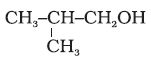
(ii)

30.
The most useful classification of drugs for medicinal chemists is ___________.
on the basis of chemical structure
on the basis of drug action
on the basis of molecular targets
on the basis of pharmacological effect
31.
The strongest base in aqueous solution among the following amines is
N, N-diethylethanamine
N-ethylethanamine
N-methylmethanamine
ethanamine
phenylmethanamine
32.
Which of the following is an essential amino acid ?
Methionine
Tyrosine
Proline
Glycine
Alanine
33.
Which of the following polymers are used as fibre?
POlytetrafluoroethene
Polychloroprene
Nylon
Terylene
34.
Given are cyclohexanol
(I) acetic acid
(II) 2,4,6-trinitrophenol
(III) and phenol
(IV) In these, the order of decreasing acidic character will be
IIII > IV II >I
III > II > IV > I
II > III > I > IV
II > III > IV > I
35.
Which is most acidic?
CCl3COOH
CHCl2COOH
CH2ClCOOH
CH3COOH
36.
Ethylidene chloride is a/an ............
vic-dihalide
gem-dihalide
allylic halide
vinylic halide
37.
Which of the following set of molecules contains the same number of lone pairs of electrons on the central atom ?
SO2, ClF3, BrF3
SF4, NH3, O3
ClF3, XeF2, H2O
H2O, SF4, NH3
38.
Copper is extracted from copper pyrites by heating in a bessemer converter.The method is based on the principle that
iron has less affinity for oxygen than sulphur at high temperature
sulphur has less affinity for oxygen than sulphur at high temperature
copper has more affinity for oxygen than sulphur at high temperature
Copper has more affinity for oxygen than sulphur at high temperature
39.
The name of the complex ion, [Fe(CN)6]3- is:
tricyanoferrate (III) ion
hexacyanidoferrate (III) ion
hexacyano iron (III) ion
hexacyanitroferrate (III) ion
40.
Large number of oxidation states are exhibited by the actinoids than those by the lanthanoids, the main reason being
more energy difference between 5f and 6d than between 4f and 5d orbitals
more reactive nature of the actinoids than the lanthanoids
4f orbitals more diffused than the 5 f orbitals
lesser energy difference between 5f and 6d than between 4f and 5d orbitals
41.
Adsorption is accompanied by
decrease in enthalpy and increase in entropy
increase in enthalpy and increase in entropy
decrease in enthalpy and decrease in entropy
no change in enthalpy and entropy
42.
The vapour pressure of a dilute solution of a solute is not influenced by
nature of the solute if it is non - electrolyte
mole fraction of the solute
melting point of the solute
degree of dissociation of the solute
43.
Conductivity k, is equal to __________________.
\(\frac { 1 }{ R } \frac { l }{ A } \)
\(\frac { { G }^{ \ast } }{ R } \)
\({ \wedge }^{ m }\)
\(\frac { l }{ A } \)
44.
Collision Theory is applicable to
First order reactions
Zero order reactions
Bimolecular reactions
Intramolecular reactions
1.
(i) These are phenol and formaldehyde.
(ii) It is a condensation reaction.
(iii) Soft bakelites are used for making glues for binding laminated sheets, wooden planks and in lacquers. Hard bakelites are used in the manufacture of combs, fountain pens, electric goods etc.
2.
(i) Iron is present in + 3 oxidation state as Fe (III).
(ii) Iron hydroxide i.e., Fe(OH)3 is insoluble in water and is therefore, not assimilated in the soil.
(iii) Fe(III)-EDTA complex is readily absorbed by the soil as it is water soluble.
(iv) The addition of this complex compound in proper amount makes plants healthy and the yield of fruits gets increased. But its deficiency also affect adversely so we will provide Fe-EDTA complex.
3.
(a) (i) Molarity: Molarity of a substance in a solution is equal to the number of moles of the substance present in one litre of the solution.
i.e., Molarity = \(\frac { No.\ of\ moles\ of\ substance }{ Volume\ of\ solution\ in\ L } \)
(ii) Molal elevation constant (Kb): It is also called ebullioscopic constant. It is equal to the change in boiling point of one molar solution.
\(\Delta\)Tb = Kb . m
So, when, Molarity = 1,\(\Delta\) Tb = Kb
(b)Given; Mass of urea, WB = 15 g
Molar mass of rea, MB = 60 g
The solution of urea in water is isotonic to that of glucose solution.
So, \(\pi _{ urea }=\pi _{ Glucose }\)
\(C_{ urea }RT=C_{ Glucose }RT\)
\(\frac { { n }_{ urea } }{ V } RT=\frac { { n }_{ Glucose } }{ V } RT\)
\(=\frac { 15 }{ 60 } =\frac { { W }_{ Glucose }V }{ 180 } \)
\(={ W }_{ Glucose }=\frac { 18\times 18 }{ 60 } \)
= 45 g
So, 45 g of glucose is present in 1 L of solution.
4.
(i) The industries involving the roasting of sulphur ores must be installed at place far from the cities so that the pollution caused by release of S02 gas may not affect human beings.
(ii) Sulphuric acid is one of the most useful industrial chemicals. It is used in strongest batteries, in textiles paper and leather industry, in manufacture of points and pigments.
5.
(a) (i) In gaseous state, hydrogen halides are covalent. But in aqueous solution, they ionise and behave as acids. The acidic strength of these acids decreases in the order:
HI > HBr > HCI > HF
Thus, HF is the weakest acid and HI is the strongest acid among these hydrogen halides. The above order of acidic strength is reverse of that expected on the basis of electronegativity. Fluorine is the most electronegative halogen, therefore, the electronegativity difference will be maximum in HF and should decrease gradually as we move towards iodine through chlorine and bromine. Thus, HF should be most ionic in nature and consequently, it should be strongest acid. Although many factors contribute towards the relative acidic strengths, the major factor is the bond dissociation energy. The bond dissociation energy decreases from HF to HI so that HF has maximum bond dissociation energy and HI has the lowest value.
Since H-I bond is weakest, it can be dissociated into H+ and 1- ions readily while HF can be dissociated with maximum difficulty. Thus, HI is the strongest acid while HF is the weakest acid among the hydrogen halides.
(ii) Oxygen molecule is held by weak van der Waals forces because of the small size and high electronegativity of oxygen. On the other hand, sulphur molecules do not exist as \({ S }_{ 2 }\) but from polyatomic molecules having eight atoms per molecule \({ S }_{ 8 }\) linked by single bonds. Therefore, S atoms are strongly held together by intermolecular forces and its melting point is higher than that of oxygen. Hence, there is large difference in melting and boiling points of oxygen and sulphur.
(iii) In molecular nitrogen, there is a triple bond between two nitrogen atoms (N-N) and it is nonpolar in character. Due to the presence of a triple bond, it has very high bond dissociation enthalpy (\(941.4kJ{ mol }^{ -1 }\)) and therefore, it does not react with other elements under normal conditions and is very unreactive. However, it may react at higher temperatures.
6.
Carbohydrates which differ in configuration at the glycosidic carbon (i.e. \({ C }_{ 1 }\) in aldoses and \({ C }_{ 2 }\) in ketoses) are called anomers while those which differ in configuration at any carbon other than glycosidic carbon are called epimers. For example, \(\alpha \)-D-glucose and \(\beta \)-D-glucose are anomers since they differ in configuration at \({ C }_{ 1 }\) (glycosidic carbon) while glucose and mannose are called epimers since they differ in configuration at \({ C }_{ 2 }\)(other than the glycosidic carbon \({ C }_{ 1 }\) ). In other words, glucose and mannose are Cr epimers. Similarly, we can show that glucose and galactose are \({ C }_{ 4 }\) -epimers since they differ in configuration only at \({ C }_{ 4 }\).
7.
The allyl carbocation is resonance stabilized and hence is as stable as a 30 carbocation
Therefore, on treatment with Lucas reagent, allyl alcohol gives white turbidity in less than 1 min.l-Propanol, on the other hand, does not react with Lucas reagent.
.JPG)
8.
(i) Loss of a proton from an oxime gives a conjugate base which is stabilized by resonance but the conjugate base of NH2OH is not.
(ii) To prepare iodoform from acetone, I+ is required which is supplied by IO- ion but not by I- ion as shown below:
(iii) During oxidation of toluene with CrO/H2SO4, the intermediate benzaldehyde formed readily undergoes oxidation to form benzoic acid due to the presence of H2O in H2SO4,
\(\underset{Toluene}{C_6H_5-CH_3}\xrightarrow[\Delta]{CrO_3/H_2SO_4}\underset{Benzaldehyde}{C_6H_5-CHO}\xrightarrow{H_2O}\underset{Benzaldehyde\ hydrate}{C_6H_5CH(OH)_2}\xrightarrow{CrO_3/H_2SO_4}\underset{Benzalde\ acid}{C_6H_5COOH}\)
However, with CrO 33 in (CH3CO)2O, due to the absence of H2O as soon as benzaldehyde is formed, it reacts with acetic anhydride to form benzylidene diacetate which does not undergo further oxidation. In this way, oxidation of benzaldehyde to benzoic acid is prevented. The gem-diacetate thus formed upon subsequent hydrolysis with alkali or acid gives benzaldehyde
\(\underset{Toluene}{C_6H_5CH_3}\xrightarrow[273-283K]{CrO_3/H_2SO_4}\underset{Benzylidene diacetate\\ (gem-diacelate)}{C_6H_5CH(OOH_3)_2}\xrightarrow[(Hydrolysis)]{H_3O^+}\underset{Benzaldehyde}{C_6H_5CHO}+\underset{Acetic\ acid}{2CH_3COOH}\)
9.
tert-Alkyl halides prefer to undergo dehydrohalogenation in presence of a strong base such as Na metal instead of undergoing Wurtz reaction as explained below:
\(\underset{tert-Butyl\ bromide}{(CH_3)_3C-Br}+2Na\longrightarrow\underset{tert-Butylsodium}{(CH_3)_3Na^+}+Na^+Br^-\)
Thus, only rand 2° alkyl halides undergo Wurtz reaction while 3° alkyl halides prefer to undergo dehydrohalogenation to form alkenes.
10.
(a) Hexaamminecobalt (III) chloride
(b) Tetraamminechloridonitrito-N-cobalt(III) chloride
(c) Hexaamminenickel (II) chloride.
(d) Diamminechloridomethylamineplatinum (II) chloride
(e) Hexaaquamanganese (II) ion
(f) Tris ethane (1, 2-diamine) cobalt (III) ION.
(g) Hexaaquatitanium (III) ion
(h) Tetrachloridonickelate (II) ion
(f) Tetracarbonylnickel (0)
11.
(i) Molar mass of CH2Cl2 = 12 × 1 + 1 × 2 + 35.5 × 2 = 85 g mol–1
Molar mass of CHCl3 = 12 × 1 + 1 × 1 + 35.5 × 3 = 119.5 g mol–1
\(\text {Moles of } \mathrm{CH}_{2} \mathrm{Cl}_{2} \quad=\frac{40 \mathrm{~g}}{85 \mathrm{~g} \mathrm{~mol}^{-1}}=0.47 \mathrm{~mol}\)
\(\text {Moles of } \mathrm{CHCl}_{3} \quad=\frac{25.5 \mathrm{~g}}{119.5 \mathrm{~g} \mathrm{~mol}^{-1}}=0.213 \mathrm{~mol}\)
\(x_{\mathrm{CH}_{2} \mathrm{Cl}_{2}}=\frac{0.47 \mathrm{~mol}}{0.683 \mathrm{~mol}}=0.688\)
xCHCl3 = 1.00 – 0.688 = 0.312
\(p_{\text {total }}=p_{1}^{0}+\left(p_{2}^{0}-p_{1}^{0}\right) x_{2}=200+(415-200) \times 0.688\)
= 200 + 147.9 = 347.9 mm Hg
(ii) y1 = p1/ptotal, we can calculate the mole fraction of the components in gas phase (y1).
\(p_{\mathrm{CH}_{2} \mathrm{Cl}_{2}}=0.688 \times 415 \mathrm{~mm} \mathrm{Hg}=285.5 \mathrm{~mm} \mathrm{Hg}\)
\(p_{\mathrm{CHCl}_{3}}=0.312 \times 200 \mathrm{~mm} \mathrm{Hg}=62.4 \mathrm{~mm} \mathrm{Hg}\)
\(y_{\mathrm{CH}_{2} \mathrm{Cl}_{2}}=285.5 \mathrm{~mm} \mathrm{Hg} / 347.9 \mathrm{~mm} \mathrm{Hg}=0.82\)
\(y_{\mathrm{CHCl}_{3}}=62.4 \mathrm{~mm} \mathrm{Hg} / 347.9 \mathrm{~mm} \mathrm{Hg}=0.18\)
12.
(i) Cast iron is made by melting pig iron with scrap iron and coke using hot air blast. It has slightly lower carbon content (in pig iron, C is 4%) and in cast iron, C is about 3% and is extremely hard and brittle.
(ii) Leaching of alumina from bauxite ore Bauxite usually contains SiO2, iron oxide and titanium oxide (TiO2) as impurities.
Powdered ore is digested with cone. NaOH solution at 473-523 K and 35-36 bar pressure.Al2O3 and SiO2 are dissolved in the solution while impurities do not.
\(Al_2O_3(S) +2NaOH(aq) + 3H_2O(l) \xrightarrow[35-36\ bar]{473-523K}\underset{Sodium\ aluminate}{2Na[Al(OH)_4](aq)}\)
Filtrate is neutralised by passing CO2 gas and hydrated Alp j is precipitated. Some freshly prepared hydrated Al2O3 is also added to solution to induce precipitation.
\(2Na [Al(OH)_4] (aq)+ 2CO_2(9)⟶\underset{(ppt.)}{Al_2O_3.xH_2O(s)}+2NaHCO_3(aq)\)
Precipitate is filtered, washed, dried and heated to give back pure Al2O3.
\(Al_2O_3. xH_2O( s)\xrightarrow{1470K}\underset{Alumina}{Al_2O_3(s)}+xH_2O(g)\)
13.
Aniline forms the salt anilinium chloride with HCIwhich is water soluble
14.
Metallic solids.
15.
Vitamins: Vitamins are group of organic compounds which are required in very small amounts for the healthy growth and functioning of animal organism. They cannot be made by organism and so have to be part of our diet. The deficiency of a vitamin can cause a specific disease, e.g.
(i) Vitamin B, deficiency causes pernicous anaemia.
(ii) Vitamin B, deficiency causes convulsion.
16.
(a) All the six ligands are assumed to be positioned symmetrically along the axis with the metal atom at the origin.
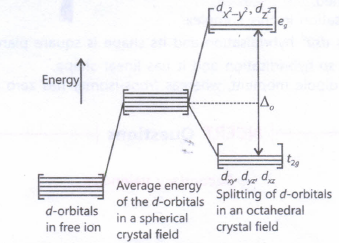
(b) As the ligand approaches, there is an increase in energies of all d-orbitals relative to that of free ion in spherical field. The orbitals \({ d }_{ { x }^{ 2 }-{ y }^{ 2 } }\) and \({ d }_{ { z }^{ 2 } }\) . lie on axis, therefore, their energy is raised. It is called e I the other orbitals dxy d yz d have lower zx have lower energy because they lie in between the axis are less repelled. These orbitals are t2g .
(c) The difference in energy of these two set of orbitals is called energy of separation \({ (\Delta }_{ 0 })\)
(ii) Depending upon the ability of the ligands to cause splitting, i.e., strength of ligands are arranged in increasing order, the series so produced is called Spectrochemical series.
\(({ I }^{ - }<{ Br }^{ - }<{ Cl }^{ - }<{ F }^{ - }<\underset { \overset { | }{ { COO }^{ - } } }{ { COO }^{ - } } <{ H }_{ 2 }O)\)
17.
(i) 8MnO4-(aq)+3S2O32-(aq)+H2O(l) \(\rightarrow \)8MnO2+6SO42-+2OH-
(ii) Cr2O72-(aq) + 6Fe2+(aq) +14H+(aq) \(\rightarrow \) 2Cr3++6Fe3++7H2O
18.
(i) Certain amount of activation energy is essential even for such reactions to be
thermodynamically feasible, therefore, heating is required.
(ii) Leaching of alumina from bauxite ore
Al2O3 (s)+ 2NaOH (aq) + 3H2O(l)\(\xrightarrow[35-36bar]{473-523K}\)2Na [Al (OH)4](aq)
2Na [Al (OH)4] (aq) + CO2(g) ⟶ Al2O3.xH2O(s) + 2NaHCO3
Al2O3.xH2P(s) \(\xrightarrow{1470K}\)\(\underset{Pure\ alumina}{Al_2O_3(s)}\)+xH2O(g)
Electrolytic reduction of alumina
2Al2O3 + 3C ⟶ 4Al + 3CO2
The electrolytic reactions are
At cathode Al3+(melt) + 3e- ⟶ Al(I)
Atanode C (s)+ O2-(melt) ⟶ CO (g)+ 2e-
C(s)+ 2O-(melt) ⟶ CO2 (g)+ 4e-
19.
(i) \({ C }_{ 6 }{ H }_{ 5 }{ NO }_{ 2 }\overset { Sn/HCI }{ \longrightarrow } { { C }_{ 6 }{ H }_{ 5 }{ NH }_{ 2 }\overset { NaNO_{ 2 }+HCI }{ \underset { 273K }{ \longrightarrow } } }{ C }_{ 6 }{ H }_{ 5 }{ N }_{ 2 }^{ + }{ CI }^{ - }\overset { { H }_{ 2 }O }{ \longrightarrow } { C }_{ 6 }{ H }_{ 5 }OH+{ N }_{ 2 }+HCI\)
(ii)\({ C }{ H }_{ 3 }CN\overset { { H }_{ 2 }O/{ H }^{ + } }{ \longrightarrow } { C }{ H }_{ 3 }-\overset { \begin{matrix} O \\ \parallel \end{matrix} }{ C } -OH\overset { NH_{ 3 } }{ \underset { \triangle }{ \longrightarrow } } { CH }_{ 3 }{ CONH }_{ 2 }\overset { { Br }_{ 2 }+KOH }{ \longrightarrow } { CH }_{ 3 }{ NH }_{ 2 }\)
20.
Lightning taking place from time to time helps in converting atmospheric nitrogen and oxygen into nitric acid as a result of series of reactions.
\(N_{ 2(g) }+O_{ 2(g) }\overset { Lightenig }{ \longrightarrow } 2NO_{ (g) }\\ 2NO_{ (g) }+O_{ 2 }\longrightarrow 2NO_{ 2(g) }\\ 4NO_{ 2(g) }+O_{ 2(g) }+2H_{ 2 }O_{ (l) }\longrightarrow 4HNO_{ 3(aq) }\)
Nitric acid dissolves in rain water and is converted into calcium nitrate by reacting with calcium salts present in the soil. Calcium nitrate and other nitrates are the nutrients for the soil which gives better yield of crop.
21.
This is because of ability to form multiple bonds.
22.
A colloidal state has larger surface area of sol particles and therefore, are more effectively adsorbed.Therefore the medicines in colloidal state are more easily assimilated or adsorbed and are more effective.
23.
(i) 0.01488 min-1
(ii) 154.77 min
(iii) 15 minutes.
24.
(a) 0.001244 ohm-1 cm-1 (b) 165.87 ohm-1 cm2 mol-1
25.
|
Condensation polymerisation |
Addition polymerisation |
|
1. It is formed by combination of large number of monomers having multifunctional groups to form polymers with loss of small molecules like H2O, NH3, etc. |
1. It is formed by addition reaction of large number of monomers having double bond without any loss of small molecules. |
|
2. It is step growth polymerisation, e.g. Nylon-66. |
2. It is chain growth polymerisation, e.g. Polythene. |
26.
Artificial sweeteners: The artificial sweeteners are another type of food additives, e.g. Ortho-sulphobenzimide (saccharin) is marketed as soluble sodium or calcium salt. It is 550 times sweeter than cane sugar. It is lifesaver for diabetic patients and is of great value to people who need to control intake of calories. Aspartame is unstable at cooking temperature, therefore, it can be used as a sugar substitute to cold foods and soft drinks. Alitame is more stable than aspartame during cooking. It can be used to prepare sweets for diabetic patients. Sucralose (trichloro derivative of sucrose) is predicted to become a great commercial success. It is stable at cooking temperature. It does not provide calories.
27.
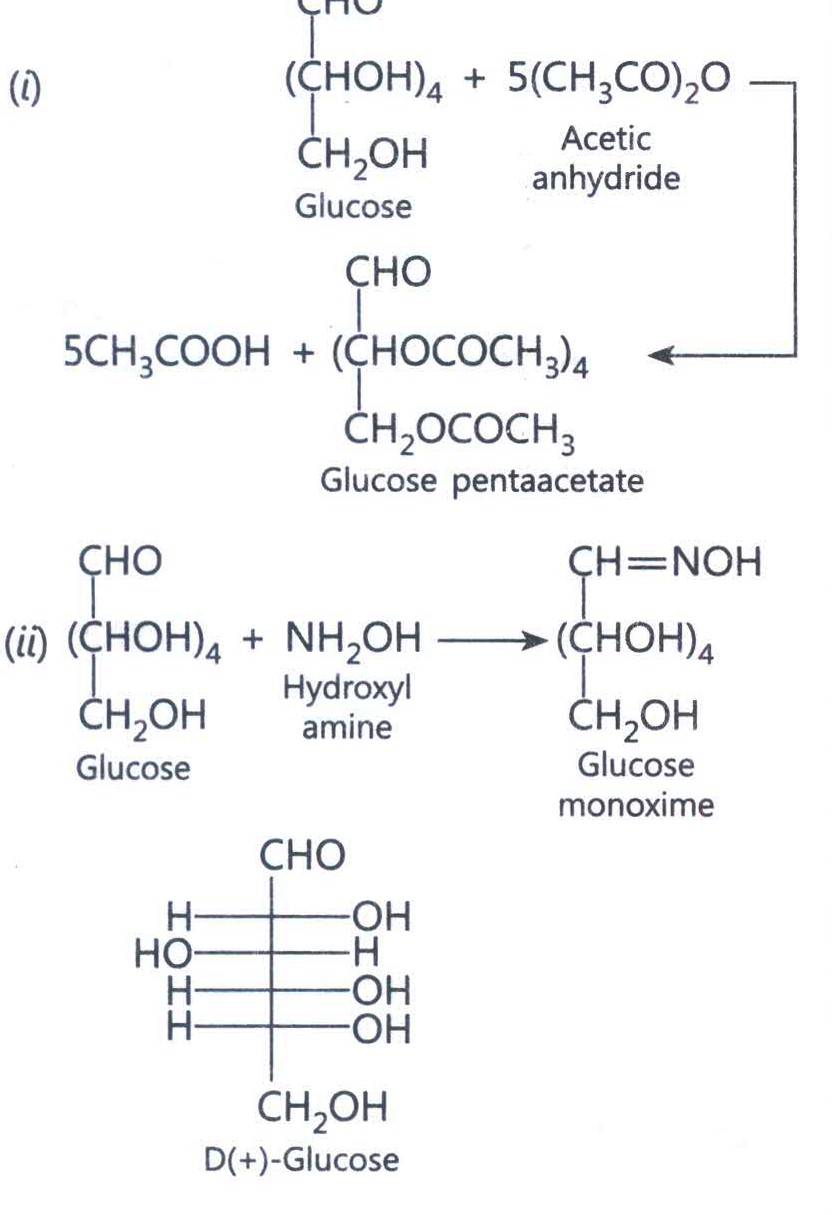
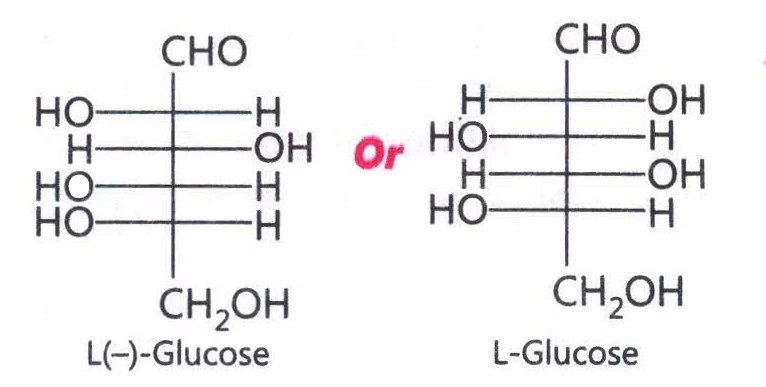
28.
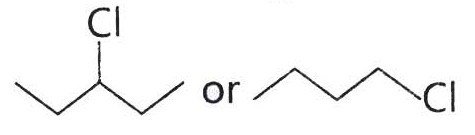
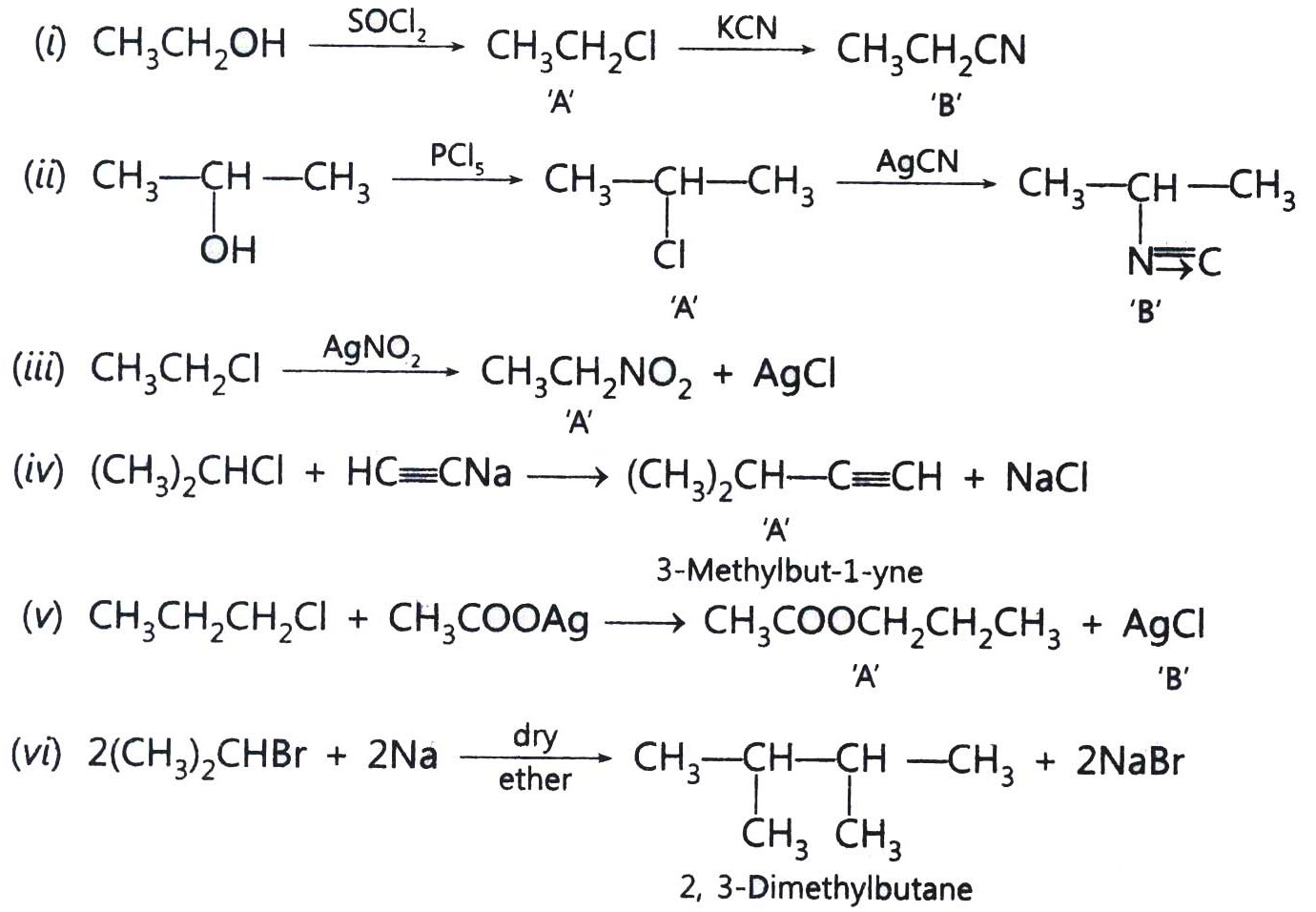
29.
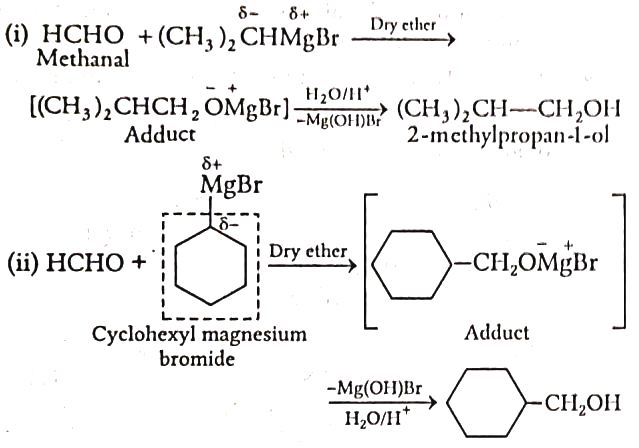
30.
(d)
on the basis of pharmacological effect
31.
Amines are stronger bases than amines followed by amines. Further, among amines, (C2H5)2NH is more basic than (CH3)2NH due to stronger +I-effect of the CH3CH2 over CH3 group. Thus, option (b) is correct.
32.
(a)
Methionine
33.
(d)
Terylene
34.
(b)
III > II > IV > I
35.
(a)
CCl3COOH
36.
(b)
gem-dihalide
37.
(b)
SF4, NH3, O3
38.
(d)
Copper has more affinity for oxygen than sulphur at high temperature
39.
(b)
hexacyanidoferrate (III) ion
40.
(d)
lesser energy difference between 5f and 6d than between 4f and 5d orbitals
41.
(c)
decrease in enthalpy and decrease in entropy
42.
(a)
nature of the solute if it is non - electrolyte
43.
(a)
\(\frac { 1 }{ R } \frac { l }{ A } \)
44.
(c)
Bimolecular reactions

12th Standard CBSE Syllabus & Materials
12th Standard CBSE
CBSE 12th Computer Science Python Revision Tour I - New Previous year Question Papers Study Material - QB365 Set A
NEW12th Standard CBSE
CBSE 12th Business Studies Planning Important Questions And Answers Study Material - QB365 Set A
NEW12th Standard CBSE
CBSE 12th Business Studies Business Environment Important Questions And Answers Study Material - QB365 Set A
NEW12th Standard CBSE
CBSE 12th Business Studies Principles of Management Important Questions And Answers Study Material - QB365 Set A



CBSE 12th Standard CBSE Subjects
CBSE Standards










