
 100% FREE ACCESS
12th Standard CBSE Syllabus & Materials
12th Standard CBSE
CBSE 12th Economics Government Budget and the Economy Previous year Question Papers Study Material - QB365 Set A
NEW12th Standard CBSE
CBSE 12th Computer Science Interface Python with MySQL - New Previous year Question Papers Study Material - QB365 Set A
NEW12th Standard CBSE
CBSE 12th Computer Science Database Concept - New Previous year Question Papers Study Material - QB365 Set A
NEW12th Standard CBSE
CBSE 12th Computer Science Data Communication - New Previous year Question Papers Study Material - QB365 Set A
NEW12th Standard CBSE
CBSE 12th Computer Science Data Structures - New Previous year Question Papers Study Material - QB365 Set A
NEW12th Standard CBSE
CBSE 12th Computer Science Functions - New Previous year Question Papers Study Material - QB365 Set A

Published on: 14/09/2019
Solution
Download CBSE Class 12th Standard CBSE Chemistry question papers, sample papers, important questions, and previous year solved papers in PDF format. Get free study materials, NCERT solutions, and exam preparation resources for Class 12th Standard CBSE Chemistry
Questions + Answers key
Take MCQ Chemistry Test
1.
45 g of ethylene glycol (C2H4O2) is mixed with 600 g of water. Calculate
(i) the freezing point depression and
(ii) the freezing point of the solution.
2.
Calculate the normal boiling point of a sample of sea water containing 3.5% of NaCl and 0.13% of MgCl2 by mass. Given Kb (water) = 0.52 K kg mol-1 (Mol. Wt. of NaCl = 58.5 g mol-1. MgCl2 = 95g mpl-1)
3.
If N2 gas is bubbled through water at 293 K, how many millimoles of N2 gas would dissolve in 1 liter of water? Assume that N2 exerts a partial pressure of 0.987 bar. Given Henry's law constant for N2 at 293 K is 76.48 kbar.
4.
Differentiate between molarity and molality of a solution. How can we change molality value of a solution into molarity value?
5.
State Raoult's law for solutions of volatile liquids. Taking suitable examples explain the meaning of positive and negative deviations from Raoult's law.
6.
Explain depression in freezing point of a solution on the addition of a solute. Show that depression in freezing point is a colligative property.
7.
Why is a molar solution of solute in water more concentrated than a molal solution?
8.
V1 cc of solution having molarity M1 is diluted to have molarity M2. Derive expression (in terms of M1,M2 and V1) for the volume of water required to be added.
9.
The degree of dissociation of Ca(NO3)2 in a dilute aqueous solution containing 14 g of the salt per 200 g of water at 100oC is 70% If the vapour pressure of water is 760 mm Hg, calculate the vapour pressure of the solutions.
10.
The boiling point of a solution of urea in water is 100.13oC. Calculate the freezing point of solution.(Kf and Kb for water are 1.86 K kg mol-1 and 0.52 K kg mol-1 respectively).
11.
What type of non-idealities are exhibited by cyclohexane-ethanol and acetone-chloroform mixture? Give reasons for your answer.
1.
Depression in freezing point is related to the molality, therefore, the molality of the solution with respect to ethylene glycol \(=\frac{\text { moles of ethylene glycol }}{\text { mass of water in kilogram }}\)
\(\text {Moles of ethylene glycol }=\frac{45 \mathrm{~g}}{62 \mathrm{~g} \mathrm{~mol}^{-1}}=0.73 \mathrm{~mol}\)
\(\text {Mass of water in } \mathrm{kg}=\frac{600 \mathrm{~g}}{1000 \mathrm{~g} \mathrm{~kg}^{-1}}=0.6 \mathrm{~kg}\)
\(\text {Hence molality of ethylene glycol }=\frac{0.73 \mathrm{~mol}}{0.60 \mathrm{~kg}}=1.2 \mathrm{~mol} \mathrm{~kg}^{-1}\)
Therefore freezing point depression,
ÄTf = 1.86 K kg mol–1 x 1.2 mol kg–1 = 2.2 K
Freezing point of the aqueous solution = 273.15 K – 2.2 K = 270.95 K
2.
Assuming complete dissociation of NaCI and MgCI2, i.e. 1 mole of NaCl producing 2 moles of species and 1 mole of MgCl2 producing 3 moles of species.The number of moles of species in water
\(\left(W_B\over M_B\right)={2\times 3.5\over58.5 }+{3\times 0.13\over 95}=0.12\)
The mass of water in the solution (WA) is 100 g - (3.5 + 0.13) g = 96.37 g
\(m={W_B\over M_B}\times{1000\over W_A}=0.12\times {1000\over 96.37}\)
1.25 mol/kg.
ΔTb = Kb x m = 0.52 x 1.25 = 0.65 K.
Boiling point of solution
= 373 + 0.65
= 373.65 K
3.
The solubility of gas is related to the mole fraction in aqueous solution. The mole fraction of the gas in the solution is calculated by applying Henry’s law. Thus:
\(x(\text { Nitrogen })=\frac{p \text { (nitrogen) }}{K_{\mathrm{H}}}=\frac{0.987 \mathrm{bar}}{76,480 \mathrm{bar}}=1.29 \times 10^{-5}\)
As 1 litre of water contains 55.5 mol of it, therefore if n represents number of moles of N2 in solution,
\(x(\text { Nitrogen })=\frac{n \text { mol }}{n \text { mol }+55.5 \text { mol }}=\frac{n}{55.5}=1.29 \times 10^{-5}\)
(n in denominator is neglected as it is < < 55.5)
Thus n = 1.29 × 10⁻⁵ \(\times\) 55.5 mol = 7.16\(\times\) 10–4 mol
\(=\frac{7.16 \times 10^{-4} \mathrm{~mol} \times 1000 \mathrm{ \ mmol}}{1 \mathrm{~mol}}=0.716 \mathrm{ \ mmol}\)
4.
Molality is defined as the number of moles of the solute per kilogram of the solvent. It is represented by m
Molality (m) = \(\frac { Number\ of\ moles\ of\ solute\times 1000 }{ Mass\ of\ solvent\ (in\ g) } \)
It does not change with change in temperature.
Molarity is defined as the number of moles of solute dissolved in one litre or one cubic decimetre of the solution.
Molality (m) = \(\frac { Number\ of\ moles\ of\ solute\times 1000 }{ Volume\ of\ solution\ (in\ mL) } \)
It decreases with increase in temperature (as V∝T)
We van change molality value of a solution into molarity value by using following relation:
Molality (m) = \(\frac { M\times 1000 }{ (1000\times d)-(M\times { M }_{ 2 }) } \)
where, M is the molarity and M2 is the molar mass of component 2 (generally solute) and d is the density of solution (in g cm-3).
5.
Raoult's law states that at a given temperature, for a solution of volatile liquids, the partial vapour pressure of each component in solution is equal to the product of vapour pressure of pure component and its mole fraction. For example, for a binary solution of two components A and B.
\({ p }_{ A }={ p }_{ A }^{ o }{ x }_{ A }\\ { p }_{ B }={ p }_{ B }^{ o }{ x }_{ B }\)
Positive deviation:When the total vapour pressure is greater than the corresponding vapour pressure exerted on the basis of Raoult's law, it is said to show positive deviation
\({ p }_{ A }>{ p }_{ A }^{ o }{ x }_{ A }and{ p }_{ B }>{ p }_{ A }^{ o }{ x }_{ B }\)
Let us consider the solutions of ethyl alcohol and cyclohexane. In alcohol,the moleculesare held together by hydrogen bonding as shown below:
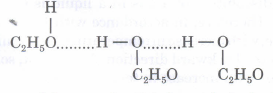
When cyclohexane is added to ethyl alcohol, the molecules of cyclohexane tend to occupy the spaces between alcohol molecules. Consequently, some hydrogen bonds in alcohol molecules break and the attractive forces in alcohol molecules are weakened. As a result there is also a slight increase in vapour pressure upon mixing.
Negative deviation: When the total vapour pressure is less than the corresponding vapour pressure exerted on the basis of Raoult's law, the solution is said to show negative deviation.
\({ p }_{ A }>{ p }_{ A }^{ o }{ x }_{ A }\quad and\quad { p }_{ B }>{ p }_{ B }^{ o }{ x }_{ B }\)
Let us consider a solution of acetone and chloroform. When acetone-and chloroform are mixed, there are new attractive forces due to intermolecular hydrogen bonding. Thus, the attractive forces become stronger and the escaping tendency of each liquid from the solution decreases.As a result, the vapour pressure of the solution is slightly less than that is expected for an ideal solution.
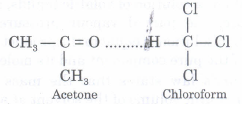
6.
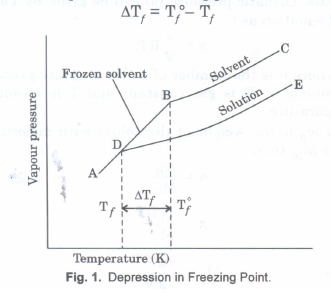
Depression in freezing point. The freezing point is the temperature at which the solid and liquid states of the substance have the same vapour pressure. Since the addition of a non-volatile solute to the pure solvent lowers its vapour pressure, so the freezing point of a solution is expected to be less than that of the pure solvent. This is known as depression in freezing point. This has been· represented graphically in Fig.1. The curves BC and DE represent the vapour pressure of pure solvent and the solution respectively. The curve AB represents the vapour pressure of the solvent at different temperatures. At point B, the liquid solvent and the solid solvent meet, hence it corresponds to the freezing point of the pure liquid (Tfo). Since the vapour pressure of a solution is always less than that of the pure solvent, the vapour pressure curve for the solution runs parallel but below the pure solvent curve. The vapour pressure curve for the solution meets the solid solvent curve at D which corresponds to the freezing point of the solution Tf. It is evident that Tfo is less than Tf, indicating that there is depression in the freezing point of a solvent. Therefore depression in freezing point,
It has been experimentally found that the depression in freezing point of a solution is proportional to the molal concentration of solute, i.e.,
\(\triangle { T }_{ f }\propto m \ or \ \triangle { T }_{ f }={ K }_{ f }m\)
where K, is the molal depression constant. It is also called molal cryoscopic constant. It is defined as the depression in freezing point for 1 molal solution i.e., a solution containing 1 gram mole of solute dissolved in 1000 g of solvent.
\(As \ { K }_{ f } \ is \ constant,\triangle { T }_{ f }\propto \ m\)
Thus, the depression in freezing point is directly proportional to the molal concentration of the solute (i.e.number of molecules) and therefore, it is a colligative property.
7.
A molar solution contains one mole of the solute present in one litre or 1000 mL of solution. On the other hand, a molal solution contains one mole of the solute in 1000 g of water. At room temperature, density of water is slightly less than one so that the volume of water corresponding to 1000 g will be greater than 1000 mL (vol = mass/density < 1). So,
the volume of water containing one mole of solute will be more in case of molal solution than molar solution. Therefore, molar solution is more concentrated than molal solution.
8.
Suppose the final volume after dilution is V2
Then \({ M }_{ 1 }{ V }_{ 1 }={ M }_{ 2 }{ V }_{ 2 }\quad or\quad { V }_{ 2 }=\frac { { M }_{ 1 }{ V }_{ 1 } }{ { M }_{ 2 } } \)
Volume of water required to be added = \({ V }_{ 2 }-{ V }_{ 1 }=\frac { { M }_{ 1 }{ V }_{ 1 } }{ { M }_{ 2 } } -{ V }_{ 1 }=\left( \frac { { M }_{ 1 } }{ { M }_{ 2 } } -1 \right) { V }_{ 1 }=\left( \frac { { M }_{ 1 }-{ M }_{ 2 } }{ { M }_{ 2 } } \right) { V }_{ 1 }\)
9.
Ca(CO3)2 ⇾ Ca2+ + 2NO3-
\(n=3,\ \alpha={i-1\over 3-1}\)
\(⇒\ 0.7={i-1\over 3-1}⇒ i=2.4\)
Now, \({p_A^0-p_A\over p_A^0}=i\times{{W_B\over M_B}\over{W_A\over M_A}+{W_B\over M_B}}\)
\(\Rightarrow\ 1-{p_A\over p_A^0}=2.4\times {{14\over 164}\over{200\over 18}+{14\over 164}}\)
\(⇒1-{p_A\over p_A^0}={2.4}\times{14\over 164}\times {164\times 18\over 33052}={14\times 18\times2.4\over 33052}={604\over 33052}\)
\(⇒ {p_a\over p_A^0}=1-{604.8\over 33052}={33052-604.8\over 33052}={32447.2\over 33052}=0.9817\)
PA = pA0 x 0.9817 = 760 x 0.9817
= 746.1 mm Hg
10.
ΔTb = 100.13°C - 100°C = 0.13 °C,
ΔTb = Kb x m => 0.13 = 0.52 x m
=> m = 0.25 m/kg
Also, ΔTf = Kf x m = 1.86 x 0.25 = 0.465 K
Freezing point of solution
= 273 - 0.465
= 272.535 K
11.
Non-ideal solutions do not follow (l) Raoult's Law (it) ΔHmix≠ 0 (iit) ΔVmix ≠ O.It is because the force of attraction between A-B is different from A-A and B-B.
Cyclohexane-ethanol mixture shows positive deviation from Raoult's law because force of attraction between cyclohexane and ethanol is less than that of pure cyclohexane as well as pure ethanol. Acetone-chloroform mixture shows negative deviation from Raoult's Law because force of attraction between acetone and chloroform is higher than that of pure acetone and pure chloroform.

12th Standard CBSE Syllabus & Materials
12th Standard CBSE
CBSE 12th Computer Science Python Revision Tour I - New Previous year Question Papers Study Material - QB365 Set A
NEW12th Standard CBSE
CBSE 12th Business Studies Planning Important Questions And Answers Study Material - QB365 Set A
NEW12th Standard CBSE
CBSE 12th Business Studies Business Environment Important Questions And Answers Study Material - QB365 Set A
NEW12th Standard CBSE
CBSE 12th Business Studies Principles of Management Important Questions And Answers Study Material - QB365 Set A



CBSE 12th Standard CBSE Subjects
CBSE Standards










