
 100% FREE ACCESS
12th Standard CBSE Syllabus & Materials
12th Standard CBSE
CBSE 12th Economics Government Budget and the Economy Previous year Question Papers Study Material - QB365 Set A
NEW12th Standard CBSE
CBSE 12th Computer Science Interface Python with MySQL - New Previous year Question Papers Study Material - QB365 Set A
NEW12th Standard CBSE
CBSE 12th Computer Science Database Concept - New Previous year Question Papers Study Material - QB365 Set A
NEW12th Standard CBSE
CBSE 12th Computer Science Data Communication - New Previous year Question Papers Study Material - QB365 Set A
NEW12th Standard CBSE
CBSE 12th Computer Science Data Structures - New Previous year Question Papers Study Material - QB365 Set A
NEW12th Standard CBSE
CBSE 12th Computer Science Functions - New Previous year Question Papers Study Material - QB365 Set A

Published on: 25/09/2019
Surface Chemistry
Download CBSE Class 12th Standard CBSE Chemistry question papers, sample papers, important questions, and previous year solved papers in PDF format. Get free study materials, NCERT solutions, and exam preparation resources for Class 12th Standard CBSE Chemistry
Questions + Answers key
Take MCQ Chemistry Test
1.
(i) In reference to Freundlich's adsorption isotherm, write the expression for adsorption of gases on solids in the form of an equation.
(ii) Write an important characteristic of lyophilic sols.
(iii) Based on the type of particles of dispersed phase, give one example each of associated colloid and multimolecular colloid.
2.
Write one difference in each of the following:
(i) Lyophobic sol and lyophilic sol.
(ii) Solution and colloid.
(iii) Homogeneous catalysis and heterogeneous catalysis
3.
What is demulsification? Name two demulsifiers.
4.
Explain the following:
(a) Same substance can act both as colloids and crystalloids.
(b) Artifical rain is caused by spraying salt over clouds.
(c) When a beam of light is passed through a colloidal sol, the path of the beam gets illuminated.
5.
1 g of charcoal adsorbs 100 ml of 0.5 M CH3COOH to form a monolayer, and thereby the molarity of CH3 COOH reduces to 0.49 M. Calculate the surface area of the charcoal adsorbed by each molecule of acetic. Surface area of charcoal = \(3.01\times { 10 }^{ 2 }{ m }^{ 2 }g\)
6.
Shyam living in Shimla, was washing clothes in cold water. He found that the clothes were not getting clean. Sneha, his grandmother, suggested that he wash the clothes in warm water, Washing of clothes with soaps or detergents is easier in luke warm water than cold water.
Answer the following questions:
(i) Why is it easier to wash the clothes in luke warm water?
(ii) What values are associated with these information?
7.
Hydrogenation of vegetable oil in presence of catalyst, is used to prepare vegetable ghee.
Vegetable oil ⟶ Vegetable ghee
It is the most important industrial process.
Answer the following questions:
(i) Which catalyst is commonly used in hydrogenation process and in which state?
(ii) Do you think we should use vegetable ghee instead of vegetable oils?
(iii) Is use of nickel useful or harmful for our body?
(iv) Why should we avoid taking deep fried snacks?
(v) Why should excessive use of antacids be avoided?
8.
Surface chemistry deals with phenomenon that occurs at all the surface or interfaces. Many important phenomenon- corrosion electrode process, heterogeneous catalysis, dissociation, adsorption, crystallisation occur at the interfaces.
Answer the following questions:
(i) Why do we use charcoal, in gas masks, in coal mines?
(ii) How is animal charcoal, used in the decolourisation of sugar?
(iii) What is the use of silica gel which is given alongwith camera and other electronic equipments?
(iv) There is safety lamp in coal mines. What is its purpose?
9.
On visit to your native village, you find that lot of smoke, dust and some other gases are coming out of the chimney of a recently set up factory near the village.
(i) As a chemistry student, what method you will suggest the factory owner to manage dust and smoke?
(ii) What is the basic principle involved in your suggestion?
(iii) What values are associated with your advice?
10.
Radha and Meera are fast friends. They both study in class XII.Radha is a student of science while Meera follows commerce stream. One day, when they were playing, Radha got hurt and started bleeding. Meera took her to house and applied some alum on the cut. The bleeding stopped immediately.
(i)Why bleeding stopped when some alum is applied on the cut?
(ii) What are the values associated with Meera's decision to take Radha to her house and apply alum on her cut?
11.
Explain the following terms:
(i) Electrophoresis
(ii) Coagulation
(iii) Dialysis
(v) Tyndal effect
12.
What are the applications of adsorption in chemical analysis?
1.
Freundlich's adsorption isotherm for adsorption of gases in the form of an equation
\(\frac { x }{ m } ={ kp }^{ 1/n }\)
where, m = mass of adsorbent, x = mass of the gas adsorbed on mass m,
p = pressure and k,n = constants
ii) Lyophilic sols are reversible sols. These are quite stable and cannot be coagulated.
(iii) Associated colloid Soap solution, detergent Multimolecular colloid Sulphur sol, gold sol.
2.
(i) Lyophilic sol The colloidal solution in which the particles of the dispersed phase have a great affinity for the dispersion medium is called lyophilic sol. e.g. gum, geletin. starch etc.
Lyophobic sol The colloidal solution in which there is no affinity between particles of the dispersed phase and the dispersion medium is called lyophobic sol. Lyophobic sols need, stabilising agents for their preservation.
(ii) Solution It contains small solute particles dispersed throughout the solvent. The particle size is less than 1 nm
Colloid It contain particles of intermediate size. It is a heterogeneous solution. The particles of colloid have diameters between 1 to 1000 nm.
(ii) Homogeneous catalysis It is the phenomenon in which reactants and catalyst are present in the same phase
\(2{ SO }_{ 2 }(g)+{ O }_{ 2 }(g)\overset { NO(g) }{ \longrightarrow } 2{ SO }_{ 3 }(g)\)
Heterogeneous catalysis It is the phenomenon in which reactants and catalyst are present in the different phase
\(2{ SO }_{ 2 }(g)+{ O }_{ 2 }(g)\overset { Pt(s) }{ \underset { Oxidation }{ \longrightarrow } } 2{ SO }_{ 3 }(g)\).
3.
The process of breaking an emulsion into its constituent liquids is called demulsification. Freezing, boiling, centrifugation, electrostatic precipitation or adding dehydrating agent leads to demulsification, e.g. lemon juice demulsifies milk.
4.
(a) Same substances like soap can act as crystalloids in low concentration, whereas in high concentration, it forms a colloidal solution.
(b) Spraying salts like AgI over clouds makes some clouds +ve, whereas other -ve. When positively and negatively charged clouds come close to each other, they cause artificial rain.
(c) It is due to scattering of light by colloidal particles.
5.
Surface area of charcoal adsobed by each molecule = \(\frac { 3.01\times { 10 }^{ 2 }{ m }^{ 2 } }{ 6.02\times { 10 }^{ 20 } } =5\times { 10 }^{ -19 }{ m }^{ 2 }\)
6.
(i) Soaps work due to the formation of micelles. But the formation of micelles takes place at a minimum temperature called 'Kraft temperature'. This temperature is reached in luke warm water.
(ii) Be humble to accept a scientific fact from a elder person.
7.
(i) Finely divided nickel is used as catalyst in hydrogenation.
(ii) No, we should use vegetable oil instead of vegetable ghee as it is partly saturated, may lead to formation of cholesterol.
(iii) Nickel gets mixed with vegetable ghee. It is harmful for our body as it is found to be carcinogenic (cancer causing).
(iv) It is because these led to the formation of excess of acid, which leads to hyperacidity, indigestion and stomach disorders.
(v) These are basic in nature and thus can induce more secretion of hydrochloric acid in gastric juice, that is why, these should be avoided as far as possible.
8.
(i) It absorbs poisonous gases to large extent and not oxygen which is used for breathing.
(ii) It absorbs the undesirable colours from aqueous solution of sugar, we get colourless sugar.
(iii) Silica gel absorbs water molecules on its surface which may spoil the equipment.
(iv) Whenever there is excess of carbon monoxide gas, the colour of flame becomes blue and coal mine workers are asked to come out because carbon monoxide gas may lead to death.
9.
(i) Dust and smoke coming out of chimney can be controlled by installing cottrell smoke precipitator.
(ii) Cottrell precipitator consists of two metal discs charged to a high electrical potential. The charge on colloidal dust and carbon particles of smoke is neutralised and they get precipitated while free gases escape out of chimney.
(iii) The knowledge of cottrell precipitator and management of dust and carbon particles of smoke can help us to clean our environment and make it healthier. Eco-friendliness and self-awareness are values associated with it.
10.
(i) Blood is a colloidal solution of albuminoid substance. The styptic action (blood stopping action) of alum is due to coagulation of blood forming a clot which stops further bleeding.
(ii) Values associated with Meera's decision are:
(a) Friendship
(b) Keen observation
(c) Applying knowledge of chemistry to daily life
(d) Responsibility
(e) Love and care.
11.
(a) Electrophoresis. The phenomenon of movement of colloidal particles under an applied the electric field is called electrophoresis. This helps to know the presence of charge on the sol particles and its nature whether positive or negative. In' this experiment, the colloidal particles move towards positive or negative electrodes depending upon their charge under the influence of electrical field. If the particles accumulate near the negative electrode, the charge on the particles is positive. On the other hand, if the sol particles accumulate near the positive electrode, the charge on the particles is negative. The apparatus consists of U tube with two platinum electrodes in each limb. Take a sol of AS2S3 in the U-tube. The intensity of the color of the sol in both the arms is same. Now, pass the current through the soL After some time, it
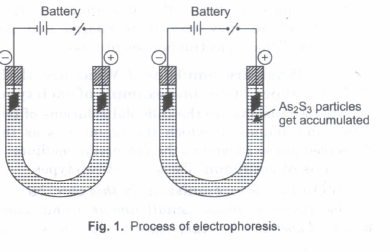
electrode became intense than the initial color. This indicates that the AS2S3particles have accumulated near the positive electrode. Therefore, the particles of AS2S3 are negatively charged and they move towards oppositely charged (positive) electrode and get accumulated there. Similarly, when an electric current is passed through positively charged Fe(OH)3sol, it is observed that they move towards negatively charged electrode and get accumulated there. Thus, by observing the direction of movement of the colloidal particles, the sign of the charge carried by the particles can be determined.
(ii) Coagulation. The phenomenon of ." precipitation of a colloidal solution by the addition of an excess of an electrolyte is called coagulation or Occultation. The coagulation capacity of different electrolytes depends upon the valency of the active ion or called flocculating ion. It is the ion carrying a charge opposite to the charge on the colloidal particles. According to Hardy Schulz law, greater the valency of the active ion or flocculating ion, greater will be its coagulating power. Thus, to coagulate negative sol of AS2S3. the coagulating power of different actions has been found to decrease in the order as:
Al3+> Mg2+>Na+
Similarly, to coagulate a positive sol., such as Fe(OH)3 the coagulating power of different anions has been found to decrease in the order:
[Fe (CN)]⟶ PO:⟶ SO⟶ CI-
(iii) Dialysis.The method used to separate the impurities from the colloidal solution is called dialysis. Its principle is based on the fact that colloidal particles cannot pass through a parchment or cellophane membrane while the ions of the electrolyte can pass through it. The colloidal solution is taken in It bag made of cellophane or parchment. The bag is suspended in fresh water. The impurities slowly diffuse out of the bag leaving behind the pure colloidal solution. Dialysis can be used for removing HCI from the ferric hydroxide sol
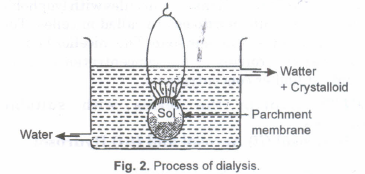
The ordinary process of dialysis is slow. To increase the process of purification, the dialysis is carried out by applying an electric field. This process is called electrodialysis.
(iv) 'Tyndall effect. When a strong beam of light is passed through a true solution placed in a beaker, in a dark room, the path of the light does not become visible as shown in However, if the light is passed through a sol, placed in the same room, the path of the light becomes visible when viewed from a direction at right angle to that of the incident beam.
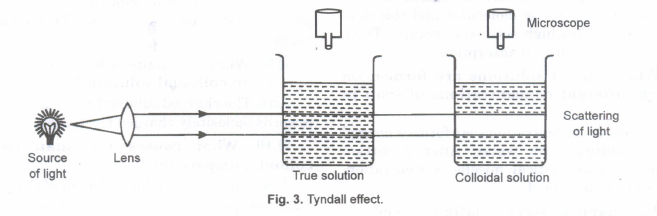
This phenomenon was studied for the first time by Tyndall and therefore it is called Tyndall effect. The cause to Tyndall effect is the scattering of light by colloidal particles i.e., these particles first absorb the incident ligand then a part of it gets scattered by them. Since the intensity of the scattered light is at a right angle to the plane of the incident light, the path becomes visible only when seen in that direction. The particles in true solution are too small in size to cause any scattering i.e., the Tyndall effect is not noticed in true solutions.
12.
(i) In TLC
(ii) As adsorption incicators
(iii) In separation of inert gases.

12th Standard CBSE Syllabus & Materials
12th Standard CBSE
CBSE 12th Computer Science Python Revision Tour I - New Previous year Question Papers Study Material - QB365 Set A
NEW12th Standard CBSE
CBSE 12th Business Studies Planning Important Questions And Answers Study Material - QB365 Set A
NEW12th Standard CBSE
CBSE 12th Business Studies Business Environment Important Questions And Answers Study Material - QB365 Set A
NEW12th Standard CBSE
CBSE 12th Business Studies Principles of Management Important Questions And Answers Study Material - QB365 Set A



CBSE 12th Standard CBSE Subjects
CBSE Standards










