
 100% FREE ACCESS
12th Standard CBSE Syllabus & Materials
12th Standard CBSE
CBSE 12th Economics Government Budget and the Economy Previous year Question Papers Study Material - QB365 Set A
NEW12th Standard CBSE
CBSE 12th Computer Science Interface Python with MySQL - New Previous year Question Papers Study Material - QB365 Set A
NEW12th Standard CBSE
CBSE 12th Computer Science Database Concept - New Previous year Question Papers Study Material - QB365 Set A
NEW12th Standard CBSE
CBSE 12th Computer Science Data Communication - New Previous year Question Papers Study Material - QB365 Set A
NEW12th Standard CBSE
CBSE 12th Computer Science Data Structures - New Previous year Question Papers Study Material - QB365 Set A
NEW12th Standard CBSE
CBSE 12th Computer Science Functions - New Previous year Question Papers Study Material - QB365 Set A

Published on: 15/09/2018
Term II - Model Question Paper
Download CBSE Class 12th Standard CBSE Chemistry question papers, sample papers, important questions, and previous year solved papers in PDF format. Get free study materials, NCERT solutions, and exam preparation resources for Class 12th Standard CBSE Chemistry
Questions + Answers key
Take MCQ Chemistry Test
1.
Give the formula of each of the following coordination entities:
(i) Co3+ ion is bound to one Cl-, one NH3 molecule (en) molecules.
(ii) Ni2+ ion is bound to two water molecules and two oxalate ions.
Write the name and magnetic behaviour of each of the above coordination entities.
(At. nos. Co = 27, Ni = 28)
2.
The HNH angle value is higher than HPH, HAsH and HSbH angles. Why?
[Hint: Can be explained on the basis of sp3 hybridisation in NH3 and only s-p bonding between hydrogen and other elements of the group]
3.
Give the resonating structures of NO2 and N2O5.
4.
Assign a reason for each of the following statements:
(i) The bond angle H-M-H in the trihydrides of Group 15 elements decreases from NH3 downward.
(ii) SiF62- is known but SiCI62- is not known.
5.
Complete the following chemical reaction equations:
(i) Xe(g) + F2(g)\(\underset { (in\ excess) }{ F_{2}(g) } \) \(\xrightarrow [7 bar]{873\ K}\)
(ii) Li + N2 \(\rightarrow\)
6.
Assign a reason for each of the following:
(i) In group 15 the bond angle H-M-H decreases in the following order NH3 (107.8o), PH3 (93.6o), AsH3 (91.8o).
(ii) Sulphur hexafluoride is used as a gaseous electrical insulator.
7.
Calculate the number of unpaired electrons in following gaseous ions: Mn3+, Cr3+, V3+ and Ti3+. Which one of these is the most stable in aqueous solution?
8.
Draw the structural formulae of the following compounds: (i) H4P2Os (ii) XeF4
9.
Describe the manufacture of H2SO4 by contact process.
10.
Write the conditions to maximise the yield of sulphuric acid by Contact process.
11.
Account for the following :
(a) Transition metals show variable oxidation states.
(b) Zn, Cd and Hg are soft metals
(c) Eo value for the Mn3+ /Mn2+ couple is highly positive (+ 1.57 V) as compared to Cr3+ /Cr2+.
(ii) Write one similarity and one difference between the chemistry of lanthanoid and actinoid elements.
12.
(a) Complete the following chemical equations:
(i) \(NaOH+C1_{ 2 }\rightarrow \)
(hot and conc.)
(ii) \(XeF_{ 4 }+O_{ 2 }F_{ 2 }\rightarrow \)
(b) Draw the structurs of the following molecules:
(i) H3PO2
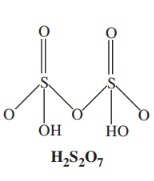
(ii) H2S2O7
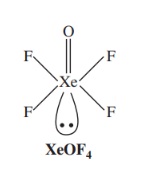
(iii) XeOF4
13.
(a) Give the preparation of potassium dichromate from chromate ore:
(b) Explain the following:
(i) Transition metals have good tendency to form complexes.
(ii) Transition metals exhibit variable oxidation states.
(c) Write the general electronic configuration of lanthanoids.
14.
(a) Give reasons for the following:
(i) Bond enthalpy of \({ F }_{ 2 }\) is lower than that of \(CI_{ 2 }\)
(ii)\(PH_{ 3 }\) has lower boiling point than
(b) Draw the structure of the following molecules:
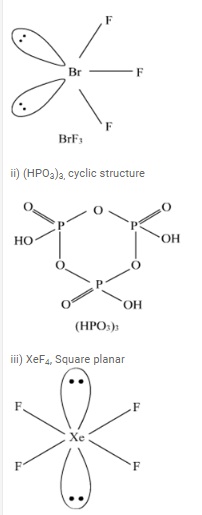
\((i)BrF_{ 3 }\quad (ii)(HPO_{ 3 })_{ 3 }\quad (iii)XeF_{ 4 }\quad \)
\(\)
15.
(a) Draw the structures of the following molecules:
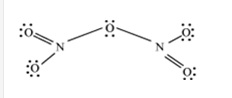
\((i){ N }_{ 2 }O_{ 5 }\ (ii)\ HCIO_{ 4 }\)
(b) Explain the following of the molecular molecules:
(i) \({ H }_{ 2 }S\)is more acidic than
(ii) Fluorine does not exhibit any positive oxidation state.
(iii) Helium forms no real chemical compound
16.
On heating lead (II) nitrate gives a brown gas "A". The gas "A" on cooling changes to colourless solid "B". Solid "B" on heating with NO changes to a blue solid 'C'. Identify 'A', 'B' and 'C' and also write reactions involved and draw the structures of 'B' and 'C'.
17.
(a) What happens when
(i) chlorine gas is passed through a hot concentrated solution of NaOH
(ii) sulphur dioxide gas is passed through an aqueous solution of a Fe (III) salt?
(b) Answer the following:
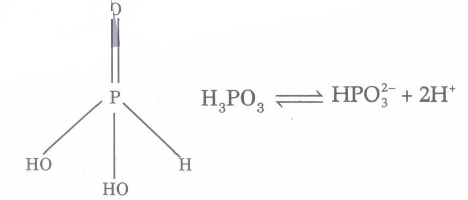
(i) What is the basicity of H3PO3 and why?
(ii) Why does fluorine not play the role of a central atom in interhalogen compounds?
(iii) Why do nobel gases have very low boiling points?
18.
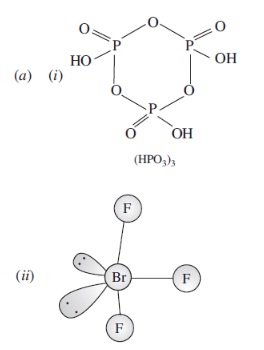
(a) Draw the structures of the following molecules:
(i) (HPO3)3
(ii) BrF3
(b) Complete the following chemical equations:
(i) HgCl2 + PH3 \(\rightarrow\)
(ii) SO3 + H2SO4 \(\rightarrow\)
(iii) XeF4 + H2O \(\rightarrow\)
19.
Identify the incorrect statement among the following :
Shielding power of 4f electrons is quit weak
There is a decrease in the radii of the atoms or ions as one proceeds from La to Lu
Lanthanoid contraction is the accumulation of successive shrinkages.
As a result of lanthanoid contraction, the properties of 4d series of the transition elements have no similarities with the 5d series of the elements.
20.
Which one of the following reactions of xenon compounds are not feasible ?
3 XeF4 + 6 H2 O \(\longrightarrow\) 2 Xe + XeO3 + 12 HF + 1.5 O2
2 XeF2 + 2 H2O \(\longrightarrow\) 2 Xe + 4 HF + O2
XeF6 + RbF \(\longrightarrow\) Rb [XeF7]
XeO3 + 6 HF \(\longrightarrow\) XeF6 + 3 H2O
21.
The shape of O2F2 is similar to that of
C2F2
H2O2
H2F2
C2H2
22.
The orange solid on heating gives a colourless gas and a green solid which cab be reduced to metal by aluminum powder. The orange and the green solids are, respectively,
(NH4)2Cr2O7 and Cr2O3
Na2Cr2O7 and Cr2O3
K2Cr2O7 and CrO3
(NH4)2CrO4 and CrO3
23.
Which of the following configuration of ions has zero CFSE in both strong and weak ligand fields?
d10
d8
d6
d4
24.
Which of the following ion is colourless in aqueous solution ?
Fe2+
Mn2+
Ti3+
Sc3+
25.
The formation of O2+[PtF6]- is the basis for the formation of xenon fluorides. This is because
O2 and Xe have comparable sizes
both O2 and Xe are gases
O2 and Xe have comparable ionisation energies
O2 and Xe have comparable electronegativities.
26.
Which of the following compounds exists?
KHCl2
KHF2
KHBr2
KHI2
27.
The element which forms oxides in all oxidation states +I to +V is
N
P
As
Sb
28.
Which of the following on heating does not give nitrogen gas?
NH4NO3
NH4NO2
Ba(N3)2
(NH4)2Cr2O7
29.
TiCI4 + A1(CH3)3
30.
Finely divided iron
31.
\([Co(NH_3)_6][Cr(CN)_6]\)
32.
\([MnF_6]^{4-}\)
33.
d7
34.
Neon
35.
N2O
36.
XeF4
37.
XeOF4
38.
XeO3
1.
(i) [CoNH3CI(en)2]2+
amminechloridobis(ethane-1,2-diamine)cobalt (Ill) ion

Co3+ : 4s03d6
(ii) [Ni(H2O)2(OX)2]2-
diaquadioxalatonickelate (II) ion
Ni2+ : 4s03d8
.png)
2.
It is because 'N' is smaller in size and N-H bond is most polar and sp3 hybridised whereas in others there is s-p bonding. Secondly, polarity is higher in NH3 than in other hydrides.
3.
Resonating structures of \({ NO }_{ 2 }\) are :
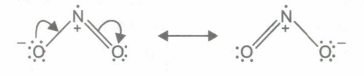
Resonating structures of \({ N }_{ 2 }{ O }_{ 5 }\) are :
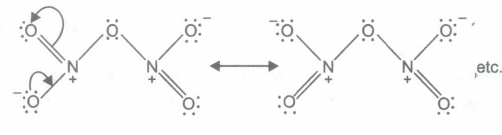
4.
(i) it is due to increase in size of central atom as a result of which bond length increases and bp-bp repulsion decreases and decrease repulsion decreases and decrease in polarity due to less difference in electronegativity.
(ii) SiF62- is known because 'F2' is best oxidising agent, smaller in size than chloride and can supply energy for excitation of electron whereas CI2 is not, therefore, SiCl62- does not exist.
5.
(i) \(Xe +\underset {excess} {2F_{2}} \xrightarrow [7 bar] {873 k} XeF_{4}\)
(ii) \(6Li + N_{2} \rightarrow 2Li_{3}N\)
\(\)
6.
(i) It is due to increases in size of group 15 elements, the bond angle decreases as bond length increases and bond pair-bond pair repulsion decreases.
(ii) It is because it is inert.
7.
Mn3+ = 3d4 = 4 unpaired electron, Cr3+ = 3d3 = 3 unpaired electrons, V3+ = 3d2 = 2 unpaired electrons, Ti3+= 3d 1 = 1 unpaired electron. Cr3+ is most stable out of these in aqueous solution because it has half filled t2g level (i.e., t32g) .
8.
(i)
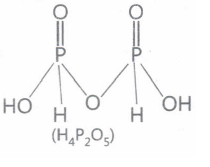
(ii)
.png)
9.
Preparation of sulphuric acid:
By Contact Process: Burning of sulphur or sulphide ores in presence of oxygen to produce SO2. Catalytic oxidation of SO2 with O2to give SO3 in the presence of V2O5.
\(2 S O_{2}(g)+O_{2}(g) \stackrel{v, 0,}{\longrightarrow} 2 S O_{3}(g)\)
Then SO3 made to react with sulphuric acid of suitable normality to obtain a thick oily liquid called oleum.
\(\mathrm{SO}_{3}(\mathrm{~g})+\mathrm{H}_{2} \mathrm{SO}_{4}(l) \rightarrow \mathrm{H}_{2} \mathrm{~S}_{2} \mathrm{O}_{7}(l)\)
Then oleum is diluted to obtain sulphuric acid of desired concentration
\(\mathrm{H}_{2} \mathrm{~S}_{2} \mathrm{O}_{7}(l)+\mathrm{H}_{2} \mathrm{O}(l) \rightarrow 2 \mathrm{H}_{2} \mathrm{SO}_{4}(l)\)
The sulphuric acid obtained by contact process is 96-98% pure.
10.
(i) High pressure (2 bar),
(ii) 720 K temperature,
(iii) V2O5 as catalyst.
11.
(i) (a) Due to the comparatively smaller size of the metal ions, their high ionic charges and the availability of vacant d-orbitals for bond formation, transition metals form a large number of complex compounds.
(b) As oxidation number (or oxidation state) of an element increases ionic character decreases. In general, the oxides in lower oxidation states of metals are basic and in their higher oxidation state, the oxides are amphoteric.
In lower oxidation state of the metal, some of the valence electrons of the metal atom are not involved in bonding. Hence, it can donate electrons and behave as a base. In higher oxidation state, valence electrons are involved in bonding and hence, electrons are not available for donation. Instead, their effective nuclear charge is high and hence they behave as acids.
(c) Mn3+(3d4) is less stable than Mn2+(3d5) because Mn2+ has stable half-filled configuration. Cr3+ has stable 3d3(t32g) configuration, therefore, Cr3+ cannot be reduced to Cr2+. That's why, EO value for the Mn3+ / Mn2+ couple is much more positive than Cr3+ /Cr2+. In other words, Mn3+ is a strong oxidising agent.
(ii) Similarity Both lanthanoids and actinoids exhibit +3 oxidation state predominantly.Difference Lanthanoids have less tendency towards complex formation while actinoids have greater tendency towards complex formation.
12.
(a) (i) \(6NaOH+3C1_{ 2 }\longrightarrow 5NaC1+NaC1O_{ 3 }+3H_{ 2 }O\)
(ii) \(XeF_{ 4 }+O_{ 2 }F_{ 2 }\overset { 143k }{ \longrightarrow } XeF_{ 6 }+O_{ 2 }\)
(b) (i) H3PO2:
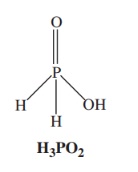
(ii) H2S2O7:
(iii) XeOF4:
13.
(i) The transition elements exhibit variable oxidation states. The variable oxidation states of transition metals are due to the participation of ns and (n - 1) d-electrons. This is because of the very small difference between the energies of (n - 1) d and ns orbitals. For the first five elements, the minimum oxidation state is equal to the number of electrons ---in the 4s orbitals and the other oxidation states are equal to the sum of 4s and some of the 3d-electrons. The highest oxidation state is equal to the sum of 4s and 3d electrons. For the remaining elements, the minimum oxidation state is equal to electrons in 4s-orbitals and the maximum oxidation state is not equal to the sum of 4s and 3d electrons. In general, the oxidation state increases up to the middle and then decreases.
14.
(a) (i) Due to small size of F atom, there are strong repulsions between the non-bonding electrons of F atoms in the small sized \({ F }_{ 2 }\) molecule. Therefore, bond enthalpy of \({ F }_{ 2 }\) is lower than relatively \({ CI }_{ 2 }\) larger molecule in which repulsions between non bonding electrons are less.
(ii) Ammonia exists as associated molecules due to its tendency to form hydrogen bonding. Therefore, it has high boiling point. Unlike \({ NH }_{ 3 }\) , phosphine (\({ PH }_{ 3 }\)) molecules are not associated through hydrogen bonding in liquid state. This is because of low electronegativity of P than N. As a result, the boiling point of \({ PH }_{ 3 }\) is lower than that of \({ NH }_{ 3 }\) .
(b) (i)
15.
(a) (i)
(ii)

(b)
(i) The size of S is more than that of 0. Therefore, the distance between S and H i.e., S-H bond length is more than O-H bond length. As a result, the bond dissociation enthalpy of S-H will be less and it will be easier to break the bond in  than O-H bond in water. Therefore, will be more acidic than .
(ii) Fluorine is the most electronegative element and therefore, it shows oxidation state of -1 only. It does not show any positive oxidation states.
(iii) Helium does not form compounds because it has very high ionisation enthalpy and smallest size. Its electron gain enthalpy is also almost zero.
16.
\(2Pb{ { { { (NO }_{ 3 }) } } }_{ 2 }\xrightarrow { heat } 2PbO(s)+{ NO }_{ 2 }+{ O }_{ 2 }\)
Brown (A)
\({ 2NO }_{ 2 }(g)\overset { cooling }{ \rightleftharpoons } { N }_{ 2 }{ O }_{ 4 }(s)\)
(B) Colourless
\({ N }_{ 2 }{ O }_{ 4 }+2NO\overset { heat }{ \underset { 250k }{ \rightleftharpoons } } { 2N }_{ 2 }{ O }_{ 3 }(s)\)
(C) Blue solid
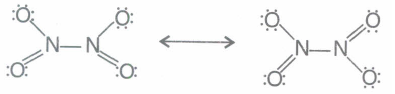
Resonating Structures of \({ N }_{ 2 }{ O }_{ 4 }\)
17.
(a) (i) Sodium chlorate and sodium chloride are formed.
\({ 3CI }_{ 2 }+6NaOH\longrightarrow 5NaCI+{ NaCIO }_{ 3 }+{ 3H }_{ 2 }O\)
(ii)_Fe (III) salt is reduced to Fe (II) salt.
\({ 2Fe }^{ 3+ }+{ SO }_{ 2 }+{ 2H }_{ 2 }O\longrightarrow { 2Fe }^{ 2+ }+{ SO }_{ 4 }^{ 2- }+{ 4H }^{ + }\)
(b) (i) \({ H }_{ 3 }{ PO }_{ 3 } \) is dibasic and has basicity of two because it has two P-OH bonds which are ionisable. The third H atom is linked to P and is non-ionisable.
(ii) Fluorine does not play the role of a central atom in interhalogen compounds because it is highly electronegative. Moreover, it has only one electron less than the octet and does not have vacant d-orbitals in its valence shell, Therefore, it can form only one bond with other halogen atoms and cannot act as central atom in interhalogen compounds.
(iii) Noble gases have very low boiling points because only weak van der Waals' forces are present between the atoms of the noble gases in the liquid state.
18.
(b) \((i)\quad { 3HgCI }_{ 2 }+{ 2PH }_{ 3 }\longrightarrow { Hg }_{ 3 }{ p }_{ 2 }+6HCI\)
\(\\ (ii)\quad { SO }_{ 2 }+{ H }_{ 2 }{ SO }_{ 4 }\longrightarrow { H }_{ 2 }{ S }_{ 2 }{ O }_{ 7 }\)
\(\\ (iii)\quad { 6XeF }_{ 4 }+{ 12H }_{ 2 }O\longrightarrow 4Xe+{ 2XeO }_{ 3 }+24HF+{ 3O }_{ 2 }\)
19.
(d)
As a result of lanthanoid contraction, the properties of 4d series of the transition elements have no similarities with the 5d series of the elements.
20.
(d)
XeO3 + 6 HF \(\longrightarrow\) XeF6 + 3 H2O
21.
(b)
H2O2
22.
(a)
(NH4)2Cr2O7 and Cr2O3
23.
(a)
d10
24.
(d)
Sc3+
25.
(c)
O2 and Xe have comparable ionisation energies
26.
(b)
KHF2
27.
(a)
N
28.
(a)
NH4NO3
29.
()
Ziegler-Natta catalyst
30.
()
Haber's Process
31.
()
coordination
32.
()
sp3d2, 5
33.
()
- 0.8
34.
()
Advertising sign
35.
()
Neutral Oxide
36.
()
Sp3d2-square planer
37.
()
sp3d2-square pyramidal
38.
()
Sp3-pyramidal

12th Standard CBSE Syllabus & Materials
12th Standard CBSE
CBSE 12th Computer Science Python Revision Tour I - New Previous year Question Papers Study Material - QB365 Set A
NEW12th Standard CBSE
CBSE 12th Business Studies Planning Important Questions And Answers Study Material - QB365 Set A
NEW12th Standard CBSE
CBSE 12th Business Studies Business Environment Important Questions And Answers Study Material - QB365 Set A
NEW12th Standard CBSE
CBSE 12th Business Studies Principles of Management Important Questions And Answers Study Material - QB365 Set A



CBSE 12th Standard CBSE Subjects
CBSE Standards










