
 100% FREE ACCESS
12th Standard CBSE Syllabus & Materials
12th Standard CBSE
CBSE 12th Economics Government Budget and the Economy Previous year Question Papers Study Material - QB365 Set A
NEW12th Standard CBSE
CBSE 12th Computer Science Interface Python with MySQL - New Previous year Question Papers Study Material - QB365 Set A
NEW12th Standard CBSE
CBSE 12th Computer Science Database Concept - New Previous year Question Papers Study Material - QB365 Set A
NEW12th Standard CBSE
CBSE 12th Computer Science Data Communication - New Previous year Question Papers Study Material - QB365 Set A
NEW12th Standard CBSE
CBSE 12th Computer Science Data Structures - New Previous year Question Papers Study Material - QB365 Set A
NEW12th Standard CBSE
CBSE 12th Computer Science Functions - New Previous year Question Papers Study Material - QB365 Set A

Published on: 03/10/2019
The p-Block Elements
Download CBSE Class 12th Standard CBSE Chemistry question papers, sample papers, important questions, and previous year solved papers in PDF format. Get free study materials, NCERT solutions, and exam preparation resources for Class 12th Standard CBSE Chemistry
Questions + Answers key
Take MCQ Chemistry Test
1.
(a) Elements of Gr. 16 generally show lower value of first ionization enthalpy compared to the corresponding periods of Gr. 15.Why ?
(b) What happens when:
(i) Concentrated H2SO4 is added to CaF2?
(ii) Sulphur dioxide reacts with chlorine in the presence of charcoal?
(iii)Ammonium chloride is treated with Ca(OH)2?
2.
Elemental phosphorous does not exist as \(P_{ 2 }\) like \(N_{ 2 }\) .Why?
3.
On heating compound (A) gives a gas (B) which is a constituent of air. This gas when treated with 3 mol of hydrogen (H2) in the presence of a catalyst gives another gas (C) Which is basic in nature. Gas C on further oxidation in moist condition gives a compound (D) which is a part of acid rain. Identify compound (A) to (D) and also give necessary equations of all the steps involved.
4.
(a) Describe the favourable conditions for the manufacture of
(i) ammonia by Haber's process, and
(ii) sulphuric acid by Contact process.
(b) Draw the structures of the following:
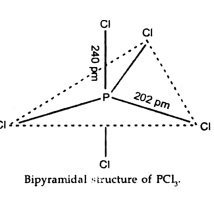
(i) PCl5 (g)
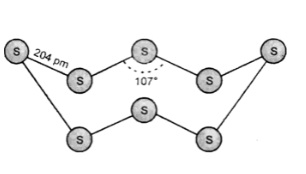
(ii) S8 (g)
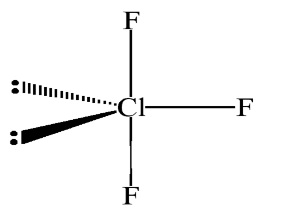
(iii) ClF3 (g)
5.
(a) Complete the following chemical equations:
(i) F2 + H2O \(\to\) .............
(ii) Ca3P2 + H2O \(\to\) .............
(iii) XeF4 + H2O \(\to\) .............
(b) Draw structures of the following species:
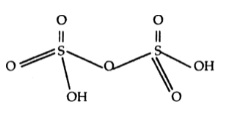
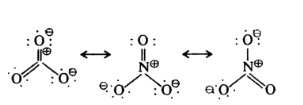
(i) H2S2O7 (ii) NO3-
6.
(a) Draw the structures of the following:
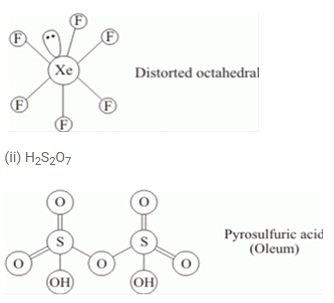
(i) XeF4 (ii) H2S2O7
(b) Explain the following observations:
(i) Phosphorus has a greater tendency for catenation than nitrogen.
(ii) The negative value of electron gain enthalpy is less for fluorine than that for chlorine.
(iii) Hydrogen fluoride has a much higher boiling point than hydrogen chloride.
7.
(a) Draw the structures of the following:
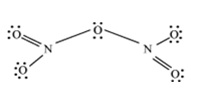
(i) N2O5
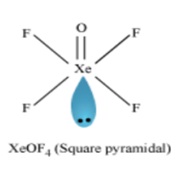
(ii) XeOF4
(b) Explain the following observations:
(i) The electron gain enthalpy of sulphur atom has a greater negative value than that of oxygen atom.
(ii) Nitrogen does not form pentahalides.
(iii) In aqueous solutions, HI is a stronger acid than HCl.
8.
(a) Draw the structures of the following molecules:
(i) (HPO3)3
(ii) BrF3
(b) Complete the following chemical equations:
(i) HgCl2 + PH3 \(\rightarrow\)
(ii) SO3 + H2SO4 \(\rightarrow\)
(iii) XeF4 + H2O \(\rightarrow\)
9.
(a) Complete the following chemical equations:
(i) Cu + HNO3(dilute) \(\rightarrow\)
(ii) XeF4 + O2F2 \(\rightarrow\)
(b) Explain the following observations:
(i) Phosphorus has greater tendency for catenation than nitrogen.
(ii) Oxygen is a gas but sulphur a solid.
(iii) The halogens are coloured. Why?
1.
(a) Due to relatively stable half - filled p-orbitals of group-15 elements.
(b) \((i)\ CaF_{ 2 }+H_{ 2 }SO_{ 4 }\longrightarrow CaSO_{ 4 }+2HF\)
\(\\ (ii)\ SO_{ 2 }(g)+C1_{ 2 }(g)\longrightarrow SO_{ 2 }C1_{ 2 }(l)\)
\(\\ (iii)\ 2NH_{ 4 }C1+Ca(OH)_{ 2 }\longrightarrow 2NH_{ 3 }+2H_{ 2 }O+CaC1_{ 2 }\)
2.
Nitrogen has a strong tendency to form multiple bonds because of its small size and high electronegativity. Therefore, it exists as a diatomic molecule, \(N\equiv N\) . On the other' hand, phosphorus because of its large size and small electronegativity does not show any tendency to form multiple bonds and therefore, 'diatomic molecule like \(N\equiv N\) is not formed. Instead, it prefers to form stable tetraatomic, \({ P }_{ 4 }\) molecules in which each P is linked to three other P atoms by three single covalent bonds. The four atoms in \({ P }_{ 4 }\) molecule lie at the corners of a regular tetrahedron.
3.
(i) \({ NH }_{ 4 }{ NO }_{ 2 }(s)\underrightarrow { heat } { N }_{ 2 }+{ 2H }_{ 2 }O\)
'A' 'B'
(ii) \({ N }_{ 2 }+{ 3H }_{ 2 }\longrightarrow 2{ NH }_{ 3 }(g)\)
'C' basic
(iii) \({ 4NH }_{ 3 }+{ 5O }_{ 2 }\longrightarrow 4NO+{ 6H }_{ 2 }O\)
\(\\ 2NO+{ O }_{ 2 }\longrightarrow { 2NO }_{ 2 }\)
'D' (part of acid rain)
\({ 3NO }_{ 2 }+{ H }_{ 2 }O\longrightarrow 2{ HNO }_{ 3 }+NO\)
4.
(a) (i) Haber's process:
\(N_{ 2 }(g)+{ 3H }_{ 2 }(g)\overset { 200\ atm }{ \underset { 673\ k,\ Fe/Mo }{ \rightleftharpoons } } { 2NH }_{ 3 }(g)+heat\)
Since the process is exothermic, therefore, the optimum temperature of 673 K is needed. There is decrease in number of moles from reactants to products, therefore, high pressure \(200\times { 10 }^{ 5 }\) pa (200 atm) is needed. Iron or molybdenum is used as catalyst with small amount of \({ K }_{ 2 }O\) and \({ AI }_{ 2 }{ O }_{ 2 }\) to increase the rate of reaction.
(ii) Contact process:
\({ 2SO }_{ 2 }(g)+{ O }_{ 2 }(g)\longrightarrow { 2SO }_{ 3 }(g)+heat\)
The process is exothermic, therefore, the optimum temperature of 720 K is suitable. The forward reaction leads to decrease in volume, therefore, high-pressure of 2 bar is needed. \({ V }_{ 2 }{ O }_{ 5 }\) should be used as catalyst.
(b) (i)
(ii)
(iii)
5.
(a) \((i)\ { 2F }_{ 2 }+2{ H }_{ 2 }O\longrightarrow { 4H }^{ + }(aq)+{ 4F }^{ - }(aq)+{ O }_{ 2 }(g)\)
\(\\ (ii)\ { Ca }_{ 3 }{ P }_{ 2 }+6{ H }_{ 2 }O\longrightarrow 3Ca(O{ H) }_{ 2 }+{ 2PH }_{ 3 }\)
\(\\ (iii)\ { 6XeF }_{ 4 }+12{ H }_{ 2 }O\longrightarrow 4Xe+{ 2XeO }_{ 3 }+24HF+{ 3O }_{ 2 }\)
(b) (i)
6.
(a) (i)
(b) (i) It is because P-P single bond is stronger than the single N-N bond.
(ii) It is because there is more interelectronic repulsion between valence electrons in 'F' atoms as compared to 'CI' atoms.
(iii) It is because HF molecules are associated with intermolecular H-bonding while HCI is not that is why HF is liquid and has higher boiling point than HCI which is a gas.
7.
(a) (i)
(ii)
(b) (i) It is because there is more interelectronic repulsion in oxygen due to smaller size than sulphur, less energy is released on addition of electrons, therefore, its electron gain enthalpy is less than sulphur.
(ii) It is due to absence of d-orbitals in nitrogen atom, it cannot show pentavalently.
(iii) HI has lower bond dissociation energy than HCI due to longer bond length it is stronger acid than HCI.
8.
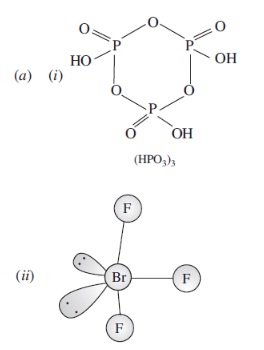
(b) \((i)\quad { 3HgCI }_{ 2 }+{ 2PH }_{ 3 }\longrightarrow { Hg }_{ 3 }{ p }_{ 2 }+6HCI\)
\(\\ (ii)\quad { SO }_{ 2 }+{ H }_{ 2 }{ SO }_{ 4 }\longrightarrow { H }_{ 2 }{ S }_{ 2 }{ O }_{ 7 }\)
\(\\ (iii)\quad { 6XeF }_{ 4 }+{ 12H }_{ 2 }O\longrightarrow 4Xe+{ 2XeO }_{ 3 }+24HF+{ 3O }_{ 2 }\)
9.
(a) (i) \(3Cu+{ 8HNO }_{ 3 }(dil.)\longrightarrow { { 3 }Cu(NO_{ 3 }) }_{ 2 }+2NO+{ 4H }_{ 2 }O\)
(ii) \({ XeF }_{ 4 }+{ O }_{ 2 }{ F }_{ 2 }\overset { { -130°C } }{ \longrightarrow } { XeF }_{ 6 }+{ O }_{ 2 }\)
(b) (i) The property of catenation depends upon the strength of the element-element bond. Since P-P bond strength (213 kJ \({ mol }^{ -1 }\) ) is much more than N-N bond strength (159 kJ \({ mol }^{ -1 }\)), phosphorus has marked catenation properties than nitrogen.
(ii) Due to small size and high electronegativity, oxygen atom forms \(p\pi -p\pi \) double bond, 0= 0. The intermolecular forces in oxygen are weak van der Waal's forces and therefore, oxygen exists as a gas. On the other hand, sulphur does not form stable \(p\pi -p\pi \) bonds and do not exists as \({ S }_{2}\) It is linked by single bonds and form polyatomic complex molecules having eight atoms per molecule \({ S }_{ 8 }\) and have puckered ring structure. Therefore, S atoms are strongly held together and it exists as a solid.
(iii) All the halogens are coloured. This is due to absorption of radiations in the visible region which results in the excitation of outer electrons to higher energy levels. By absorbing different quanta of radiations, they display different colours. The fluorine atom is the smallest and the force of attraction between the nucleus and the outer electrons is very large. As a result, it requires large excitation energy and absorbs violet light (high energy) and therefore, appears pale yellow. On the other hand, iodine needs very less excitation energy and absorbs yellow light of low energy. Thus, it appears dark violet. Similarly, we can explain the greenish yellow colour of chlorine and reddish brown colour of iodine.

12th Standard CBSE Syllabus & Materials
12th Standard CBSE
CBSE 12th Computer Science Python Revision Tour I - New Previous year Question Papers Study Material - QB365 Set A
NEW12th Standard CBSE
CBSE 12th Business Studies Planning Important Questions And Answers Study Material - QB365 Set A
NEW12th Standard CBSE
CBSE 12th Business Studies Business Environment Important Questions And Answers Study Material - QB365 Set A
NEW12th Standard CBSE
CBSE 12th Business Studies Principles of Management Important Questions And Answers Study Material - QB365 Set A



CBSE 12th Standard CBSE Subjects
CBSE Standards










