
 100% FREE ACCESS
12th Standard CBSE Syllabus & Materials
12th Standard CBSE
CBSE 12th Economics Government Budget and the Economy Previous year Question Papers Study Material - QB365 Set A
NEW12th Standard CBSE
CBSE 12th Computer Science Interface Python with MySQL - New Previous year Question Papers Study Material - QB365 Set A
NEW12th Standard CBSE
CBSE 12th Computer Science Database Concept - New Previous year Question Papers Study Material - QB365 Set A
NEW12th Standard CBSE
CBSE 12th Computer Science Data Communication - New Previous year Question Papers Study Material - QB365 Set A
NEW12th Standard CBSE
CBSE 12th Computer Science Data Structures - New Previous year Question Papers Study Material - QB365 Set A
NEW12th Standard CBSE
CBSE 12th Computer Science Functions - New Previous year Question Papers Study Material - QB365 Set A

Published on: 16/09/2019
The p-Block Elements
Download CBSE Class 12th Standard CBSE Chemistry question papers, sample papers, important questions, and previous year solved papers in PDF format. Get free study materials, NCERT solutions, and exam preparation resources for Class 12th Standard CBSE Chemistry
Questions + Answers key
Take MCQ Chemistry Test
1.
Describe the manufacture of H2SO4 by contact process.
2.
Write the conditions to maximise the yield of sulphuric acid by Contact process.
3.
Complete the following equations:
(i) C + conc. H2SO4\(\longrightarrow \)
(ii) \(XeF_{ 2 }+H_{ 2 }O\rightarrow \)
4.
Write the structures of the following:
(i) BrF3 (ii) XeF4
5.
Give an example to show the effect of concentration of nitric acid on the formation of oxidation product.
6.
Nitric acid forms an oxide of nitrogen on reaction with P4O10. Write the reaction involved. Also wirte the resonating structure of the oxide of nitrogen formed.
7.
Name three oxoacids of nitrogen. Write the disproportionation reaction of that oxoacid of nitrogen in which nitrogen is in +3 oxidation state.
8.
Why is nitric oxide paramagnetic in gaseous state but the solid obtained on cooling it is diamagnetic?
9.
Complete the following chemical reaction equations:
(i) Xe(g) + F2(g)\(\underset { (in\ excess) }{ F_{2}(g) } \) \(\xrightarrow [7 bar]{873\ K}\)
(ii) Li + N2 \(\rightarrow\)
10.
Complete the following reaction equations:
(i) Ca(OCI)2 + HCI \(\to\)
(ii) Ca3(PO4)2 + SiO2 + C \(\rightarrow\)
\(\)
11.
Assign a reason for each of the following:
(i) In group 15 the bond angle H-M-H decreases in the following order NH3 (107.8o), PH3 (93.6o), AsH3 (91.8o).
(ii) Sulphur hexafluoride is used as a gaseous electrical insulator.
12.
How would you account for the following?
(i) Hydrogen fluoride is much less volatile than hydrogen chloride.
(ii) Interhalogen compounds are strong oxidising agents>
13.
Complete the following chemical reaction equations:
(i) I2 + HNO3 (conc.) \(\rightarrow\)
(ii) HgCl2 PH3 \(\rightarrow\)
1.
Preparation of sulphuric acid:
By Contact Process: Burning of sulphur or sulphide ores in presence of oxygen to produce SO2. Catalytic oxidation of SO2 with O2to give SO3 in the presence of V2O5.
\(2 S O_{2}(g)+O_{2}(g) \stackrel{v, 0,}{\longrightarrow} 2 S O_{3}(g)\)
Then SO3 made to react with sulphuric acid of suitable normality to obtain a thick oily liquid called oleum.
\(\mathrm{SO}_{3}(\mathrm{~g})+\mathrm{H}_{2} \mathrm{SO}_{4}(l) \rightarrow \mathrm{H}_{2} \mathrm{~S}_{2} \mathrm{O}_{7}(l)\)
Then oleum is diluted to obtain sulphuric acid of desired concentration
\(\mathrm{H}_{2} \mathrm{~S}_{2} \mathrm{O}_{7}(l)+\mathrm{H}_{2} \mathrm{O}(l) \rightarrow 2 \mathrm{H}_{2} \mathrm{SO}_{4}(l)\)
The sulphuric acid obtained by contact process is 96-98% pure.
2.
(i) High pressure (2 bar),
(ii) 720 K temperature,
(iii) V2O5 as catalyst.
3.
(i) \(C+2H_{ 2 }SO_{ 4 }(conc).CO_{ 2 }+2SO_{ 2 }+2H_{ 2 }O\)
(ii) \(2XeF_{ 2 }+2H_{ 2 }O\rightarrow 2Xe+4HF+O_{ 2 }\)
4.
(i) BrF3
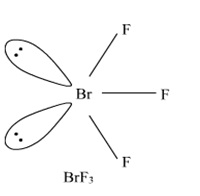
(ii) XeF4
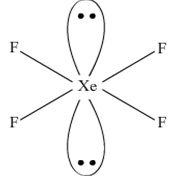
5.
Dilute and conc. Nitric acid gives different products of oxidation when reacted with copper metal.
3Cu(s) + 8HNO3(dil.) \(\to\) 3Cu(No3)2(aq) + 2NO(g) + 4H2O(l)
Cu(s) + 4HNO3(conc.) \(\to\) Cu(NO3)2(aq) + 2NO2 + 2H2O(l)
6.
\({ P }_{ 4 }{ O }_{ 10 }\) is a strong dehydrating agent. It reacts with \({ HNO }_{ 3 }\) to form metaphosphoric acid \(\left( { HPO }_{ 3 } \right) \) and dinitrogen pentoxide, \({ N }_{ 2 }{ O }_{ 5 }\)
\(4HN{ O }_{ 3 }+{ P }_{ 4 }{ O }_{ 10 }\longrightarrow 4HP{ O }_{ 3 }+2{ N }_{ 2 }{ O }_{ 5 }\) \(\)
7.
(i) HNO2 (Nitrous acid)
(ii) HNO3 (Nitric acid)
(iii) H2N2O2 (Hydronitrous acid)
\(\underset{+3}{3HNO_2 } \xrightarrow{Disproportionation} \underset {+5}{HNO_3} + H_2O + \underset {+2}{2NO}\)
\(\)
8.
Nitric oxide [NO] is monomeric and paramagnetic in nature in gaseous state due to presence of unpaired electron but it exists as dimer in solid state which is diamagnetic due to absence of unpaired electron.
9.
(i) \(Xe +\underset {excess} {2F_{2}} \xrightarrow [7 bar] {873 k} XeF_{4}\)
(ii) \(6Li + N_{2} \rightarrow 2Li_{3}N\)
\(\)
10.
(i) Ca(OCI)2 + 4HCI \(\to\) CaCI2 + 2H2O + 2CI2.
(ii) 2Ca3(PO4)2 + 6Si O2 + 10C \(\to\) P4 + 6CaSi O3 + 10CO.
11.
(i) It is due to increases in size of group 15 elements, the bond angle decreases as bond length increases and bond pair-bond pair repulsion decreases.
(ii) It is because it is inert.
12.
(i) It is because HF molecules are associated with intermolecular H-bonding whereas HCI is not.
(ii) It is due to low bond dissociation energy due to less effective overlapping.
13.
(i) I2 + 10HNO3 (conc.) \(\to \) 2HIO3 + 10NO2 +H2O
(ii) 3HgCl2 2PH3 \(\to \) Hg3P2 + 6 HCl

12th Standard CBSE Syllabus & Materials
12th Standard CBSE
CBSE 12th Computer Science Python Revision Tour I - New Previous year Question Papers Study Material - QB365 Set A
NEW12th Standard CBSE
CBSE 12th Business Studies Planning Important Questions And Answers Study Material - QB365 Set A
NEW12th Standard CBSE
CBSE 12th Business Studies Business Environment Important Questions And Answers Study Material - QB365 Set A
NEW12th Standard CBSE
CBSE 12th Business Studies Principles of Management Important Questions And Answers Study Material - QB365 Set A



CBSE 12th Standard CBSE Subjects
CBSE Standards










