
 100% FREE ACCESS
12th Standard CBSE Syllabus & Materials
12th Standard CBSE
CBSE 12th Economics Government Budget and the Economy Previous year Question Papers Study Material - QB365 Set A
NEW12th Standard CBSE
CBSE 12th Computer Science Interface Python with MySQL - New Previous year Question Papers Study Material - QB365 Set A
NEW12th Standard CBSE
CBSE 12th Computer Science Database Concept - New Previous year Question Papers Study Material - QB365 Set A
NEW12th Standard CBSE
CBSE 12th Computer Science Data Communication - New Previous year Question Papers Study Material - QB365 Set A
NEW12th Standard CBSE
CBSE 12th Computer Science Data Structures - New Previous year Question Papers Study Material - QB365 Set A
NEW12th Standard CBSE
CBSE 12th Computer Science Functions - New Previous year Question Papers Study Material - QB365 Set A

Published on: 15/02/2019
The Solid State Important Questions
Download CBSE Class 12th Standard CBSE Chemistry question papers, sample papers, important questions, and previous year solved papers in PDF format. Get free study materials, NCERT solutions, and exam preparation resources for Class 12th Standard CBSE Chemistry
Questions + Answers key
Take MCQ Chemistry Test
1.
Which point defect in crystals of a solid decreases the density of the solid?
2.
What is the coordination number in a rock salt type structure?
3.
Why is glass considered as supercooled liquid?
4.
Some of the glass objects recovered from ancient monument look milky instead of being transparent. Why? Iron (IT) oxide has a cubic structure and each side of the unit cell is 5 \(A^{ 0 }\) . If density of the oxide is 4 g cm3 , calculate the number of Fe2+ and 02- ions present is each unit cell. (Atomic mass Fe = 56 u, Avogadro's number = 6.023 1023 mol-1)
5.
What is doping? What are n-type and p-type semiconductors?
6.
Lithium iodide crystal has a face-centred cubic unit cell.If the edge length of the unit cell is 620pm,determine the ionic radius of I-ion.
7.
You are given marbles of diameter 10mm.They are to be placed such that their centres are lying in a square bound by four lines each of length 40mm.What will be the arrangement of marbles in a plane so that maximum number of marbles can be placed inside the area?Sketch the diagram and derive an expression for the number of marbles per unit area.
8.
Lithium borohydride,LiBH4,crystallize in an orthorhombic system with 4 molecules per unit cell.The unit cell dimensions are: a=6.81\(\overset { 0 }{ A } \) ,b=4.43\(\overset{0}{A}\) and c=7.17\(\overset{0}{A}\).Calculate the density of the crystal.Take atomic mass of Li=7,B=11 and H=1 a.m.u.
9.
If the atoms of an element have the radius r,then in a primitive cubic unit cell,calculate
(A) the length of the face diagonal
(B) the length of the body diagonal
10.
Copper crystallises in face-centred cubic lattice and has density of 8.930 g cm-3 at 293 K. Calculate the radius of copper atom. [Atomic mass of Cu=63.55 u, NA 6.02\(\times \)1023 mol-1].
11.
Which of the following lattices has the highest packing efficiency
(i) simple cubic
(ii) body-centred cubic and
(iii) hexagonal close-packed lattice?
12.
An element crystallizes in a bcc lattice with cell edge of 500 pm. The density of the element is 7.5 g cm-3 How many atoms are present in 300 g of the element?
13.
An element crystallizes in a fcc lattice with cell edge 250 pm. Calculate the density if 300 g of this element contain 2 x 1024 atom
14.
Examine the given defective crystal
| \({ A }^{ + }\) | \({ B }^{ - }\) | \({ A }^{ + }\) | \({ B }^{ - }\) | \({ A }^{ + }\) |
| \({ B }^{ - }\) | \(O \) | \({ B }^{ - }\) | \({ A }^{ + }\) | \({ B }^{ - }\) |
| \({ A }^{ + }\) | \({ B }^{ - }\) | \({ A }^{ + }\) | \(O \) | \({ A }^{ + }\) |
| \({ B }^{ - }\) | \({ A }^{ + }\) | \({ B }^{ - }\) | \({ A }^{ + }\) | \({ B }^{ - }\) |
Answer the following questions:
(i) What type of stoichiometric defect is shown by the crystal?
(ii) How is the density of the crystal affected by this defect?
(iii) What type of ionic substances show such defect?
15.
Ionic solids which have anionic vacancies to metal excess defect develop colour. Explain with the help of a suitable example.
16.
Define the following terms:
(i) ferromagnetism
(ii) Ferrimagnetism
17.
The well know mineral flurite is chemically calcium fluride. It is well know that in one unit of this mineral,there are 4 Ca2+ ions and 8 F- ions, and that Ca2+ ions. The edge of the unit cell is 6.46 \(\times\) 10-8 cm in length. The density of the solid is 3.18 g cm-3. Use this information to calculate Avogadro's number (Molar mass of CaF2 = 78.08 g mol-1).
18.
If three elements P,Q and R crystallize in a cubic solid lattice with P atoms at the corners, Q atoms at the cube centre and R atoms at the centre of the faces of the cube, then write the formula of the compound.
19.
The well-known mineral fluorite is chemically calcium fluoride. It is known that in one unit cell of this mineral, there are 4 Ca2+ ions and 8 F- ions and that Ca2+ ions are arranged in a fcc lattice. The F- ions fill all tetrahedral holes in the face-centred cubic lattice of Ca2+ ions. The edge of the unitcell is 5.46\(\times \)10-8 cm in length. The density of the solid is 3.18 g cm-3. Use this information to calculate Avogadro's number. (Molar mass of CaF2 = 78.08 G mol-1)
20.
Silver crystallizes in face-centred cubic unit cell. Each side of this unit cell has a length of 400 pm. Calculate the radius of the silver atom. (Assume the atoms just touch each other on the diagonal across the face of the unit cell. That is , each face atom is touching the four corner atoms.)
21.
Assign reasons for the following:
(i) Phosphorus doped silicon is a semiconductor.
(ii) Schottky defect lowers the density of a solid.
(iii) Some of the very old glass objects appear slightly milky instead of being transparent.
22.
A compound forms hexagonal clo se-packed structure. What is the total number of voids in 0.5 mol of it? How many of these are tetrahedral voids?
23.
In terms of band theory, what is the difference
(i) between a conductor and a semiconductor?
(ii) between a conductor and an insulator?
24.
Frenkel defect is also known as.......................... .
stoichiometric defect
dislocation defect
impurity defect
non-stoichometric effect
25.
KCl crystallises in the same type of lattice as does NaCl.Given that rNa+/rCl-=0.55 and rK+/rCl-=0.74.Calculate the side of the unit cell of KCl to that of NaCl
1.123
0.891
1.414
0.414
1.732
26.
For a solid with the following structure,the coordination number of the points A and B respectively are
6,8
8,8
6,6
4,6
27.
Which of the following statement is not true about amorphous solids?
On heating they may become crystalline at certain temperature.
They may become crystalline on keeping for long time.
Amorphous solids can be moulded by heating.
They are anisotropic in nature.
28.
The correct statement regarding defects in crystalline solids is
Frenkel defect is a dislocation defect
Frenkel defect is found in halids of alkaline metals
Schottky defects have no effect on the density of crystalline solids
Frenkel defects decrease the density of crystalline solids
29.
If 'a' stands for the edge length of the cubic systems simple cubic,body centered cubic and face centered cubic,then the ratio of the radii of the spheres in these systems will be respectively
\({1\over2}a:{\sqrt{3}\over4}a:{1\over2\sqrt{2}}a\)
\({1\over2}a:{\sqrt{3}}a:{1\over\sqrt{2}}a\)
\({1\over2}a:{\sqrt{3}\over4}:{\sqrt{2}\over2}a\)
\({1\over2}a:{\sqrt{3}}a:{\sqrt{2}}a\)
30.
A given metal crystallizes out with a cubic structure having edge length of 361pm.If there are four metal atoms in one unit cell,what is the radius of one atom?
80pm
108pm
40pm
127pm
31.
A metal crystallize with a face-centred cubic lattice.The edge of the unit cell is 408pm.The diameter of the metal atom is
288pm
408pm
144pm
204pm
32.
The arrangement of X- ions around A+ ions in solid AX is given in the fig(not drawn to scale).If the radius of X- is 250pm,the radius of A+ is
104pm
125pm
183pm
57pm
33.
A compound MpXq has cubic close packing(ccp) arrangement of X.Its unit cell structure is shown below.The empirical formula of the compound is
MX
MX2
M2X
M5X14
34.
The vacant space in bcc lattice unit cell is
23%
32%
26%
48%
35.
In a face-centered cubic lattice, atom A occupies the corner positions and atom B occupies the face centre positions.If one atom of B is missing from one of the face centred points,the formula of the compound is
AB2
A2B3
A2B5
A2B
36.
Which of the following statement about amorphous solids is incorrect?
They melt over a range of temperature
They are anisotropic
There is no orderly arrangement of particles
They are rigid and incompressible
37.
Which of the following exists as covalent crystals in the solid state?
Phosphorus
Iodine
Silicon
Sulphur
38.
In a solid lattice, the cation has left a lattice site and is located at an interstitial position. The lattice defect is
n-type
p-type
Frenkel defect
Schottky defect
39.
Which kind of defect is found in KCl crystal ?
Frenkel
Schottky
Linear
Impurity
40.
In crystal structure of NaCl, total number of Cl- ions in a unit cell is
6
4
8
2
41.
What is the coordination number of sodium in sodium oxide (Na2O) ?
6
4
8
2
42.
The crystal lattice of NaCl is
Face-centered cubic lattice
Body-centered cubic lattice
Simple cubic lattice
Hexagonal close packing
43.
In a compound, atoms of element Y form ccp lattice and those of element X occupy 2/3rd of tetrahedral voids. The formula of the compound will be
X2 Y
X3Y4
X4Y3
X2Y3
44.
Cubic and tetragonal
45.
X=At the corners , Y=One on each body diagonal
46.
Compounds having general molecular formula \(AFe_{ 2 }O_{ 4 }\) are called ferrites and posses spinel type structures. Some common examples are \(MgFe_{ 2 }O_{ 4 }\) and \(ZnFe_{ 2 }O_{ 4 }\) They may be thought of being formed by replacing \(Fe^{ 2+ }\) ions present in \(Fe_{ 3 }O_{ 4 }\) by bivalent cations such as \(Mg^{ 2+ },Zn^{ 2+ }\) ions etc. Now answer the following questions :
(i) What types of materials are ferrites?
(ii) What are the main uses of ferrites?
47.
Certain crystals, when subjected to a mechanical stress get deformed and produce electricity due to displacement of ions. The electricity thus produced is called piezoelectricity and such crystals are called piezoelectric crystals. On the other hand, when such crystals are subjected to an electric field, the atomic displacements are produced which cause mechanical distortion in the crystals. These unique properties of piezoelectric crystals find several applications. Now, answer the following questions:
(i) How do piezoelectric crystals behave?
(ii) Mention one application of piezoelectric crystals.
(iii) Just like certain crystals piezoelectric crystals perform better even under mechanical stress and show' various application, how do you behave under stress? What values we can adopt from even these non-living crystals?
1.
()
Schottky defect.
2.
()
The coordination number of each type of ions is 6 in a rock-salt type crystal structure, i.e. Na+ has 6, CI- has 6.
3.
()
It is because glass windows are thicker at the bottom and thinner at the top. it shows that glass can flow, that is why it is called super cooled liquid.
4.
(i) When amorphous solid (glass) are heated and cooled slowly, they acquire crystallinity at same temperature. Glass objects of ancient monuments, over a period of years, are exposed to sunlight and cooled during night times, which has resulted in the crystallization of the glass object which imparts milky colour to the ancient monuments.
(ii) Density = \(\frac { Z\times M }{ a^{ 3 }\times N_{ A } } \)
\(4=\frac { Z\times 72 }{ (5\times 10^{ -8 })^{ 3 }\times 6.023\times 10^{ 23 } } \)
So Z = 4.18
As Z = 4 so 4 units of FeO are present and hence 4Fe2+ and 4O2- are present in each unit cell.
5.
The substances whose conductance lies between that of conductors (metals) and insulators are called semiconductors. They have conductivity values ranging from 10-6 to 104 n-1m-1. Two main types of semiconductors are n-type and p-type.
(i) n-type semiconductors: These are the semiconductors in which the current is carried by the electrons in the normal way. For example, silicon and germanium belong to group 14 of the periodic table and have four valence electrons each. In their crystals, each atom forms four covalent bonds with its neighbors,' When it is doped with an element of group 15 such as P or As, which contains five valence electrons, they occupy some of the lattice sites in silicon or germanium crystal. Four of the five valence electrons are used in the formation of four covalent bonds with the four neighboring Si atoms .and the fifth electron is extra and becomes delocalised. This delocalised electron will be able to conduct and such type of conduction is called n-type conduction. Hence silicon or germanium doped with an extra electron of impurity are called n-type semiconductors'.
(ii) p-type semiconductors: These are the semiconductors in which current is carried by the movement of positive holes. For example, when Ge or Si are doped with electron deficient atoms such as Ga or In (of Group 13) containing three valence electrons, the atoms of Ga or In will replace Ge atoms. Each In or Ga atom will use its three electrons for forming three covalent bonds with neighboring Ge atoms and the place for the fourth bond will remain missing and is called electron vacancy or hole. Such holes can move through the crystals like a positive charge giving rise to conductivity. This type of conduction is called p-type conduction. Hence, Si or Ge doped with electron deficient atoms as an impurity are called p-type semiconductors.
6.
219.17pm
7.
1.125
8.
0.676g cm-3
9.
\(2\sqrt{2}r\)
10.
\(4r=\sqrt{2}a\)
\(\Rightarrow\ r={\sqrt{2}a\over 4}={a\over 2\sqrt{2}}\)
for fcc element, where' a' is the edge length of unit cell and 'r' is the radius of atom.Z = 4 for fcc element.
Now, \(d={Z\times M\over N_4\times d}\)
\(\Rightarrow\ a^3={Z\times M\over N_A\times d}\)
\(={4\times63.55\over 6.02\times\times10^{23}\times8.93}\)
a3 = 4.728 x 10⁻²³ crrr'
= 47.28 x 10⁻²⁴ crrr',
a = 3.615 x 10⁻⁸ cm
= 361.5 pm
\(4r=\sqrt{2}a\)
\(r={a\over 2\sqrt{2}}={361.5\over 2\times1.414}=127.82 \ pm\)
11.
(iii) The packing efficiency of simple cubic lattice is 52.4%, body-centred is 68% and that of hexagonal close-packed lattice is 74%.
Therefore, hexagonal dose-packed lattice has the highest packing efficiency.
12.
Z=2
\(d=\frac { Z\times M }{ a^{ 3 }\times N_{ A } } \)
\(N_{ A }=\frac { Z\times M }{ d\times a^{ 3 } } \)
\(N_{ A }=\frac { 2\times 300 }{ [7.5\times (5\times 10^{ -8 }cm)^{ 3 }] } \)
\(=6.4\times 10^{ 23 }atoms\)
13.
a = 250 pm = 250 x 10-12 m = 250 x 10-10 cm
2 x 1024 atom weighs = 300 g
6.022 x10²³ atoms weigh =\(\frac { 300\times 6.022\times 10^{ 23 } }{ 2\times 10^{ 24 } } \)
= 90.3 g
\(d=\frac { M\times Z }{ a^{ 3 }\times N_{ A } } \)
=\(\frac { 4\times 90.3 }{ (250\times 10^{ -10 })\times 6.022\times 10^{ 23 } } \)
= 38.4 g cm-3
14.
(i) Schottky defect
(ii) Density of the crystal decreases.
(iii) Crystal having
(a) high coordination number and
(b) ions (cations and anions)of almost similar sizes.
For example: KCI, KBr.
15.
When crystals of alkali metal halides such as NaCI are heated in the atmosphere of sodium vapour, the excess of sodium atoms are deposited on the surface of the crystal. The CI- ions diffuse to the surface and combine with sodium atoms to form NaCI. This happens by the loss electrons by Na atoms to form the visible light falls on the crystal and occupy anionic sites. As a result, the structure has an excess of sodium.
The crystals acquired yellow colour because when visible light falls on the crystals, they absorb energy from the visible region to excite the electrons. Hence, they are coloured. Similarly, excess of Li makes LiCI crystals pink and excess of K makes KCI crystals viloet.
16.
(i) When there is spontaneous alignment of magnetic moments of domains in the same direction, we get ferromagnetism. These have strong magnetic effects and ordering of domains persists even when magnetic field is removed and ferromagnetic substance becomes permanent magnet.
(ii) When the magnetic moments of the domains are aligned in parallel or anti-parallel directions in unequal numbers resulting in net magnetic moment, we get ferromagnetism.
17.
6.033\(\times\) 1023
18.
PQR3
19.
\(4{ Ca }^{ 2+ }and{ 8F }^{ - }ions \ means \ { 4CaF }_{ 2 }units\)
\(Z=4, \ d=\frac { Z\times M }{ { a }^{ 3 }\times { N }_{ A } } \)
\({ N }_{ A }=\frac { Z\times M }{ d\times { a }^{ 3 } }\)
\( =\frac { 4\times 78.08g{ mol }^{ -1 } }{ 3.18g{ cm }^{ -3 }\times { \left( 5.46 \right) }^{ 3 }\times { 10 }^{ -24 }{ cm }^{ 3 } } \)
\(=\frac { 312.32\times { 10 }^{ 24 } }{ 3.18\times { \left( 5.46 \right) }^{ 3 } } =\frac { 3123.2 }{ 517.61 } \times { 10 }^{ 23 }\)
\({ N }_{ A }=6.0338\times { 10 }^{ 23 }{ mol }^{ -1 }\)
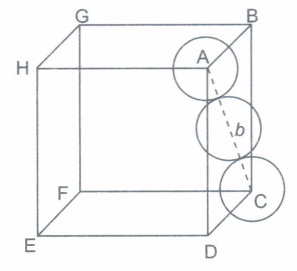
20.
If a is the edge length of fcc unit cell, then
face diagonal = 4r
\(4r=\sqrt { 2 } a\)
\( r=\frac { \sqrt { 2 } }{ 4 } a\)
\(=\frac { \sqrt { 2 } \times 400pm }{ 4 } \)
\(=1.414\times 100=141.4pm\)
21.
(i) It is because its conductance is intermediate between conductor and insulator.
(ii) In Schottky defect, both cations and anions are missing which lead to lowering in the density of a solid.
(iii) The glass is supercooled liquid, therefore, very old glass objects become slightly milky because of heating during the day and cooling at nights, i.e. annealing over a number of years, glass acquires some crystalline structure.
22.
No.of atoms in the close packing = 0.5 mol = \(0.5\times 6.022\times { 10 }^{ 23 }=3.011\times { 10 }^{ 23 }\)
No.of octahedral voids = No.of atoms in the packing = \(3.011\times { 10 }^{ 23 }\)
No.of tetrahedral voids= 2\(\times \)No.of atoms in the packing = \(2\times 3.011\times { 10 }^{ 23 }=6.022\times { 10 }^{ 23 }\)
Total no.of voids\(=3.011\times10+6.022\times { 10 }^{ 23 }=9.033\times { { 10 }^{ 23 } }\)
23.
(i) The energy gap between valence band and condition band in an insulator is very large where as in a conductor, the energy gap is very small or there is overlapping between valence band and conduction band.
(ii) In a conductor, there is verysmall energy gap or there is verlapping between valence band and conduction band but in a semiconductor, there is always a small energy gap between them.
24.
(a)
stoichiometric defect
25.
1.123
26.
The given structure is similar ti that of NaCl in which coordination number of each Na+ and Cl- ions is 6
27.
(d)
They are anisotropic in nature.
28.
Frenkel defect is a dislocation defect as some cations are dislocation from lattice sites and occupy interstitial sites.
29.
(a)
\({1\over2}a:{\sqrt{3}\over4}a:{1\over2\sqrt{2}}a\)
30.
127pm
31.
(a)
288pm
32.
(a)
104pm
33.
MX2
34.
(b)
32%
35.
(c)
A2B5
36.
(b)
They are anisotropic
37.
(c)
Silicon
38.
(c)
Frenkel defect
39.
(b)
Schottky
40.
(b)
4
41.
(c)
8
42.
(a)
Face-centered cubic lattice
43.
(c)
X4Y3
44.
()
are two crystal system
45.
()
XY4
46.
(i) Ferrites are magnetic material.
(ii) They are used in telephones and memory loops in computers.
47.
(i) Piezoelectric crystals behaves as mechanical electrical transducer.
(ii) Piezoelectric crystals are used as pickups in record players where they produce electric signals by application of pressure.
(iii) We generally become tense and pessimistic under stress. But we should face every situation, accept every worst situation as challenge and maintain our mental balance. It will definitely result in our performance just like in piezoelectric crystals. We can learn from these non-living crystals to be optimistic as worst situations can be converted into an opportunity.

12th Standard CBSE Syllabus & Materials
12th Standard CBSE
CBSE 12th Computer Science Python Revision Tour I - New Previous year Question Papers Study Material - QB365 Set A
NEW12th Standard CBSE
CBSE 12th Business Studies Planning Important Questions And Answers Study Material - QB365 Set A
NEW12th Standard CBSE
CBSE 12th Business Studies Business Environment Important Questions And Answers Study Material - QB365 Set A
NEW12th Standard CBSE
CBSE 12th Business Studies Principles of Management Important Questions And Answers Study Material - QB365 Set A



CBSE 12th Standard CBSE Subjects
CBSE Standards










