
 100% FREE ACCESS
12th Standard CBSE Syllabus & Materials
12th Standard CBSE
CBSE 12th Economics Government Budget and the Economy Previous year Question Papers Study Material - QB365 Set A
NEW12th Standard CBSE
CBSE 12th Computer Science Interface Python with MySQL - New Previous year Question Papers Study Material - QB365 Set A
NEW12th Standard CBSE
CBSE 12th Computer Science Database Concept - New Previous year Question Papers Study Material - QB365 Set A
NEW12th Standard CBSE
CBSE 12th Computer Science Data Communication - New Previous year Question Papers Study Material - QB365 Set A
NEW12th Standard CBSE
CBSE 12th Computer Science Data Structures - New Previous year Question Papers Study Material - QB365 Set A
NEW12th Standard CBSE
CBSE 12th Computer Science Functions - New Previous year Question Papers Study Material - QB365 Set A

Published on: 20/11/2019
The Solid State
Download CBSE Class 12th Standard CBSE Chemistry question papers, sample papers, important questions, and previous year solved papers in PDF format. Get free study materials, NCERT solutions, and exam preparation resources for Class 12th Standard CBSE Chemistry
Questions + Answers key
Take MCQ Chemistry Test
1.
Calculate the efficiency of packing in case of a metal crystal for
(a) simple cubic,
(b) body-centred cubic, and
(c) face-centred cubic (with the assumption that atoms are touching each other).
2.
An alloy is of gold and cadmium crystallises with a cubic structure in which gold atoms occupy the corners and cadmium atoms fit into the face centre. Assign formula for this alloy.
3.
Calculate the packing efficiency in case of a metal crystal for simple cubic lattice.
4.
Explain the following terms with suitable examples of each:
(i) Freeomagnetism
(ii) Antiferromagnetism.
5.
Define the following terms in relation to crystalline solids:
(i) Unit cell
(ii) Coordination number
Give one example in each case.
6.
The density of copper metal is 8.95 g cm-3. If the radius of copper atom is 127.8 pm, is the copper unit cell a simple cubic, a body-centred cubic or a face-centred cubic structure?
(Give: At. mass of Cu = 63.54 g mol-1 and NA = 6.02\(\times \)1023 mol-1).
7.
Explain the following properties given suitable examples:
(i) Ferromagnetism;
(ii) Paramagnetism;
(iii) Ferrimagnetism.
8.
Copper crystallises with face-centred cubic unit cell. If the radius of copper atom is 127.8 pm, calculate the density of copper metal.(Atomic mass of Cu = 63.55 u and Avogadro's number, NA = 6.02\(\times \) 1023 MOL-1)
9.
An element occurs in bcc structure. It has a cell edge length of 250 pm. Calculate the molar mass if its densuty is 8.0 g cm-3. Also calculate the radius of an atom of this element.
10.
Which of the following is an amorphous solid?
Graphite (C)
Quartz glass (SiO2)
Chrome alum
Silicon carbide (SiC)
11.
If the edge length of a NaH unit cell is 488pm,what is the length of Na-H bond if it crystallises in the fcc structure?
122pm
244pm
488pm
976pm
12.
Edge length of a cube is 400pm,its body diagonal would be
500pm
600pm
566pm
693pm
13.
If a is the length of side of a cube,the distance between the body-centred atom and one corner atom in the will be
\({2\over\sqrt{3}}a\)
\({4\over\sqrt{3}}a\)
\({3\over\sqrt{4}}a\)
\({3\over\sqrt{2}}a\)
14.
Sodium metal crystallize in a body-centred cubic lattice with a unit cell edge of 4.29\(\overset{0}{A}\).The radius of sodium metal is approximately
5.72\(\overset{0}{A}\)
0.93\(\overset{0}{A}\)
1.86\(\overset{0}{A}\)
3.22\(\overset{0}{A}\)
15.
In a solid 'AB' having NaCl structure, 'A' atoms occupy the corners of the cubic unit cell.If all the face-centred atoms along one of the axes are removed,then the resultant stoichiometry of the solid is
AB2
A2B
A4B3
A3B4
16.
In a face-centered cubic lattice, atom A occupies the corner positions and atom B occupies the face centre positions.If one atom of B is missing from one of the face centred points,the formula of the compound is
AB2
A2B3
A2B5
A2B
17.
In a solid lattice, the cation has left a lattice site and is located at an interstitial position. The lattice defect is
n-type
p-type
Frenkel defect
Schottky defect
18.
In a compound, atoms of element Y form ccp lattice and those of element X occupy 2/3rd of tetrahedral voids. The formula of the compound will be
X2 Y
X3Y4
X4Y3
X2Y3
19.
Wax is an example of
ionic crystal
covalent crystal
molecular crystal
amorphous crystal
20.
How can you convert NaCl structure into CsCl structure and vice versa?
21.
Classify the following into ionic, molecular, covalent and metallic crystals.
Bronze, Dry ice, Nitre and Diamond
22.
Compounds having general molecular formula \(AFe_{ 2 }O_{ 4 }\) are called ferrites and posses spinel type structures. Some common examples are \(MgFe_{ 2 }O_{ 4 }\) and \(ZnFe_{ 2 }O_{ 4 }\) They may be thought of being formed by replacing \(Fe^{ 2+ }\) ions present in \(Fe_{ 3 }O_{ 4 }\) by bivalent cations such as \(Mg^{ 2+ },Zn^{ 2+ }\) ions etc. Now answer the following questions :
(i) What types of materials are ferrites?
(ii) What are the main uses of ferrites?
23.
Certain crystals, when subjected to a mechanical stress get deformed and produce electricity due to displacement of ions. The electricity thus produced is called piezoelectricity and such crystals are called piezoelectric crystals. On the other hand, when such crystals are subjected to an electric field, the atomic displacements are produced which cause mechanical distortion in the crystals. These unique properties of piezoelectric crystals find several applications. Now, answer the following questions:
(i) How do piezoelectric crystals behave?
(ii) Mention one application of piezoelectric crystals.
(iii) Just like certain crystals piezoelectric crystals perform better even under mechanical stress and show' various application, how do you behave under stress? What values we can adopt from even these non-living crystals?
1.
Hexagonal closed-packed lattice has maximum efficiency; i.e 74%, whereas body centred cubic has 68% and simple cubic has 52.4%.
2.
As there are 8 corners in a cube and gold atoms are present at the corners of the cube, Thus, 8 gold atoms at the eight corners contribute 8 x 1/8 = 1 [Contribution of an 8 atom at the corner per unit cell is 1/8] As there are 6 face centers in a cube and cadmium atoms fit into six face centers of the cube, Thus, 6 cadmium atoms at the six faces contribute 6 x 1/2 =3 [Contribuion per unit cell of an atom at face center is 1/2]. Thus, formula of this alloy is AuCd3
3.
Suppose the edge length of the unit cell = a and radius of the sphere = r Since the spheres are touching each other, a = 2r Now, there are eight spheres at the corners of the cube: Each sphere at the corner is shared by eight unit cells and the contribution per unit cell is 1/8 so that number of spheres per unit cell is 8 x 1/8 = 1 Volume of cube = a3 = (2r)3 = 8r3. Since simple cubic unit cell has only one atom per unit cells the volume of space occupied is \(\frac { 4 }{ 3 } \pi { r }^{ 3 }\)
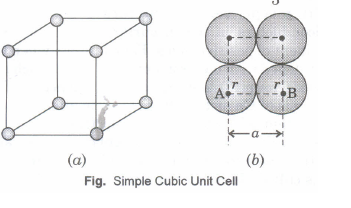
\(Packing \ efficiency=\frac { Volume \ of \ one \ sphere }{ Volume \ of \ cubic \ unit \ cell } \times 100\)
\(\\ \frac { \frac { 4 }{ 3 } \pi { r }^{ 3 } }{ 8{ r }^{ 3 } } \times 100\)
= 52.37 or 52.4
4.
Ferromagnetism: When magnetic moments are aligned in the same direction, it gives rise to ferromagnetism, e.g. iron, cobalt and nickel show ferromagnetism.
Antiferromagnetism: When magnetic moments are aligned in such a way that net magnetic moment is zero, then magnetism is called antiferromagnetism, e.g. MnO shows antiferromagnetism.
5.
(i) The unit cell is the smallest portion of a crystal lattice which when repeated over and over again in different directions results in the entire lattice. For example, simple cubic unit cell.
(ii) The number of nearest neighbors in a packing is called coordination number.For example,in a body-centered cubic structure, the coordination number is eight.
6.
Let us assume, Z = 4 (copper has fcc)
\(d={Z\times M\over a^3\times N_4}\)
\(\Rightarrow\ 8.95={4\times63.54\over a^3\times6.02\times10^{23}}\)
\(\Rightarrow\ a^3={4\times63.54\over 8.95\times6.02\times10^{23}}\)
\(={254.16\over 53.88}\times10^{-23}\)
= 4.7171 x 10⁻²³cm3
a3 = 47.171 x 10⁻²⁴ crrr3
\(\Rightarrow\ a=\sqrt[3]{47.171}\times10^{-24}cm^3\)
= 3.613 x 10⁻⁸ cm = 361.2 pm
For fcc,
\(4r=\sqrt{2a}\)
\(\Rightarrow\ r={a\over 2\sqrt{2}}={361.\over 2\times1.414}\)
= 127.76 pm
It shows that it has fcc structure as given radius is nearly equal to calculated radius by taking Z = 4.
7.
(i) Ferromagnetism: Those substances which remain magnetized even after the magnetic field is removed are called ferromagnetic substances. They have unpaired electrons, e.g. iron, cobalt, nickel, CrO2, etc. These substances are strongly attracted by a magnetic field. The phenomenon is called Ferromagnetism.
(ii) Paramagnetism: Those substances. which have unpaired electrons are called paramagnetic substances. They are weakly attracted by a magnet, e.g. O2, Cu2+, Fe2+ are paramagnetic in nature. The phenomenon is called Paramagnetism.
(iii) Ferrimagnetism: It is observed when the magnetic moments of the domains are aligned parallel and anti-parallel but unequal in number is called ferromagnetic substances, e.g.Fe3O4, CuFep.vetc. The phenomenon is called Ferrimagnetism.
8.
For a fcc structure, length of the unit cell is related to radius of atom as
\(r=\frac { a }{ 2\sqrt { 2 } } \)
\(\\ or \ a=2\sqrt { 2 } r\)
\(=2\times 1.414\times 127.8 \ pm=361.42pm\)
\(Density, \ \rho =\frac { Z\times M }{ { a }^{ 3 }\times { N }_{ A } } \)
\(=Z=4(for \ fcc),M=63.55 \ g \ { mol }^{ -1 }\)
\(a=361.42\times { 10 }^{ -12 }m=361.42\times { 10 }^{ -10 }cm\)
\({ N }_{ A }=6.02\times { 10 }^{ 23 }\)
\(\rho =\frac { 4\times 63.55 }{ { \left( 361.42\times { 10 }^{ -10 } \right) }^{ 3 }\times 6.02\times { 10 }^{ 23 } }\)
\(=8.94 \ g{ cm }^{ -3 }\)
\(Density, \ \rho =\frac { Z\times M }{ { a }^{ 3 }\times { N }_{ A } } \)
\(a=286.65pm=286.65\times { 10 }^{ -12 }m\)
\(=286.65\times { 10 }^{ -10 }cm\)
\(\ Z=2(for \ bcc), \ M=56.0\)
\(\rho =7.87 \ g{ cm }^{ -3 }\)
\(7.87=\frac { 2\times 56.0 }{ { \left( 286.65\times { 10 }^{ -10 } \right) }^{ 3 }\times { N }_{ A } }\)
\( { N }_{ A }=\frac { 2\times 56.0 }{ { \left( 286.65\times { 10 }^{ -10 } \right) }^{ 3 }\times 7.87 } \)
\(=6.04\times { 10 }^{ 23 }\)
9.
\(d=\frac { Z\times M }{ { a }^{ 3 }\times { N }_{ A } } \)
\(\\ M=\frac { d\times { a }^{ 3 }\times { N }_{ A } }{ Z }\)
\( Z=\frac { 8.0g{ cm }^{ -3 }\times { \left( 250 \right) }^{ 3 }\times { 10 }^{ -30 }{ cm }^{ 3 }\times 6.023\times { 10 }^{ 23 } }{ 2 }\)
\(Z=\frac { 8\times 15.625\times 6.023 }{ 20 } \)
\(=\frac { 752.875 }{ 20 } \)
\(\\ 37.64 \ g{ \ mol }^{ -1 }\)
\(For \ bcc, \ 4r=\sqrt { 3 } a\)
\(\ r=\frac { \sqrt { 3 } a }{ 4 } =\frac { 1.732\times 250 }{ 4 } =108.25 \ pm\)
10.
(b)
Quartz glass (SiO2)
11.
(b)
244pm
12.
(d)
693pm
13.
(d)
\({3\over\sqrt{2}}a\)
14.
\(1.86\overset{0}{A}\)
15.
(d)
A3B4
16.
(c)
A2B5
17.
(c)
Frenkel defect
18.
(c)
X4Y3
19.
(c)
molecular crystal
20.
()
NaCl structure can be converted into CsCl structure by application of pressure while the reverse can be done by heating to 760 K.
21.
()
Bronze=Metallic, Dry ice=Covalent; Nitre=Ionic,Diamond=Covalent.
22.
(i) Ferrites are magnetic material.
(ii) They are used in telephones and memory loops in computers.
23.
(i) Piezoelectric crystals behaves as mechanical electrical transducer.
(ii) Piezoelectric crystals are used as pickups in record players where they produce electric signals by application of pressure.
(iii) We generally become tense and pessimistic under stress. But we should face every situation, accept every worst situation as challenge and maintain our mental balance. It will definitely result in our performance just like in piezoelectric crystals. We can learn from these non-living crystals to be optimistic as worst situations can be converted into an opportunity.

12th Standard CBSE Syllabus & Materials
12th Standard CBSE
CBSE 12th Computer Science Python Revision Tour I - New Previous year Question Papers Study Material - QB365 Set A
NEW12th Standard CBSE
CBSE 12th Business Studies Planning Important Questions And Answers Study Material - QB365 Set A
NEW12th Standard CBSE
CBSE 12th Business Studies Business Environment Important Questions And Answers Study Material - QB365 Set A
NEW12th Standard CBSE
CBSE 12th Business Studies Principles of Management Important Questions And Answers Study Material - QB365 Set A



CBSE 12th Standard CBSE Subjects
CBSE Standards










