
 100% FREE ACCESS
12th Standard CBSE Syllabus & Materials
12th Standard CBSE
CBSE 12th Economics Government Budget and the Economy Previous year Question Papers Study Material - QB365 Set A
NEW12th Standard CBSE
CBSE 12th Computer Science Interface Python with MySQL - New Previous year Question Papers Study Material - QB365 Set A
NEW12th Standard CBSE
CBSE 12th Computer Science Database Concept - New Previous year Question Papers Study Material - QB365 Set A
NEW12th Standard CBSE
CBSE 12th Computer Science Data Communication - New Previous year Question Papers Study Material - QB365 Set A
NEW12th Standard CBSE
CBSE 12th Computer Science Data Structures - New Previous year Question Papers Study Material - QB365 Set A
NEW12th Standard CBSE
CBSE 12th Computer Science Functions - New Previous year Question Papers Study Material - QB365 Set A

Published on: 20/09/2019
The Solid State
Download CBSE Class 12th Standard CBSE Chemistry question papers, sample papers, important questions, and previous year solved papers in PDF format. Get free study materials, NCERT solutions, and exam preparation resources for Class 12th Standard CBSE Chemistry
Questions + Answers key
Take MCQ Chemistry Test
1.
Copper has fcc structure. If its densities 8.92 g cm-3 . Calculate its radius if atomic mass of Cu is 63.5 g mol-1
2.
The edge length of unit cell of a metal having molecular weight 75 g/mol is 5\(A^{ 0 }\) which crystallizes in cubic lattice If the density is 2g/cc then find the radius of metal atom.(NA=6 x10²³ mol-1 ) Give the answer in pm.
3.
What do you understand by non-stoichiometric compounds? Give examples.
4.
What are point defects in crystals and how do they develop?
5.
Define the following:
(i) Dislocation
(ii) F-centre
(iii) Anti-ferroelectric
6.
Define the following terms:
(i) ferromagnetism
(ii) Ferrimagnetism
7.
What is meant by anisotropy? Which of the two : quartz or glass shows this property?
8.
Calculate the approximate number of unit cells present in 1 g of gold. Given that gold crystallizes in the face-centred cubic lattice. (Atomic mass of gold=197u).
9.
An ionic compound made up of atoms A and B has a face-centered cubic arrangement in the corner and atoms B are at the face-centers. If one of the atoms is missing from the corner, what is the simplest formula of the compound?
10.
What makes a glass different from a solid such as quartz? Under what conditions could quartz be converted into glass?
11.
The well-known mineral fluorite is chemically calcium fluoride. It is known that in one unit cell of this mineral, there are 4 Ca2+ ions and 8 F- ions and that Ca2+ ions are arranged in a fcc lattice. The F- ions fill all tetrahedral holes in the face-centred cubic lattice of Ca2+ ions. The edge of the unitcell is 5.46\(\times \)10-8 cm in length. The density of the solid is 3.18 g cm-3. Use this information to calculate Avogadro's number. (Molar mass of CaF2 = 78.08 G mol-1)
12.
Silver crystallizes in face-centred cubic unit cell. Each side of this unit cell has a length of 400 pm. Calculate the radius of the silver atom. (Assume the atoms just touch each other on the diagonal across the face of the unit cell. That is , each face atom is touching the four corner atoms.)
13.
Explain the following properties given suitable examples:
(i) Ferromagnetism;
(ii) Paramagnetism;
(iii) Ferrimagnetism.
14.
Classify the following as amorphous crystalline solids: Polyurethane, naphthalene, benzoic acid, teflon, potassium nitrate, cellophane, polyvinyl chloride, fibre glass, copper.
15.
Calculate the efficiency of packing in case of a metal crystal for
(a) simple cubic,
(b) body-centred cubic, and
(c) face-centred cubic (with the assumption that atoms are touching each other).
1.
\(d=\frac { Z\times M }{ a^{ 3 }\times N_{ A } } \)
\(\Rightarrow 8.92=\frac { 4\times 63.5 }{ 8.92\times 6.02\times 10^{ 23 } } \)
\(\Rightarrow a^{ 3 }=\frac { 4\times 63.5 }{ 8.92\times 6.02\times 10^{ 23 } } \)
\(=\frac { 254 }{ 53.6984\times 10^{ 23 } } \)
\(=4.73\times 10^{ -23 }\)
\(=0.0473\times 10^{ -21 }\)
\(a=0.36\times 10^{ -7 }\ cm\)
For fcc crystal
Radius (r) =\(\frac { \sqrt { 2 } a }{ 4 } \)
\(=\frac { 1.414\times 36\times 10^{ -7 } }{ 4 } \)
\(=0.127\times 10^{ -8 }\ cm\)
2.
\(d=\frac { Z\times M }{ a^{ 3 }\times N_{ A } } \)
\(\Rightarrow Z=\frac { d\times a^{ 3 }\times N_{ A } }{ M } \)
\(\Rightarrow Z=\frac { (2 \ g \ cm^{ -3 })(5\times 10^{ -8 })^{ 3 }(6\times 10^{ 23 }mol^{ -1 }) }{ 75gmol^{ -1 } } \)
Z = 2
Since the number of atoms per unit cell is 2, it indicates that the metal has body centred cubic (bcc) lattice.
For bcc lattice, body diagonal of the unit cell
d = 2r
\(=\frac { \sqrt { 3a } }{ 2 } =\frac { 4\times Atomic \ radius }{ \sqrt { 3 } xedge \ length } \)
\(\Rightarrow 4r=\sqrt { 3 } a\)
\(\Rightarrow 4r=\frac { \sqrt { 3 } }{ 4 } \times 5\)
=216.5 pm.
3.
Non-stoichiometric compounds: Non-stoichiometric compounds are those in which the ratio of the number of positive ions and the negative ions does not correspond to the simple whole number as suggested by the formula. There is a large number of non-stoichiometric ionic solids which contain an excess or deficiency of one of the components. As a result, the crystal structure becomes irregular and this leads to the presence of a defect. Such defects are also called non-stoichiometric defects.
For example, vanadium oxide has the formula VOx where x lies between 0.6 and 1.3. Similarly, iron (II) oxide samples contain more oxygen atoms than iron atoms while samples contain more oxygen atoms than iron atoms while samples of zinc oxides, ZnO usually has excess of zinc atoms than oxygen atoms. However, it may be noted that in each case, the electrical neutrality of the crystal is maintained.
4.
When imperfections or defects in a crystal are caused by the departure from the definite arrangement in the vicinity of an atom or a group of atoms, the imperfections are called point defects. The imperfections are caused either by missing or dislocations of a constituent particle to a position meant for another particle or shifting to an interstitial position.
Point defects are of two common types:
(i) Schottky defect
(ii) Frenkel defect.
For Schottky and Frenkel defects.
5.
(i) Dislocation: Lattice imperfections which are extended along lines are called dislocations or line defects.
(ii) F-centre: The electrons trapped in anion vacancies are called F-centres.
(iii) Anti-ferroelectric: If in a piezoelectric crystal, the dipoles in alternative polyhedra pointing up and down so that there is no net dipole moment, the crystal is reffered to as anti-ferroelectric. For example, PbZrO3 (lead zirconate).
6.
(i) When there is spontaneous alignment of magnetic moments of domains in the same direction, we get ferromagnetism. These have strong magnetic effects and ordering of domains persists even when magnetic field is removed and ferromagnetic substance becomes permanent magnet.
(ii) When the magnetic moments of the domains are aligned in parallel or anti-parallel directions in unequal numbers resulting in net magnetic moment, we get ferromagnetism.
7.
Physical properties such as electrical conductivity, thermal conductivity, refractivity index etc. show different values when measured along different directions in the same crystal. This phenomenon is called anisotropy. It arises because of different arrangement of particles in different directions. quartz shows this property because it is crystalline.
8.
7.64 x 10²⁰
9.
A7B24
10.
Quartz is three dimensional crystalline solids having regular arrangement of silicon and oxygen.
The ordinary glass which is metal silicate is amorphous solid. When quartz is melted and the melt is cooled rapidly, it forms a glass or amorphous solid.
11.
\(4{ Ca }^{ 2+ }and{ 8F }^{ - }ions \ means \ { 4CaF }_{ 2 }units\)
\(Z=4, \ d=\frac { Z\times M }{ { a }^{ 3 }\times { N }_{ A } } \)
\({ N }_{ A }=\frac { Z\times M }{ d\times { a }^{ 3 } }\)
\( =\frac { 4\times 78.08g{ mol }^{ -1 } }{ 3.18g{ cm }^{ -3 }\times { \left( 5.46 \right) }^{ 3 }\times { 10 }^{ -24 }{ cm }^{ 3 } } \)
\(=\frac { 312.32\times { 10 }^{ 24 } }{ 3.18\times { \left( 5.46 \right) }^{ 3 } } =\frac { 3123.2 }{ 517.61 } \times { 10 }^{ 23 }\)
\({ N }_{ A }=6.0338\times { 10 }^{ 23 }{ mol }^{ -1 }\)
12.
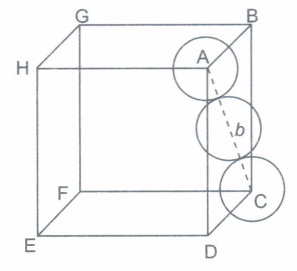
If a is the edge length of fcc unit cell, then
face diagonal = 4r
\(4r=\sqrt { 2 } a\)
\( r=\frac { \sqrt { 2 } }{ 4 } a\)
\(=\frac { \sqrt { 2 } \times 400pm }{ 4 } \)
\(=1.414\times 100=141.4pm\)
13.
(i) Ferromagnetism: Those substances which remain magnetized even after the magnetic field is removed are called ferromagnetic substances. They have unpaired electrons, e.g. iron, cobalt, nickel, CrO2, etc. These substances are strongly attracted by a magnetic field. The phenomenon is called Ferromagnetism.
(ii) Paramagnetism: Those substances. which have unpaired electrons are called paramagnetic substances. They are weakly attracted by a magnet, e.g. O2, Cu2+, Fe2+ are paramagnetic in nature. The phenomenon is called Paramagnetism.
(iii) Ferrimagnetism: It is observed when the magnetic moments of the domains are aligned parallel and anti-parallel but unequal in number is called ferromagnetic substances, e.g.Fe3O4, CuFep.vetc. The phenomenon is called Ferrimagnetism.
14.
Crystalline solids: Benzoic acid, naphthalene, potassium nitrate, copper.
Amorphous solids: Polyurethane, teflon, cellophane, polyvinyl chloride, fibre glass.
15.
Hexagonal closed-packed lattice has maximum efficiency; i.e 74%, whereas body centred cubic has 68% and simple cubic has 52.4%.

12th Standard CBSE Syllabus & Materials
12th Standard CBSE
CBSE 12th Computer Science Python Revision Tour I - New Previous year Question Papers Study Material - QB365 Set A
NEW12th Standard CBSE
CBSE 12th Business Studies Planning Important Questions And Answers Study Material - QB365 Set A
NEW12th Standard CBSE
CBSE 12th Business Studies Business Environment Important Questions And Answers Study Material - QB365 Set A
NEW12th Standard CBSE
CBSE 12th Business Studies Principles of Management Important Questions And Answers Study Material - QB365 Set A



CBSE 12th Standard CBSE Subjects
CBSE Standards










