
 100% FREE ACCESS
12th Standard CBSE Syllabus & Materials
12th Standard CBSE
CBSE 12th Economics Government Budget and the Economy Previous year Question Papers Study Material - QB365 Set A
NEW12th Standard CBSE
CBSE 12th Computer Science Interface Python with MySQL - New Previous year Question Papers Study Material - QB365 Set A
NEW12th Standard CBSE
CBSE 12th Computer Science Database Concept - New Previous year Question Papers Study Material - QB365 Set A
NEW12th Standard CBSE
CBSE 12th Computer Science Data Communication - New Previous year Question Papers Study Material - QB365 Set A
NEW12th Standard CBSE
CBSE 12th Computer Science Data Structures - New Previous year Question Papers Study Material - QB365 Set A
NEW12th Standard CBSE
CBSE 12th Computer Science Functions - New Previous year Question Papers Study Material - QB365 Set A

Published on: 31/08/2019
Solution
Download CBSE Class 12th Standard CBSE Chemistry question papers, sample papers, important questions, and previous year solved papers in PDF format. Get free study materials, NCERT solutions, and exam preparation resources for Class 12th Standard CBSE Chemistry
Questions + Answers key
Take MCQ Chemistry Test
1.
State Henry's law about the solubility of a gas in a liquid.
2.
Find the boiling point of a solution containing 0.520 g of glucose (C6 H12 O6) dissolved in 80.2 g of water. [Given : Kb for water = 0.52 K/m]
3.
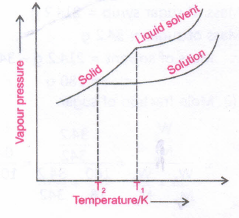
An aqueous solution of solidum chloride freezes below 273 K.Explain the freezing points of water with the help of a suitable diagram.
4.
Define the following terms:
(i) Mole fraction
(ii) Isotonic solutions
(iii) van't Hoff factor
(iv) Ideal solution
5.
State the main advantage of molality over molarity as the unit of concentration.
6.
Measurement of which colligative property is preferred for determination of molar mass.
7.
What mass of ethylene glycol (molar mass = 62.0 g mol-1) must be added to 5.50 kg of water to lower the freezing point of water from 0oC to -10oC? (Kf for water = 1.86 K kg mol-1)
8.
(a) Define the terms osmosis and osmotic pressure. Is the osmotic pressure of a solution a colligative property? Explain.
(b) Calculate the boiling point of a solution prepared by adding 15.00 g of NaCl to 250.0 g of water.
(K b for water = 0.512 K kg mol-1, molar mass of NaCl = 58.44 g)
9.
What role does the molecular interaction play in solution of alcohol and water?
10.
Formation of a solution from two components can be considered as
(i) pure solvent \(\longrightarrow \) seperated solvent molecules, \(\Delta { H }_{ 1 }\)
(ii) pure solute \(\longrightarrow \) seperated solute molecules,\(\Delta { H }_{ 2 }\)
(iii) separated solvent and solute molecules \(\longrightarrow \) solution,\(\Delta { H }_{ 3 }\)
Solution so formed will be ideal if.
\(\Delta { H }_{ soln }=\Delta { H }_{ 1 }+\Delta { H }_{ 2 }+\Delta { H }_{ 3 }\)
\(\Delta { H }_{ soln }=\Delta { H }_{ 1 }+\Delta { H }_{ 2 }-\Delta { H }_{ 3 }\)
\(\Delta { H }_{ soln }=\Delta { H }_{ 1 }-\Delta { H }_{ 2 }-\Delta { H }_{ 3 }\)
\(\Delta { H }_{ soln }=\Delta { H }_{ 3 }-\Delta { H }_{ 1 }-\Delta { H }_{ 2 }\)
11.
12.0g of urea is dissolved in 1 litre of water and 68.4g sucrose is dissolved in 1 litre of water. The relative lowering of vapour pressure of urea solution is
greater than sucrose solution
less than sucrose solution
double that of sucrose solution
equal to that of sucrose solution
12.
In which mode of expression, the concentration of solution remains independent of temperature ?
Molarity
Normality
Formality
Molality
13.
Brass is
Solid solution
Liquid solution
Gas solution
All of these
1.
The Henry's law states that the mass of a gas dissolved per unit volume of the solvent at a given temperature is proportional to the pressure of the gas in equilibrium with the solution.
\( m \propto p \\
\mathrm{m}=\mathrm{kp} \)
where k is proportionality constant.
2.
\(\triangle { T }_{ b }={ K }_{ b }\times m={ K }_{ b }\times \frac { { W }_{ B } }{ { M }_{ B } } \times \frac { 1000 }{ { W }_{ A } } \)
\(\\ \Rightarrow \ \triangle { T }_{ b }=0.52\times \frac { 0.52 }{ 180 } \times \frac { 1000 }{ 80.2 } =\frac { 270.4 }{ 14436 }\)
\( =0.0187\)
Boiling point of solution = 373 + 0.0187
= 373.0187 K
3.
When non-volatile solute is added to solvent, its vapour pressure decreases, therefore, at a lower temperature, vapour pressure of solid and solution becomes equal, i.e. depression in freezing point takes place as shown in diagram.
4.
(i) Mole fraction (x): It is the ratio of number of moles of a particular component to the total number of moles of all the components.
For example, mole fraction of a component A,
\({ X }_{ A }=\frac { { n }_{ A } }{ { n }_{ A }+{ n }_{ B } } \)
where \({ n }_{ A }\ and \ { n }_{ B }\) are the number of moles of components 'A' and 'B' respectively.
(ii) Isotonic solutions: Two solutions are said to be isotonic when they exert the same osmotic pressure because they have same molar concentration. All intravenous injections must be isotonic with body fluids.
(iii) van't Hoff factor (i): The ratio of the experimental value of a colligative property to the theoretical value (calculated on the basis of normal behaviour of solute) is known as van't Hoff factor.
Experimentally determined
\(i=\frac { value \ of \ the \ colligative \ property }{ \ \ Calculated \ value \ of\ the\\ \ \ colligative \ property } \)
(iv) Ideal solution: Those solutions which obey Raoult's law are called ideal solutions. When the forces of attraction between A-A, B-B are similar to A-B, then A and B will form ideal solution.
5.
Molality is more accurate than molarity because molarity does not depend on temperatures mass does not change with temperature.
6.
Osmotic pressure.
7.
Given, M2 (ethylene glycol) = 62 g mol-1
W1 = 5.50 kg = 5500 g. \(\Delta T_f\)= 10K
[00C - (- 10° C)= 10° C = 10 K]
and Kf = 1.86 K kg mol-1
\(\Delta T_f=\frac{K_f W_2 1000}{M_2W_1}\)
\(W_2=\frac{\Delta T_f M_2 W_1}{K_f 1000}\)
\(=\frac{10 K \times 62 g mol{-1}\times 5500 g}{1.86 K kg mol^{-1}\times 1000}\)
W3 = 1833.33 g = 1.833 kg
8.
(a) Osmosis is the flow of solvent from solution of lower concentration to higher concentration through a semi-permeable membrane.
Osmotic pressure is the excess pressure which must be applied to a solution to prevent the passage of solvent through a semi-permeable memberane.
It has been found experimentally that for n moles of the solute dissolved in V litres of the solution, the osmotic pressure (π) at temperature T is
πV=nRT
Where R is a gas constant.
or \(\pi={n\over V}RT\)
= C RT
Where Cis the molar concentration ofthe solution.For a solution at given tempeature, both R and T are constant, so that
π ∝ C
Thus, osmotic pressure depends upon the molar concentration ofsolution and therefore, is a colligative property.
(b) \(ΔT_b={iK_b\times1000\times W_2\over W_1\times M_2}\)
NaCI dissociates as:
NaCI ⇾ Na+ + Cl-
i = 2
W2 = 1.5.0g, W1 = 250.0 g, M2 = 58.44 g mol-1 Kb = 0.512 K kg mol-1
\(\Delta T_b={2\times 0.512\times1000\times15.0\over 250.0\times58.44}\)
= 1.05 °C
Boiling point of solution = 100 + 1.05
= 101.5° C
9.
Alcohol is polar compound. It can form H-0bound with water molecule. That is why alcohols are miscible with water in all proportion. They also have dipole-dipole interactions due to which there is the force of attraction between alcohol and water molecules.
10.
(a)
\(\Delta { H }_{ soln }=\Delta { H }_{ 1 }+\Delta { H }_{ 2 }+\Delta { H }_{ 3 }\)
11.
(d)
equal to that of sucrose solution
12.
(d)
Molality
13.
(a)
Solid solution

12th Standard CBSE Syllabus & Materials
12th Standard CBSE
CBSE 12th Computer Science Python Revision Tour I - New Previous year Question Papers Study Material - QB365 Set A
NEW12th Standard CBSE
CBSE 12th Business Studies Planning Important Questions And Answers Study Material - QB365 Set A
NEW12th Standard CBSE
CBSE 12th Business Studies Business Environment Important Questions And Answers Study Material - QB365 Set A
NEW12th Standard CBSE
CBSE 12th Business Studies Principles of Management Important Questions And Answers Study Material - QB365 Set A



CBSE 12th Standard CBSE Subjects
CBSE Standards










