
 100% FREE ACCESS
12th Standard CBSE Syllabus & Materials
12th Standard CBSE
CBSE 12th Economics Government Budget and the Economy Previous year Question Papers Study Material - QB365 Set A
NEW12th Standard CBSE
CBSE 12th Computer Science Interface Python with MySQL - New Previous year Question Papers Study Material - QB365 Set A
NEW12th Standard CBSE
CBSE 12th Computer Science Database Concept - New Previous year Question Papers Study Material - QB365 Set A
NEW12th Standard CBSE
CBSE 12th Computer Science Data Communication - New Previous year Question Papers Study Material - QB365 Set A
NEW12th Standard CBSE
CBSE 12th Computer Science Data Structures - New Previous year Question Papers Study Material - QB365 Set A
NEW12th Standard CBSE
CBSE 12th Computer Science Functions - New Previous year Question Papers Study Material - QB365 Set A

Published on: 03/08/2019
The p-Block Elements
Download CBSE Class 12th Standard CBSE Chemistry question papers, sample papers, important questions, and previous year solved papers in PDF format. Get free study materials, NCERT solutions, and exam preparation resources for Class 12th Standard CBSE Chemistry
Questions + Answers key
Take MCQ Chemistry Test
1.
In the preparation of H2SO4 by contact process, why is SO3 not absorbed directly in water to form H2SO4?
2.
Ammonia is a good complexing agent. Give reasons.
3.
PCl5 is known but NCl5 is not known.
4.
Give an example to show the effect of concentration of nitric acid on the formation of oxidation product.
5.
Assign a reason for each of the following:
(i) In group 15 the bond angle H-M-H decreases in the following order NH3 (107.8o), PH3 (93.6o), AsH3 (91.8o).
(ii) Sulphur hexafluoride is used as a gaseous electrical insulator.
6.
Complete the following reaction equation:
(i) XeF2(s) + H2O(l) \(\longrightarrow\)
(ii) NaOH(Cold & dilute) + Cl2 \(\longrightarrow\)
\(\to\)
7.
State reasons for each of the following:
(i) All the P-Cl bonds in PCl5 molecule are not equivalent.
(ii) Sulphur has greater tendency for catenation than oxygen.
8.
Phosphorus has three allotropic forms -
(i) white phosphorus
(ii) red phosphorus and
(iii) black phosphorus.
Write the difference between white and red phosphorus on the basis of their structure and reactivity.
9.
Arrange the following in order of the property mentioned:
(i) PH3, NH3, SbH3, AsH3 (increasing basic strength)
(ii) HCl, HBr, HI, HF (increasing acid strength)
(iii) HClO4, HClO, HClO2 (increasing oxidising power)
10.
(a) Explain the following:
(i) NF3 is an exothermic compound whereas NCl3 is not.
(ii) F2 is most reactive of all the four common halogens.
(b) Complete the following chemical equations:
(i) c + H2SO4 (conc.) \(\longrightarrow \)
(ii) P4 + NaOH + H2O \(\longrightarrow \)
(iii) Cl2 \(\to\) \(\underset{excess}{F_2}\) \(\longrightarrow \)
\(\)
11.
(a) Complete the following chemical reaction equations:
(i) \({ I }^{ - }(aq)+{ H }_{ 2 }O(l)+{ O }_{ 3 }(g)\) \(\rightarrow\)
(ii) P4 (s) + NaOH (aq) + H2O (l) \(\rightarrow\)
(b) Explain the following observations:
(i) H2S is less acidic than H2Te.
(ii) Fluorine is a stronger oxidising agent than chlorine.
(iii) Noble gases are the least reactive elements.
12.
Cold ferrous sulphate solution on absorption of NO develops brown colour due to the formation of
paramagnetic [Fe(H2O)5(NO)] SO4
diamagnetic [Fe(H2O)5(N3)] SO4
paramagnetic [Fe(H2O)5(NO3)] (SO4)2
diamagnetic [Fe(H2O)4(SO4)] NO3
13.
A gaseous substance dissolves in water giving a pale blue solution which decolourises KMnO4 and oxidises KI to I2 . Gaseous substance is
N2O5
NH3
N2O3
HNO3
14.
In which of the following reactions, conc. H2SO4 is used as an oxidising reagent?
CaF2 + H2SO4 \(\rightarrow\) CaSO4 + 2HF
2HI + H2SO4 \(\rightarrow\) I2 + SO2 + 2H2O
Cu + 2H2SO4 \(\rightarrow\) CuSO4 + SO2 + 2H2O
NaCl + H2SO4 \(\rightarrow\) NaHSO4 + HCl
15.
Which of the following options are not in accordance with the property mentioned against them?
F2 > Cl2 > Br2 > I2 Oxidising power
MI > MBr > MCl > MF Ionic character of metal halide
F2 > Cl2 > Br2 > I2 Bond dissociation enthalpy
HI < HBr < HCl < HF Hydrogen-halogen bond strength.
16.
The oxidation state of central atom in the anion of compound NaH2PO2 will be ............
+3
+5
+1
-3
17.
Strong reducing behaviour of H3PO2 is due to
Low oxidation state of phosphorus
Presence of two -OH groups and one P-H
Presence of One -OH group and two P-H bonds
High electron gain enthalpy of phosphorus.
18.
Which of the following compounds exists?
KHCl2
KHF2
KHBr2
KHI2
19.
The element evolving two different gases on reaction with cone. Sulphuric acid is
P
C
Hg
S
20.
The element which forms oxides in all oxidation states +I to +V is
N
P
As
Sb
21.
Which of the following does not form a pentachloride?
P
As
Sb
N
1.
()
Acid fog is formed which is difficult to condense.Secodly, the reaction is highly exothermic, beyond control.
2.
Due to the presence of a lone pair of electrons on N, NH3 acts as a complexing agent (ligand). As a result, it combines with transition metal cations to form complexes. For example:
\(AgCl\quad +\quad 2{ NH }_{ 3 }\longrightarrow \left[ Ag{ \left( { NH }_{ 3 } \right) }_{ 2 } \right] Cl\)
\(\\ Silver\quad chloride\quad \quad Diamminesilver\left( I \right) chloride\)
\(Cu{ SO }_{ 4 }\quad +\quad 4{ NH }_{ 3 }\longrightarrow \left[ Cu{ \left( { NH }_{ 3 } \right) }_{ 4 } \right] { SO }_{ 4 }\)
\(\\ Copper\quad sulphate\quad Tetraamminecopper\left( II \right) sulphate\)
\(Cr{ Cl }_{ 3 }\quad +\quad { 6NH }_{ 3 }\longrightarrow \left[ C{ r\left( { NH }_{ 3 } \right) }_{ 6 } \right] Cl_{ 3 }\)
\(\\ Chromium\quad chloride\quad Hexaamminechromium\left( III \right) chloride\)
3.
Electronic configuration of P is \(1{ s }^{ 2 }2{ s }^{ 2 }2{ s }^{ 6 }3{ s }^{ 2 }3{ p }_{ x }^{ 1 }3{ p }_{ y }^{ 1 }3{ p }_{ z }^{ 1 }3{ d }^{ 0 }.\) Thus, P has empty 3d orbitals to which the 3s
.png)
electron can be excited to have five half-filled orbitals needed for formation of \(P{ Cl }_{ 5 }.\) Thus, \(P{ Cl }_{ 5 }\) is known.
In contrast, electronic configuration of N is \(1{ s }^{ 2 }2{ s }^{ 2 }2{ p }_{ x }^{ 1 }2{ p }_{ y }^{ 1 }2{ p }_{ z }^{ 1 }.\) Since the valence shell of nitrogen has n = 2, therefore, it cannot have d-orbitals. However, if one of the 2s electron is excited to 3s orbital, five half-filled orbitals needed to form \({ NCl }_{ 5 }\) can still be obtained. But such an excitation is thermodynamically not favorable since the energy needed for excitation is more than the energy expected to be generated during the formation of two additional P - Cl bonds. Therefore, nitrogen does not form \({ NCl }_{ 5 }\). In other words, \({ NCl }_{ 5 }\) is unknown.
.png)
4.
Dilute and conc. Nitric acid gives different products of oxidation when reacted with copper metal.
3Cu(s) + 8HNO3(dil.) \(\to\) 3Cu(No3)2(aq) + 2NO(g) + 4H2O(l)
Cu(s) + 4HNO3(conc.) \(\to\) Cu(NO3)2(aq) + 2NO2 + 2H2O(l)
5.
(i) It is due to increases in size of group 15 elements, the bond angle decreases as bond length increases and bond pair-bond pair repulsion decreases.
(ii) It is because it is inert.
6.
(i) XeF6 + 3HO \(\to\) Xe + 2HF + \(1\over2\) O2
(ii) \(\ \ \ {2NaOH} \\{ (cold\ and \ dill)}\) + Cl2 \(\to\) NaCl + NaCIO + H2O
7.
(i) it is because all the bonds are not in same plane. Axial bonds are longer than equatorial bonds due to more repulsion.
(ii) It is because of strong S-S bond than O-O due to greater repulsion between valence electrons of smaller atoms of oxygen than sulphur atoms.
8.
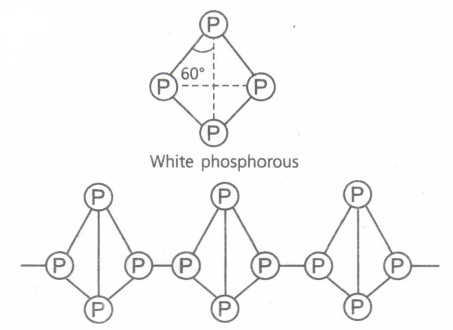
(a) White phosphorus exists as discrete (separate) tetrahedral molecules. Thus, it has tetrahedral structure with six P-P bonds. Red phosphorus has polymeric  structure in which molecules (tetrahedral) are linked through P-P bonds to form chain. Black phosphorus has two forms -black and -black phosphorus. It can be sublined in air and has opaque monoclinic or rhomohedral crystals; It does not oxidise in air. -black phosphorus does not burn in air up to 673 K. Black phosphorus is thermodynamically most stable.
Reactivity: White phosphorus is more reactive than red phosphorus because it is monomeric and has angular strain due to bond angles at 60°C. Black phosphorus is also less reactive.
9.
(i) SbH3 < AsH3 < PH3 < NH3 is increasing order of basic strength.
(ii) HF < HCl < HBr < HI is increasing order of acidic strength.
(iii) HClO < HClO2 < HClO4 is increasing order of oxidising power.
10.
(a) (i) It is because \({ NF }_{ 3 }\) is more stable than \({ NCI }_{ 3 }\)because \({ F }_{ 2 }\)is stronger oxidising agent than \({ CI }_{ 2 }\) .
(ii) It is due to low bond dissociation energy, high hydration energy, high electron affinity.
(b) \((i)\ C+{ 2H }_{ 2 }{ SO }_{ 4 }(conc.)\longrightarrow { CO }_{ 2 }+{ 2SO }_{ 2 }+2H_{ 2 }O\)
\(\\ (ii)\ { P }_{ 4 }+3NaOH+3H_{ 2 }O\longrightarrow { 3NaH }_{ 2 }{ PO }_{ 2 }+PH_{ 3 }\)
\(\\ (iii)\ { CI }_{ 2 }+3{ F }_{ 2 }\longrightarrow 2CIF_{ 3 }\)
11.
(a)\((i)\quad { 2I }^{ - }+{ O }_{ 3 }+{ H }_{ 2 }{ O }\longrightarrow { I }_{ 2 }+{ O }_{ 2 }+2{ OH }^{ - }\)
\(\\ (ii)\quad { P }_{ 4 }(s)+3NaOH(aq)+{ 3H }_{ 2 }{ O }(l)\longrightarrow { PH }_{ 3 }{ (g) }+{ 3NaH }_{ 2 }{ PO }_{ 2 }\)
(b)(i) It is because bond dissociation energy of H-Te bond is less than H-S bond due to longer bond length.
(ii) It is due to higher standard reduction potential, low bond dissociation energy, high electron affinity and higher enthalpy of hydration.
(iii) It is due to stable electronic configuration i.e., their octet is complete except in He which has duplet i.e., 1st shell is complete having 2 electrons.
12.
(a)
paramagnetic [Fe(H2O)5(NO)] SO4
13.
(c)
N2O3
14.
(b)
2HI + H2SO4 \(\rightarrow\) I2 + SO2 + 2H2O
15.
(b)
MI > MBr > MCl > MF Ionic character of metal halide
16.
(c)
+1
17.
(c)
Presence of One -OH group and two P-H bonds
18.
(b)
KHF2
19.
(b)
C
20.
(a)
N
21.
N does not have d-orbitals in the valence shell

12th Standard CBSE Syllabus & Materials
12th Standard CBSE
CBSE 12th Computer Science Python Revision Tour I - New Previous year Question Papers Study Material - QB365 Set A
NEW12th Standard CBSE
CBSE 12th Business Studies Planning Important Questions And Answers Study Material - QB365 Set A
NEW12th Standard CBSE
CBSE 12th Business Studies Business Environment Important Questions And Answers Study Material - QB365 Set A
NEW12th Standard CBSE
CBSE 12th Business Studies Principles of Management Important Questions And Answers Study Material - QB365 Set A



CBSE 12th Standard CBSE Subjects
CBSE Standards










