
 100% FREE ACCESS
12th Standard CBSE Syllabus & Materials
12th Standard CBSE
CBSE 12th Economics Government Budget and the Economy Previous year Question Papers Study Material - QB365 Set A
NEW12th Standard CBSE
CBSE 12th Computer Science Interface Python with MySQL - New Previous year Question Papers Study Material - QB365 Set A
NEW12th Standard CBSE
CBSE 12th Computer Science Database Concept - New Previous year Question Papers Study Material - QB365 Set A
NEW12th Standard CBSE
CBSE 12th Computer Science Data Communication - New Previous year Question Papers Study Material - QB365 Set A
NEW12th Standard CBSE
CBSE 12th Computer Science Data Structures - New Previous year Question Papers Study Material - QB365 Set A
NEW12th Standard CBSE
CBSE 12th Computer Science Functions - New Previous year Question Papers Study Material - QB365 Set A

Published on: 05/09/2019
The p-Block Elements
Download CBSE Class 12th Standard CBSE Chemistry question papers, sample papers, important questions, and previous year solved papers in PDF format. Get free study materials, NCERT solutions, and exam preparation resources for Class 12th Standard CBSE Chemistry
Questions + Answers key
Take MCQ Chemistry Test
1.
Complete the following chemical equation-\(H_{ g }C1_{ 2 }+PH_{ 3 }\longrightarrow \)
2.
Write the conditions to maximise the yield of sulphuric acid by Contact process.
3.
PH3 forms bubbles when passed slowly in water but NH3 dissolves. Explain why?
4.
In the preparation of H2SO4 by contact process, why is SO3 not absorbed directly in water to form H2SO4?
5.
PCl5 reacts with finely divided silver on heating and a white silver salt is obtained, which dissolves on adding excess aqueous NH3 solution. Write the reactions involved to explain what happens.
6.
Why is nitric oxide paramagnetic in gaseous state but the solid obtained on cooling it is diamagnetic?
7.
Assign reason for each of the following:
(a) Noble gases are mostly chemically inert.
(b) Bismuth is a strong oxidising agent in pentavalent state.
8.
Complete the following reaction equation:
(i) XeF4 + H2O \(\rightarrow\)
(ii) I2 + H2O + Cl2 \(\rightarrow\)
9.
What is the action of heat on
(i) Pyrophosphoric acid
(ii) Metaphosphoric acid
10.
An almorphous solid "A" burns in air to form a gas "B" Which turns lime water milky. The gas is also produced as a by-product during roasting of sulphide ore. This gas decolourises acidified aqueous KMnO4 solution and reduces Fe3+ to Fe2+. Identify the soild "A" and the gas "B" and write the reactions involved.
11.
On reaction with Cl2, phosphorus forms two types of halides 'A' and 'B'. Halide A is yellowish-white powder but halide 'B' is colourless oily liquid. Identify A and B and write the formulas of their hydrolysis products.
12.
Account for the following:
(i) NH3 acts as a good ligand.
(ii) H2S is more acidic than water.
13.
Account for the following:
(i) BiCl3 is less covalent than PCl3
(ii) O3 acts as a powerful oxidising agent.
(iii) F2 is a stronger oxidising agent than Cl2
14.
Elemental phosphorous does not exist as \(P_{ 2 }\) like \(N_{ 2 }\) .Why?
15.
On heating lead (II) nitrate gives a brown gas "A". The gas "A" on cooling changes to colourless solid "B". Solid "B" on heating with NO changes to a blue solid 'C'. Identify 'A', 'B' and 'C' and also write reactions involved and draw the structures of 'B' and 'C'.
16.
(a) Complete the following chemical equations:
(i) Cu + HNO3(dilute) \(\rightarrow\)
(ii) XeF4 + O2F2 \(\rightarrow\)
(b) Explain the following observations:
(i) Phosphorus has greater tendency for catenation than nitrogen.
(ii) Oxygen is a gas but sulphur a solid.
(iii) The halogens are coloured. Why?
17.
On heating, lead nitrate forms oxides of nitrogen and lead. The oxides formed are.......
N2O, PbO
NO2 ,PbO
NO, PbO
NO, PbO2
18.
In a cyclo tri metaphosphoric acid molecule, how many single and double bonds are present?
3 double bonds ; 9 single bonds
6 double bonds ; 6 single bonds
3 double bonds ; 12 single bonds
zero double bonds ; 12 single bonds
19.
Which one of the following arrangements represents the correct order of electron gain enthalpy (with negative sign) of the given atomic species?
F<Cl<O<S
S<O<Cl>F
O<S<F<Cl
Cl<F<S<O
20.
Which o the following is not hydrolysed?
AsCl3
PF3
SbCl3
NF3
21.
Oleum is formed when .......... is passed through conc. H2SO4
1.
()
\(3H_{ g }C1_{ 2 }+2PH_{ 3 }\longrightarrow H_{ g3 }P_{ 2 }+6HCI\)
2.
(i) High pressure (2 bar),
(ii) 720 K temperature,
(iii) V2O5 as catalyst.
3.
()
NH3 forms H -- bonds with water, therefore, it is soluble in water whereas PH3 cannot fprm H-- Bond, therefore, it escapes as a gas.
4.
()
Acid fog is formed which is difficult to condense.Secodly, the reaction is highly exothermic, beyond control.
5.
PCl5 + 2Ag \(\to\) 2AgCl + PCl3
AgCl + 2NH3 \(\to\) \(\underset {soluble\ complex} {[Ag(NH_3)_2]^+Cl^-}\)
\(\)
6.
Nitric oxide [NO] is monomeric and paramagnetic in nature in gaseous state due to presence of unpaired electron but it exists as dimer in solid state which is diamagnetic due to absence of unpaired electron.
7.
(a) It is due to stable electronic configuration.
(b) Bi3+ is more stable than Bi5+ gains 2 electrons to form Bi3+ and acts as oxidising agent.
Bi5+ + 2e- \(\rightarrow\) Bi3+
8.
(i) 6XeF4 + 12H2O \(\to\) 4Xe + 2XeO3 + 24 HF + 302
(ii) I2 + 6H2O + 5Cl2 \(\to\) 2HIO3 + 10HCl
9.
(i) Pyrophosphoric acid \(({ H }_{ 4 }{ P }_{ 2 }{ O }_{ 7 })\) on heating gives metaphosphoric acid.
\(({ H }_{ 4 }{ P }_{ 2 }{ O }_{ 7 })\overset { \triangle }{ \longrightarrow } { 2HPO }_{ 3 }+{ H }_{ 2 }O\)
metaphosphoric acid
(ii) Metaphosphoric acid \({ (HPO }_{ 3 })\) on heating gives phosphorous pentoxide.
\({ 2HPO }_{ 3 }\longrightarrow { P }_{ 2 }{ O }_{ 5 }+{ H }_{ 2 }O\)
10.
\('A'\quad is\quad { S }_{ 8 }.\quad 'B'is{ SO }_{ 2 }(g).\)
\({ S }_{ 8 }+{ 8O }_{ 2 }\overset { heat }{ \rightarrow } { 8SO }_{ 2 }(g)\)
'B' decolorizes \(KMnS{ O }_{ 4 }\)
\(2KMn{ O }_{ 4 }+5S{ O }_{ 2 }+{ 2H }_{ 2 }O\longrightarrow { 2H }_{ 2 }{ SO }_{ 4 }+2Mn{ SO }_{ 4 }+{ K }_{ 2 }{ SO }_{ 4 }\)
'B' turns lime water milky due to formation of
\(Ca{ (OH) }_{ 2 }(aq)+{ SO }_{ 2 }(g)\longrightarrow CaSO_{ 3 }(s)+{ H }_{ 2 }O(l)\)
'B' is obtained by roasting of sulphideores
\(2ZnS(s)+{ 3O }_{ 2 }\longrightarrow 2ZnO(s)+{ 2SO }_{ 2 }(g)\)
'B' reduces in aqueous solution.
\(2{ Fe }^{ 3+ }+{ SO }_{ 2 }+{ 2H }_{ 2 }O\longrightarrow { Fe }^{ 2+ }+{ SO }_{ 4 }^{ 2- }+{ 4H }^{ + }\)
11.
'A' is PCl5. (It is a yellowish-white solid).
'B' is PCl3 (It is a colourless oily liquid).
P4(s) + 10Cl2(g) \(\to\) 4PCl5(s)
P4(s) + 6Cl2 (g) \(\to\) 4PCI3(l)
PCl5, on hydrolysis gives H3PO4, whereas
PCl3, on hydrolysis gives H3PO3.
PCl5 + 4H2O \(\to\) H3PO4 + 5HCl
PCl3 + 3H2O \(\to\) H3PO3 + 3HCl
12.
(i) NH3 acts as good ligand due to presence of lone pair of electron which it can readily donate.
(ii) H2S has H-S bond weaker than H-O bond in H2O, due to longer bond length and low bond dissociation energy, therefore, H2S is more acidic than H2O.
(iii) It is because fluorine is most electronegative and strongest oxidising agent.
13.
(i) It is because ionisation enthalpy of Bi is lower than phosphorus, therefore, Bi forms ionic BiCl3; whereas PCl3 is covalent.
(ii) It is because O3 is highly unstable and gives out [O] due to which it is powerful oxidising agent.
(iii) It is because F2 has highest standard reduction potential, higher than Cl2.
14.
Nitrogen has a strong tendency to form multiple bonds because of its small size and high electronegativity. Therefore, it exists as a diatomic molecule, \(N\equiv N\) . On the other' hand, phosphorus because of its large size and small electronegativity does not show any tendency to form multiple bonds and therefore, 'diatomic molecule like \(N\equiv N\) is not formed. Instead, it prefers to form stable tetraatomic, \({ P }_{ 4 }\) molecules in which each P is linked to three other P atoms by three single covalent bonds. The four atoms in \({ P }_{ 4 }\) molecule lie at the corners of a regular tetrahedron.
15.
\(2Pb{ { { { (NO }_{ 3 }) } } }_{ 2 }\xrightarrow { heat } 2PbO(s)+{ NO }_{ 2 }+{ O }_{ 2 }\)
Brown (A)
\({ 2NO }_{ 2 }(g)\overset { cooling }{ \rightleftharpoons } { N }_{ 2 }{ O }_{ 4 }(s)\)
(B) Colourless
\({ N }_{ 2 }{ O }_{ 4 }+2NO\overset { heat }{ \underset { 250k }{ \rightleftharpoons } } { 2N }_{ 2 }{ O }_{ 3 }(s)\)
(C) Blue solid
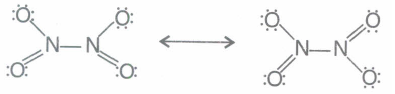
Resonating Structures of \({ N }_{ 2 }{ O }_{ 4 }\)
16.
(a) (i) \(3Cu+{ 8HNO }_{ 3 }(dil.)\longrightarrow { { 3 }Cu(NO_{ 3 }) }_{ 2 }+2NO+{ 4H }_{ 2 }O\)
(ii) \({ XeF }_{ 4 }+{ O }_{ 2 }{ F }_{ 2 }\overset { { -130°C } }{ \longrightarrow } { XeF }_{ 6 }+{ O }_{ 2 }\)
(b) (i) The property of catenation depends upon the strength of the element-element bond. Since P-P bond strength (213 kJ \({ mol }^{ -1 }\) ) is much more than N-N bond strength (159 kJ \({ mol }^{ -1 }\)), phosphorus has marked catenation properties than nitrogen.
(ii) Due to small size and high electronegativity, oxygen atom forms \(p\pi -p\pi \) double bond, 0= 0. The intermolecular forces in oxygen are weak van der Waal's forces and therefore, oxygen exists as a gas. On the other hand, sulphur does not form stable \(p\pi -p\pi \) bonds and do not exists as \({ S }_{2}\) It is linked by single bonds and form polyatomic complex molecules having eight atoms per molecule \({ S }_{ 8 }\) and have puckered ring structure. Therefore, S atoms are strongly held together and it exists as a solid.
(iii) All the halogens are coloured. This is due to absorption of radiations in the visible region which results in the excitation of outer electrons to higher energy levels. By absorbing different quanta of radiations, they display different colours. The fluorine atom is the smallest and the force of attraction between the nucleus and the outer electrons is very large. As a result, it requires large excitation energy and absorbs violet light (high energy) and therefore, appears pale yellow. On the other hand, iodine needs very less excitation energy and absorbs yellow light of low energy. Thus, it appears dark violet. Similarly, we can explain the greenish yellow colour of chlorine and reddish brown colour of iodine.
17.
(b)
NO2 ,PbO
18.
(a)
3 double bonds ; 9 single bonds
19.
(c)
O<S<F<Cl
20.
Neither N nor F have d-orbits to accept electrons donated by H2O for hydrolysis.
21.
()
SO3

12th Standard CBSE Syllabus & Materials
12th Standard CBSE
CBSE 12th Computer Science Python Revision Tour I - New Previous year Question Papers Study Material - QB365 Set A
NEW12th Standard CBSE
CBSE 12th Business Studies Planning Important Questions And Answers Study Material - QB365 Set A
NEW12th Standard CBSE
CBSE 12th Business Studies Business Environment Important Questions And Answers Study Material - QB365 Set A
NEW12th Standard CBSE
CBSE 12th Business Studies Principles of Management Important Questions And Answers Study Material - QB365 Set A



CBSE 12th Standard CBSE Subjects
CBSE Standards










