
 100% FREE ACCESS
12th Standard CBSE Syllabus & Materials
12th Standard CBSE
CBSE 12th Economics Government Budget and the Economy Previous year Question Papers Study Material - QB365 Set A
NEW12th Standard CBSE
CBSE 12th Computer Science Interface Python with MySQL - New Previous year Question Papers Study Material - QB365 Set A
NEW12th Standard CBSE
CBSE 12th Computer Science Database Concept - New Previous year Question Papers Study Material - QB365 Set A
NEW12th Standard CBSE
CBSE 12th Computer Science Data Communication - New Previous year Question Papers Study Material - QB365 Set A
NEW12th Standard CBSE
CBSE 12th Computer Science Data Structures - New Previous year Question Papers Study Material - QB365 Set A
NEW12th Standard CBSE
CBSE 12th Computer Science Functions - New Previous year Question Papers Study Material - QB365 Set A

Published on: 23/09/2019
Application of Integrals
Download CBSE Class 12th Standard CBSE Maths question papers, sample papers, important questions, and previous year solved papers in PDF format. Get free study materials, NCERT solutions, and exam preparation resources for Class 12th Standard CBSE Maths
Questions + Answers key
Take MCQ Maths Test
1.
Find the area of the region given by:
\(\left\{ \left( x,y \right) :{ x }^{ 2 }\le y\le \left| x \right| \right\} \)
2.
Calculate the area enclosed in the region:
\(\left\{ \left( x,y \right) :{ x }^{ 2 }+{ y }^{ 2 }\le 1
3.
Draw the rough sketch and find the area of the region:
\(\left\{ \left( x,y \right) :{ 4x }^{ 2 }+{ y }^{ 2 }\le 4,2x+\ge 2 \right\} \)
4.
Find the area included between the curves y2 = 4ax and x2 = 4ay, a > 0.
5.
Using the method of integration, find the area of the region bounded by the lines:
3x - 2y + 1 = 0, 2x + 3y - 21 = 0 and x - 5y + 9 = 0
6.
Find the area between the curve \(\frac { { x }^{ 2 } }{ { a }^{ 2 } } +\frac { { y }^{ 2 } }{ { b }^{ 2 } } =1\) and the x - axis between x = 0 and x = a. Draw a rough sketch of the curve also.
7.
Find the area of the region bounded by:
y2 = 4x, x = 1, x = 4 and x - axis in the first quadrant.
8.
Find the area of the region bounded by the curve ay2 = x3 , the y - axis and the lines y = a and y = 2a.
9.
Find the area bounded by the curves:
\(\left\{ \left( x,y \right) :y\ge { x }^{ 2 }andy=\left| x \right| \right\} \)
10.
Find the area under the given curves and given lines :
(i) y = x2, x = 1, x = 2 and x - axis
(ii) y = x4, x = 1, x = 5 and x - axis.
11.
Find the area bounded by the curve x2 = 4y and the line x = 4y - 2.
12.
Find the area of the region bounded by the parabola y = x2 and \(y=\left| x \right| \)
13.
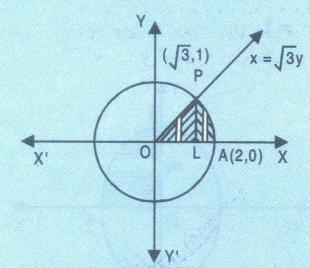
Find the area of the region in the first quadrant enclosed by x - axis and \(x=\sqrt { 3 } y\) by the circle \({ x }^{ 2 }+{ y }^{ 2 }=4\).
14.
Find the area of the region bounded by x2 - 4y, y = 2, y = 4 and the y - axis in the first quadrant.
1.
Let us first sketch the region whose area is to be found out. The required area is the area included between the curves:
x 2 = y and y = IxI.
The graph of x2 = y is a parabola with vertex (0,0) and axis as y - axis.
The graph of y - IxI is the union of lines y = x, x \(\ge \) 0 and y = x, x < 0.
Solving x2 = y and y = x, we get the points of intersection as O (0,0) and A (1,1).
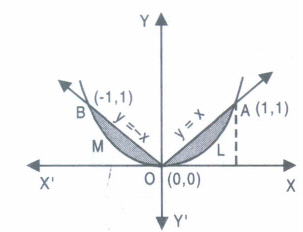
Solving, x2 = y and y = -x, we get the points of intersection as O (0,0) and B (-1,1).
Therefore, Required area = area OAL + area OBM = 2 area OAL
\(=2\left[ \overset { 1 }{ \underset { 0 }{ \int { } } } xdx-\overset { 1 }{ \underset { 0 }{ \int { } } } { x }^{ 2 }dx \right] =2\left[ \left| \frac { { x }^{ 2 } }{ 2 } \right| _{ 0 }^{ 1 }-\left| \frac { { x }^{ 3 } }{ 3 } \right| _{ 0 }^{ 1 } \right] \)
\(=2\left[ \left( \frac { 1 }{ 2 } -0 \right) -\left( \frac { 1 }{ 3 } -0 \right) \right] =2\left[ \frac { 1 }{ 2 } -\frac { 1 }{ 3 } \right] \)
\(=2\left( \frac { 1 }{ 6 } \right) =\frac { 1 }{ 3 } sq.units\)
2.
Let us first sketch the region whose area is to be found out. The required area is the area included between the curves:
x2 + y2 = 1 and x + y = 1
x2 + y2 = 1 is a circle having centre at (0, 0) and radius 1 unit.
x + y = 1 is a st. line passing through the points (1, 0) and (0, 1).
Required area is shown shaded as in the sd joining figure.
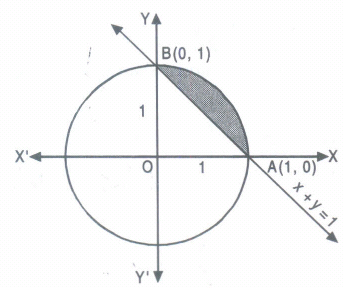
Therefore, Reqd. area = \(\overset { 1 }{ \underset { 0 }{ \int { } } } \sqrt { { 1-x }^{ 2 } } dx-\overset { 1 }{ \underset { 0 }{ \int { } } } (1-x)dx\)
\(=\left[ \frac { x\sqrt { { 1-x }^{ 2 } } }{ 2 } +\frac { 1 }{ 2 } { sin }^{ -1 }x \right] _{ 0 }^{ 1 }-\left[ x-\frac { 1 }{ 2 } { x }^{ 2 } \right] _{ 0 }^{ 1 }.\)
\(=\left[ \left( 0+\frac { 1 }{ 2 } \left( \frac { \pi }{ 2 } \right) \right) -\left( 0+0 \right) \right] -\left[ \left( 1-\frac { 1 }{ 2 } \right) -\left( 0-0 \right) \right] \)
\(=\left( \frac { \pi }{ 4 } -\frac { 1 }{ 2 } \right) sq.units\)
3.
We have : 4x 2 + y2 \(\le \) 4 and 2x + y \(\ge \) 2
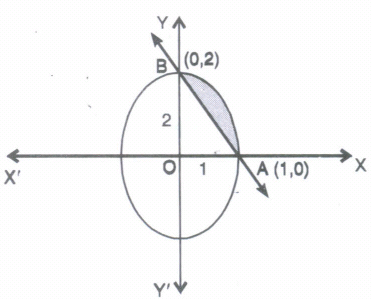
Draw the ellipse \(\frac { { x }^{ 2 } }{ 1 } +\frac { { y }^{ 2 } }{ 4 } =1\), which is an upward ellipse and the line \(\frac { x }{ 1 } +\frac { y }{ 2 } =1\).
The reqd.region is shown shaded in the figure.
Therefore, Reqd.area = \(\overset { 1 }{ \underset { 0 }{ \int { } } } \sqrt { { 4-4x }^{ 2 } } dx-\overset { 1 }{ \underset { 0 }{ \int { } } } (2-2x)dx\)
\(=2\overset { 1 }{ \underset { 0 }{ \int { } } } \sqrt { { 1-x }^{ 2 } } dx-2\overset { 1 }{ \underset { 0 }{ \int { } } } (1-x)dx\)
\(=2\left[ \left\{ \frac { x\sqrt { { 1-x }^{ 2 } } }{ 2 } +\frac { 1 }{ 2 } { sin }^{ -1 }\frac { x }{ 1 } \right\} _{ 0 }^{ 1 }-\left\{ x-\frac { { x }^{ 2 } }{ 2 } \right\} _{ 0 }^{ 1 } \right] \)
\(=\left[ x\sqrt { 1-{ x }^{ 2 } } +{ sin }^{ -1 }x \right] ^{ 1 }_{ 0 }-\left[ x-\frac { { x }^{ 2 } }{ 2 } \right] _{ 0 }^{ 1 }\)
\(=\left[ \left( 0+{ sin }^{ -1 }1 \right) -\left( 0+0 \right) \right] -\left[ \left( 1-\frac { 1 }{ 2 } \right) -(0-0) \right] \)
\(=\frac { \pi }{ 2 } -\frac { 1 }{ 2 } =\frac { 1 }{ 2 } (\pi -1)sq.units\)
4.
The given curves viz. parabolas are :
y2 = 4ax and x2 = 4ay
These two intersects at O (0,0) and B (4a,4a). [Solve!]
Therefore, Reqd.area = Shaded area OABCO
= area OABL - area OCBL
= (area under parabola y2 = 4ax) - (area under parabola x2 = 4ay)
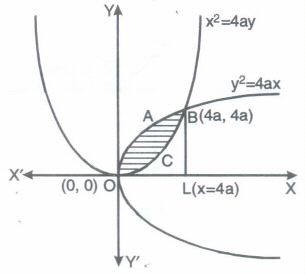
\(=\overset { 4a }{ \underset { 0 }{ \int { } } } \sqrt { 4ax } dx-\overset { 4a }{ \underset { 0 }{ \int { } } } \frac { { x }^{ 2 } }{ 4a } dx\)
\(=2\sqrt { a } \overset { 4a }{ \underset { 0 }{ \int { } } } { x }^{ 1/2 }dx-\frac { 1 }{ 4a } \overset { 4a }{ \underset { 0 }{ \int { } } } { x }^{ 2 }dx\)
\(=2\sqrt { a } \left[ \frac { { x }^{ 3/2 } }{ 3/2 } \right] _{ 0 }^{ 4a }-\frac { 1 }{ 4a } \left[ \frac { { x }^{ 3 } }{ 3 } \right] _{ 0 }^{ 4a }\)
\(=\frac { 4\sqrt { a } }{ 3 } \left[ { (4a) }^{ 3/2 }-0 \right] -\frac { 1 }{ 2a } \left[ { 64a }^{ 3 }-0 \right] \)
\(=\frac { 32 }{ 3 } { a }^{ 2 }-\frac { 16 }{ 3 } { a }^{ 2 }=\frac { { 16a }^{ 2 } }{ 3 } sq.units.\)
5.
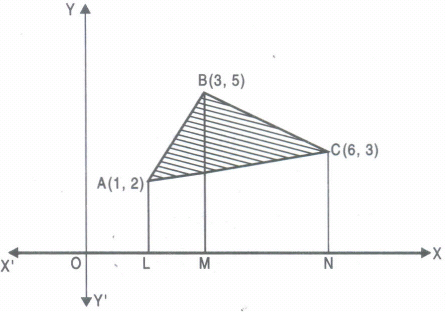
Let the sides AB, BC and CA of \(\Delta \)ABC be:
3x - 2y + 1 = 0
2x + 3y - 21 = 0 and
x - 5y + 9 = 0
Solving (3) and (1), we get A as (1,2).
Solving (1) and (2), we get B as (3,5)
Solving (2) and (3), we get C as (6,3).
Now ar (\(\Delta \)ABC) = ar (ALMB) + ar (BMNC) - ar (ALNC)
\(=\overset { 3 }{ \underset { 1 }{ \int { } } } \frac { 3x+1 }{ 2 } dx+\overset { 6 }{ \underset { 3 }{ \int { } } } \frac { 21-2x }{ 3 } dx-\overset { 6 }{ \underset { 1 }{ \int { } } } \frac { x+9 }{ 5 } dx\)
\(=\frac { 1 }{ 2 } \left[ \frac { 3 }{ 2 } { x }^{ 2 }+x \right] _{ 1 }^{ 3 }+\frac { 1 }{ 3 } \left[ 21x-{ x }^{ 2 } \right] _{ 3 }^{ 6 }-\frac { 1 }{ 5 } \left[ \frac { { x }^{ 2 } }{ 2 } +9x \right] _{ 1 }^{ 6 }\)
\(=\frac { 1 }{ 2 } \left[ \left( \frac { 27 }{ 2 } +3 \right) -\left( \frac { 3 }{ 2 } +1 \right) \right] +\frac { 1 }{ 3 } \left[ \left( 126-36 \right) -\left( 63-9 \right) \right] -\frac { 1 }{ 5 } \left[ \left( 18+54 \right) -\left( \frac { 1 }{ 2 } +9 \right) \right] \)
\(=\frac { 1 }{ 2 } \left[ 12+2 \right] +\frac { 1 }{ 3 } \left[ 90-54 \right] -\frac { 1 }{ 5 } \left[ 72-\frac { 19 }{ 2 } \right] \)
\(=7+12-\frac { 125 }{ 10 } =19-\frac { 125 }{ 10 } =\frac { 190-125 }{ 10 } \)
\(=\frac { 65 }{ 10 } =\frac { 13 }{ 2 } =6.5\quad sq.units.\)
6.
The given ellipse is \(\frac { { x }^{ 2 } }{ { a }^{ 2 } } +\frac { { y }^{ 2 } }{ { b }^{ 2 } } =1\)
The ellipse is symmetrical about x - axis.
[because On changing y to -y, (1) remains unchanged]
The ellipse is symmetrical about y - axis.
[because On changing x to -x, (1) remains unchanged]
Thus area of the ellipse = (Shaded area) = (area OAB)
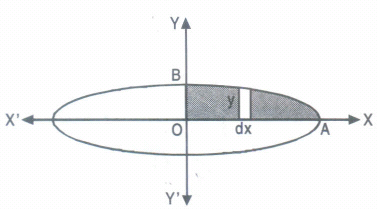
\(=\overset { a }{ \underset { 0 }{ \int { } } } ydx\)
[Taking vertical strips]
\(=\overset { a }{ \underset { 0 }{ \int { } } } \frac { b }{ a } \sqrt { { a }^{ 2 }-{ x }^{ 2 } } dx\)
\(=\left[ \because \frac { { x }^{ 2 } }{ { a }^{ 2 } } +\frac { { y }^{ 2 } }{ { b }^{ 2 } } =1\Rightarrow \frac { { y }^{ 2 } }{ { b }^{ 2 } } =1-\frac { { x }^{ 2 } }{ { a }^{ 2 } } \\
\Rightarrow { y }^{ 2 }=\frac { { b }^{ 2 } }{ { a }^{ 2 } } ({ a }^{ 2 }-{ x }^{ 2 })\Rightarrow y=\frac { b }{ a } \sqrt { { a }^{ 2 }-{ x }^{ 2 } } (\because y>0) \right] \)
\(=\frac { b }{ a } \overset { a }{ \underset { 0 }{ \int { } } } \sqrt { { a }^{ 2 }-{ x }^{ 2 } } dx=\frac { b }{ a } \left[ \frac { \sqrt { { a }^{ 2 }-{ x }^{ 2 } } }{ 2 } +\frac { { a }^{ 2 } }{ 2 } { sin }^{ -1 }\frac { x }{ a } \right] _{ 0 }^{ a }\)
\(=\frac { b }{ a } \left[ \left\{ \frac { a }{ 2 } (0)+\frac { { a }^{ 2 } }{ 2 } { sin }^{ -1 }(1) \right\} -\left\{ 0+0 \right\} \right] =\frac { b }{ a } \left[ \frac { { a }^{ 2 } }{ 2 } .\frac { \pi }{ 2 } \right] =\frac { \pi ab }{ 4 } \)
7.
y2 = 4x is right - handed parabola.
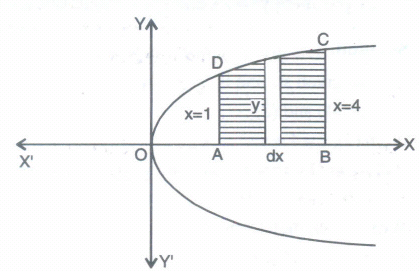
Therefore, Required area, ABCD = \(\overset { 4 }{ \underset { 1 }{ \int { } } } ydx\) [Taking vertical strips]
\(\overset { 4 }{ \underset { 1 }{ \int { } } } 2\sqrt { x } dx\\ \)
[\({ y }^{ 2 }=4x\Rightarrow y=\pm 2\sqrt { x } .\) But region ABCD lies in 1st quadrant, Therefore y is +ve]
\(=2\overset { 4 }{ \underset { 1 }{ \int { } } } { x }^{ 1/2 }dx=2\left[ \frac { { x }^{ 3/2 } }{ 3/2 } \right] _{ 1 }^{ 4 }=\frac { 4 }{ 3 } [{ 4 }^{ 3/2 }-1]\)
\(=\frac { 4 }{ 3 } [8-1]=\frac { 28 }{ 3 } =9\frac { 1 }{ 3 } sq.units.\)
8.
The given curve is ay2 = x3
The region is shown as shaded in the figure:
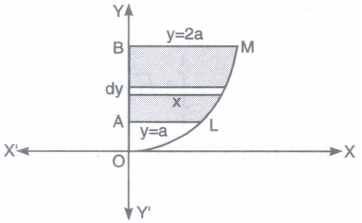
Therefore, Required area, ALMB
\(=\overset { 2a }{ \underset { a }{ \int { } } } xdy=\overset { 2a }{ \underset { a }{ \int { } } } { a }^{ 1/3 }{ y }^{ 2/3 }dy\)
\(={ a }^{ 1/3 }\left[ \frac { { y }^{ 5/3 } }{ 5/3 } \right] _{ a }^{ 2a }=\frac { 3 }{ 5 } { a }^{ 1/3 }\left[ { (2a) }^{ 5/3 }-{ a }^{ 5/3 } \right] \)
\(=\frac { 3 }{ 5 } { a }^{ 1/3 }{ a }^{ 5/3 }\left[ { 2.2 }^{ 2/3 }-1 \right] =\frac { 3 }{ 5 } { a }^{ 2 }({ 2.2 }^{ 2/3 }-1)sq.units\)
9.
Let us first sketch the region whose area is to be found out. The required area is the area included between the curves x2 = y and y = IxI.
The graph of x2 = y is parabola with vertex (0,0) and axis as y - axis.
The graph of y = I x I is the union of lines y = x, x \(\ge \) 0 and y = -x, x < 0.
Solving x2 = y and y = x, we get the points of intersection as:
O (0,0) and A (1,1).
Solving, x2 = y and y = -x, we get the points of intersection as O (0,0) and B (-1,1).
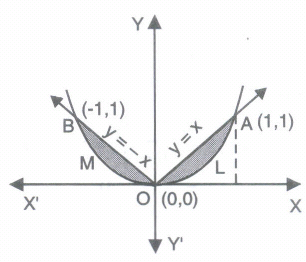
Therefore, Required area = area OAL + area OBM= 2 area OAL
\(=\left[ \overset { 1 }{ \underset { 0 }{ \int { } } } xdx-\overset { 1 }{ \underset { 0 }{ \int { } } } { x }^{ 2 }dx \right] \)
\(=\left[ \left| \frac { { x }^{ 2 } }{ 2 } \right| _{ 0 }^{ 1 }-\left| \frac { { x }^{ 3 } }{ 3 } \right| _{ 0 }^{ 1 } \right] \)
\(=2\left[ \left( \frac { 1 }{ 2 } -0 \right) -\left( \frac { 1 }{ 3 } -0 \right) \right] =2\left[ \frac { 1 }{ 2 } -\frac { 1 }{ 3 } \right] \)
\(=2\left( \frac { 1 }{ 6 } \right) =\frac { 1 }{ 3 } sq.unit.\)
10.
(i) Required area = \(\overset { 2 }{ \underset { 1 }{ \int { } } } ydx\) [Taking vertical strips]
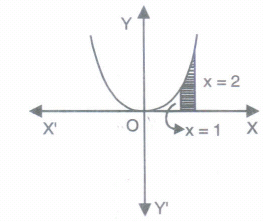
\(=\overset { 2 }{ \underset { 1 }{ \int { } } } { x }^{ 2 }dx=\left[ \frac { { x }^{ 3 } }{ 3 } \right] _{ 1 }^{ 2 }\)
\(=\frac { 8 }{ 3 } -\frac { 1 }{ 3 } =\frac { 7 }{ 3 } sq.units.\)
(ii) Required. area
\(=\overset { 5 }{ \underset { 1 }{ \int { } } } ydx=\overset { 5 }{ \underset { 1 }{ \int { } } } { x }^{ 4 }dx\)
\(=\left[ \frac { { x }^{ 5 } }{ 5 } \right] _{ 1 }^{ 5 }=\frac { { 5 }^{ 5 } }{ 5 } -\frac { 1 }{ 5 } =625-\frac { 1 }{ 5 } \)
\(=\frac { 3125-1 }{ 5 } =\frac { 3124 }{ 5 } \)
\(=624.8sq.units\)
11.
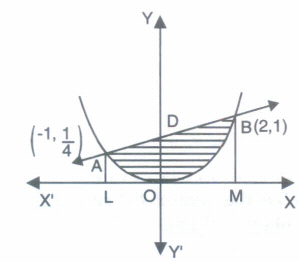
The given curve is x2 = 4y
which is an upward parabola with vertex (0,0).
The given line is x = 4y - 2
Solving (1) and (2):
\( { (4y-2) }^{ 2 }=4y\)
\(\Rightarrow { 16y }^{ 2 }-16y+4=4y\)
\(\Rightarrow { 16y }^{ 2 }-20y+4=0\Rightarrow { 4y }^{ 2 }-5y+1=0\)
\(\Rightarrow (4y-1)(y-1)=0\Rightarrow y=\frac { 1 }{ 4 } ,1\)
\(When \ y=\frac { 1 }{ 4 } ,thenx=4\left( \frac { 1 }{ 4 } \right) -2\)
\(=1-2=-1\)
\(When \ y=1,thenx=4(1)-2=4-2=2\)
\(Thus(2)meets(1)at\)
\(A\left( -1,\frac { 1 }{ 4 } \right) andB(2,1).\)
\(\therefore Reqd.area=ar(ALOMBDA)-ar(LMBOAL)\)
\(=\overset { 2 }{ \underset { -1 }{ \int { } } } \frac { x+2 }{ 4 } dx-\overset { 2 }{ \underset { -1 }{ \int { } } } \frac { { x }^{ 2 } }{ 4 } dx\)
\(=\frac { 1 }{ 4 } \left[ \frac { { x }^{ 2 } }{ 2 } +2x \right] ^{ 2 }_{ -1 }-\frac { 1 }{ 4 } \left[ \frac { { x }^{ 3 } }{ 3 } \right] _{ -1 }^{ 2 }\)
\(=\frac { 1 }{ 4 } \left[ \left( 2+4 \right) -\left( \frac { 1 }{ 2 } -2 \right) \right] -\frac { 1 }{ 12 } \left[ 8-\left( -1 \right) \right] \)
\(=\frac { 1 }{ 4 } \left[ 6+\frac { 3 }{ 2 } \right] -\frac { 1 }{ 12 } [9]=\frac { 15 }{ 8 } -\frac { 3 }{ 4 } \)
\(=\frac { 15-6 }{ 8 } =\frac { 9 }{ 8 } sq.units.\)
12.
The given parabola is x2 = y
This is an upward parabola with vertex (0, 0)
y = IxI represents the st. lines:
y = x and y = -x
y = x meets (1) at O (0, 0) and A (1, 1)
y = -x meets (1) at O (0, 0) and A (-1, 1)
Therefore, Required area = 2 (Shaded area in first quadrant)
\(=2\left( \overset { 1 }{ \underset { 0 }{ \int { } } } xdx-\overset { 1 }{ \underset { 0 }{ \int { } } } { x }^{ 2 }dx \right) \)
\(=2\left( \left[ \frac { { x }^{ 2 } }{ 2 } \right] _{ 0 }^{ 1 }-\left[ \frac { { x }^{ 3 } }{ 3 } \right] _{ 0 }^{ 1 } \right) \)
\(=2\left( \left( \frac { 1 }{ 2 } -0 \right) -\left( \frac { 1 }{ 3 } -0 \right) \right) =2\left( \frac { 1 }{ 2 } -\frac { 1 }{ 3 } \right) \)
\(=2\left( \frac { 1 }{ 6 } \right) =\frac { 1 }{ 3 } sq.unit.\)
13.
The given line is \(x=\sqrt { 3 } y\) and the given circle is x2 + y2 = 4
From (1) \(y=\frac { x }{ \sqrt { 3 } } \)
Putting in (2), \({ x }^{ 2 }+\frac { { x }^{ 2 } }{ 3 } =4\Rightarrow \frac { { 4x }^{ 2 } }{ 3 } =4\Rightarrow { x }^{ 2 }=3\Rightarrow x=\pm \sqrt { 3 } \)
When \(x=\pm \sqrt { 3 } ,y=\pm 1\)
Thus P is \((\sqrt { 3 } ,1)\)
Now Reqd, area = ar (OPL) + ar (PLA)
\(\overset { \sqrt { 3 } }{ \underset { 0 }{ \int { } } } \frac { x }{ \sqrt { 3 } } dx+\overset { 2 }{ \underset { \sqrt { 3 } }{ \int { } } } \sqrt { 4-{ x }^{ 2 } } dx\ [Taking\ vertical\ strips]\)
\(=\frac { 1 }{ \sqrt { 3 } } \overset { \sqrt { 3 } }{ \underset { 0 }{ \int { } } } xdx+\overset { 2 }{ \underset { \sqrt { 3 } }{ \int { } } } \sqrt { { 2 }^{ 2 }-{ x }^{ 2 } } dx\)
\(=\frac { 1 }{ \sqrt { 3 } } \left[ \frac { { x }^{ 2 } }{ 2 } \right] _{ 0 }^{ \sqrt { 3 } }+\left[ \frac { x\sqrt { 4-{ x }^{ 2 } } }{ 2 } +\frac { 4 }{ 2 } { sin }^{ -1 }\frac { x }{ 2 } \right] _{ \sqrt { 3 } }^{ 2 }\)
\(=\frac { 1 }{ 2\sqrt { 3 } } [3-0]+\left[ \left\{ { 0+2sin }^{ -1 }(1) \right\} -\left\{ \frac { \sqrt { 3 } (1) }{ 2 } +2{ sin }^{ -1 }\frac { \sqrt { 3 } }{ 2 } \right\} \right] \)
\(=\frac { \sqrt { 3 } }{ 2 } +2\left( \frac { \pi }{ 2 } \right) -\frac { \sqrt { 3 } }{ 2 } -2\left( \frac { \pi }{ 3 } \right) \)
\(=\pi -\frac { 2\pi }{ 3 } =\frac { \pi }{ 3 } sq.units\)
14.
The area of the region bounded by the curve, x2 = 4y, y = 2, and y = 4, and the y-axis is the area ABCD.
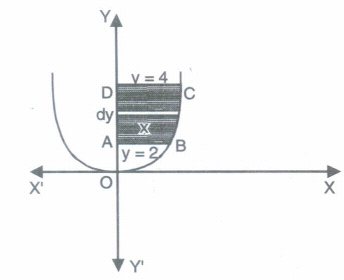
\(\text { Area of } \mathrm{ABCD} =\int_{2}^{4} x d y \)
\(=\int_{2}^{4} 2 \sqrt{y} d y \)
\(=2 \int_{2}^{4} \sqrt{y} d y \)
\(=2\left[\frac{y^{\frac{3}{2}}}{3}\right.\)
\(=\left(\frac{4}{2}\right]_{2}^{4} \)
\(=\frac{4}{3}\left[(4)^{\frac{3}{2}}-(2)^{\frac{3}{2}}\right] \)
\(=\frac{4}{3}[8-2 \sqrt{2}] \)
\(=\left(\frac{32-8 \sqrt{2}}{3}\right) \text { units } \)

12th Standard CBSE Syllabus & Materials
12th Standard CBSE
CBSE 12th Computer Science Python Revision Tour I - New Previous year Question Papers Study Material - QB365 Set A
NEW12th Standard CBSE
CBSE 12th Business Studies Planning Important Questions And Answers Study Material - QB365 Set A
NEW12th Standard CBSE
CBSE 12th Business Studies Business Environment Important Questions And Answers Study Material - QB365 Set A
NEW12th Standard CBSE
CBSE 12th Business Studies Principles of Management Important Questions And Answers Study Material - QB365 Set A



CBSE 12th Standard CBSE Subjects
CBSE Standards










