
 100% FREE ACCESS
12th Standard CBSE Syllabus & Materials
12th Standard CBSE
CBSE 12th Economics Government Budget and the Economy Previous year Question Papers Study Material - QB365 Set A
NEW12th Standard CBSE
CBSE 12th Computer Science Interface Python with MySQL - New Previous year Question Papers Study Material - QB365 Set A
NEW12th Standard CBSE
CBSE 12th Computer Science Database Concept - New Previous year Question Papers Study Material - QB365 Set A
NEW12th Standard CBSE
CBSE 12th Computer Science Data Communication - New Previous year Question Papers Study Material - QB365 Set A
NEW12th Standard CBSE
CBSE 12th Computer Science Data Structures - New Previous year Question Papers Study Material - QB365 Set A
NEW12th Standard CBSE
CBSE 12th Computer Science Functions - New Previous year Question Papers Study Material - QB365 Set A

Published on: 15/02/2020
12th Standard CBSE Mathematics Board Exam Model Question Paper III 2020
Download CBSE Class 12th Standard CBSE Maths question papers, sample papers, important questions, and previous year solved papers in PDF format. Get free study materials, NCERT solutions, and exam preparation resources for Class 12th Standard CBSE Maths
Questions + Answers key
Take MCQ Maths Test
1.
If ey (x+1) = 1, show that dy/dx = -ey
2.
If y = log(sin x), find \(\frac { { d }^{ 2 }y }{ d{ x }^{ 2 } } \)
3.
Write the statement of Rolle's theorem.
4.
Let f and g be real function be \(f(x)=\sqrt { x+4 } ,x\ge 4\) find the function fg, \(\frac { f }{ g } \)
5.
Write in the simplest form : \(sin\left[ 2{ tan }^{ -1 }\sqrt { \frac { 1-x }{ 1+x } } \right] \)
6.
Prove that : \({ sin }^{ -1 }x+{ cos }^{ -1 }x=\frac { \pi }{ 2 } ;if\in x[-1,\quad 1]\)
7.
\(f(x)=x^{ 2 },x\in R\) Find \(\frac { f(1.1)-f(1) }{ 1.1-1 } \)
8.
Prove that the diagonal elements of a skew symmetric matrix are all zero.
9.
Find the value of X and Y if
\(X+Y=\left[ \begin{matrix} 2 & 3 \\ 5 & 1 \end{matrix} \right] ,X-Y=\left[ \begin{matrix} 6 & 5 \\ 7 & 3 \end{matrix} \right] \)
10.
If \(A=\left| \begin{matrix} 6 & 0 & 1 \\ 0 & 1 & 2 \\ 0 & 0 & 4 \end{matrix} \right| \), then show that |2A| = 8|A|:
11.
If \(A=\left| \begin{matrix} 2 & 3 & -1 \\ 4 & 1 & 0 \\ 3 & 3 & 2 \end{matrix} \right| \) , find \(M_{ 12 }\times M_{ 21 }+C_{ 21 }\times C_{ 12 }\) when Mjj called minor and Cjj called co-factors of A.
12.
Write the principal value of \({ tan }^{ -1 }\left( tan\frac { 7\pi }{ 6 } \right) \)
13.
Find the value of a if
\(\left[ \begin{matrix} a-b & 2a+c \\ 2a-b & 3c+d \end{matrix} \right] =\left[ \begin{matrix} -1 & 5 \\ 0 & 13 \end{matrix} \right] \)
14.
Write A-1 for A =\(\begin{bmatrix} 2 & 5 \\ 1 & 3 \end{bmatrix}\)
15.
* is a binary operation defined on the set of natural numbers N, defined by a*b = ab Find
(i) 2*3
(ii) 3*2
16.
If \(A=\left[ \begin{matrix} 1 & 1 & 1 \\ 1 & 1 & 1 \\ 1 & 1 & 1 \end{matrix} \right] \) Prove that , A =\(\left[ \begin{matrix} { 3 }^{ x-1 } & { 3 }^{ x-1 } & { 3 }^{ x-1 } \\ { 3 }^{ x-1 } & { 3 }^{ x-1 } & { 3 }^{ x-1 } \\ { 3 }^{ x-1 } & { 3 }^{ x-1 } & { 3 }^{ x-1 } \end{matrix} \right] \) for every positive integer n.
17.
Solve tan-1 2x + tan-13x = \(\frac { \pi }{ 4 } \)
18.
If A = \(\left[ \begin{matrix} 1 & -1 & 0 \\ 2 & 3 & 4 \\ 0 & 1 & 2 \end{matrix} \right] \) and B = \(\left[ \begin{matrix} 2 & 2 & -4 \\ -4 & 2 & -4 \\ 2 & -1 & 5 \end{matrix} \right] \) are square matrices, find A, B and hence solve the system of equation:
x - y = 3, 2x + 3y + 4z = 17 and y + 2z = 7
19.
Examine the differentiability of the function f(x)=\(\begin{cases} x\left[ x \right] \quad \ \ \ \ \ ,\quad if\quad 0\le x< \\ \left( x-1 \right) x \ \ , \quad if\quad 2\le x<3 \end{cases}\quad \)at x=2
20.
By using elementary transformations, find the inverse of the matrix
\(\left[ \begin{matrix} 0 & 1 & 2 \\ 1 & 2 & 3 \\ 3 & 1 & 1 \end{matrix} \right] \)
21.
Using matrices solve the following system of linear equations:
x - y + 2z = 7;
3x + 4y - 5z = -5;
2x - y + 3z = 12
22.
Solve for X, 2tan-1(sin x) = tan-1(2sec x), \(x\neq \frac { \pi }{ 2 } \)
23.
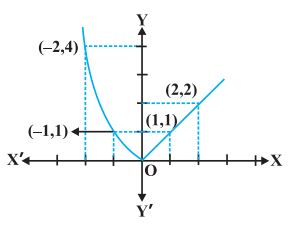
Discuss the continuity of the function f given by:
\(f\left( x \right) =\begin{cases} x,\quad if\quad x\ge 0 \\ { x }^{ 2 }\quad if\quad x<0 \end{cases}\)
24.
Using elementary transformations, find the inverse of matrix \(\begin{bmatrix} 2 & 5 \\ 1 & 3 \end{bmatrix}\)
25.
If \(A=\begin{bmatrix} \alpha & \beta \\ \gamma & -\alpha \end{bmatrix}\) is such that \({ A }^{ 2 }=I\), then:
\((A)\quad 1+{ \alpha }^{ 2 }+\beta \gamma =0\\ (B)\quad 1-{ \alpha }^{ 2 }+\beta \gamma =0\\ (C)\quad 1-{ \alpha }^{ 2 }-\beta \gamma =0\\ (D)\quad 1+{ \alpha }^{ 2 }-\beta \gamma =0\)
26.
Show that if the determinant: \(\Delta=\left| \begin{matrix} 3 & -2 & sin3\theta \\ -7 & 8 & cos2\theta \\ -11 & 14 & 2 \end{matrix} \right| =0\) then \(sin\theta=0\ or\ {1\over2}\)
27.
Is '*' defined on the set {1,2,3,4,5} by a*b=L.C.M. of a and b, a binary operations? Justify your answer.
28.
Show that the function f defined by f(x) = |1 – x + | x | |, where x is any real number, is a continuous function
29.
Find adjoint of each of the matrices
\(\left|\begin{matrix}1&2\\ 3&4\end{matrix}\right|\)
30.
Let \(f:N\rightarrow R\) be a function defined as \(f(x)=4x^{ 2 }+12x+15\) Show that \(f:N\rightarrow \) Range f is invertible. Find the inverse off.
31.
Find te principal values of the following
\({ sin }^{ -1 }\left( -\frac { 1 }{ 2 } \right) \)
32.
Write \({ cot }^{ -1 }\left( \frac { 1 }{ \sqrt { { x }^{ 2 }-1 } } \right) ,x>1\) in the simplest form.
33.
Let f : R ⟶ R be defined as f(x) = x4. Choose the correct answer
f is one-one onto
f is many-one onto
f is one-one but not onto
f is neither one-one nor onto
34.
Derivative of cot x° with respect to x is
cosec x°
cosec x° cot x°
-1° cosec2 x°
-1° cosec x° cot x°
35.
If A = \(\begin{bmatrix} 5 & x \\ y & 0 \end{bmatrix}\) and A = A’ then
x = 0, y = 5
x = y
x + y = 5
x – y = 5
36.
If sin-1x + sin-1y + sin-1z = then the value of x + y² + z3 is
1
3
2
5
1.
On differentiating ey (x+1) = 1
ey+(x+1)eydy/dx = 0
\(\Rightarrow { e }^{ y }+\frac { dy }{ dx } =0\)
\(\Rightarrow \frac { dy }{ dx } ={ -e }^{ y }\)
2.
We have y = log(sin x)
dy/dx = d/dx \(\left| log(sinx) \right| \)
= \(\frac { 1 }{ sinx } \times cosx\)
\(\Rightarrow\) dy/dx = cot x
\(\therefore\) \(\frac { { d }^{ 2 }y }{ dx^{ 2 } } =-{ cosec }^{ 2 }x\)
3.
Let f : [a, b] and differentiable on (a, b), such that f(a) = f(b), where a and b are some real numbers, then there exists some c in (a, b) such that f'(c) = 0.
4.
(i) f(g) = f(x)g(x)
\(fg=(\sqrt { x+4 } )(\sqrt { x-4 } )=\sqrt { x^{ 2 }-4 } \)
(ii) \(\frac { f }{ g } =\frac { f(x) }{ g(x) } =\frac { \sqrt { x+4 } }{ \sqrt { x-4 } } \)
\(=\frac { \sqrt { x+4 } }{ \sqrt { x-4 } } \times \frac { \sqrt { x-4 } }{ \sqrt { x-4 } } \)
\(=\frac { \sqrt { x^{ 2 }-16 } }{ x-4 } \)
5.
Let x = cos 2\(\theta \)
\(=sin\left[ 2t{ an }^{ -1 }\sqrt { \frac { 1-cos2\theta }{ 1+cos2\theta } } \right] \)
\(=sin\left[ 2tan^{ -1 }\sqrt { \frac { 2{ sin }^{ 2 }\theta }{ 2{ cos }^{ 2 }\theta } } \right] \)
\(\left[ \because cos2\theta =1-2{ sin }^{ 2 }\theta \ and\ cos\ 2\theta =2{ cos }^{ 2 }\theta -1 \right] \)
\(=sin\left[ 2{ tan }^{ -1 }\left( tan\quad \theta \right) \right] \)
\(=sin(2\theta )=\sqrt { 1-{ cos }^{ 2 }2\theta } \)
\(=sin\quad 2\theta =\sqrt { 1-{ x }^{ 2 } } \)
6.
We have \(x\in [-1,\quad 1]\)
Let x = sin \(\theta\) \(\therefore \quad \theta \in \left[ -\frac { \pi }{ 2 } ,\frac { \pi }{ 2 } \right] \)
\(\Rightarrow \quad \quad \theta ={ sin }^{ -1 }x\)
\(\Rightarrow \quad \quad -\frac { \pi }{ 2 } \le \theta \le \frac { \pi }{ 2 } \)
\(\Rightarrow \quad \quad \frac { \pi }{ 2 } \ge -\theta \ge -\frac { \pi }{ 2 } \)
\(\Rightarrow \quad \frac { \pi }{ 2 } +\frac { \pi }{ 2 } \ge \frac { \pi }{ 2 } -\theta \ge -\frac { \pi }{ 2 } +\frac { \pi }{ 2 } \)
\(\Rightarrow \quad\pi \ge \frac { \pi }{ 2 } -\theta \ge 0\)
\(\Rightarrow \quad cos\left( \frac { \pi }{ 2 } -\theta \right) =sin\quad \theta =x\)
\(\Rightarrow \quad \frac { \pi }{ 2 } -\theta ={ cos }^{ -1 }x\)
\(\Rightarrow { \quad cos }^{ -1 }x=\frac { \pi }{ 2 } -{ sin }^{ -1 }x\)
\(\Rightarrow { \quad sin }^{ -1 }x+{ cos }^{ -1 }x=\frac { \pi }{ 2 } if\quad x\in [-1,\quad 1]\)
7.
\(f(x)=x^{ 2 },x\in Ra\)
\(f(1.1)=(1.1)^{ 2 }z\)
\(=1.21\)
\(f(1)=(1)^{ 2 }=1\)
\(\frac { f(1.1)-f(1) }{ 1.1-1 } =\frac { 1.21 }{ 1.1-1 } =\frac { 0.21 }{ 0.1 } \)
\(=2.1\)
8.
Let A be a skew-symmetric matrix. Then by definition \({ A }^{ \prime }=-A\)
\(\Rightarrow\) the (i, j)th element of \({ A }^{ \prime }\) = the (i, j)th element of (- A)
\(\Rightarrow\) the (j, i)th element of A = - the (i, j)th element of A
For the diagonal elements i = j \(\Rightarrow\) the (i, j)the element of A = - the (i, j)th element of A.
\(\Rightarrow\) the (i, j)th element of A = 0
Hence the diagonal elements are all zero.
9.
We have, \(X+Y=\left[ \begin{matrix} 2 & 3 \\ 5 & 1 \end{matrix} \right] ,X-Y=\left[ \begin{matrix} 6 & 5 \\ 7 & 3 \end{matrix} \right] \)
\(\left( X+Y \right) +\left( X-Y \right) =\left[ \begin{matrix} 2 & 3 \\ 5 & 1 \end{matrix} \right] +\left[ \begin{matrix} 6 & 5 \\ 7 & 3 \end{matrix} \right] \)
\(2X=\left[ \begin{matrix} 8 & 8 \\ 12 & 4 \end{matrix} \right] \)
\(\Rightarrow X=\left[ \begin{matrix} 4 & 4 \\ 6 & 2 \end{matrix} \right] \)
\(\therefore \ X=\left[ \begin{matrix} 4 & 4 \\ 6 & 2 \end{matrix} \right] \)
and \(Y=\left[ \begin{matrix} 2 & 3 \\ 5 & 1 \end{matrix} \right] -\left[ \begin{matrix} 4 & 4 \\ 6 & 2 \end{matrix} \right] \)
\(=\left[ \begin{matrix} -2 & -1 \\ -1 & -1 \end{matrix} \right] \)
10.
We have, \(A=\left| \begin{matrix} 6 & 0 & 1 \\ 0 & 1 & 2 \\ 0 & 0 & 4 \end{matrix} \right| \)
|A| = 6(4-0)-0(0-0)+1(0-0)
|2A| = \(\left| \begin{matrix} 12 & 0 & 2 \\ 0 & 2 & 4 \\ 0 & 0 & 8 \end{matrix} \right| \)
= 12(16-0)-0(0-0)+2(0-0)
= 192
|2A| = 8 x 24 = 8|A|
11.
We have, \(A=\left| \begin{matrix} 2 & 3 & -1 \\ 4 & 1 & 0 \\ 3 & 3 & 2 \end{matrix} \right| \)
\(M_{ 12 }\left| \begin{matrix} 4 & 0 \\ 3 & 2 \end{matrix} \right| =8-0=8\)
\(M_{ 21 }\left| \begin{matrix} 3 & -1 \\ 3 & 2 \end{matrix} \right| =6+3=9\)
\(C_{ 21 }=-\left| \begin{matrix} 3 & -1 \\ 3 & 2 \end{matrix} \right| =-(6+3)=-9\)
\(C_{ 12 }=-\left| \begin{matrix} 4 & 0 \\ 3 & 2 \end{matrix} \right| =-(8-0)=-8\)
\( M_{ 12 }\times M_{ 21 }+C_{ 21 }\times C_{ 12 }\)
\( 8\times (9)+(-9)(-8)=72+72\)
\(=144\)
12.
\({ tan }^{ -1 }\left( tan\frac { 7\pi }{ 6 } \right) =\frac { \pi }{ 6 } \)
Alternative Method :
\({ tan }^{ -1 }\left( tan\frac { 7\pi }{ 6 } \right) ={ tan }^{ -1 }\left[ tan\left( \pi +\frac { \pi }{ 6 } \right) \right] \)
\(={ tan }^{ -1 }\left[ tan\frac { \pi }{ 6 } \right] =\frac { \pi }{ 6 } \)
\(\left[ \because { tan }^{ -1 }(tan\theta )=\theta \forall \theta \in \left( -\frac { \pi }{ 2 } ,\frac { \pi }{ 2 } \right) \right] \)
13.
a = 1
Alternate Method :
Given \(\left[ \begin{matrix} a-b & 2a+c \\ 2a-b & 3c+d \end{matrix} \right] =\left[ \begin{matrix} -1 & 5 \\ 0 & 13 \end{matrix} \right] \)
By equating, a - b = - 1.. (i)
and 2a - b = 0... (ii)
By (ii) - (i),
2a - b - a + b = 0 + 1
⇒ a = 1
14.
\(|A|=6-5=1, \text { adj } A=\left[\begin{array}{rr} 3 & -5 \\ -1 & 2 \end{array}\right]
\)
\(\therefore \ A^{-1}=\frac{1}{|A|} \operatorname{adj} A
\)
\(\Rightarrow A^{-1}=\frac{1}{1}\left[\begin{array}{rr} 3 & -5 \\ -1 & 2 \end{array}\right]=\left[\begin{array}{rr} 3 & -5 \\ -1 & 2 \end{array}\right]
\)
15.
(i) 2 * 3 = 23 = 8
(ii) 3 * 2 = 32 = 9.
16.
\({ A }^{ -1 }=\frac { 1 }{ 8 } \left[ \begin{matrix} 5 & -1 \\ -7 & 3 \end{matrix} \right] \)
17.
\(\text { We have } \tan ^{-1} 2 x+\tan ^{-1} 3 x=\frac{\pi}{4}\)
\(\text { Or }\tan ^{-1}\left(\frac{2 x+3 x}{1-2 x \times 3 x}\right)=\frac{\pi}{4}\)
\(\text { i.e. }\tan ^{-1}\left(\frac{5 x}{1-6 x^{2}}\right)=\frac{\pi}{4}\)
\(\text { Therefore } \quad \frac{5 x}{1-6 x^{2}}=\tan \frac{\pi}{4}=1\)
\(\text { or } \quad 6 x^{2}+5 x-1=0 \text { i.e., }(6 x-1)(x+1)=0\)
\(\text { which gives } \ x=\frac{1}{6} \text { or } x=-1 .\)
Since x = – 1 does not satisfy the equation, as the L.H.S. of the equation becomes negative\(x=\frac{1}{6}\) is the only solution of the given equation
18.
Given A = \(\left[ \begin{matrix} 1 & -1 & 0 \\ 2 & 3 & 4 \\ 0 & 1 & 2 \end{matrix} \right] \)
and B = \(\left[ \begin{matrix} 2 & 2 & -4 \\ -4 & 2 & -4 \\ 2 & -1 & 5 \end{matrix} \right] \)
\(\therefore AB=\left[ \begin{matrix} 2+4 & 2-2 & -4+4 \\ 4-12+8 & 4+6-4 & -8-12+20 \\ -4+4 & 2-2 & -4+10 \end{matrix} \right] \)
=\(\left[ \begin{matrix} 6 & 0 & 0 \\ 0 & 6 & 0 \\ 0 & 0 & 6 \end{matrix} \right] \)
\(\therefore \) AB = 6I
Premultiplying by A-1
A-1AB = 6A-1I
=> IB = 6A-1I (\(\therefore \) A-1A = I)
=> B = 6A-1 (\(\therefore \) IX = X)
=> A-1 = 1/6B
Given equations are:
x - y = 3
2x + 3y + 4z = 17
y + 2z = 7
=> \(\left[ \begin{matrix} 1 & -1 & 0 \\ 2 & 3 & 4 \\ 0 & 1 & 2 \end{matrix} \right] \left[ \begin{matrix} x \\ y \\ z \end{matrix} \right] =\left[ \begin{matrix} 3 \\ 17 \\ 7 \end{matrix} \right] \)
AX = C, where
C = \(\left[ \begin{matrix} 3 \\ 17 \\ 7 \end{matrix} \right] \)
X = \(\left[ \begin{matrix} x \\ y \\ z \end{matrix} \right] \)
=> A-1AX = A-1C
=> X = A-1C
=> X = \(\frac { 1 }{ 6 } \left[ \begin{matrix} 2 & 2 & -4 \\ -4 & 2 & -4 \\ 2 & -1 & 5 \end{matrix} \right] \left[ \begin{matrix} 3 \\ 17 \\ 7 \end{matrix} \right] =\frac { 1 }{ 6 } \left[ \begin{matrix} 12 \\ -6 \\ 24 \end{matrix} \right] =\left[ \begin{matrix} 2 \\ -1 \\ 4 \end{matrix} \right] \)
\(\therefore \) x = 2, y = -1 and z = 4
19.
Hence, the given function is not differentiable at x=2.
20.
We have, \(\begin{equation} A=\left[\begin{array}{lll} 0 & 1 & 2 \\ 1 & 2 & 3 \\ 3 & 1 & 1 \end{array}\right] \end{equation}\)
For applying row operations, write A as A = lA,
where I is an identity matrix of order 3.
i.e \(\begin{equation} \left[\begin{array}{lll} 0 & 1 & 2 \\ 1 & 2 & 3 \\ 3 & 1 & 1 \end{array}\right]=\left[\begin{array}{lll} 1 & 0 & 0 \\ 0 & 1 & 0 \\ 0 & 0 & 1 \end{array}\right] A \end{equation}\)
Here, a11 = 0, so on applying R1 ↔️ R2' we get
Applying R3➝R3 we get
\(\begin{equation} \left[\begin{array}{rrr} 1 & 2 & 3 \\ 0 & 1 & 2 \\ 0 & -5 & -8 \end{array}\right]=\left[\begin{array}{rrr} 0 & 1 & 0 \\ 1 & 0 & 0 \\ 0 & -3 & 1 \end{array}\right] \end{equation}\)
Applying R1➝ Rl ➝ 2R2 and R3 ➝ R3 + 5R2, we get
\(\begin{equation} \left[\begin{array}{rrr} 1 & 0 & -1 \\ 0 & 1 & 2 \\ 0 & 0 & 2 \end{array}\right]=\left[\begin{array}{rrr} -2 & 1 & 0 \\ 1 & 0 & 0 \\ 5 & -3 & 1 \end{array}\right] \end{equation}\)
Applying \(\begin{equation} R_{3} \rightarrow \frac{1}{2} R_{3} \end{equation}\) we get
\(\begin{equation} \left[\begin{array}{rrr} 1 & 0 & -1 \\ 0 & 1 & 2 \\ 0 & 0 & 1 \end{array}\right]=\left[\begin{array}{rcc} -2 & 1 & 0 \\ 1 & 0 & 0 \\ \frac{5}{2} & -\frac{3}{2} & \frac{1}{2} \end{array}\right] A \end{equation}\)
Applying R1 ➝ Rl + R3 and R2 ➝ R2 - 2R3,we get
\(\begin{equation} \left[\begin{array}{lll} 1 & 0 & 0 \\ 0 & 1 & 0 \\ 0 & 0 & 1 \end{array}\right]=\left[\begin{array}{ccc} 1 / 2 & -1 / 2 & 1 / 2 \\ -4 & 3 & -1 \\ 5 / 2 & -3 / 2 & 1 / 2 \end{array}\right] \end{equation}\)
Now, new matrix equation is in the form of
I = BA , where \(\begin{equation} B=\left[\begin{array}{ccc} 1 / 2 & -1 / 2 & 1 / 2 \\ -4 & 3 & -1 \\ 5 / 2 & -3 / 2 & 1 / 2 \end{array}\right] \end{equation}\)
Hence,
\(\begin{equation} A^{-1}=\left[\begin{array}{ccc} 1 / 2 & -1 / 2 & 1 / 2 \\ -4 & 3 & -1 \\ 5 / 2 & -3 / 2 & 1 / 2 \end{array}\right] \end{equation}\)
21.
Given equation can be written as
\(\left[ \begin{matrix} 1 & -1 & 2 \\ 3 & 4 & -5 \\ 2 & -1 & 3 \end{matrix} \right] \left[ \begin{matrix} x \\ y \\ z \end{matrix} \right] \)
=\(\left[ \begin{matrix} 7 \\ -5 \\ 12 \end{matrix} \right] \) or AX = B
|A| = 1(7)+1(19)+2(-11)
= 4\(\neq \)0
\(\therefore \)A-1 exists
Co-factors
a11 = 7, a12 = -19 a13 = -11
a21 = 1, a22 = -1 a23 = -1
a31 = -3, a32 = 11 a33 = 7
\(\Rightarrow { A }^{ -1 }=\frac { 1 }{ 4 } \left[ \begin{matrix} 7 & 1 & -3 \\ -19 & -1 & 11 \\ -11 & -1 & 7 \end{matrix} \right] \)
\(\therefore \) X = A-1B
\(\therefore \left[ \begin{matrix} x \\ y \\ z \end{matrix} \right] =\frac { 1 }{ 4 } \left[ \begin{matrix} 7 & 1 & -3 \\ -19 & -1 & 11 \\ -11 & -1 & 7 \end{matrix} \right] \left[ \begin{matrix} 7 \\ -5 \\ 12 \end{matrix} \right] \)
=\(\left[ \begin{matrix} 2 \\ 1 \\ 3 \end{matrix} \right] \)
\(\therefore \) x = 2, y = 1 and z = 3
22.
\(\text {We have } 2 \tan ^{-1}(\sin x)=\tan ^{-1}(2 \sec x) \)
\(\Rightarrow \tan ^{-1}\left(\frac{2 \sin x}{1-\sin ^{2} x}\right)=\tan ^{-1}\left(\frac{2}{\cos x}\right) \)
\(\Rightarrow \frac{2 \sin x}{\cos ^{2} x}=\frac{2}{\cos x} \Rightarrow \frac{\sin x}{\cos x}=1 \)
\(\Rightarrow \tan x=1 \Rightarrow x=\frac{\pi}{4} \)
23.
Clearly the function is defined at every real number. By inspection, it seems prudent to partition the domain of definition of f into three disjoint subsets of the real line.
Let \( \mathrm{D}_1=\{x \in \mathbf{R}: x<0\}, \mathrm{D}_2=\{0\} \text { and } \mathrm{D}_3=\{x \in \mathbf{R}: x>0\} \)
Case 1 At any point in D1 , we have f(x) = x 2 and it is easy to see that it is continuous there
Case 2 At any point in D3 , we have f(x) = x and it is easy to see that it is continuous there
Case 3 Now we analyse the function at x = 0. The value of the function at 0 is f(0) = 0. The left hand limit of f at 0 is
\(\lim _{x \rightarrow 0^{-}} f(x)=\lim _{x \rightarrow 0^{-}} x^2=0^2=0\)
The right hand limit of f at 0 is
\(\lim _{x \rightarrow 0^{+}} f(x)=\lim _{x \rightarrow 0^{+}} x=0\)
Thus \(\lim _{x \rightarrow 0} f(x)=0=f(0)\)and hence f is continuous at 0. This means that f is continuous at every point in its domain and hence, f is a continuous function
24.
\(We\quad know\quad that\quad A={ I }_{ 2 }A\)
\(i.e.\ \begin{bmatrix} 2 & 5 \\ 1 & 3 \end{bmatrix}=\begin{bmatrix} 1 & 0 \\ 0 & 1 \end{bmatrix}A\)
\(\Rightarrow \begin{bmatrix} 1 & 2 \\ 1 & 3 \end{bmatrix}=\begin{bmatrix} 1 & -1 \\ 0 & 1 \end{bmatrix}A \quad [Applying\quad { R }_{ 1 }\rightarrow { R }_{ 1 }-{ R }_{ 2 }]\)
\(\Rightarrow \begin{bmatrix} 1 & 2 \\ 1 & 3 \end{bmatrix}=\begin{bmatrix} 1 & -1 \\ -1 & 2 \end{bmatrix}A \quad [Applying\quad { R }_{ 2 }\rightarrow { R }_{ 2 }-{ R }_{ 1 }]\)
\(\Rightarrow \begin{bmatrix} 1 & 0 \\ 0 & 1 \end{bmatrix}=\begin{bmatrix} 3 & -5 \\ -1 & 2 \end{bmatrix}A.\quad [Applying\quad { R }_{ 1 }\rightarrow { R }_{ 1 }-{ 2R }_{ 2 }]\)
\(Hence,\quad { A }^{ -1 }=\begin{bmatrix} 3 & -5 \\ -1 & 2 \end{bmatrix}.\)
25.
(C) is the correct answer.
Reason. \({ A }^{ 2 }=AA\)
\(=\begin{bmatrix} \alpha & \beta \\ \gamma & -\alpha \end{bmatrix}\begin{bmatrix} \alpha & \beta \gamma & -\alpha \end{bmatrix}\)
\(=\begin{bmatrix} { \alpha }^{ 2 }+\beta \gamma & \alpha \beta -\beta \alpha \\ \gamma \alpha -\alpha \gamma & \beta \gamma +{ \alpha }^{ 2 } \end{bmatrix}\)
\(=\begin{bmatrix} { \alpha }^{ 2 }+\beta \gamma & 0 \\ 0 & { \alpha }^{ 2 }+\beta \gamma \end{bmatrix}.\)
Now \({ A }^{ 2 }=I\)
\(\Rightarrow { \alpha }^{ 2 }+\beta \gamma =1\)
\(\Rightarrow 1-{ \alpha }^{ 2 }-\beta \gamma =0.\)
26.
2+4R1 and R3-->R3+7R1]
\(\Rightarrow 2[5(2+7sin3\theta)-10(cos2\theta+4sin3\theta)]=0\) [Expanding by C2]
\(\Rightarrow 10[(2+7sin3\theta)-(2cos2\theta+8sin\theta)]=0\)
\(\Rightarrow 2+7sin3\theta-2cos2\theta-8sin3\theta=0\)
\(\Rightarrow 2-2cos2\theta-sin3\theta=0\)
\(\Rightarrow 2-2(1-2sin^2\theta)-(3sin\theta-4sin^3\theta)=0\)
\(\Rightarrow 4sin^3\theta-3sin\theta+4sin^2\theta=0\)
\(\Rightarrow sin\theta(4sin^2\theta+4sin\theta-3)=0\)
\(\Rightarrow sin\theta(2sin\theta-1)(2sin\theta+3)=0\)
\(\Rightarrow sin\theta=0\ or\ sin\theta={1\over2}\), which is true
[∵ sinθ=-\(3\over2\) is not true]
27.
Since a * b = L.C.M of a,b,
\(\therefore \) 2*3 = L.C.M of 2 and 3 = 6 \(\notin \){1, 2, 3, 4, 5}.
Hence ' * ' is not a binary operation.
28.
Define g by g(x) = 1 – x + |x| and h by h(x) = |x| for all real x.
Then (h o g) (x) = h(g (x)) = h (1– x + | x |)
= |1– x + | x || = f(x)
we have seen that h is a continuous function.
Hence g being a sum of a polynomial function and the modulus function is continuous.
But then f being a composite of two continuous functions is continuous.
29.
Let A=\(\left|\begin{matrix}1&2\\ 3&4\end{matrix}\right|\)
Then =\(A_11=(-1)^{1+1}M_{11}=(+1)(4)\)
\(=4\)
\(=A_{12}=(-1)^{1+2}M_{12}=(-1)(3)\)
\(=-3\)
\(A_{21}=(-1)^{2+1}M_{21}=(-1)(2)\)
\(=-2\)
\(A_{22}=(-1)^{2+2}M_{22}=(+1)(1)\)
\( =1\)
\(\therefore\ adj\ A=\begin{vmatrix} A_{11}&A_{12}\\A_{21}&A_{22}\end{vmatrix}'\)
\(\left[\begin{matrix}4&-3\\ -2&1\end{matrix}\right]'=\left[\begin{matrix}4&-2\\ -3&1\end{matrix}\right]\)
30.
Let y be an arbitrary element of range f. Then y = 4x2 + 12x + 15, for some
x in N, which implies that y = (2x + 3)2 + 6. This gives \(x=\frac{((\sqrt{y-6})-3)}{2}, \text { as } y \geq 6\)
\(\text { Let us define } g: \mathrm{S} \rightarrow \mathbf{N} \text { by } g(y)=\frac{((\sqrt{y-6})-3)}{2}\)
Now gof (x) = g(f (x)) = g(4x2 + 12x + 15) = g((2x + 3)2 + 6)
\(=\frac{\left(\left(\sqrt{(2 x+3)^{2}+6-6}\right)-3\right)}{2}=\frac{(2 x+3-3)}{2}=x\)
\(\text { and }\operatorname{fog}(y)=f\left(\frac{((\sqrt{y-6})-3)}{2}\right)=\left(\frac{2((\sqrt{y-6})-3)}{2}+3\right)^{2}+6\)
\(=((\sqrt{y-6})-3+3))^{2}+6=(\sqrt{y-6})^{2}+6=y-6+6=y\)
Hence, gof = IN and fog =IS. This implies that f is invertible with f –1 = g.
31.
Let \({ sin }^{ -1 }\left( -\frac { 1 }{ 2 } \right) =y\) where \(y\in \left[ -\frac { \pi }{ 2 } ,\frac { \pi }{ 2 } \right] \)
\(\Rightarrow siny=-\frac { \pi }{ 2 } \)
\(\Rightarrow siny=-sin\frac { \pi }{ 6 } =sin\left( -\frac { \pi }{ 6 } \right) \)
\(\Rightarrow y=-\frac { \pi }{ 6 } \)
Hence, the required principal value = \(-\frac { \pi }{ 6 } \)
32.
Let x = sec θ, then \(\sqrt{x^2-1}=\sqrt{\sec ^2 \theta-1}=\tan \theta\)
Therefore, \(\cot ^{-1} \frac{1}{\sqrt{x^2-1}}=\cot ^{-1}(\cot \theta)=\theta=\sec ^{-1} x\) which is the simplest form
33.
(d)
f is neither one-one nor onto
34.
As xo = \(\frac { \pi }{ 180 } { x }^{ c }\)
\(\therefore \frac { d }{ dx } (cot{ x }^{ o })=\)\(\frac { d }{ dx } \left( cot\frac { \pi }{ 180 } x \right) \)
\(=-\frac { \pi }{ 180 } { cosec }^{ 2 }\frac { \pi }{ 180 } x\)
\(=-{ 1 }^{ o }{ cosec }^{ 2 }\frac { \pi }{ 180 } x\)
\(=-{ 1 }^{ o }{ cosec }^{ 2 }{ x }^{ 0 }\)
35.
As \(\begin{bmatrix} 5 & x \\ y & 0 \end{bmatrix}=\begin{bmatrix} 5 & x \\ y & 0 \end{bmatrix}\Rightarrow x=y\)
36.
As sin-1 x = \(\frac { \pi }{ 2 } \), sin-1 y = \(\frac { \pi }{ 2 } \), sin-1z = \(\frac { \pi }{ 2 } \)
⇒ x = 1, y = 1, z = 1
∴ x + y2 + z3 = 1 + 1 + 1 = 3

12th Standard CBSE Syllabus & Materials
12th Standard CBSE
CBSE 12th Computer Science Python Revision Tour I - New Previous year Question Papers Study Material - QB365 Set A
NEW12th Standard CBSE
CBSE 12th Business Studies Planning Important Questions And Answers Study Material - QB365 Set A
NEW12th Standard CBSE
CBSE 12th Business Studies Business Environment Important Questions And Answers Study Material - QB365 Set A
NEW12th Standard CBSE
CBSE 12th Business Studies Principles of Management Important Questions And Answers Study Material - QB365 Set A



CBSE 12th Standard CBSE Subjects
CBSE Standards










