
 100% FREE ACCESS
12th Standard CBSE Syllabus & Materials
12th Standard CBSE
CBSE 12th Economics Government Budget and the Economy Previous year Question Papers Study Material - QB365 Set A
NEW12th Standard CBSE
CBSE 12th Computer Science Interface Python with MySQL - New Previous year Question Papers Study Material - QB365 Set A
NEW12th Standard CBSE
CBSE 12th Computer Science Database Concept - New Previous year Question Papers Study Material - QB365 Set A
NEW12th Standard CBSE
CBSE 12th Computer Science Data Communication - New Previous year Question Papers Study Material - QB365 Set A
NEW12th Standard CBSE
CBSE 12th Computer Science Data Structures - New Previous year Question Papers Study Material - QB365 Set A
NEW12th Standard CBSE
CBSE 12th Computer Science Functions - New Previous year Question Papers Study Material - QB365 Set A

Published on: 03/03/2020
12th Standard CBSE Mathematics Public Exam Model Question 2020
Download CBSE Class 12th Standard CBSE Biology question papers, sample papers, important questions, and previous year solved papers in PDF format. Get free study materials, NCERT solutions, and exam preparation resources for Class 12th Standard CBSE Biology
Questions + Answers key
Take MCQ Biology Test
1.
What are the 2 types of source of water pollution?
2.
A man with blood group A married a woman with B group.They have a son with AB group and a daughter with blood group O.Work out and show the possibiliy of such inheritance
3.
Briefly, explain the various types of disorders arising from improper function of the immune system
4.
Mention two adaptations the mammals of colder regions have, to minimise the loss of body heat.
5.
Discuss pasturage/crop/flora of honey bee.
6.
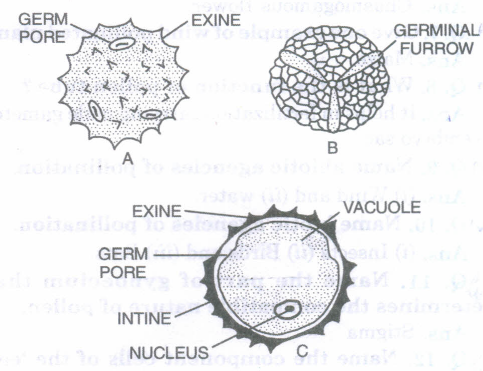
Describe the structure of typical microspore (Pollen grain).
7.
What is brewing?
8.
List the changes observed in an angiosperm flower subsequent to pollination and fertilization.
9.
What is foetal ejection reflex? Explain how it leads to parturition?
10.
Discuss briefly the ultraviolet B
11.
(a)Explain how to find whether an E.Coli bacterium has transformed or not when a recombinant DNA bearing ampicillin-resistant gene is transferred into it.
(b)What does the ampicillin-resistant gene act as, in the above case?
12.
A part from plants and animals,microbes form a permanent biotic component in an ecosystem.While plants have been referred to as autorophs and animals a sheterotrophs,How do microbes fulfil their energy requirements?
13.
How was the earth's atmosphere formed?
14.
Draw a schematic diagram of a part of double-stranded dinucleotide DNA chain, having all the four nitrogenous bases and showing the correct polarity
15.
Why are Copper-containing intrauterire devices considered an ideal contraceptive for human females?
16.
(i) What is population density? Why are ecologists interested in measuring it?
(ii) Write the different ways of measuring population density. Explain any two with the help of specific examples.
17.
On world population day, Rohit and his friends arranged an awareness campaign on population explosion programme in their locality. Some elderly people tried to stop the children and asked them not to talk about such things in public.
The children convinced the elders about the need for the programme and on understanding their point of view, the elders also joined the campaign.
(i) Why is such awareness programme necessary?
(ii) What role has the government played in controlling population explosion?
(iii) When were reproductive health programmes initiated in India?
(iv) What values did Rohit and his friends show on the occasion?
18.
In every summer, Ravi used to visit his native village. Many years ago when he was a small child, a large amount of soil was removed from his village land for construction purpose and as a result a pond was formed after rainy season. Every year, he observed gradual changes in the vegetation of the pond.
Read the above passage and answer the following questions:
(i) What is the term used to describe the process of colonization of a new barren area?
(ii) Define climax. What is the status of climax community?
19.
In a maternity ward, two new born babies got exchanged and two women claiming to be the mother of one child and the matter went to the court.The judge asked to conduct DNA test of the child and two women, and on the basis of report settled the issue of paternity
Read the above passage and answer the following questions:
(i)What is the meaning of DNA test?
(ii)How is it helpful in deciding paternity issues?
20.
Why is ozone layer in stratosphere called a protective layer?
21.
Explain how a test cross can be conducted to distinguish between a homozygous and heterozygous dominant genotype.
22.
Which type of food would contain lactic acid bacteria? Discuss their useful application.
23.
Explain the different ways of diagnosing cancer.
24.
Enumerate the points that have to be considered for successful bee-keeping.
25.
(a) Name two animals showing external fertilisation. Why are move gametes produced by such animals?
(b) Name two animals showing internal fertilisation. What are the characteristics of the gametes produced by such aimals?
26.
Narrowly utilitarian arguments are put forth in support of biodiversity conservation. Explain the other two arguments that are put forth in support of the same cause.
27.
How did an American Company, Elr Lily use the knowledge of r-DNA technology to produce human insulin?
28.
Draw a diagram of human sperm. Label only those parts along with their functions that assist the sperm to reach and gain entry into the female gamete.
29.
Co-extinction is the loss of species as a results of loss of other species that depends on it. Such effects are likely to be most severe in interactions. State the effect of such type of interaction on both species and an example of each.
30.
'Introducing sex education in schools is a good step for providing the right information to adolescents'. In context to the statement given above, answer the questions that follow:
(i) Which part of the brain controls the sex urge?
(ii) what are the necessary topics that should be taught in schools, in the context of STDs and AIDS?
(iii) What do you understand by the term emotional brain?
31.
Mention three uses of PCR.
32.
Match the items in Column (A) with Column (B). Each point in column (A) has minimum one match in column (B) and maximum two matches.
| Column (A) | Column (B) |
| 1. Autogamy | (a) Megasporangia |
| 2. Apomixis | (b) Xenogamy |
| 3. Pollen sacs | (c) Female gametophyte |
| 4. Ovules | (d) Asexual reproduction |
| 5. Embryosac | (e) Allogamy |
| 6. Pollar nuclei | (f) Secondary nucleus |
| 7. Cross pollination | (g) Microsporangia |
| (h) Agamospermy | |
| (i) Self pollination |
33.
Describe Griffith's experiment to demonstrate that DNA is the basic genetic material. What was an explanation for Griffith's observation given by Avery, McCarty and MacCleod?
34.
State the disadvantages of inbreeding among cattle. How it can be overcome?
35.
Study the graph given below:
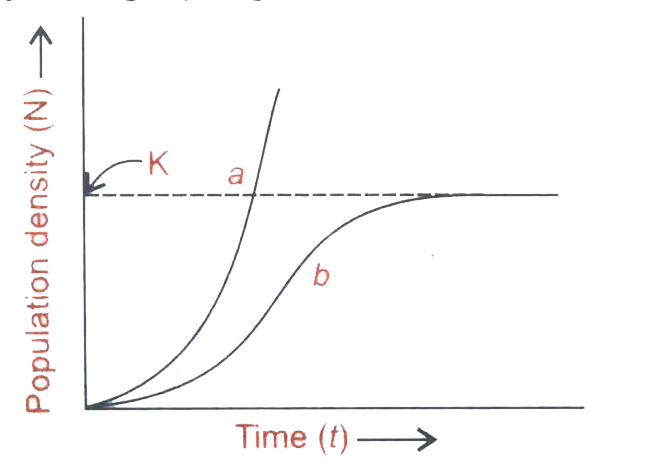
(i) What does the curve 'a' represent in the graph? What does 'K' stand for?
(ii) Which one of the two curves is considered a more realistic one for most of the animal population?
(iii) Which curve would deplict the population of a species of deer if there are no predators in the habitat? Why is it so?
36.
Name any three organic acids and the bacteria that produce them.
37.
Name the cells HIV attacks first when it gains entry into a human body.How does this virus replicate further to cause immunodeficiency in the body?
38.
What are the periods in Palaeozoic era and name the plant group that appeared in each of them,
39.
How is aneuplody different from polyplodiy? Mention their causes.
40.
Which one of the following pairs of gases are the major cause of 'green house effect'?
CO2 and O3
CO2 and CO
CFCs and SO2
CO2 and N2O
41.
Which layer develops first during embryonic development?
ectoderm
mesoderm
endoderm
both (b) and (c)
42.
What is common to whale, seal and shark?
thick subcutaneous fat
convergent evolution
homeothermy
seasonal migration
43.
Select the formula for ecological efficiency
\(\frac { Gross\quad primary\quad productivity\times 100 }{ Incident\quad total\quad solar\quad radiation } \)
\(\frac { Food\quad primary\quad assimilated\times 100 }{ Food\quad energy\quad ingested } \)
\(\frac { Net\quad primary\quad productivity\times 100 }{ Gross\quad primary\quad productivity } \)
\(\frac { Energy\quad in\quad biomass\quad production\quad at\quad a\quad trophic\quad level\times 100 }{ Energy\quad in\quad biomass\quad production\quad at\quad previous\quad trophic\quad level } \)
\(\frac { Volume\quad of\quad { CO }_{ 2 }\quad evolved }{ Volumed\quad of\quad { O }_{ 2 }\quad consumed } \)
44.
If the Bengal tiger becomes extinct
Hyaenas and Wolves will become scarce
The wild areas will be safe for man and domestic animals
its gene pool will be lost forever
The population of beautiful animals like deers will get stabilized
45.
Tobacco consumption is known to stimulate secretion of adrenaline and nor-adrenaline. The component causing this could be:
Nicotine
Tannic acid
Curaimin
Catechin
46.
Which one of the following pollinations is autogamous?
geitonogamy
xenogamy
chasmogamy
cleistogamy
47.
When seeds are attached to parent plant the type of germination is known as
Ovipary
Epigeal
Vivipary
Hypogeal
48.
Amplification of gene of interest by using DNA polymerase may go upto
0.1 million times
1.0 million times
1.0 billion times
1.0 trillion times
49.
Given below is a sample of a portion of DNA strand giving the base sequence on the opposite strands. What is to special shown in it?
5'.........GAATTC.....3'
3'.........CTTAAG.....5'
replication completed
deletion mutation
start codon at the 5' end
pallindromic sequence of base pairs
50.
An organism used as a biofertilizer for raising soyabean crop is
Azotobacter
Azospirillum
Rhizobium
Nostoc
51.
In which one of the following habitats does the diurnal temperature of soil surface vary most?
Forest
Desert
Grassland
Shrub land
52.
Which one of the following products is used in cosmetics and polishes.
honey
oil
wax
royal jelly
53.
Mendel's Law of independent assortment holds good for genes situated on the :
non-homologous chromosomes
homologous chromosomes
extra nuclear genetic element
same chromosome
54.
Initiator (starting) codon in eukaryotes is
AUG
AAG
CCU
GGC
55.
Given below are the four methods and their modes of action in achieving contraception.Select their correct matching from the four options that follows.
|
control measures |
Mode of Action |
| (A) Pill | 1. Prevents sperms reaching cervix |
| (B) Condom | 2. Prevents implication |
| (C)Vasectomy | 3. Prevents ovulation |
| (D) Copper T | 4. Semen contains no sperms |
| A | B | C | D |
| 3 | 4 | 1 | 2 |
| A | B | C | D |
| 2 | 3 | 1 | 4 |
| A | B | C | D |
| 3 | 1 | 4 | 2 |
| A | B | C | D |
| 4 | 1 | 2 | 3 |
1.
Point source that brings pollutants through regular channels, and diffusion source that absorbs pollutants scattered on surface of soil.
2.
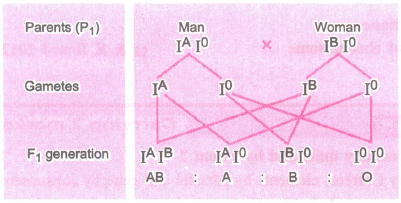
3.
1.Severe combined immunodeficiency(SCID), It is caused due to absence of T-cells and B-cells in new born children.
2.Acquired immuno-deficiency syndrome (AIDS).It is due to reduction in number of helper T-cells that activate other lymphocytes.
4.
The adaptations are as follows:
1. Mammals of colder regions have shorter ears and limbs (called as Allen's rule).
2. Aquatic mammals of colder seas have a thick layer of fat, called blubber, below the skin, which acts as an insulator and reduces the loss of body heat.
5.
Pasturage/crop/flora value and quality of honey depends upon the flora or pasturage available for the nectar and pollen collection by honey bees. Availability of flora or pasturage should be in the visiting of apiary to facilitate nectar collection. Pollens serve as protein food for bees. Pasturage may be different as per geographical regions/locations i.e. mountains or plains and region to region. Therefore flora is responsible for quality and taste of honey. For example, Almond honey of Kashmir honey tastes good as nectar is collected from almond. Pasturage Flora of Honey Bee include Mango (Aam), Coconut (narial), Almond (badam), Tamarind (imli), ber, berseem, litchi, cotton, shisham, apple, mahua, coriander, cashew, coffee, rubber plant, guava, sunflower, etc.
6.
Structure of Pollen grains
1. Pollen grains are normally spherical in outline.
2. Each pollen grain has a prominent two-layered wall.
3. The outer layer is called exine and the inner layer is called intine.
4. Exine is hard and made of sporopollenin; it shows a variety of architecture, characteristic of each species.
5. Intine is thin and it is made of cellulose and pectin.
6. At certain places exine is either absent or very thin and such places are called germ pores. In monocots there are germinal furrows.
7. A mature pollen grain has two cells-a vegetative cell and a generative cell.
8. The vegetative cell is larger, has abundant reserve food and a large irregular-shaped nucleus.
9. The generative cell is small, spindle-shaped and floats in the cytoplasm of the vegetative cell.
7.
Brewing is a complex fermentation process, which involves the production of malt beverages such as beer, ale, porter and stout with the help of strains of saccharo-myces cerevisiae.
8.
It leads to formation of fruit where ovules have been converted into seeds and ovary wall has formed fruit wall (pericarp). It is followed by dehiscence of fruits and seeds. Next step is dispersal of fruits and then germination of seeds occurs to form seedlings.
9.
Foetal ejection reflex is neuroendocrine mechanism initiated by fully formed foetus and placenta which helps in parturition. It operates as below:
1.Foetus secretes hormone from its adrenal glands. These hormone stimulate the posterior pituitary of the mother to release oxytocin.
2.Oxytocin causes forceful contraction of smooth muscles of myometrium called labour pains, which further stimulates more secretion of oxytocin.
3.The stimulatory reflex between uterine contraction and oxytocin secretion continues which causes more forceful contraction of uterine muscles.
4.Uterine contractions pushes the young gradually out through the dilated cervix(caused by relaxin) and vagina.
10.
1. UV-B has a wavelength of 280-315 nm.
2. It causes the most damage to plants and animals
3. Chlorofluorocarbons and nitrous oxide are responsible for ozone depletion; there is an increase in UV-B radiation reaching the earth.
UV-B radiation causes
1. Skin cancer (melanoma)
2. Cataract and snow-blindness
3. Weakening of immune system
4. Damage to DNA and mutation
11.
(a) The recombinant/transformant can be selected out from the non-recombinants/non-transformants by plating the transformants on ampicillin containing medium.
1. The transformants will grow in it, while the non-transformants will not grow.
(b) It acts as a selectable marker.
12.
1. The microbes are also heterotrophs.
2. Those microbes which meet their energy requirement by degrading the dead and decaying organic matter,are called decomposers.
3. Those microbes which depend on living organisms for their food as well as shelter, are called parasites.
13.
Earth's atmosphere:
Water vapour, methane, carbon dioxide and ammonia were released from the molten mass covered the surface.
The UV rays from the sun broke up water into hydrogen and oxygen.
The lighter hydrogen escaped into the atmosphere.
Oxygen combined with ammonia and methane to form carbon dioxide and other gases.
Later ozone was formed from the oxygen.
14.
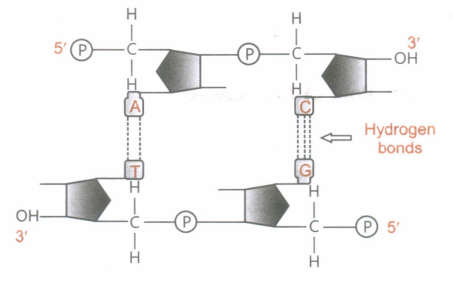
15.
Cut is an intra-uterine device (IUD) and functions as follows:
1. It suppresses sperm motility and the fertilising capacity of sperms.
2. It increases phagocytosis of sperms within the uterus.
16.
(i) The population density is the number of individuals of a population found per unit area at a given times. Whatever ecological process we wish to investigate in a population (competition/pesticide applicable) we always evaluate in terms of any change in population size (numbers/biomas)
(ii) Number of organism
Biomas of organism
Example: Less than 10 Siberian cranes at Bharatpur wetlands
In an area there may be a single banyan tree or 200 Parthenium plants
17.
(i) To understand the problem faced by the family and the nation due to increasing population and the benefits of having a small family.
(ii) Role of Government in controlling population explosion are:
(a) Creating public awareness through mass media.
(b) Education at all Levels.
(c) Family planning.
(d) Increasing marriageable age (18 for girls and 21 for boys)
(iii) In India, these programmes called 'family planning' were initiated in 1951.
(iv) Rohit and his friends showed understanding about the problem of population explosion, teamwork, and motivational capacity.
18.
(i) It is known as ecological succession.
(ii) This is the terminal stage of the process of ecological succession. The final community becomes more or less stabilized for a long period of time and can maintain itself in a perfect equilibrium with climatic and edaphic conditions.
19.
(i) DNA test refers to profiling of DNA of an individual
(ii) It is done by comparing the base pair sequences of DNA of the child with those of the parents
20.
Ozone layer as protective layer:
The ozone layer in the stratosphere is very useful to human beings because it absorbs the major part of harmful ultraviolet radiation coming from the sun. Therefore, it is called protective layer. However, it has been observed that the ozone layer is getting depleted. One of the reasons for depletion of ozone layer is action of aerosols spray propellants. These are the chemicals such as fluorocarbons and chloro-fluorocarbons. These compounds react with ozone gas in the atmosphere thereby depleting it. Scientists all over the world are worried at the destruction of ozone layer. If the ozone layer in the atmosphere is significantly decreased, these harmful radiations would reach the earth and would cause many damages such as skin cancer, genetic disorders in man and other living forms. Efforts are being made to find substitutes of these chemicals which do not react with ozone.
21.
The results can be easily analysed. If you follow the monohybrid cross where the F1 is test crossed, a ratio of 1:1 will be obtained. On the same basis.iyou can work out that in a dihybrid case, the test cross ratio will be 1:1:1:1. Test cross can also be used for another purpose. The homo and heterozygous genotypes for dominant trait cannot be differentiated because they show the same phenotype. If put them through a test cross, it is observed that all homozygous dominant combinations will breed true but heter Z gous gen~types will follow the segregation.
22.
1. Aeration to prevent alcohol formation.
2. Optimum pH = 5.
3. Ammonium phosphate that stimulates then growth of yeast.
23.
Cancer-Diagnosis:
Cancer can be diagnosed/detected by:
(i) Biopsy and histopathological studies of the tissue.
(ii) Blood and bone marrow tests for increased cell counts as in leukaemia.
(iii) Use of techniques like radiography,Magnetic Resonance Imagine (MRI) and computed tomography (CT) for cancer of internal organs.
(iv) Use of antibodies against cancer specific antigens.
(v) Applying principles of molecular biology to detect genes in individuals with inherited susceptibility to certain types of cancer.
24.
Successful bee keeping
It requires the following considerations:
(i) Knowledge of the nature and habits of bees.
(ii) Selection of suitable location of keeping beehives.
(iii) Catching and hiving of swarms.
(iv) Management of beehives at different seasons.
(v) Handling and collection of honey and beewax.
25.
(a) Frogs and Bony fish.
More gametes are produced by these organisms in order to enhance the chances of syngamy.
(b) A bird (parrot, crow, etc.), monkey and human beings.
1. The female gametes are retained inside the body of the female animals; they are produced in less numbers-one or a few.
2. The male gametes are motile; they are produced in sufficiently large numbers.
26.
Broadly utilitarian arguments: Biodiversity plays an important role in maintaining sustaining supply of good & ecological services.
The different ecosystem services provided are: purify air, cycling of nutrients, habitat for wildlife, pollinating crops, aesthetic pleasure.
Ethical reasons:
It is our philosophical/spiritual & moral duty to ensure well being of all living brings for utilization of future generations.
27.
Two chains of DNA sequence corresponding to A and B chains of human insulin prepared, introduced them into plasmids of E. coli to produce separate A and B chains, A and B chains extracted combined by creating disulphide bonds.
28.
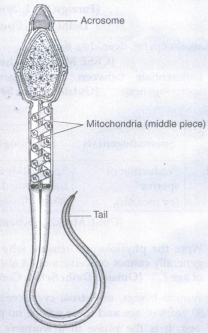
Functions:
Acrosome : filled with enzymes that help enter the ovum.
Mitochondia (middle piece) : energy source for movement of tail to reach ovum.
Tail : For motility
29.
Co-extinction is most severe in mutualism and parasitism.
| Interaction | Effect on species A | Effect on species A | Example |
| Mutualism (beneficial to both, obligatory) | (+) | (+) | Lichen (mutualism between algae and a fungus) |
| Parasitism (parasite benefitted, host harmed) | (+) | (-) | Barnacles and whales |
30.
(i) The septal nuclei or septum present in the amygdala is associated with sexual emotions.
(ii) Yes, it is necessary to guide and instruct the nature of HIV/AID, methods of its transmission, strategies to reduce the risk of human immunodeficiency virus infection and society related issues to the students in school.
(iii) Amygdala and hippocampus together from a region which was formerly called rhinencephalon but is also called emotional brain due to its association with emotional functioning.
31.
Three uses of PCR are:
(i) It is used to during rDNA for production of newer and desired DNA
(ii) It is used for DNA sequencing.
(iii) It is used in DNA figerprinting.
32.
1.(i); 2. (d), (h), 3. (g); 4. (a); 5. (c); 6.(f) ; 7.(b), (e)
33.
Griffith's experiment to demonstrate
DNA as genetic material.
Transformation experiments were initially conducted by F. Griffith in 1928.
1. He injected a mixture of two strains of Pneumococcus (Diplococcus pneumoniae) into mice. One ofthese two strains S III as virulent and the other strain RII was non-virulent, i.e., causes no infection.
2. The S III type bacteria when injected into mice cause pneumonia and ultimately to death. The R II type bacteria when injected, no pneumonia occurred.
3.The S III bacteria, prior to injection are killed by heating. It is then injected into the mice. It did not cause the disease.
4. Heat killed S III and R II (non-virulent) bacteria, when injected into mice, caused pneumonia. Finally death occurred.
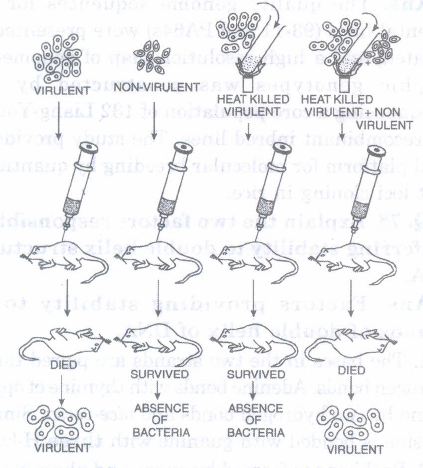
5. This proved that DNA of S III type bacteria has transformed the DNA of R II type bacteria into virulent type S III. This phenomenon of transferring characters of one strain to another by using a DNA extract of former is called transformation.
Conclusion. Griffith concluded that virulence was transferred fromS-Typedead cells to R-Type living cells in the form of capsule (some component of cell) rather than the whole cells.
Contribution of Avery, MacCleod and McCarty
6. Avery, MacCleod and McCarty gave the proof that transforming agent is DNA. They carried out the experiments with Diplococcus and showed transformation of type R-U to type S-III. They gave proof that active component was DNA and not the RNA or Proteins or Polysaccharides.
34.
(a) Disadvantages of inbreeding among cattle.
1. It reduces fertility.
2. It also reduces productivity (Less milk per lactation).
It is termed inbreeding depression.
(b) It can be overcome by breeding selected animals with unrelated superior animals.
35.
(i) 'a' represents exponential growth curve. 'K' represents carrying capacity, i.e. the maximum number of individuals of a population that the given environment can sustain.
(ii) Curve 'b' is considered more realistic.
(iii) Curve 'a'. In the absence of predators and unlimited resources, the populations grow exponentially.
36.
(i) Acetic acid - Acetobacter aceti
(ii) Butyric acid - Clostridium butylicum
(iii) Lacteric acid - Lactobacillus delbruekii
37.
1. After entering the body of a person,the virus enters the macrophages.
2. The viral genome (RNA) undergoes replication and reverse transcription to become viral DNA with the help of reverse transcriptase.
3. The viral DNA gets incorporated into the DNA of the cells and directs these cells to produce virus particles.
4. The macrophages function as HIV factory and produce a number of HIV particles.
5. These HIV particles move out of macrophages and infect the helper T-lymphocytes and replicant to produce progeny viruses.
6. The progeny viruses released in the blood attack new helper T- cells.
7. This process is repeated and there is a progressive decrease in the number of helper T-cells.
38.
(i) Silurian - Zosterophyllum, Psilophyton
(ii) Devonian - Progymnosperm
(iii) Carboniferous - Seed fern
(iv) Permian - Arborescent Lycopods
39.
| Aneploidy | Polyploidy |
| It is the phenomenon of loss or gain of one or more chromosomes from any pair(s) of chromosomes in a diploid cell/ organism, called aneuploid. | It is the presence of three or more sets of chromosomes in an organism, called polyploid. |
|
It arises due to failure of segergation of members of one/more pair (s) of homologous chromsomes. |
It arises due to failure of cytokineses following the telophase stage of cell division. It is found in many plants. |
40.
(d)
CO2 and N2O
41.
(c)
endoderm
42.
(b)
convergent evolution
43.
(d)
\(\frac { Energy\quad in\quad biomass\quad production\quad at\quad a\quad trophic\quad level\times 100 }{ Energy\quad in\quad biomass\quad production\quad at\quad previous\quad trophic\quad level } \)
44.
(c)
its gene pool will be lost forever
45.
(a)
Nicotine
46.
(d)
cleistogamy
47.
(c)
Vivipary
48.
(c)
1.0 billion times
49.
(d)
pallindromic sequence of base pairs
50.
(c)
Rhizobium
51.
(b)
Desert
52.
(a)
honey
53.
(a)
non-homologous chromosomes
54.
(a)
AUG
55.
(c)
| A | B | C | D |
| 3 | 1 | 4 | 2 |

12th Standard CBSE Syllabus & Materials
12th Standard CBSE
CBSE 12th Computer Science Python Revision Tour I - New Previous year Question Papers Study Material - QB365 Set A
NEW12th Standard CBSE
CBSE 12th Business Studies Planning Important Questions And Answers Study Material - QB365 Set A
NEW12th Standard CBSE
CBSE 12th Business Studies Business Environment Important Questions And Answers Study Material - QB365 Set A
NEW12th Standard CBSE
CBSE 12th Business Studies Principles of Management Important Questions And Answers Study Material - QB365 Set A



CBSE 12th Standard CBSE Subjects
CBSE Standards










