
 100% FREE ACCESS
12th Standard CBSE Syllabus & Materials
12th Standard CBSE
CBSE 12th Economics Government Budget and the Economy Previous year Question Papers Study Material - QB365 Set A
NEW12th Standard CBSE
CBSE 12th Computer Science Interface Python with MySQL - New Previous year Question Papers Study Material - QB365 Set A
NEW12th Standard CBSE
CBSE 12th Computer Science Database Concept - New Previous year Question Papers Study Material - QB365 Set A
NEW12th Standard CBSE
CBSE 12th Computer Science Data Communication - New Previous year Question Papers Study Material - QB365 Set A
NEW12th Standard CBSE
CBSE 12th Computer Science Data Structures - New Previous year Question Papers Study Material - QB365 Set A
NEW12th Standard CBSE
CBSE 12th Computer Science Functions - New Previous year Question Papers Study Material - QB365 Set A

Published on: 15/02/2020
12th Standard CBSE Mathematics Public Model Question Paper I 2019 - 2020
Download CBSE Class 12th Standard CBSE Maths question papers, sample papers, important questions, and previous year solved papers in PDF format. Get free study materials, NCERT solutions, and exam preparation resources for Class 12th Standard CBSE Maths
Questions + Answers key
Take MCQ Maths Test
1.
The sum of three numbers is -1. If we multiply the second number by 2 , third number by 3 and add them we get 5. If we subtract the third number from the sum of first and second numbers we get -1. Represent it by a system of equations . Find the three numbers using inverse of a matrix
2.
Using Principle of Mathematical Induction , prove that
\({ A }^{ n }=\left[ \begin{matrix} 1+2n & -4n \\ n & 1-2n \end{matrix} \right] \) where, \(A=\left[ \begin{matrix} 3 & -4 \\ 1 & -1 \end{matrix} \right] \)
3.
Solve tan-1 2x + tan-13x = \(\frac { \pi }{ 4 } \)
4.
If \(\overrightarrow { a } ,\overrightarrow { b } ,\overrightarrow { c } \) are unit vectors such that \(\overrightarrow { a } .\overrightarrow { b } =\overrightarrow { a } .\overrightarrow { c } =0\) and the angle between \(\overrightarrow { b } \) and \(\overrightarrow { c } \) is \(\frac{\pi}{6}\) , then prove that:
(i) \(\overrightarrow { a } =\pm 2\left( \overrightarrow { b } \times \overrightarrow { c } \right) \)
(ii) \(\left[ \overrightarrow { a } +\overrightarrow { b } ,\overrightarrow { b } +\overrightarrow { c } ,\overrightarrow { c } +\overrightarrow { a } \right] =\pm 1\)
5.
Five bad oranges are accidently mixed with 20 good ones. If four oranges are drawn one by one successively with replacement, then find the probability distribution of number of bad oranges drawn. Hence, find the mean and variance of the distribution.
6.
Evaluate : \(\int { \frac { { x }^{ 2 }+x+1 }{ (x+2)({ x }^{ 2 }+1) } } dx\)
7.
If \(A=\left[ \begin{matrix} 1 & 2 & 1 \\ -1 & 1 & 1 \\ 1 & -3 & 1 \end{matrix} \right] ,\) find A-1. Hence solve the system of equations : x + 2y + z = 4, -x + y+ z = 0, x - 3y + z = 4.
8.
A given rectangular area is to be fenced off, in a field whose length lies along the river. Show that the least length will be required when length of the field is twice its breadth.
9.
Let * be a binary operation defined on Q x Q by (a, b) * (c, d) = (ac, b + ad). where Q is the set of rational numbers. Determine, whether * is commutative and associative. Find the identity element for * and the invertible elements of Q x Q.
10.
If \(\sin ^{ -1 }{ x } +\sin ^{ -1 }{ y } +\sin ^{ -1 }{ z } =\pi ,\) then prove that \(x\sqrt { 1-{ x }^{ 2 } } +y\sqrt { 1-{ y }^{ 2 } } +z\sqrt { 1-{ z }^{ 2 } } =2xyz.\)
11.
Is the function f (x)=\(\begin{cases} \frac { { e }^{ 1/x }-1 }{ { e }^{ 1/x }+1 } \ \ \ ,\ if\quad x\neq 0 \\ \quad \quad 0 \ \ \ , \ \ if\quad x=0 \end{cases}\) continuous at x=0?
12.
Find : \(\int { (3x+1)\sqrt { 4-3x-2x^{ 2 } } } dx\)
13.
Solve the following Linear Programming Problems graphically:
Maximise Z = 5x + 3y
subject to 3x + 5y ≤ 15, 5x + 2y ≤ 10, x ≥ 0, y ≥ 0
14.
Show that the line joining the midpoints of the two sides of the triangle is parallel to the third side and is half of its length.
15.
(Manufacturing Problem) A manufacturing company makes two models A and B of a product. Each piece of Model A requires 9 labour hours for fabricating and 1 labour hour for finishing. Each piece of Model B requires 12 labour hours for fabricating and 3 labour hours for finishing. For fabricating and finishing, the maximum labour hours available are 180 and 30 respectively. The company makes a profit of Rs. 12,000 on each piece of Model B. How many pieces of Model A and Model B should be manufactured per week to realise a maximum profit? What is the maximum profit per week?
16.
Using elementary transformations, find the inverse of matrix \(\begin{bmatrix} 6 & -3 \\ -2 & 1 \end{bmatrix}\)
17.
(i) If a triangular field is bounded by the lines:
x + 2y = 2, y - x = 1 and 2x + y = 7.
Using integration, compute the area of the field.
(ii) In each square unit area 4 trees may be planted. Find the number of trees which can be planted in the field.
(iii) Why plantation of trees is necessary?
18.
In a bank, principal increases continuously at the rate of 5% per year. In how many years Rs 1000 double itself?
19.
Find dy/dx in the following: \({ sin }^{ 2 }y+cosxy=\pi \)
20.
Find the area enclosed between the parabola y2 = 4ax and the line y = mx.
21.
2x - y = 5
x + y = 4 Prove that the given equations are consistent or not
22.
Show that :
\({ sin }^{ -1 }(2x\sqrt { 1-{ x }^{ 2 } } )={ 2cos }^{ -1 }x,\frac { 1 }{ \sqrt { 2 } } \le x\le 1.\)
23.
There are three coins. One is a two headed coin (having head on both faces), another is a biased coin that comes up tails 25% of the times and the third is an unbiased coin. One of the three coins is chosen at random and tossed, it shows head, what is the probability that it was from the two headed coin?
24.
Solve the differential equation : y(ex + 1)dy = (y + 1) ex dx.
25.
If, A = |aij| = \(\left[ \begin{matrix} 2 & 3 & -5 \\ 1 & 4 & 9 \\ 0 & 7 & -2 \end{matrix} \right] \)and B =|bij| =\(\left[ \begin{matrix} 2 & -1 \\ -3 & 4 \\ 1 & 2 \end{matrix} \right] \) Write the value of
(i)a22 + b21
(ii) a11b11 +a22b22
26.
Evaluate : \(\int _{ 0 }^{ 1 }{ x{ e }^{ x } } dx\)
27.
If y = tan-1\(\sqrt { \frac { sinx }{ 1+cosx } , } find\frac { dy }{ dx } \)
28.
Find vector equation as well as cartesian equation which is passes through the point (1, 2, 3) and is parallel to the vector 3i + 2j - 3k.
29.
If P(E) = \(\frac { 7 }{ 13 } \) , P(F) = \(\frac { 9 }{ 13 } \) and P(E\(\cap\)F) = \(\frac { 4 }{ 13 } \),then evaluate :
(a) \(P(\overline { E } /F)\)
(b) \(P(\overline { E } /F)\)
30.
If \(\overset\rightarrow a=3\overset\wedge i+7\overset\wedge j+2\overset\wedge k,\overset\rightarrow b=7\overset\wedge i-2\overset\wedge j+3\overset\wedge k\). Is \(\left|\overset\rightarrow a \right| =\left|\overset\rightarrow b \right| \).Can we say \(\overset\rightarrow a=\overset\rightarrow b?\)Give reason.
31.
Solve the differential equation \(\frac { dy }{ dx } ={ e }^{ x-y }+x{ e }^{ -y }\).
32.
Show that : \({ sin }^{ -1 }\frac { 5 }{ 13 } +{ cos }^{ -1 }\frac { 3 }{ 5 } ={ tan }^{ -1 }\frac { 63 }{ 16 } \)
33.
Define Transitive Relation. Give one example.
34.
If \(A=\left[ \begin{matrix} 2 & 1 \\ 3 & 4 \end{matrix} \right] ,B=\left[ \begin{matrix} -1 & 4 \\ 0 & 2 \end{matrix} \right] \), show that \(AB\neq BA\).
35.
If \(A=\left| \begin{matrix} 2 & 3 & -1 \\ 4 & 1 & 0 \\ 3 & 3 & 2 \end{matrix} \right| \) , find \(M_{ 12 }\times M_{ 21 }+C_{ 21 }\times C_{ 12 }\) when Mjj called minor and Cjj called co-factors of A.
36.
Area of the region bounded by the curve y2 = 2y – x and y-axis is:
4/3 sq. units
3/4 sq. units
4 sq. units
3 sq. units
37.
A stone is dropped into a quiet lake and waves move in circles at a speed of 2cm per second. At the instant, when the radius of the circular wave is 12 cm, how fast is the enclosed area changing ?
Decreasing at the rate of 48π cm2 / sec
Increasing at the rate of 24π cm2 / sec
Increasing at the rate of 48π cm2 / sec
Decreasing at the rate of 24π cm2 / sec
38.
The equations of y-axis in space are
x = 0, y = 0
x = 0, z = 0
y = 0, z = 0
y = 0
39.
Set A has 3 elements and the set B has 4 elements. Then the number of injective functions that can be defined from set A to set B is
144
12
24
64
1.
Let numbers be x, y, z then
x + y + z = -1
2y + 3z = 5
x + y – z = -1
\(x=-\frac { 7 }{ 2 } \), y = \(\frac { 5 }{ 2 } \), z = 0
2.
Order of A = 2 x 3
\(A=\left[ \begin{matrix} 1 & -2 & -5 \\ 3 & 4 & 0 \end{matrix} \right] \)
3.
\(\text { We have } \tan ^{-1} 2 x+\tan ^{-1} 3 x=\frac{\pi}{4}\)
\(\text { Or }\tan ^{-1}\left(\frac{2 x+3 x}{1-2 x \times 3 x}\right)=\frac{\pi}{4}\)
\(\text { i.e. }\tan ^{-1}\left(\frac{5 x}{1-6 x^{2}}\right)=\frac{\pi}{4}\)
\(\text { Therefore } \quad \frac{5 x}{1-6 x^{2}}=\tan \frac{\pi}{4}=1\)
\(\text { or } \quad 6 x^{2}+5 x-1=0 \text { i.e., }(6 x-1)(x+1)=0\)
\(\text { which gives } \ x=\frac{1}{6} \text { or } x=-1 .\)
Since x = – 1 does not satisfy the equation, as the L.H.S. of the equation becomes negative\(x=\frac{1}{6}\) is the only solution of the given equation
4.
As given \(\overrightarrow { a } .\overrightarrow { b } =\overrightarrow { a } .\overrightarrow { c } =0=\overrightarrow { a } \bot \)both \(\overrightarrow { b } \) and \(\overrightarrow { c } \)
⇒ \(\overrightarrow { a } \parallel \left( \overrightarrow { b } \times \overrightarrow { c } \right) \)
Let \(\overrightarrow { a } =\lambda \left( \overrightarrow { b } \times \overrightarrow { c } \right) \)
then \(\left| \overrightarrow { a } \right| =\left| \lambda \right| \left| \left( \overrightarrow { b } \times \overrightarrow { c } \right) \right| \)
⇒ \(\frac { \left| \overrightarrow { a } \right| }{ \left| \left( \overrightarrow { b } \times \overrightarrow { c } \right) \right| } =\left| \lambda \right| \)
⇒ \(\left| \lambda \right| =\frac { 1 }{ sin\frac { \pi }{ 6 } } =2\)
λ = 士2
\(\overrightarrow { a } =\pm 2\left( \overrightarrow { b } \times \overrightarrow { c } \right) \)
Hence proved
(ii) Now \(\left[ \overrightarrow { a } +\overrightarrow { b } ,\overrightarrow { b } +\overrightarrow { c } ,\overrightarrow { c } +\overrightarrow { a } \right] \)
= \(\left[ \left( \overrightarrow { a } +\overrightarrow { b } \right) \times \left( \overrightarrow { b } \times \overrightarrow { c } \right) \right] .\left( \overrightarrow { c } +\overrightarrow { a } \right) \)
= \(\left( \overrightarrow { a } \times \overrightarrow { b } \right) .\overrightarrow { c } +\left( \overrightarrow { b } \times \overrightarrow { c } \right) .\overrightarrow { a } \)
(As the scalar triple product = 0, if any two vectors are equal)
Hence, \(\overrightarrow { a } .\left( \overrightarrow { b } \times \overrightarrow { c } \right) +\left( \overrightarrow { a } \times \overrightarrow { b } \right) .\overrightarrow { c } \) = \(\overrightarrow { a } .\left( \overrightarrow { b } \times \overrightarrow { c } \right) +\overrightarrow { c } \left( \overrightarrow { b } \times \overrightarrow { c } \right) \)
= 2\(\overrightarrow { a } \left( \overrightarrow { b } \times \overrightarrow { c } \right) \)
= \(2\overrightarrow { a } \left( \pm \frac { 1 }{ 2 } \overrightarrow { a } \right) \)
= 士1
Hence proved
5.
Total number of oranges = 25
number of good oranges = 20
number of bad oranges = 5
Probability of getting a bad orange,
\(P(B)=\frac { 5 }{ 25 } =\frac { 1 }{ 5 } \)
Now \(p=\frac { 1 }{ 5 } \)
\(\\ q=1-p=\frac { 4 }{ 5 } \)
Let X be the random variable of "Number of bad oranges".
\(\Rightarrow X=0,1,2,3,4\)
\(P(X=0)={ n }_{ { C }_{ r } }{ \left( p \right) }^{ n-r }{ \left( q \right) }^{ r }\)
\(P(X=0)={ 4 }_{ { C }_{ 0 } }{ \left( \frac { 4 }{ 5 } \right) }^{ 4 }=\frac { 256 }{ 625 } \)
\(P(X=1)=4\times \frac { 64 }{ 125 } \times \frac { 1 }{ 5 } =\frac { 256 }{ 625 } \)
\(P(X=2)={ 4 }_{ { C }_{ 2 } }{ \left( \frac { 4 }{ 5 } \right) }^{ 2 }{ \left( \frac { 1 }{ 5 } \right) }^{ 2 }\)
\(=6\times \frac { 16 }{ 625 } =\frac { 96 }{ 625 } \)
\(P(X=3)={ 4 }_{ { C }_{ 3 } }\left( \frac { 4 }{ 5 } \right) { \left( \frac { 1 }{ 5 } \right) }^{ 3 }\)
\(=4\times \frac { 4 }{ 625 } =\frac { 16 }{ 625 } \)
\(P(X=4)={ 4 }_{ { C }_{ 4 } }{ \left( \frac { 4 }{ 5 } \right) }^{ 0 }{ \left( \frac { 1 }{ 5 } \right) }^{ 4 }\)
\(=\frac { 1 }{ 625 } \)
\(\therefore\) Probability distribution is
| X | P(X) | XP(X) | X2P(X) |
| 0 | 256/625 | 0 | 0 |
| 1 | 256/625 | 256/625 | 256/625 |
| 2 | 96/625 | 192/625 | 384/625 |
| 3 | 16/625 | 48/625 | 144/625 |
| 4 | 1/625 | 4/625 | 16/625 |
\(\therefore Mean=\sum { XP(X) } \)
\(=\frac { 500 }{ 625 } =\frac { 20 }{ 25 } =\frac { 4 }{ 5 } \)
\(Var.\quad (X)=E({ X }^{ 2 })-[E(X){ ] }^{ 2 }\)
\(=\frac { 800 }{ 625 } -\frac { 16 }{ 25 } \)
\(Var.(X)=\frac { 32 }{ 25 } -\frac { 16 }{ 25 } =\frac { 16 }{ 25 } \)
6.
\(I=\int { \frac { { x }^{ 2 }+x+1 }{ (x+2)({ x }^{ 2 }+1) } } dx\)
\(=\int { \left[ \frac { A }{ (x+2) } +\frac { Bx+C }{ ({ x }^{ 2 }+1) } \right] dx } \)
\(\Rightarrow A{ x }^{ 2 }+A+B{ x }^{ 2 }+2Bx+Cx+2C\)
\(=x+{ x }^{ 2 }+1\)
\(A+B=1\)
\(2B+C=1\)
\(A+2C=1\)
\(A=3/5,\)
\(B=2/5,\)
and \(C=1/5\)
\(\therefore I=\int { \left[ \frac { 3 }{ 5(x+2) } +\frac { \frac { 2 }{ 5 } x+\frac { 1 }{ 5 } }{ ({ x }^{ 2 }+1 } \right] dx } \)
\(=\frac { 1 }{ 5 } \int { \left[ \frac { 3 }{ (x+2) } +\frac { 2x+1 }{ ({ x }^{ 2 }+1) } \right] } dx\)
\(=\frac { 1 }{ 5 } \left[ \int { \frac { 3 }{ (x+2) } } dx+\int { \frac { 2x+1 }{ ({ x }^{ 2 }+1) } dx+\int { \frac { 1 }{ ({ x }^{ 2 }+1) } dx } } \right] \)
\({ I }_{ 1 }=\frac { 1 }{ 5 } \int { \frac { 3 }{ (x+2) } } dx\)
\(=\frac { 3 }{ 5 } log(x+2)+{ C }_{ 1 }\)
\({ I }_{ 2 }=\frac { 1 }{ 5 } \int { \frac { 2x }{ ({ x }^{ 2 }+1) } } dx\)
Let \({ x }^{ 2 }+1=t,\Rightarrow 2xdx=dt\)
\(=\frac { 1 }{ 5 } \int { \frac { dt }{ t } =\frac { 1 }{ 5 } logt } \)
\(=\frac { 1 }{ 5 } log(1+{ x }^{ 2 })+{ C }_{ 2 }\)
\({ I }_{ 3 }=\frac { 1 }{ 5 } \int { \frac { 1 }{ { x }^{ 2 }+1 } dx } \)
\(=\frac { 1 }{ 5 } tan^{ -1 }x+{ C }_{ 3 }\)
\(\therefore I=\frac { 1 }{ 5 } \left[ 3log(x+2)+log(1+{ x }^{ 2 })+tan^{ -1 }x \right] +C\)
7.
Given \(A=\left[ \begin{matrix} 1 & 2 & 1 \\ -1 & 1 & 1 \\ 1 & -3 & 1 \end{matrix} \right] \)
|A| = 1(1+3)-2(-1-1)+1(3-1)
= 4 + 4 + 2 = 10
Co-factor Matrix is :
\(=\left[ \begin{matrix} 4 & 2 & 2 \\ -5 & 0 & 5 \\ 1 & -2 & 3 \end{matrix} \right] \)
\(\therefore\) adj A = transpose of above matrix
\(=\left[ \begin{matrix} 4 & -5 & 2 \\ 2 & 0 & -2 \\ 2 & 5 & 3 \end{matrix} \right] \quad \)
\(\therefore { A }^{ -1 }=\frac { adj\quad A }{ |A| } \)
\(=\frac { 1 }{ 10 } \left[ \begin{matrix} 4 & -5 & 2 \\ 2 & 0 & -2 \\ 2 & 5 & 3 \end{matrix} \right] \quad \)
\(\Rightarrow { A }^{ -1 }=\left[ \begin{matrix} 2/5 & -1/2 & 1/10 \\ 1/5 & 0 & -1/5 \\ 1/5 & 1/2 & 3/10 \end{matrix} \right] \)
Given set of equations are:
x + 2y + z = 4
-x + y + z = 0
x - 3y + z = 4
\(\Rightarrow \quad \left[ \begin{matrix} 1 & 2 & 1 \\ -1 & 1 & 1 \\ 1 & -3 & 1 \end{matrix} \right] \left[ \begin{matrix} x \\ y \\ z \end{matrix} \right] =\left[ \begin{matrix} 4 \\ 0 \\ 4 \end{matrix} \right] \)
\(\Rightarrow \quad A.X=B\)
Multiplying both sides by A-1 , we get
\({ A }^{ -1 }AX={ A }^{ -1 }B\)
\(\Rightarrow X={ A }^{ -1 }B\)
\(\Rightarrow \left[ \begin{matrix} x \\ y \\ z \end{matrix} \right] =\left[ \begin{matrix} 2/5 & -1/2 & 1/10 \\ 1/5 & 0 & -1/5 \\ 1/5 & 1/2 & 3/10 \end{matrix} \right] \left[ \begin{matrix} 4 \\ 0 \\ 4 \end{matrix} \right] \)
\(\Rightarrow \left[ \begin{matrix} x \\ y \\ z \end{matrix} \right] =\left[ \begin{matrix} \frac { 8 }{ 5 } +\frac { 2 }{ 5 } \\ \frac { 4 }{ 5 } -\frac { 4 }{ 5 } \\ \frac { 4 }{ 5 } +\frac { 6 }{ 5 } \end{matrix} \right] \)
\(\Rightarrow \left[ \begin{matrix} x \\ y \\ z \end{matrix} \right] =\left[ \begin{matrix} 2 \\ 0 \\ 2 \end{matrix} \right] \)
\(\therefore \ x=2,y=0,z=2\)
8.
Let length be x m and breadth be y m.
༜ Length of fence L = x + 2y
Let given area \(=a\Rightarrow xy=a\ or\ y=\frac{a}{x}\)
\(\Rightarrow L=x+\frac{2a}{a}\)
\(\Rightarrow \frac{dL}{dx}=1-\frac{2a}{x^2}\)
For maxima or minima,
\(\frac{dL}{dx}=0\Rightarrow x^2=2a, \ \therefore x=\sqrt{2a}\)
\(\frac{d^2L}{dx^2}=\frac{2a}{x^3}>2\)
For minimum length,
\(L=\sqrt{2a}+\frac{2a}{\sqrt{2a}}\)
\(=2\sqrt{2a}\)
\(x=\sqrt{2a},y=\frac{a}{\sqrt{2a}}=\frac{\sqrt{2a}}{2}=\frac{1}{2}x\)
\(\therefore x=2y\)
9.
Let (a, b), (c, d) E Q x Q. Then b + ad may not be mequal to d + cd. We find that (1, 2) * (2, 3) = (2, 5), (2,3) * (1,2) = (2,7) '*(2, 5) Hence, * is not commutative.
Let, (a, b), (c, d), (e,f> E Q x Q, {(a, b) * (c, d) * (e,f)
= (ace, b + ad + acf)
= (a, b) * {(c, d) * (e, f)
Hence * is associative. 1
(x, y) Q x Q is the identity element for * if 2
(x, y) Q x Q is the inverse of (a, b) E Q x Q if (c, d) * (a, b) = (a, b) * (c, d) = (1,0),
i.e., (ac, b + ad) = (ca, d + cb) = (1,0)
\(\Rightarrow c=\frac { 1 }{ a } ,d=\frac { -b }{ a } \)
The inverse of (a,b) \(\in Q\) XQ \(a\neq 0\quad \left( \frac { 1 }{ a } ,\frac { -b }{ a } \right) \)
10.
Let, \(\sin ^{ -1 }{ x } =\sin { A } \quad \Rightarrow \quad \sin { A } =x\)
\(\sin ^{ -1 }{ y } =\sin { B } \quad \Rightarrow \quad \sin { B } =y\)
\(\sin ^{ -1 }{ z } =\sin { C } \quad \Rightarrow \quad \sin { C } =z\)
\(\Rightarrow \quad A+B+C=\pi \quad \Rightarrow \quad 2A+2B+2C=2\pi \)
\(\therefore \quad sin2A+sin2B+sin2C=4sinAsinBsinC\)
[Using trigonometric property]
\(\Rightarrow \quad 2sinAcosA+2sinBcosB+2sinCcosC=4sinAsinBsinC\)
\(\Rightarrow \quad 2sinA\sqrt { 1-\sin ^{ 2 }{ A } } +2sinB\sqrt { 1-\sin ^{ 2 }{ B } } +2sinC\sqrt { 1-\sin ^{ 2 }{ C } } =4sinAsinBsinC\)
\(\Rightarrow \quad 2x\sqrt { 1-{ x }^{ 2 } } +2y\sqrt { 1-{ y }^{ 2 } } +2z\sqrt { 1-{ z }^{ 2 } } =4xyz\)
\(\Rightarrow \quad x\sqrt { 1-{ x }^{ 2 } } +y\sqrt { 1-{ y }^{ 2 } } +2z\sqrt { 1-{ z }^{ 2 } } =2xyz\)
Hence proved.
11.
\(\mathrm{LHL}=\lim _{x=0} f(0-h)=\lim _{h \rightarrow 0} \frac{e^{-1 / h}-1}{e^{-1 / h}+1} \)
\(=\lim _{h \rightarrow 0} \frac{\frac{1}{e^{1 / h}}-1}{\frac{1}{e^{1 / h}}+1}=\frac{0-1}{0+1}=-1\)
\(\mathrm{RHL} =\lim _{h=0} f(0+h)=\lim _{h \rightarrow 0} \frac{e^{1 / h}-1}{e^{1 / h}+1}=\lim _{h \rightarrow 0} \frac{1-\frac{1}{e^{1 / h}}}{1+\frac{1}{e^{1 / h}}} \)
\(=\frac{1-0}{1+0}=1\)
\(\begin{matrix} LHL \\ x=0 \end{matrix}\neq \begin{matrix} RHL \\ x=0 \end{matrix} \)
\(\therefore \) Discontinuous.
12.
Let \((3x+1)=A\frac { d }{ dx } (4-3x-2x^{ 2 })+B\)
\(\Rightarrow 3x+1=A(-3-4x)+B\)
When \(x=-\frac { 3 }{ 4 } \)
\(3\left( -\frac { 3 }{ 4 } \right) +1=A\left[ -3-4\left( -\frac { 3 }{ 4 } \right) \right] +B\)
\(\Rightarrow -\frac { 9 }{ 4 } +1=B\)
\(\Rightarrow B=-\frac { 5 }{ 4 } \)
When x = 0,
3(0) + 1 = A(-3-0) + B
= -3A + B
\(\Rightarrow 1+\frac { 5 }{ 4 } =-3A\) \(\left( \because B=-\frac { 5 }{ 4 } \right) \)
\(\Rightarrow \frac { 9 }{ 4 } \times \left( -\frac { 1 }{ 3 } \right) =A\)
\(\Rightarrow A=-\frac { 3 }{ 4 } \)
\(\therefore 3x+1=-\frac { 3 }{ 4 } (-3-4x)-\frac { 5 }{ 4 } \)
\(\therefore I=\int { \left[ -\frac { 3 }{ 4 } (-3-4x)-\frac { 5 }{ 4 } \right] \sqrt { 4-3x-2x^{ 2 }dx } } \)
\(=\int { -\frac { 3 }{ 4 } (-3-4x)\sqrt { 4-3x-2x^{ 2 }dx } } -\int { \frac { 5 }{ 4 } } \sqrt { 4-3x-2x^{ 2 }dx } \)
\(=-\frac { 3 }{ 4 } \frac { (4-3x-2x^{ 2 })^{ 3/2 } }{ \frac { 3 }{ 2 } } -\frac { 5 }{ 4 } \int { \sqrt { 2\left( 2-\frac { 3x }{ 2 } -{ x }^{ 2 } \right) } } dx\)
\(=-\frac { 1 }{ 2 } (4-3x-2x^{ 2 })-\frac { 5\sqrt { 2 } }{ 4 } \int { \sqrt { \left( \frac { \sqrt { 41 } }{ 4 } \right) ^{ 2 }-\left( x+\frac { 3 }{ 4 } \right) ^{ 2 } } } dx\)
\(=\frac { 1 }{ 2 } (4-3x-2x^{ 2 })-\frac { 5\sqrt { 2 } }{ 4 } \left[ \frac { 4x+3 }{ 8 } \sqrt { \left( \frac { \sqrt { 41 } }{ 4 } \right) ^{ 2 }-\left( x+\frac { 3 }{ 4 } \right) ^{ 2 } } +\frac { \frac { 41 }{ 16 } }{ 2 } { sin }^{ -1 }\frac { x+\frac { 3 }{ 4 } }{ \frac { \sqrt { 41 } }{ 16 } } \right] +C\)
\(\therefore I=-\frac { 1 }{ 2 } (4-3x-2x^{ 2 })^{ 3/2 }\)
\(=-\frac { 5\sqrt { 2 } }{ 4 } \left[ \frac { 4x+3 }{ 8 } \sqrt { \left( \frac { \sqrt { 41 } }{ 4 } \right) ^{ 2 }-\left( x+\frac { 3 }{ 4 } \right) ^{ 2 } } +\frac { 41 }{ 32 } sin^{ -1 }\frac { 4x+3 }{ \sqrt { 41 } } \right] \)
13.
The feasible region determined by the system of constraints, 3x + 5y ≤ 15, 5x + 2y ≤ 10, x ≥ 0, and y ≥ 0, are as follows.
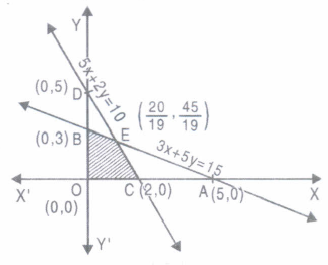
The corner points of the feasible region are O (0, 0), A (2, 0), B (0, 3), and C\(\left( \frac { 20 }{ 19 } ,\frac { 45 }{ 19 } \right) \)
The values of Z at these corner points are as follows.
Corner Point |
Corresponding Value of Z |
| C : (2,0) | 10 |
| E : \(\left( \frac { 20 }{ 19 } ,\frac { 45 }{ 19 } \right) \) | \(\frac { 235 }{ 19 } \) (Maximum) |
| B : (0,3) | 9 |
| O : (0,0) | 0 |
Therefore, the maximum value of Z is \(\frac { 235 }{ 19 } \) at \(\left( \frac { 20 }{ 19 } ,\frac { 45 }{ 19 } \right) \).
14.
Let A (x1 ,y1 ,z1 ), B(x2, y2, z2) and C(x3, y3, z3)be the vertices of
\(\Delta \)ABC. If D, E are mid-points of [AB] and [AC] respectively, then their co-ordinates are
\(\left( \frac { { x }_{ 1 }+{ x }_{ 2 } }{ 2 } ,\frac { { y }_{ 1 }+{ y }_{ 2 } }{ 2 } ,\frac { { z }_{ 1 }+{ z }_{ 2 } }{ 2 } \right) \)
\(and\ \left( \frac { { x }_{ 1 }+{ x }_{ 3 } }{ 2 } ,\frac { { y }_{ 1 }+{ y }_{ 3 } }{ 2 } ,\frac { { z }_{ 1 }+{ z }_{ 3 } }{ 2 } \right) \) respectively
Now direction-ratios of BC are:
\(<{ x }_{ 3 }-{ x }_{ 2 },{ y }_{ 3 }-{ y }_{ 2 },{ z }_{ 3 }-{ z }_{ 2 }>\)
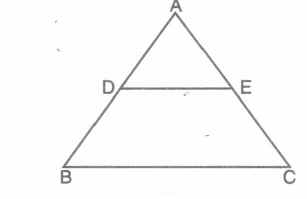
and direction-ratios of DE are:
\(<\frac { { x }_{ 1 }+{ x }_{ 3 } }{ 2 } -\frac { { x }_{ 1 }+{ x }_{ 2 } }{ 2 } ,\frac { { y }_{ 1 }+{ y }_{ 3 } }{ 2 } -\frac { { y }_{ 1 }+{ y }_{ 2 } }{ 2 } ,\frac { { z }_{ 1 }+{ z }_{ 3 } }{ 2 } -\frac { { z }_{ 1 }+{ z }_{ 2 } }{ 2 } >\)
\(i.e.<\frac { { x }_{ 3 }-{ x }_{ 2 } }{ 2 } ,\frac { { y }_{ 3 }-{ y }_{ 2 } }{ 2 } ,\frac { { z }_{ 3 }-{ z }_{ 2 } }{ 2 } >\)
\(i.e.<{ x }_{ 3 }-{ x }_{ 2 },{ y }_{ 3 }-{ y }_{ 2 },{ z }_{ 3 }-{ z }_{ 2 }>\)
Thus DE are||BC
Now
\(|DE|=\sqrt { { \left( \frac { { x }_{ 1 }+{ x }_{ 3 } }{ 2 } -\frac { { x }_{ 1 }+{ x }_{ 2 } }{ 2 } \right) }^{ 2 }+{ \left( \frac { { y }_{ 1 }+{ y }_{ 3 } }{ 2 } -\frac { { y }_{ 1 }+{ y }_{ 2 } }{ 2 } \right) }^{ 2 }+{ \left( \frac { { z }_{ 1 }+{ z }_{ 3 } }{ 2 } -\frac { { z }_{ 1 }+{ z }_{ 2 } }{ 2 } \right) }^{ 2 } }\)
\(=\frac { 1 }{ 2 } \sqrt { { \left( { x }_{ 3 }-{ x }_{ 2 } \right) }^{ 2 }+{ \left( { y }_{ 3 }-{ y }_{ 2 } \right) }^{ 2 }+{ \left( { z }_{ 3 }-{ z }_{ 2 } \right) }^{ 2 } } \)
\(=\frac { 1 }{ 2 } |BC|\)
Hence, DE||BC and |DE| = 1/2BC
15.
Let 'x' and 'y' be the number of pieces of Model A and Model B respectively.
We have: \(x\ge 0\) ....(1)
\(y\ge 0\) .....(2)
\(9x+12y\le 180\quad i.e.3x+4y\le 60\) .....(3)
\(x+3y\le 30\)....(4)
The mathematical formulation of the problem is as be low:
Maximize Z = 8000x + 12000y subject to the constraints (1)-(4).
For solution set, we draw the lines:
x = 0, y = 0, 3x + 4y = 60 and 3y = 30.
The lines 3x + 4y = 60 and x + 3y = 30 meet at E (12, 6).
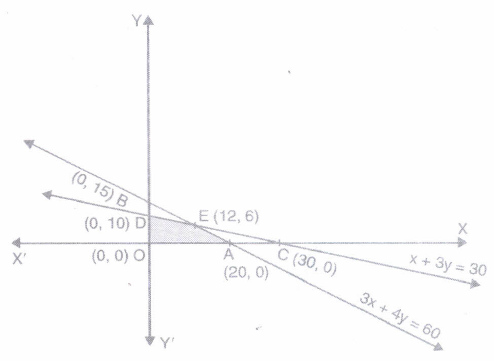
The shaded portion represents the feasible region, which is bounded.
Applying Corner Point Method, we have:
| Corner Point | Z = 8000x +12000y |
| O : (0,0) | 0 |
| A : (20,0) | 160000 |
| E : (12,6) | 168000 (Maximum) |
| D : (0,10) | 120000 |
Hence, the maximum profit is Rs. 1,68,000 when 12 pieces of Model A and 6 pieces of Model B are manufactured per week.
16.
\(We\quad know\quad that\quad A={ I }_{ 2 }A\)
\(i.e.\ \begin{bmatrix} 6 & -3 \\ -2 & 1 \end{bmatrix}=\begin{bmatrix} 1 & 0 \\ 0 & 1 \end{bmatrix}A\)
\( \Rightarrow \begin{bmatrix} -2 & 1 \\ 6 & -3 \end{bmatrix}=\begin{bmatrix} 0 & 1 \\ 1 & 0 \end{bmatrix}A\quad [Applying\quad { R }_{ 1 }\leftrightarrow { R }_{ 2 }]\)
\( \Rightarrow \begin{bmatrix} -2 & 1 \\ 0 & 0 \end{bmatrix}=\begin{bmatrix} 0 & 1 \\ 1 & 3 \end{bmatrix}A\quad [Applying\quad { R }_{ 2 }\rightarrow { R }_{ 2 }+3{ R }_{ 1 }]\)
Since second row of LHS matrix has all zero,
\(\therefore \ { A }^{ -1 }\) does not exist.
17.
(i) As usual, area of the field - 6 sq. units.
(ii) No.of trees = 4 \(\times\)26 = 104.
(iii) Plants provide us oxygen and play major role in rains, so plantation is necessary for all human beings.
18.
Let 'P' be the principal at any time t.
By the question.\(\frac { dP }{ dt } =\frac { 5 }{ 100 } P\)
\(\Rightarrow \)\(\frac { dP }{ P } =\frac { 1 }{ 20 } dt\) | Variables Separable
Integrating, \(\int { \frac { dP }{ P } =\frac { 1 }{ 20 } \int { 1.dt+c } } \)
\(\Rightarrow \) \({ log }_{ e }P=\frac { 1 }{ 20 } t+c\)....(1)
\(\left[\therefore P>0\right]\)
When \(t=0,P=1000,{ log }_{ e }1000=0+c\Rightarrow c={ log }_{ e }1000.\)
Putting in (1), \({ log }_{ e }P=\frac { 1 }{ 20 } t+{ log }_{ e }1000\) ..(2)
When \(P=2000,{ log }_{ e }2000=\frac { 1 }{ 20 } t+{ log }_{ e }1000\)
\(\Rightarrow \)\(\frac { 1 }{ 20 } t={ log }_{ e }\frac { 2000 }{ 1000 } ={ log }_{ e }\quad 2\Rightarrow t=20{ log }_{ e }2.\)=
Hence, Rs 1000 double in 20 \({ log }_{ e }\) 2 years.
19.
\(we\ have\ :\ { sin }^{ 2 }y+cosxy=\pi \)
\(Diff\ w.r.t.x,\)
\(\Rightarrow 2sin\ y\ cos\ y\frac { dy }{ dx } -sin\ xy\left( x.\frac { dy }{ dx } +y.1 \right) =0\)
\(\Rightarrow (2\ siny\ cos\ y-x\ sinxy)\frac { dy }{ dx } =y\ sin\ xy\)
\(Hence,\ \frac { dy }{ dx } =\frac { y\ sin\ xy }{ sin\ 2y-x\ sin\ xy } \)
20.
The given parabola is :
y2 = 4ax
and the given line is y = mx
Putting the value of y from (2) in (1), we get:
\({ m }^{ 2 }{ x }^{ 2 }=4ax\Rightarrow x({ m }^{ 2 }x-4a)=0\Rightarrow 0,\frac { 4a }{ { m }^{ 2 } } \)
When x = 0, then from (2), y = 0.
When \(x=\frac { 4a }{ { m }^{ 2 } } \), then from (2), \(y=\frac { 4a }{ m } \).
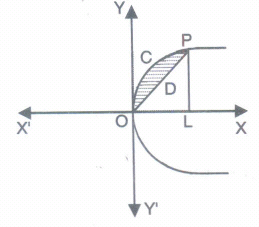
Thus the line (2) meets the parabola at O (0,0) and
\(P\left( \frac { 4a }{ { m }^{ 2 } } ,\frac { 4a }{ m } \right) \)
\(\therefore \ Reqd.area=ar(OCPL)-ar(ODPL)\)
\(=\overset { \frac { 4a }{ { m }^{ 2 } } }{ \underset { 0 }{ \int { } } } (\sqrt { 4ax } -mx)dx\)
\(=2\sqrt { a } \left[ \frac { { x }^{ \frac { 3 }{ 2 } } }{ \frac { 3 }{ 2 } } \right] _{ 0 }^{ \frac { 4a }{ { m }^{ 2 } } }-m\left[ \frac { { x }^{ 2 } }{ 2 } \right] ^{ \frac { 4a }{ { m }^{ 2 } } }_{ 0 }\)
\(=\frac { 4 }{ 3 } \sqrt { a } \left[ \left( \frac { 4a }{ { m }^{ 2 } } \right) ^{ \frac { 3 }{ 2 } }-0 \right] -\frac { m }{ 2 } \left[ \frac { { 16a }^{ 2 } }{ { m }^{ 4 } } -0 \right] \)
\(=\frac { 4 }{ 3 } \sqrt { a } \frac { { 8a }^{ \frac { 3 }{ 2 } } }{ { m }^{ 3 } } -\frac { { 8a }^{ 2 } }{ { m }^{ 3 } } =\frac { 32 }{ 3 } \frac { { a }^{ 2 } }{ { m }^{ 3 } } -\frac { { 8a }^{ 2 } }{ { m }^{ 3 } } \)
\(=\left( \frac { 32 }{ 3 } -8 \right) \frac { { a }^{ 2 } }{ { m }^{ 3 } } =\frac { { 8a }^{ 2 } }{ { 3m }^{ 3 } } sq.units\)
21.
The given equations are:
2x - y = 5
x + y = 4
Here |A| = \(\left|\begin{matrix}2&-1\\1&1\end {matrix}\right|\)
= 2 + 1 = 3 \(\neq\)0
Hence the given system of equations is consistent.
22.
Take x = cos θ, then proceeding as above, we get, \({ \sin }^{ -1 }(2x\sqrt { 1-{ x }^{ 2 } } )\) = 2 cos–1 x
23.
Let the events Be:
E1 : coin is two headed
E2 : coin is biased(heads 75%)
E3 : Coin is biased(tails 40%)
and A : coin shows up head
\(P({ E }_{ 1 })=P({ E }_{ 2 })=P({ E }_{ 3 })=\frac { 1 }{ 3 } \)
\(P(A/{ E }_{ 1 })=1,P(A/{ E }_{ 2 })=\frac { 75 }{ 100 } =\frac { 3 }{ 4 } ,\)
By Bayes' theorem
\(P({ E }_{ 1 }/A)=\frac { P({ E }_{ 1 })P(A/{ E }_{ 1 }) }{ P({ E }_{ 1 })P(A/{ E }_{ 1 })+P({ E }_{ 2 })P(A/{ E }_{ 2 })+P({ E }_{ 3 })P(A/{ E }_{ 3 }) } \)
\(=\frac { \frac { 1 }{ 3 } \times 1 }{ \frac { 1 }{ 3 } \times 1+\frac { 1 }{ 3 } \times \frac { 3 }{ 4 } +\frac { 1 }{ 3 } \times \frac { 3 }{ 5 } } \)
\(=\frac{4}{4+3+2}=\frac{4}{9}\)
24.
\(\Rightarrow \) y - log |y+1| = log|ex + 1| + c
25.
1, 20
26.
\(\Rightarrow I=\int _{ 0 }^{ 1 }{ x{ e }^{ x } } dx\)
\(\Rightarrow I=\left[ \left[ x\int { { e }^{ x }dx } -\int { \left[ \frac { d }{ dx } x\int { { e }^{ x }dx } \right] dx } \right] \right] ^{ 1 }_{ 0 }\)
\(\Rightarrow I=\left[ x{ e }^{ x }-\int { 1.{ e }^{ x }.dx } \right] ^{ 1 }_{ 0 }\)
\(\Rightarrow I=\left[ xe^{ x }-e^{ x } \right] ^{ 1 }_{ 0 }\)
\(\Rightarrow I=\left[ (1e^{ 2 }-e^{ 1 })-({ 0e }^{ 0 }-{ e }^{ 0 } \right] \)
\(\Rightarrow I=(0)-(0-1)=1\)
27.
Given, y = tan-1\(\sqrt { \frac { sinx }{ 1+cosx } } \)
y = tan-1\(\sqrt { \frac { 2sin\frac { x }{ 2 } cos\frac { x }{ 2 } }{ 2{ cos }^{ 2 }\frac { x }{ 2 } } } \)
y = tan-1\(\left( \sqrt { tan\frac { x }{ 2 } } \right) \)
y = tan-1
28.
Position vector of the point (1, 2, 3)
\(\therefore \overset { \rightarrow }{ a } =\overset { \wedge }{ i } +2\overset { \wedge }{ j } +3\overset { \rightarrow }{ k } \)
and parallel to vector \(3\overset { \wedge }{ i } +2\overset { \wedge }{ j } -3\overset { \wedge }{ k } \)
Required vector equation of line
\(\overset { \rightarrow }{ r } =\overset { \rightarrow }{ a\quad } +\lambda \overset { \rightarrow }{ b\quad } \)
\(\Rightarrow \overset { \rightarrow }{ r } =\overset { \rightarrow }{ i } +2\overset { \rightarrow }{ j } +3\overset { \rightarrow }{ k } +l(3\overset { \rightarrow }{ i } +2\overset { \rightarrow }{ j } -3\overset { \rightarrow }{ k } )\)
Cartesian equation
\(\frac { x-1 }{ 3 } =\frac { y-2 }{ 2 } =\frac { z-2 }{ -3 } \)
29.
P(E) = \(\frac { 7 }{ 13 } \)
P(F) = \(\frac { 9 }{ 13 } \)
and P(E\(\cap\)F) = \(\frac { 4 }{ 13 } \)
(a) \(P(\bar { E } /F)=\frac { P(\bar { E } \cap F) }{ P(F) } \)
\(=\frac { P(F)-P(E\cap F)) }{ P(F) } \)
\(=1-\frac { P(E\cap F) }{ P(F) } =1-\frac { \frac { 4 }{ 13 } }{ \frac { 9 }{ 13 } } \)
\(\Rightarrow P(\bar { E } /F)=1-\frac { 4 }{ 9 } =\frac { 5 }{ 9 } \)
(b) \(P(\bar { E } /\bar { F } )=\frac { P(\bar { E } \cap \bar { F } ) }{ P(\bar { F } ) } \)
\(=\frac { P\overline { (E\cup F) } }{ P(\bar { F } ) } \)
\(=\frac { 1-P(E\cup F) }{ 1-P(F) } \)
\(P(E\cup F)=P(E)+P(F)-P(E\cap F)\)
\(=\frac { 7 }{ 13 } +\frac { 9 }{ 13 } -\frac { 4 }{ 13 } \)
\(=\frac { 12 }{ 13 } \)
\(P(E/F)=\frac { 1-\frac { 12 }{ 13 } }{ 1-\frac { 9 }{ 13 } } \)
\(=\frac { \frac { 1 }{ 13 } }{ \frac { 4 }{ 13 } } \)
\(=\frac { 1 }{ 4 } \)
30.
\(\overset\rightarrow a=3\overset\wedge i+7\overset\wedge j+2\overset\wedge k\)
\(\left|\overset\rightarrow a \right| =\sqrt{9+49+4}=\sqrt{62}\)
and
\(b=7\overset\wedge i-2\overset\wedge j+3\overset\wedge k\)
\(\left|\overset\rightarrow b \right| =\sqrt{9+49+4}=\sqrt{62}\)
\(\left|\overset\rightarrow a \right| =\left|\overset\rightarrow b \right| \)
but \(\overset\rightarrow a \neq\overset\rightarrow b\)because their corresponding components are different.
31.
\(\frac { dy }{ dx } ={ e }^{ x-y }+x{ e }^{ -y }\)
\(={ e }^{ -y }\left[ { e }^{ x }+x \right] \)
\(\Rightarrow \frac { dy }{ dx } =\left( { e }^{ x }+x \right) { e }^{ -y }\)
\(\Rightarrow \int { { e }^{ y }dy } =\int { \left( { e }^{ x }+x \right) { dx } } \)
\(\Rightarrow { e }^{ y }={ e }^{ x }+\frac { { x }^{ 2 } }{ 2 } +C\)
32.
\(L.H.S.={ sin }^{ -1 }\frac { 5 }{ 13 } +{ cos }^{ -1 }\frac { 3 }{ 5 } \)
\(\because { sin }^{ -1 }x={ tan }^{ -1 }\left( \frac { x }{ \sqrt { 1-{ x }^{ 2 } } } \right) \)
\({ sin }^{ -1 }\frac { 5 }{ 13 } ={ tan }^{ -1 }\left( \frac { 5/13 }{ \sqrt { 1-25/169 } } \right) \)
\(={ tan }^{ -1 }\frac { (5/13) }{ \sqrt { \frac { 144 }{ 169 } } } ={ tan }^{ -1 }\frac { 5 }{ 12 } \)
\(and\quad { cos }^{ -1 }x={ tan }^{ -1 }\left( \frac { \sqrt { 1-{ x }^{ 2 } } }{ x } \right) \)
\(\therefore \quad { cos }^{ -1 }\frac { 3 }{ 5 } ={ tan }^{ -1 }\left( \frac { \sqrt { 1-\frac { 9 }{ 25 } } }{ \frac { 3 }{ 5 } } \right) \)
\(={ tan }^{ -1 }\left( \frac { \sqrt { \frac { 16 }{ 25 } } }{ \frac { 3 }{ 5 } } \right) ={ tan }^{ -1 }\left( \frac { 4 }{ 3 } \right) \)
\({ tan }^{ -1 }\frac { 5 }{ 12 } +{ tan }^{ -1 }\frac { 4 }{ 3 } ={ tan }^{ -1 }\left[ \frac { \frac { 5 }{ 12 } +\frac { 4 }{ 2 } }{ 1-\frac { 5\times 4 }{ 12\times 3 } } \right] \)
\(\left[ { tan }^{ -1 }x+{ tan }^{ -1 }y={ tan }^{ -1 }\frac { x+y }{ 1-xy } \right] \)
\(={ tan }^{ -1 }\left| \frac { \frac { 15+48 }{ 36 } }{ \frac { 36-20 }{ 36 } } \right| \)
\(={ tan }^{ -1 }\left( \frac { 63 }{ 16 } \right) =R.H.S.\)
33.
A relation R on a non-empty set A is called a transitive relation if (a, b), (b, c) \(\in R\) then (a, c) \(\in R\) , i.e., aRb, bRc implies aRc.
Thus a relation R on a non empty set A is said to be transitive if there exist a, b, c \(\in A\) such that (a, b)(b, c) \(\in R\) implies (a, c) . \(\in R\)
Example
Let A = (1, 2, 3, 6)
R = (3, 6) (6, 1) (3, 1)
3 R 6 and 6 R 1 \(\Rightarrow \)(3, 1) \(\in R\)
\(\therefore\) A is transitive.
34.
We have, \(A=\left[ \begin{matrix} 2 & 1 \\ 3 & 4 \end{matrix} \right] \) and \(B=\left[ \begin{matrix} -1 & 4 \\ 0 & 2 \end{matrix} \right] \)
\(AB=\left[ \begin{matrix} 2 & 1 \\ 3 & 4 \end{matrix} \right] \left[ \begin{matrix} -1 & 4 \\ 0 & 2 \end{matrix} \right] \)
\(AB=\left[ \begin{matrix} -2+0 & 8+2 \\ -3+0 & 12+8 \end{matrix} \right] \)
\(\left[ \begin{matrix} -2 & 10 \\ -3 & 20 \end{matrix} \right] \)
and \(BA=\left[ \begin{matrix} -1 & 4 \\ 0 & 2 \end{matrix} \right] \left[ \begin{matrix} 2 & 1 \\ 3 & 4 \end{matrix} \right] \)
\(=\left[ \begin{matrix} 10 & 15 \\ 6 & 8 \end{matrix} \right] \)
\(\therefore\) \(AB\neq BA\)
35.
We have, \(A=\left| \begin{matrix} 2 & 3 & -1 \\ 4 & 1 & 0 \\ 3 & 3 & 2 \end{matrix} \right| \)
\(M_{ 12 }\left| \begin{matrix} 4 & 0 \\ 3 & 2 \end{matrix} \right| =8-0=8\)
\(M_{ 21 }\left| \begin{matrix} 3 & -1 \\ 3 & 2 \end{matrix} \right| =6+3=9\)
\(C_{ 21 }=-\left| \begin{matrix} 3 & -1 \\ 3 & 2 \end{matrix} \right| =-(6+3)=-9\)
\(C_{ 12 }=-\left| \begin{matrix} 4 & 0 \\ 3 & 2 \end{matrix} \right| =-(8-0)=-8\)
\( M_{ 12 }\times M_{ 21 }+C_{ 21 }\times C_{ 12 }\)
\( 8\times (9)+(-9)(-8)=72+72\)
\(=144\)
36.
(a)
4/3 sq. units
37.
(c)
Increasing at the rate of 48π cm2 / sec
38.
As on the y-axis, x-coordinate and z-coordinate are zeroes
39.
Total injective mappings/functions
= 4 P3 = 4! = 24.

12th Standard CBSE Syllabus & Materials
12th Standard CBSE
CBSE 12th Computer Science Python Revision Tour I - New Previous year Question Papers Study Material - QB365 Set A
NEW12th Standard CBSE
CBSE 12th Business Studies Planning Important Questions And Answers Study Material - QB365 Set A
NEW12th Standard CBSE
CBSE 12th Business Studies Business Environment Important Questions And Answers Study Material - QB365 Set A
NEW12th Standard CBSE
CBSE 12th Business Studies Principles of Management Important Questions And Answers Study Material - QB365 Set A



CBSE 12th Standard CBSE Subjects
CBSE Standards










