
 100% FREE ACCESS
12th Standard CBSE Syllabus & Materials
12th Standard CBSE
CBSE 12th Economics Government Budget and the Economy Previous year Question Papers Study Material - QB365 Set A
NEW12th Standard CBSE
CBSE 12th Computer Science Interface Python with MySQL - New Previous year Question Papers Study Material - QB365 Set A
NEW12th Standard CBSE
CBSE 12th Computer Science Database Concept - New Previous year Question Papers Study Material - QB365 Set A
NEW12th Standard CBSE
CBSE 12th Computer Science Data Communication - New Previous year Question Papers Study Material - QB365 Set A
NEW12th Standard CBSE
CBSE 12th Computer Science Data Structures - New Previous year Question Papers Study Material - QB365 Set A
NEW12th Standard CBSE
CBSE 12th Computer Science Functions - New Previous year Question Papers Study Material - QB365 Set A

Published on: 15/02/2020
12th Standard CBSE Mathematics Public Model Question Paper I 2020
Download CBSE Class 12th Standard CBSE Maths question papers, sample papers, important questions, and previous year solved papers in PDF format. Get free study materials, NCERT solutions, and exam preparation resources for Class 12th Standard CBSE Maths
Questions + Answers key
Take MCQ Maths Test
1.
Let \(f:[4, \infty) \rightarrow[4, \infty)\) be defined by \(f(a)=5^{a(a-4)}\),Then,\( f^{-1}(a) \)is
\(2+\sqrt{4+\log _{5} a}\)
\(2-\sqrt{4+\log _{5} a}\)
\(5+3 \log _{5} a\)
not defined
2.
If x = \(\frac { at }{ 1+{ t }^{ 2 } } ,y=\frac { a{ t }^{ 2 } }{ 1+{ t }^{ 2 } } ,find\frac { dy }{ dx } at\) t = 2
3.
Find the cartesian and vector equation of the line which passes through the point (- 2, 4, - 5) and parallel to the line given by \(\frac{x+3}{3}=\frac{y-4}{5}=\frac{8-z}{-6} .\)
4.
Find the general solution of differential equation
\(\frac { dy }{ dx } +y={ e }^{ -x }\)
5.
Find the projection of \(\overset\rightarrow a+\overset\rightarrow b\) on \(\overset\rightarrow a-\overset\rightarrow b,\)\(\overset\rightarrow a=i+2j+k,\overset\rightarrow b=3\overset\wedge i+\overset\wedge j-\overset\wedge k\).
6.
Prove that if E and F are independent events, then so are the events E and F′.
7.
Prove that \({ cos }^{ -1 }x=2{ sin }^{ -1 }\left( \sqrt { \frac { 1-x }{ 2 } } \right) \)
8.
\(\int { { cos }^{ 3 } } xdx\)
9.
What is meant by one-one function?
10.
Prove that the diagonal elements of a skew symmetric matrix are all zero.
11.
If \(A=\left| \begin{matrix} 6 & 0 & 1 \\ 0 & 1 & 2 \\ 0 & 0 & 4 \end{matrix} \right| \), then show that |2A| = 8|A|:
12.
If \(A=\left[ \begin{matrix} 0 & 0 & 1 \\ 0 & 1 & 0 \\ 1 & 0 & 0 \end{matrix} \right] \), find \({ A }^{ 2 }\). Hence find \({ A }^{ 6 }\).
13.
\(\int _{ 2 }^{ 5 }{ f(x) } dx,\) when: \(f(x)=\left| x-2 \right| +\left| x-3 \right| +\left| x-5 \right| .\)
14.
Show that the minimum of Z occurs at more than two points.
Maximise Z = x + y, subject to x – y ≤ –1, –x + y ≤ 0, x, y ≥ 0.
15.
Show that the function f: \(R\rightarrow R\) given by:
\(f(x)=ax+b,\) where \(a,b\in R,\quad a\neq 0\) is a bijection.
16.
The population of a village increases continuosly at the rate proportional to the number of its inhabitants present at any time. If the population of the village was 20,000 in1999 and 25,000 in the year 2004, what was the population of the village in 2009?
17.
If x sin (a + y)+sin a cos(a+y) = 0, then prove that:
\(\frac { dy }{ dx } =\frac { { sin }^{ 2 }(a+y) }{ sin\quad a } \)
18.
5x-y+4z=5
2x+3y+5z=2
5x-2y+6z=-1 Prove that the given equations are consistent or not
19.
\(A={ \left[ { a }_{ ij } \right] }_{ m\times n }\) is a square matrix, if:
(A) m < n
(B) m > n
(C) m=n
(D) None of these.
20.
Verify that \(\frac { { l }_{ 1 }+{ l }_{ 2 }+{ l }_{ 3 } }{ \sqrt { 3 } } ,\frac { { m }_{ 1 }+{ m }_{ 2 }+{ m }_{ 3 } }{ \sqrt { 3 } } ,\frac { { n }_{ 1 }+{ n }_{ 2 }+{ n }_{ 3 } }{ \sqrt { 3 } } \) can be taken as direction cosines \({ l }_{ 1 },{ m }_{ 1 },{ n }_{ 1 };{ l }_{ 2 },{ m }_{ 2 },{ n }_{ 2 }\) and \({ l }_{ 3 },{ m }_{ 3 },{ n }_{ 3 }\) of a line equally inclined to three mutually perpendicular lines with direction cosines
21.
Solve the differential equation: xy' - y + x sin \(\frac {y}{x} = 0.\)
22.
A factory has two machines A and B. Past record shows that machine A produced 60% of the items of output and machine B produced 40% of the items. Further, 2% of the items produced by machine A and 1% produced by machine B were defective. All the items are put into one stockpile and then one item is chosen at random from this and is found to be defective. What is the probability that it was produced by machine B?
23.
Find the area bounded by the ellipse \(\frac { { x }^{ 2 } }{ { a }^{ 2 } } +\frac { { y }^{ 2 } }{ { b }^{ 2 } } =1\) and the ordinates x = ae and x = 0, where b2 = a2(1-e2) and e<1.
24.
The sum of three numbers is -1. If we multiply the second number by 2 , third number by 3 and add them we get 5. If we subtract the third number from the sum of first and second numbers we get -1. Represent it by a system of equations . Find the three numbers using inverse of a matrix
25.
Define a binary operation * on the set {0, 1, 2, 3, 4, 5} as \(a * b=\left\{\begin{array}{ll} a+b, & \text { if } a+b<6 \\ a+b-6 & \text { if } a+b \geq 6 \end{array}\right.\) show that 0 is the identity for this operation and each element of the set is invertible with 6 - a being the inverse of a.
26.
If \(\overrightarrow { a } ,\overrightarrow { b } ,\overrightarrow { c } \) are unit vectors such that \(\overrightarrow { a } .\overrightarrow { b } =\overrightarrow { a } .\overrightarrow { c } =0\) and the angle between \(\overrightarrow { b } \) and \(\overrightarrow { c } \) is \(\frac{\pi}{6}\) , then prove that:
(i) \(\overrightarrow { a } =\pm 2\left( \overrightarrow { b } \times \overrightarrow { c } \right) \)
(ii) \(\left[ \overrightarrow { a } +\overrightarrow { b } ,\overrightarrow { b } +\overrightarrow { c } ,\overrightarrow { c } +\overrightarrow { a } \right] =\pm 1\)
27.
Find the inverse of the matrix : \(A=\left[ \begin{matrix} a & 0 & 0 \\ 0 & b & 0 \\ 0 & 0 & c \end{matrix} \right] \)
Can you find the inverse for all values of a, b, c? If same rule is applied to the progress of a person, what value is most essential in?
28.
Five bad oranges are accidently mixed with 20 good ones. If four oranges are drawn one by one successively with replacement, then find the probability distribution of number of bad oranges drawn. Hence, find the mean and variance of the distribution.
29.
Find : \(\int { \frac { sinx }{ sin^{ 3 }x+cos^{ 3 }x } } dx\)
30.
Find the intervals in which f(x) = sin3x - cos3x,0 < x < π is strictly increasing or strictly decreasing.
31.
Show that : \(2\tan ^{ -1 }{ \left\{ \tan { \frac { \alpha }{ 2 } } \tan { \left( \frac { \pi }{ 4 } -\frac { \beta }{ 2 } \right) } \right\} } =\tan ^{ -1 }{ \frac { \sin { \alpha } +\cos { \beta } }{ \cos { \alpha } +\sin { \beta } } } \)
32.
Show that the elements on the main diagonal of a skew-symmetric matrix are all zero.
33.
If xy=ex-y, prove that \(\frac { dy }{ dx } =\frac { log\quad x }{ \left( 1+log \ \ x \right) ^{ 2 } } .\)
34.
The direction cosines of the line whose direction ratios are 6, – 6, 3 are:
\(\frac { 2 }{ 3 } ,\frac { -2 }{ 3 } ,\frac { 1 }{ 3 } \)
\(\frac { -2 }{ 3 } ,\frac { 2 }{ 3 } ,\frac { -1 }{ 3 } \)
\(\frac { 6 }{ 3 } ,\frac { -6 }{ 3 } ,\frac { -1 }{ 3 } \)
\(\frac { 2 }{ 9 } ,\frac { -2 }{ 9 } ,\frac { 1 }{ 9 } \)
35.
The total cost associated with the production of x units of a product is given by c(x) = 5x2 + 14x + 6. Find marginal cost when 5 units are produced
Rs. 64
Rs. 70
Rs. 50
Rs. (10x + 14)
36.
Area lying in the first quadrant and bounded by the circle x2 + y2 = 4 and the lines x = 0 and x = 2 is
π
\(\frac { \pi }{ 2 } \)
\(\frac { \pi }{ 3 } \)
\(\frac { \pi }{ 3 } \)
1.
Let f(a) = b , then \(5^{44-6}=b\)
\(\Rightarrow a^{2}-4 a=\log _{1} b \rightarrow a^{t}-4 a-\ln g_{0} b=0\)
\(\Rightarrow a=\frac{4 \pm \sqrt{16+4 \log _{0} b}}{2}\)
Hence \(f^{-1}(\alpha)=2+\sqrt{4+\log _{t} a}\)
2.
We have, x = \(\frac { at }{ 1+{ t }^{ 2 } } ,y=\frac { { at }^{ 2 } }{ 1+{ t }^{ 2 } } \)
\(\frac { dx }{ dt } =\frac { { (1+t) }^{ 2 }a-at(2t) }{ { (1+{ t }^{ 2 }) }^{ 2 } } \)
\(\Rightarrow\) \(\frac { dx }{ dt } =\)\(\frac { a+a{ t }^{ 2 }-2a{ t }^{ 2 } }{ { (1+{ t }^{ 2 }) }^{ 2 } } \)
=\(\frac { a-a{ t }^{ 2 } }{ { (1+{ t }^{ 2 }) }^{ 2 } } \)
and \(\frac { dy }{ dt } =\frac { { (1+{ t }^{ 2 } })^{ 2 }2at-a{ t }^{ 2 }(2t) }{ { (1+{ t }^{ 2 } })^{ 2 } } \)
\(\Rightarrow\)\(\frac { dy }{ dt } =\frac { 2at+2a{ t }^{ 3 }-2a{ t }^{ 3 } }{ { (1+{ t }^{ 2 }) }^{ 2 } } =\frac { 2at }{ { (1+{ t }^{ 2 }) }^{ 2 } } \)
\(\therefore\) \(\frac { dy }{ dx } =\frac { 2at }{ { (1+{ t }^{ 2 } })^{ 2 } } \times \frac { { (1+{ t }^{ 2 } })^{ 2 } }{ a-a{ t }^{ 2 } } \)
\(=\frac { 2at }{ a-a{ t }^{ 2 } } =\frac { 2t }{ 1-{ t }^{ 2 } } \)
\({ (\frac { dy }{ dx } ) }_{ att=2 }\) = \(\frac { 2(2) }{ 1-4 } \)
= -4/3
3.
Given, equations of line is \(\frac{x+3}{3}=\frac{y-4}{5}=\frac{8-z}{-6}\) or \(\frac{x+3}{3}=\frac{y-4}{5}=\frac{z-8}{6}\) and the point is (-2, 4, -5)
Now, cartesian equations of the required line is \(\frac{x+2}{3}=\frac{y-4}{5}=\frac{z+5}{6}\) ...(i)
[\(\because\) in parallel lines, direction ratios are proportional] and vector equation of the required line is
\(\vec{r}=(-\hat{2} i+\hat{4} j-\hat{5} k)+\lambda(3 \hat{i}+5 \hat{j}+6 \hat{k})\)
4.
\(\frac { dy }{ dx } +y={ e }^{ -x }\)
Let \(\frac { dy }{ dx } +Py=Q\)
Where P = 1, Q = e-x
\(y\left( I.F. \right) =\int { I.F.\times Qdx } \)
\(\Rightarrow I.F.={ e }^{ \int { Pdx } }={ e }^{ \int { Pdx } }={ e }^{ x }\)
\(\Rightarrow y{ e }^{ x }=\int { { e }^{ x }.{ e }^{ -x } } dx=\int { dx } \)
\(\Rightarrow y{ e }^{ x }=x+C\)
5.
\(\overset\rightarrow c=\overset\rightarrow a+\overset\rightarrow b\)
\(=\overset\wedge i+2\overset\wedge j+\overset\wedge k+3\overset\wedge i+\overset\wedge j-\overset\wedge k\)
\(\Rightarrow \overset\rightarrow c=4\overset\wedge i+3\overset\wedge j\)
\(\Rightarrow \overset\rightarrow d=\overset\rightarrow a-\overset\rightarrow b\)
=(i+2j+k)-(3i+j-k)
\(\Rightarrow\overset\rightarrow d =-2\overset\wedge i+\overset\wedge j+2\overset\wedge k\)
Projection \(\overset\rightarrow c \) on \(\overset\rightarrow d\)\(=\frac{\overset\rightarrow c.\overset\rightarrow d}{\left| \overset\rightarrow d \right| }\)
\(=\frac{(4\overset\wedge i+3\overset\wedge j).(-2\overset\wedge i+\overset\wedge j+2\overset\wedge k)}{\left|-2\overset\wedge i+\overset\wedge j+2\overset\wedge k \right| }\)
\(=\frac{-8+3}{\sqrt{4+1+4}}=-\frac{5}{3}\)
6.
Since E and F are independent, we have
P(E ∩ F) = P(E) . P(F) ....(1)
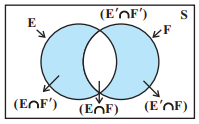
From the venn diagram in Fig 13.3, it is clear that E ∩ F and E ∩ F′ are mutually exclusive events and also E =(E ∩ F) ∪ (E ∩ F′). Therefore P(E) = P(E ∩ F) + P(E ∩ F′)
or P(E ∩ F′) = P(E) − P(E ∩ F)
= P(E) − P(E) . P(F) (by (1))
= P(E) (1−P(F))
= P(E). P(F′)
Hence, E and F′ are independent
7.
\(R.H.S.=2{ sin }^{ -1 }\sqrt { \frac { 1-x }{ 2 } } \quad \quad \begin{cases} Let\quad x=cos\theta \\ \Rightarrow \theta ={ cos }^{ -1 }x \end{cases}\)
\(=2{ sin }^{ -1 }\left( \sqrt { \frac { 1-cos\theta }{ 2 } } \right) \)
\( \begin{cases} as\quad cos\theta =1=2{ sin }^{ 2 }\frac { \theta }{ 2 } \\ \Rightarrow 1-cos\theta =2sin^{ 2 }\frac { \theta }{ 2 } \end{cases}\)
\(=2{ sin }^{ -1 }\left( sin\frac { \theta }{ 2 } \right) \)
\(=2\left( \frac { \theta }{ 2 } \right) =\theta ={ cos }^{ -1 }x\)
L.H.S = R.H.S
8.
\(\int { { cos }^{ 3 } } xdx=\frac { 1 }{ 4 } \int { (cos } 3x+3cosx)dx\)
\([\because cos3x=4cos^{ 3 }x-3cosx]\)
\(=\frac { 1 }{ 4 } \int { cos3x } dx+\int { \frac { 3 }{ 4 } } cosxdx\)
\(=\frac { 1 }{ 4 } \left( \frac { sin3x }{ 3 } \right) +\frac { 3 }{ 4 } sinx+C\)
\(=\frac { 1 }{ 12 } sin3x+\frac { 3 }{ 4 } sinx+C\)
9.
A function \(f:A\rightarrow B\) is said to be one-one if
\(a\neq b\)
\(\Rightarrow f(a)\neq f(b)for\quad all\quad a,b,\in A\)
or f(a) = f(b)
a = b for all a,b,A
In other words, is one-one, if no two elements of A have same image, i.e., no two elements of A are mapped to same elements of B.
10.
Let A be a skew-symmetric matrix. Then by definition \({ A }^{ \prime }=-A\)
\(\Rightarrow\) the (i, j)th element of \({ A }^{ \prime }\) = the (i, j)th element of (- A)
\(\Rightarrow\) the (j, i)th element of A = - the (i, j)th element of A
For the diagonal elements i = j \(\Rightarrow\) the (i, j)the element of A = - the (i, j)th element of A.
\(\Rightarrow\) the (i, j)th element of A = 0
Hence the diagonal elements are all zero.
11.
We have, \(A=\left| \begin{matrix} 6 & 0 & 1 \\ 0 & 1 & 2 \\ 0 & 0 & 4 \end{matrix} \right| \)
|A| = 6(4-0)-0(0-0)+1(0-0)
|2A| = \(\left| \begin{matrix} 12 & 0 & 2 \\ 0 & 2 & 4 \\ 0 & 0 & 8 \end{matrix} \right| \)
= 12(16-0)-0(0-0)+2(0-0)
= 192
|2A| = 8 x 24 = 8|A|
12.
\({ A }^{ 2 }=\left[ \begin{matrix} 0 & 0 & 1 \\ 0 & 1 & 0 \\ 1 & 0 & 0 \end{matrix} \right] \left[ \begin{matrix} 0 & 0 & 1 \\ 0 & 1 & 0 \\ 1 & 0 & 0 \end{matrix} \right] =\left[ \begin{matrix} 1 & 0 & 0 \\ 0 & 1 & 0 \\ 0 & 0 & 1 \end{matrix} \right]
\)
\(=l;{ A }^{ 6 }=({ A }^{ 2 })^{ 3 }={ l }^{ 3 }=l
\)
13.
\( \int _{ 2 }^{ 5 }{ (\left| x-2 \right| +\left| x-3 \right| +\left| x-5 \right| ) } dx,....(1)\)
Now \(\int _{ 2 }^{ 5 }{ \left| x-2 \right| } dx=\int _{ 2 }^{ 5 }{ (x-2) } dx\)
\(={ \left[ \frac { { x }^{ 2 } }{ 2 } -2x \right] }_{ 2 }^{ 5 }=\left( \frac { 25 }{ 2 } -10 \right) -\left( \frac { 4 }{ 2 } -4 \right) =\frac { 5 }{ 2 } +2=\frac { 9 }{ 2 } .\)
And \(\int _{ 2 }^{ 5 }{ \left| x-3 \right| } dx=\int _{ 2 }^{ 3 }{ \left| x-3 \right| } dx+\int _{ 3 }^{ 5 }{ \left| x-3 \right| } dx\)
\(=\int _{ 2 }^{ 3 }{ -(x-3) } dx+\int _{ 3 }^{ 5 }{ (x-3) } dx\)
\(={ \left[ \frac { { x }^{ 2 } }{ 2 } -3x \right] }_{ 2 }^{ 3 }+{ \left[ \frac { { x }^{ 2 } }{ 2 } -3x \right] }_{ 3 }^{ 5 }\)
\(=-\left[ \left( \frac { 9 }{ 2 } -9 \right) -\left( \frac { 4 }{ 2 } -6 \right) \right] +\left[ \left( \frac { 25 }{ 2 } -15 \right) -\left( \frac { 9 }{ 2 } -9 \right) \right] \)
\(=-\left[ -\frac { 9 }{ 2 } +4 \right] +\left[ -\frac { 5 }{ 2 } +\frac { 9 }{ 2 } \right] \)
\(=\frac { 1 }{ 2 } +2=\frac { 5 }{ 2 } \)
Finally \(\int _{ 2 }^{ 5 }{ \left| x-5 \right| } dx=\int _{ 2 }^{ 5 }{ -(x-5) } dx\)
\(=-{ \left[ \frac { { x }^{ 2 } }{ 2 } -5x \right] }_{ 2 }^{ 3 }\)
\(=-\left[ \left( \frac { 9 }{ 2 } -15 \right) -\left( \frac { 4 }{ 2 } -10 \right) \right] \)
\(=-\left[ -\left( \frac { 21 }{ 2 } +8 \right) \right] =\frac { 5 }{ 2 } .\)
ஃ From (1), \(\int _{ 2 }^{ 5 }{ [\left| x-2 \right| +\left| x-3 \right| +\left| x-5 \right| ] } dx\)
\(=\frac { 9 }{ 2 } +\frac { 5 }{ 2 } +\frac { 5 }{ 2 } \frac { 19 }{ 2 } .\)
14.
The region determined by the constraints, x – y ≤ –1, –x + y ≤ 0, x, y ≥ 0 is as follows.
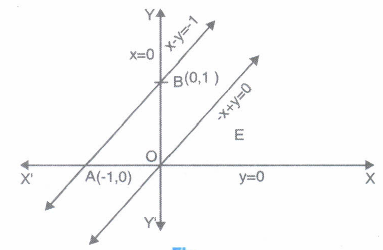
There is no feasible region and thus, Z has no maximum value.
15.
Let \(x_{ 1 },x_{ 2 }\in R\)
Now \(f(x_{ 1 })f(x_{ 2 })\Rightarrow ax_{ 1 }+b=ax_{ 2 }+b\)
\(\Rightarrow \) \(ax_{ 1 }=ax_{ 2 }\Rightarrow x_{ 1 }=x_{ 2 }\)
\(\Rightarrow \) 'f' is one-one.
Let \(y\in R.\) Let \(y=f(x_{ 0 })\)
Then \(ax_{ 0 }+b=y\Rightarrow x_{ 0 }=\frac { y-b }{ a } \Rightarrow x_{ 0 }\in R\).
\(f(x_{ 0 })=ax_{ 0 }+b=a\left( \frac { y-b }{ a } \right) +b=y.\)
\(\therefore \) For each \(y\in R\) , there exists \(x_{ 0 }\in R\) such that \(f(x_{ 0 })=y\).
\(\therefore \) 'f' is onto.
Hence, 'f' is a bijection.
16.
Let 'P' be the population at any time.
By the question, \(\frac { dP }{ dt } =kP\)
\(\Rightarrow\) \(\frac { dP }{ P } =k\quad dt\)
|Variables Separable
Integrating, \(log\quad P=kt+C\)...(1) [\(\because\)P>0]
Let \(t=0\) referred to \(1999\)
When \(t=0,\quad P=20000,\)
\(\therefore\) \(log\quad 20000=0+C\)
\(\Rightarrow\) \(C=log\quad 20000\)..(2)
When \(t=5,P=25000,\)
\(\therefore \) \(log\quad 25000=5k\quad +C\)
\(\Rightarrow\) \(log\quad 25000=5k+log20000\)
\(\Rightarrow\) \(5k=log\frac { 25 }{ 20 } \Rightarrow k=\frac { 1 }{ 5 } log\frac { 5 }{ 4 } \)
Using (2) and (3) in (1), we get:
\(logP=\frac { 1 }{ 5 } \left( log\frac { 5 }{ 4 } \right) t+log20000\)
When \(t=10,\)
then \(log\quad P\quad =\frac { 1 }{ 5 } \left( log\frac { 5 }{ 4 } \right) \left( 10 \right) +log20000\)
\(=2log\frac { 5 }{ 4 } +log 20000\)
\(=log\frac { 25 }{ 16 } +log20000=log\frac { 25 }{ 16 } \times 20000\)
\(=log\quad 31250.\)
hence, the population was 31,250 in 2009
17.
We have: x sin(a + y) + sin a cos(a+y) = 0 ......(1)
\(x=-\frac { sin\quad a\quad cos(a+y) }{ sin\quad (a+y) } ...(2)\)
Diff.w.r.t.x,
\(x\ cos(a+y)\left( 0+\frac { dy }{ dx } \right) +sin(a+y).1+sin\quad a(-sin(a+y))\left( 0+\frac { dy }{ dx } \right) =0\)
\(\left[ x\ cos(a+y)-sin\ a\ sin(a+y) \right] \frac { dy }{ dx } =-sin(a+y)\)
\(=\left[ -\frac { sin\quad a\quad cos(a+y) }{ sin\quad (a+y) } cos(a+y)-sinasin(a+y) \right] \frac { dy }{ dx } \)
\(=-sin(a+y)\)
\(=-sina\left[ { cos }^{ 2 }(a+y)+{ sin }^{ 2 }(a+y) \right] \frac { dy }{ dx } \)
\(=-{ sin }^{ 2 }(a+y)\)
\(=-sin\quad a(1)\frac { dy }{ dx } =-{ sin }^{ 2 }(a+y)\)
Hence, \(\frac { dy }{ dx } =\frac { { sin }^{ 2 }(a+y) }{ sin\quad a } \) which is true.
18.
The given equation are:
5x-y+4z=5
2x+3y+5z=2
5x-2y+6z=-1
Here A= \(\begin{bmatrix}5&-1&4\\2&3&5\\5&-2&6 \end{bmatrix}\)
Now |A|=\(\begin{bmatrix}5&-1&4\\2&3&5\\5&-2&6 \end{bmatrix}\)
=5(18+10)+1.(12-25)+4(-4-15)
=140-13-76=\(51\neq0\)
Hence, the given system of equations is consistent.
19.
The correct answer is C.
It is known that a given matrix is said to be a square matrix if the number of rows is equal to the number of columns.
Therefore, \(A={ \left[ { a }_{ ij } \right] }_{ m\times n }\) is a square matrix, if m = n.
20.
As three given lines are mutually perpendicular to each other, therefore,
\(l_{1} l_{2}+m_{1} m_{2}+n_{1} n_{2}=0 \)
\(l_{1} l_{3}+m_{1} m_{3}+n_{1} n_{3}=0 \)
\(l_{2} l_{3}+m_{2} m_{3}+n_{2} n_{3}=0
\)
Let a be angle between lines with direction cosines
\(\frac{l_{1}+l_{2}+l_{3}}{\sqrt{3}}, \frac{m_{1}+m_{2}+m_{3}}{\sqrt{3}}, \frac{n_{1}+n_{2}+n_{3}}{\sqrt{3}} \text { and } l_{1}, m_{1}, n_{1},\)
\(\text { then, } \cos \alpha=l_{1}\left(\frac{l_{1}+l_{2}+l_{3}}{\sqrt{3}}\right)+m_{1}\left(\frac{m_{1}+m_{2}+m_{3}}{\sqrt{3}}\right) +n_{1}\left(\frac{n_{1}+n_{2}+n_{3}}{\sqrt{3}}\right) \)
\(\Rightarrow \cos \alpha=\frac{l_{1}^{2}+m_{1}^{2}+n_{1}^{2}}{\sqrt{3}}
\)
\(cos\alpha =\frac { 1 }{ \sqrt { 3 } } \) Similarly, find angle with other lines.
21.
\(log\left| cosec\frac { y }{ x } -cot\frac { y }{ x } \right| =-log\left| x \right| =logc\Rightarrow x\left[ cosec\frac { y }{ x } -cot\frac { y }{ x } \right] =c\) is the required solution.
22.
Let the events be:
E1 : Item from machine A
E2 : Item from machine B
And A : Item is defective.
\(P({ E }_{ 1 })=\frac { 60 }{ 100 } =\frac { 3 }{ 5 } \)
\(P({ E }_{ 2 })=\frac { 40 }{ 100 } =\frac { 2 }{ 5 } \)
Also \(P(A/{ E }_{ 1 })=\frac { 2 }{ 100 } ,P(A/{ E }_{ 2 })=\frac { 1 }{ 100 } \)
By Bayes' Theorem,
\(P({ E }_{ 1 }/A)=\frac { P({ E }_{ 1 })P(A/{ E }_{ 1 }) }{ P({ E }_{ 1 })P(A/{ E }_{ 1 })+P({ E }_{ 2 })P(A/{ E }_{ 2 }) } \)
\(=\frac { \left( \frac { 2 }{ 5 } \right) \left( \frac { 1 }{ 100 } \right) }{ \left( \frac { 3 }{ 5 } \right) \left( \frac { 2 }{ 100 } \right) +\left( \frac { 2 }{ 5 } \right) \left( \frac { 1 }{ 100 } \right) } \)
\(=\frac { 2 }{ 6+2 } =\frac { 2 }{ 8 } =\frac { 1 }{ 4 } \)
23.
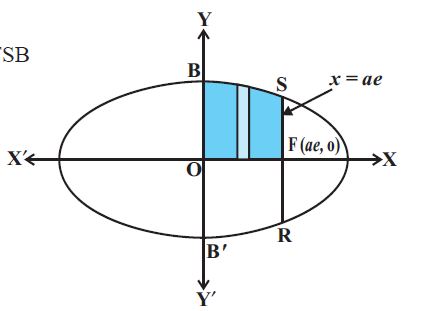
The required area of the region BOB′RFSB is enclosed by the ellipse and the lines x = 0 and x = ae.
Note that the area of the region BOB′RFSB
\(=2 \int_{0}^{a e} y d x=2 \frac{b}{a} \int_{0}^{a e} \sqrt{a^{2}-x^{2}} d x \)
\(=\frac{2 b}{a}\left[\frac{x}{2} \sqrt{a^{2}-x^{2}}+\frac{a^{2}}{2} \sin ^{-1} \frac{x}{a}\right]_{0}^{a e} \)
\(=\frac{2 b}{2 a}\left[a e \sqrt{a^{2}-a^{2} e^{2}}+a^{2} \sin ^{-1} e\right] \)
\(=a b\left[e \sqrt{1-e^{2}}+\sin ^{-1} e\right] \)
24.
Let numbers be x, y, z then
x + y + z = -1
2y + 3z = 5
x + y – z = -1
\(x=-\frac { 7 }{ 2 } \), y = \(\frac { 5 }{ 2 } \), z = 0
25.
Let X = {0, 1, 2, 3, 4, 5}.
The operation * on X is defined as:
\(a * b=\left\{\begin{array}{ll} a+b, & \text { if } a+b<6 \\ a+b-6 & \text { if } a+b \geq 6 \end{array}\right.\)
An element e ∈ X is the identity element for the operation *, if a * e = a = e * a ∀ a ∈ X
For a ∈ X we observed that
a * 0 = a + 0 =a [a ∈ X ⇒ a + 0 < 6]
0 * a = 0 + a = a [a ∈ X ⇒ 0 + a < 6]
a * 0 = a = 0 * a ∀ a ∈ X
Thus, 0 is the identity element for the given operation *.
An element a ∈ X is invertible if there exists b∈ X such that a * b = 0 = b * a.
ie \(\left\{\begin{array}{ll} a+b=0=b+a & \text { if } a+b<6 \\ a+6-6=0=b+a-6 & \text { if } a+b \geq 6 \end{array}\right.\)
i.e.,
a = −b or b = 6 − a
But, X = {0, 1, 2, 3, 4, 5} and a, b ∈ X. Then, a ≠ −b.
26.
As given \(\overrightarrow { a } .\overrightarrow { b } =\overrightarrow { a } .\overrightarrow { c } =0=\overrightarrow { a } \bot \)both \(\overrightarrow { b } \) and \(\overrightarrow { c } \)
⇒ \(\overrightarrow { a } \parallel \left( \overrightarrow { b } \times \overrightarrow { c } \right) \)
Let \(\overrightarrow { a } =\lambda \left( \overrightarrow { b } \times \overrightarrow { c } \right) \)
then \(\left| \overrightarrow { a } \right| =\left| \lambda \right| \left| \left( \overrightarrow { b } \times \overrightarrow { c } \right) \right| \)
⇒ \(\frac { \left| \overrightarrow { a } \right| }{ \left| \left( \overrightarrow { b } \times \overrightarrow { c } \right) \right| } =\left| \lambda \right| \)
⇒ \(\left| \lambda \right| =\frac { 1 }{ sin\frac { \pi }{ 6 } } =2\)
λ = 士2
\(\overrightarrow { a } =\pm 2\left( \overrightarrow { b } \times \overrightarrow { c } \right) \)
Hence proved
(ii) Now \(\left[ \overrightarrow { a } +\overrightarrow { b } ,\overrightarrow { b } +\overrightarrow { c } ,\overrightarrow { c } +\overrightarrow { a } \right] \)
= \(\left[ \left( \overrightarrow { a } +\overrightarrow { b } \right) \times \left( \overrightarrow { b } \times \overrightarrow { c } \right) \right] .\left( \overrightarrow { c } +\overrightarrow { a } \right) \)
= \(\left( \overrightarrow { a } \times \overrightarrow { b } \right) .\overrightarrow { c } +\left( \overrightarrow { b } \times \overrightarrow { c } \right) .\overrightarrow { a } \)
(As the scalar triple product = 0, if any two vectors are equal)
Hence, \(\overrightarrow { a } .\left( \overrightarrow { b } \times \overrightarrow { c } \right) +\left( \overrightarrow { a } \times \overrightarrow { b } \right) .\overrightarrow { c } \) = \(\overrightarrow { a } .\left( \overrightarrow { b } \times \overrightarrow { c } \right) +\overrightarrow { c } \left( \overrightarrow { b } \times \overrightarrow { c } \right) \)
= 2\(\overrightarrow { a } \left( \overrightarrow { b } \times \overrightarrow { c } \right) \)
= \(2\overrightarrow { a } \left( \pm \frac { 1 }{ 2 } \overrightarrow { a } \right) \)
= 士1
Hence proved
27.
\({ A }^{ -1 }=\left[ \begin{matrix} 1/a & 0 & 0 \\ 0 & 1/b & 0 \\ 0 & 0 & 1/c \end{matrix} \right] \)
The inverse is impossible. It is possible when a, b, c are all real and\(\ne\)0, otherwise |A| becomes singular
i.e., |A| = 0
and \({ A }^{ -1 }=\frac { adj\quad A }{ |A| } \)
will become meaningless.
Value: Anybody can progress till he continues working, otherwise his progress will be halted.
28.
Total number of oranges = 25
number of good oranges = 20
number of bad oranges = 5
Probability of getting a bad orange,
\(P(B)=\frac { 5 }{ 25 } =\frac { 1 }{ 5 } \)
Now \(p=\frac { 1 }{ 5 } \)
\(\\ q=1-p=\frac { 4 }{ 5 } \)
Let X be the random variable of "Number of bad oranges".
\(\Rightarrow X=0,1,2,3,4\)
\(P(X=0)={ n }_{ { C }_{ r } }{ \left( p \right) }^{ n-r }{ \left( q \right) }^{ r }\)
\(P(X=0)={ 4 }_{ { C }_{ 0 } }{ \left( \frac { 4 }{ 5 } \right) }^{ 4 }=\frac { 256 }{ 625 } \)
\(P(X=1)=4\times \frac { 64 }{ 125 } \times \frac { 1 }{ 5 } =\frac { 256 }{ 625 } \)
\(P(X=2)={ 4 }_{ { C }_{ 2 } }{ \left( \frac { 4 }{ 5 } \right) }^{ 2 }{ \left( \frac { 1 }{ 5 } \right) }^{ 2 }\)
\(=6\times \frac { 16 }{ 625 } =\frac { 96 }{ 625 } \)
\(P(X=3)={ 4 }_{ { C }_{ 3 } }\left( \frac { 4 }{ 5 } \right) { \left( \frac { 1 }{ 5 } \right) }^{ 3 }\)
\(=4\times \frac { 4 }{ 625 } =\frac { 16 }{ 625 } \)
\(P(X=4)={ 4 }_{ { C }_{ 4 } }{ \left( \frac { 4 }{ 5 } \right) }^{ 0 }{ \left( \frac { 1 }{ 5 } \right) }^{ 4 }\)
\(=\frac { 1 }{ 625 } \)
\(\therefore\) Probability distribution is
| X | P(X) | XP(X) | X2P(X) |
| 0 | 256/625 | 0 | 0 |
| 1 | 256/625 | 256/625 | 256/625 |
| 2 | 96/625 | 192/625 | 384/625 |
| 3 | 16/625 | 48/625 | 144/625 |
| 4 | 1/625 | 4/625 | 16/625 |
\(\therefore Mean=\sum { XP(X) } \)
\(=\frac { 500 }{ 625 } =\frac { 20 }{ 25 } =\frac { 4 }{ 5 } \)
\(Var.\quad (X)=E({ X }^{ 2 })-[E(X){ ] }^{ 2 }\)
\(=\frac { 800 }{ 625 } -\frac { 16 }{ 25 } \)
\(Var.(X)=\frac { 32 }{ 25 } -\frac { 16 }{ 25 } =\frac { 16 }{ 25 } \)
29.
Let \(I=\int { \frac { sinx }{ sin^{ 3 }x+cos^{ 3 }x } } dx\)
\(=\int { \frac { tanxsec^{ 2 }x }{ { tan }^{ 3 }x+1 } } dx\)
On substituting tanx = t and sec2x = dx = dt, we get
\(I=\int { \frac { t }{ { t }^{ 3 }+1 } } dt\)
\(=\int { \frac { t }{ (t+1)({ t }^{ 2 }-t+1) } } dt\)
\(=-\frac { 1 }{ 3 } \int { \frac { 1 }{ t+1 } dt+\frac { 1 }{ 3 } } \int { \frac { t+1 }{ { t }^{ 2 }-t+1 } dt } \)
\(=-\frac { 1 }{ 3 } log\left| t+1 \right| +\frac { 1 }{ 6 } \int { \frac { (2t-1)+3 }{ { t }^{ 2 }-t+1 } } dt+\frac { 1 }{ 2 } \int { \frac { 1 }{ { t }^{ 2 }-t+1 } } dt\)
\(=-\frac { 1 }{ 3 } log\left| t+1 \right| +\frac { 1 }{ 6 } log\left| { t }^{ 2 }t+1 \right| +\frac { 1 }{ 2 } \int { \frac { 1 }{ \left( t-\frac { 1 }{ 2 } \right) ^{ 2 }+\left( \frac { \sqrt { 3 } }{ 2 } \right) ^{ 2 } } } dt\)
\(=-\frac { 1 }{ 3 } log\left| t+1 \right| +\frac { 1 }{ 6 } log\left| { t }^{ 2 }-t+1 \right| +\frac { 1 }{ \sqrt { 3 } } { tan }^{ -1 }\left( \frac { 2t-1 }{ \sqrt { 3 } } \right) \)
\(=-\frac { 1 }{ 3 } log\left| tanx+1 \right| +\frac { 1 }{ 6 } log\left| { tan }^{ 2 }x-tanx+1 \right| +\frac { 1 }{ \sqrt { 3 } } { tan }^{ -1 }\left( \frac { 2tanx-1 }{ \sqrt { 3 } } \right) +C\)
30.
\(\Rightarrow f'(x)=3\cos3x+3\sin3x\)
\(=3(\cos3x+\sin3x)\)
Put \(f'(x)=0\)
\(\Rightarrow \cos3x+\sin3x=0\)
\(\Rightarrow \sin3x=-\cos3x\)
\(\Rightarrow -\tan3x=1\)
\(\Rightarrow \tan3x=-1\)
As 0
ஃ tan 3x is negative for the following values:
\(3x=\frac{3\pi}{4}\)
\(\Rightarrow x=\frac{\pi}{4}\)
\(3x=\pi+\frac{3\pi}{4}=\frac{7\pi}{4}\)
\(\Rightarrow x=\frac{7\pi}{12}\)
\(3x=\frac{7\pi}{4}+\pi=\frac{11\pi}{4}\)
\(\Rightarrow x=\frac{11\pi}{12}\)
Hence we have intervals:
Hence, \(f(x)-\sin3x-\cos3x\) is strictly increasing in the intervals \((0,\frac{\pi}{4})\cup(\frac{7\pi}{12},\frac{11\pi}{12}) \) and strictly decreasing in intervals \((\frac{\pi}{4},\frac{7\pi}{12})\cup(\frac{11\pi}{12},\pi)\)
31.
\(=2\tan ^{ -1 }{ \left\{ \tan { \frac { \alpha }{ 2 } } \tan { \left( \frac { \pi }{ 4 } -\frac { \beta }{ 2 } \right) } \right\} } \)
\(=\tan ^{ -1 }{ \frac { 2\tan { \frac { \alpha }{ 2 } } .\tan { \left( \frac { \pi }{ 4 } -\frac { \beta }{ 2 } \right) } }{ 1-\tan ^{ 2 }{ \frac { \alpha }{ 2 } } \tan ^{ 2 }{ \left( \frac { \pi }{ 4 } -\frac { \beta }{ 2 } \right) } } } \) \(\left[ \because \quad 2\tan ^{ -1 }{ x } =\tan ^{ -1 }{ \frac { 2x }{ 1-{ 2x }^{ 2 } } } \right] \)
\(=\tan ^{ -1 }{ \frac { 2\tan { \frac { \alpha }{ 2 } } \left[ \frac { 1-\tan { \frac { \beta }{ 2 } } }{ 1+\tan { \frac { \beta }{ 2 } } } \right] }{ 1-\tan ^{ 2 }{ \frac { \alpha }{ 2 } { \left( \frac { 1-\tan { \frac { \beta }{ 2 } } }{ 1+\tan { \frac { \beta }{ 2 } } } \right) }^{ 2 } } } } \)
\(\left[ \because \tan { (A-B) } =\frac { \tan { A } -\tan { B } }{ 1+\tan { A } \tan { B } } \right] \)
\(=\tan ^{ -1 }{ \left( \frac { 2\tan { \frac { \alpha }{ 2 } } \left[ \frac { \left( 1-\tan { \frac { \beta }{ 2 } } \right) \left( 1+\tan { \frac { \beta }{ 2 } } \right) }{ { \left( 1+\tan { \frac { \beta }{ 2 } } \right) }^{ 2 } } \right] }{ \frac { { \left( 1+\tan { \frac { \beta }{ 2 } } \right) }^{ 2 }-\tan ^{ 2 }{ \frac { \alpha }{ 2 } } { \left( 1-\tan { \frac { \beta }{ 2 } } \right) }^{ 2 } }{ { \left( 1+\tan { \frac { \beta }{ 2 } } \right) }^{ 2 } } } \right) } \)
\(=\tan ^{ -1 }{ \left( \frac { 2\tan { \frac { \alpha }{ 2 } } .\left( 1-\tan ^{ 2 }{ \frac { \beta }{ 2 } } \right) }{ { \left( 1+\tan { \frac { \beta }{ 2 } } \right) }^{ 2 }-\tan ^{ 2 }{ \frac { \alpha }{ 2 } } { \left( 1-\tan { \frac { \beta }{ 2 } } \right) }^{ 2 } } \right) } \)
\(=\tan ^{ -1 }{ \left[ \frac { 2\tan { \frac { \alpha }{ 2 } } .\left( 1-\tan ^{ 2 }{ \frac { \beta }{ 2 } } \right) }{ \left( 1+\tan ^{ 2 }{ \frac { \beta }{ 2 } } \right) \left( 1-\tan ^{ 2 }{ \frac { \alpha }{ 2 } } \right) +2\tan { \frac { \beta }{ 2 } } \left( 1-\tan ^{ 2 }{ \frac { \alpha }{ 2 } } \right) } \right] } \)
\(=\tan ^{ -1 }{ \left[ \frac { \frac { 2\tan { \frac { \alpha }{ 2 } } }{ \left( 1+\tan ^{ 2 }{ \frac { \alpha }{ 2 } } \right) } .\frac { \left( 1-\tan ^{ 2 }{ \frac { \beta }{ 2 } } \right) }{ \left( 1+\tan ^{ 2 }{ \frac { \beta }{ 2 } } \right) } }{ \frac { 1-\tan ^{ 2 }{ \frac { \alpha }{ 2 } } }{ \left( 1-\tan ^{ 2 }{ \frac { \alpha }{ 2 } } \right) } +\frac { 2\tan { \frac { \beta }{ 2 } } }{ \left( 1+\tan ^{ 2 }{ \frac { \beta }{ 2 } } \right) } } \right] } \)
\(=\tan ^{ -1 }{ \frac { \sin { \alpha } +\cos { \beta } }{ \cos { \alpha } +\sin { \beta } } } \)
[Dividing N, and D ' by \(\left( 1+\tan ^{ 2 }{ \frac { \alpha }{ 2 } } \right) \)\(\left( 1+\tan ^{ 2 }{ \frac { \beta }{ 2 } } \right) \)]
= RHS
32.
We know that:
A square matrix \(A=\left[ { a }_{ ij } \right] \) is said to be skew-symmetric if the (i, j)th element of
A = -(j, i)th element of A i.e., \({ a }_{ ij }=-{ a }_{ ji }\) for all i, j.
\(\therefore \ { a }_{ ii }=-{ a }_{ ii }\) for all i
\(\Rightarrow 2{ a }_{ ii }=0 \Rightarrow \quad { a }_{ ii }=0\).
Hence, the elements on the main diagonal of skew-symmetric matrix are all zero.
33.
\(\Rightarrow { y }^{ ' }=\frac { log\quad x }{ \left( 1+log\quad x \right) ^{ 2 } } \)
34.
(a)
\(\frac { 2 }{ 3 } ,\frac { -2 }{ 3 } ,\frac { 1 }{ 3 } \)
35.
36.
(a)
π

12th Standard CBSE Syllabus & Materials
12th Standard CBSE
CBSE 12th Computer Science Python Revision Tour I - New Previous year Question Papers Study Material - QB365 Set A
NEW12th Standard CBSE
CBSE 12th Business Studies Planning Important Questions And Answers Study Material - QB365 Set A
NEW12th Standard CBSE
CBSE 12th Business Studies Business Environment Important Questions And Answers Study Material - QB365 Set A
NEW12th Standard CBSE
CBSE 12th Business Studies Principles of Management Important Questions And Answers Study Material - QB365 Set A



CBSE 12th Standard CBSE Subjects
CBSE Standards










