
 100% FREE ACCESS
12th Standard CBSE Syllabus & Materials
12th Standard CBSE
CBSE 12th Economics Government Budget and the Economy Previous year Question Papers Study Material - QB365 Set A
NEW12th Standard CBSE
CBSE 12th Computer Science Interface Python with MySQL - New Previous year Question Papers Study Material - QB365 Set A
NEW12th Standard CBSE
CBSE 12th Computer Science Database Concept - New Previous year Question Papers Study Material - QB365 Set A
NEW12th Standard CBSE
CBSE 12th Computer Science Data Communication - New Previous year Question Papers Study Material - QB365 Set A
NEW12th Standard CBSE
CBSE 12th Computer Science Data Structures - New Previous year Question Papers Study Material - QB365 Set A
NEW12th Standard CBSE
CBSE 12th Computer Science Functions - New Previous year Question Papers Study Material - QB365 Set A

Published on: 15/02/2020
12th Standard CBSE Mathematics Public Model Question Paper II 2019 - 2020
Download CBSE Class 12th Standard CBSE Maths question papers, sample papers, important questions, and previous year solved papers in PDF format. Get free study materials, NCERT solutions, and exam preparation resources for Class 12th Standard CBSE Maths
Questions + Answers key
Take MCQ Maths Test
1.
An unbiased coin is tossed 4 times. Find the mean and variance of number of heads obtained.
2.
Solve the differential equation :3ex tan y dx + (2 - ex)sec2 y dy = 0, given that when x = 0, \(y=\frac { \pi }{ 4 } \).
3.
Evaluate : \(\int { \frac { 5x+3 }{ \sqrt { { x }^{ 2 }+4x+10 } } } dx\)
4.
If the function f: \(R\rightarrow R\) be given by \(f(x)=x^{ 2 }\) and g: \(R\rightarrow R\) be given by \(g(x)=\frac { x }{ x-1 } ,x\neq 1\), find fog and gof and hence find fog (2) and gof (-3).
5.
Find dy/dx in the following: \(y={ tan }^{ -1 }\frac { 3x-{ x }^{ 3 } }{ 1-3{ x }^{ 2 } } \)
6.
5x-y+4z=5
2x+3y+5z=2
5x-2y+6z=-1 Prove that the given equations are consistent or not
7.
If \(x\left[ \begin{matrix} 2 \\ 3 \end{matrix} \right] +y\left[ \begin{matrix} -1 \\ 1 \end{matrix} \right] =\left[ \begin{matrix} 10 \\ 5 \end{matrix} \right]\) find the values of x and y.
8.
Find the value of \(sin^{-1}\left(sin{2\pi\over3}\right)\)
9.
Show that :
\({ \sin }^{ -1 }(2x\sqrt { 1-{ x }^{ 2 } } )={ 2\sin }^{ -1 }x,\frac { 1 }{ \sqrt { 2 } } \le x\le \frac { 1 }{ \sqrt { 2 } } \)
10.
Verify that the function y = a cos x + b sin x, where a, b \(\in\) R is a solution of differential equation \(\frac { { d }^{ 2 }y }{ { dx }^{ 2 } } +y=0\).
11.
Prove that the curves y2 = 4x and x2 = 4y divide the area of the square bounded by x = 0, x = 4, y = 4 and y = 0 into three equal parts.
12.
If \(A=\left[ \begin{matrix} 1 & 1 & 1 \\ 1 & 1 & 1 \\ 1 & 1 & 1 \end{matrix} \right] \) Prove that , A =\(\left[ \begin{matrix} { 3 }^{ x-1 } & { 3 }^{ x-1 } & { 3 }^{ x-1 } \\ { 3 }^{ x-1 } & { 3 }^{ x-1 } & { 3 }^{ x-1 } \\ { 3 }^{ x-1 } & { 3 }^{ x-1 } & { 3 }^{ x-1 } \end{matrix} \right] \) for every positive integer n.
13.
A card from a pack of 52 cards is lost. From the remaining cards of the pack, two cards at random and are found to be hearts. Find the probability of the missing card to be a heart
14.
If \(\overrightarrow { a } ,\overrightarrow { b } ,\overrightarrow { c } \) are unit vectors such that \(\overrightarrow { a } .\overrightarrow { b } =\overrightarrow { a } .\overrightarrow { c } =0\) and the angle between \(\overrightarrow { b } \) and \(\overrightarrow { c } \) is \(\frac{\pi}{6}\) , then prove that:
(i) \(\overrightarrow { a } =\pm 2\left( \overrightarrow { b } \times \overrightarrow { c } \right) \)
(ii) \(\left[ \overrightarrow { a } +\overrightarrow { b } ,\overrightarrow { b } +\overrightarrow { c } ,\overrightarrow { c } +\overrightarrow { a } \right] =\pm 1\)
15.
Show that the altitude of the right circular cone of maximum volume that can be inscribed in a sphere of radius r is \(\frac { 4r }{ 3 } \) Also show that the maximum volume of the cone is \(\frac { 8 }{ 27 } \) of the volume of the sphere.
16.
If y = \(e^{ ax }\) cos bx then prove that \(\frac { d^{ 2 }y }{ dx^{ 2 } } +(a^{ 2 }+b^{ 2 })y=0\)
17.
Two factories decided to award their employees for three values of
(a) adaptable new techniques,
(b) careful and alert in difficult situations and
(c) keeping calm in tense situations, at the rate of Rs. x, Rs. y and Rs. z per person respectively 2, 4 and 3 employees with a total prize money of Rs. 29,000. The second factory decided to honour respectively 5, 2 and 3 employees with the prize money of Rs. 30,500. If the three prizes per person together cost Rs. 9,500; then
(i) Represent the above situation by a matrix equation and form linear equations using matrix multiplication.
(ii) Solve these equations using matrices
(iii) Which values are reflected in this question?
18.
Evaluate : \(\int { \frac { { x }^{ 2 }+1 }{ (x-1)^{ 2 }(x+3) } } dx\)
19.
Show that the binary operation * on A = R-{-1} defined as a*b = a + b for all a, b, c A is commutative and associative on A. Also find the identity element of * in A and prove that every element of A is invertible
20.
If \(A=\left[ \begin{matrix} 1 & 1 & 1 \\ 1 & 1 & 1 \\ 1 & 1 & 1 \end{matrix} \right] \) then prove that \({ A }^{ n }=\left[ \begin{matrix} { 3 }^{ n-1 } & { 3 }^{ n-1 } & { 3 }^{ n-1 } \\ { 3 }^{ n-1 } & { 3 }^{ n-1 } & { 3 }^{ n-1 } \\ { 3 }^{ n-1 } & { 3 }^{ n-1 } & { 3 }^{ n-1 } \end{matrix} \right] ,\) then \(n\epsilon N\).
21.
A trust fund has Rs. 30,000 that must be invested in two different types of bonds. The first bond pays 5% and second 7% interest per year.Using matrix multiplication, determine how to divide Rs. 30,000 among the two types of bonds if the trust must obtain an annual total interest of:
(a) Rs. 1800
(b) Rs. 2000
22.
The graph of the inequation 3x+2y>6 does not lie in the 4th quadrant. (True/False)
23.
if \(\left[ \begin{matrix} a+b & 2 \\ 5 & ab \end{matrix} \right] =\left[ \begin{matrix} 6 & 2 \\ 5 & 8 \end{matrix} \right] \)find the relation between a and b
24.
If \(\overrightarrow a\times \overrightarrow b=\overrightarrow c\times \overrightarrow b\) and \(\overrightarrow a\times \overrightarrow c=\overrightarrow b\times \overrightarrow d\), then show that \(\overrightarrow a\ne\overrightarrow d\) and \(\overrightarrow b\ne \overrightarrow c\)
25.
Evaluate : \(\int _{ 0 }^{ 1 }{ x{ e }^{ x } } dx\)
26.
If x = \(\theta\)sin\(\theta\), y = \(\theta\)cos\(\theta\) find dy/dx at \(\theta\) = \(\pi/4\)
27.
Find the distance between the point (5, ,4, - 6) and its image in xy-plane.
28.
If P(A)=\(\frac { 2 }{ 5 } ,P(B)=\frac { 1 }{ 3 } ,P(A\cap B)=\frac { 1 }{ 5 } ,\) then find \(P(\bar { A } /\bar { B } )\) .
29.
Solve the differential equation \(\frac { dy }{ dx } =xy+2y\)
30.
Let A = (a, b, e) and B = (1, 2, 3). Find r of the following function f from A to B, if it exists.
(i) f = {(a, 3) (b,2)(e, 1)}
(ii) {(a, 2) (b, 1)(e, 1)}.
31.
Solve the equation \({ tan }^{ -1 }\left( \frac { 1-x }{ 1+x } \right) =\frac { 1 }{ 2 } { tan }^{ -1 }x\)
32.
If \(A=\left| \begin{matrix} 6 & 0 & 1 \\ 0 & 1 & 2 \\ 0 & 0 & 4 \end{matrix} \right| \), then show that |2A| = 8|A|:
33.
Write the shaded region as an integral
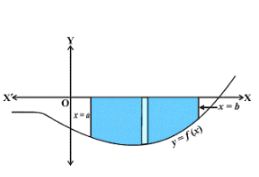
\(-\left| \int _{ a }^{ b }{ f(x)dx } \right| \)
\(\int _{ a }^{ b }{ \left| f(x)dx \right| } \)
\(\left| \int _{ a }^{ b }{ f(x)dx } \right| \)
\(-\int _{ a }^{ b }{ \left| f(x)dx \right| } \)
34.
The planes: 2x – y + 4z = 5 and 5x – 2.5y + 10z = 6 are
Perpendicular
Parallel
intersect y-axis
passes through \((0,0,\frac{5}{4})\)
35.
A cylindrical tank of radius 10 m is being filled with wheat at the rate of 314 cubic metre per hour. Then the depth of the wheat is increasing at the rate of
1 m/h
0.1 m/h
1.1 m/h
0.5 m/h
36.
Given set A ={1, 2, 3} and a relation R = {(1, 2), (2, 1)}, the relation R will be
reflexive if (1, 1) is added
symmetric if (2, 3) is added
transitive if (1, 1) is added
symmetric if (3, 2) is added
1.
Given n = 4
Getting \(p=\frac { 1 }{ 2 } \ and\ q=\frac { 1 }{ 2 } \)
| No. of Successes(x) | 0 | 1 | 2 | 3 | 4 |
| P(x) | \({ 4 }_{ { C }_{ 0 } }{ \left( \frac { 1 }{ 2 } \right) }^{ 2 }=\frac { 1 }{ 16 } \) | \({ 4 }_{ { C }_{ 1 } }{ \left( \frac { 1 }{ 2 } \right) }^{ 3 }\left( \frac { 1 }{ 2 } \right) =\frac { 4 }{ 16 } \) | \({ 4 }_{ { C }_{ 2 } }{ \left( \frac { 1 }{ 2 } \right) }^{ 2 }{ \left( \frac { 1 }{ 2 } \right) }^{ 2 }=\frac { 6 }{ 16 } \) | \({ 4 }_{ { C }_{ 3 } }\left( \frac { 1 }{ 2 } \right) { \left( \frac { 1 }{ 2 } \right) }^{ 3 }=\frac { 4 }{ 16 } \) | \(\quad { 4 }_{ { C }_{ 1 } }{ \left( \frac { 1 }{ 2 } \right) }^{ 4 }=\frac { 1 }{ 16 } \) |
| xP(x) | 0 | \(\frac { 4 }{ 16 } \) | \(\frac { 12 }{ 16 } \) | \(\frac { 12 }{ 16 } \) | \(\frac { 4 }{ 16 } \) |
| x2p(x) | 0 | \(\frac { 4 }{ 16 } \) | \(\frac { 24 }{ 16 } \) | \(\frac { 36 }{ 16 } \) | \(\frac { 16 }{ 16 } \) |
Mean = \(\sum { xp(x)=\frac { 32 }{ 16 } =2 } \)
\(\\ Variance=\sum { { x }^{ 2 }p(x)-\{ \sum { P(x){ \} }^{ 2 } } } \)
\(=\frac { 80 }{ 16 } -{ (2) }^{ 2 }=5-4=1\)
2.
3ex tan y dx + (2 - ex)sec2 y dy = 0
\(\Rightarrow\) (2 - ex)sec2 y dy = - 3ex tan y dx
\(\frac { \sec ^{ 2 }{ y } }{ \tan { y } } dy=\frac { -3{ e }^{ x } }{ 2-{ e }^{ x } } dx\)
On integrating both sides
\(\int { \frac { \sec ^{ 2 }{ ydy } }{ \tan { y } } } =\int { \frac { -3{ e }^{ x }dx }{ 2-{ e }^{ x } } } \)
\(\Rightarrow \log { \left| \tan { y } \right| } =3\log { \left| 2-{ e }^{ x } \right| } +\log { C } \)
\(\Rightarrow \log { \left| \tan { y } \right| } =\log { \left| C\left( 2-{ e }^{ x } \right) ^{ 3 } \right| } \)
\(\Rightarrow \tan { y } =C\left( 2-{ e }^{ x } \right) ^{ 3 }\)
Putting x = 0, \(y=\frac { \pi }{ 4 } \), we get
\(\Rightarrow \tan { \frac { \pi }{ 4 } } =C\left( 2-{ e }^{ 0 } \right) ^{ 3 }\)
\(\Rightarrow C=1\)
Therefore particular solution is
\(\tan { y } =\left( 2-{ e }^{ x } \right) ^{ 3 }\)
3.
\(I=\int { \frac { 5x+3 }{ \sqrt { { x }^{ 2 }+4x+10 } } } dx\)
\(\int { \frac { \frac { 5 }{ 2 } (2x+4)-7 }{ \sqrt { { x }^{ 2 }+4x+10 } } } dx\)
\(=\frac { 5 }{ 2 } \int { \frac { (2x+4)-7 }{ \sqrt { { x }^{ 2 }+4x+10 } } } dx-7\int { \frac { 1 }{ \sqrt { (x+2)^{ 2 }+(\sqrt { 6 } )^{ 2 } } } } dx\)
\(=5.\sqrt { { x }^{ 2 }+4x+10a } -7log\left| x+2+\sqrt { { x }^{ 2 }+4x+10 } \right| +C\)
4.
We have:
\(f(x)=x^{ 2 }+2\) and \(g(x)=\frac { x }{ x-1 } \)
\(\therefore \) \(fog(x)=f(g(x))=(g(x))^{ 2 }+2\)
\(=\left( \frac { x }{ x-1 } \right) ^{ 2 }+2=\frac { x^{ 2 }+2(x-1)^{ 2 } }{ (x-1)^{ 2 } } \)
\(=\frac { x^{ 2 }+2(x^{ 2 }-2x+1) }{ (x-1)^{ 2 } } =\frac { 3x^{ 2 }-4x+2 }{ (x-1)^{ 2 } } \)
Hence, fog (2)\(=\frac { 3(4)-4(2)+2 }{ (2-1)^{ 2 } } =\frac { 12-8+2 }{ (1)^{ 2 } } =\frac { 6 }{ 1 } =6\)
And \(gof(x)=g(f(x))=\frac { f(x) }{ f(x)-1 } \)
\(=\frac { x^{ 2 }+2 }{ (x^{ 2 }+2)-1 } =\frac { x^{ 2 }+2 }{ x^{ 2 }+1 } \)
Hence, \(gof(-3)=\frac { (-3)^{ 2 }+2 }{ (-3)^{ 2 }+1 } =\frac { 9+2 }{ 9+1 } =\frac { 11 }{ 10 } \) .
5.
\(Here\quad y={ tan }^{ -1 }\frac { 3x-{ x }^{ 3 } }{ 1-3{ x }^{ 2 } } \)
\(={ tan }^{ -1 }\frac { 3tan\theta -{ tan }^{ 3 }\theta }{ 1-3{ tan }^{ 2 }\theta } \)
\(={ tan }^{ -1 }(tan3\theta )=3\theta =3{ tan }^{ -1 }x\)
\(Hence,\quad \frac { dy }{ dx } =\frac { 3 }{ 1+{ x }^{ 2 } } \)
6.
The given equation are:
5x-y+4z=5
2x+3y+5z=2
5x-2y+6z=-1
Here A= \(\begin{bmatrix}5&-1&4\\2&3&5\\5&-2&6 \end{bmatrix}\)
Now |A|=\(\begin{bmatrix}5&-1&4\\2&3&5\\5&-2&6 \end{bmatrix}\)
=5(18+10)+1.(12-25)+4(-4-15)
=140-13-76=\(51\neq0\)
Hence, the given system of equations is consistent.
7.
\(We\quad have:\quad x\left[ \begin{matrix} 2 \\ 3 \end{matrix} \right] +y\left[ \begin{matrix} -1 \\ 1 \end{matrix} \right] =\left[ \begin{matrix} 10 \\ 5 \end{matrix} \right]\)
\(\Rightarrow \left[ \begin{matrix} 2x \\ 3x \end{matrix} \right] +\left[ \begin{matrix} -y \\ y \end{matrix} \right] =\left[ \begin{matrix} 10 \\ 5 \end{matrix} \right]\)
\(\Rightarrow \left[ \begin{matrix} 2x-y \\ 3x+y \end{matrix} \right] =\left[ \begin{matrix} 10 \\ 5 \end{matrix} \right] .\)
Equating corresponding elements:
2x - y = 10...(1)
and 3x + y = 5....(2)
Adding (1) and (2), 5x = 15 \(\Rightarrow \) x = 3.
Putting in (1), 2, (3) - y = 10 \(\Rightarrow\) y = 6-10 = -4.
Hence, x = 3 and y = -4.
8.
First split \(\frac{2 \pi}{3} \text { as } \frac{(3 \pi-\pi)}{3} \text { or } \pi-\frac{\pi}{3}\)
After substuting in the given we get,
\(\sin ^{-1}\left(\sin \left(\frac{2 \pi}{3}\right)\right)=\sin ^{-1}\left(\sin \left(\pi-\frac{\pi}{3}\right)\right)=\frac{\pi}{3}\)
9.
Let sin-1 x = \(\theta\) then sin-1 x = \(\theta\). we have
sin-1 \((2x\sqrt { 1-{ x }^{ 2 } } )\) = sin-1\(2\sin { \theta } \sqrt { 1-{ sin }^{ 2 } } \)
= sin–1 (2sinθ cosθ) = sin–1 (sin2θ) = 2θ = 2 sin–1 x
10.
The given function is
y = a cos x + b sin x ... (1)
Differentiating both sides of equation (1) with respect to x, successively, we get
\(\frac{d y}{d x}=-a \sin x+b \cos x \)
\(\frac{d^{2} y}{d x^{2}}=-a \cos x-b \sin x \)
Substituting the values of \(\frac{d^{2} y}{d x^{2}}\)and y in the given differential equation, we get
L.H.S. = (– a cos x – b sin x) + (a cos x + b sin x) = 0 = R.H.S..
Therefore, the given function is a solution of the given differential equation.
11.
Given curve, \(y^{2}=4 x\) ..(i)
is a parabola having vertex (0, 0) and open right sides and the curve x2 = 4y ...(ii)
is a parabola having vertex (0, 0) and open upward.
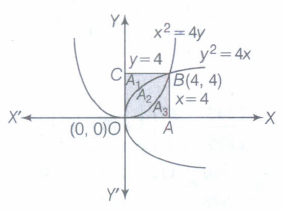
Also, draw the square bounded by the lines x = 0,x = 4
y = 4 and y = 0.To prove, Area A1 = Area A2 = Area A 3
Now, the point of intersection of curves y2 = 4x and
\(x^{2}=4 y \text { is given by }\left(\frac{y^{2}}{4}\right)^{2}=4 y\)
\(\Rightarrow y^{4}=64 y \Rightarrow y\left(y^{3}-64\right)=0\)
\(\Rightarrow y=0, y^{3}=64 \Rightarrow y=0, y=4\)
When \(y=0, \text { then } 0^{2}=4 x \Rightarrow x=0\)
When \(y=4, \text { then } 4^{2}=4 x \Rightarrow x=4\)
So, the points of intersection are 0(0, 0) and B(4, 4).
Now, the area of the region bounded by curves y2 = 4x and x2 = 4y is
\(A_{2}=\int_{0}^{4}[y\{\text { parabola }(\mathrm{i})\}-y\{\text { parabola }(\mathrm{ii})\}] d x\)
\(=\int_{0}^{4}\left(\sqrt{4 x}-\frac{x^{2}}{4}\right) d x=\int_{0}^{4}\left(2 \sqrt{x}-\frac{x^{2}}{4}\right) d x\)
\( =\left[2 \times \frac{x^{3 / 2}}{3 / 2}-\frac{x^{3}}{12}\right]_{0}^{4}=\left[\frac{4}{3}(4)^{3 / 2}-\frac{4^{3}}{12}-(0-0)\right. \)
\(=\left[\frac{4}{3}(2)^{3}-\frac{64}{12}\right] \)
\(=\frac{32}{3}-\frac{16}{3}=\frac{16}{3} \mathrm{sq} \text { units } \)
Now, the area of the region bounded by the curves
\(x^{2}=4 y, x=4 \text { and } X \text { -axis is } A_{3}=\int_{0}^{4} y d x=\int_{0}^{4}\left(\frac{x^{2}}{4}\right) d x\)
\( =\left[\frac{x^{3}}{12}\right]_{0}^{4}=\frac{(4)^{3}}{12}-0 \)
\(=\frac{16}{3} \text { sq units } \)
Similarly, the area of the region bounded by the curve
\(y^{2}=4 x, Y \text { -axis and } y=4 \text { is }\)
\(A_{1}=\int_{0}^{4} x d y=\int_{0}^{4} \frac{y^{2}}{4} d y=\left[\frac{y^{3}}{12}\right]_{0}^{4}=\frac{1}{12}\left[4^{3}-0\right]\)
\(=\frac{1}{12}(64)=\frac{16}{3} \text { sq units }\)
Here, we see that
\(A_{1}=A_{2}=A_{3}=\frac{16}{3} \mathrm{sq} \text { units }\)
Hence proved.
12.
\({ A }^{ -1 }=\frac { 1 }{ 8 } \left[ \begin{matrix} 5 & -1 \\ -7 & 3 \end{matrix} \right] \)
13.
Let C1, C2, C3, C4 be the events that the lost card is of heart, spades, diamond or club respectively.
Obviously P(C1) = P(C2) = P(C3) = P(C4)
\(={13\over 52}={1\over 4}\)
Let S be the event of drawing two cards of heart from the remaining 51 cards.We wish to find \(P\left(C_1\over S\right)\)
Now \(P\left(C_1\over S\right)\) is the probability of drawing two heart cards from 51 cards given that one heart card is lost
\(={^{12}C_2\over ^{51}C_2}={12\times11\over 1\times2}\times{1\times2\over 51\times50}={22\over 425}\)
\(P\left( S\over C_3\right)=P\left( S\over C_3\right)=P\left( S\over C_4\right)={^{13}C_2\over ^{51}C_2}\)
\(={13\times12\over 1\times2}\times{1\times2\over 51\times50}={26\over 425}\)
By Bayes' Theorem
\(P\left(C_1\over S\right)={P(C_1).P\left(S\over C_1\right)\over \sum P(C_1).P\left(S\over C_1\right)}\)
\(={{1\over4}\times{22\over 425}\over{1\over 4}\times{22\over 425}+{1\over 4}\times{26\over 425}+{1\over4}\times{26\over 425}}\)
\(={22\over 22+26+26+26}\)
\(={11\over 50}\)
14.
As given \(\overrightarrow { a } .\overrightarrow { b } =\overrightarrow { a } .\overrightarrow { c } =0=\overrightarrow { a } \bot \)both \(\overrightarrow { b } \) and \(\overrightarrow { c } \)
⇒ \(\overrightarrow { a } \parallel \left( \overrightarrow { b } \times \overrightarrow { c } \right) \)
Let \(\overrightarrow { a } =\lambda \left( \overrightarrow { b } \times \overrightarrow { c } \right) \)
then \(\left| \overrightarrow { a } \right| =\left| \lambda \right| \left| \left( \overrightarrow { b } \times \overrightarrow { c } \right) \right| \)
⇒ \(\frac { \left| \overrightarrow { a } \right| }{ \left| \left( \overrightarrow { b } \times \overrightarrow { c } \right) \right| } =\left| \lambda \right| \)
⇒ \(\left| \lambda \right| =\frac { 1 }{ sin\frac { \pi }{ 6 } } =2\)
λ = 士2
\(\overrightarrow { a } =\pm 2\left( \overrightarrow { b } \times \overrightarrow { c } \right) \)
Hence proved
(ii) Now \(\left[ \overrightarrow { a } +\overrightarrow { b } ,\overrightarrow { b } +\overrightarrow { c } ,\overrightarrow { c } +\overrightarrow { a } \right] \)
= \(\left[ \left( \overrightarrow { a } +\overrightarrow { b } \right) \times \left( \overrightarrow { b } \times \overrightarrow { c } \right) \right] .\left( \overrightarrow { c } +\overrightarrow { a } \right) \)
= \(\left( \overrightarrow { a } \times \overrightarrow { b } \right) .\overrightarrow { c } +\left( \overrightarrow { b } \times \overrightarrow { c } \right) .\overrightarrow { a } \)
(As the scalar triple product = 0, if any two vectors are equal)
Hence, \(\overrightarrow { a } .\left( \overrightarrow { b } \times \overrightarrow { c } \right) +\left( \overrightarrow { a } \times \overrightarrow { b } \right) .\overrightarrow { c } \) = \(\overrightarrow { a } .\left( \overrightarrow { b } \times \overrightarrow { c } \right) +\overrightarrow { c } \left( \overrightarrow { b } \times \overrightarrow { c } \right) \)
= 2\(\overrightarrow { a } \left( \overrightarrow { b } \times \overrightarrow { c } \right) \)
= \(2\overrightarrow { a } \left( \pm \frac { 1 }{ 2 } \overrightarrow { a } \right) \)
= 士1
Hence proved
15.
Let radius of cone be x and its height be h.
\(\therefore\) OD = (h - r)
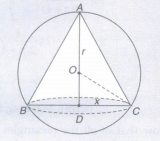
Volume of cone (V)
\(=\frac { 1 }{ 3 } \pi { x }^{ 2 }h\) ...(i)
In \(\Delta OCD,\quad { x }^{ 2 }+({ h-r) }^{ 2 }={ r }^{ 2 }or\quad { x }^{ 2 }={ r }^{ 2 }-{ (h-r) }^{ 2 }\)
\(\therefore V=\frac { 1 }{ 3 } \pi h\{ { r }^{ 2 }-(h-r{ ) }^{ 2 }\} \)
\(=\frac { 1 }{ 3 } \pi (-{ h }^{ 3 }+{ 2h }^{ 2 }r)\)
\(\Rightarrow \frac { dV }{ dh } =\frac { \pi }{ 3 } (-3{ h }^{ 2 }+4hr)\)
\(\therefore \quad \frac { dV }{ dh } =0\Rightarrow h=\frac { 4r }{ 3 } \)
\(\frac { { d }^{ 2 }V }{ { dh }^{ 2 } } =\frac { \pi }{ 3 } (-6h+4r)\)
\(=\frac { \pi }{ 3 } \left( -6\left( \frac { 4r }{ 3 } \right) +4r \right) \)
\(=-\frac { 4\pi r }{ 3 } <0\)
\(\therefore \ at\quad h=\frac { 4r }{ 3 } \), Volume is maximum
Maximum volume
\(=\frac { 1 }{ 3 } \pi .\left\{ -{ \left( \frac { 4r }{ 3 } \right) }^{ 3 }+2{ \left( \frac { 4r }{ 3 } \right) }^{ 2 }r \right\} \)
\(=\frac { 8 }{ 27 } .\left( \frac { 4 }{ 3 } \pi { r }^{ 3 } \right) \)
\(=\frac { 8 }{ 27 } \) (volume of sphere)
16.
y = eax
\(\frac { dy }{ dx } \)= eax(-sinbx)b+cosbx \(\times \) eax\(\times \) a
\(\frac { dy }{ dx } -be^{ ax }sinbx+ay\Rightarrow \left[ \frac { -1 }{ b } \left( \frac { dy }{ dx } -ay \right) \right] =e^{ ax }sinbx\)
\(\frac { dy }{ dx } =-b\left[ e^{ a^{ x }cosb }\times a \right] +\frac { ady }{ dx } \)
\(\frac { d^{ 2 }y }{ dx^{ 2 } } -b\left[ by\frac { -a }{ -b } \left( \frac { dy }{ dx } -ay \right) \right] +\frac { ady }{ dx } \) from (1)
\(\frac { d^{ 2 }y }{ dx^{ 2 } } -b^{ 2 }y+a\frac { dy }{ dx } -a^{ 2 }y+a\frac { dy }{ dx } \)
\(\frac { d^{ 2 }y }{ dx^{ 2 } } +\left( a^{ 2 }+b^{ 2 } \right) y-2a\frac { dy }{ dx } =0\)
Hence proved
17.
Let x, y and z be the values of adaptable new techniques, careful and alert in difficult situations and keeping calm in tense situations respectively.
Then the system of equations is
2x + 4y + 3z = 29,000
5x + 2y + 3z = 30,500
x + y + z = 9,500
Matrix equation is
\(\left[ \begin{matrix} 2 & 4 & 3 \\ 5 & 2 & 3 \\ 1 & 1 & 1 \end{matrix} \right] \left[ \begin{matrix} x \\ y \\ z \end{matrix} \right] =\left[ \begin{matrix} 29000 \\ 30500 \\ 9500 \end{matrix} \right] \)
i.e, AX = B
\(|A|=\left| \begin{matrix} 2 & 4 & 3 \\ 5 & 2 & 3 \\ 1 & 1 & 1 \end{matrix} \right| \)
= 2(2-3)-495-3)+3(5-2)
= -1 \(\ne\) 0
\(\therefore\) A-1 exists.
adj A = \({ \left[ \begin{matrix} -1 & -2 & 3 \\ -2 & -1 & 2 \\ 3 & 2 & -16 \end{matrix} \right] }^{ T }\)
\(=\left[ \begin{matrix} -1 & -1 & 6 \\ -2 & -1 & 9 \\ 3 & 2 & -16 \end{matrix} \right] \)
\(X={ A }^{ -1 }B\)
\(=-1\left[ \begin{matrix} -29,000-30,500+57,000 \\ -58,000-30,500+85,500 \\ 87,00+61,000-15,2,000 \end{matrix} \right] \)
\(\left[ \begin{matrix} x \\ y \\ z \end{matrix} \right] =\left[ \begin{matrix} 2,500 \\ 3,000 \\ 4,000 \end{matrix} \right] \)
x = 2,500, y = 3,000, z = 4,000
i.e., Rs. 2,500 for adaptable n.ew technique Rs. 3,000 for careful and alert in difficult situations and Rs. 4,000 for keeping calm in tense situations,
Value: Award should'be given to a person who truly deserves it.
18.
\(I=\int { \frac { { x }^{ 2 }+1 }{ (x-1)^{ 2 }(x+3) } } dx\)
Let \(\int { \frac { { x }^{ 2 }+1 }{ (x-1)^{ 2 }(x+3) } } =\frac { A }{ x-1 } +\frac { B }{ (x-1)^{ 2 } } +\frac { C }{ x+3 } \)
\(\Rightarrow { x }^{ 2 }+1=A(x-1)(x+3)+B(x+3)+C(x-1)^{ 2 }\)
Getting the values \(A=\frac { 3 }{ 8 } , B=\frac { 1 }{ 2 } , C=\frac { 5 }{ 8 } \)
\(\therefore \ I=\int { \frac { { x }^{ 2 }+1 }{ (x-1)^{ 2 }(x+3) } } dx\)
\(=\frac { 3 }{ 8 } \int { \frac { dx }{ x-1 } +\frac { 5 }{ 8 } \int { \frac { dx }{ x+3 } +\frac { 1 }{ 2 } \int { \frac { 1 }{ (x-1)^{ 2 } } } } } dx\)
\(I=\frac { 3 }{ 8 } log\left[ x-1 \right] +\frac { 5 }{ 8 } log\left[ x+3 \right] -\frac { 1 }{ 2 } \frac { 1 }{ (x-1) } +C\)
19.
Let a, b \(\in A\), a " b = a + b + ab
Commutatively : for all a, b \(\in A\)
.a * b = a + b + ab
= b + a + ba
= b * a
Associatively: Let a, b, c \(\in A\)
(a * b) " c = (a + b + ab) " c
= (a + b + ab) + c + (a + b + ab)c
(a * b) " c = a + b + c + ab + bc + ac + abc
a * (b * c) = a * (b + c + bc)
= a + b + c + ab + bc + ac + abc
Clearly
(a * b) * c = a * (b "c) \(\forall \) a, b, c \(\in A\)}
* is associative.
Identity: Let e \(\in A\)}such that
a * c = a
c + a + ea = a
c = 0
Identity element of A is e = O.
Inverse: Let b \(\in A\)such that
a*b = b*a = e
\(\Rightarrow \) a + b + ab = 0 and b + a + ba = 0
\(\Rightarrow \) a = -b-ab
\(\Rightarrow \) a = -b(l + a)
\(\Rightarrow \) b = \(\frac { -a }{ 1+a } \) \([\because \quad a\in A\therefore a\neq -1]\)
Invertible element of A is \(\frac { -a }{ 1+a } \) for all \(a\in A\)
20.
We shall prove the result by using principle of mathematical induction.
Let \(P\left( n \right) { :A }^{ n }=\left[ \begin{matrix} { 3 }^{ n-1 } & { 3 }^{ n-1 } & { 3 }^{ n-1 } \\ { 3 }^{ n-1 } & { 3 }^{ n-1 } & { 3 }^{ n-1 } \\ { 3 }^{ n-1 } & { 3 }^{ n-1 } & { 3 }^{ n-1 } \end{matrix} \right] \)
Now, \(P\left( 1 \right) { :A }^{ 1 }=\left[ \begin{matrix} { 3 }^{ 0 } & { 3 }^{ 0 } & { 3 }^{ 0 } \\ { 3 }^{ 0 } & { 3 }^{ 0 } & { 3 }^{ 0 } \\ { 3 }^{ 0 } & { 3 }^{ 0 } & { 3 }^{ 0 } \end{matrix} \right] =\left[ \begin{matrix} 1 & 1 & 1 \\ 1 & 1 & 1 \\ 1 & 1 & 1 \end{matrix} \right] \)
The result is true for n = 1.
Let the result be true for n = k.
So, \({ A }^{ k }=\left[ \begin{matrix} { 3 }^{ k-1 } & { 3 }^{ k-1 } & { 3 }^{ k-1 } \\ { 3 }^{ k-1 } & { 3 }^{ k-1 } & { 3 }^{ k-1 } \\ { 3 }^{ k-1 } & { 3 }^{ k-1 } & { 3 }^{ k-1 } \end{matrix} \right] \)
Now, we prove that P(k + 1) is true.
Now, Ak+1 = A. Ak
\(=\left[ \begin{matrix} 1 & 1 & 1 \\ 1 & 1 & 1 \\ 1 & 1 & 1 \end{matrix} \right] \left[ \begin{matrix} { 3 }^{ k-1 } & { 3 }^{ k-1 } & { 3 }^{ k-1 } \\ { 3 }^{ k-1 } & { 3 }^{ k-1 } & { 3 }^{ k-1 } \\ { 3 }^{ k-1 } & { 3 }^{ k-1 } & { 3 }^{ k-1 } \end{matrix} \right] \)
\(=\left[ \begin{matrix} { 3.3 }^{ k-1 } & { 3.3 }^{ k-1 } & { 3.3 }^{ k-1 } \\ { 3.3 }^{ k-1 } & { 3.3 }^{ k-1 } & { 3.3 }^{ k-1 } \\ { 3.3 }^{ k-1 } & { 3.3 }^{ k-1 } & { 3.3 }^{ k-1 } \end{matrix} \right] \)
\(=\left[ \begin{matrix} { 3 }^{ k } & { 3 }^{ k } & { 3 }^{ k } \\ { 3 }^{ k } & { 3 }^{ k } & { 3 }^{ k } \\ { 3 }^{ k } & { 3 }^{ k } & { 3 }^{ k } \end{matrix} \right] \)
= Ak+1
Hence, it is true n = k + 1.
Hence, by principle of mathematical induction P(n) is true for all \(n\epsilon N\)
21.
Let Rs. 30,000 be divided into two parts:
Rs. x invested in 1st type and Rs. (30,000-x) in 2nd type.
The values of the bonds are represented by \(1\times 2\) row matrix as: \(A=\left[ \begin{matrix} x & 30,000-x \end{matrix} \right] \)
The amount received as interest per Rs. annually are represented by \(2\times 1\) column matrix as: \(B=\left[ \begin{matrix} \frac { 5 }{ 100 } \\ \frac { 7 }{ 100 } \end{matrix} \right] .\)
\(\therefore \) The interest to be obtained is a \(1\times 1\) matrix, which is represented by the product matrix \(1\times 1\).
\(AB=\left[ \begin{matrix} x & 30,000-x \end{matrix} \right] \left[ \begin{matrix} \frac { 5 }{ 100 } \\ \frac { 7 }{ 100 } \end{matrix} \right] \)
\(=\left[ \frac { 5x }{ 100 } +\left( 30,000-x \right) \frac { 7 }{ 100 } \right] \)
\(=\left[ 2100-\frac { 2x }{ 100 } \right] .\)
(a) By the question,
\(\left[ 2100-\frac { 2x }{ 100 } \right] =\left[ 1800 \right] \)
\(\Rightarrow 2100-\frac { 2x }{ 100 } =1800\)
\(\Rightarrow \frac { 2x }{ 100 } =300\)
\(\Rightarrow x=15000\)
Hence, the reqd.amounts are Rs.15,000 and Rs. (30,000 - 15,000) i.e., Rs. 15,000 and Rs. 15,000.
(b) By the question,
\(\left[ 2100-\frac { 2x }{ 100 } \right] =\left[ 2000 \right] \)
\(\Rightarrow 2100-\frac { 2x }{ 100 } =2000\)
\(\Rightarrow \frac { 2x }{ 100 } =100\)
\(\Rightarrow x=5000\)
Hence, the reqd .amounts are Rs. 5,000 and Rs. (30,000 - 5,000)
i.e., Rs. 5,000 and Rs. 25,000.
22.
False
23.
a = 2b {a=4, b=2}
24.
Given,
\(\overrightarrow a\times \overrightarrow b=\overrightarrow a\times \overrightarrow b \) and \(\overrightarrow a\times \overrightarrow c=\overrightarrow b\times \overrightarrow d\)
\(\Rightarrow \overrightarrow a\times \overrightarrow b-\overrightarrow a\times \overrightarrow c=\overrightarrow c\times \overrightarrow d-\overrightarrow b\times \overrightarrow d\)
\(\Rightarrow \overrightarrow a\times \overrightarrow d-\overrightarrow a\times \overrightarrow c+\overrightarrow b\times \overrightarrow b-\overrightarrow c\times \overrightarrow d=\overrightarrow 0\)
\(\Rightarrow \overrightarrow a\times(\overrightarrow b-\overrightarrow c)+(\overrightarrow b-\overrightarrow c)\times \overrightarrow d=\overrightarrow 0\)[By left and right distributive law]
\(\Rightarrow \overrightarrow a\times(\overrightarrow b-\overrightarrow c)-\overrightarrow b\times (\overrightarrow b-\overrightarrow c)=\overrightarrow 0\)\([\because \overrightarrow a\times \overrightarrow b=-\overrightarrow b\times \overrightarrow a]\)
\(\Rightarrow (\overrightarrow a-\overrightarrow d)\times (\overrightarrow b-\overrightarrow c)=\overrightarrow 0\)
\(\Rightarrow(\overrightarrow a-\overrightarrow d)\parallel(\overrightarrow b-\overrightarrow c)\)
25.
\(\Rightarrow I=\int _{ 0 }^{ 1 }{ x{ e }^{ x } } dx\)
\(\Rightarrow I=\left[ \left[ x\int { { e }^{ x }dx } -\int { \left[ \frac { d }{ dx } x\int { { e }^{ x }dx } \right] dx } \right] \right] ^{ 1 }_{ 0 }\)
\(\Rightarrow I=\left[ x{ e }^{ x }-\int { 1.{ e }^{ x }.dx } \right] ^{ 1 }_{ 0 }\)
\(\Rightarrow I=\left[ xe^{ x }-e^{ x } \right] ^{ 1 }_{ 0 }\)
\(\Rightarrow I=\left[ (1e^{ 2 }-e^{ 1 })-({ 0e }^{ 0 }-{ e }^{ 0 } \right] \)
\(\Rightarrow I=(0)-(0-1)=1\)
26.
\(\frac { dx }{ d\theta } =\theta cos\theta +sin\theta \)
\(\frac { dy }{ d\theta } =-\theta sin\theta +cos\theta \)
\(\frac { dy }{ dx } =\frac { cos\theta -\theta sin\theta }{ \theta cos\theta +sin\theta } \)
dy/dx at \(\theta\)= \(\pi/4\)
\(=\frac { cos\frac { \pi }{ 4 } -\frac { \pi }{ 4 } sin\frac { \pi }{ 4 } }{ \frac { \pi }{ 4 } cos\frac { \pi }{ 4 } +sin\frac { \pi }{ 4 } } \)
\(=\frac { \frac { 1 }{ \sqrt { 2 } } -\frac { \pi }{ 4 } \times \frac { 1 }{ \sqrt { 2 } } }{ \frac { \pi }{ 4 } \times \frac { 1 }{ \sqrt { 2 } } +\frac { 1 }{ \sqrt { 2 } } } \)
=\(\frac { 1-\frac { \pi }{ 4 } }{ \frac { \pi }{ 4 } +1 } \)
\(\Rightarrow\)\(\frac { dy }{ dx } =\frac { 4-\pi }{ 4+\pi } \)
27.
Let A be the point (5, 4, - 6)
Image A' be the point (5, 4, - 6)
\(\therefore\) A'(5, 4, - 6)
Distance between AA'
\(=\sqrt { (5-5)^{ 2 }+(4-4)^{ 2 }+(6+6)^{ 2 } } \)
\(=\sqrt { 0+0+12^{ 2 } } \)
=123 units
28.
\(P(\bar { A } /\bar { B } )=\frac { P(\bar { A } \cap \bar { B } ) }{ P(\bar { B } ) } \)
\(=\frac { 1-P(A\cup B) }{ 1-P(B) } \)
\(=\frac { 1-[P(A)+P(B)-P(A\cap B)] }{ 1-P(B) } \)
\(=\frac { 7 }{ 10 } \)
29.
\(\frac { dy }{ dx } =xy+2y\)
\(\Rightarrow \frac { dy }{ dx } =y\left( x+2 \right) \)
Integrating both the sides,
\(\int { \frac { dy }{ y } } =\int { \left( x+2 \right) dx } \)
\(\Rightarrow \log { y } =\frac { { x^{ 2 } } }{ 2 } +2x+c\)
30.
we have f = {(a, 3) (b, 2) (e, 1)}, f is a one-one function.
\(f^{ -1 },f^{ 0 }=[(3,a),(2,b)(1,c)]\)
(ii) f = {(a, 2), (b, 1)(e, 1)}. f is not one-one, f is not onto because 3 \(\epsilon\) B as it has no Pre-image.
31.
\({ tan }^{ -1 }\left( \frac { 1-x }{ 1+x } \right) =\frac { 1 }{ 2 } { tan }^{ -1 }x\) [Given]
Put, x = tan \(\theta \) \(\Rightarrow\) tan-1 x=\(\theta \)
\(\Rightarrow \quad { tan }^{ -1 }\left[ \frac { 1-tan\theta }{ 1+tan\theta } \right] =\frac { 1 }{ 2 } \theta \)
\(\Rightarrow \quad { tan }^{ -1 }\left[ tan\left( \frac { \pi }{ 4 } -\theta \right) \right] =\frac { \theta }{ 2 } \)
\(\Rightarrow \quad \frac { \pi }{ 4 } -\theta =\frac { \theta }{ 2 } \)
\(\Rightarrow \quad \frac { \pi }{ 4 } =\frac { \theta }{ 2 } +\theta \)
\(\Rightarrow \quad \frac { \pi }{ 4 } =\frac { 3\theta }{ 2 } \Rightarrow \theta =\frac { \pi }{ 6 } \)
\(\Rightarrow \quad { tan }^{ -1 }x=\frac { \pi }{ 6 } \)
\(\Rightarrow \quad x=tan\frac { \pi }{ 6 } =\frac { 1 }{ \sqrt { 3 } } \)
32.
We have, \(A=\left| \begin{matrix} 6 & 0 & 1 \\ 0 & 1 & 2 \\ 0 & 0 & 4 \end{matrix} \right| \)
|A| = 6(4-0)-0(0-0)+1(0-0)
|2A| = \(\left| \begin{matrix} 12 & 0 & 2 \\ 0 & 2 & 4 \\ 0 & 0 & 8 \end{matrix} \right| \)
= 12(16-0)-0(0-0)+2(0-0)
= 192
|2A| = 8 x 24 = 8|A|
33.
(c)
\(\left| \int _{ a }^{ b }{ f(x)dx } \right| \)
34.
(b)
Parallel
35.
(a)
1 m/h
36.
Here (1,2) e R, (2,1) € R, if transitive (1,1) should belong to R.

12th Standard CBSE Syllabus & Materials
12th Standard CBSE
CBSE 12th Computer Science Python Revision Tour I - New Previous year Question Papers Study Material - QB365 Set A
NEW12th Standard CBSE
CBSE 12th Business Studies Planning Important Questions And Answers Study Material - QB365 Set A
NEW12th Standard CBSE
CBSE 12th Business Studies Business Environment Important Questions And Answers Study Material - QB365 Set A
NEW12th Standard CBSE
CBSE 12th Business Studies Principles of Management Important Questions And Answers Study Material - QB365 Set A



CBSE 12th Standard CBSE Subjects
CBSE Standards










