
 100% FREE ACCESS
12th Standard CBSE Syllabus & Materials
12th Standard CBSE
CBSE 12th Economics Government Budget and the Economy Previous year Question Papers Study Material - QB365 Set A
NEW12th Standard CBSE
CBSE 12th Computer Science Interface Python with MySQL - New Previous year Question Papers Study Material - QB365 Set A
NEW12th Standard CBSE
CBSE 12th Computer Science Database Concept - New Previous year Question Papers Study Material - QB365 Set A
NEW12th Standard CBSE
CBSE 12th Computer Science Data Communication - New Previous year Question Papers Study Material - QB365 Set A
NEW12th Standard CBSE
CBSE 12th Computer Science Data Structures - New Previous year Question Papers Study Material - QB365 Set A
NEW12th Standard CBSE
CBSE 12th Computer Science Functions - New Previous year Question Papers Study Material - QB365 Set A

Published on: 15/02/2020
12th Standard CBSE Mathematics Public Model Question Paper II 2020
Download CBSE Class 12th Standard CBSE Maths question papers, sample papers, important questions, and previous year solved papers in PDF format. Get free study materials, NCERT solutions, and exam preparation resources for Class 12th Standard CBSE Maths
Questions + Answers key
Take MCQ Maths Test
1.
Find the magnitude of two vectors \(\overrightarrow a\) and \(\overrightarrow b\) of equal magnitude such that the angle between them is a 60o and their scalar product is \(\frac{1}{2}.\)
2.
\(y={ tan }^{ -1 }\frac { 5x }{ 1-6{ x }^{ 2 } } \),\(-\frac { 1 }{ \sqrt { 6 } }
3.
If a lines makes angle 60° and 45° with the positive directions of x-axis and z-axis respectively, then find the angle that it makes with the y-axis.
4.
If E and F are two events such that \(P(E)=\frac { 1 }{ 4 } ,\) \(P(E)=\frac { 1 }{ 2 } \) and \( P(E\cap F)=\frac { 1 }{ 8 } \), find
(a) P(E or F)
(b) P(not E and not F).
5.
Show that the solution of differential equation :
\(y=\left( { 2x }^{ 2 }-1 \right) +c{ e }^{ { -x }^{ 2 } }\) is \(\frac { dy }{ dx } +2xy-4{ x }^{ 3 }=0\)
6.
Let f and g be real valued functions defined as \(f(x)=x^{ 2 }+1,x\in R\)and g(x) = 2x + 1, \(x\in R\) Find the value of fog and gof
7.
Write in the simplest form : \(sin\left[ 2{ tan }^{ -1 }\sqrt { \frac { 1-x }{ 1+x } } \right] \)
8.
\(\int { \frac { a }{ b+ce^{ x } } } dx\)
9.
Find the value of X and Y if
\(X+Y=\left[ \begin{matrix} 2 & 3 \\ 5 & 1 \end{matrix} \right] ,X-Y=\left[ \begin{matrix} 6 & 5 \\ 7 & 3 \end{matrix} \right] \)
10.
If \(A=\left| \begin{matrix} 6 & 0 & 1 \\ 0 & 1 & 2 \\ 0 & 0 & 4 \end{matrix} \right| \), then show that |2A| = 8|A|:
11.
Show that all the elements on the main diagonal of a skew symmetric matrix are zero.
12.
If A-1 = \(\left[ \begin{matrix} 3 & -1 & 1 \\ -15 & 6 & -5 \\ 5 & -2 & 2 \end{matrix} \right] \) and B =\(\left[ \begin{matrix} 1 & 2 & -2 \\ -1 & 3 & 0 \\ 0 & -2 & 1 \end{matrix} \right] \) find (AB)-1
13.
If \(\overrightarrow { a } ,\overrightarrow { b } ,\overrightarrow { c } \) are unit vectors such that \(\overrightarrow { a } .\overrightarrow { b } =\overrightarrow { a } .\overrightarrow { c } =0\) and the angle between \(\overrightarrow { b } \) and \(\overrightarrow { c } \) is \(\frac{\pi}{6}\) , then prove that:
(i) \(\overrightarrow { a } =\pm 2\left( \overrightarrow { b } \times \overrightarrow { c } \right) \)
(ii) \(\left[ \overrightarrow { a } +\overrightarrow { b } ,\overrightarrow { b } +\overrightarrow { c } ,\overrightarrow { c } +\overrightarrow { a } \right] =\pm 1\)
14.
Evaluate: \(\int _{ 1 }^{ 4 }{ \left( { x }^{ 2 }-x \right) dx } \) as the limit of sums.
15.
A man is known to speak the truth 3 out of 5 times. He throws a die and reports that it is 1. Find the probability that it is actually 1.
16.
Show that the binary operation * on A = R-{-1} defined as a*b = a + b for all a, b, c A is commutative and associative on A. Also find the identity element of * in A and prove that every element of A is invertible
17.
If \(A=\left( \begin{matrix} 1 & 0 & 2 \\ 0 & 2 & 1 \\ 2 & 0 & 3 \end{matrix} \right) \), prove that A3 - 6A2 + 7A + 2I = 0
18.
If y=tan x + sec x, prove that (1-sin x)2 \(\frac { { d }^{ 2 }y }{ { dx }^{ 2 } } \)=cos x
19.
Find the matrix X, such that X \(\left[ \begin{matrix} 1 & 2 & 3 \\ 4 & 5 & 6 \end{matrix} \right] =\left[ \begin{matrix} -7 & -8 & -9 \\ 2 & 4 & 6 \end{matrix} \right] .\)
20.
An urn contains 4 white and 6 red balls. Four balls are drawn at random (without replacement) from the urn. Find the probability distribution of the number of white balls.
21.
Evaluate the following indefinite integral:
\(\int { \frac { 1 }{ sinx-sin2x } } dx\)
22.
An oil company has two depots A and B with capacities of 7000 L and 4000 L respectively. The company is to supply oil to three petrol pumps, D, E and F whose requirements are 4500 L, 3000 L and 3500 L respectively. The distance (in km) between the depots and the petrol pumps are given in the following table:
| Distance in (km.) | ||
| From/To | A B | |
| D E F |
7 6 3 |
3 4 2 |
Assuming that the transportation cost of 10 litres of oil is Rs. 1 per km, how should the delivery be scheduled in order that the transportation cost is minimum? What is the minimum cost?
23.
Le A = N x N and let ' * ' be a binary operations on A defined by (a,b)*(c,d) = (a+c, b+d).
Show that ' * ' is commutative and associative. Find the identity element for ' * ' on A, if any.
24.
Find the second order derivative of the functions: \(sin\ (log\ x)\)
25.
Find the general solution of the differential equation:\(\frac { dy }{ dx } +\sqrt { \frac { 1-{ y }^{ 2 } }{ 1-{ x }^{ 2 } } } =0.\)
26.
Find the area of the circle 4x2 + 4y2 = 9, which is interior to the parabola x2 = 4y.
27.
If x = -4 is root of \(\Delta=\left|\begin{matrix}x&2&3\\ 1&x&1\\3&2&x\end{matrix}\right|=0\)then find the other two roots.
28.
Find x and y, if \(2\begin{bmatrix} 1 & 3 \\ 0 & x \end{bmatrix}+\begin{bmatrix} y & 0 \\ 1 & 2 \end{bmatrix}=\begin{bmatrix} 5 & 6 \\ 1 & 8 \end{bmatrix}.\)
29.
Find te principal values of the following: \({ cosec }^{ -1 }\left( -\sqrt { 2 } \right) \)
30.
Show that the lines x = ay + b, z = cy + d and x = a'y + b', z = c'y + d' are perpendicular to each other, if aa' + cc' + 1 = 0.
31.
Solve the differential equation : \(\frac {dy}{dx}\) = ex-y + x3 e-y.
32.
The direction cosines of the line whose direction ratios are 6, – 6, 3 are:
\(\frac { 2 }{ 3 } ,\frac { -2 }{ 3 } ,\frac { 1 }{ 3 } \)
\(\frac { -2 }{ 3 } ,\frac { 2 }{ 3 } ,\frac { -1 }{ 3 } \)
\(\frac { 6 }{ 3 } ,\frac { -6 }{ 3 } ,\frac { -1 }{ 3 } \)
\(\frac { 2 }{ 9 } ,\frac { -2 }{ 9 } ,\frac { 1 }{ 9 } \)
33.
The area enclosed between the lines x = 2 and x = 7 is
Infinite
7 units
5 units
2 units
34.
Let R be a relation on N (set of natural numbers) such that (m, n) R (p, q)mq(n + p) = np(m + q). Then, R is
An Equivalence Relation
Only Reflexive
Symmetric and reflexive
Only Transitive
35.
The total revenue in Rupees received from the sale of x units of a product is given by
R(x) = 3x2 + 36x + 5. The marginal revenue, when x = 15 is
116
96
90
126
1.
Given, \(\left| a\right| =\left| b \right| \)
and a.b \(=\frac{1}{2}\)
Let \(\theta \) be thae angle between \(\overrightarrow a\) and \(\overrightarrow b\)
then, \(\cos \theta=\frac{a.b}{\left| a\right| \left| b \right| }\)
\(\cos 60^{ \circ }=\frac{\frac{1}{2}}{\left| \overrightarrow { a } \right| .\left| \overrightarrow { a} \right| }\)
\(\Rightarrow \frac{1}{2}=\frac{\frac{1}{2}}{\left| \overrightarrow { a } \right|^{ 2} }\)
\(\Rightarrow \left| \overrightarrow { a } \right| ^{2 }=\frac{\frac{1}{2}}{\frac{1}{2}}=1\)
\(\Rightarrow \left| \overrightarrow { a} \right| =1 \)
\(\Rightarrow\left| \overrightarrow { a} \right| =\left| \overrightarrow { b} \right| =1\)
2.
\(y={ tan }^{ -1 }\frac { 3x+2x }{ 1-3x2x } \)
= \({ tan }^{ -1 }3x+{ tan }^{ -1 }2x\)
\(\Rightarrow \frac { dy }{ dx } =\frac { 3 }{ 1+9{ x }^{ 3 } } +\frac { 2 }{ 1+4{ x }^{ 2 } } \)
3.
\(\alpha =60^{ \circ },\beta =?,\gamma =45^{ \circ }\)
Let \(\alpha \) makes with x-axis, y makes with z-axis and \(\beta \) makes with y-axis
\(\alpha =cos\quad 60^{ \circ },m=cos\quad \beta ,y=cos45^{ \circ }\)
\(\alpha ^{ 2 }+\beta ^{ 2 }+\gamma ^{ 2 }=1\)
\(\Rightarrow cos^{ 2 }60^{ \circ }+cos^{ 2 }\beta +cos^{ 2 }45^{ \circ }\)
\(\Rightarrow \frac { 1 }{ 4 } +cos^{ 2 }\beta +\frac { 1 }{ 2 } =1\)
\(\Rightarrow cos^{ 2 }\beta =1-\frac { 1 }{ 4 } -\frac { 1 }{ 2 } \)
\(=\frac { 4-1-2 }{ 4 } \)
\(=\frac { 1 }{ 4 } \)
\(\Rightarrow cos \beta =\pm \frac { 1 }{ 2 } \)
\(\beta =\frac { \pi }{ 3 } or\ \frac { 2\pi }{ 3 } \)
But angle between two lines in the interval \(\left( 0,\frac { \pi }{ 2 } \right) \)
Hence required angles is \(\frac { \pi }{ 3 } \)
4.
Given, \(P(E)=\frac { 1 }{ 4 } \)
\(P(F)=\frac { 1 }{ 2 } \)
and \(P(E\cap F) =\frac { 1 }{ 8 } \)
(a) P(E or F) = (E\(\cup\)F) = P(E) + P(F) - P(E\(\cap\)F)
\(=\frac { 1 }{ 4 } +\frac { 1 }{ 2 } -\frac { 1 }{ 8 } \)
\(=\frac { 2+4-1 }{ 8 } \)
\(=\frac { 5 }{ 8 } \)
(b) P(not E and not F) = \(P(\bar { E } \cap \bar { F } )=P\overline { (E\cup F) } \)
= 1 - P(E\(\cup\) F)
= 1 - \(\frac { 5 }{ 8 } =\frac { 3 }{ 8 } \)
5.
\(y=\left( { 2x }^{ 2 }-1 \right) +c{ e }^{ { -x }^{ 2 } }\)
\(\Rightarrow \frac { dy }{ dx } =2\left( 2x \right) +c{ e }^{ { -x }^{ 2 } }\times -2x\)
\(\Rightarrow \frac { dy }{ dx } =4x-2xc{ e }^{ { -x }^{ 2 } }\) ...(i)
\(y=2\left( { x }^{ 2 }-1 \right) +c{ e }^{ { -x }^{ 2 } }\)
\(\Rightarrow c{ e }^{ { -x }^{ 2 } }=y-{ 2x }^{ 2 }+2\)...(ii)
Putting the value of \(c{ e }^{ { -x }^{ 2 } }\) from eqn. (ii) to eqn.(i),
\(\frac { dy }{ dx } =4x-2x\left( y-{ 2x }^{ 2 }+2 \right) \)
\(\Rightarrow \frac { dy }{ dx } =4x-2xy+{ 4x }^{ 3 }-4x\)
\(\therefore \ \frac { dy }{ dx } +2xy+{ 4x }^{ 3 }=0\)
6.
\(f(x)=x^{ 2 }+1,g(x)=2x+1\)
\(fog=f[(g(x)\} =f(2x+1)\)
\(=4x^{ 2 }+4x+1+1\)
\(=4x^{ 2 }+4x+2\)
\(gof=g(f(x)=g(x^{ 2 }+1)\)
\(=2(x^{ 2 }+1)+1\)
\(=2x^{ 2 }+2+1\)
\(=2x^{ 2 }+3\)
7.
Let x = cos 2\(\theta \)
\(=sin\left[ 2t{ an }^{ -1 }\sqrt { \frac { 1-cos2\theta }{ 1+cos2\theta } } \right] \)
\(=sin\left[ 2tan^{ -1 }\sqrt { \frac { 2{ sin }^{ 2 }\theta }{ 2{ cos }^{ 2 }\theta } } \right] \)
\(\left[ \because cos2\theta =1-2{ sin }^{ 2 }\theta \ and\ cos\ 2\theta =2{ cos }^{ 2 }\theta -1 \right] \)
\(=sin\left[ 2{ tan }^{ -1 }\left( tan\quad \theta \right) \right] \)
\(=sin(2\theta )=\sqrt { 1-{ cos }^{ 2 }2\theta } \)
\(=sin\quad 2\theta =\sqrt { 1-{ x }^{ 2 } } \)
8.
\(\int { \frac { a }{ b+ce^{ x } } } dx\)
Multiply by e-x to numerator and denominator
\(\int { \frac { a{ e }^{ -x } }{ be^{ -x }+c } } dx\)
Put \(be^{ -x }+c=t\)
\(\Rightarrow -be^{ -x }dx=dt\)
\(\Rightarrow { e }^{ -x }dx=\frac { dt }{ -b } \)
\(=-\frac { a }{ b } \int { \frac { dt }{ t } } \)
\(\Rightarrow -\frac { a }{ b } log\left| t \right| =-\frac { a }{ b } log\left| b{ e }^{ -x }+c \right| +K\)
9.
We have, \(X+Y=\left[ \begin{matrix} 2 & 3 \\ 5 & 1 \end{matrix} \right] ,X-Y=\left[ \begin{matrix} 6 & 5 \\ 7 & 3 \end{matrix} \right] \)
\(\left( X+Y \right) +\left( X-Y \right) =\left[ \begin{matrix} 2 & 3 \\ 5 & 1 \end{matrix} \right] +\left[ \begin{matrix} 6 & 5 \\ 7 & 3 \end{matrix} \right] \)
\(2X=\left[ \begin{matrix} 8 & 8 \\ 12 & 4 \end{matrix} \right] \)
\(\Rightarrow X=\left[ \begin{matrix} 4 & 4 \\ 6 & 2 \end{matrix} \right] \)
\(\therefore \ X=\left[ \begin{matrix} 4 & 4 \\ 6 & 2 \end{matrix} \right] \)
and \(Y=\left[ \begin{matrix} 2 & 3 \\ 5 & 1 \end{matrix} \right] -\left[ \begin{matrix} 4 & 4 \\ 6 & 2 \end{matrix} \right] \)
\(=\left[ \begin{matrix} -2 & -1 \\ -1 & -1 \end{matrix} \right] \)
10.
We have, \(A=\left| \begin{matrix} 6 & 0 & 1 \\ 0 & 1 & 2 \\ 0 & 0 & 4 \end{matrix} \right| \)
|A| = 6(4-0)-0(0-0)+1(0-0)
|2A| = \(\left| \begin{matrix} 12 & 0 & 2 \\ 0 & 2 & 4 \\ 0 & 0 & 8 \end{matrix} \right| \)
= 12(16-0)-0(0-0)+2(0-0)
= 192
|2A| = 8 x 24 = 8|A|
11.
A square matrix \(A=[{ a }_{ ij }] \)is skew symmetric
if \({ a }_{ ij }=-{ a }_{ ji }\forall i,j \)
Let \(i=j\Rightarrow { a }_{ ii }=-{ a }_{ ii }\Rightarrow { 2a }_{ ii }=0\Rightarrow { a }_{ ii }=0\Rightarrow 0 \)
All the diagonal elements of a skew symmetric matrix are always zero.
12.
\(\left( AB \right) ^{ -1 }=\left[ \begin{matrix} 9 & -3 & 5 \\ -2 & 1 & 0 \\ 1 & 0 & 2 \end{matrix} \right] \)
13.
As given \(\overrightarrow { a } .\overrightarrow { b } =\overrightarrow { a } .\overrightarrow { c } =0=\overrightarrow { a } \bot \)both \(\overrightarrow { b } \) and \(\overrightarrow { c } \)
⇒ \(\overrightarrow { a } \parallel \left( \overrightarrow { b } \times \overrightarrow { c } \right) \)
Let \(\overrightarrow { a } =\lambda \left( \overrightarrow { b } \times \overrightarrow { c } \right) \)
then \(\left| \overrightarrow { a } \right| =\left| \lambda \right| \left| \left( \overrightarrow { b } \times \overrightarrow { c } \right) \right| \)
⇒ \(\frac { \left| \overrightarrow { a } \right| }{ \left| \left( \overrightarrow { b } \times \overrightarrow { c } \right) \right| } =\left| \lambda \right| \)
⇒ \(\left| \lambda \right| =\frac { 1 }{ sin\frac { \pi }{ 6 } } =2\)
λ = 士2
\(\overrightarrow { a } =\pm 2\left( \overrightarrow { b } \times \overrightarrow { c } \right) \)
Hence proved
(ii) Now \(\left[ \overrightarrow { a } +\overrightarrow { b } ,\overrightarrow { b } +\overrightarrow { c } ,\overrightarrow { c } +\overrightarrow { a } \right] \)
= \(\left[ \left( \overrightarrow { a } +\overrightarrow { b } \right) \times \left( \overrightarrow { b } \times \overrightarrow { c } \right) \right] .\left( \overrightarrow { c } +\overrightarrow { a } \right) \)
= \(\left( \overrightarrow { a } \times \overrightarrow { b } \right) .\overrightarrow { c } +\left( \overrightarrow { b } \times \overrightarrow { c } \right) .\overrightarrow { a } \)
(As the scalar triple product = 0, if any two vectors are equal)
Hence, \(\overrightarrow { a } .\left( \overrightarrow { b } \times \overrightarrow { c } \right) +\left( \overrightarrow { a } \times \overrightarrow { b } \right) .\overrightarrow { c } \) = \(\overrightarrow { a } .\left( \overrightarrow { b } \times \overrightarrow { c } \right) +\overrightarrow { c } \left( \overrightarrow { b } \times \overrightarrow { c } \right) \)
= 2\(\overrightarrow { a } \left( \overrightarrow { b } \times \overrightarrow { c } \right) \)
= \(2\overrightarrow { a } \left( \pm \frac { 1 }{ 2 } \overrightarrow { a } \right) \)
= 士1
Hence proved
14.
\(\int _{ 1 }^{ 4 }{ \left( { x }^{ 2 }-x \right) dx } =\int _{ 1 }^{ 4 }{ { x }^{ 2 }dx } -\int _{ 1 }^{ 4 }{ { x }dx } ={ I }_{ 1 }-{ I }_{ 2 }\)
Let \({ I }_{ 1 }=\int _{ 1 }^{ 4 }{ { x }^{ 2 }dx } \) [See Imp.keys and formulae]
Here \(h-\frac { b-a }{ n } =\frac { 4-1 }{ n } =\frac { 3 }{ n } \)
\(=\left( 4-1 \right) \underset { n\rightarrow \infty }{ lim } \frac { 1 }{ n } \left[ f\left( 1 \right) +f\left( 1+\frac { 3 }{ n } \right) +......+n\ terms \right] \)
\(= 3\underset { n\rightarrow \infty }{ lim } \frac { 1 }{ n } \left[ { 1 }^{ 2 }+{ \left( 1+\frac { 3 }{ n } \right) }^{ 2 }+\left( 1+\frac { 6 }{ n } \right) ^{ 2 }+......+\ n\ terms \right] \)
\(= 3\underset { n\rightarrow \infty }{ lim } \frac { 1 }{ n } \left[ \left( { 1 }^{ 2 }+{ 1 }^{ 2 }+....n\ terms \right) +\left\{ \left( \frac { 3 }{ n } \right) ^{ 2 }+{ \left( \frac { 6 }{ n } \right) }^{ 2 }+.....+\left( n-1 \right) \ terms \right\} +\left\{ 2\times \frac { 3 }{ n } +2\times \frac { 6 }{ n } +.....+\left( n-1 \right) terms \right\} \right] \)
\(=3\underset { n\rightarrow \infty}{ lim } \frac { 1 }{ n } \left[ n+\frac { 9 }{ { n }^{ 2 } } \frac { \left( n-1 \right) n\left( 2n-1 \right) }{ 6 } +\frac { 6 }{ n } \left( \frac { n\left( n+1 \right) }{ 2 } \right) \right] \)
\(=3\left[ 1+2\times \frac { 9 }{ 6 } +3 \right] =3\times 7=21\)
and \({ I }_{ 2 }=\int _{ 1 }^{ 4 }{ xdx } \)
\(=\left( 4-1 \right) \underset { n\rightarrow \infty }{ lim } \frac { 1 }{ n } \left[ f\left( 1 \right) +f\left( 1+\frac { 3 }{ n } \right) +......+n\ terms \right] \)
\(= 3\underset { n\rightarrow \infty }{ lim } \frac { 1 }{ n } \left[ { 1 }^{ 2 }+{ \left( 1+\frac { 3 }{ n } \right) }^{ 2 }+\left( 1+\frac { 6 }{ n } \right) ^{ 2 }+......+\ n\ terms \right] \)
\(= 3\underset { n\rightarrow \infty }{ lim } \frac { 1 }{ n } \left[ n+\frac { { n }^{ 2 } }{ 2 } +\frac { 3n }{ 2 } \right] \)
\(= 3\underset { n\rightarrow \infty }{ lim } \left[ 1+\frac { 3 }{ 2 } \right] \)
\(= 3\left[ 1+\frac { 3 }{ 2 } \right] =\frac { 15 }{ 2 } \)
\(\therefore \int _{ 1 }^{ 4 }{ \left( { x }^{ 2 }-x \right) } .dx={ I }_{ 1 }-{ I }_{ 2 }=21-\frac { 15 }{ 2 } =\frac { 27 }{ 2 } .\)
15.
E1 = Event that 1 occur;
E2 = Event that 1 does not occur;
A = Event that the man reports that 1 occur.
\(P({ E }_{ 1 })=\frac { 1 }{ 6 } ;P({ E }_{ 2 })=\frac { 5 }{ 6 } ;\)
\(P(A/{ E }_{ 1 })=\frac { 3 }{ 5 } ;P(A/{ E }_{ 2 })=\frac { 2 }{ 5 } ;\)
\(P({ E }_{ 1 }/A)=\frac { \frac { 1 }{ 6 } .\frac { 3 }{ 5 } }{ \frac { 1 }{ 6 } .\frac { 3 }{ 5 } +\frac { 5 }{ 6 } .\frac { 2 }{ 5 } } =\frac { 3 }{ 13 } \)
16.
Let a, b \(\in A\), a " b = a + b + ab
Commutatively : for all a, b \(\in A\)
.a * b = a + b + ab
= b + a + ba
= b * a
Associatively: Let a, b, c \(\in A\)
(a * b) " c = (a + b + ab) " c
= (a + b + ab) + c + (a + b + ab)c
(a * b) " c = a + b + c + ab + bc + ac + abc
a * (b * c) = a * (b + c + bc)
= a + b + c + ab + bc + ac + abc
Clearly
(a * b) * c = a * (b "c) \(\forall \) a, b, c \(\in A\)}
* is associative.
Identity: Let e \(\in A\)}such that
a * c = a
c + a + ea = a
c = 0
Identity element of A is e = O.
Inverse: Let b \(\in A\)such that
a*b = b*a = e
\(\Rightarrow \) a + b + ab = 0 and b + a + ba = 0
\(\Rightarrow \) a = -b-ab
\(\Rightarrow \) a = -b(l + a)
\(\Rightarrow \) b = \(\frac { -a }{ 1+a } \) \([\because \quad a\in A\therefore a\neq -1]\)
Invertible element of A is \(\frac { -a }{ 1+a } \) for all \(a\in A\)
17.
A2 = \(\left( \begin{matrix} 5 & 0 & 8 \\ 2 & 4 & 5 \\ 8 & 0 & 13 \end{matrix} \right) \); A3 = \(\left( \begin{matrix} 21 & 0 & 34 \\ 12 & 8 & 23 \\ 34 & 0 & 55 \end{matrix} \right) \)
L.H.S = A3 - 6A2 + 7A + 2I
\(=\left( \begin{matrix} 21 & 0 & 34 \\ 12 & 8 & 23 \\ 34 & 0 & 55 \end{matrix} \right) -\left( \begin{matrix} 30 & 0 & 48 \\ 12 & 24 & 30 \\ 48 & 0 & 78 \end{matrix} \right) +\left( \begin{matrix} 7 & 0 & 14 \\ 0 & 14 & 7 \\ 14 & 0 & 21 \end{matrix} \right) +\left( \begin{matrix} 2 & 0 & 0 \\ 0 & 2 & 0 \\ 0 & 0 & 2 \end{matrix} \right) \)
\(=\left( \begin{matrix} 0 & 0 & 0 \\ 0 & 0 & 0 \\ 0 & 0 & 0 \end{matrix} \right) =0\)
= RHS
18.
(1-sin x)2 y"=cos x
19.
\(X=\begin{bmatrix} 1 & -2 \\ 2 & 0 \end{bmatrix}\)
20.
Let x be the random variable denoting no. of white balls selected.
No. of balls can be 0, 1, 2, 3 or 4.
\(P_{ (0) }=\frac { { 6 }_{ C_{ 4 } }\times 4_{ C_{ 0 } } }{ { 10 }_{ { C }_{ 4 } } } =\frac { 15 }{ 210 } =\frac { 1 }{ 14 } \)
\(P_{ (1) }=\frac { { 6 }_{ { C }_{ 3 } }\times { 4 }_{ { C }_{ 1 } } }{ { 10 }_{ { C }_{ 4 } } } =\frac { 80 }{ 210 } =\frac { 8 }{ 21 } \)
\({ p }_{ (2) }=\frac { 6{ c }_{ 2 }\times { 4 }_{ C_{ 2 } } }{ 10_{ { C }_{ 4 } } } =\frac { 90 }{ 210 } =\frac { 3 }{ 7 } \)
\({ P }_{ (3) }=\frac { { 6 }_{ { C }_{ 1 } }\times { 4 }_{ { C }_{ 3 } } }{ { 10 }_{ { C }_{ 3 } } } =\frac { 24 }{ 210 } =\frac { 4 }{ 35 } \)
\(P_{ (4) }=\frac { { 6 }_{ { C }_{ 0 } }\times { 4 }_{ { C }_{ 4 } } }{ { 10 }_{ { C }_{ 4 } } } =\frac { 1 }{ 210 } \)
| x | 0 | 1 | 2 | 3 | 4 |
| P(x) | \(\frac { 1 }{ 14 } \) | \(\frac { 8 }{ 21 } \) | \(\frac { 3 }{ 7 } \) | \(\frac { 4 }{ 35 } \) | \(\frac { 1 }{ 210 } \) |
21.
We have,
\(I=\int { \frac { 1 }{ sinx-sin2x } } dx\)
\(\Rightarrow I=\int { \frac { dx }{ sinx-2sinxcosx } } \)
\(\Rightarrow I=\int { \frac { dx }{ sinx(1-2cosx) } dx } \)
\(\Rightarrow I=\int { \frac { sinx }{ sin^{ 2 }x(1-2cosx) } dx } \)
\(\Rightarrow I=\int { \frac { sinxdx }{ (1-cos^{ 2 }x)(1-2cosx) } } \)
Putting, \(cosx=t\Rightarrow -sinxdx=dt\) or sinxdx=-dt, we get
\(I=\int { \frac { -dt }{ (1-t^{ 2 })(1-2t) } } \)
\(\Rightarrow I=\int { \frac { -1 }{ (1+t)(1-t)(1-2t) } dt } \)
Let \(\int { \frac { 1 }{ (1+t)(1-t)(1-2t) } } \)
\(=\frac { A }{ (1+t) } +\frac { B }{ (1-t) } +\frac { C }{ 1-2t } \)
\(A=\left[ \frac { 1 }{ (1-t)(1-2t) } \right] _{ t=-1 }=\frac { 1 }{ 6 } \)
\(B=\left[ \frac { 1 }{ (1+t)(1-2t) } \right] _{ t=1 }=-\frac { 1 }{ 2 } \)
\(C=\left[ \frac { 1 }{ (1+t)(1-t) } \right] _{ t=\frac { 1 }{ 2 } }=\frac { 4 }{ 3 } \)
\(\therefore I=-\frac { 1 }{ 6 } \int { \frac { dt }{ 1+t } +\frac { 1 }{ 2 } \int { \frac { dt }{ 1-t } -\frac { 4 }{ 3 } \int { \frac { dt }{ 1-2t } } } } \)
\(\Rightarrow I=-\frac { 1 }{ 6 } log\left| 1+t \right| -\frac { 1 }{ 2 } log\left| 1-t \right| -\frac { 4 }{ 3 } \times \left( -\frac { 1 }{ 2 } \right) log\left| 1-2t \right| +C\)
\(\Rightarrow -\frac { 1 }{ 6 } log\left| 1+cosx \right| -\frac { 1 }{ 2 } log\left| 1-cosx \right| +\frac { 2 }{ 3 } log\left| 1-2cosx \right| +C\)
22.
Let x and y litres of oil be supplied from A to the petrol pumps, D and E. Then, (7000 − x − y) will be supplied from A to petrol pump F.
The requirement at petrol pump D is 4500 L. Since x L are transported from depot A, the remaining (4500 −x) L will be transported from petrol pump B.
Similarly, (3000 − y) L and 3500 − (7000 − x − y) = (x + y − 3500) L will be transported from depot B to petrol pump E and F respectively.
The given problem can be represented diagrammatically as follows.
Minimize: \(C=\frac { 3x }{ 10 } +\frac { y }{ 10 } +3950\)
Subject to: \(4500-x\ge 0\Leftrightarrow x\le 4500\) ...(1)
\(3000-y\ge 0\Leftrightarrow y\le 3000\)....(2)
\(x+y-3500\ge 0\Leftrightarrow x+y\ge 3500\) ...(3)
\(7000-(x+y)\ge 0\Leftrightarrow x+y\le 7000\) ..(4)
and \(x,y\ge 0\) ....(5)
Cost of transporting \(10 \mathrm{~L} \text { of petrol }=\operatorname{Re} 1\)
Cost of transporting \( 1 \mathrm{~L} \text { of petrol }=\mathrm{Rs} \frac{1}{10}\)
Therefore, total transportation cost is given by,
\(z =\frac{7}{10} \times x+\frac{6}{10} y+\frac{3}{10}(7000-x-y)+\frac{3}{10}(4500-x)+\frac{4}{10}(3000-y)+\frac{2}{10}(x+y-3500)\)
\(=0.3 x+0.1 y+3950 \)
The problem can be formulated as follows.
Minimize z = 0.3x + 0.1y + 3950 … (1)
subject to the constraints,
\(x+y \leq 7000 \)
\(x \leq 4500 \)
\(y \leq 3000 \)
\(x+y \geq 3500 \)
\(x, y \geq 0 \)
The feasible region determined by the constraints is as follows.
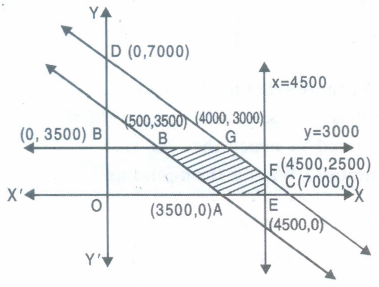
The corner points of the feasible region are A (3500, 0), B (4500, 0), C (4500, 2500), D (4000, 3000), and E (500, 3000).
The values of z at these corner points are as follows.
| Corner point | z = 0.3x + 0.1y + 3950 | |
| A (3500, 0) | 5000 | |
| B (4500, 0) | 5300 | |
| C (4500, 2500) | 5550 | |
| D (4000, 3000) | 5450 | |
| E (500, 3000) | 4400 | → Minimum |
The minimum value of z is 4400 at (500, 3000).
Thus, the oil supplied from depot A is 500 L, 3000 L, and 3500 L and from depot B is 4000 L, 0 L, and 0 L to petrol pumps D, E, and F respectively.
The minimum transportation cost is Rs. 4400.
23.
(i) Commutativity.
(a,b) * (c,d) = (a+c, b+d)
= (c+a, d+b)
[∵ Addition is commutative in N]
= (c,d) * (a,b).
Hence ' * ' is commutative
(ii) Associativity.
[(a*b)*(c,d)]*(e,f)] = (a+c, b+d)*(e,f)
= [(a+c)+e,(b+d)+f)
= (a+(c+e),b+(d+f)
[∵ Addition is associative in N]
= (a,b)*(c+e,d+f)
= (a,b)*[(c,d)*(e,f)]
Hence, '*' is associative.
(iii) Let (x, y) be the identity element.
Then (a,b)*(x,y) = (a,b)
\(\Rightarrow \) (a+x, b+y) = (a,b)
\(\Rightarrow \) a+x = a, b+y = b
\(\Rightarrow \) x = 0, y = 0.
But \(0\notin N\).
Hence, identity element does not exist.
24.
\(Let\ y=sin\ (log\ x)\)
\(\frac { dy }{ dx } =cos(log\ x).\frac { 1 }{ x } \)
\(and\ \frac { { d }^{ 2 }y }{ { dx }^{ 2 } } =\frac { x.\frac { d }{ dx } (cos(log\ x))-cos(log\ x).1 }{ { x }^{ 2 } } \)
\(=\frac { x.(-sin(log\ x))\frac { 1 }{ x } -cos(log\ x) }{ { x }^{ 2 } } \)
\(=-\frac { sin(log\ x)+cos(log\ x) }{ { x }^{ 2 } } \)
25.
We have: \(\frac { dy }{ dx } +\sqrt { \frac { 1-{ y }^{ 2 } }{ 1-{ x }^{ 2 } } } =0.\)
\(\Rightarrow \) \(\frac { dy }{ \sqrt { 1-{ y }^{ 2 } } } +\frac { dx }{ \sqrt { 1-{ x }^{ 2 } } } =0\)
| Variables Separable
Integrating, \(\int { \frac { dy }{ \sqrt { 1-{ y }^{ 2 } } } } +\int { \frac { dx }{ \sqrt { 1-{ x }^{ 2 } } } } =C\)
\(\Rightarrow \) \({ sin }^{ -1 }\quad y+{ sin }^{ -1 }x=C,\)
Which is the reqd. solution.
26.
The given circle is 4x2 + 4y2 = 9
i.e., x2 + y2 = \(\frac{9}{4}\)
which has centre (0,0) and radius \(\frac{3}{2}\)
The given parabola is x2 = 4y which is an upward parabola with vertex (0,0).
The reqd. area is shown shaded in the figure.
Solving (1) and (2):
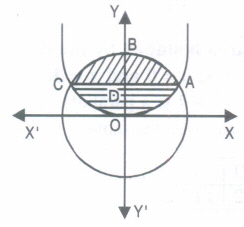
Putting the value of x2 from (2) in (1), we get:
\(4y+{ y }^{ 2 }=\frac { 9 }{ 4 } \Rightarrow { 4y }^{ 2 }+16y-9=0\)
\(\Rightarrow (2y+9)(2y-1)=0\Rightarrow y=-\frac { 9 }{ 2 } ,\frac { 1 }{ 2 }\)
\(Thus\ y=\frac { 1 }{ 2 } \left[ \because y\neq -\frac { 9 }{ 2 } \right] \)
\(\therefore Reqd.area=ar(OABC)\)
\(=ar(OAC)+ar(ACB)\)
\(=2\left[ \left( arOAD \right) +ar\left( DAB \right) \right] \)
\(=2\left[ 2\overset { 1/2 }{ \underset { 0 }{ \int { } } } \sqrt { y } dx+\overset { 3/2 }{ \underset { 1/2 }{ \int { } } } \frac { \sqrt { { 9-4y }^{ 2 } } }{ 2 } dy\left[ \because { x }^{ 2 }+{ y }^{ 2 }=\frac { 9 }{ 4 } \Rightarrow x=\sqrt { \frac { { 9-4y }^{ 2 } }{ 2 } } \right] \right] \)
\(=4\overset { 1/2 }{ \underset { 0 }{ \int { } } } { y }^{ 1/2 }dx+2\overset { 3/2 }{ \underset { 1/2 }{ \int { } } } \sqrt { \frac { 9 }{ 4 } -{ y }^{ 2 } } dy\)
\(=4\left[ \frac { { y }^{ 3/2 } }{ 3/2 } \right] _{ 0 }^{ 3/2 }+2\left[ \frac { y }{ 2 } \sqrt { \frac { 9 }{ 4 } -{ y }^{ 2 } } +\frac { 9 }{ 8 } { sin }^{ -1 }\left( \frac { 2y }{ 3 } \right) \right] _{ 1/2 }^{ 3/2 }\)
\(=\frac { 8 }{ 3 } \left( \frac { 1 }{ 2 } \right) ^{ 3/2 }+2\left[ \frac { y }{ 2 } \sqrt { \frac { 9 }{ 4 } -{ y }^{ 2 } } +\frac { 9 }{ 8 } { sin }^{ -1 }\left( \frac { 2y }{ 3 } \right) \right] _{ 1/2 }^{ 3/2 }\)
\(=\frac { 8 }{ 3 } \times \frac { 1 }{ 2\sqrt { 2 } } +2\left[ \left( 0+\frac { 9 }{ 8 } { sin }^{ -1 }(1) \right) -\left( \frac { 1 }{ 4 } \sqrt { 2 } +\frac { 9 }{ 8 } { sin }^{ -1 }\frac { 1 }{ 3 } \right) \right] \)
\(=\frac { 2\sqrt { 2 } }{ 3 } -\frac { \sqrt { 2 } }{ 2 } +\frac { 9 }{ 4 } \left( { sin }^{ -1 }1-{ sin }^{ -1 }\frac { 1 }{ 3 } \right) \)
\(=\frac { \sqrt { 2 } }{ 6 } +\frac { 9 }{ 4 } { sin }^{ -1 }\left( (1)\sqrt { 1-\frac { 1 }{ 9 } } -\frac { 1 }{ 3 } \sqrt { 1-1 } \right) \)
\(=\frac { \sqrt { 2 } }{ 6 } +\frac { 9 }{ 4 } { sin }^{ -1 }\left( \frac { 2\sqrt { 2 } }{ 3 } -0 \right) \)
\(=\left( \frac { \sqrt { 2 } }{ 6 } +\frac { 9 }{ 4 } { sin }^{ -1 }\frac { 2\sqrt { 2 } }{ 3 } \right) sq.units.\)
27.
\(\Delta=\begin{vmatrix}x+4&x+4&x+4\\1&x&1\\3&2&x \end{vmatrix}\)
\((x+4)\begin{vmatrix} 1&1&1\\1&x&1\\3&2&x\end{vmatrix}\)
\(=(x+4)\begin{vmatrix}1&0&0\\1&x-1&0\\3&-1&x-3 \end{vmatrix}\)
= (x+4) (1)[(x-1) (x-3)+0]
= (x+4) (x-1) (x-3)
Thus \(\Delta=0\Rightarrow x=-4,1,3.\)
Hence the other two roots are 1 and 3.
28.
\(We\quad have:\quad 2\begin{bmatrix} 1 & 3 \\ 0 & x \end{bmatrix}+\begin{bmatrix} y & 0 \\ 1 & 2 \end{bmatrix}=\begin{bmatrix} 5 & 6 \\ 1 & 8 \end{bmatrix}.\)
\(\Rightarrow \begin{bmatrix} 2 & 6 \\ 0 & 2x \end{bmatrix}+\begin{bmatrix} y & 0 \\ 1 & 2 \end{bmatrix}=\begin{bmatrix} 5 & 6 \\ 1 & 8 \end{bmatrix}\)
\( \Rightarrow \begin{bmatrix} 2+y & 6+0 \\ 0+1 & 2x+2 \end{bmatrix}=\begin{bmatrix} 5 & 6 \\ 1 & 8 \end{bmatrix}\)
\(\Rightarrow \begin{bmatrix} y+2 & 6 \\ 1 & 2x+2 \end{bmatrix}=\begin{bmatrix} 5 & 6 \\ 1 & 8 \end{bmatrix}.\)
Equating corresponding elements:
2x + 2 = 8 and y + 2 = 5
\(\Rightarrow \) 2x = 6 and y = 3.
Hence, x = 3 and y = 3.
29.
Let \({ cosec }^{ -1 }\left( -\sqrt { 2 } \right) =y\), where \(y\in \left[ -\frac { \pi }{ 2 } ,\frac { \pi }{ 2 } \right] -\left\{ 0 \right\} \)
\(\Rightarrow cosecy=-\sqrt { 2 } =-cosec\frac { \pi }{ 4 } \)
\(=cosec\left( -\frac { \pi }{ 4 } \right) \)
\(\Rightarrow y=-\frac { \pi }{ 4 } \)
Hence, the required principal value = \(-\frac { \pi }{ 4 } \)
30.
If perpendicular then aa' + 1 + cc' = 0
31.
\(\int e^{y} d y=\int\left(e^{x}+x^{3}\right) d x\)
\(\Rightarrow { e }^{ y }={ e }^{ x }+\frac { { x }^{ 4 } }{ 4 } +c\)
32.
(a)
\(\frac { 2 }{ 3 } ,\frac { -2 }{ 3 } ,\frac { 1 }{ 3 } \)
33.
(a)
Infinite
34.
(c)
Symmetric and reflexive
35.
(d)
126

12th Standard CBSE Syllabus & Materials
12th Standard CBSE
CBSE 12th Computer Science Python Revision Tour I - New Previous year Question Papers Study Material - QB365 Set A
NEW12th Standard CBSE
CBSE 12th Business Studies Planning Important Questions And Answers Study Material - QB365 Set A
NEW12th Standard CBSE
CBSE 12th Business Studies Business Environment Important Questions And Answers Study Material - QB365 Set A
NEW12th Standard CBSE
CBSE 12th Business Studies Principles of Management Important Questions And Answers Study Material - QB365 Set A



CBSE 12th Standard CBSE Subjects
CBSE Standards










