
 100% FREE ACCESS
12th Standard CBSE Syllabus & Materials
12th Standard CBSE
CBSE 12th Economics Government Budget and the Economy Previous year Question Papers Study Material - QB365 Set A
NEW12th Standard CBSE
CBSE 12th Computer Science Interface Python with MySQL - New Previous year Question Papers Study Material - QB365 Set A
NEW12th Standard CBSE
CBSE 12th Computer Science Database Concept - New Previous year Question Papers Study Material - QB365 Set A
NEW12th Standard CBSE
CBSE 12th Computer Science Data Communication - New Previous year Question Papers Study Material - QB365 Set A
NEW12th Standard CBSE
CBSE 12th Computer Science Data Structures - New Previous year Question Papers Study Material - QB365 Set A
NEW12th Standard CBSE
CBSE 12th Computer Science Functions - New Previous year Question Papers Study Material - QB365 Set A

Published on: 15/02/2020
12th Standard CBSE Mathematics Public Model Question Paper III 2019 - 2020
Download CBSE Class 12th Standard CBSE Maths question papers, sample papers, important questions, and previous year solved papers in PDF format. Get free study materials, NCERT solutions, and exam preparation resources for Class 12th Standard CBSE Maths
Questions + Answers key
Take MCQ Maths Test
1.
A plane meets the co-ordinate axes in A, B, and C such that the centroid of \(\triangle\)ABC is the point \((\alpha,\beta,\gamma).\) Show that the equation of the plane is \({{x}\over{\alpha}}+{{y}\over{\beta}}+{{z}\over{\gamma}}=3.\)
2.
If x = \(\frac { at }{ 1+{ t }^{ 2 } } ,y=\frac { a{ t }^{ 2 } }{ 1+{ t }^{ 2 } } ,find\frac { dy }{ dx } at\) t = 2
3.
Three cards are drawn without replacement from a pack of 52 cards. Find the probability that
(a) the cards drawn are king, queen and jack respectively.
(b) the cards drawn are king, queen and jack.
4.
Find the direction cosines of the vector joining the points A(1, 2, - 3) and B(- 1, - 2, 1) directed from B to A.
5.
Solve the differential equation \(\frac { dy }{ dx } ={ e }^{ x-y }+x{ e }^{ -y }\).
6.
\(\int { \frac { cosx }{ cos(x+\alpha ) } } dx\)
7.
Prove the following by the principle of mathematical induction :
if \(A=\left[ \begin{matrix} 3 & -4 \\ 1 & -1 \end{matrix} \right] \), then \({ A }^{ n }=\left[ \begin{matrix} 1+2n & -4n \\ n & 1-2n \end{matrix} \right] \) for every positive integer n.
8.
Prove that : \({ sin }^{ -1 }x+{ cos }^{ -1 }x=\frac { \pi }{ 2 } ;if\in x[-1,\quad 1]\)
9.
How many equivalence relations on the set {1,2, 3} containing (1, 2) and (2, 1) are there in all? Justify your answer.
10.
If \(A=\left| \begin{matrix} 6 & 0 & 1 \\ 0 & 1 & 2 \\ 0 & 0 & 4 \end{matrix} \right| \), then show that |2A| = 8|A|:
11.
Evaluate the following : \([a\quad b]\left[ \begin{matrix} c \\ d \end{matrix} \right] +[a\quad b\quad c\quad d]\left[ \begin{matrix} a \\ b \\ c \\ d \end{matrix} \right] \)
12.
A diet for a sick person must contain at least 4,000 units of vitamins, 50 units of minerals and 1,400 units of calories. Two foods A and B are available at a cost of Rs. 5 and Rs. 4 per unit respectively. One unit of the food A contains 200 units of vitamins, 1 unit of minerals and 40 units of calories, while one unit of food B contains 100 units of vitamins, 2 units of minerals and 40 units of calories. Find what combination of the foods A and B should be used to have least cost, but it must satisfy the requirements of the sick persons. Form the questions as LLP and solve it graphically.
13.
Find the particular solution of the differential equation: \(\left( 1+{ x }^{ 2 } \right) \frac { dy }{ dx } ={ e }^{ m\_ tan-1_{ x } }-y,\) given that \(y=1\) when \(x=0\)
14.
If \({ x }^{ y }={ e }^{ x-y }\), show that: \(\frac { dy }{ dx } =\frac { log\quad x }{ { \left( 1+logx \right) }^{ 2 } } \)
15.
Find the area of the region bounded by:
y2 = 4x, x = 1, x = 4 and x - axis in the first quadrant.
16.
Find\({ P }^{ -1 }\), if it exists, given:\(P=10\begin{bmatrix} 10 & -2 \\ -5 & 1 \end{bmatrix}.\)
17.
Find the inverse of each of the matrices given
\(\left[\begin{matrix}-1&5\\ -3&2\end{matrix}\right]\)
18.
Show that :
\({ sin }^{ -1 }\frac { 12 }{ 13 } +cos^{ -1 }\frac { 4 }{ 5 } =tan^{ -1 }\frac { 63 }{ 16 } =\pi \)
19.
Given three identical boxes I, II and III, each containing two coins. In box I, both coins are gold coins, in box II, both are silver coins and in the box III, there is one gold and one silver coin. A person chooses a box at random and takes out a coin. If the coin is of gold, what is the probability that the other coin in the box is also of gold?
20.
Solve: \(\cos x \frac{d y}{d x}+y=\sin x\), given that y = 2 when x = 0.
21.
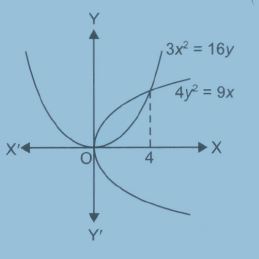
Sketch the rough graph of the two parabolas 4y2 = 9x and 3x2 = 16y and find the area bounded by the two curves.
22.
Evaluate the integral: \(\int {e^x\over\sqrt{5-4e^x-e^{2x}}}dx\)
23.
The sum of three numbers is -1. If we multiply the second number by 2 , third number by 3 and add them we get 5. If we subtract the third number from the sum of first and second numbers we get -1. Represent it by a system of equations . Find the three numbers using inverse of a matrix
24.
A card from a pack of 52 cards is lost. From the remaining cards of the pack, two cards at random and are found to be hearts. Find the probability of the missing card to be a heart
25.
If \(\overrightarrow { a } ,\overrightarrow { b } ,\overrightarrow { c } \) are unit vectors such that \(\overrightarrow { a } .\overrightarrow { b } =\overrightarrow { a } .\overrightarrow { c } =0\) and the angle between \(\overrightarrow { b } \) and \(\overrightarrow { c } \) is \(\frac{\pi}{6}\) , then prove that:
(i) \(\overrightarrow { a } =\pm 2\left( \overrightarrow { b } \times \overrightarrow { c } \right) \)
(ii) \(\left[ \overrightarrow { a } +\overrightarrow { b } ,\overrightarrow { b } +\overrightarrow { c } ,\overrightarrow { c } +\overrightarrow { a } \right] =\pm 1\)
26.
Evaluate : \(\int _{ 0 }^{ \pi }{ \frac { x\tan { x } }{ \sec { x } +\tan { x } } } dx\)
27.
If \(A=\left[ \begin{matrix} 2 & -3 & 5 \\ 3 & 2 & -4 \\ 1 & 1 & -2 \end{matrix} \right] ,\) find A-1 Hence solve the system of equations:
2x - 3y + 5z = 11,
3x + 2y - 4z = -5,
x + y - 2z = -3.
28.
Let A = \(R\times R\) and * be a binary operation on A defined by
(a,b)*(c,d) = (a+c, b+c)
Show that * is commutative and associative. Find the identity element for * on A. Also find • the inverse of every element (a, b) \(\in A\) *.
29.
Find the value of the constant k, so that the function f(x) defined below is continuous at function f(x) defined below is continuous at
x=0, where f(x) = \(\begin{cases} (\frac { 1-cos4x }{ 8{ x }^{ 2 } } )ifx\neq 0 \\ k,ifx=0 \end{cases}\)
30.
For the matrix \(A=\begin{bmatrix} 3 & 1 \\ 7 & 5 \end{bmatrix}\), find a and b such that A2+al=bA, where l is a \(2\times 2\) identify matrix.
31.
The direction cosines of the line whose direction ratios are 6, – 6, 3 are:
\(\frac { 2 }{ 3 } ,\frac { -2 }{ 3 } ,\frac { 1 }{ 3 } \)
\(\frac { -2 }{ 3 } ,\frac { 2 }{ 3 } ,\frac { -1 }{ 3 } \)
\(\frac { 6 }{ 3 } ,\frac { -6 }{ 3 } ,\frac { -1 }{ 3 } \)
\(\frac { 2 }{ 9 } ,\frac { -2 }{ 9 } ,\frac { 1 }{ 9 } \)
32.
Area of the shaded region in the given figure is:
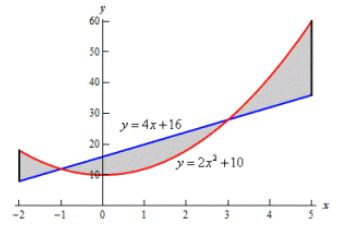
144/3 sq. units
142/3 sq. units
145/3 sq. units
143/2 sq. units
33.
Let A = {1,2,3,4} and B = {x,y,z}. Then R = {(1,x) , ( 2,z), (1,y), (3,x)} is
relation from B to A
Is not a relation
relation from A to B
relation from B to B
34.
The point on the curve x2 = 2y which is nearest to the point (0, 5) is
(2 \(\sqrt2\),4)
(2 \(\sqrt2\),0)
(0, 0)
(2, 2)
1.
We know that the equation of the plane having intercepts a, band c on the three
co-ordinate axes is
\({{x}\over{a}}+{{y}\over{b}}+{{y}\over{c}}=1\)
Here, the co-ordinates of A, Band C are (a, 0, 0), (0, b, 0) and (0, 0, c) respectively.
The centroid of \(\triangle \)ABC is \(\left({{a}\over{3}},{{b}\over{3}},{{c}\over{3}}\right).\)
Equating \(\left( {{a}\over{3}},{{b}\over{3}},{{c}\over{3}} \right)\) to \((\alpha,\beta,\gamma),\) we get a = \(3\alpha,\) b = \(3\beta\) and c = \(3\gamma\)
Thus, the equation of the plane is
\({{x}\over{3\alpha}}+{{y}\over{3\beta}}+{{z}\over{3\gamma}}=1\)
or \({{x}\over{\alpha}}+{{y}\over{\beta}}+{{z}\over{\gamma}}=3\)
2.
We have, x = \(\frac { at }{ 1+{ t }^{ 2 } } ,y=\frac { { at }^{ 2 } }{ 1+{ t }^{ 2 } } \)
\(\frac { dx }{ dt } =\frac { { (1+t) }^{ 2 }a-at(2t) }{ { (1+{ t }^{ 2 }) }^{ 2 } } \)
\(\Rightarrow\) \(\frac { dx }{ dt } =\)\(\frac { a+a{ t }^{ 2 }-2a{ t }^{ 2 } }{ { (1+{ t }^{ 2 }) }^{ 2 } } \)
=\(\frac { a-a{ t }^{ 2 } }{ { (1+{ t }^{ 2 }) }^{ 2 } } \)
and \(\frac { dy }{ dt } =\frac { { (1+{ t }^{ 2 } })^{ 2 }2at-a{ t }^{ 2 }(2t) }{ { (1+{ t }^{ 2 } })^{ 2 } } \)
\(\Rightarrow\)\(\frac { dy }{ dt } =\frac { 2at+2a{ t }^{ 3 }-2a{ t }^{ 3 } }{ { (1+{ t }^{ 2 }) }^{ 2 } } =\frac { 2at }{ { (1+{ t }^{ 2 }) }^{ 2 } } \)
\(\therefore\) \(\frac { dy }{ dx } =\frac { 2at }{ { (1+{ t }^{ 2 } })^{ 2 } } \times \frac { { (1+{ t }^{ 2 } })^{ 2 } }{ a-a{ t }^{ 2 } } \)
\(=\frac { 2at }{ a-a{ t }^{ 2 } } =\frac { 2t }{ 1-{ t }^{ 2 } } \)
\({ (\frac { dy }{ dx } ) }_{ att=2 }\) = \(\frac { 2(2) }{ 1-4 } \)
= -4/3
3.
(a) K then Q then J(fix case)
\(\frac { 4 }{ 52 } \times \frac { 4 }{ 51 } \times \frac { 4 }{ 50 } =\frac { 1 }{ 13 } \times \frac { 4 }{ 51 } \times \frac { 2 }{ 25 } \)
\(=\frac { 8 }{ 16575 } \)
(b) KQJ or QKJ or JQK or KJQ or OJK or JKQ = 3!
\(6\left( \frac { 4 }{ 52 } \times \frac { 4 }{ 51 } \times \frac { 4 }{ 50 } \right) =6\times \frac { 8 }{ 16575 } =\frac { 48 }{ 16575 } \)
4.
\(\overset\rightarrow {BA}\)= Position vector of A- Position vector of B
\(\overset\rightarrow{BA}=(\overset\wedge i+2\overset\wedge j-3\overset\wedge k)-(-\overset\wedge i-2\overset\wedge j+\overset\wedge k)\)
\(\overset\rightarrow {BA}=2\overset\wedge i+4\overset\wedge j-\overset\wedge k \)
\(\left| \overset\rightarrow {BA}\right| =\sqrt{2^{2}+4^{2}+(-4)^{2}}\)
\(=\sqrt{4+16+16}\)
\(=\sqrt{36}=6 \)
Direction cosines of the vector \(\overset\rightarrow{BA}\) are \((\frac{2}{6},\frac{4}{6},-\frac{4}{6})\)
\(=(\frac{1}{3},\frac{2}{3},-\frac{2}{3})\)
5.
\(\frac { dy }{ dx } ={ e }^{ x-y }+x{ e }^{ -y }\)
\(={ e }^{ -y }\left[ { e }^{ x }+x \right] \)
\(\Rightarrow \frac { dy }{ dx } =\left( { e }^{ x }+x \right) { e }^{ -y }\)
\(\Rightarrow \int { { e }^{ y }dy } =\int { \left( { e }^{ x }+x \right) { dx } } \)
\(\Rightarrow { e }^{ y }={ e }^{ x }+\frac { { x }^{ 2 } }{ 2 } +C\)
6.
\(x+\alpha =t\)
\(x=t-\alpha \)
\(dx=dt\)
\(\int { \frac { cos(t-\alpha )dt }{ cost } } =\int { \frac { costcos\alpha +sintsin\alpha }{ cost } } \)
\(\int { \frac { costcos\alpha dy }{ cost } } +\int { \frac { sintsin\alpha }{ cost } } dt\)
\(=cos\alpha \int { dt+sin\alpha \int { tantdt } } \)
\(=tcos\alpha +sin\alpha \quad log\left| sect \right| +c\)
\(=(x+\alpha )cos\alpha +sin\alpha \quad log\left| sec(x+\alpha \right| +c\)
7.
We shall prove the result by mathematical induction on n.
Step 1 : When n = 1, by the definition or integral powers of a matrix, we have
\({ A }^{ 1 }=\left[ \begin{matrix} 1+2\left( 1 \right) & -4n \\ n & 1-2\left( 1 \right) \end{matrix} \right] =\left[ \begin{matrix} 3 & -4 \\ 1 & -1 \end{matrix} \right] \)
So, the result is true for n = 1.
Step 2 : Let the result be true for n = m. Then,
\({ A }^{ m }=\left[ \begin{matrix} 1+2m & -4m \\ m & 1-2m \end{matrix} \right] \)
Now, we will show that the result is true for n = m + 1, i.e.,
\({ A }^{ m+1 }=\left[ \begin{matrix} 1+2\left( m+1 \right) & -4\left( m+1 \right) \\ \left( m+1 \right) & 1-2\left( m+1 \right) \end{matrix} \right] \)
By the definition of integral powers of a square matrix, we have
\({ A }^{ m+1 }={ A }^{ m }.A\)
\(\Rightarrow { A }^{ m+1 }=\left[ \begin{matrix} 1+2m & -4m \\ m & 1-2m \end{matrix} \right] \left[ \begin{matrix} 3 & -4 \\ 1 & -1 \end{matrix} \right] \)
[by supposition (i)]
\(\Rightarrow { A }^{ m+1 }=\left[ \begin{matrix} 3+6m-4m & -4-8m+4m \\ 3m+1-2m & -4m-4+2m \end{matrix} \right] \)
\(=\left[ \begin{matrix} 1+2\left( m+1 \right) & -4\left( m+1 \right) \\ \left( m+1 \right) & 1-2\left( m+1 \right) \end{matrix} \right] \)
This shows that the result is true for n = m + 1, whenever it is true for n = m.
Hence, by the principle of mathematical induction, the result is true for any positive integer n.
8.
We have \(x\in [-1,\quad 1]\)
Let x = sin \(\theta\) \(\therefore \quad \theta \in \left[ -\frac { \pi }{ 2 } ,\frac { \pi }{ 2 } \right] \)
\(\Rightarrow \quad \quad \theta ={ sin }^{ -1 }x\)
\(\Rightarrow \quad \quad -\frac { \pi }{ 2 } \le \theta \le \frac { \pi }{ 2 } \)
\(\Rightarrow \quad \quad \frac { \pi }{ 2 } \ge -\theta \ge -\frac { \pi }{ 2 } \)
\(\Rightarrow \quad \frac { \pi }{ 2 } +\frac { \pi }{ 2 } \ge \frac { \pi }{ 2 } -\theta \ge -\frac { \pi }{ 2 } +\frac { \pi }{ 2 } \)
\(\Rightarrow \quad\pi \ge \frac { \pi }{ 2 } -\theta \ge 0\)
\(\Rightarrow \quad cos\left( \frac { \pi }{ 2 } -\theta \right) =sin\quad \theta =x\)
\(\Rightarrow \quad \frac { \pi }{ 2 } -\theta ={ cos }^{ -1 }x\)
\(\Rightarrow { \quad cos }^{ -1 }x=\frac { \pi }{ 2 } -{ sin }^{ -1 }x\)
\(\Rightarrow { \quad sin }^{ -1 }x+{ cos }^{ -1 }x=\frac { \pi }{ 2 } if\quad x\in [-1,\quad 1]\)
9.
Equivalence relations could be the following:
{(1, 1), (2, 2), (3, 3), (1,2), (2, 1)} and
{(1, I), (2, 2), (3, 3), (1, 2), (1, 3), (2,1), (2, 3), (3, 1), (3,2)}
So, only two equivalence relations.
10.
We have, \(A=\left| \begin{matrix} 6 & 0 & 1 \\ 0 & 1 & 2 \\ 0 & 0 & 4 \end{matrix} \right| \)
|A| = 6(4-0)-0(0-0)+1(0-0)
|2A| = \(\left| \begin{matrix} 12 & 0 & 2 \\ 0 & 2 & 4 \\ 0 & 0 & 8 \end{matrix} \right| \)
= 12(16-0)-0(0-0)+2(0-0)
= 192
|2A| = 8 x 24 = 8|A|
11.
\([ac+bd]+[{ a }^{ 2 }+{ b }^{ 2 }+{ c }^{ 2 }+{ d }^{ 2 }]=[ac+bd+{ a }^{ 2 }+{ b }^{ 2 }+{ c }^{ 2 }+{ d }^{ 2 }] \)
12.
Let 'x' units of food A and 'y' units of food B be used.
Then LLP problem is:
Minimize: Z = 5x + 4y
Subject to: \(200x+100y\ge 4000\) i.e. \(2x+y\ge 40\) ,
\(x+2y\ge 50,\)
\(40x+40y\ge 4000\) i.e. \(x+y\ge 35\)
and \(x\ge 0,y\ge 0.\)
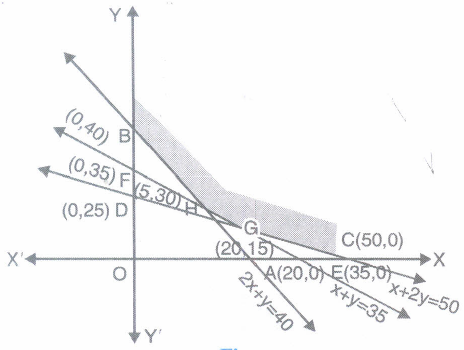
The feasible region (shaded) is unbounded.
Let us evaluate Z at the corner points:
C(50, 0), G(20, 15),
[Point of intersection of x + 2y = 50, x + y = 35]H(5, 30)
[Point of intersection of 2x + y = 40, x + y = 35] and B(0, 40).
Applying Corner Point Method, we have:
| Corner Point | Z = 5x + 4y |
| C : (50, 0) | 250 |
| G : (20, 15) | 160 |
| H : (5, 30) | 145 (Minimum) |
| B : (0, 40) | 160 |
Hence, least is Rs. 145 when 5 units of food A and 30 units of food B are used.
13.
The given equation is
\(\left( 1+{ x }^{ 2 } \right) \frac { dy }{ dx } ={ e }^{ m\_ tan-1_{ x } }-y,\)
\(\Rightarrow \) \(\frac { dy }{ dx } +\frac { y }{ 1+{ x }^{ 2 } } =\frac { { e }^{ m\_ tan-1_{ x } } }{ 1+{ x }^{ 2 } } \)..(1)
| Linear Equation
Comparing with \(\frac { dy }{ dx } +Py=Q,\) we have:
\('P'=\frac { 1 }{ 1+{ x }^{ 2 } } \) and \('Q'=\frac { { e }^{ m\_ tan-1_{ x } } }{ 1+{ x }^{ 2 } } .\)
\(\therefore\) \(I.F.={ e }^{ \int { P\quad dx } }={ e }^{ \int { \frac { 1 }{ 1+{ x }^{ 2 } } dx } }={ e }^{ m\_ tan-1_{ x } }.\)
Multiplying (1) by \({ e }^{ tan-1_{ x } }\) we get:
\({ e }^{ tan-1_{ x } }.\frac { dx }{ dy } +\frac { y }{ 1+{ x }^{ 2 } } { e }^{ tan-1_{ x } }={ e }^{ tan-1_{ x } }.\frac { { e }^{ m\_ tan-1_{ x } } }{ 1+{ x }^{ 2 } } \)
\(\Rightarrow \) \(\frac { d }{ dx } \left( y.{ e }^{ tan-1_{ x } } \right) =\frac { { e }^{ \left( m+1 \right) tan-1_{ x } } }{ 1+{ x }^{ 2 } } .\)
Integrating, \(y.{ e }^{ \left( m+1 \right) tan-1_{ x } }=\int { \frac { { e }^{ \left( m+1 \right) tan-1_{ x } } }{ 1+{ x }^{ 2 } } } dx+c\)....(2)
Now \(I=\int { \frac { { e }^{ \left( m+1 \right) tan-1_{ x } } }{ 1+{ x }^{ 2 } } } dx.\)
Put \({ tan }^{ -1 }x=t\) so that \(\frac { 1 }{ 1+{ x }^{ 2 } } dx=dt\)
\(\therefore\) \(I=\int { { e }^{ \left( m+1 \right) t }dt= } \frac { { e }^{ \left( m+1 \right) t } }{ m+1 } =\frac { { e }^{ \left( m+1 \right) tan-1_{ x } } }{ m+1 } \)
\(\therefore\) From(2),\(y.{ e }^{ { tan-1 }_{ x } }=\frac { { e }^{ \left( m+1 \right) tan-1_{ x } } }{ m+1 } +c\)
\(\Rightarrow \) \(y=\frac { { e }^{ \left( m+1 \right) tan-1_{ x } } }{ m+1 } +c{ e }^{ { tan-1 }_{ x } }\)...(3)
When \(y=1,x=0,\therefore 1=\frac { 1 }{ m+1 } +c\)
\(\Rightarrow \) \(c=1-\frac { 1 }{ m+1 } =\frac { m }{ m+1 } .\)
Putting in(3), \(y=\frac { { e }^{ { tan-1 }_{ x } } }{ m+1 } +\frac { m }{ m+1 } { e }^{ { tan-1 }_{ x } },\)
which is the required solution
14.
We have: \({ x }^{ y }={ e }^{ x-y }\)
Taking logs., \(ylogx=(x-y)\)
\(y(1+log\quad x)=x\)
\(y=\frac { x }{ 1+log\quad x } \)
\(\frac { dy }{ dx } =\frac { \left( 1+log\quad x \right) .1-x\left( 0+\frac { 1 }{ x } \right) }{ { \left( 1+logx \right) }^{ 2 } } \)
\(=\frac { 1+log\quad x-1 }{ { \left( 1+logx \right) }^{ 2 } } =\frac { log\quad x }{ { \left( 1+logx \right) }^{ 2 } } \)
\(\frac { dy }{ dx } =\frac { log\quad x }{ { \left( log\quad e+log\quad x \right) }^{ 2 } } \)
15.
y2 = 4x is right - handed parabola.
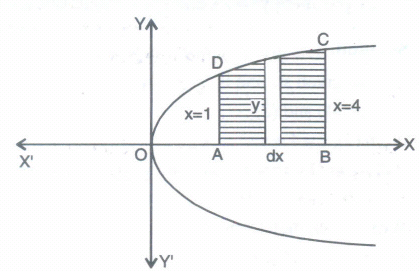
Therefore, Required area, ABCD = \(\overset { 4 }{ \underset { 1 }{ \int { } } } ydx\) [Taking vertical strips]
\(\overset { 4 }{ \underset { 1 }{ \int { } } } 2\sqrt { x } dx\\ \)
[\({ y }^{ 2 }=4x\Rightarrow y=\pm 2\sqrt { x } .\) But region ABCD lies in 1st quadrant, Therefore y is +ve]
\(=2\overset { 4 }{ \underset { 1 }{ \int { } } } { x }^{ 1/2 }dx=2\left[ \frac { { x }^{ 3/2 } }{ 3/2 } \right] _{ 1 }^{ 4 }=\frac { 4 }{ 3 } [{ 4 }^{ 3/2 }-1]\)
\(=\frac { 4 }{ 3 } [8-1]=\frac { 28 }{ 3 } =9\frac { 1 }{ 3 } sq.units.\)
16.
We know that, \(P={ I }_{ 2 }P\)
\(\Rightarrow \ \begin{bmatrix} 10 & -2 \\ -5 & 1 \end{bmatrix}=\begin{bmatrix} 1 & 0 \\ 0 & 1 \end{bmatrix}P\)
\(\Rightarrow \begin{bmatrix} 1 & { -1 }/{ 5 } \\ -5 & 1 \end{bmatrix}=\begin{bmatrix} { 1 }/{ 10 } & 0 \\ 0 & 1 \end{bmatrix}P.\ [\text{Applying} { R }_{ 1 }\rightarrow \left( \frac { 1 }{ 10 } \right) { R }_{ 1 }]\)
\(\begin{bmatrix} 1 & { -1 }/{ 5 } \\ -5 & 1 \end{bmatrix}=\begin{bmatrix} { 1 }/{ 10 } & 0 \\ { 1 }/{ 2 } & 1 \end{bmatrix}P. [\text {Applying} { R }_{ 2 }\rightarrow { R }_{ 2 }+5{ R }_{ 1 }]\)
Since second row of LHS matrix has all zeros,
\(\therefore\ { P }\) does not exist.
17.
Let \(A=\left[\begin{matrix}-1&5\\ -3&2\end{matrix}\right]\)
\(|A|=\left[\begin{matrix}-1&5\\ -3&2\end{matrix}\right]=-2+15=13\neq0\)
A is non-singular = A-1 exists.
Now \(A_{11}=(-1)^{1+1}M_{11}(+1)(1 )=2\)
\(A_{12}=(-1)^{1+2}M_{12}\\ =(-1)(-3)=3;\)
\(A_{21}=(-1)^{2+1}M_{21}=(-1)(5)=-5\)
\(A_{22}=(-1)^{2+2}M_{22}\\ =(+1)(-1)=-1\)
\(\therefore\ adj\ A=\begin{bmatrix}2&3\\-5&-1 \end{bmatrix}=\begin{bmatrix}2&-5\\3&-1 \end{bmatrix}\)
\(\therefore\ A^{-1}={1\over|A|}(adj\ A)\)
\(={1\over13}\begin{bmatrix} 2&-5\\3&-1\end{bmatrix}\)
=\(\left[\begin{matrix}{2\over13}&{-5\over13}\\ {3\over13}&-{1\over13}\end{matrix}\right]\)
18.
\(\text {Let } \sin ^{-1} \frac{12}{13}=x, \quad \cos ^{-1} \frac{4}{5}=y, \tan ^{-1} \frac{63}{16}=z\)
\( \sin x=\frac{12}{13}, \quad \cos y=\frac{4}{5}, \quad \tan z=\frac{63}{16}\)
\(\cos x=\frac{5}{13}, \sin y=\frac{3}{5}, \tan x=\frac{12}{5} \text { and } \tan y=\frac{3}{4}\)
\(\text {We have }\tan (x+y)=\frac{\tan x+\tan y}{1-\tan x \tan y}=\frac{\frac{12}{5}+\frac{3}{4}}{1-\frac{12}{5} \times \frac{3}{4}}=-\frac{63}{16}\)
Hence tan(x + y) = − tan z
i.e., tan (x + y) = tan (–z) or tan (x + y) = tan (p – z)
Therefore x + y = – z or x + y = p – z
Since x, y and z are positive, x + y \(\ne\) – z (Why?)
\(\text {Hence }x+y+z=\pi \text { or } \sin ^{-1} \frac{12}{13}+\cos ^{-1} \frac{4}{5}+\tan ^{-1} \frac{63}{16}=\pi\)
19.
Let E1 , E2 and E3 be the events that boxes I, II and III are chosen, respectively.
Then P(E1) = P(E2) = P(E3 ) = \(\frac { 1 }{ 3 } \)
Also, let A be the event that ‘the coin drawn is of gold’
Then P(A|E1) = P(a gold coin from bag I) = \(\frac { 2 }{ 2 } \)= 1,
P(A|E2) = P(a gold coin from bag II) = 0 and
p(A|E3) = P(a gold coin from bag III) = \(\frac { 1 }{ 2 } \)
Now, the probability that the other coin in the box is of gold = the probability that gold coin is drawn from the box I.
= P(E1 |A)
By Bayes' theorem, we know that
P(E1|A) \(=\frac { P({ E }_{ 1 })P(A|{ E }_{ 1 }) }{ P({ E }_{ 1 })P(A|{ E }_{ 1 })+P({ E }_{ 2 })P(A|{ E }_{ 2 })+P({ E }_{ 3 })P(A|{ E }_{ 3 }) } \)
= \(\frac { \frac { 1 }{ 3 } \times1}{ \frac { 1 }{ 3 } \times1 +\left( \frac { 1 }{ 3 } \right) \times 0 +\frac { 1 }{ 3 } \times \frac { 1 }{ 2 } } =\frac { 2 }{ 3 } \)
20.
Substituting in (i) we get
(sec x + tan x)y = sec x + tan x - x + 1 is the required nsolution.
21.
Curves are 4y2 = 9x and 3x2 = 16y
Eliminating y from two equations, we get
\(4\left(\frac{3 x^{2}}{16}\right)^{2}=9 x\)
\(\Rightarrow x^{4}= \frac{9 \times 16^{2}}{4 \times 9} x=64 x \Rightarrow x=4 \text { or } x=0 \)
\(\therefore \text { area } =\int_{0}^{4}\left(y_{1}-y_{2}\right) d x=\int_{0}^{4}\left(\sqrt{\frac{9 x}{4}}-\frac{3 x^{2}}{16}\right) d x \)
\(=4 \text { sq units } \)
22.
\(\int \frac{e^{x}}{\sqrt{5-4 e^{x}-e^{2 x}}} =\int \frac{1}{\sqrt{5-4 t-t^{2}}} d t=\int \frac{1}{\sqrt{9-(t+2)^{2}}} d t \)
\(=\sin ^{-1}\left(\frac{t+2}{3}\right)+C=\sin ^{-1}\left(\frac{e^{x}+2}{3}\right)+C
\)
23.
Let numbers be x, y, z then
x + y + z = -1
2y + 3z = 5
x + y – z = -1
\(x=-\frac { 7 }{ 2 } \), y = \(\frac { 5 }{ 2 } \), z = 0
24.
Let C1, C2, C3, C4 be the events that the lost card is of heart, spades, diamond or club respectively.
Obviously P(C1) = P(C2) = P(C3) = P(C4)
\(={13\over 52}={1\over 4}\)
Let S be the event of drawing two cards of heart from the remaining 51 cards.We wish to find \(P\left(C_1\over S\right)\)
Now \(P\left(C_1\over S\right)\) is the probability of drawing two heart cards from 51 cards given that one heart card is lost
\(={^{12}C_2\over ^{51}C_2}={12\times11\over 1\times2}\times{1\times2\over 51\times50}={22\over 425}\)
\(P\left( S\over C_3\right)=P\left( S\over C_3\right)=P\left( S\over C_4\right)={^{13}C_2\over ^{51}C_2}\)
\(={13\times12\over 1\times2}\times{1\times2\over 51\times50}={26\over 425}\)
By Bayes' Theorem
\(P\left(C_1\over S\right)={P(C_1).P\left(S\over C_1\right)\over \sum P(C_1).P\left(S\over C_1\right)}\)
\(={{1\over4}\times{22\over 425}\over{1\over 4}\times{22\over 425}+{1\over 4}\times{26\over 425}+{1\over4}\times{26\over 425}}\)
\(={22\over 22+26+26+26}\)
\(={11\over 50}\)
25.
As given \(\overrightarrow { a } .\overrightarrow { b } =\overrightarrow { a } .\overrightarrow { c } =0=\overrightarrow { a } \bot \)both \(\overrightarrow { b } \) and \(\overrightarrow { c } \)
⇒ \(\overrightarrow { a } \parallel \left( \overrightarrow { b } \times \overrightarrow { c } \right) \)
Let \(\overrightarrow { a } =\lambda \left( \overrightarrow { b } \times \overrightarrow { c } \right) \)
then \(\left| \overrightarrow { a } \right| =\left| \lambda \right| \left| \left( \overrightarrow { b } \times \overrightarrow { c } \right) \right| \)
⇒ \(\frac { \left| \overrightarrow { a } \right| }{ \left| \left( \overrightarrow { b } \times \overrightarrow { c } \right) \right| } =\left| \lambda \right| \)
⇒ \(\left| \lambda \right| =\frac { 1 }{ sin\frac { \pi }{ 6 } } =2\)
λ = 士2
\(\overrightarrow { a } =\pm 2\left( \overrightarrow { b } \times \overrightarrow { c } \right) \)
Hence proved
(ii) Now \(\left[ \overrightarrow { a } +\overrightarrow { b } ,\overrightarrow { b } +\overrightarrow { c } ,\overrightarrow { c } +\overrightarrow { a } \right] \)
= \(\left[ \left( \overrightarrow { a } +\overrightarrow { b } \right) \times \left( \overrightarrow { b } \times \overrightarrow { c } \right) \right] .\left( \overrightarrow { c } +\overrightarrow { a } \right) \)
= \(\left( \overrightarrow { a } \times \overrightarrow { b } \right) .\overrightarrow { c } +\left( \overrightarrow { b } \times \overrightarrow { c } \right) .\overrightarrow { a } \)
(As the scalar triple product = 0, if any two vectors are equal)
Hence, \(\overrightarrow { a } .\left( \overrightarrow { b } \times \overrightarrow { c } \right) +\left( \overrightarrow { a } \times \overrightarrow { b } \right) .\overrightarrow { c } \) = \(\overrightarrow { a } .\left( \overrightarrow { b } \times \overrightarrow { c } \right) +\overrightarrow { c } \left( \overrightarrow { b } \times \overrightarrow { c } \right) \)
= 2\(\overrightarrow { a } \left( \overrightarrow { b } \times \overrightarrow { c } \right) \)
= \(2\overrightarrow { a } \left( \pm \frac { 1 }{ 2 } \overrightarrow { a } \right) \)
= 士1
Hence proved
26.
Let, \(I=\int _{ 0 }^{ \pi }{ \frac { x\tan { x } }{ \sec { x }+ \tan { x } } } \)...(i)
\(\Rightarrow I=\int _{ 0 }^{ \pi }{ \frac { \left( \pi -x \right) \tan { \left( \pi -x \right) } }{ \sec { \left( \pi -x \right) }+ \tan { \left( \pi -x \right) } } } \)
\(=\int _{ 0 }^{ \pi }{ \frac { \left( \pi -x \right) \tan { x } }{ \sec { x } +\tan { x } } } dx\)
Add eqn. (i) & (ii),
\(2I=\pi \int _{ 0 }^{ \pi }{ \frac { \tan { x } }{ \sec { x } +\tan { x } } } dx\)
Multiply & divide by (secx - tanx) on RHS,
\(\Rightarrow 2I=\pi \int _{ 0 }^{ \pi }{ \tan { x } \left( \sec { x } -\tan { x } \right) } dx\)
\(=\pi \int _{ 0 }^{ \pi }{ \left( \sec { x } .\tan { x } -\sec ^{ 2 }{ x } +1 \right) } dx\)
\(\Rightarrow 2I=\left[ \pi \left( \sec { x } -\tan { x } +x \right) \right] _{ 0 }^{ \pi }\)
\(=\pi \left\{ \left( -1-0+\pi -1 \right) \right\} =\pi \left( \pi -2 \right) \)
\(\therefore \ I=\frac { { \pi }^{ 2 }-2\pi }{ 2 } \)
27.
\(A=\left[ \begin{matrix} 2 & -3 & 5 \\ 3 & 2 & -4 \\ 1 & 1 & -2 \end{matrix} \right] \)
|A| = 2 x 0-(-3) x -2+5 x 1
= -6 + 5 = -1
a11 = (-4 + 4) = 0
a12 = -(-6 + 4) = 2
a13 = (3 - 2) = 1
a21 = -(6 - 5) = -1
a22 = (-4 - 5) = -9
a23 = -(2 + 3) = -5
a31 = (12 - 10) = 2
a32 = -(-8 - 15) = 23
a33 = (4 + 9) = 13
\({ A }^{ -1 }=\frac { 1 }{ -1 } \left[ \begin{matrix} 0 & -1 & 2 \\ 2 & -9 & 23 \\ 1 & -5 & 13 \end{matrix} \right] \)
\(=\left[ \begin{matrix} 0 & 1 & -2 \\ -2 & 9 & -23 \\ -1 & 5 & -13 \end{matrix} \right] \)
Given set of equations may be written as
\(AX=B,\)
where \(B=\left[ \begin{matrix} 11 \\ -5 \\ -3 \end{matrix} \right] \)
\(X=\left[ \begin{matrix} x \\ y \\ z \end{matrix} \right] \)
\(\Rightarrow X={ A }^{ -1 }B\)
\(\Rightarrow \left[ \begin{matrix} x \\ y \\ z \end{matrix} \right] =\left[ \begin{matrix} 0 & 1 & -2 \\ -2 & 9 & -23 \\ -1 & 5 & -13 \end{matrix} \right] \left[ \begin{matrix} 11 \\ -5 \\ -3 \end{matrix} \right] \)
\(=\left[ \begin{matrix} 0-5+6 \\ -22-45+69 \\ 11-25+39 \end{matrix} \right] =\left[ \begin{matrix} 1 \\ 2 \\ 3 \end{matrix} \right] \)
Hence x = 1, y = 2 and x = 3.
28.
Proving" is commutative
Proving" is associative
Getting identity element as (0, 0)
Getting inverse of (a, b) as (- a, - b)
29.
\(\lim _{ x\rightarrow 0 }{ (\frac { 1-cos4x }{ 8{ x }^{ 2 } } ) } \) = \(\lim _{ x\rightarrow 0 }{ (\frac { 2{ sin }^{ 2 }2x }{ 8{ x }^{ 2 } } ) } \)
\(=\lim _{ x\rightarrow 0 }{ { (\frac { sin2x }{ 2x } ) }^{ 2 } } =1\)
f is continuous at x=0
\(\therefore\) \(\lim _{ x\rightarrow 0 }{ f\left( x \right)=f(0) } \)
f(x)=k
\(\therefore\) 1=k or k=1
30.
\(A^{2}+a I=b A \)
\(\Rightarrow\left[\begin{array}{ll} 3 & 1 \\ 7 & 5 \end{array}\right]\left[\begin{array}{ll} 3 & 1 \\ 7 & 5 \end{array}\right]+a\left[\begin{array}{ll} 1 & 0 \\ 0 & 1 \end{array}\right]=b\left[\begin{array}{ll} 3 & 1 \\ 7 & 5 \end{array}\right] \)
\(\Rightarrow\left[\begin{array}{cc} 9+7 & 3+5 \\ 21+35 & 7+25 \end{array}\right]+\left[\begin{array}{cc} a & 0 \\ 0 & a \end{array}\right]=\left[\begin{array}{cc} 3 b & b \\ 7 b & 5 b \end{array}\right] \)
\(\Rightarrow\left[\begin{array}{cc} 16 & 8 \\ 56 & 32 \end{array}\right]+\left[\begin{array}{cc} a & 0 \\ 0 & a \end{array}\right]=\left[\begin{array}{cc} 3 b & b \\ 7 b & 5 b \end{array}\right] \)
\(\Rightarrow\left[\begin{array}{cc} 16+a & 8 \\ 56 & 32+a \end{array}\right]=\left[\begin{array}{cc} 3 b & b \\ 7 b & 5 b \end{array}\right] \)
\(\Rightarrow 16+a=3 b, b=8,7 b=56 ; 32+a=5 b \)
\(\Rightarrow b=8 \text { and } 16+a=24 \Rightarrow a=8 \)
a = 8, b = 8 satisfy all the above equations
31.
(a)
\(\frac { 2 }{ 3 } ,\frac { -2 }{ 3 } ,\frac { 1 }{ 3 } \)
32.
(b)
142/3 sq. units
33.
(c)
relation from A to B
34.
(a)
(2 \(\sqrt2\),4)

12th Standard CBSE Syllabus & Materials
12th Standard CBSE
CBSE 12th Computer Science Python Revision Tour I - New Previous year Question Papers Study Material - QB365 Set A
NEW12th Standard CBSE
CBSE 12th Business Studies Planning Important Questions And Answers Study Material - QB365 Set A
NEW12th Standard CBSE
CBSE 12th Business Studies Business Environment Important Questions And Answers Study Material - QB365 Set A
NEW12th Standard CBSE
CBSE 12th Business Studies Principles of Management Important Questions And Answers Study Material - QB365 Set A



CBSE 12th Standard CBSE Subjects
CBSE Standards










