
 100% FREE ACCESS
12th Standard CBSE Syllabus & Materials
12th Standard CBSE
CBSE 12th Economics Government Budget and the Economy Previous year Question Papers Study Material - QB365 Set A
NEW12th Standard CBSE
CBSE 12th Computer Science Interface Python with MySQL - New Previous year Question Papers Study Material - QB365 Set A
NEW12th Standard CBSE
CBSE 12th Computer Science Database Concept - New Previous year Question Papers Study Material - QB365 Set A
NEW12th Standard CBSE
CBSE 12th Computer Science Data Communication - New Previous year Question Papers Study Material - QB365 Set A
NEW12th Standard CBSE
CBSE 12th Computer Science Data Structures - New Previous year Question Papers Study Material - QB365 Set A
NEW12th Standard CBSE
CBSE 12th Computer Science Functions - New Previous year Question Papers Study Material - QB365 Set A

Published on: 15/02/2020
12th Standard CBSE Mathematics Public Model Question Paper III 2020
Download CBSE Class 12th Standard CBSE Maths question papers, sample papers, important questions, and previous year solved papers in PDF format. Get free study materials, NCERT solutions, and exam preparation resources for Class 12th Standard CBSE Maths
Questions + Answers key
Take MCQ Maths Test
1.
Prove that \(\tan ^{-1}\left(\frac{\sqrt{1+x^{2}}+\sqrt{1-x^{2}}}{\sqrt{1+x^{2}}-\sqrt{1-x^{2}}}\right)=\frac{\pi}{4}+\frac{1}{2} \cos ^{-1} x^{2}\)
2.
If \(\overrightarrow { a } ,\overrightarrow { b } ,\overrightarrow { c } \) are unit vectors such that \(\overrightarrow { a } .\overrightarrow { b } =\overrightarrow { a } .\overrightarrow { c } =0\) and the angle between \(\overrightarrow { b } \) and \(\overrightarrow { c } \) is \(\frac{\pi}{6}\) , then prove that:
(i) \(\overrightarrow { a } =\pm 2\left( \overrightarrow { b } \times \overrightarrow { c } \right) \)
(ii) \(\left[ \overrightarrow { a } +\overrightarrow { b } ,\overrightarrow { b } +\overrightarrow { c } ,\overrightarrow { c } +\overrightarrow { a } \right] =\pm 1\)
3.
Evaluate : \(\int _{ 0 }^{ \pi }{ \frac { x }{ { a }^{ 2 }\cos ^{ 2 }{ x } +{ b }^{ 2 }\sin ^{ 2 }{ x } } } dx\)
4.
Find the inverse of the matrix : \(A=\left[ \begin{matrix} a & 0 & 0 \\ 0 & b & 0 \\ 0 & 0 & c \end{matrix} \right] \)
Can you find the inverse for all values of a, b, c? If same rule is applied to the progress of a person, what value is most essential in?
5.
There are three coins. First is a biased that comes up tails 60% of the times, second is also a biased coin that comes up heads 75% of the times and third is an unbiased coin. One of the three coins is chosen at random and tossed, it shows heads, what is the probability that it was the first coin?
6.
Prove that the semi-vertical angle of the right circular cone of given volume and least curved surface area is \(\cot^{-1}\sqrt2\)
7.
Using elementary transformation, find the inverse of the matrix \(A=\left[ \begin{matrix} 8 & 4 & 3 \\ 2 & 1 & 1 \\ 1 & 2 & 2 \end{matrix} \right] \) and use it to solve the following system of lines equations :
8x + 4y + 3z = 19
2x + y + z = 5
x + 2y + 2z = 7
8.
If \(A=\begin{bmatrix} 0 & 1 \\ 0 & 0 \end{bmatrix}\) and \(l=\begin{bmatrix} 1 & 0 \\ 0 & 1 \end{bmatrix}\), prove that \((al+bA)^{ 3 }={ a }^{ 3 }l+{ 3a }^{ 2 }bA.\)
9.
Write the following functions in the simplest form:
\({ tan }^{ -1 }\left[ \frac { 3{ a }^{ 2 }x-{ x }^{ 3 } }{ { a }^{ 3 }-3{ a }^{ 2 } } \right] ,\ a > 0;\ -\frac { a }{ \sqrt { 3 } } \le x\le \frac { a }{ \sqrt { 3 } }\)
10.
P speaks truth in 70% of the cases and Q in 80% of the cases. In what percent of cases are they likely to agree in stating the same fact? Do you think, when they agree, means both are speaking truth?
11.
Two godowns A and B have grain capacity of 100 quintals and 50 quintals respectively. They supply to 3 ration shops, D, E and F whose requirements are 60, 50 and 40 quintals respectively. The cost of transportation per quintal from the godowns to the shops are given in the following table:
| Transportation Cost per Quintal (in RS) | ||
| From | A | B |
| To | ||
| D E F |
6 3 2.50 |
4 2 3 |
How should the supplies be transported in order that the transportation cost is minimum? What is the minimum cost?
12.
Solve the differential equation : \({ x }^{ 2 }dy+\left( 2xy+{ y }^{ 2 } \right) dx=0\) given that \({ x }^{ 2 }dy+\left( 2xy+{ y }^{ 2 } \right) dx=0\) when \(x=1\)
13.
If \(y={ X }^{ x }\)prove that \(\frac { { d }^{ 2 }y }{ { dx }^{ 2 } } -\frac { 1 }{ y } { \left( \frac { dy }{ dx } \right) }^{ 2 }-\frac { y }{ x } =0\)
14.
Determine whether or not each of the definition of '*' given below gives a binary operation. In the event that '*' is not a binary operation, give justification for this:
(i) On \(Z^{ + }\), define '*' by a *b=a-b
(ii) On \(Z^{ + }\), define '*' by a *b=ab
(iii) On R, define '*' by a * b=\(ab^{ 2 }\)
(iv) On \(Z^{ + }\), define '*' by a *b=\(\left| a-b \right| \)
(v) On \(Z^{ + }\), define '*' by a *b=a
15.
Find the area of the region bounded by the parabola y2 = 2x and the straight line x - y = 4.
16.
If \(A\prime =\begin{bmatrix} -2 & 3 \\ 1 & 2 \end{bmatrix}\) and \(B=\ \begin{bmatrix} -1 & 0 \\ 1 & 2 \end{bmatrix}\) , then find \((A+2B)\prime \) .
17.
Evaluate: \(\Delta =\left| \begin{matrix} 1 & a & bc \\ 1 & b & ca \\ 1 & c & ab \end{matrix} \right| .\)
18.
Find te principal values of the following
\({ sin }^{ -1 }\left( -\frac { 1 }{ 2 } \right) \)
19.
Solve the differential equation : (x2 + 1) \(\frac {dy}{dx}\) + 2xy = \(\sqrt {{x}^{2} + 4}\).
20.
Evaluate the integral: \(\int tan^{-1}\sqrt{1-x\over1+x}dx.\)
21.
Evaluate : \(\int _{ \frac { \pi }{ 6 } }^{ \frac { \pi }{ 3 } }{ \frac { \sqrt [ 3 ]{ sinx } }{ \sqrt [ 3 ]{ cosx } +\sqrt [ 3 ]{ sinx } } } dx\)
22.
Find \(\left| \overrightarrow {a } \times \overrightarrow { b } \right| \) if \(\left| \overrightarrow { a} \right| =10,\left| \overrightarrow { b } \right| =2\) and \(\overrightarrow a.\overrightarrow b=12\).
23.
If y = ax +xa+xx+aa, find dy/dx
24.
Find the general solution of differential equation
\(\frac { dy }{ dx } +y={ e }^{ -x }\)
25.
If a lines makes angle 60° and 45° with the positive directions of x-axis and z-axis respectively, then find the angle that it makes with the y-axis.
26.
A bag contain 2 red, 6 black and 8 green balls. A ball is drawn at random from the bag. Find the probabilty:
(a) a red ball
(b) a black ball
(c) a green ball
(d) a non-red ball
27.
Simplify : \({ cot }^{ -1 }\frac { 1 }{ \sqrt { { x }^{ 2 }-1 } } for\quad x<-1\)
28.
Prove the following by the principle of mathematical induction :
if \(A=\left[ \begin{matrix} 3 & -4 \\ 1 & -1 \end{matrix} \right] \), then \({ A }^{ n }=\left[ \begin{matrix} 1+2n & -4n \\ n & 1-2n \end{matrix} \right] \) for every positive integer n.
29.
For what value of k, the matrix \(\left[ \begin{matrix} 2k+3 & 4 & 5 \\ -4 & 0 & -6 \\ -5 & 6 & -2k-3 \end{matrix} \right] \) is a skew symmetric matrix?
30.
Define symmetric Relation. Give one example
31.
If \(A=\left| \begin{matrix} 2 & 3 & -1 \\ 4 & 1 & 0 \\ 3 & 3 & 2 \end{matrix} \right| \) , find \(M_{ 12 }\times M_{ 21 }+C_{ 21 }\times C_{ 12 }\) when Mjj called minor and Cjj called co-factors of A.
32.
Find the direction cosines of a line which makes an angle with all three the coordinate axes.
± 1/\(\sqrt2\)
1/\(\sqrt3\)
1/\(\sqrt2\)
1/\(\sqrt3\)
33.
In the set N x N the relation R is defined by (a, b) R (c, d) ⇔ ad = bc. Then R is
symmetric and transitive but not reflexive
reflexive and transitive but not symmetric
Equivalence relation
Partial order relation
34.
Area bounded by the curve y = x3, the x-axis and the ordinates x = – 2 and x = 1 is
-9
\(\frac{-15}{4}\)
\(\frac{15}{4}\)
\(\frac{17}{4}\)
35.
A cylindrical tank of radius 10 m is being filled with wheat at the rate of 314 cubic metre per hour. Then the depth of the wheat is increasing at the rate of
1 m/h
0.1 m/h
1.1 m/h
0.5 m/h
1.
\(\mathrm{LHS}=\tan ^{-1}\left(\frac{\sqrt{1+x^{2}}+\sqrt{1-x^{2}}}{\sqrt{1+x^{2}}-\sqrt{1-x^{2}}}\right) \)
\(\text { Put } x^{2}=\cos 2 \theta, \text { then } \)
\(\mathrm{LHS}=\tan ^{-1}\left(\frac{\sqrt{1+\cos 2 \theta}+\sqrt{1-\cos 2 \theta}}{\sqrt{1+\cos 2 \theta}-\sqrt{1-\cos 2 \theta}}\right)\)
\( \tan ^{-1}\left(\frac{\sqrt{2} \cos \theta+\sqrt{2} \sin \theta}{\sqrt{2} \cos \theta-\sqrt{2} \sin \theta}\right)\)
\(\tan ^{-1}\left(\frac{\cos \theta+\sin \theta}{\cos \theta-\sin \theta}\right)=\tan ^{-1}\left(\frac{1+\tan \theta}{1-\tan \theta}\right)\)
[divide numerator and denominator inside the bracket by \(cos \theta]\)
2.
As given \(\overrightarrow { a } .\overrightarrow { b } =\overrightarrow { a } .\overrightarrow { c } =0=\overrightarrow { a } \bot \)both \(\overrightarrow { b } \) and \(\overrightarrow { c } \)
⇒ \(\overrightarrow { a } \parallel \left( \overrightarrow { b } \times \overrightarrow { c } \right) \)
Let \(\overrightarrow { a } =\lambda \left( \overrightarrow { b } \times \overrightarrow { c } \right) \)
then \(\left| \overrightarrow { a } \right| =\left| \lambda \right| \left| \left( \overrightarrow { b } \times \overrightarrow { c } \right) \right| \)
⇒ \(\frac { \left| \overrightarrow { a } \right| }{ \left| \left( \overrightarrow { b } \times \overrightarrow { c } \right) \right| } =\left| \lambda \right| \)
⇒ \(\left| \lambda \right| =\frac { 1 }{ sin\frac { \pi }{ 6 } } =2\)
λ = 士2
\(\overrightarrow { a } =\pm 2\left( \overrightarrow { b } \times \overrightarrow { c } \right) \)
Hence proved
(ii) Now \(\left[ \overrightarrow { a } +\overrightarrow { b } ,\overrightarrow { b } +\overrightarrow { c } ,\overrightarrow { c } +\overrightarrow { a } \right] \)
= \(\left[ \left( \overrightarrow { a } +\overrightarrow { b } \right) \times \left( \overrightarrow { b } \times \overrightarrow { c } \right) \right] .\left( \overrightarrow { c } +\overrightarrow { a } \right) \)
= \(\left( \overrightarrow { a } \times \overrightarrow { b } \right) .\overrightarrow { c } +\left( \overrightarrow { b } \times \overrightarrow { c } \right) .\overrightarrow { a } \)
(As the scalar triple product = 0, if any two vectors are equal)
Hence, \(\overrightarrow { a } .\left( \overrightarrow { b } \times \overrightarrow { c } \right) +\left( \overrightarrow { a } \times \overrightarrow { b } \right) .\overrightarrow { c } \) = \(\overrightarrow { a } .\left( \overrightarrow { b } \times \overrightarrow { c } \right) +\overrightarrow { c } \left( \overrightarrow { b } \times \overrightarrow { c } \right) \)
= 2\(\overrightarrow { a } \left( \overrightarrow { b } \times \overrightarrow { c } \right) \)
= \(2\overrightarrow { a } \left( \pm \frac { 1 }{ 2 } \overrightarrow { a } \right) \)
= 士1
Hence proved
3.
\(I=\int _{ 0 }^{ \pi }{ \frac { x }{ { a }^{ 2 }\cos ^{ 2 }{ x } +{ b }^{ 2 }\sin ^{ 2 }{ x } } } dx\) ..(i)
Apply property
\(\Rightarrow I=\int _{ 0 }^{ \pi }{ \frac { \left( \pi -x \right) }{ { a }^{ 2 }\cos ^{ 2 }{ x } +{ b }^{ 2 }\sin ^{ 2 }{ x } } } dx\)
By adding eqn. (i) and (ii),
\(2I=\pi \int _{ 0 }^{ \pi }{ \frac { 1 }{ { a }^{ 2 }\cos ^{ 2 }{ x } +{ b }^{ 2 }\sin ^{ 2 }{ x } } } dx\)
\(\Rightarrow I=\pi \int _{ 0 }^{ \pi /2 }{ \frac { \sec ^{ 2 }{ x } }{ { a }^{ 2 }+{ b }^{ 2 }\tan ^{ 2 }{ x } } } dx\)
Dividing Nr. & Dr. by cos2x
Put \(b\tan { x } =t\Rightarrow \sec ^{ 2 }{ x } dx=\frac { 1 }{ b } dt\)
Where x = 0, t = 0;
and \(x=\frac { \pi }{ 2 } ,\)
\(t=\infty ;\)
\(\Rightarrow I=\frac { \pi }{ b } \int _{ 0 }^{ \infty }{ \frac { dt }{ { a }^{ 2 }+{ t }^{ 2 } } } \)
\(\Rightarrow =\frac { \pi }{ b } \left[ \frac { 1 }{ a } \tan ^{ -1 }{ \frac { t }{ a } } \right] _{ 0 }^{ \infty }\)
\(\Rightarrow I=\frac { \pi }{ ab } \left( \frac { \pi }{ 2 } -0 \right) \)
\(=\frac { { \pi }^{ 2 } }{ 2ab } \)
4.
\({ A }^{ -1 }=\left[ \begin{matrix} 1/a & 0 & 0 \\ 0 & 1/b & 0 \\ 0 & 0 & 1/c \end{matrix} \right] \)
The inverse is impossible. It is possible when a, b, c are all real and\(\ne\)0, otherwise |A| becomes singular
i.e., |A| = 0
and \({ A }^{ -1 }=\frac { adj\quad A }{ |A| } \)
will become meaningless.
Value: Anybody can progress till he continues working, otherwise his progress will be halted.
5.
Let the events be:
E1 = Choosing 1st coin
E2 = Choosing 2nd coin
E3 = Choosing 3rd coin
A: Getting Heads
\(P({ E }_{ 1 })=P({ E }_{ 2 })=P(E_{ 3 })=\frac { 1 }{ 3 } \)
\(P(A/{ E }_{ 1 })=\frac { 40 }{ 100 } ,P(A/{ E }_{ 2 })=\frac { 75 }{ 100 } ,\)
\(P(A/{ E }_{ 3 })=\frac { 1 }{ 2 } \)
\(P({ E }_{ 1 }/A)\)
\(=\frac { P({ E }_{ 1 })P(A/{ E }_{ 1 }) }{ P({ E }_{ 1 })P(A/{ E }_{ 1 })+P({ E }_{ 2 })P(A/{ E }_{ 2 })+P({ E }_{ 3 })P(A/{ E }_{ 3 }) } \)
\(=\frac { \frac { 1 }{ 3 } .\frac { 40 }{ 100 } }{ \frac { 1 }{ 3 } .\frac { 40 }{ 100 } +\frac { 1 }{ 3 } .\frac { 75 }{ 100 } +\frac { 1 }{ 3 } .\frac { 1 }{ 2 } } =\frac { 8 }{ 33 } \)
6.
let radius, height and slant height of cone be r, h and l respectively.
\(\therefore r^2+h^2=l^2\)
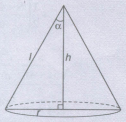
V(volume) \(=\frac{\pi}{3}r^2h\)
\(\Rightarrow V^2=\frac{\pi^2r^4h^2}{9}\)
\(\Rightarrow h^2=\frac{9V^2}{\pi^2r^4}\)
\(A=\pi r l,z=A^2=\pi^2r^2l^2\)
\(=\pi^2r^2(r^2+h^2)\)
\(let \ \ A^2=z\)
\(\therefore\ z=\pi^2r^2[r^2+\frac{9V^2}{\pi^2r^4}]\)
\( z=\pi^2[r^4+\frac{9V^2}{\pi^2r^2}]\)
\( \frac{dz}{dr}=\pi^2[4r^3-\frac{18V^2}{\pi^2r^3}]\)
\(\therefore \ \ \ \frac{dz}{dr}=0\)
\(\Rightarrow\ r=6\sqrt{\frac{9V^2}{2\pi^2}}\)
at \( r=6\sqrt{\frac{9V^2}{2\pi^2}}\)
\(\frac{d^2z}{dr^2}=\pi^2(12r^2+\frac{54V^2}{\pi^2r^4 })>0\)
\(\therefore\) curved surface area is minimum iff
\(2\pi^2r^6=9V^2\)
i.e., \(2\pi^2r^6=\pi^2r^4h^2\)
7.
We know that A = I3A
\(\left[ \begin{matrix} 8 & 4 & 3 \\ 2 & 1 & 1 \\ 1 & 2 & 2 \end{matrix} \right] =\left[ \begin{matrix} 1 & 0 & 0 \\ 0 & 1 & 0 \\ 0 & 0 & 1 \end{matrix} \right] A\)
Applying \({ R }_{ 3 }\rightarrow 2{ R }_{ 3 }\)
\(\left[ \begin{matrix} 8 & 4 & 3 \\ 2 & 1 & 1 \\ 2 & 4 & 4 \end{matrix} \right] =\left[ \begin{matrix} 1 & 0 & 0 \\ 0 & 1 & 0 \\ 0 & 0 & 2 \end{matrix} \right] A\)
Applying \({ R }_{ 3 }\rightarrow { R }_{ 3 }-{ R }_{ 2 }\)
\(\left[ \begin{matrix} 8 & 4 & 3 \\ 2 & 1 & 1 \\ 0 & 3 & 3 \end{matrix} \right] =\left[ \begin{matrix} 1 & 0 & 0 \\ 0 & 1 & 0 \\ 0 & -1 & 2 \end{matrix} \right] A\)
Applying \({ R }_{ 2 }\rightarrow 4{ R }_{ 2 }\)
\(\left[ \begin{matrix} 8 & 4 & 3 \\ 8 & 4 & 4 \\ 0 & 3 & 3 \end{matrix} \right] =\left[ \begin{matrix} 1 & 0 & 0 \\ 0 & 4 & 0 \\ 0 & -1 & 2 \end{matrix} \right] A\)
Applying \({ R }_{ 2 }\rightarrow { R }_{ 2 }-{ R }_{ 1 }\)
\(\left[ \begin{matrix} 8 & 4 & 3 \\ 0 & 0 & 1 \\ 0 & 3 & 3 \end{matrix} \right] =\left[ \begin{matrix} 1 & 0 & 0 \\ -1 & 4 & 0 \\ 0 & -1 & 2 \end{matrix} \right] A\)
Applying \({ R }_{ 2 }\rightarrow { R }_{ 2 }+{ R }_{ 3 }\)
\(\left[ \begin{matrix} 8 & 4 & 3 \\ 0 & 3 & 4 \\ 0 & 3 & 3 \end{matrix} \right] =\left[ \begin{matrix} 1 & 0 & 0 \\ -1 & 3 & 2 \\ 0 & -1 & 2 \end{matrix} \right] A\)
Applying \({ R }_{ 3 }\rightarrow { R }_{ 3 }-{ R }_{ 2}\)
\(\left[ \begin{matrix} 8 & 4 & 3 \\ 0 & 3 & 4 \\ 0 & 0 & -1 \end{matrix} \right] =\left[ \begin{matrix} 1 & 0 & 0 \\ -1 & 3 & 2 \\ 1 & -4 & 0 \end{matrix} \right] A\)
Applying \({ R }_{ 1 }\rightarrow { R }_{ 1 }+{ 3R }_{ 3 }\)
\(\left[ \begin{matrix} 8 & 4 & 0 \\ 0 & 3 & 4 \\ 0 & 0 & -1 \end{matrix} \right] =\left[ \begin{matrix} 4 & -12 & 0 \\ -1 & 3 & 2 \\ 1 & -4 & 0 \end{matrix} \right] A\)
Applying \({ R }_{ 2 }\rightarrow { R }_{ 2 }+{ 4R }_{ 3 }\)
\(\left[ \begin{matrix} 8 & 4 & 0 \\ 0 & 3 & 0 \\ 0 & 0 & -1 \end{matrix} \right] =\left[ \begin{matrix} 4 & -12 & 0 \\ 3 & -13 & 2 \\ 1 & -4 & 0 \end{matrix} \right] A\)
Applying \({ R }_{ 1 }\rightarrow { R }_{ 1 }-\frac { 4 }{ 3 } { R }_{ 2 }\)
\(\left[ \begin{matrix} 8 & 0 & 0 \\ 0 & 3 & 0 \\ 0 & 0 & -1 \end{matrix} \right] =\left[ \begin{matrix} 0 & \frac { 16 }{ 3 } & -\frac { 8 }{ 3 } \\ 3 & -13 & 2 \\ 1 & -4 & 0 \end{matrix} \right] \)
Applying \({ R }_{ 1 }\rightarrow \frac { 1 }{ 8 } { R }_{ 1 },{ R }_{ 2 }\rightarrow \frac { 1 }{ 3 } { R }_{ 2 }\) and R3 = - R3
\(\left[ \begin{matrix} 1 & 0 & 0 \\ 0 & 1 & 0 \\ 0 & 0 & 1 \end{matrix} \right] =\left[ \begin{matrix} 0 & \frac { 2 }{ 3 } & -\frac { 1 }{ 3 } \\ 3 & -\frac { 13 }{ 3 } & \frac { 2 }{ 3 } \\ -1 & 4 & 0 \end{matrix} \right] A\)
\({ A }^{ -1 }=\left[ \begin{matrix} 0 & \frac { 2 }{ 3 } & -\frac { 1 }{ 3 } \\ 3 & -\frac { 13 }{ 3 } & \frac { 2 }{ 3 } \\ -1 & 4 & 0 \end{matrix} \right] \)
Matrix representation of given linear equation is
\(\left[ \begin{matrix} 8 & 4 & 3 \\ 2 & 1 & 1 \\ 1 & 2 & 2 \end{matrix} \right] \left[ \begin{matrix} x \\ y \\ z \end{matrix} \right] =\left[ \begin{matrix} 19 \\ 5 \\ 7 \end{matrix} \right] \)
\(\Rightarrow \) AX = B
\(\Rightarrow \) X = A-1B
\(\left[ \begin{matrix} x \\ y \\ z \end{matrix} \right] =\left[ \begin{matrix} 0 & \frac { 2 }{ 3 } & -\frac { 1 }{ 3 } \\ 1 & -\frac { 13 }{ 3 } & \frac { 2 }{ 3 } \\ -1 & 4 & 0 \end{matrix} \right] \left[ \begin{matrix} 19 \\ 5 \\ 7 \end{matrix} \right] \)
\(\Rightarrow \left[ \begin{matrix} x \\ y \\ z \end{matrix} \right] =\left[ \begin{matrix} 0+\frac { 10 }{ 3 } -\frac { 7 }{ 3 } \\ 19-\frac { 65 }{ 3 } +\frac { 14 }{ 3 } \\ -19+20+0 \end{matrix} \right] \)
\(\therefore \left[ \begin{matrix} x \\ y \\ z \end{matrix} \right] =\left[ \begin{matrix} 1 \\ 2 \\ 1 \end{matrix} \right] \)
\(\therefore \) x = 1, y = 2, z = 1
8.
\(\mathrm{LHS}=(a I+b A)^{3}=\left\{\left[\begin{array}{ll} a & 0 \\ 0 & a \end{array}\right]+\left[\begin{array}{ll} 0 & b \\ 0 & 0 \end{array}\right]\right\}^{3} \)
\(=\left[\left.\begin{array}{ll} a & b \\ 0 & a \end{array}\right|^{3}=\left[\begin{array}{ll} a & b \\ 0 & a \end{array}\right]\left[\begin{array}{ll} a & b \\ 0 & a \end{array}\right]\left[\begin{array}{ll} a & b \\ 0 & a \end{array}\right]\right. \)
\(=\left[\begin{array}{cc} a^{2} & 2 a b \\ 0 & a^{2} \end{array}\right]\left[\begin{array}{ll} a & b \\ 0 & a \end{array}\right]=\left[\begin{array}{cc} a^{3}+0 & a^{2} b+2 a^{2} b \\ 0+0 & 0+a^{3} \end{array}\right]=\left[\begin{array}{cc} a^{3} & 3 a^{2} b \\ 0 & a^{3} \end{array}\right] \)
\(\mathrm{RHS}=a^{3} I+3 a^{2} b A=\left[\begin{array}{cc} a^{3} & 0 \\ 0 & a^{3} \end{array}\right]+\left[\begin{array}{cc} 0 & 3 a^{2} b \\ 0 & 0 \end{array}\right]=\left[\begin{array}{cc} a^{3} & 3 a^{2} b \\ 0 & a^{3} \end{array}\right] \)
\(\mathrm{LHS}=\mathrm{RHS} \)
\(\text {Hence, }(a I+b l)^{3}=a^{3} I+3 a^{2} b A \)
9.
After dividing numerator and denominator by a^3 we have,
\( \tan ^{-1}\left(\frac{3\left(\frac{x}{a}\right)-\left(\frac{x}{a}\right)^3}{1-3\left(\frac{x}{a}\right)^2}\right) \)
\(Put \mathrm{x} / \mathrm{a}=\tan \theta\ and\ \theta=\tan ^{-1}(\mathrm{x} / \mathrm{a}) \)
\( =\tan ^{-1}\left(\frac{3 \tan \theta-\tan ^3 \theta}{1-3 \tan ^2 \theta}\right) \)
\(=\tan ^{-1}(\tan 3 \theta) \)
\(=3 \theta \\ =3 \tan ^{-1}(\mathrm{x} / \mathrm{a})\)
10.
Let PT : Event that P speaks truth
and QT: Event that Q speaks truth.
Given, \(P\left(P_T\right)=\frac{70}{100}
\), then \(P\left(\bar{P}_T\right)=1-\frac{70}{100}=\frac{30}{100}\)
and \(P\left(Q_T\right)=\frac{80}{100} \text {, }\)then \(P\left(\bar{Q}_T\right)=1-\frac{80}{100}=\frac{20}{100}\)
P (A and B are agree to each other)
\(\begin{aligned}
=P\left(P_T \cap Q_T\right)+P\left(\bar{P}_T \cap \bar{Q}_T\right)
\end{aligned}\)
\(\begin{aligned}
=P\left(P_T\right) \cdot P\left(Q_T\right)+P\left(\bar{P}_T\right) \cdot P\left(\bar{Q}_T\right)
\end{aligned}\)
[\(\because\) events PT and QT are independent events]
\(\begin{aligned}
=\frac{70}{100} \times \frac{80}{100}+\frac{30}{100} \times \frac{20}{100}
\end{aligned}\)
\(\begin{aligned}
=\frac{5600}{10000}+\frac{600}{10000}
\end{aligned}\)
\(\begin{aligned}
=\frac{6200}{10000}=\frac{62}{100}
\end{aligned}\)
\(\therefore\) Percentage of P(A and B are agree to each other)
\(=\frac{62}{100} \times 100=62 \%\)
No, agree does not mean that they are speaking truth.
11.
Let godown A supply x and y quintals of grain to the shops D and E respectively. Then, (100 − x − y) will be supplied to shop F.
The requirement at shop D is 60 quintals since x quintals are transported from godown A. Therefore, the remaining (60 −x) quintals will be transported from godown B.
Similarly, (50 − y) quintals and 40 − (100 − x − y) = (x + y − 60) quintals will be transported from godown B to shop E and F respectively.
The given problem can be represented diagrammatically as follows.
\(60-x\ge 0\Leftrightarrow x\le 60\) ..(1)
\(50-y\ge 0\Leftrightarrow y\le 50\) .(2)
\(100-(x+y)\ge 0\Leftrightarrow x+y\le 100\) ..(3)
\(x+y-60\ge 0\Leftrightarrow x+y\ge 60\) ..(4)
and \(x,y\ge 0\) ...(5)
The given problem can be formulated as
Minimize z = 2.5x + 1.5y + 410 … (1)
subject to the constraints,
The feasible region determined by the system of constraints is as follows.
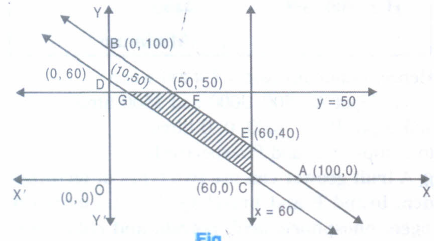
The corner points are A (60, 0), B (60, 40), C (50, 50), and D (10, 50).
The values of z at these corner points are as follows.
| Corner point | z = 2.5x + 1.5y + 41 | |
| A (60, 0) | 560 | |
| B (60, 40) | 620 | |
| C (50, 50) | 610 | |
| D (10, 50) | 510 | → Minimum |
The minimum value of z is 510 at (10, 50).
Thus, the amount of grain transported from A to D, E, and F is 10 quintals, 50 quintals, and 40 quintals respectively and from B to D, E, and F is 50 quintals, 0 quintals, and 0 quintals respectively.
The minimum cost is Rs. 510.
12.
The given equation is \({ x }^{ 2 }dy+\left( 2xy+{ y }^{ 2 } \right) dx=0\)
\(\Rightarrow\) \(\frac { dy }{ dx } =-\frac { 2xy+{ y }^{ 2 } }{ { x }^{ 2 } } \)
| Homogeneous
Put \(y=vx\) so that \(\frac { dy }{ dx } =v+x\frac { dv }{ dx } \)
\(\therefore \) (1) becomes :\(v+x\frac { dv }{ dx } =-\frac { 2v{ x }^{ 2 }+{ v }^{ 2 }{ x }^{ 2 } }{ { x }^{ 2 } } \)
\(\Rightarrow\) \(v+x\frac { dv }{ dx } =-2v-{ v }^{ 2 }\)
\(\Rightarrow\) \(x\frac { dv }{ dx } =-3v-{ v }^{ 2 }\)
\(\Rightarrow\) \(\frac { dv }{ 3v-{ v }^{ 2 } } =-\frac { dx }{ x } \)
| Variables Separable
Integrating, \(\int { \frac { dv }{ v\left( v+3 \right) } } =-\int { \frac { dx }{ x } } +\) constant
\(\Rightarrow\) \(\frac { 1 }{ 3 } \int { \left( \frac { 1 }{ v } -\frac { 1 }{ v+3 } \right) } dv=-\int { \frac { dx }{ x } + } \) constant
[Partial Fractions]
\(\Rightarrow\) \(\frac { 1 }{ 3 } \quad log|v|-\frac { 1 }{ 3 } log|v+3|=-log\quad |x|+log\quad c'|\)
\(\Rightarrow\) \(\frac { 1 }{ 3 } log|\frac { 1 }{ v+3 } |=log\quad |\frac { c' }{ x } |\Rightarrow \frac { v }{ v+3 } ={ \left( \frac { c' }{ x } \right) }^{ 3 }\)
\(\Rightarrow\) \(\frac { \frac { y }{ x } }{ \frac { y }{ x+3 } } =\frac { { c' }^{ 3 } }{ { x }^{ 3 } } \Rightarrow \frac { y }{ y+3x } =\frac { { c' }^{ 3 } }{ { x }^{ 3 } } \)
\(\Rightarrow\) \( { x }^{ 3 }y=c\left( 3x+y \right) \)..(2)
When \(x=1,y=1\) then (1)(1) \(=c\left( 3+1 \right) \Rightarrow c=\frac { 1 }{ 4. } \)
Putting in (2),
\({ x }^{ 3 }y=\frac { 1 }{ 4. } \left( 3x+y \right) ,\)
which is the required solution
13.
We have: \(y={ X }^{ x }\)
Taking logs \(logy\quad y=x\quad log\quad x\)
\(loy\quad y=x\quad log\quad x\)
\(\frac { 1 }{ y } \frac { dy }{ dx } =x.\frac { 1 }{ x } +log\quad x.1\)
\(\frac { dy }{ dx } =y(1+log\quad x)...(1)\)
\(\frac { { d }^{ 2 }y }{ { dx }^{ 2 } } =y.\frac { d }{ dx } (1+log\quad x)+\frac { dy }{ dx } (1+log\quad x)\)
\(\frac { { d }^{ 2 }y }{ { dx }^{ 2 } } =y.\left( 0+\frac { 1 }{ x } \right) +\frac { dy }{ dx } .\frac { \frac { dy }{ dx } }{ y } \)
\(\frac { { d }^{ 2 }y }{ { dx }^{ 2 } } =\frac { y }{ x } +\frac { 1 }{ y } { \left( \frac { dy }{ dx } \right) }^{ 2 }\)
\(\frac { { d }^{ 2 }y }{ { dx }^{ 2 } } -\frac { 1 }{ y } { \left( \frac { dy }{ dx } \right) }^{ 2 }-\frac { y }{ x } =0\)
14.
(i) When \(a,b\in Z^{ + }\) , then a-b may not belong to \(Z^{ + }\).
\(\left[ For\quad Ex.\quad 5-7=-2\notin Z^{ + } \right] \)
Hence "*' is not a binary operation on \(Z^{ + }\).
(ii) When \(a,b\in Z^{ + }\) , then \(a,b\in Z^{ + }\)
Hence, "*' is a binary operation on \(Z^{ + }\).
(iii) When \(a,b\in R\) , then \(ab^{ 2 }\) \(\in R\) .
Hence, '*' is a binary operation on R.
(iv) When \(a,b\in Z^{ + }\), \(\left| a-b \right| \in Z^{ + }\).
\(\left[ \because \quad \left| a-b \right| \ge 0 \right] \)
Hence, '*' is a binary operation on \(Z^{ + }\).
(v) When \(a,b\in Z^{ + }\) , then \(a,\in Z^{ + }\).
Hence, '*' is a binary operation on \(Z^{ + }\) .
15.
The given parabola is y2 = 2x and the given st. line is x - y = 4
Solving (1) and (2):
From (2), x = 4 + y
Putting in (1), y2 = 8 + 2y \(\Rightarrow\) y2 - 2y - 8 = 0 \(\Rightarrow\) (y - 4) (y + 2) = 0 \(\Rightarrow\) y = 4, - 2
When y = 4, then from (3), x = 4 + 4 = 8
When y = -2, then from (3), x = 4 - 2 = 2
Thus the line (2) cuts parabola (2) in the points A (2, -2) and B(8, 4).
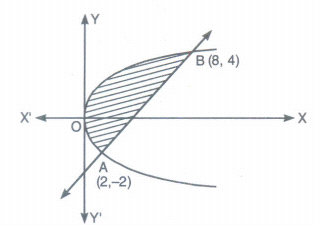
The region is shown as shaded in the above figure.
Therefore, Reqd.area
\(=\overset { 4 }{ \underset { -2 }{ \int { } } } \left( 4+y\frac { { y }^{ 2 } }{ 2 } \right) dy=\left[ 4y+\frac { { y }^{ 2 } }{ 2 } -\frac { { y }^{ 3 } }{ 6 } \right] _{ -2 }^{ 4 }\)
\(=\left( 4(4)+\frac { 16 }{ 2 } -\frac { 64 }{ 6 } \right) -\left( -8+\frac { 4 }{ 2 } +\frac { 8 }{ 6 } \right) \)
\(=\left( 16+8\frac { 64 }{ 6 } \right) -\left( -8+2+\frac { 8 }{ 6 } \right) \)
\(=\left( 24-\frac { 64 }{ 6 } \right) +\left( 6-\frac { 8 }{ 6 } \right) =30-\frac { 72 }{ 6 } =30-12=18sq.units\)
16.
We have: \(A\prime =\begin{bmatrix} -2 & 3 \\ 1 & 2 \end{bmatrix}.\quad and\ B=\ \begin{bmatrix} -1 & 0 \\ 1 & 2 \end{bmatrix}\quad \)
Then \(A=\begin{bmatrix} -2 & 1 \\ 3 & 2 \end{bmatrix}.\)
Now \(A+2B=\begin{bmatrix} -2 & 1 \\ 3 & 2 \end{bmatrix}+2\begin{bmatrix} -1 & 0 \\ 1 & 2 \end{bmatrix}\)
\(=\begin{bmatrix} -2 & 1 \\ 3 & 2 \end{bmatrix}+\begin{bmatrix} -2 & 0 \\ 2 & 4 \end{bmatrix}\)
\( =\begin{bmatrix} -2-2 & 1+0 \\ 3+2 & 2+4 \end{bmatrix}=\begin{bmatrix} -4 & 1 \\ 5 & 6 \end{bmatrix}\)
Hence \((A+2B)\prime =\begin{bmatrix} -4 & 5 \\ 1 & 6 \end{bmatrix}.\)
17.
We get \(\begin{vmatrix}1&a&bc\\0&b-a&c(a-b)\\0&c-a&b(a-c) \end{vmatrix}\)
Taking factors (b – a) and (c – a) common from R2 and R3, respectively, we get
\((b-a)(c-a)\begin{vmatrix} 1&a&bc\\0&1&-c\\0&1&-b\end{vmatrix}\)
= (b – a) (c – a) [(– b + c)] (Expanding along first column)
= (a – b) (b – c) (c – a)
18.
Let \({ sin }^{ -1 }\left( -\frac { 1 }{ 2 } \right) =y\) where \(y\in \left[ -\frac { \pi }{ 2 } ,\frac { \pi }{ 2 } \right] \)
\(\Rightarrow siny=-\frac { \pi }{ 2 } \)
\(\Rightarrow siny=-sin\frac { \pi }{ 6 } =sin\left( -\frac { \pi }{ 6 } \right) \)
\(\Rightarrow y=-\frac { \pi }{ 6 } \)
Hence, the required principal value = \(-\frac { \pi }{ 6 } \)
19.
\(\Rightarrow\left(1+x^{2}\right) y=\underline{x}, \sqrt{x^{2}+4}+2 \log \left|x+\sqrt{x^{2}+4}\right|\) is the required solution.
20.
\({x\over2}cos^{-1}\ x-{1\over2}\sqrt{1-x^2}+c\)
21.
\(I=\int _{ \frac { \pi }{ 6 } }^{ \frac { \pi }{ 3 } }{ \frac { \sqrt [ 3 ]{ sinx } }{ \sqrt [ 3 ]{ cosx } +\sqrt [ 3 ]{ sinx } } } dx\)
Apply the property
\(\int _{ 0 }^{ b }{ f(x)\quad dx } =\int { f(a+b-x)dx } \)
\(I=\int _{ \frac { \pi }{ 6 } }^{ \frac { \pi }{ 3 } }{ \frac { \sqrt [ 3 ]{ sin\left( \frac { \pi }{ 2 } -x \right) dx } }{ \sqrt [ 3 ]{ cos\left( \frac { \pi }{ 2 } -x \right) } +\sqrt [ 3 ]{ sin\left( \frac { \pi }{ 2 } -x \right) } } } \)
as \(\frac { \pi }{ 3 } +\frac { \pi }{ 6 } =\frac { 2\pi +\pi }{ 6 } =\frac { 3\pi }{ 6 } =\frac { \pi }{ 2 } \)
\(I=\int _{ \frac { \pi }{ 6 } }^{ \frac { \pi }{ 3 } }{ \frac { \sqrt [ 3 ]{ cosx } }{ \sqrt [ 3 ]{ cosx } +\sqrt [ 2 ]{ sinx } } } dx\)
by adding eqn. (i) and (ii),
\(=\int _{ \frac { \pi }{ 6 } }^{ \frac { \pi }{ 3 } }{ dx } =\left[ x \right] ^{ \pi /3 }_{ \pi /6 }\)
\(=\left[ \frac { \pi }{ 3 } -\frac { \pi }{ 6 } \right] =\frac { \pi }{ 6 } \)
\(\Rightarrow 2I=\frac { \pi }{ 6 }\)
\( \Rightarrow I=\frac { \pi }{ 12 } \)
22.
\(\cos \theta=\frac{\overrightarrow a.\overrightarrow b}{\left| \overrightarrow { a } \right| \left| \overrightarrow { b } \right| }=\frac{12}{10\times 2}=\frac{3}{5}\)
\(\cos \theta =\frac{3}{5}\)
\(\sin \theta=\sqrt{1-\cos ^{2}\theta} =\sqrt{1-\frac{9}{25}}\)
\(\sin \theta=\frac{\left| \overrightarrow { a } \times \overrightarrow { b } \right| }{\left| \overrightarrow {a } \right| \left| \overrightarrow {b } \right| }\)
\(\Rightarrow \left| \overrightarrow { a } \times \overrightarrow { b } \right| =\left| \overrightarrow { a } \right| \left| \overrightarrow { b} \right| \sin\theta\)
\(\Rightarrow \left| \overrightarrow { a } \times \overrightarrow { b } \right| =10\times2\times\frac{4}{5}=16\)
23.
We have, y = ax +xa+xx+aa
Let v = xx
log v = x log x
\(\frac { 1 }{ v } \frac { dv }{ dx } =x+\frac { 1 }{ x } +logx\)
\(\frac { dv }{ dx } =v\left| 1+logx \right| \)
= xx(1+lodx)
\(\frac { dy }{ dx } ={ a }^{ x }loga+a{ x }^{ a-1 }+\frac { dv }{ dx } +0\)
\(\Rightarrow \frac { dy }{ dx } ={ a }^{ x }loga+a{ x }^{ a-1 }+{ x }^{ x }(1+logx)\)
24.
\(\frac { dy }{ dx } +y={ e }^{ -x }\)
Let \(\frac { dy }{ dx } +Py=Q\)
Where P = 1, Q = e-x
\(y\left( I.F. \right) =\int { I.F.\times Qdx } \)
\(\Rightarrow I.F.={ e }^{ \int { Pdx } }={ e }^{ \int { Pdx } }={ e }^{ x }\)
\(\Rightarrow y{ e }^{ x }=\int { { e }^{ x }.{ e }^{ -x } } dx=\int { dx } \)
\(\Rightarrow y{ e }^{ x }=x+C\)
25.
\(\alpha =60^{ \circ },\beta =?,\gamma =45^{ \circ }\)
Let \(\alpha \) makes with x-axis, y makes with z-axis and \(\beta \) makes with y-axis
\(\alpha =cos\quad 60^{ \circ },m=cos\quad \beta ,y=cos45^{ \circ }\)
\(\alpha ^{ 2 }+\beta ^{ 2 }+\gamma ^{ 2 }=1\)
\(\Rightarrow cos^{ 2 }60^{ \circ }+cos^{ 2 }\beta +cos^{ 2 }45^{ \circ }\)
\(\Rightarrow \frac { 1 }{ 4 } +cos^{ 2 }\beta +\frac { 1 }{ 2 } =1\)
\(\Rightarrow cos^{ 2 }\beta =1-\frac { 1 }{ 4 } -\frac { 1 }{ 2 } \)
\(=\frac { 4-1-2 }{ 4 } \)
\(=\frac { 1 }{ 4 } \)
\(\Rightarrow cos \beta =\pm \frac { 1 }{ 2 } \)
\(\beta =\frac { \pi }{ 3 } or\ \frac { 2\pi }{ 3 } \)
But angle between two lines in the interval \(\left( 0,\frac { \pi }{ 2 } \right) \)
Hence required angles is \(\frac { \pi }{ 3 } \)
26.
Total number of cards = 2 + 6 + 8 = 16
(a) Number of red balls = 2
\(\therefore\) Required probability = \(\frac { 2 }{ 16 } =\frac { 1 }{ 8 } \)
(b) Number of black balls = 6
\(\therefore\) Required probability = \(\frac { 6 }{ 16 } =\frac { 3 }{ 8 } \)
(c) number of green balls = 8
\(\therefore\) Required probability = \(\frac { 8 }{ 16 } =\frac { 1 }{ 2 } \)
(d) Number of non-red balls = 14
\(\therefore\) Required probability = \(\frac { 14 }{ 16 } \)
27.
\(Let\quad { sec }^{ -1 }x=\theta ,\quad then\quad x=sec\theta \quad and\quad for\quad x<-1,\)
\(\frac { \pi }{ 2 } <\theta <\pi \)
Given expression = cot-1(-cot \(\theta \))
\(={ cot }^{ -1 }\left[ cot\left( \pi -\theta \right) \right] =\pi -{ sec }^{ -1 }x\quad as\quad 0<\pi -\theta <\frac { \pi }{ 2 } \)
28.
We shall prove the result by mathematical induction on n.
Step 1 : When n = 1, by the definition or integral powers of a matrix, we have
\({ A }^{ 1 }=\left[ \begin{matrix} 1+2\left( 1 \right) & -4n \\ n & 1-2\left( 1 \right) \end{matrix} \right] =\left[ \begin{matrix} 3 & -4 \\ 1 & -1 \end{matrix} \right] \)
So, the result is true for n = 1.
Step 2 : Let the result be true for n = m. Then,
\({ A }^{ m }=\left[ \begin{matrix} 1+2m & -4m \\ m & 1-2m \end{matrix} \right] \)
Now, we will show that the result is true for n = m + 1, i.e.,
\({ A }^{ m+1 }=\left[ \begin{matrix} 1+2\left( m+1 \right) & -4\left( m+1 \right) \\ \left( m+1 \right) & 1-2\left( m+1 \right) \end{matrix} \right] \)
By the definition of integral powers of a square matrix, we have
\({ A }^{ m+1 }={ A }^{ m }.A\)
\(\Rightarrow { A }^{ m+1 }=\left[ \begin{matrix} 1+2m & -4m \\ m & 1-2m \end{matrix} \right] \left[ \begin{matrix} 3 & -4 \\ 1 & -1 \end{matrix} \right] \)
[by supposition (i)]
\(\Rightarrow { A }^{ m+1 }=\left[ \begin{matrix} 3+6m-4m & -4-8m+4m \\ 3m+1-2m & -4m-4+2m \end{matrix} \right] \)
\(=\left[ \begin{matrix} 1+2\left( m+1 \right) & -4\left( m+1 \right) \\ \left( m+1 \right) & 1-2\left( m+1 \right) \end{matrix} \right] \)
This shows that the result is true for n = m + 1, whenever it is true for n = m.
Hence, by the principle of mathematical induction, the result is true for any positive integer n.
29.
\(k=-\frac { 3 }{ 2 }\)
Alternative Method :
Since diagonal elements in a skew symmetric matrix are zero.
We can compare diagonal elements to zero.
i.e., 2k + 3 = 0
⇒ 2k = - 3
∴ \(k=-\frac { 3 }{ 2 }\)
30.
Symmetric Relation : A relation R on a set A is called symmetric relation if aRb implies bRa, for every a,b \(\in a\) i.,e if (a,b) \(\in R\) \(\Rightarrow \) (b,a) \(\in R\)For every a,b \(\in A\)
Example
A = (1,2,3)
A x A =(1,2) (2,1) (1,1) (2,2) (3,3) (1,3) (2,3) (3,1) (3,2 ) \(\in R\)
since (a,b) \(\in R\) (b,a) \(\in R\) for every a, b \(\in A\)
Relation is said to be symmetric
31.
We have, \(A=\left| \begin{matrix} 2 & 3 & -1 \\ 4 & 1 & 0 \\ 3 & 3 & 2 \end{matrix} \right| \)
\(M_{ 12 }\left| \begin{matrix} 4 & 0 \\ 3 & 2 \end{matrix} \right| =8-0=8\)
\(M_{ 21 }\left| \begin{matrix} 3 & -1 \\ 3 & 2 \end{matrix} \right| =6+3=9\)
\(C_{ 21 }=-\left| \begin{matrix} 3 & -1 \\ 3 & 2 \end{matrix} \right| =-(6+3)=-9\)
\(C_{ 12 }=-\left| \begin{matrix} 4 & 0 \\ 3 & 2 \end{matrix} \right| =-(8-0)=-8\)
\( M_{ 12 }\times M_{ 21 }+C_{ 21 }\times C_{ 12 }\)
\( 8\times (9)+(-9)(-8)=72+72\)
\(=144\)
32.
(d)
1/\(\sqrt3\)
33.
(c)
Equivalence relation
34.
(d)
\(\frac{17}{4}\)
35.
(a)
1 m/h

12th Standard CBSE Syllabus & Materials
12th Standard CBSE
CBSE 12th Computer Science Python Revision Tour I - New Previous year Question Papers Study Material - QB365 Set A
NEW12th Standard CBSE
CBSE 12th Business Studies Planning Important Questions And Answers Study Material - QB365 Set A
NEW12th Standard CBSE
CBSE 12th Business Studies Business Environment Important Questions And Answers Study Material - QB365 Set A
NEW12th Standard CBSE
CBSE 12th Business Studies Principles of Management Important Questions And Answers Study Material - QB365 Set A



CBSE 12th Standard CBSE Subjects
CBSE Standards










