
 100% FREE ACCESS
12th Standard CBSE Syllabus & Materials
12th Standard CBSE
CBSE 12th Economics Government Budget and the Economy Previous year Question Papers Study Material - QB365 Set A
NEW12th Standard CBSE
CBSE 12th Computer Science Interface Python with MySQL - New Previous year Question Papers Study Material - QB365 Set A
NEW12th Standard CBSE
CBSE 12th Computer Science Database Concept - New Previous year Question Papers Study Material - QB365 Set A
NEW12th Standard CBSE
CBSE 12th Computer Science Data Communication - New Previous year Question Papers Study Material - QB365 Set A
NEW12th Standard CBSE
CBSE 12th Computer Science Data Structures - New Previous year Question Papers Study Material - QB365 Set A
NEW12th Standard CBSE
CBSE 12th Computer Science Functions - New Previous year Question Papers Study Material - QB365 Set A

Published on: 15/02/2020
12th Standard CBSE Mathematics Public Model Question Paper IV 2019 - 2020
Download CBSE Class 12th Standard CBSE Maths question papers, sample papers, important questions, and previous year solved papers in PDF format. Get free study materials, NCERT solutions, and exam preparation resources for Class 12th Standard CBSE Maths
Questions + Answers key
Take MCQ Maths Test
1.
If \(A=\left[ \begin{matrix} 1 & 1 & 1 \\ 1 & 1 & 1 \\ 1 & 1 & 1 \end{matrix} \right] \) Prove that , A =\(\left[ \begin{matrix} { 3 }^{ x-1 } & { 3 }^{ x-1 } & { 3 }^{ x-1 } \\ { 3 }^{ x-1 } & { 3 }^{ x-1 } & { 3 }^{ x-1 } \\ { 3 }^{ x-1 } & { 3 }^{ x-1 } & { 3 }^{ x-1 } \end{matrix} \right] \) for every positive integer n.
2.
If \(\overrightarrow { a } ,\overrightarrow { b } ,\overrightarrow { c } \) are unit vectors such that \(\overrightarrow { a } .\overrightarrow { b } =\overrightarrow { a } .\overrightarrow { c } =0\) and the angle between \(\overrightarrow { b } \) and \(\overrightarrow { c } \) is \(\frac{\pi}{6}\) , then prove that:
(i) \(\overrightarrow { a } =\pm 2\left( \overrightarrow { b } \times \overrightarrow { c } \right) \)
(ii) \(\left[ \overrightarrow { a } +\overrightarrow { b } ,\overrightarrow { b } +\overrightarrow { c } ,\overrightarrow { c } +\overrightarrow { a } \right] =\pm 1\)
3.
Does the following trigonometric equation have any solutions? If yes, obtain the solutions (s);
\(tan^{ -1 }\left( \frac { x+1 }{ x-1 } \right) +tan^{ -1 }\left( \frac { x-1 }{ x } \right) =-tan^{ -1 }7\)
4.
Find : \(\int { \frac { 1 }{ { cos }^{ 4 }x+{ sin }^{ 4 }x } } dx\)
5.
Using properties of determinants, show that triangle ABC is isosceles if:
\(\left| \begin{matrix} 1 & 1 & 1 \\ 1+cosA & 1+cosB & 1+cosC \\ \cos ^{ 2 }{ A } +cosA & \cos ^{ 2 }{ B } +cosB & \cos ^{ 2 }{ B } +cosC \end{matrix} \right| =0\)
6.
A bag contains 4 red and 4 black balls, another bag contains 2 red and 6 black balls. One of the two bags is selected at random and two balls are drawn at random (without replacement) from the bag which are both found to be red. Find the probability that the balls are drawn from the first bag.
7.
Prove that \({ cos }^{ -1 }\left( \frac { 12 }{ 13 } \right) +{ cos }^{ -1 }\left( \frac { 4 }{ 5 } \right) ={ tan }^{ -1 }\left( \frac { 56 }{ 33 } \right) \)
8.
Let A = \(R\times R\) and * be a binary operation on A defined by
(a,b)*(c,d) = (a+c, b+c)
Show that * is commutative and associative. Find the identity element for * on A. Also find • the inverse of every element (a, b) \(\in A\) *.
9.
Find the derivative of each of the following function w.r.t. x, or find \(\frac { dy }{ dx } \):
\(y=\sqrt { { x }^{ 2 }+1 } -log\left( \frac { 1 }{ x } +\sqrt { 1+\frac { 1 }{ { x }^{ 2 } } } \right) \)
10.
Construct a \(3\times 3\) matrix \([{ a }_{ ij }]\), whose elements are given by \({ a }_{ ij }=2i-3j.\)
11.
Find the shortest distance between two lines whose vector equations are \(\overrightarrow{r}=(\hat{i}+2\hat{j}+3\hat{k})+\lambda(\hat{i}-3\hat{j}+2\hat{k})\) and \(\overrightarrow{r}=(4\hat{i}+5\hat{j}+6\hat{k})+\mu(2\hat{i}+3\hat{j}+\hat{k}).\)
12.
Two ships in the sea were reported missing their link with ground control suddenly. They were on the lines, \(\vec { r_{ 1 } } =\hat { i }- \hat { j }+\lambda \left( 2\hat { i } +2\hat { j } +\hat { k } \right) \) and \(\vec { r_{ 2 } } =2\hat { i } +2\hat { j } -\hat { k } +\mu \left( 5\hat { i } -3\hat { j } +2\hat { k } \right) \).Using shortest distance formula, determine whether they met any mishappening. What value do you see in it?
13.
A manufacturer produces nuts and bolts. It takes 1 hour of work on machine A and 3 hours on machine B to produce a package of nuts while It takes 3 hours on machine A and 1 hour on machine B to produce a package of bolts. He earns a profit of Rs. 17.50 per package on nuts and Rs. 7per package of bolts. How many packages of each should be produced each day so as to maximise his profits if he operates his machines for at the most 12 hours a day? Formulate this mathematically and then solve it.
14.
(Diet Problem) A dietician has to develop a special diet using two foods P and Q. Each packet (containing 50g) of food P contains 12 units of calcium, 4 units of iron, 6 units of cholesterol and 6 units of vitamin A. Each packet of the same quantity of food q contains 3 units of calcium, 20 units of iron, 4 units of cholesterol and 3 units of vitamin A. The diet requires at least 240 units of calcium, at least 460 units of iron and at most 300 units of cholesterol. How many packets of each food should be used to minimise the amount of vitamin A in the diet. What is the minimum amount of vitamin A?
15.
Find the area of the region bounded by the ellipse \(\frac { { x }^{ 2 } }{ 16 } +\frac { { y }^{ 2 } }{ 9 } =1\)
16.
If A,B are symmetric matrices of same order, then AB-BA is a:
(A) Skew-symmetric matrix
(B) Symmetric matrix
(C) Zero matrix
(D) Identity matrix.
17.
Find the derivative of tan(2x+3).
18.
prove that :
\(\left| \begin{matrix} x & { x }^{ 2 } & yz \\ y & { y }^{ 2 } & zx \\ z & { z }^{ 2 } & xy \end{matrix} \right| =(x-y)(y-z)(z-x)(xy+yz+zx)\)
19.
Show that :
\({ \sin }^{ -1 }(2x\sqrt { 1-{ x }^{ 2 } } )={ 2\sin }^{ -1 }x,\frac { 1 }{ \sqrt { 2 } } \le x\le \frac { 1 }{ \sqrt { 2 } } \)
20.
Integrate:\(\int ^{3}_{1} {(2x^2)+5\ x}dx.\)
21.
Show that the general solution of the differential equation \(\frac {dy}{dx}\)+\(\frac { { y }^{ 2 }+y+1 }{ { x }^{ 2 }+x+1 } =0\) is given by (x + y + 1) = A (1 - x - y - 2xy), where A is parameter.
22.
Solve the differential equation : \(x\frac { dy }{ dx } +y={ x }^{ 3 },\) given that y = 1, when x = 2.
23.
If A is square matrix such that A2 = A, then write the value of (I + A)2-3A.
24.
Find the magnitude of two vectors \(\overrightarrow a\) and \(\overrightarrow b\) of equal magnitude such that the angle between them is a 60o and their scalar product is \(\frac{1}{2}.\)
25.
If y = \(log\left( tanx\frac { x }{ 2 } \right) find\frac { dy }{ dx } \)
26.
If the equation of a line is x = ay + b z = cy + d, then find direction ratios of the line and a point on the line.
27.
If P(A)=\(\frac { 2 }{ 5 } ,P(B)=\frac { 1 }{ 3 } ,P(A\cap B)=\frac { 1 }{ 5 } ,\) then find \(P(\bar { A } /\bar { B } )\) .
28.
Solve the differential \(xdy=\left( \frac { y+1 }{ y } \right) dx\)
29.
\(\int { { e }^{ x }{ tan }^{ -1 } } xdx+\int { \frac { { e }^{ x } }{ 1+{ x }^{ 2 } } } dx\)
30.
Let f and g be real valued functions defined as \(f(x)=x^{ 2 }+1,x\in R\)and g(x) = 2x + 1, \(x\in R\) Find the value of fog and gof
31.
Prove that \({ cos }^{ -1 }x=2{ sin }^{ -1 }\left( \sqrt { \frac { 1-x }{ 2 } } \right) \)
32.
Find \(\frac { 1 }{ 2 } \left( A+{ A }^{ \prime } \right) \) and \(\frac { 1 }{ 2 } \left( A-{ A }^{ \prime } \right) \) . If \(A=\left[ \begin{matrix} 0 & a & b \\ -a & 0 & c \\ -b & -c & 0 \end{matrix} \right] \)
33.
If \(A=\left| \begin{matrix} 6 & 0 & 1 \\ 0 & 1 & 2 \\ 0 & 0 & 4 \end{matrix} \right| \), then show that |2A| = 8|A|:
34.
The direction cosines of the line whose direction ratios are 6, – 6, 3 are:
\(\frac { 2 }{ 3 } ,\frac { -2 }{ 3 } ,\frac { 1 }{ 3 } \)
\(\frac { -2 }{ 3 } ,\frac { 2 }{ 3 } ,\frac { -1 }{ 3 } \)
\(\frac { 6 }{ 3 } ,\frac { -6 }{ 3 } ,\frac { -1 }{ 3 } \)
\(\frac { 2 }{ 9 } ,\frac { -2 }{ 9 } ,\frac { 1 }{ 9 } \)
35.
The area enclosed between the lines x = 2 and x = 7 is
Infinite
7 units
5 units
2 units
36.
Let R = { (P,Q) : OP = OQ , O being the origin} be an equivalence relation on A . The equivalence class [( 1,2)] is
{(x, y): x2 + y2 = 5}
{(x, y): x2 = y2}
{(x, y): x2 + y2 = 1}
{(x, y): x2 + y2 = 4}
37.
The angle between the curve y² = x and x² = y at (1, 1) is
60°
tan-1\(\frac43\)
cot-1\(\frac43\)
90°
1.
\({ A }^{ -1 }=\frac { 1 }{ 8 } \left[ \begin{matrix} 5 & -1 \\ -7 & 3 \end{matrix} \right] \)
2.
As given \(\overrightarrow { a } .\overrightarrow { b } =\overrightarrow { a } .\overrightarrow { c } =0=\overrightarrow { a } \bot \)both \(\overrightarrow { b } \) and \(\overrightarrow { c } \)
⇒ \(\overrightarrow { a } \parallel \left( \overrightarrow { b } \times \overrightarrow { c } \right) \)
Let \(\overrightarrow { a } =\lambda \left( \overrightarrow { b } \times \overrightarrow { c } \right) \)
then \(\left| \overrightarrow { a } \right| =\left| \lambda \right| \left| \left( \overrightarrow { b } \times \overrightarrow { c } \right) \right| \)
⇒ \(\frac { \left| \overrightarrow { a } \right| }{ \left| \left( \overrightarrow { b } \times \overrightarrow { c } \right) \right| } =\left| \lambda \right| \)
⇒ \(\left| \lambda \right| =\frac { 1 }{ sin\frac { \pi }{ 6 } } =2\)
λ = 士2
\(\overrightarrow { a } =\pm 2\left( \overrightarrow { b } \times \overrightarrow { c } \right) \)
Hence proved
(ii) Now \(\left[ \overrightarrow { a } +\overrightarrow { b } ,\overrightarrow { b } +\overrightarrow { c } ,\overrightarrow { c } +\overrightarrow { a } \right] \)
= \(\left[ \left( \overrightarrow { a } +\overrightarrow { b } \right) \times \left( \overrightarrow { b } \times \overrightarrow { c } \right) \right] .\left( \overrightarrow { c } +\overrightarrow { a } \right) \)
= \(\left( \overrightarrow { a } \times \overrightarrow { b } \right) .\overrightarrow { c } +\left( \overrightarrow { b } \times \overrightarrow { c } \right) .\overrightarrow { a } \)
(As the scalar triple product = 0, if any two vectors are equal)
Hence, \(\overrightarrow { a } .\left( \overrightarrow { b } \times \overrightarrow { c } \right) +\left( \overrightarrow { a } \times \overrightarrow { b } \right) .\overrightarrow { c } \) = \(\overrightarrow { a } .\left( \overrightarrow { b } \times \overrightarrow { c } \right) +\overrightarrow { c } \left( \overrightarrow { b } \times \overrightarrow { c } \right) \)
= 2\(\overrightarrow { a } \left( \overrightarrow { b } \times \overrightarrow { c } \right) \)
= \(2\overrightarrow { a } \left( \pm \frac { 1 }{ 2 } \overrightarrow { a } \right) \)
= 士1
Hence proved
3.
\(tan^{ -1 }\left( \frac { x+1 }{ x-1 } \right) +tan^{ -1 }\left( \frac { x-1 }{ x } \right) =-tan^{ -1 }7\)
\(\Rightarrow tan^{ -1 }\left( \frac { \left( \frac { x+1 }{ x-1 } \right) +\left( \frac { x-1 }{ x } \right) }{ 1-\left( \frac { x+1 }{ x-1 } \right) \left( \frac { x-1 }{ x } \right) } \right) =-tan^{ -1 }7\)
if \(\left( \frac { x+1 }{ x-1 } \right) \left( \frac { x-1 }{ x } \right) <1\)
\(\Rightarrow tan^{ -1 }\left[ \frac { x(x+1)+(x-1)^{ 2 } }{ \left( x-1 \right) x-\left( x+1 \right) \left( x-1 \right) } \right] =tan^{ -1 }7\)
\(\Rightarrow \frac { \left( x^{ 2 }+x \right) +\left( x^{ 2 }+1-2x \right) }{ \left( x^{ 2 }-x \right) -\left( x^{ 2 }-1 \right) } =tan\left[ -tan^{ -1 }7 \right] \)
\(\Rightarrow \frac { 2x^{ 2 }-x+1 }{ -x+1 } =-7\)
\(\Rightarrow \frac { 2x^{ 2 }-x+1 }{ -x+1 } =-7\)
\(\Rightarrow \) 2x2 - 8x + 8 = 0
\(\Rightarrow \) (x - 2)2 = 0
\(\Rightarrow \) x = 2
Let us now verify whether x = 2 satisfies the condition (i)
\(\left( \frac { x+1 }{ x-1 } \right) \left( \frac { x-1 }{ x } \right) =3\times \frac { 1 }{ 2 } =\frac { 3 }{ 2 } \) Which is not less than 1.
Hence this value does not satisfy the condition (i) there is no solution to the given trigonometric equation.
4.
\(I=\int { \frac { 1 }{ { cos }^{ 4 }x+{ sin }^{ 4 }x } } dx\)
Dividing numerator and denominator by cos4x
\(=\int { \frac { sec^{ 4 }x }{ 1+tan^{ 4 }x } } dx\)
\(=\int { \frac { (1+tan^{ 2 }x)sec^{ 2 }x }{ 1+tan^{ 4 }x } } dx\)
Putting, tanx=t
\(\Rightarrow sec^{ 2 }xdx=dt\)
\(=\int { \frac { ({ t }^{ 2 }+1)dt }{ { t }^{ 4 }+1 } } \)
\(=\int { \frac { 1+\frac { 1 }{ { t }^{ 2 } } }{ { t }^{ 2 }+\frac { 1 }{ { t }^{ 2 } } } } dt\) [dividing by t2]
\(=\int { \frac { dz }{ { z }^{ 2 }+(\sqrt { 2 } )^{ 2 } } } \) , where \(t-\frac { 1 }{ t } =z\)
\(=\frac { 1 }{ \sqrt { 2 } } { tan }^{ -1 }\left( \frac { z }{ \sqrt { z } } \right) +C\)
\(=\frac { 1 }{ \sqrt { 2 } } { tan }^{ -1 }\left( \frac { { t }^{ 2 }-1 }{ \sqrt { 2t } } \right) +C\)
\(=\frac { 1 }{ \sqrt { 2 } } { tan }^{ -1 }\left( \frac { { tan }^{ 2 }x-1 }{ \sqrt { 2 } tanx } \right) +C\)
5.
Applying \({ C }_{ 2 }\rightarrow { C }_{ 2 }-{ C }_{ 1 }\quad and\quad { C }_{ 3 }\rightarrow { C }_{ 3 }-{ C }_{ 1 }\)
\(\left| \begin{matrix} 1 & 0 & 0 \\ 1+cosA & cosB-cosA\cos ^{ 2 }{ B } +cosB & cosC-cosA\cos ^{ 2 }{ C } -cosC \\ \cos ^{ 2 }{ A } +cosA & \cos ^{ 2 }{ A } -cosA & -\cos ^{ 2 }{ A } -cosA \end{matrix} \right| =0\)
\({ R }_{ 3 }\rightarrow { R }_{ 3 }-{ R }_{ 2 }\)
\(\left| \begin{matrix} 1 & 0 & 0 \\ 1+cosA & cosB-cosA & cosC-cosA \\ \cos ^{ 2 }{ A } -1 & \cos ^{ 2 }{ B } -\cos ^{ 2 }{ A } & \cos ^{ 2 }{ C } -cosA \end{matrix} \right| =0\)
\({ C }_{ 3 }\rightarrow { C }_{ 3 }-{ C }_{ 2 }\)
(cos B - cos A ) x ( cos C -cos B)
\(\left| \begin{matrix} 1 & 0 & 0 \\ 1+cosA & 1 & 0 \\ \cos ^{ 2 }{ A } -1 & cosB+cosA & cosC-cosA \end{matrix} \right| =0\)
\(\therefore \quad (cosB-cosA)\times (cosC-cosA)\times (cosC-cosB)\)
[1-0]=0 (Expanding along C3)
\(\therefore \ -cosB=cosA\quad or\quad cosC=cosAorcosC=cosB\)
\(\Rightarrow cosB=cosAorcosC=cosAorcosC=cosB\)
\(\Rightarrow \angle B=\angle Aor\angle C=\angle Aor\angle C=\angle B\)
\(\Rightarrow \triangle ABC\) is an isosceles triangle.
6.
Let E1: Event selecting bag with 4 red & 4 black balls
E2: Event selecting bag with 2 red & 6 black balls
A: Event selecting 2 red balls without replacement
Then, P(E1) = P(E2) = \(\frac { 1 }{ 2 } \)
\(P(A/{ E }_{ 1 })=\frac { 4_{ C_{ 2 } } }{ { 8 }_{ C_{ 2 } } } =\frac { 3 }{ 14 } ,\)
\(P(A/{ E }_{ 2 })=\frac { { 2 }_{ { C }_{ 2 } } }{ { 8 }_{ { C }_{ 2 } } } =\frac { 1 }{ 28 } .\)
\(P\left( \frac { { E }_{ 1 } }{ A } \right) =\frac { P({ E }_{ 1 }).P(A/{ E }_{ 1 }) }{ P({ E }_{ 1 }).P(A/{ E }_{ 1 })+P({ E }_{ 2 }).P(A/{ E }_{ 2 }) } \)
\(=\frac { \frac { 1 }{ 2 } .\frac { 3 }{ 14 } }{ \frac { 1 }{ 2 } .\frac { 3 }{ 14 } +\frac { 1 }{ 2 } .\frac { 1 }{ 28 } } =\frac { 6 }{ 7 } \)
7.
\(cos^{ -1 }\left( \frac { 12 }{ 13 } \right) ={ tan }^{ -1 }\frac { 5 }{ 12 } ,\)
\(and\quad { cos }^{ -1 }\left( \frac { 4 }{ 5 } \right) ={ tan }^{ -1 }\frac { 3 }{ 4 } \)
\(L.H.S.\ ={ tan }^{ -1 }\frac { 5 }{ 12 } +{ tan }^{ -1 }\frac { 3 }{ 4 } \)
\(={ tan }^{ -1 }\left( \frac { \frac { 5 }{ 12 } +\frac { 3 }{ 4 } }{ 1-\frac { 5 }{ 12 } \times \frac { 3 }{ 4 } } \right) \)
\(={ tan }^{ -1 }\left( \frac { \frac { 20+36 }{ 48 } }{ \frac { 48-15 }{ 48 } } \right) \)
\(={ tan }^{ -1 }\left( \frac { 56 }{ 33 } \right) =R.H.S.\)
8.
Proving" is commutative
Proving" is associative
Getting identity element as (0, 0)
Getting inverse of (a, b) as (- a, - b)
9.
=\(\frac { { x }^{ 2 }+\sqrt { 1+x^{ 2 } } +1 }{ x\left( 1+\sqrt { 1+{ x }^{ 2 } } \right) } \)
10.
\(a_{11}=2-3=-1 ; a_{12}=2-6=-4 ; a_{13}=2-9=-7 \)
\(a_{21}=4-3=1 ; a_{22}=4-6=-2 ; a_{23}=4-9=-5 \)
\(a_{31}=6-3=3 ; a_{32}=6-6=0 ; a_{33}=6-9=-3\)
Matrix is \(\left[ \begin{matrix} -1 & -4 & -7 \\ 1 & -2 & -5 \\ 3 & 0 & -3 \end{matrix} \right] \)
11.
Here, \({\overrightarrow{a}}_{1}=\hat{i}+2\hat{j}+3\hat{k};\) \({\overrightarrow{b}}_{1}=\hat{i}-3\hat{j}+2\hat{k}\)
and \({\overrightarrow{a}}_{2}=4\hat{i}+5\hat{j}+6\hat{k};\) \({\overrightarrow{b}}_{2}=2\hat{i}+3\hat{j}+\hat{k}\)
\({\overrightarrow{a}}_{2}-{\overrightarrow{a}}_{1}=3\hat{i}+3\hat{j}+3\hat{k};\)
\({\overrightarrow{b}}_{1}-{\overrightarrow{b}}_{2}=\begin{vmatrix} \hat { i } & \hat { j } & \hat { k } \\ 1 & -3 & 2 \\ 2 & 3 & 1 \end{vmatrix}=-9\hat{i}+3\hat{j}+9\hat{k}\)
\(({\overrightarrow{b}}_{1}\times{\overrightarrow{b}}_{2}).({\overrightarrow{a}}_{2}-{\overrightarrow{a}}_{1})\) = - 27 + 9 + 27 = 9;
\(|{\overrightarrow{b}_{1}}\times{\overrightarrow{b}_{2}}|=\sqrt{171}\)
= \(\left| {{(\overrightarrow{b}_{1}\times{\overrightarrow{b}}_{2}).({\overrightarrow{a}}_{2}-{\overrightarrow{a}}_{1})}\over{|{\overrightarrow{b}}_{1}\times{\overrightarrow{b}}_{2}|}} \right| \)
= \({{9}\over{\sqrt{171}}}={{3}\over{\sqrt{19}}}\) or \({{3\sqrt{19}}\over{19}}\)
12.
\(\because \vec { r } =\vec { { a }_{ 1 } } +\lambda \vec { { b }_{ 1 } } \)
\(\vec { r } =\vec { { a }_{ 2 } } +\mu \vec { { b }_{ 2 } } \)
\(\therefore \vec { { a }_{ 1 } } =\left( \hat { i } -\hat { j } \right) , \vec { { a }_{ 2 } } =\left( 2\hat { i } +2\hat { j } -\hat { k } \right) \)
\(\therefore\vec { { a }_{ 2 } } -\vec { { a }_{ 1 } } =\left( \hat { i } +3\hat { j } -\hat { k } \right) \)
\(\vec { { b }_{ 1 } } \times \vec { { b }_{ 2 } } =\left| \begin{matrix} \hat { i } & \hat { j } & \hat { k } \\ 2 & 2 & 1 \\ 5 & -3 & 2 \end{matrix} \right| \)
\(\hat { i } \left( 4+3 \right) -\hat { j } \left( 4-5 \right) +\hat { k } \left( -6-10 \right) \left( 7\hat { i } +\hat { j } -16\hat { k } \right) \)
\(d=\left| \frac { \left( 7\hat { i } +\hat { j } -16\hat { k } \right) .\left( \hat { i } +3\hat { j } -\hat { k } \right) }{ \sqrt { { 7 }^{ 2 }+{ 1 }^{ 2 }+{ 16 }^{ 2 } } } \right| \)
\(\Rightarrow d=\left| \frac { 7+3+16 }{ \sqrt { \left( 49 \right) +\left( 1 \right) +\left( 256 \right) } } \right| =\frac { 26 }{ \sqrt { 306 } } \)
\(\therefore d=\frac { 26 }{ 3\sqrt { 34 } } units\)
The two ships will not meet any accidental collision.
Value: Carelessness leads to mishappening.
13.
Let the manufacturer produce x packages of nuts and y packages of bolts. Therefore, x ≥ 0 and y ≥ 0
The given information can be compiled in a table as follows.
| Nuts | Bolts | Availability | |
| Machine A (h) | 1 | 3 | 12 |
| Machine B (h) | 3 | 1 | 12 |
The profit on a package of nuts is Rs. 17.50 and on a package of bolts is Rs. 7. Therefore, the constraints are
x + 3y ≤ 12
3x + y ≤ 12
Total profit, Z = 17.5x + 7y
The mathematical formulation of the given problem is
Maximise Z = 17.5x + 7y … (1)
subject to the constraints,
x + 3y ≤ 12 … (2)
3x + y ≤ 12 … (3)
x, y ≥ 0 … (4)
The feasible region determined by the system of constraints is as follows.
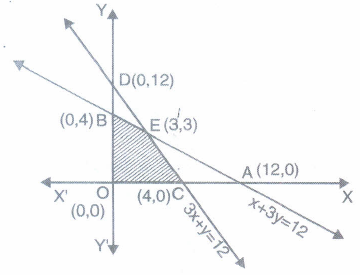
The corner points are A (4, 0), B (3, 3), and C (0, 4).
The values of Z at these corner points are as follows.
| Corner point | Z = 17.5x + 7y | |
| O(0, 0) | 0 | |
| A(4, 0) | 70 | |
| B(3, 3) | 73.5 | → Maximum |
| C(0, 4) | 28 |
The maximum value of Z is Rs. 73.50 at (3, 3).
Thus, 3 packages of nuts and 3 packages of bolts should be produced each day to get the maximum profit of Rs. 73.50.
14.
Let 'x' and 'y' the number of packets of food P and Q respectively.
We have: \(x\ge 0\) ...(1)
\(y\ge 0\) ....(2)
\(12x+3y\ge 240\quad i.e.4x+y\ge 80\) .....(3)
\(4x+20y\ge 460\quad i.e.x+5y\ge 115\) .....(4)
\(6x+4y\le 300\quad i.e.3x+2y\le 150\) .....(5)
The mathematical problem is as below:
Minimize Z=6x+3y subject to (1)-(5)
Draw the lines
x = 0, 4x + y = 80, x + 5y = 80, x + 5y = 115 and 3x + 2y = 150.
The lines 3x + 2y = 150 and 4x + y = 80 meet at L (2, 72)
The lines 4x + y = 80 and x + 3y = 115 meet at M (15, 20)
The lines 3x + 2y = 150 and x + 5y = 115 meet at N(40,15).
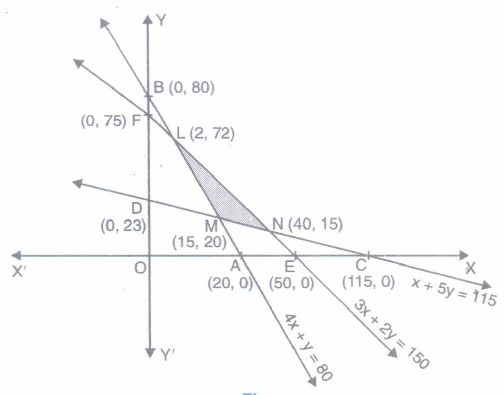
The shaded portion represents the feasible region, which is bounded.
Apply Corner Point Method, we have:
| Corner Point | Z = 6x + 3y |
| L : (2,72) | 228 |
| M : (15,20) | 150 (Maximum) |
| N : (40,15) | 285 |
Hence, minimum amount of vitamin A = 150 units.
15.
The given ellipse is \(\frac { { x }^{ 2 } }{ 16 } +\frac { { y }^{ 2 } }{ 9 } =1\)
Since (1) is symmetrical about both axes,
Therefore, area of the ellipse = 4 (Shaped area).
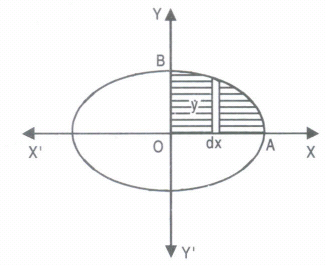
\(=4(area\ OAB)\)
\(But\ area\ OAB=\overset { 4 }{ \underset { 0 }{ \int { } } } ydx\quad [Taking\ vertical\ strips]\)
\(=\overset { 4 }{ \underset { 0 }{ \int { } } } \frac { 3 }{ 4 } \sqrt { 16-{ x }^{ 2 } } dx\)
\([\because \frac { { x }^{ 2 } }{ 16 } +\frac { { y }^{ 2 } }{ 9 } =1\Rightarrow \frac { { y }^{ 2 } }{ 9 } =1-\frac { { x }^{ 2 } }{ 16 } \Rightarrow y=\frac { 3 }{ 4 } \sqrt { 16-{ x }^{ 2 } } (\because y>0)]\)
\(=\frac { 3 }{ 4 } \left[ \frac { x\sqrt { 16-{ x }^{ 2 } } }{ 2 } +\frac { 16 }{ 2 } { sin }^{ -1 }\frac { x }{ 4 } \right] _{ 0 }^{ 4 }\)
\(=\frac { 3 }{ 4 } [[2(0)+8{ sin }^{ -1 }(1)]-[0-0]]\)
\(=\frac { 3 }{ 4 } \left[ 8\frac { \pi }{ 2 } \right] =3\pi \)
\(\therefore From\ (2),area\ of\ the\ ellipse =4(3\pi )=12\pi sq.units.\)
16.
(A) is the correct answer.
Reason: Since A and B are symmetric matrices,
\(\therefore \ A\prime =A\quad and\quad B\prime =B ...(1)\)
\(Now\ (AB-BA)\prime =(AB)\prime -(BA)\prime \)
\(=B\prime A\prime -A\prime B\prime\)
\(=BA-AB\)
\(=-(AB-BA)\)
\(\Rightarrow (AB-BA)\) is skew-symmetric.
17.
Let y=tan(2x+3)=tan t, where t=2x+3
\(\frac { dy }{ dt } ={ sec }^{ 2 }\ t\ and\ \)
\(\frac { dt }{ dx } =2(1)+0=2.\)
\(By\quad chain\quad rule,\frac { dy }{ dx } =\frac { dy }{ dt } .\frac { dt }{ dx } \)
\(={ sec }^{ 2 }\ t.2\)
\(=2 { sec }^{ 2 }(2x+3)\)
18.
\(\left| \begin{matrix} x & { x }^{ 2 } & yz \\ y & { y }^{ 2 } & zx \\ z & { z }^{ 2 } & xy \end{matrix} \right| \)
= \(\left| \begin{matrix} x-y & { x }^{ 2 }-y^2 & yz-zx \\ y-z & { y }^{ 2 }-z^2 & zx-xy \\ z & { z }^{ 2 } & xy \end{matrix} \right| \)
[Operating R\(\rightarrow\)R1-R2 & R\(\rightarrow\)R2-R3] =
\(\left| \begin{matrix} x-y & (x-y)(x+y) & z(y-x) \\ y-z &(y-z)(y+z)& x(z-y)\\ z & { z }^{ 2 } & xy \end{matrix} \right| \)
= \((x-y)(y-z)\left| \begin{matrix}0 &x-z&-z+x \\ 1 & y+z &-x \\ z & { z }^{ 2 } & xy \end{matrix} \right| \)
[Taking (z-x)common from R1]
\((x-y)(y-z)(z-x)\left| \begin{matrix} 0 &-1 & -1 \\ 1 & y+z & -x \\ z & z^2 & xy \end{matrix} \right| \)
\((x-y)(y-z)(z-x)\left| \begin{matrix} 0 & 0 & -1 \\ 1 & x+y+z & -x \\ z & z^2-xy & xy \end{matrix} \right| \)
\((x-y)(y-z)(z-x)(-1)\left| \begin{matrix} 1 & x+y+z \\z &z^2-xy\end{matrix} \right| \)
= (x-y) (y-z) (z-x) (-1) [z2-xy-zx-yz-z2]
= (x-y) (y-z) (z-x) (1) (-xy-yz-zx)
= (x-y) (y-z) (z-x) (xy+yz+zx)
19.
Let sin-1 x = \(\theta\) then sin-1 x = \(\theta\). we have
sin-1 \((2x\sqrt { 1-{ x }^{ 2 } } )\) = sin-1\(2\sin { \theta } \sqrt { 1-{ sin }^{ 2 } } \)
= sin–1 (2sinθ cosθ) = sin–1 (sin2θ) = 2θ = 2 sin–1 x
20.
\(={112\over3}\)
21.
We have: \(\frac { dy }{ dx } +\frac { { y }^{ 2 }+y+1 }{ { x }^{ 2 }+x+1 } =0\)
\(\Rightarrow \frac { dy }{ { y }^{ 2 }+y+1 } +\frac { dx }{ { x }^{ 2 }+x+1 } =0\) |Variables Separable
Integrating, \(\int { \frac { dy }{ { y }^{ 2 }+y+1 } } +\int { \frac { dx }{ { x }^{ 2 }+x+1 } = } \) Constant
\(\Rightarrow \int { \frac { dy }{ \left( { y }^{ 2 }+y+\frac { 1 }{ 4 } \right) +\frac { 3 }{ 4 } } } +\int { \frac { dx }{ \left( { x }^{ 2 }+x+\frac { 1 }{ 4 } \right) +\frac { 3 }{ 4 } } } =\) Constant
\(\Rightarrow \int { \frac { dy }{ { \left( \frac { \sqrt { 3 } }{ 2 } \right) }^{ 2 }+{ \left( y+\frac { 1 }{ 2 } \right) }^{ 2 } } } \)\(+\int { \frac { dx }{ { \left( \frac { \sqrt { 3 } }{ 2 } \right) }^{ 2 }+{ \left( x+\frac { 1 }{ 2 } \right) }^{ 2 } } } =\) Constant
\(\Rightarrow \frac { 1 }{ \frac { \sqrt { 3 } }{ 2 } } { tan }^{ -1 }\frac { y+\frac { 1 }{ 2 } }{ \frac { \sqrt { 3 } }{ 2 } } +\frac { 1 }{ \frac { \sqrt { 3 } }{ 2 } } { tan }^{ -1 }\frac { x+\frac { 1 }{ 2 } }{ \frac { \sqrt { 3 } }{ 2 } } =\frac { 1 }{ \frac { \sqrt { 3 } }{ 2 } } { tan }^{ -1 }A\)
\(\Rightarrow { tan }^{ -1 }\frac { 2y+1 }{ \sqrt { 3 } } +{ tan }^{ -1 }\frac { \left( 2x+1 \right) }{ \sqrt { 3 } } ={ tan }^{ -1 }A\)
\({ tan }^{ -1 }\frac { \frac { 2y+1 }{ \sqrt { 3 } } +\frac { 2x+1 }{ \sqrt { 3 } } }{ 1-\left( \frac { 2y+1 }{ \sqrt { 3 } } \right) \left( \frac { 2x+1 }{ \sqrt { 3 } } \right) } { tan }^{ -1 }A'\)
\(\Rightarrow \frac { \left( 2y+1 \right) +\left( 2x+1 \right) }{ \left[ 3-\left( 2x+2y+4xy+1 \right) \right] } =\sqrt { 3 } A'\)
\(=2\left( x+y+1 \right) =A\left( 2-2x-2y-4xy \right) ,\)
where \(\sqrt { 3 } A'=A\)
\(\Rightarrow x+y+1=A\left( 1-x-y-2xy \right) ,\)
which is true.
22.
\(y = \frac {{x}^{3}}{4}-\frac {2}{x}\)
23.
(I + A)2-3A = I
Alternative Mwthod:
Given A2 = A,
(I+A)2-3A = I2 + 2IA + A2-3A
= I + 2A + A - 3A = I
24.
Given, \(\left| a\right| =\left| b \right| \)
and a.b \(=\frac{1}{2}\)
Let \(\theta \) be thae angle between \(\overrightarrow a\) and \(\overrightarrow b\)
then, \(\cos \theta=\frac{a.b}{\left| a\right| \left| b \right| }\)
\(\cos 60^{ \circ }=\frac{\frac{1}{2}}{\left| \overrightarrow { a } \right| .\left| \overrightarrow { a} \right| }\)
\(\Rightarrow \frac{1}{2}=\frac{\frac{1}{2}}{\left| \overrightarrow { a } \right|^{ 2} }\)
\(\Rightarrow \left| \overrightarrow { a } \right| ^{2 }=\frac{\frac{1}{2}}{\frac{1}{2}}=1\)
\(\Rightarrow \left| \overrightarrow { a} \right| =1 \)
\(\Rightarrow\left| \overrightarrow { a} \right| =\left| \overrightarrow { b} \right| =1\)
25.
We have, y = \(log\left( tanx\frac { x }{ 2 } \right) \)
\(\frac { dy }{ dx } =\frac { 1 }{ \frac { tanx }{ 2 } } \times { sec }^{ 2 }\frac { x }{ 2 } \times \frac { 1 }{ 2 } \)
\(\Rightarrow \frac { dy }{ dx } =\frac { \frac { cosx }{ 2 } }{ \frac { sinx }{ 2 } } \times \frac { 1 }{ { cos }^{ 2 }\frac { x }{ 2 } } \times \frac { 1 }{ 2 } \)
\(=\frac { 1 }{ 2sin\frac { x }{ 2 } cos\frac { x }{ 2 } } =\frac { 1 }{ sinx } \)
\(\Rightarrow \frac { dy }{ dx } =cosecx\)
26.
Given equation
x = ay + b, Z = cy + d
\(\frac { x-b }{ a } =y,\frac { x-d }{ c } =y\)
\(\Rightarrow \frac { x-b }{ z } =\frac { y-0 }{ 1 } =\frac { z-d }{ c } \)
Direction ratios are (a, 1, c) and a point on the given line is (b, 0, d).
27.
\(P(\bar { A } /\bar { B } )=\frac { P(\bar { A } \cap \bar { B } ) }{ P(\bar { B } ) } \)
\(=\frac { 1-P(A\cup B) }{ 1-P(B) } \)
\(=\frac { 1-[P(A)+P(B)-P(A\cap B)] }{ 1-P(B) } \)
\(=\frac { 7 }{ 10 } \)
28.
\(xdy=\left( \frac { y+1 }{ y } \right) dx\)
\(\Rightarrow \frac { ydy }{ y+1 } =\frac { dx }{ x } \)
Integrating both the sides,
\(\int { \frac { y }{ y+1 } } dy=\int { \frac { dx }{ x } } \)
\(\Rightarrow \int { \frac { y+1-1 }{ y+1 } } dy=\int { \frac { dx }{ x } } \)
\(\Rightarrow \int { dy } -\int { \frac { dy }{ y+1 } } =\int { \frac { dx }{ x } } \)
\(\Rightarrow y-\log { \left( y+1 \right) } =\log { x } +C\)
29.
\(\int { { e }^{ x } } tan^{ -1 }xdx+\int { \frac { { e }^{ x } }{ 1+{ x }^{ 2 } } } dx\)
\(={ tan }^{ -1 }x\int { { e }^{ x } } dx-\int { \left( \frac { d }{ dx } { tan }^{ -1 }x\int { { e }^{ x }dx } \right) } dx+\int { \frac { { e }^{ x } }{ 1+{ x }^{ 2 } } } dx\)
\(={ e }^{ x }{ tan }^{ -1 }x-\int { \frac { 1 }{ 1+{ x }^{ 2 } } \times } { e }^{ x }dx+\int { \frac { { e }^{ x } }{ 1+{ x }^{ 2 } } } \)
\(={ e }^{ x }{ tan }^{ -1 }x+C\)
30.
\(f(x)=x^{ 2 }+1,g(x)=2x+1\)
\(fog=f[(g(x)\} =f(2x+1)\)
\(=4x^{ 2 }+4x+1+1\)
\(=4x^{ 2 }+4x+2\)
\(gof=g(f(x)=g(x^{ 2 }+1)\)
\(=2(x^{ 2 }+1)+1\)
\(=2x^{ 2 }+2+1\)
\(=2x^{ 2 }+3\)
31.
\(R.H.S.=2{ sin }^{ -1 }\sqrt { \frac { 1-x }{ 2 } } \quad \quad \begin{cases} Let\quad x=cos\theta \\ \Rightarrow \theta ={ cos }^{ -1 }x \end{cases}\)
\(=2{ sin }^{ -1 }\left( \sqrt { \frac { 1-cos\theta }{ 2 } } \right) \)
\( \begin{cases} as\quad cos\theta =1=2{ sin }^{ 2 }\frac { \theta }{ 2 } \\ \Rightarrow 1-cos\theta =2sin^{ 2 }\frac { \theta }{ 2 } \end{cases}\)
\(=2{ sin }^{ -1 }\left( sin\frac { \theta }{ 2 } \right) \)
\(=2\left( \frac { \theta }{ 2 } \right) =\theta ={ cos }^{ -1 }x\)
L.H.S = R.H.S
32.
We have, \(A=\left[ \begin{matrix} 0 & a & b \\ -a & 0 & c \\ -b & -c & 0 \end{matrix} \right] \)
\({ A }^{ \prime }=\left[ \begin{matrix} 0 & -a & -b \\ a & 0 & -c \\ b & c & 0 \end{matrix} \right] \)
\({ A+A }^{ \prime }=\left[ \begin{matrix} 0 & 0 & 0 \\ 0 & 0 & 0 \\ 0 & 0 & 0 \end{matrix} \right] \)
\(\Rightarrow \frac { 1 }{ 2 } { A+A }^{ \prime }=\frac { 1 }{ 2 } \left[ \begin{matrix} 0 & 0 & 0 \\ 0 & 0 & 0 \\ 0 & 0 & 0 \end{matrix} \right] =0\)
and \({ A-A }^{ \prime }=\left[ \begin{matrix} 0 & 2a & 2b \\ -2a & 0 & 2c \\ -2b & -2c & 0 \end{matrix} \right] \)
\(\Rightarrow \frac { 1 }{ 2 } { A-A }^{ \prime }=\frac { 1 }{ 2 } \left[ \begin{matrix} 0 & 2a & 2b \\ -2a & 0 & 2c \\ -2b & -2c & 0 \end{matrix} \right] \)
\(\Rightarrow A=\left[ \begin{matrix} 0 & a & b \\ -a & 0 & c \\ -b & -c & 0 \end{matrix} \right] \)
33.
We have, \(A=\left| \begin{matrix} 6 & 0 & 1 \\ 0 & 1 & 2 \\ 0 & 0 & 4 \end{matrix} \right| \)
|A| = 6(4-0)-0(0-0)+1(0-0)
|2A| = \(\left| \begin{matrix} 12 & 0 & 2 \\ 0 & 2 & 4 \\ 0 & 0 & 8 \end{matrix} \right| \)
= 12(16-0)-0(0-0)+2(0-0)
= 192
|2A| = 8 x 24 = 8|A|
34.
(a)
\(\frac { 2 }{ 3 } ,\frac { -2 }{ 3 } ,\frac { 1 }{ 3 } \)
35.
(a)
Infinite
36.
(a)
{(x, y): x2 + y2 = 5}
37.
As for y2 = x, 2yy' = 1⇒ y'](1,1) = \(\frac12\)
for x2 = y, y' = 2x ⇒ y'](1,1)= 2
\(\therefore tan\theta =\left| \frac { \frac { 1 }{ 2 } -2 }{ 1+\frac { 1 }{ 2 } .2 } \right| \) \(\Rightarrow tan\theta =\left| \frac { -\frac { 3 }{ 2 } }{ 2 } \right| \)
\(\Rightarrow \theta ={ tan }^{ -1 }\left( \frac { 3 }{ 4 } \right) \) or \({ cot }^{ -1 }\left( \frac { 4 }{ 3 } \right) \)

12th Standard CBSE Syllabus & Materials
12th Standard CBSE
CBSE 12th Computer Science Python Revision Tour I - New Previous year Question Papers Study Material - QB365 Set A
NEW12th Standard CBSE
CBSE 12th Business Studies Planning Important Questions And Answers Study Material - QB365 Set A
NEW12th Standard CBSE
CBSE 12th Business Studies Business Environment Important Questions And Answers Study Material - QB365 Set A
NEW12th Standard CBSE
CBSE 12th Business Studies Principles of Management Important Questions And Answers Study Material - QB365 Set A



CBSE 12th Standard CBSE Subjects
CBSE Standards










