
 100% FREE ACCESS
12th Standard CBSE Syllabus & Materials
12th Standard CBSE
CBSE 12th Economics Government Budget and the Economy Previous year Question Papers Study Material - QB365 Set A
NEW12th Standard CBSE
CBSE 12th Computer Science Interface Python with MySQL - New Previous year Question Papers Study Material - QB365 Set A
NEW12th Standard CBSE
CBSE 12th Computer Science Database Concept - New Previous year Question Papers Study Material - QB365 Set A
NEW12th Standard CBSE
CBSE 12th Computer Science Data Communication - New Previous year Question Papers Study Material - QB365 Set A
NEW12th Standard CBSE
CBSE 12th Computer Science Data Structures - New Previous year Question Papers Study Material - QB365 Set A
NEW12th Standard CBSE
CBSE 12th Computer Science Functions - New Previous year Question Papers Study Material - QB365 Set A

Published on: 15/02/2020
12th Standard CBSE Mathematics Public Model Question Paper IV 2020
Download CBSE Class 12th Standard CBSE Maths question papers, sample papers, important questions, and previous year solved papers in PDF format. Get free study materials, NCERT solutions, and exam preparation resources for Class 12th Standard CBSE Maths
Questions + Answers key
Take MCQ Maths Test
1.
If a \(\neq \)p b\(\neq \)q c\(\neq \)r and \(\left| \begin{matrix} p & b & c \\ a & q & c \\ a & b & r \end{matrix} \right| \) = 0 find the value of \(\frac { p }{ p-a } +\frac { q }{ q-b } +\frac { r }{ r-c } \)
2.
If \(\overrightarrow { a } ,\overrightarrow { b } ,\overrightarrow { c } \) are unit vectors such that \(\overrightarrow { a } .\overrightarrow { b } =\overrightarrow { a } .\overrightarrow { c } =0\) and the angle between \(\overrightarrow { b } \) and \(\overrightarrow { c } \) is \(\frac{\pi}{6}\) , then prove that:
(i) \(\overrightarrow { a } =\pm 2\left( \overrightarrow { b } \times \overrightarrow { c } \right) \)
(ii) \(\left[ \overrightarrow { a } +\overrightarrow { b } ,\overrightarrow { b } +\overrightarrow { c } ,\overrightarrow { c } +\overrightarrow { a } \right] =\pm 1\)
3.
Evaluate : \(\int _{ \frac { \pi }{ 6 } }^{ \frac { \pi }{ 3 } }{ \frac { dx }{ 1+\sqrt { \cot { x } } } } \)
4.
An insurance company insured 2,000 cyclists, 4,000 scooter drivers and 6,000 motorbike drivers. The probability of an accident involving a cyclist, scooter driver and a motorbike driver are 0.01, 0.03 and 0.15 respectively. One of the insured persons meets with an accident. What is the probability that he is a scooter driver?
Which mode of transport would you suggest to a student and why?
5.
Find the point P on the curve \(y^2= 4ax\) which is nearest to the point (11a, 0).
6.
If sin[ cot-1 (x + 1) ] = cos(tan-1x), then find x.
7.
If \(A=\left( \begin{matrix} 1 & 0 & 2 \\ 0 & 2 & 1 \\ 2 & 0 & 3 \end{matrix} \right) \) and A3 - 6A2 + 7A + kI3 = 0, find k.
8.
Differentiate \(log({ x }^{ x }+{ cosec }^{ 2 }x)\) w.r.t.x.
9.
Find x, if \(\left[ x\quad 1 \right] \begin{bmatrix} 1 & 0 \\ -2 & -3 \end{bmatrix}\left[ \begin{matrix} x \\ 3 \end{matrix} \right] =O\)
10.
Solve \(\left( x^{ 2 }-1 \right) +2xy=\frac { 2 }{ { x }^{ 2 }-1 } .\)
11.
A firm can produce three types of cloth; say 'A', 'B' and 'C'. Three kinds of wool are required for it, say red wool, green wool and blue wool. One unit length of type 'A' cloth needs 2 yards of red wool, 2 yards of green wool and 2 yards of blue wool, one unit length of type 'C' cloth needs 5 yards of green wool and 4 yards of blue wool. The firm has only a stock of 8 yards of red wool, 10 yards of green wool and 15 yards of blue wool. It is assumed that the income obtained from one unit of type 'A' cloth is Rs. 3, for type 'B' cloth is Rs. 5 and for type 'C' cloth is Rs. 4 Formulate the problem as a LPP so as to maximize the profit of the firm by using the available materials.
12.
Differentiate the functions with respect to x : \(sin({ x }^{ 2 }+5)\)
13.
Find the area of the region bounded by the curve y2 = x and the lines x = 1 , x = 4 and the x - axis.
14.
Show that the number of equivalence relation in the set {1, 2, 3} containing (1, 2) and (2, 1) is two.
15.
\(If\quad A=\begin{bmatrix} 3 & -2 \\ 4 & -2 \end{bmatrix}\ and\ I=\begin{bmatrix} 1 & 0 \\ 0 & 1 \end{bmatrix},find\ k\ so\ that:{ A }^{ 2 }=kA-2I\)
16.
If A = \(\left| \begin{matrix} 1 & 1 & -2 \\ 2 & 1 & -3 \\ 5 & 4 & -9 \end{matrix} \right| \), find |A|
17.
Find te principal values of the following: \({ cosec }^{ -1 }\left( -\sqrt { 2 } \right) \)
18.
Evaluate the integral: \(\int \sqrt{x^4-1}dx.\)
19.
Draw the rough sketch of \({ y }^{ 2 }+1=x,x\le 2\) and find the area enclosed by the curve and the ordinate at X = 2.
20.
If three consecutive vertices of a parallelogram are (3, - 1, - 1), (5, - 4,0), (2,3, - 2), then the coordinates of the fourth vertex .
21.
If x = \(\theta\)sin\(\theta\), y = \(\theta\)cos\(\theta\) find dy/dx at \(\theta\) = \(\pi/4\)
22.
If P(F) = 0.35 and P(E\(\cup\)F) = 0.85 and E and F are independent events. Find P(E).
23.
Find the direction cosines of the vector joining the points A(1, 2, - 3) and B(- 1, - 2, 1) directed from B to A.
24.
Find the general solution of differential equation \(\frac { dy }{ dx } ={ e }^{ 3x-4y }\)
25.
Write in the simplest form : \(sin\left[ 2{ tan }^{ -1 }\sqrt { \frac { 1-x }{ 1+x } } \right] \)
26.
\(\int { tan^{ -1 } } \sqrt { \frac { 1-cos2x }{ 1+cos2x } } dx\)
27.
If \(A=\left| \begin{matrix} 6 & 0 & 1 \\ 0 & 1 & 2 \\ 0 & 0 & 4 \end{matrix} \right| \), then show that |2A| = 8|A|:
28.
Solve the matrix equation \(\left[ \begin{matrix} { x }^{ 2 } \\ { y }^{ 2 } \end{matrix} \right] -3\left[ \begin{matrix} x \\ 2y \end{matrix} \right] =\left[ \begin{matrix} -2 \\ -9 \end{matrix} \right] \)
29.
If \(\left[ \begin{matrix} xy & 4 \\ z+6 & x+y \end{matrix} \right] =\left[ \begin{matrix} 8 & w \\ 0 & 6 \end{matrix} \right] \), write the value of x + y + z.
30.
The area enclosed between the lines x = 2 and x = 7 is
Infinite
7 units
5 units
2 units
31.
The planes: 2x – y + 4z = 5 and 5x – 2.5y + 10z = 6 are
Perpendicular
Parallel
intersect y-axis
passes through \((0,0,\frac{5}{4})\)
32.
Given triangles with sides T1 : 3, 4, 5; T2 : 5, 12, 13; T3 : 6, 8, 10; T4 : 4, 7, 9 and a relation R in set of triangles defined as R = {(Δ1, Δ2) : Δ1 is similar to Δ2}. Which triangles belong to the same equivalence class?
T1 and T2
T2 and T3
T1 and T3
T1 and T4
1.
0
2.
As given \(\overrightarrow { a } .\overrightarrow { b } =\overrightarrow { a } .\overrightarrow { c } =0=\overrightarrow { a } \bot \)both \(\overrightarrow { b } \) and \(\overrightarrow { c } \)
⇒ \(\overrightarrow { a } \parallel \left( \overrightarrow { b } \times \overrightarrow { c } \right) \)
Let \(\overrightarrow { a } =\lambda \left( \overrightarrow { b } \times \overrightarrow { c } \right) \)
then \(\left| \overrightarrow { a } \right| =\left| \lambda \right| \left| \left( \overrightarrow { b } \times \overrightarrow { c } \right) \right| \)
⇒ \(\frac { \left| \overrightarrow { a } \right| }{ \left| \left( \overrightarrow { b } \times \overrightarrow { c } \right) \right| } =\left| \lambda \right| \)
⇒ \(\left| \lambda \right| =\frac { 1 }{ sin\frac { \pi }{ 6 } } =2\)
λ = 士2
\(\overrightarrow { a } =\pm 2\left( \overrightarrow { b } \times \overrightarrow { c } \right) \)
Hence proved
(ii) Now \(\left[ \overrightarrow { a } +\overrightarrow { b } ,\overrightarrow { b } +\overrightarrow { c } ,\overrightarrow { c } +\overrightarrow { a } \right] \)
= \(\left[ \left( \overrightarrow { a } +\overrightarrow { b } \right) \times \left( \overrightarrow { b } \times \overrightarrow { c } \right) \right] .\left( \overrightarrow { c } +\overrightarrow { a } \right) \)
= \(\left( \overrightarrow { a } \times \overrightarrow { b } \right) .\overrightarrow { c } +\left( \overrightarrow { b } \times \overrightarrow { c } \right) .\overrightarrow { a } \)
(As the scalar triple product = 0, if any two vectors are equal)
Hence, \(\overrightarrow { a } .\left( \overrightarrow { b } \times \overrightarrow { c } \right) +\left( \overrightarrow { a } \times \overrightarrow { b } \right) .\overrightarrow { c } \) = \(\overrightarrow { a } .\left( \overrightarrow { b } \times \overrightarrow { c } \right) +\overrightarrow { c } \left( \overrightarrow { b } \times \overrightarrow { c } \right) \)
= 2\(\overrightarrow { a } \left( \overrightarrow { b } \times \overrightarrow { c } \right) \)
= \(2\overrightarrow { a } \left( \pm \frac { 1 }{ 2 } \overrightarrow { a } \right) \)
= 士1
Hence proved
3.
\(I=\int _{ \frac { \pi }{ 6 } }^{ \frac { \pi }{ 3 } }{ \frac { dx }{ 1+\sqrt { \cot { x } } } } \)
\(=\int _{ \frac { \pi }{ 6 } }^{ \frac { \pi }{ 3 } }{ \frac { \sqrt { \sin { x } } }{ \sqrt { \sin { x } } +\sqrt { \cos { x } } } } dx\)
Apply property \(\int _{ a }^{ b }{ f\left( x \right) } =\int _{ a }^{ b }{ f\left( a+b-x \right) } \)
\(=\int _{ \frac { \pi }{ 6 } }^{ \frac { \pi }{ 3 } }{ \frac { \sqrt { \sin { \frac { \pi }{ 3 } +\frac { \pi }{ 6 } -x } } }{ \sqrt { \sin { \frac { \pi }{ 3 } +\frac { \pi }{ 6 } -x } } +\sqrt { \cos { \frac { \pi }{ 3 } +\frac { \pi }{ 6 } -x } } } } dx\)
\(\therefore I=\int _{ \frac { \pi }{ 6 } }^{ \frac { \pi }{ 3 } }{ \frac { \sqrt { \cos { x } } }{ \sqrt { \cos { x } } +\sqrt { \sin { x } } } } dx\)
Adding, we get \(2I=\int _{ \frac { \pi }{ 6 } }^{ \frac { \pi }{ 3 } }{ dx } =\left[ x \right] _{ \frac { \pi }{ 6 } }^{ \frac { \pi }{ 3 } }\)
4.
Let the events defined are :
E1: Person chosen is a cyclist
E2: Person chosen is a scooter driver
E3: Person chosen is a motorbike driver
A:Person meets with an accident
P(E1_= 1/6, P(E2) = 1/3, P(E3) = 1/2
P(A/E1) = 0.01, P(A/E2) = 0.03,
P(A/E3) = 0.15
\(P{ (E }_{ 2 }/A)=\frac { P({ E }_{ 2 }).P(A/{ E }_{ 2 }) }{ P({ E }_{ 1 }).P(A/{ E }_{ 1 })+P({ E }_{ 2 }).P(A/{ E }_{ 2 })+P({ E }_{ 3 }).P(A/{ E }_{ 3) } } \)
\(=\frac { \frac { 1 }{ 3 } \times 0.03 }{ \frac { 1 }{ 6 } \times 0.01+\frac { 1 }{ 3 } \times 0.03+\frac { 1 }{ 2 } \times 0.15 } \)
\(=\frac { 0.01 }{ 0.086 } \)
= 0.11627
Suggestion: Cycle should be promoted as it is:
(i) Good for health
(ii) Pollution free
(iii) Saves energy (no petrol).
5.
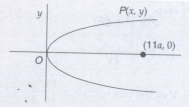
Let P(x, y) be the nearest point
\(\therefore \ D=\sqrt{(x-11a)^2+y^2}\)
\(S=(x-11a)^2+y^2=(x-11a)^2+4ax\)
\(\frac{dS}{dx}=2(x-11a)+4a\)
\(\frac{dS}{dx}=0\Rightarrow x=9a\)
\(\therefore\ y=pm6a\)
\(\Rightarrow\ \frac{d^2S}{dx^2}=2>0\)
For minimum distance, coordinates are \(p(9a,\pm6a)\)
6.
Given that sin[ cot -1(x + 1)] = cos(tan-1x)....(i)
We know that,
\({ cot }^{ -1 }(A)={ sin }^{ -1 }\frac { 1 }{ \sqrt { 1+{ A }^{ 2 } } } \)
Here, A = x + 1
Applying this identity in equation (i), we have
\(sin\left[ { sin }^{ -1 }\frac { 1 }{ \sqrt { 1+(1+{ x) }^{ 2 } } } \right] =cos({ tan }^{ -1 }x)\) ...(ii)
Also, we know that
\({ tan }^{ -1 }A={ cos }^{ -1 }\frac { 1 }{ \sqrt { 1+{ A }^{ 2 } } } \)
Here, A = x
Applying this identity in equation (ii), we have
\(sin\left[ { sin }^{ -1 }\frac { 1 }{ \sqrt { 1+(1+{ x) }^{ 2 } } } \right] =cos\left( { cos }^{ -1 }\frac { 1 }{ \sqrt { 1+{ x }^{ 2 } } } \right) \)
\(\Rightarrow \frac { 1 }{ \sqrt { 1+(1+{ x) }^{ 2 } } } =\frac { 1 }{ \sqrt { 1+{ x }^{ 2 } } } \)
\(\left[ \because { sin }^{ -1 }(sin\theta )=\theta \in \left( -\frac { \pi }{ 2 } ,\frac { \pi }{ 2 } \right) \right] \)
and cos-1 (cos \(\theta \)) = \(\theta \) \(\forall \theta \) [0, \(\pi \)]]
Squaring and Reciprocating both side, we have
1+(1 + x)2 = 1 + x2
\(\Rightarrow\) 1 + 1 + x2 + 2x = 1 + x2
\(\Rightarrow\) 1 + 2x = 0
\(\Rightarrow\) \(x=-\frac { 1 }{ 2 } \quad \)
7.
For getting A2 = \(\left( \begin{matrix} 5 & 0 & 8 \\ 2 & 4 & 5 \\ 8 & 0 & 13 \end{matrix} \right) \)
For getting A3 = \(\left( \begin{matrix} 21 & 0 & 34 \\ 12 & 8 & 23 \\ 34 & 0 & 55 \end{matrix} \right) \)
Simplifying A3 - 6A2 + 7A + kI3 as
\(\left( \begin{matrix} k-2 & 0 & 0 \\ 0 & k-2 & 0 \\ 0 & 0 & k-2 \end{matrix} \right) \)
Equating \(\left( \begin{matrix} k-2 & 0 & 0 \\ 0 & k-2 & 0 \\ 0 & 0 & k-2 \end{matrix} \right) \)
\(=\left( \begin{matrix} 0 & 0 & 0 \\ 0 & 0 & 0 \\ 0 & 0 & 0 \end{matrix} \right) \)
\(\Rightarrow\) k - 2 = 0
\(\Rightarrow\) k = 2
Alternative Method :
\(A=\left[ \begin{matrix} 1 & 0 & 2 \\ 0 & 2 & 1 \\ 2 & 0 & 3 \end{matrix} \right] \)
\({ A }^{ 2 }=\left[ \begin{matrix} 1 & 0 & 2 \\ 0 & 2 & 1 \\ 2 & 0 & 3 \end{matrix} \right] \times \left[ \begin{matrix} 1 & 0 & 2 \\ 0 & 2 & 1 \\ 2 & 0 & 3 \end{matrix} \right] \)
\(=\left[ \begin{matrix} 1+0+4 & 0+0+0 & 2+0+6 \\ 0+0+2 & 0+4+0 & 0+2+3 \\ 2+0+6 & 0+0+0 & 4+0+9 \end{matrix} \right] \)
\(=\left[ \begin{matrix} 5 & 0 & 8 \\ 2 & 4 & 5 \\ 8 & 0 & 13 \end{matrix} \right] \)
A3 = A2 . A = \(\left[ \begin{matrix} 5 & 0 & 8 \\ 2 & 4 & 5 \\ 8 & 0 & 13 \end{matrix} \right] \left[ \begin{matrix} 1 & 0 & 2 \\ 0 & 2 & 1 \\ 2 & 0 & 3 \end{matrix} \right] \)
\(=\left[ \begin{matrix} 21 & 0 & 34 \\ 12 & 8 & 23 \\ 34 & 0 & 55 \end{matrix} \right] \)
Now A3 - 6A2 + 7A + kP3 = 0
\(\Rightarrow \left[ \begin{matrix} 21 & 0 & 34 \\ 12 & 8 & 23 \\ 34 & 0 & 55 \end{matrix} \right] -\left[ \begin{matrix} 30 & 0 & 48 \\ 12 & 24 & 30 \\ 48 & 0 & 78 \end{matrix} \right] +\left[ \begin{matrix} 7 & 0 & 14 \\ 0 & 14 & 7 \\ 14 & 0 & 21 \end{matrix} \right] +\left[ \begin{matrix} k & 0 & 0 \\ 0 & k & 0 \\ 0 & 0 & k \end{matrix} \right] \)
\(=\left[ \begin{matrix} 0 & 0 & 0 \\ 0 & 0 & 0 \\ 0 & 0 & 0 \end{matrix} \right] \)
\(\Rightarrow\) 21 - 30 + 7 + k = 0
\(\Rightarrow\) k = 2
8.
Let y=\(log({ x }^{ x }+{ cosec }^{ 2 }x)\)
\(\frac { dy }{ dx } =\frac { 1 }{ { x }^{ x }+{ cosec }^{ 2 }x } \frac { d }{ dx } ({ x }^{ x }+{ cosec }^{ 2 }x)\)
\(=\frac { 1 }{ { x }^{ x }+{ cosec }^{ 2 }x } \left[ { x }^{ x }(1+log\quad x)+2cosec\quad x(-cosec\quad x\quad cot\quad x) \right] \)
\(=\frac { 1 }{ { x }^{ x }+{ cosec }^{ 2 }x } \left[ { x }^{ x }(1+log\quad x)-2cot\quad x{ cosec }^{ 2 }x \right] \)
9.
\({\left[\begin{array}{ll} x-2 & -3 \end{array}\right]\left[\begin{array}{l} x \\ 3 \end{array}\right]=0} \)
\(\Rightarrow\left[x^{2}-2 x-9\right]=[0] \Rightarrow x^{2}-2 x-9=0 \)
\(x=\frac { 2\pm \sqrt { 4+36 } }{ 2 } =1\pm \sqrt { 10 } \)
10.
The given equation is:
\(\left( x^{ 2 }-1 \right) +2xy=\frac { 2 }{ { x }^{ 2 }-1 } \)
\(\Rightarrow \) \(\frac { dy }{ dx } +\frac { 2x }{ { x }^{ 2 }-1 } y=\frac { 2 }{ { \left( { x }^{ 2 }-1 \right) }^{ 2 } } \) ..(1)
| Linear Equation
Comparing with \(\frac { dy }{ dx } +Py=Q,\)we have:
\('P'=\frac { 2x }{ { x }^{ 2 }-1 } \)
\('Q'=\frac { 2 }{ { \left( { x }^{ 2 }-1 \right) }^{ 2 }. } \)
\(\therefore \) \(\int { Pdx } =\int { \frac { 2x }{ { x }^{ 2 }-1 } } dx=log|{ x }^{ 2 }-1|\)
\(\therefore \) I.F. \(={ e }^{ \int { Pdx } }={ e }^{ log|{ x }^{ 2 }-1| }={ x }^{ 2 }-1.\)
Multiplying (1) by \(\left( { x }^{ 2 }-1 \right) ,\) we get:
\(\left( { x }^{ 2 }-1 \right) \frac { dy }{ dx } +2xy=\frac { 2 }{ { x }^{ 2 }-1 } \)
\(\Rightarrow \) \(\frac { d }{ dx } \left( y\left( { x }^{ 2 }-1 \right) \right) =\frac { 2 }{ { x }^{ 2 }-1 } \)
Integrating, \(y\left( { x }^{ 2 }-1 \right) =2\int { \frac { 1 }{ { x }^{ 2 }-1 } } dx+c\)
\(\Rightarrow \) \(y\left( { x }^{ 2 }-1 \right) =\frac { 2 }{ 2\left( 1 \right) } log|\frac { x-1 }{ x+1 } |+c,\)
\(\Rightarrow \) \(y\left( { x }^{ 2 }-1 \right) =log|\frac { x-1 }{ x+1 } |+c,\)
which is the required solution
11.
Maximize P = 3x + 4y + 5z subject to:
\(2x+3y \le 8,2y+5z\le 10,3x+2y+4z\le 15,x\ge 0,y\ge 0,z\ge 0.\)
12.
\(Let\quad y=sin({ x }^{ 2 }+5)\)
\(Put\quad { x }^{ 2 }+5=t\)
\(y=sin\quad t,\quad where\quad t={ x }^{ 2 }+5\)
\( \frac { dy }{ dx } =\frac { dy }{ dt } .\frac { dt }{ dx } \)
\(=cos\quad t.\quad (2x+0)=2xcos({ x }^{ 2 }+5)\)
13.
The area of the region bounded by the curve, y2 = x, the lines, x = 1 and x = 4, and the x-axis is the area ABCD.
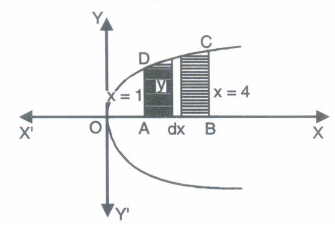
\(\text { Area of } \mathrm{ABCD} =\int^{1} y d x \)
\(=\int^{4} \sqrt{x} d x \)
\(=\left[\frac{x^{\frac{3}{2}}}{\frac{3}{2}}\right]_{1}^{4} \)
\(=\frac{2}{3}\left[(4)^{\frac{3}{2}}-(1)^{\frac{3}{2}}\right] \)
\(=\frac{2}{3}[8-1] \)
\(=\frac{14}{3} \text { units }
\)
14.
The smallest equivalence relation R1 containing (1, 2) and (2, 1) is {(1, 1), (2, 2), (3, 3), (1, 2), (2, 1)}. Now we are left with only 4 pairs namely (2, 3), (3, 2), (1, 3) and (3, 1). If we add any one, say (2, 3) to R1 , then for symmetry we must add (3, 2) also and now for transitivity we are forced to add (1, 3) and (3, 1). Thus, the only equivalence relation bigger than R1 is the universal relation. This shows that the total number of equivalence relations containing (1, 2) and (2, 1) is two
15.
\({ A }^{ 2 }=AA=\begin{bmatrix} 3 & -2 \\ 4 & -2 \end{bmatrix}\begin{bmatrix} 3 & -2 \\ 4 & -2 \end{bmatrix}\)
\(=\begin{bmatrix} 3\times 3+(-2)\times 4 & 3\times (-2)+(-2)\times (-2) \\ 4\times 3+(-2)\times 4 & 4\times (-2)+(-2)\times (-2) \end{bmatrix}\)
\(=\begin{bmatrix} 9-8 & -6+4 \\ 12-8 & -8+4 \end{bmatrix}=\begin{bmatrix} 1 & -2 \\ 4 & -4 \end{bmatrix}.\)
\(Now { A }^{ 2 }=kA-2I\)
\(\Rightarrow \begin{bmatrix} 1 & -2 \\ 4 & -4 \end{bmatrix}=k\begin{bmatrix} 3 & -2 \\ 4 & -2 \end{bmatrix}-2\begin{bmatrix} 1 & 0 \\ 0 & 1 \end{bmatrix}\)
\(\Rightarrow \begin{bmatrix} 1 & -2 \\ 4 & -4 \end{bmatrix}=\begin{bmatrix} 3k & -2k \\ 4k & -2k \end{bmatrix}+\begin{bmatrix} -2 & 0 \\ 0 & -2 \end{bmatrix}\)
\(=\begin{bmatrix} 3k-2 & -2k \\ 4k & -2k-2 \end{bmatrix}.\)
Equating corresponding elements:
1 = 3k-2
\(\Rightarrow \)3k = 3\(\Rightarrow \) k = 1
-2 = -2k \(\Rightarrow \) k = 1
4 = 4k \(\Rightarrow \) k = 1
-4 = -2k - 2 \(\Rightarrow \) -2k = 4 - 2 = 2 \(\Rightarrow \) k = 1.
Hence, k = 1.
16.
|A| = \(\left| \begin{matrix} 1 & 1 & -2 \\ 2 & 1 & -3 \\ 5 & 4 & -9 \end{matrix} \right| \)
= \((1)\left| \begin{matrix} 1 & -3 \\ 4 & -9 \end{matrix} \right| -1\begin{vmatrix} 2 & -3 \\ 5 & -9 \end{vmatrix}-2\begin{vmatrix} 2 & 1 \\ 5 & 4 \end{vmatrix}\)
= 1(-9 + 12) - (-18 + 15) -2 (8 - 5)
= 3 + 3 - 6 = 0
= 6 - 6 = 0
= 0
17.
Let \({ cosec }^{ -1 }\left( -\sqrt { 2 } \right) =y\), where \(y\in \left[ -\frac { \pi }{ 2 } ,\frac { \pi }{ 2 } \right] -\left\{ 0 \right\} \)
\(\Rightarrow cosecy=-\sqrt { 2 } =-cosec\frac { \pi }{ 4 } \)
\(=cosec\left( -\frac { \pi }{ 4 } \right) \)
\(\Rightarrow y=-\frac { \pi }{ 4 } \)
Hence, the required principal value = \(-\frac { \pi }{ 4 } \)
18.
\({1\over4}{[x^2\sqrt{x^4-1}-log |x^2+\sqrt{x^4-1}|]+c}\)
19.
Curve is y2 + 1 = x, curve is symmetrical about the x-axis.
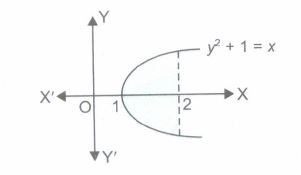
\(\text { Area } =2 \int_{1}^{2} \sqrt{x-1} d x=\frac{4}{3}\left[(x-1)^{3 / 2}\right]_{1}^{2} \)
\(=\frac{4}{3}\left[(2-1)^{3 / 2}-(1-1)^{3 / 2}\right]=\frac{4}{3} \text { sq units }\)
20.
Since ABCD is a parallelogram and diagonal are bisect each other.
Let A(3, - 1, - 1), B(5, - 4, 0), C(2, 3, - 2), \(D(x_{ 2 },y_{ 2 },z_{ 2 })\)
Midpoint of AC \(\left( \frac { 2+3 }{ 2 } ,\frac { 3-1 }{ 2 } .\frac { -2-1 }{ 2 } \right) \)
\(=\left( \frac { 5 }{ 2 } ,\frac { 2 }{ 2 } ,\frac { -3 }{ 2 } \right) \)
\(=\left( \frac { 5 }{ 2 } ,1,\frac { -3 }{ 2 } \right) \)
Mid-point of BD is same let P be the mid-point of ACand BD
\(\frac { 5 }{ 2 } =\frac { 5+x_{ 2 } }{ 2 } ,1=\frac { -4+y_{ 2 } }{ 2 } \)
\(\frac { -3 }{ 2 } =\frac { 0+z_{ 2 } }{ 2 } \)
\(\Rightarrow x_{ 2 }=0,y_{ 2 }=6,z_{ 2 }=-3\)
D(0,6,-3)
21.
\(\frac { dx }{ d\theta } =\theta cos\theta +sin\theta \)
\(\frac { dy }{ d\theta } =-\theta sin\theta +cos\theta \)
\(\frac { dy }{ dx } =\frac { cos\theta -\theta sin\theta }{ \theta cos\theta +sin\theta } \)
dy/dx at \(\theta\)= \(\pi/4\)
\(=\frac { cos\frac { \pi }{ 4 } -\frac { \pi }{ 4 } sin\frac { \pi }{ 4 } }{ \frac { \pi }{ 4 } cos\frac { \pi }{ 4 } +sin\frac { \pi }{ 4 } } \)
\(=\frac { \frac { 1 }{ \sqrt { 2 } } -\frac { \pi }{ 4 } \times \frac { 1 }{ \sqrt { 2 } } }{ \frac { \pi }{ 4 } \times \frac { 1 }{ \sqrt { 2 } } +\frac { 1 }{ \sqrt { 2 } } } \)
=\(\frac { 1-\frac { \pi }{ 4 } }{ \frac { \pi }{ 4 } +1 } \)
\(\Rightarrow\)\(\frac { dy }{ dx } =\frac { 4-\pi }{ 4+\pi } \)
22.
\(P(E\cap F)=P(E)\times P(F)\)
\(P(E\cup F)=P(E)+P(F)-P(E\cap F)\)
\(\Rightarrow P(E\cup F)=P(E)+P(F)-P(E)\times P(F)\)
\(\Rightarrow 0.85=P(E)+0.35-P(E)\times 0.35\)
\(\Rightarrow 0.85=P(E)(1-0.35)+0.35\)
\(\Rightarrow 0.85-0.35=P(E)(0.65)\)
\(\Rightarrow \frac { 0.52 }{ 0.65 } =P(E)\)
\(\Rightarrow P(E)=\frac { 50 }{ 65 } =\frac { 10 }{ 13 } \)
\(\therefore P(F)=1-\frac { 10 }{ 13 } =\frac { 3 }{ 13 } \)
23.
\(\overset\rightarrow {BA}\)= Position vector of A- Position vector of B
\(\overset\rightarrow{BA}=(\overset\wedge i+2\overset\wedge j-3\overset\wedge k)-(-\overset\wedge i-2\overset\wedge j+\overset\wedge k)\)
\(\overset\rightarrow {BA}=2\overset\wedge i+4\overset\wedge j-\overset\wedge k \)
\(\left| \overset\rightarrow {BA}\right| =\sqrt{2^{2}+4^{2}+(-4)^{2}}\)
\(=\sqrt{4+16+16}\)
\(=\sqrt{36}=6 \)
Direction cosines of the vector \(\overset\rightarrow{BA}\) are \((\frac{2}{6},\frac{4}{6},-\frac{4}{6})\)
\(=(\frac{1}{3},\frac{2}{3},-\frac{2}{3})\)
24.
\(\frac { dy }{ dx } ={ e }^{ 3x-4y }\)
\(\frac { dy }{ dx } ={ e }^{ 3x }.{ e }^{ -4y }\)
\(\Rightarrow \frac { dy }{ { e }^{ -4y } } ={ e }^{ 3x }dx\)
integrating both the sides
\(\int { { e }^{ 4y }dy } =\int { { e }^{ 3x }dx } \)
\(\Rightarrow \frac { 1 }{ 4 } { e }^{ 4y }=\frac { 1 }{ 3 } { e }^{ 3y }+C\)
25.
Let x = cos 2\(\theta \)
\(=sin\left[ 2t{ an }^{ -1 }\sqrt { \frac { 1-cos2\theta }{ 1+cos2\theta } } \right] \)
\(=sin\left[ 2tan^{ -1 }\sqrt { \frac { 2{ sin }^{ 2 }\theta }{ 2{ cos }^{ 2 }\theta } } \right] \)
\(\left[ \because cos2\theta =1-2{ sin }^{ 2 }\theta \ and\ cos\ 2\theta =2{ cos }^{ 2 }\theta -1 \right] \)
\(=sin\left[ 2{ tan }^{ -1 }\left( tan\quad \theta \right) \right] \)
\(=sin(2\theta )=\sqrt { 1-{ cos }^{ 2 }2\theta } \)
\(=sin\quad 2\theta =\sqrt { 1-{ x }^{ 2 } } \)
26.
\(\int { tan^{ -1 } } \sqrt { \frac { 1-cos2x }{ 1+cos2x } } dx=\int { tan^{ -1 } } \sqrt { \frac { 2sin^{ 2 }x }{ 2cos^{ 2 }x } } \)
\(=\int { { tan }^{ -1 }(tanx) } dx\)
\(=\int { x } dx\)
\(=\frac { { x }^{ 2 } }{ 2 } +C\)
27.
We have, \(A=\left| \begin{matrix} 6 & 0 & 1 \\ 0 & 1 & 2 \\ 0 & 0 & 4 \end{matrix} \right| \)
|A| = 6(4-0)-0(0-0)+1(0-0)
|2A| = \(\left| \begin{matrix} 12 & 0 & 2 \\ 0 & 2 & 4 \\ 0 & 0 & 8 \end{matrix} \right| \)
= 12(16-0)-0(0-0)+2(0-0)
= 192
|2A| = 8 x 24 = 8|A|
28.
We have, \(\left[ \begin{matrix} { x }^{ 2 } \\ { y }^{ 2 } \end{matrix} \right] -3\left[ \begin{matrix} x \\ 2y \end{matrix} \right] =\left[ \begin{matrix} -2 \\ -9 \end{matrix} \right] \)
\(\Rightarrow\) x2 - 3x = - 2 and y2 - 6y = - 9
\(\Rightarrow\) x2 - 3x + 2 = 0 and y2 - 6y + 9 = 0
\(\Rightarrow\) x2 - 2x - x + 2 = 0 and y2 - 3y - 3y + 9 = 0
\(\Rightarrow\) x(x - 2) - 1(x - 2) = 0 and y(y - 3) - 3(y - 3) = 0
\(\Rightarrow\) (x - 2)(x - 1) = 0 and (y - 3)(y - 3) = 0
\(\therefore\) x = 1, 2 and y = 3, 3
29.
x + y + z = 0
Alternate method :
\(\left[ \begin{matrix} xy & 4 \\ z+6 & x+y \end{matrix} \right] =\left[ \begin{matrix} 8 & w \\ 0 & 6 \end{matrix} \right] \)
By equating z + 6 = 0 and x + y = 6
⇒ z = - 6, x + y = 6
x + y + z = 6 - 6
⇒ x + y + z = 0
30.
(a)
Infinite
31.
(b)
Parallel
32.
T1 and T3 are similar as their sides are proportional.

12th Standard CBSE Syllabus & Materials
12th Standard CBSE
CBSE 12th Computer Science Python Revision Tour I - New Previous year Question Papers Study Material - QB365 Set A
NEW12th Standard CBSE
CBSE 12th Business Studies Planning Important Questions And Answers Study Material - QB365 Set A
NEW12th Standard CBSE
CBSE 12th Business Studies Business Environment Important Questions And Answers Study Material - QB365 Set A
NEW12th Standard CBSE
CBSE 12th Business Studies Principles of Management Important Questions And Answers Study Material - QB365 Set A



CBSE 12th Standard CBSE Subjects
CBSE Standards










