
 100% FREE ACCESS
12th Standard CBSE Syllabus & Materials
12th Standard CBSE
CBSE 12th Economics Government Budget and the Economy Previous year Question Papers Study Material - QB365 Set A
NEW12th Standard CBSE
CBSE 12th Computer Science Interface Python with MySQL - New Previous year Question Papers Study Material - QB365 Set A
NEW12th Standard CBSE
CBSE 12th Computer Science Database Concept - New Previous year Question Papers Study Material - QB365 Set A
NEW12th Standard CBSE
CBSE 12th Computer Science Data Communication - New Previous year Question Papers Study Material - QB365 Set A
NEW12th Standard CBSE
CBSE 12th Computer Science Data Structures - New Previous year Question Papers Study Material - QB365 Set A
NEW12th Standard CBSE
CBSE 12th Computer Science Functions - New Previous year Question Papers Study Material - QB365 Set A

Published on: 15/02/2020
12th Standard CBSE Mathematics Public Model Question Paper V 2020
Download CBSE Class 12th Standard CBSE Maths question papers, sample papers, important questions, and previous year solved papers in PDF format. Get free study materials, NCERT solutions, and exam preparation resources for Class 12th Standard CBSE Maths
Questions + Answers key
Take MCQ Maths Test
1.
If y = \(log\left( tanx\frac { x }{ 2 } \right) find\frac { dy }{ dx } \)
2.
Find the distance between the point (5, ,4, - 6) and its image in xy-plane.
3.
Find \(\left| \overset\rightarrow a\right|\) and \(\left| \overset\rightarrow b\right|\)if \((\overset\rightarrow a+\overset\rightarrow b).(\overset\rightarrow a-\overset\rightarrow b)=8\)and \(\left|\overset\rightarrow a \right| =8\left|\overset\rightarrow b \right|\).
4.
A box contains 50 bolts and 50 nuts. Half of the bolts and nuts are rusted. If two items are drawn with replacement, what is the probability that either both are rusted or both are bolts.
5.
From the differential equation of equation y = a cos2x + b sin2x, where a and b are constant.
6.
Simplify : \({ cot }^{ -1 }\frac { 1 }{ \sqrt { { x }^{ 2 }-1 } } for\quad x<-1\)
7.
\(\int { sin2xcos3xdx } \)
8.
If is \(A=\left[ \begin{matrix} 0 & b & -2 \\ 3 & 1 & 3 \\ 2a & 3 & -1 \end{matrix} \right] \)skew symmetric matrix, find the values of a and b.
9.
Let A be the set of all human beings in a town at a particular time. Determine whether the relation R = {(x, y) : x is wife of y ; x, Y\(\in \)A} is reflexive, symmetric and transitive.
10.
If \(A=\left| \begin{matrix} 6 & 0 & 1 \\ 0 & 1 & 2 \\ 0 & 0 & 4 \end{matrix} \right| \), then show that |2A| = 8|A|:
11.
If \({ X }_{ m\times 3 }{ Y }_{ p\times 4 }={ Z }_{ 2\times b }\), for three matrices X, Y and Z, find the values of m, p and b.
12.
There are two types of fertilizers F1 and F2. F1 consists of 10% nitrogen and 6% phosphoric acid and F2 consists of 5% nitrogen and 10% phosphoric acid. After testing the soil conditions, a farmer finds that she needs at least 14 kg. of nitrogen and 14 kg of phosphoric acid for her crop. If F1 costs Rs. 6/kg and F2 costs Rs. 5/kg, determine how much of each type of fertilizer should be used that nutrient requirement are met at a minimum cost. What is the minimum cost?
13.
Find a particular solution of the differential equation : \(\left( x+1 \right) \frac { dy }{ dx } =2{ e }^{ -y }-1\) given that \(y=0,\)when x = 0
14.
Find the area bounded by y = x, the x - axis and the lines x = -1 and x = 2.
15.
Using elementary transformations, find the inverse of matrix \(\begin{bmatrix} 4 & 5 \\ 3 & 4 \end{bmatrix}.\)
16.
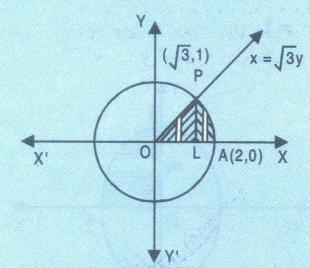
Find the area of the region in the first quadrant enclosed by x - axis and \(x=\sqrt { 3 } y\) by the circle \({ x }^{ 2 }+{ y }^{ 2 }=4\).
17.
\(Differentiate\quad { sin }^{ 2 }x\quad w.r.t.{ \quad e }^{ cosx }\)
18.
Solve the system of linear equations, using matrix method in
2x - y = -2
3x + 4y = 3
19.
Let S = {1,2,3}. Determine whether the functions \(f:S\rightarrow S\) defined below has inverse. Find \(f^{ -1 }\) , if it exists:
(a) f = {(1, 1), (2, 2), (3, 3)}
(b) f = {(1, 2), (2, 1), (3, 1)}
(c) f = {(1, 3), (3, 2), (2, 1)}
20.
Simplify :
\({ tan }^{ -1 }\left( \frac { acosx-bsinx }{ bcos+asinx } \right) \), if \(\frac { a }{ b } tanx>-1\)
21.
Find the length and the foot of the perpendicular from the point P (7, 14, 5) to the plane 2x + 4y - z = 2. Also find the image of point P in the plane.
22.
In answering a question on a multiple choice questions test with four choices per question. A student knows the answer, guesses or copies the answer. If 1/2 be the probability that he knows the answer, 1/4 be the probability that he guesses it and 1/4 that he copies it. Assuming that a student who copies the answer will be correct with the probability 3/4. What is the probability that the students knows the answer given that he answered it correctly? Arjun does not know the answer to one of the question in the test. The evaluation process has negative marking. Which value would Arjun 'violate if he restores to unfair means? How would an act like the above hamper his character development in the coming years?
23.
Show that the differential equation (x - y) \(\frac{dy}{dx}\) = x + 2y is homogeneous and solve it.
24.
Evaluate the integral: \(\int{dx\over\sqrt{2x+1}+\sqrt{2x+2}}.\)
25.
The sum of three numbers is -1. If we multiply the second number by 2 , third number by 3 and add them we get 5. If we subtract the third number from the sum of first and second numbers we get -1. Represent it by a system of equations . Find the three numbers using inverse of a matrix
26.
If \(\overrightarrow { a } ,\overrightarrow { b } ,\overrightarrow { c } \) are unit vectors such that \(\overrightarrow { a } .\overrightarrow { b } =\overrightarrow { a } .\overrightarrow { c } =0\) and the angle between \(\overrightarrow { b } \) and \(\overrightarrow { c } \) is \(\frac{\pi}{6}\) , then prove that:
(i) \(\overrightarrow { a } =\pm 2\left( \overrightarrow { b } \times \overrightarrow { c } \right) \)
(ii) \(\left[ \overrightarrow { a } +\overrightarrow { b } ,\overrightarrow { b } +\overrightarrow { c } ,\overrightarrow { c } +\overrightarrow { a } \right] =\pm 1\)
27.
Does the following trigonometric equation have any solutions? If yes, obtain the solutions (s);
\(tan^{ -1 }\left( \frac { x+1 }{ x-1 } \right) +tan^{ -1 }\left( \frac { x-1 }{ x } \right) =-tan^{ -1 }7\)
28.
Find : \(\int { \frac { \sqrt { x^{ 2 }+1 } \left\{ log({ x }^{ 2 }+1)-2logx \right\} }{ x^{ 4 } } } dx\)
29.
Using properties of determinants, prove that \(\left| \begin{matrix} \frac { { (a+b) }^{ 2 } }{ c } & c & c \\ a & \frac { { (b+c) }^{ 2 } }{ a } & a \\ b & b & \frac { { (c+a) }^{ 2 } }{ b } \end{matrix} \right| =2{ (a+b+c) }^{ 3 }.\)
30.
Show that of all the rectangles inscribed in a given fixed circle, the square has the maximum area.
31.
A man is known to speak the truth 3 out of 5 times. He throws a die and reports that it is 1. Find the probability that it is actually 1.
32.
Solve for \(x:\tan ^{ -1 }{ (x-1) } +\tan ^{ -1 }{ x } +\tan ^{ -1 }{ (x+1) } =\tan ^{ -1 }{ 3x } \)
33.
Verify Rolle's Theorem for the following functions:
f (x)=sin x-sin 2x in \(\left[ 0,2\pi \right] \)
34.
Using approximation find the value of \(y=\sqrt{4.01}\)
2.025
2.001
2.01
2.0025
35.
Distance between planes \(\overrightarrow { r } .(2\widehat { i } +\widehat { j } -2\widehat { k } )+5=0\) and \(\overrightarrow { r } .(6\widehat { i } +3\widehat { j } -6\widehat { k } )+2=0\) is
\(\frac { 9 }{ 13 } \)
\(\frac { 15 }{ 4 } \)
\(\frac { 13 }{ 9 } \)
\(\frac { 1 }{ 13 } \)
36.
Given triangles with sides T1 : 3, 4, 5; T2 : 5, 12, 13; T3 : 6, 8, 10; T4 : 4, 7, 9 and a relation R in set of triangles defined as R = {(Δ1, Δ2) : Δ1 is similar to Δ2}. Which triangles belong to the same equivalence class?
T1 and T2
T2 and T3
T1 and T3
T1 and T4
1.
We have, y = \(log\left( tanx\frac { x }{ 2 } \right) \)
\(\frac { dy }{ dx } =\frac { 1 }{ \frac { tanx }{ 2 } } \times { sec }^{ 2 }\frac { x }{ 2 } \times \frac { 1 }{ 2 } \)
\(\Rightarrow \frac { dy }{ dx } =\frac { \frac { cosx }{ 2 } }{ \frac { sinx }{ 2 } } \times \frac { 1 }{ { cos }^{ 2 }\frac { x }{ 2 } } \times \frac { 1 }{ 2 } \)
\(=\frac { 1 }{ 2sin\frac { x }{ 2 } cos\frac { x }{ 2 } } =\frac { 1 }{ sinx } \)
\(\Rightarrow \frac { dy }{ dx } =cosecx\)
2.
Let A be the point (5, 4, - 6)
Image A' be the point (5, 4, - 6)
\(\therefore\) A'(5, 4, - 6)
Distance between AA'
\(=\sqrt { (5-5)^{ 2 }+(4-4)^{ 2 }+(6+6)^{ 2 } } \)
\(=\sqrt { 0+0+12^{ 2 } } \)
=123 units
3.
\((\overset\rightarrow a+\overset\rightarrow b).(\overset\rightarrow a-\overset\rightarrow b)\)
\(\overset\rightarrow a.\overset\rightarrow a+\overset\rightarrow a.\overset\rightarrow b-\overset\rightarrow b.\overset\rightarrow a-\overset\rightarrow b.\overset\rightarrow b=\left| \overset\rightarrow a \right| ^{ 2}-\left| \overset\rightarrow b \right| ^{ 2}\)
\((\overset\rightarrow a+\overset\rightarrow b).(\overset\rightarrow a-\overset\rightarrow b)=8\left|\overset\rightarrow b \right| ^{ 2 }-\left|\overset\rightarrow b \right| ^{2 }\)
\(=64\left| \overset { \rightarrow }{b } \right| ^{2 }-\left| \overset { \rightarrow }{b } \right| ^{2 }\)
\(=63\left| \overset { \rightarrow }{ b} \right| ^{ 2 }\)
\((\overset\rightarrow a+\overset\rightarrow b).(\overset\rightarrow a-\overset\rightarrow b)=8\)
\(63\left| \overset { \rightarrow }{ b} \right| ^{ 2 }=8\)
\(\left| \overset { \rightarrow }{b } \right| =\sqrt{\frac{8}{63}}=\frac{2\sqrt7}{3\sqrt7}\)
\(\left|\overset\rightarrow a \right| =\frac{8\times 2\sqrt2}{3\sqrt{7}}=\frac{16\sqrt2}{3\sqrt{7}}\)
4.
Total number of bolts = 50
Total number of nuts = 50
Total number of rusted bolts = 25
Total number of rusted nuts = 25
Total no. of items = 100
Total no. rusted items = 50
E = rusted item, F = Bolts
\(P(E\cup F)=P(F)+P(F)-P(E\cap F)\)
\(P(E)=\left( \frac { 25 }{ 100 } \times \frac { 25 }{ 100 } \right) \)
\(=\frac { 1 }{ 4 } \times \frac { 1 }{ 4 } =\frac { 1 }{ 16 } \)
\(P(F)=\left( \frac { 50 }{ 100 } \times \frac { 50 }{ 100 } \right) =\frac { 1 }{ 4 } \)
\(P(E\cap F)=\left( \frac { 25 }{ 100 } \times \frac { 25 }{ 100 } \right) \)
\(=\frac { 1 }{ 4 } \times \frac { 1 }{ 4 } =\frac { 1 }{ 16 } \)
\(P(E\cup F)=\frac { 1 }{ 16 } +\frac { 1 }{ 4 } -\frac { 1 }{ 16 } \)
\(=\frac { 1 }{ 4 } \)
5.
y = a cos2x + b sin2x
\(\Rightarrow \frac { dy }{ dx } =-a\sin { 2x } \times 2+b\cos { 2x } \times 2\)
\(\Rightarrow \frac { dy }{ dx } =2\left[ -a\sin { 2x } +b\cos { 2x } \right] \)
\(\Rightarrow \frac { { d }^{ 2 }y }{ { dx }^{ 2 } } =2\left[ -a\cos { 2x } \times 2-b\sin { 2x } \times 2 \right] \)
\(\Rightarrow \frac { { x }^{ 2 }y }{ { dx }^{ 2 } } =-4\left[ a\cos { 2x } +b\sin { 2x } \right] =-4y\)
\(\frac { { d }^{ 2 }y }{ { dx }^{ 2 } } +4y=0\)
6.
\(Let\quad { sec }^{ -1 }x=\theta ,\quad then\quad x=sec\theta \quad and\quad for\quad x<-1,\)
\(\frac { \pi }{ 2 } <\theta <\pi \)
Given expression = cot-1(-cot \(\theta \))
\(={ cot }^{ -1 }\left[ cot\left( \pi -\theta \right) \right] =\pi -{ sec }^{ -1 }x\quad as\quad 0<\pi -\theta <\frac { \pi }{ 2 } \)
7.
\(cosC.sinD=\frac { 1 }{ 2 } \left[ sin(C+D)-sin(C-D) \right] \)
\(=\frac { 1 }{ 2 } \int { \left[ sin(3x+2x)-sin(3x-2x) \right] } dx\)
\(=\frac { 1 }{ 2 } \int { (sin5x-sinx) } dx\)
\(=\frac { 1 }{ 2 } \left( -\frac { cos5x }{ 5 } \right) -\frac { 1 }{ 2 } \left[ -cosx \right] \)
\(=\frac { 1 }{ 2 } \left[ cosx-\frac { 1 }{ 5 } cos5x \right] +C\)
8.
If A is symmetric matrix then
\(A={ A }^{ \prime }\)
\(\Rightarrow \left[ \begin{matrix} 0 & b & -2 \\ 3 & 1 & 3 \\ 2a & 3 & -1 \end{matrix} \right] =\left[ \begin{matrix} 0 & 3 & 2a \\ b & 1 & 3 \\ -2 & 3 & -1 \end{matrix} \right] \)
\(\therefore\) By equality of matrices,
b = 3 and a = - 1
9.
Given A = Set of all human beings in a town at a particular time and R = {(x, y); x is a wife of y; x, y \(\in \) A}
(i) Since x is a wife of x, is not true (x, x) \(\notin \) R
So, R is not reflexive.
(ii) x is a wife of y, but y not wife of (y, x) \(\notin \) : R. So, R is not symmetric.
(iii) x is a wife of y, and y is wife of z But this situation does not exist. So, R is not transitive.
10.
We have, \(A=\left| \begin{matrix} 6 & 0 & 1 \\ 0 & 1 & 2 \\ 0 & 0 & 4 \end{matrix} \right| \)
|A| = 6(4-0)-0(0-0)+1(0-0)
|2A| = \(\left| \begin{matrix} 12 & 0 & 2 \\ 0 & 2 & 4 \\ 0 & 0 & 8 \end{matrix} \right| \)
= 12(16-0)-0(0-0)+2(0-0)
= 192
|2A| = 8 x 24 = 8|A|
11.
Given \({ X }_{ m\times 3 }{ Y }_{ p\times 4 }={ Z }_{ 2\times b }\)
If XY is defined,
then \(3=p\Rightarrow p=3\)and
\({ Z }_{ m\times 4 }={ Z }_{ 2\times b }\Rightarrow \) m = 2 and b = 4.
\(\therefore \ p=3,m=2\quad and\quad b=4.\)
12.
Let the farmer buy x kg of fertilizer F1 and y kg of fertilizer F2. T`herefore,
x ≥ 0 and y ≥ 0
The given information can be complied in a table as follows.
| Nitrogen (%) | Phosphoric Acid (%) | Cost (Rs/kg) | |
| F1 (x) | 10 | 6 | 6 |
| F2 (y) | 5 | 10 | 5 |
|
Requirement (kg) |
14 | 14 |
F1 consists of 10% nitrogen and F2 consists of 5% nitrogen. However, the farmer requires at least 14 kg of nitrogen.
∴ 10% of x + 5% of y ≥ 14
x10 + y 20 ≥ 14
2x + y ≥ 280
F1 consists of 6% phosphoric acid and F2 consists of 10% phosphoric acid. However, the farmer requires at least 14 kg of phosphoric acid.
∴ 6% of x + 10% of y ≥ 14
6x/100 + 10y/100 > = 14
3x +56y > = 700
Total cost of fertilizers, Z = 6x + 5y
The mathematical formulation of the given problem is
Minimize Z = 6x + 5y … (1)
subject to the constraints,
2x + y ≥ 280 … (2)
3x + 5y ≥ 700 … (3)
x, y ≥ 0 … (4)
The feasible region determined by the system of constraints is as follows.
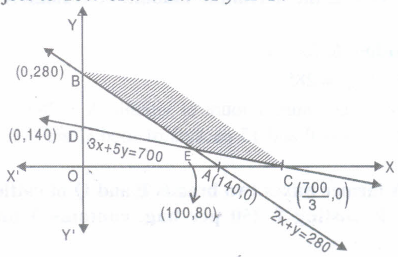
It can be seen that the feasible region is unbounded.
The corner points are A(700/3, 0), B(100, 80) and C(0, 280)
The values of Z at these points are as follows.
|
Corner point |
Z = 6x + 5y | |
| A(700/3,0) | 1400 | |
| B(100, 80) | 1000 | → Minimum |
| C(0, 280) | 1400 |
As the feasible region is unbounded, therefore, 1000 may or may not be the minimum value of Z.
For this, we draw a graph of the inequality, 6x + 5y < 1000, and check whether the resulting half plane has points in common with the feasible region or not.
It can be seen that the feasible region has no common point with
6x + 5y < 1000
Therefore, 100 kg of fertiliser F1 and 80 kg of fertilizer F2 should be used to minimize the cost. The minimum cost is Rs. 1000.
13.
The given equation is:
\(\left( x+y \right) \frac { dy }{ dx } =2{ e }^{ -y }-1\)
\(\Rightarrow\) \(\frac { dy }{ 2{ e }^{ -y }-1 } =\frac { dx }{ x+1 } \)
Variables Separable
Integrating, \(\int { \frac { dy }{ 2{ e }^{ -y }-1 } } =\int { \frac { dx }{ x+1 } +C } \)
\(\Rightarrow\) \(\int { \frac { dy }{ 2{ e }^{ -y }-1 } =log|x+1|+C } \) .(1)
Now \(I=\int { \frac { dy }{ 2{ e }^{ -y }-1 } } =\int { \frac { { e }^{ y } }{ 2-{ e }^{ y } } } dy\)
Put \({ e }^{ y }=t\) so that \({ e }^{ y }\quad dy=dt.\)
\(\therefore\) \(I=\int { \frac { dt }{ 2-t } =- } log|2-t|=-log|2-{ e }^{ y }|.\)
From(1), \(-log2-{ e }^{ y }|=log|x+1|+C\)...(2)
When \(x=0,y=0,\)
\(\therefore\) \(log|2-1|=log|0+1|+C\)
\(\Rightarrow\) \(log|1|=log|1|+C\)
\(\Rightarrow\) \(0=0+C\Rightarrow C=0.\)
Putting in (2), \(-log|2-{ e }^{ y }|=log|x+1|\)
\(\Rightarrow\) \(log|2-{ e }^{ y }|=log|\frac { 1 }{ x+1 } |\)
\(\Rightarrow\) \(2-{ e }^{ y }=\frac { 1 }{ x+1 } \)
\(\Rightarrow\) \({ e }^{ y }=2-\frac { 1 }{ x+1 } =\frac { 2x+1 }{ x+1 } \)
\(\Rightarrow\) \(y=log|\frac { 2x+1 }{ x+1 } |,x\neq -1.\)
Which is the requored solution.
14.
\(\frac { 5 }{ 2 } sq.units\)
15.
\(We\quad know\quad that\quad A={ I }_{ 2 }A\)
\(i.e.\ \begin{bmatrix} 4 & 5 \\ 3 & 4 \end{bmatrix}=\begin{bmatrix} 1 & 0 \\ 0 & 1 \end{bmatrix}A\)
\(\Rightarrow \begin{bmatrix} 1 & 1 \\ 3 & 4 \end{bmatrix}=\begin{bmatrix} 1 & -1 \\ 0 & 1 \end{bmatrix}A \quad [Applying\quad { R }_{ 1 }\rightarrow { R }_{ 1 }-{ R }_{ 2 }]\)
\(\Rightarrow \begin{bmatrix} 1 & 1 \\ 0 & 1 \end{bmatrix}=\begin{bmatrix} 1 & -1 \\ -3 & 4 \end{bmatrix}A \quad [Applying\quad { R }_{ 2 }\rightarrow { R }_{ 2 }-{ 3R }_{ 1 }]\)
\(\Rightarrow \begin{bmatrix} 1 & 0 \\ 0 & 1 \end{bmatrix}=\begin{bmatrix} 4 & -5 \\ -3 & 4 \end{bmatrix}A.\quad [Applying\quad { R }_{ 1 }\rightarrow { R }_{ 1 }-{ R }_{ 2 }]\)
\(Hence,\ { A }^{ -1 }=\begin{bmatrix} 4 & -5 \\ -3 & 4 \end{bmatrix}.\)
16.
The given line is \(x=\sqrt { 3 } y\) and the given circle is x2 + y2 = 4
From (1) \(y=\frac { x }{ \sqrt { 3 } } \)
Putting in (2), \({ x }^{ 2 }+\frac { { x }^{ 2 } }{ 3 } =4\Rightarrow \frac { { 4x }^{ 2 } }{ 3 } =4\Rightarrow { x }^{ 2 }=3\Rightarrow x=\pm \sqrt { 3 } \)
When \(x=\pm \sqrt { 3 } ,y=\pm 1\)
Thus P is \((\sqrt { 3 } ,1)\)
Now Reqd, area = ar (OPL) + ar (PLA)
\(\overset { \sqrt { 3 } }{ \underset { 0 }{ \int { } } } \frac { x }{ \sqrt { 3 } } dx+\overset { 2 }{ \underset { \sqrt { 3 } }{ \int { } } } \sqrt { 4-{ x }^{ 2 } } dx\ [Taking\ vertical\ strips]\)
\(=\frac { 1 }{ \sqrt { 3 } } \overset { \sqrt { 3 } }{ \underset { 0 }{ \int { } } } xdx+\overset { 2 }{ \underset { \sqrt { 3 } }{ \int { } } } \sqrt { { 2 }^{ 2 }-{ x }^{ 2 } } dx\)
\(=\frac { 1 }{ \sqrt { 3 } } \left[ \frac { { x }^{ 2 } }{ 2 } \right] _{ 0 }^{ \sqrt { 3 } }+\left[ \frac { x\sqrt { 4-{ x }^{ 2 } } }{ 2 } +\frac { 4 }{ 2 } { sin }^{ -1 }\frac { x }{ 2 } \right] _{ \sqrt { 3 } }^{ 2 }\)
\(=\frac { 1 }{ 2\sqrt { 3 } } [3-0]+\left[ \left\{ { 0+2sin }^{ -1 }(1) \right\} -\left\{ \frac { \sqrt { 3 } (1) }{ 2 } +2{ sin }^{ -1 }\frac { \sqrt { 3 } }{ 2 } \right\} \right] \)
\(=\frac { \sqrt { 3 } }{ 2 } +2\left( \frac { \pi }{ 2 } \right) -\frac { \sqrt { 3 } }{ 2 } -2\left( \frac { \pi }{ 3 } \right) \)
\(=\pi -\frac { 2\pi }{ 3 } =\frac { \pi }{ 3 } sq.units\)
17.
\(Let\ y={ sin }^{ 2 }x\quad and\quad u={ \quad e }^{ cosx }\)
\( \frac { dy }{ dx } ={ \quad e }^{ cosx }.(-sinx)=-sinx{ \quad e }^{ cosx }\)
\(\frac { dy }{ du } =\frac { { dy }/{ dx } }{ { du }/{ dx } } =\frac { 2sinxcosx }{ -sinx{ \quad e }^{ cosx } } =-\frac { 2cosx }{ { \quad e }^{ cosx } } \)
18.
The given system of equation is:
2x - y = -2
3x + 4y = 3
these can be written as A X = B
= X = A-1B
where \(A=\begin{bmatrix} 2&-1\\3&4\end{bmatrix}, X=\begin{bmatrix} x\\y\end{bmatrix}\ and\ B=\begin{bmatrix}-2\\3 \end{bmatrix}\)
\(|A|=\begin{bmatrix} 2&-1\\3&4\end{bmatrix}=8+3=11\neq0\Rightarrow A^{-1}\)exists.
Now \(adj\ A=\begin{bmatrix} 4&-3\\1&2\end{bmatrix}=\begin{bmatrix}4&1\\-3&2 \end{bmatrix}\)
\(A^{-1}={1\over |A|}(adj\ A)={1\over11}\begin{bmatrix}4&1\\3&2 \end{bmatrix}\)
\(X={1\over11}\begin{bmatrix}4&1\\-3&2 \end{bmatrix}\begin{bmatrix} -2\\3\end{bmatrix}\)
\(={1\over11}\begin{bmatrix} -8+.3\\6+6\end{bmatrix}={1\over11}\begin{bmatrix} -5\\12\end{bmatrix}\)
\(\Rightarrow \begin{bmatrix} x\\y\end{bmatrix}=\begin{bmatrix} -5/11\\12/11\end{bmatrix}\)
\(x={-5\over11},y={12\over11}\)|
19.
(a) It is easy to see that f is one-one and onto, so that f is invertible with the inverse f –1 of f given by f –1 = {(1, 1), (2, 2), (3, 3)} = f.
(b) Since f (2) = f (3) = 1, f is not one-one, so that f is not invertible.
(c) It is easy to see that f is one-one and onto, so that f is invertible with f –1 = {(3, 1), (2, 3), (1, 2)}.
20.
We have
\(\tan ^{-1}\left[\frac{a \cos x-b \sin x}{b \cos x+a \sin x}\right]=\tan ^{-1}\left[\frac{\frac{a \cos x-b \sin x}{b \cos x}}{\frac{b \cos x+a \sin x}{b \cos x}}\right]=\tan ^{-1}\left[\frac{\frac{a}{b}-\tan x}{1+\frac{a}{b} \tan x}\right]\)
\(=\tan ^{-1} \frac{a}{b}-\tan ^{-1}(\tan x)=\tan ^{-1} \frac{a}{b}-x\)
21.
Equation of line PR is \(\frac { x-7 }{ 2 } =\frac { y-14 }{ 4 } =\frac { z-5 }{ -1 } =\lambda \)
General point on line is R \((2\lambda +7,4\lambda +14,-\lambda +5)\)
If this point lies in plane 2x + 4y - z = 2,
then \(2(2\lambda +7)+4(4\lambda +14)-(-\lambda +5)=2\Rightarrow 21\lambda =-63\Rightarrow \lambda =-3\)
Substituting in (i), Foot of perpendicular is R (1,2,8).
\(PR=\sqrt { { (7-1) }^{ 2 }+{ (14-2) }^{ 2 }+{ (5-8) }^{ 2 } } =\sqrt { 36+144+9 } =\sqrt { 189 } \) units
From (i) and (iii), we get
\(\left( \frac { 7+\alpha }{ 2 } ,\frac { 14+\beta }{ 2 } ,\frac { 5\gamma }{ 2 } \right) =(1,2,8)\)
\(\Rightarrow \frac { 7+\alpha }{ 2 } =1,\frac { 14+\beta }{ 2 } =2,\frac { 5+\gamma }{ 2 } =8\Rightarrow \alpha =-5,\beta =-10,\gamma =11.\)
Image of point P (7,14,5) in plane 2x + 4y - z= 2 is Q (-5, -10, 11).
22.
Let the events be as felow:
E1 : He knows the answer
E2 : He guesses
E3 : He copies
And A : He answerd correctly.
Then \(P({ E }_{ 1 })=\frac { 1 }{ 2 } ,P({ E }_{ 2 })=\frac { 1 }{ 4 } ,P({ E }_{ 3 })=\frac { 1 }{ 4 } \)
Also \(P(A/{ E }_{ 1 })=1,P(A/{ E }_{ 2 })=\frac { 1 }{ 4 } ,P(A/{ E }_{ 3 })=\frac { 3 }{ 4 } \)
By Bayes' theorem
\(({ E }_{ 1 }/A)=\frac { P({ E }_{ 1 })P(A/{ E }_{ 1 }) }{ P({ E }_{ 1 })P(A/{ E }_{ 1 })+P({ E }_{ 2 })P(A/{ E }_{ 2 })+P({ E }_{ 3 })P(A/{ E }_{ 3 }) } \)
\(=\frac { \frac { 1 }{ 2 } \times 1 }{ 1\times \frac { 1 }{ 2 } +\frac { 1 }{ 4 } \times \frac { 1 }{ 4 } +\frac { 1 }{ 4 } \times \frac { 3 }{ 4 } } \)
= \(\frac { \frac { 1 }{ 2 } }{ \frac { 1 }{ 2 } +\frac { 1 }{ 16 } +\frac { 3 }{ 16 } } =\frac { 1 }{ 2 } \times \frac { 16 }{ 8+1+3 } \)
= \(\frac { 8 }{ 12 } =\frac { 2 }{ 3 } \)
(I) If Arjun copies the answer, then there is violation of honesty in his character.
(II) If Arjun gusses the answer, it may give him negative marking for wrong answer
(III) Arjun should accept the question the way as it is and leave tha question unanswered because cheating spoils his character in the long run.
23.
The given differential equation can be expressed as
\( \frac{d y}{d x} =\frac{x+2 y}{x-y} \) ... (1)
Let \(\mathrm{~F}(x, y) =\frac{x+2 y}{x-y} \)
Now \(\mathrm{~F}(\lambda x, \lambda y) =\frac{\lambda(x+2 y)}{\lambda(x-y)}=\lambda^0 \cdot f(x, y)\)
Therefore, F(x, y) is a homogenous function of degree zero. So, the given differential equation is a homogenous differential equation
Alternatively,
\(\frac{d y}{d x}=\left(\frac{1+\frac{2 y}{x}}{1-\frac{y}{x}}\right)=g\left(\frac{y}{x}\right)\) ... (2)
R.H.S. of differential equation (2) is of the form \(g\left(\frac{y}{x}\right)\) and so it is a homogeneous function of degree zero. Therefore, equation (1) is a homogeneous differential equation. To solve it we make the substitution
y = vx ... (3)
Differentiating equation (3) with respect to, x we get
\(\frac{d y}{d x}=v+x \frac{d v}{d x}\)
Substituting the value of y and \(\frac{d y}{d x}\) in equation (1) we get
\(v+x \frac{d v}{d x}=\frac{1+2 v}{1-v}\)
or \(x \frac{d v}{d x}=\frac{1+2 v}{1-v}-v\)
or \(x \frac{d v}{d x}=\frac{v^2+v+1}{1-v}\)
\(\frac{v-1}{v^2+v+1} d v=\frac{-d x}{x}\)
Integrating both sides of equation (5), we get
\(\int \frac{v-1}{v^2+v+1} d v=-\int \frac{d x}{x}\)
\(\frac{1}{2} \int \frac{2 v+1-3}{v^2+v+1} d v=-\log |x|+\mathrm{C}_1\)
\( or \ \frac{1}{2} \int \frac{2 v+1}{v^2+v+1} d v-\frac{3}{2} \int \frac{1}{v^2+v+1} d v=-\log |x|+\mathrm{C}_1 \\ or\ \frac{1}{2} \log \left|v^2+v+1\right|-\frac{3}{2} \int \frac{1}{\left(v+\frac{1}{2}\right)^2+\left(\frac{\sqrt{3}}{2}\right)^2} d v=-\log |x|+\mathrm{C}_1 \)
\( \frac{1}{2} \log \left|v^2+v+1\right|-\frac{3}{2} \cdot \frac{2}{\sqrt{3}} \tan ^{-1}\left(\frac{2 v+1}{\sqrt{3}}\right)=-\log |x|+\mathrm{C}_1 \\ \frac{1}{2} \log \left|v^2+v+1\right|+\frac{1}{2} \log x^2=\sqrt{3} \tan ^{-1}\left(\frac{2 v+1}{\sqrt{3}}\right)+\mathrm{C}_1 \)
Replacing v by \(\frac{y}{x}\) we get
\(\frac{1}{2} \log \left|\frac{y^2}{x^2}+\frac{y}{x}+1\right|+\frac{1}{2} \log x^2=\sqrt{3} \tan ^{-1}\left(\frac{2 y+x}{\sqrt{3} x}\right)+\mathrm{C}_1\)
or \(\frac{1}{2} \log \left|\left(\frac{y^2}{x^2}+\frac{y}{x}+1\right) x^2\right|=\sqrt{3} \tan ^{-1}\left(\frac{2 y+x}{\sqrt{3} x}\right)+\mathrm{C}_1\)
or \(\log \left|\left(y^2+x y+x^2\right)\right|=2 \sqrt{3} \tan ^{-1}\left(\frac{2 y+x}{\sqrt{3} x}\right)+2 \mathrm{C}_1\)
or \(\log \left|\left(x^2+x y+y^2\right)\right|=2 \sqrt{3} \tan ^{-1}\left(\frac{x+2 y}{\sqrt{3} x}\right)+\mathrm{C}\)
which is the general solution of the differential equation (1)
24.
\(={(2x+2)^{3/2}\over 3}-{(2x+1)^{3/2}\over3}+c\)
25.
Let numbers be x, y, z then
x + y + z = -1
2y + 3z = 5
x + y – z = -1
\(x=-\frac { 7 }{ 2 } \), y = \(\frac { 5 }{ 2 } \), z = 0
26.
As given \(\overrightarrow { a } .\overrightarrow { b } =\overrightarrow { a } .\overrightarrow { c } =0=\overrightarrow { a } \bot \)both \(\overrightarrow { b } \) and \(\overrightarrow { c } \)
⇒ \(\overrightarrow { a } \parallel \left( \overrightarrow { b } \times \overrightarrow { c } \right) \)
Let \(\overrightarrow { a } =\lambda \left( \overrightarrow { b } \times \overrightarrow { c } \right) \)
then \(\left| \overrightarrow { a } \right| =\left| \lambda \right| \left| \left( \overrightarrow { b } \times \overrightarrow { c } \right) \right| \)
⇒ \(\frac { \left| \overrightarrow { a } \right| }{ \left| \left( \overrightarrow { b } \times \overrightarrow { c } \right) \right| } =\left| \lambda \right| \)
⇒ \(\left| \lambda \right| =\frac { 1 }{ sin\frac { \pi }{ 6 } } =2\)
λ = 士2
\(\overrightarrow { a } =\pm 2\left( \overrightarrow { b } \times \overrightarrow { c } \right) \)
Hence proved
(ii) Now \(\left[ \overrightarrow { a } +\overrightarrow { b } ,\overrightarrow { b } +\overrightarrow { c } ,\overrightarrow { c } +\overrightarrow { a } \right] \)
= \(\left[ \left( \overrightarrow { a } +\overrightarrow { b } \right) \times \left( \overrightarrow { b } \times \overrightarrow { c } \right) \right] .\left( \overrightarrow { c } +\overrightarrow { a } \right) \)
= \(\left( \overrightarrow { a } \times \overrightarrow { b } \right) .\overrightarrow { c } +\left( \overrightarrow { b } \times \overrightarrow { c } \right) .\overrightarrow { a } \)
(As the scalar triple product = 0, if any two vectors are equal)
Hence, \(\overrightarrow { a } .\left( \overrightarrow { b } \times \overrightarrow { c } \right) +\left( \overrightarrow { a } \times \overrightarrow { b } \right) .\overrightarrow { c } \) = \(\overrightarrow { a } .\left( \overrightarrow { b } \times \overrightarrow { c } \right) +\overrightarrow { c } \left( \overrightarrow { b } \times \overrightarrow { c } \right) \)
= 2\(\overrightarrow { a } \left( \overrightarrow { b } \times \overrightarrow { c } \right) \)
= \(2\overrightarrow { a } \left( \pm \frac { 1 }{ 2 } \overrightarrow { a } \right) \)
= 士1
Hence proved
27.
\(tan^{ -1 }\left( \frac { x+1 }{ x-1 } \right) +tan^{ -1 }\left( \frac { x-1 }{ x } \right) =-tan^{ -1 }7\)
\(\Rightarrow tan^{ -1 }\left( \frac { \left( \frac { x+1 }{ x-1 } \right) +\left( \frac { x-1 }{ x } \right) }{ 1-\left( \frac { x+1 }{ x-1 } \right) \left( \frac { x-1 }{ x } \right) } \right) =-tan^{ -1 }7\)
if \(\left( \frac { x+1 }{ x-1 } \right) \left( \frac { x-1 }{ x } \right) <1\)
\(\Rightarrow tan^{ -1 }\left[ \frac { x(x+1)+(x-1)^{ 2 } }{ \left( x-1 \right) x-\left( x+1 \right) \left( x-1 \right) } \right] =tan^{ -1 }7\)
\(\Rightarrow \frac { \left( x^{ 2 }+x \right) +\left( x^{ 2 }+1-2x \right) }{ \left( x^{ 2 }-x \right) -\left( x^{ 2 }-1 \right) } =tan\left[ -tan^{ -1 }7 \right] \)
\(\Rightarrow \frac { 2x^{ 2 }-x+1 }{ -x+1 } =-7\)
\(\Rightarrow \frac { 2x^{ 2 }-x+1 }{ -x+1 } =-7\)
\(\Rightarrow \) 2x2 - 8x + 8 = 0
\(\Rightarrow \) (x - 2)2 = 0
\(\Rightarrow \) x = 2
Let us now verify whether x = 2 satisfies the condition (i)
\(\left( \frac { x+1 }{ x-1 } \right) \left( \frac { x-1 }{ x } \right) =3\times \frac { 1 }{ 2 } =\frac { 3 }{ 2 } \) Which is not less than 1.
Hence this value does not satisfy the condition (i) there is no solution to the given trigonometric equation.
28.
\(\int { \frac { \sqrt { x^{ 2 }+1 } \left\{ log({ x }^{ 2 }+1)-2logx \right\} }{ x^{ 4 } } } dx\)
\(=\sqrt { 1+\frac { 1 }{ { x }^{ 2 } } } \left( log\left( 1+\frac { 1 }{ x^{ 2 } } \right) \right) \frac { 1 }{ x^{ 3 } } dx\)
Let, \(1+\frac { 1 }{ { x }^{ 2 } } ={ t }^{ 2 }\)
\(\Rightarrow \frac { -2 }{ { x }^{ 3 } } dx=2tdt\)
\(\Rightarrow \frac { 1 }{ { x }^{ 3 } } dx=-tdt\)
\(=-\int { t(2logt)t\quad dt+ } -2\int { logt.{ t }^{ 2 }dt } \)
\(=-2logt.\frac { { t }^{ 3 } }{ 3 } +\int { 2\frac { 1 }{ t } .\frac { t^{ 3 } }{ 3 } dt } \)
\(=-\frac { 2 }{ 3 } logt.{ t }^{ 3 }+\frac { 2 }{ 9 } { t }^{ 3 }+C\)
\(=\frac { 2 }{ 3 } \left( 1+\frac { 1 }{ { x }^{ 2 } } \right) ^{ 3 }\left( -log\left( 1+\frac { 1 }{ { x }^{ 2 } } \right) +\frac { 1 }{ 3 } \right) +C\)
29.
LHS = \(\frac { 1 }{ abc } \left| \begin{matrix} { (a+b) }^{ 2 } & c & c \\ a & { (b+c) }^{ 2 } & a \\ b & b & { (c+a) }^{ 2 } \end{matrix} \right| \)
\({ C }_{ 1 }\rightarrow { C }_{ 1 }-{ C }_{ 3 },{ C }_{ 2 }\rightarrow { C }_{ 2 }-{ C }_{ 3 }\)
\(=\frac { 1 }{ abc } \left| \begin{matrix} (a+b+c)(a+b-c) & 0 & { c }^{ 2 } \\ 0 & (b+c+a)(b+c-a) & { a }^{ 2 } \\ (b+c+a)(b-c-a) & (b+c+a)(b-c-a) & { (c+a) }^{ 2 } \end{matrix} \right| \)
\(=\frac { { (a+b+c) }^{ 2 } }{ abc } \left| \begin{matrix} (a+b-c) & 0 & { c }^{ 2 } \\ 0 & (b+c-a) & { a }^{ 2 } \\ (-2a) & (-2c) & { 2ca } \end{matrix} \right| \)
\({ R }_{ 3 }\rightarrow { R }_{ 3 }-{ R }_{ 1 }-{ R }_{ 2 }\)
\(=\frac { { (a+b+c) }^{ 2 } }{ abc } \left| \begin{matrix} (ac+bc-{ c }^{ 2 }) & 0 & { c }^{ 2 } \\ 0 & (b+c-a) & { a }^{ 2 } \\ (-2a) & (-2c) & { 2ca } \end{matrix} \right| \)
\(({ C }_{ 1 }\rightarrow { C }_{ 1 }+{ C }_{ 3 },{ C }_{ 2 }\rightarrow { C }_{ 2 }+{ C }_{ 3 })\)
\(=\frac { { (a+b+c) }^{ 2 } }{ abcca } \left| \begin{matrix} (ac+bc) & { c }^{ 2 } & { c }^{ 2 } \\ { a }^{ 2 } & (ba+ca) & { a }^{ 2 } \\ 0 & 0 & { 2ca } \end{matrix} \right| \)
\(=\frac { { (a+b+c) }^{ 2 }2{ c }^{ 2 }{ a }^{ 2 } }{ abcca } \left| \begin{matrix} (a+b) & c & c \\ a & (b+c) & a \\ 0 & 0 & { 1 } \end{matrix} \right| \)
\(=\frac { { (a+b+c) }^{ 2 }2 }{ b } (ab+ac+{ b }^{ 2 }+bc-ac)\)
\(=2{ (a+b+c) }^{ 3 }\)
30.
Let ABCD be a rectangle inscribed in a given circle with centre at 0 and radius a.
Let AB = 2x and BC = 2y
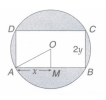
Then, OA2 = OM2 + AM2
\(\Rightarrow a^2=y^2+x^2\)
\(\Rightarrow y=\sqrt{a^2-x^2}\)
Let A be the area of the rectangle.
\(\therefore A=4xy=4x\sqrt{x^2-x^2}\)
\(\Rightarrow \ \ \frac{dA}{dx}=4\{\frac{a^2-2x^2}{\sqrt{a^2-x^2}}\}\)
For maximum or minimum value of A,
\(\frac{dA}{dx}=0\)
\(=4\{\frac{a^2-2x^2}{\sqrt{a^2-x^2}}\}=0\Rightarrow\ \ x=\frac{a}{\sqrt{2}}\)
Now, \(\frac{d^2A}{dx^2}=4\frac{d}{dx}\{(a^2-2x^2)(a^2-x^2)^{-1/2}\}\)
\(\Rightarrow \frac{d^2A}{dx^2}=4[-4x(a^2-x^2)^{-1/2}+(a^2-2x^2)\times(-1/2)(a^2-x^2)^(-3/2)(-2x)]\)
\(=[\frac{-4x}{\sqrt{a^2-x^2}}+\frac{x(a^2-2x^2)}{(a^2-x^2)^{3/2}}]\)
\(\therefore\ (\frac{d^2A}{dx^2})_{x=\frac{a}{\sqrt2}}=-16<0\)
Thus A is maximum when \(x=\frac{a}{\sqrt2}\)
putting \(x=\frac{a}{\sqrt2}\) in (i) \(y=\frac{a}{\sqrt2}\)
Therefore \(x=y=\frac{a}{\sqrt2}\)
Hence area is maximum when x = y ⇒ 2x = 2y
i.e., the rectangle is a square.
31.
E1 = Event that 1 occur;
E2 = Event that 1 does not occur;
A = Event that the man reports that 1 occur.
\(P({ E }_{ 1 })=\frac { 1 }{ 6 } ;P({ E }_{ 2 })=\frac { 5 }{ 6 } ;\)
\(P(A/{ E }_{ 1 })=\frac { 3 }{ 5 } ;P(A/{ E }_{ 2 })=\frac { 2 }{ 5 } ;\)
\(P({ E }_{ 1 }/A)=\frac { \frac { 1 }{ 6 } .\frac { 3 }{ 5 } }{ \frac { 1 }{ 6 } .\frac { 3 }{ 5 } +\frac { 5 }{ 6 } .\frac { 2 }{ 5 } } =\frac { 3 }{ 13 } \)
32.
\(\tan ^{ -1 }{ (x-1) } +\tan ^{ -1 }{ (x+1) } =\tan ^{ -1 }{ 3x } -\tan ^{ -1 }{ x } \)
\(\Rightarrow \tan ^{ -1 }{ \left( \frac { 2x }{ 2-{ x }^{ 2 } } \right) } =\tan ^{ -1 }{ \left( \frac { 2x }{ 2-3{ x }^{ 2 } } \right) } \)
\(\Rightarrow \frac { 2x }{ 2-{ x }^{ 2 } } =\frac { 2x }{ 2-3{ x }^{ 2 } } \)
\(\Rightarrow 2x(1+3{ x }^{ 2 }-2+{ x }^{ 2 })=0\)
\(\Rightarrow x=0,\frac { 1 }{ 2 } ,-\frac { 1 }{ 2 } \)
Alternative method:
We have,
\(\tan ^{ -1 }{ (x-1) } +\tan ^{ -1 }{ x } +\tan ^{ -1 }{ (x+1) } =\tan ^{ -1 }{ 3x } \)
\(\tan ^{ -1 }{ (x-1) } +\tan ^{ -1 }{ (x+1) } +\tan ^{ -1 }{ x } =\tan ^{ -1 }{ 3x } \)
Taking LHS
\(\tan ^{ -1 }{ \left( \frac { (x-1)+(x+1) }{ 1-(x-1)(x+1) } \right) } +\tan ^{ -1 }{ x } \)
\(= \tan ^{ -1 }{ \left( \frac { 2x }{ 1-{ x }^{ 2 }+1 } \right) } +\tan ^{ -1 }{ x } \)
\(=\tan ^{ -1 }{ \left( \frac { 2x }{ 2-{ x }^{ 2 } } \right) +\tan ^{ -1 }{ x } } \)
\(=\tan ^{ -1 }{ \left[ \frac { \frac { 2x }{ 2-{ x }^{ 2 } } +x }{ 1-\frac { 2x }{ 2-{ x }^{ 2 } } \times x } \right] } \)
\(= \tan ^{ -1 }{ \left( \frac { 2x+2x-{ x }^{ 3 } }{ 2-{ x }^{ 2 }-2{ x }^{ 2 } } \right) } \)
\(\therefore \tan ^{ -1 }{ \left( \frac { 4x-{ x }^{ 3 } }{ 2-3{ x }^{ 2 } } \right) } =\tan ^{ -1 }{ 3x } \)
\(\Rightarrow \frac { 4x-{ x }^{ 3 } }{ 2-3{ x }^{ 2 } } =3x\)
\(\Rightarrow 6x-9{ x }^{ 3 }=4x-{ x }^{ 3 }\)
\(\Rightarrow 8{ x }^{ 2 }-2x=0\)
\(\Rightarrow x=0\quad or\quad 4{ x }^{ 2 }-1=0\)
\(\Rightarrow x=0\quad or\quad 4{ x }^{ 2 }=1\)
\(\Rightarrow x=0\quad or\quad x=\pm \frac { 1 }{ 2 } \)
\(\Rightarrow x=0,\quad x=\frac { 1 }{ 2 } \quad x=-\frac { 1 }{ 2 } \)
\(\Rightarrow x=0\quad or\quad { x }^{ 2 }=\frac { 1 }{ 4 } \)
33.
Continuous in [0, 2\(\pi\)] as difference of two continuous functions is continuous
f'(x) = cos x - 2cos 2x, exists in (0, 2\(\pi\)), hence f is derivable;
\( f(0)=0, f(2 \pi)=0, \text { conditions satisfy } \)
\(\therefore \ f^{\prime}(c)=0 \Rightarrow \cos c-2 \cos 2 c=0 \)
\(\Rightarrow \cos c-2\left(2 \cos ^{2} c-1\right)=0 \)
\(\Rightarrow 4 \cos ^{2} c-\cos c-2=0 \Rightarrow \cos c=\frac{1 \pm \sqrt{1+32}}{8} \)
\(c={ cos }^{ -1 }\left\{ \frac { 1\pm \sqrt { 33 } }{ 8 } \right\} \)
34.
(d)
2.0025
35.
As distance = \(\left| \frac { 5-\frac { 2 }{ 3 } }{ \sqrt { 4+1+4 } } \right| =\frac { 13 }{ 9 } \) units
36.
T1 and T3 are similar as their sides are proportional.

12th Standard CBSE Syllabus & Materials
12th Standard CBSE
CBSE 12th Computer Science Python Revision Tour I - New Previous year Question Papers Study Material - QB365 Set A
NEW12th Standard CBSE
CBSE 12th Business Studies Planning Important Questions And Answers Study Material - QB365 Set A
NEW12th Standard CBSE
CBSE 12th Business Studies Business Environment Important Questions And Answers Study Material - QB365 Set A
NEW12th Standard CBSE
CBSE 12th Business Studies Principles of Management Important Questions And Answers Study Material - QB365 Set A



CBSE 12th Standard CBSE Subjects
CBSE Standards










